
By the Elevate GTM Solutions Team · Updated November 13, 2026 · 25 min read
What Is a GTM Motion? The Main Types, How They Differ, and How to Choose the One Your Company Should Use
"What's our motion?" is one of those questions that sounds simple until two executives answer it differently in the same meeting. One says product-led. The other says enterprise sales. A third says "a bit of both," which is true and not yet an answer.
A go-to-market motion is the repeatable way a company finds, wins and keeps customers. Choosing one is one of the biggest decisions in a go-to-market strategy, because it decides who you hire, what you build, how you price, what you measure and what a good week looks like. This guide explains the main motions in plain terms, shows how they differ, gives you a method for choosing, and covers what happens when you run more than one or need to change.
We make a GTM strategy platform, so we are not neutral on the value of planning. We have tried to keep the guidance honest, which includes saying that no motion is best in general and that the right one depends on your product, your buyers and your economics. The examples are invented to show the thinking. We use no benchmark numbers, because the ones that circulate are mostly from vendors or from companies that look nothing like yours.
What is a GTM motion?
A GTM motion is the repeatable pattern a company uses to reach customers and turn them into revenue: how buyers first hear of you, how they evaluate, who talks to them, how they buy and how they are supported afterward. The main types are product-led (the product itself brings in and converts users), sales-led (sellers lead the process), marketing-led or inbound (content and campaigns generate demand that is handed to sales), partner or channel-led (other companies sell or recommend you), community-led (a user community pulls others in) and account-based (you pick specific accounts and go after them together). Which one should you use? The one that fits how your buyers actually buy, what your price and product complexity allow, and what your team can run well. Most companies end up running a main motion with one supporting motion.
Is a motion the same as a strategy? No. Strategy is the set of choices about who to serve and why you win. The motion is how you carry that out repeatedly.
Can you run more than one? Yes, but one should lead, and each needs its own owner, metrics and handoffs.
The short version
Every motion answers the same five questions. What differs is the answer.
| Question | What it decides |
|---|---|
| How do buyers first find us? | Where you spend time and money to be seen |
| Who does the early work of explaining the product? | The product, content, a seller or a partner |
| Who closes the deal? | Self-serve checkout, a seller, a partner or a mix |
| How do customers expand? | In-product upgrade, account management, new seats or new products |
| What does it cost to win a customer, and how long does it take? | The economics that limit how fast you can grow |
If you can answer all five for your own company in plain sentences, you know your motion. If you cannot, you are probably running several motions by accident, and that is a common reason teams feel busy without making progress.
Motion, strategy, playbook and model: four words that get mixed up
People use these words loosely. Here is a clean way to separate them, which helps when you write things down.
Strategy is the set of choices: which customers, which problem, which promise and why you can win. Our guide to unified GTM strategy goes into that.
Motion is the repeatable pattern of reaching and winning customers. It is what you do over and over.
Playbook is the written, step-by-step guide to one part of a motion, such as how to run a first call or how to handle a competitor. See what is a GTM playbook.
Model is sometimes used as a synonym for motion and sometimes to mean the revenue model, such as subscription or usage-based. When someone says "our GTM model," ask which they mean.
A useful picture: strategy is the decision to open a restaurant for office workers who want a quick, healthy lunch. The motion is how you get them in the door and keep them coming: a lunch rush, a loyalty card, deals with nearby offices. The playbook is how the counter staff handle the rush.
The main motions
There is no official list, and writers carve the space differently. This one covers what most B2B companies actually run.
Product-led
The product is the main way people discover, try and buy. A user signs up, gets value quickly and either upgrades or invites others. Sellers, when they exist, step in after the user shows interest or hits a limit.
It fits when the product can deliver value on its own within minutes or a few days, when a single user can start without a purchase approval, when the price is low enough to put on a card, and when the product spreads inside teams. It strains when value takes weeks of setup, when the buyer is not the user, or when a large share of revenue comes from a small number of big contracts.
What it asks of you: strong onboarding, a product people want to show colleagues, and data on how users behave. Our guides on what is product-led growth and product-led versus sales-led go deeper.
Sales-led
Sellers lead the process: they find or receive the interest, explain the product, run the evaluation and negotiate the deal. The product usually follows the sale, not the other way round.
It fits when the product is complex, when the deal is large, when several people must agree, when the buyer needs help to justify the spend or when security and legal reviews are part of the process. It strains when the price cannot support the cost of a seller, or when buyers refuse to talk to a salesperson before trying the product.
What it asks of you: a defined sales process, hiring and coaching, and enough pipeline to keep sellers busy. See what is sales-led growth.
Marketing-led, or inbound
Content, events, search, paid campaigns and email generate demand and capture leads, which are qualified and passed to sellers or to a self-serve path.
It fits when buyers research on their own before talking to anyone, when you can say something useful that they search for and when you have the patience to build an audience. It strains when your market is tiny, when buyers do not search, or when the handoff to sales is poor and good leads go cold. Our guide to outbound versus inbound covers this.
Outbound
Sellers or automated systems reach out to chosen accounts and people, instead of waiting for them to come. Outbound is a style of reaching buyers and often sits inside a sales-led motion.
It fits when you can name your target accounts, when the market is small enough to list and when buyers will not find you on their own. It strains when your message is generic, when your list is bad, or when you rely on volume over relevance.
Account-based
You pick a set of accounts, plan the approach to each, and coordinate marketing, sales and sometimes customer success around them. It is a way of focusing effort. See account tiering for how to decide who gets which level of attention.
It fits when you sell large deals to a limited list of companies. It strains when you cannot name the accounts or when marketing and sales do not agree on the list.
Partner or channel-led
Other companies, such as resellers, integrators, consultants or technology partners, sell, install or recommend your product. You trade some margin or control for reach.
It fits when partners already have the customer's trust, when your product needs local or specialist help to deploy, or when you want to enter markets you cannot staff. It strains when partners have no reason to push you over others, or when you cannot support them.
What it asks of you: a partner program, training, clear rules on who owns the customer and deal registration, and someone whose job it is to make partners successful.
Community-led
An active group of users, developers or practitioners shares knowledge, answers questions and brings in new people. The community is both a source of demand and a source of trust.
It fits when users are passionate, when peers influence each other strongly and when the product benefits from shared learning. It strains when you treat the community as a lead source and nothing else.
Other patterns you will hear about
Usage-based or land-and-expand. A small first purchase grows as customers use more. This is a pricing and expansion pattern that attaches to other motions.
Founder-led. The founders sell. This is common early on, and the lessons from it become the first version of every other motion.
Services-led. Advisory or implementation work brings in customers who then buy software or a longer contract.
Event-led, or field. In-person events and local teams generate relationships. It fits specific markets and relationship-driven industries.
A side-by-side view
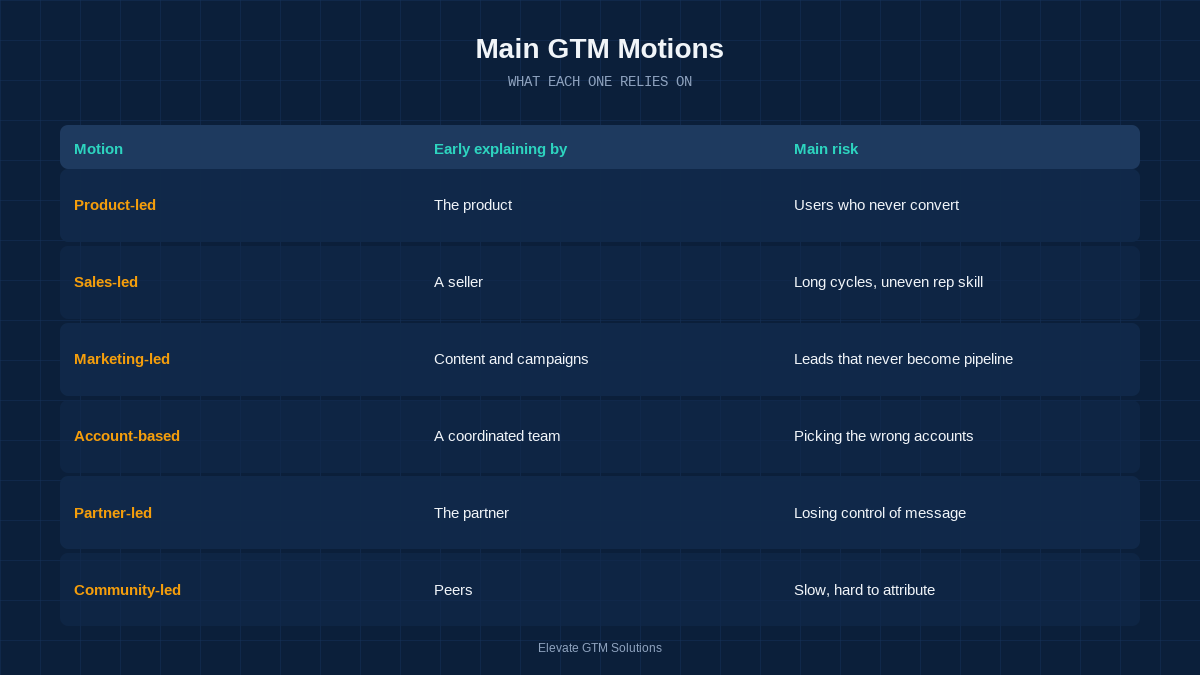
| Motion | Who does the early explaining | Typical buyer behavior | Main cost to watch | Main risk |
|---|---|---|---|---|
| Product-led | The product | Tries first, buys later | Free usage, onboarding, product investment | Users who never convert |
| Sales-led | A seller | Wants a conversation and proof | Seller salaries and ramp time | Long cycles, uneven rep skill |
| Marketing-led | Content and campaigns | Researches alone first | Media, content, tools | Leads that never become pipeline |
| Account-based | A coordinated team | Buying group with several people | Time per account | Picking the wrong accounts |
| Partner-led | The partner | Trusts a known advisor | Partner margin and support | Loss of control over message and customer |
| Community-led | Peers | Follows peer advice | Community staff and programs | Slow, hard to attribute |
These are tendencies and not rules, and plenty of companies break them on purpose.
How to choose: seven questions
There is no scoring formula that gives you the right answer. A more honest approach asks a set of questions and sees which way the answers lean. Answer each one for your own company with evidence, not hope. Our worked example later shows how.
1. How does your buyer buy? Watch the last ten deals you won. Where did the buyer first learn of you? Did they try the product, talk to a seller, ask a peer or work with a partner? The pattern in real deals beats the pattern you wish for.
2. How fast does a new user reach value? If it is minutes or hours, product-led is possible. If it is weeks and needs data or integration work, a seller or an implementation partner probably has to help.
3. How large is the typical deal, and how does it vary? A rough rule is that the price has to support the cost of the people involved in selling. A deal that is too small for a seller needs a lower-touch path. A deal that is large enough needs more than a checkout page.
4. Who is the buyer and who is the user? When they are the same person, self-serve works better. When the buyer is a budget holder who has never used the tool, someone has to make the case to that person.
5. How many people have to say yes? A single approver can buy through a card. A buying group of several people with security, finance and legal involved needs a process. See our evidence review on buying groups.
6. How big and how findable is your market? If you can list your target accounts, account-based and outbound approaches become practical. If the market is huge and anonymous, inbound and product-led approaches scale better.
7. What can your team actually run well? A strong sales leader and no product growth skills points one way. A product-minded team with no sales experience points the other. Honest self-assessment prevents expensive mismatches.
Reading your answers
If most answers point toward self-service, quick value and individual buyers, lean product-led. If they point toward complexity, large deals and many approvers, lean sales-led. If they point toward a named list of big accounts, add account-based on top. If trusted third parties shape buying, consider a partner motion. Mixed answers are normal and usually mean a primary motion with a supporting one.
A worked example, invented for illustration
Imagine a company that sells software that helps finance teams reconcile payments. Last year it won twenty deals. A look at those deals shows that fourteen began with a finance manager signing up for a free trial, but eleven of those needed a call with a seller before the company signed because of a security review and a request for an integration with the accounting system. Six deals came through an accounting consultancy. Time to first value in the trial was about a week, mostly because of setup.
What does that tell us? Pure product-led does not match reality, because buyers need security answers and integration help. Pure sales-led does not match either, because most deals begin with a trial. The honest description is product-assisted sales: a trial brings in interest, and a seller steps in when the user hits setup and approval steps. A partner channel is worth building, since a consultancy already brings in a share of deals.
The implications are practical. Improve onboarding so the trial reaches value faster. Create security and integration material that sellers can send before the call. Define when a trial user becomes a sales-qualified account. Start a small partner program with the consultancy that is already working. And measure each path separately.
That is a more useful result than a label.
Running more than one motion
Most companies above a certain size run more than one. A product-led base with a sales team for larger accounts is common. So is sales-led for enterprise and partner-led for small business. Mixed models work when you manage the seams.
Pick a lead motion. One motion should get the primary investment and the clearest ownership. Without that, each gets half the attention.
Give each motion its own metrics. A self-serve funnel and an enterprise pipeline behave differently. Mixing them in one report hides problems in both. Our guide on GTM metrics and KPIs can help you pick.
Define the handoffs in writing. When does a self-serve user become a sales opportunity? What makes an account eligible for a seller? Who owns the customer after a partner closes the deal? Unclear handoffs cause conflict and lost deals. The sales and marketing SLA framework is one place to start.
Watch for channel conflict. If sellers earn commission on accounts that signed up themselves, or partners lose deals to your own team, trust erodes. Write the rules before the conflict.
Do not copy another company's blend. A famous company's mix grew out of its product, its buyers and its history. Yours has a different starting point.
When to change your motion
Motions are not permanent. Companies change them when something shifts underneath.
The product changes. A move from a simple tool to a platform changes how buyers evaluate it.
The customer changes. Moving from small businesses to enterprises almost always means adding sellers, security work and longer cycles. Our guide on how to move upmarket touches the testing side.
The economics stop working. If the cost to win a customer outruns what the customer pays, something has to change. Our research page on CAC payback discusses how to think about that.
The market changes. New competitors, new buying habits or new regulation can change how buyers want to buy.
The company grows. What worked with five people often breaks with fifty.
How to change without breaking things
- Test before you commit. Run the new motion with a small team on a defined segment for a fixed period. Write down what you expect and what would change your mind.
- Keep the old one running. Do not shut down what pays the bills while you test the new idea.
- Change one big thing at a time. If you change the motion, the pricing and the target customer at once, you will not know what worked.
- Reset enablement. Messages, training and proof should change with the motion. See what is GTM enablement.
- Tell people why. Sellers and marketers can handle change. They struggle with change that has no reason attached.
What a motion needs to work
Choosing a motion is the start. Running it takes a few ingredients, whatever the label.
A clear ideal customer. Your motion is built around a specific buyer. See ICP and ICP scoring.
A message that fits the path. A self-serve homepage and a first sales call need different messages that still tell the same story. See positioning.
A defined process. Even a product-led motion has stages: sign up, activate, expand, renew. Write them down and name the owner of each.
The right people and tools. A sales-led motion needs sellers and a CRM. A product-led one needs product analytics and growth skills. A partner motion needs a partner manager.
Data on how it performs. Pick a small set of measures for each stage and look at them often.
An owner. Someone should be accountable for the motion as a whole. See who owns GTM strategy.
A one-page motion definition you can copy
Write this in plain language and keep it to one page. Revisit it each quarter.
- Who we sell to. Three sentences on the customer, the person who buys and the person who uses.
- How they find us. The top three paths, based on real deals.
- How they evaluate. What they do, who they talk to, what proof they need.
- Who closes. Self-serve, seller, partner, or a rule for when each applies.
- How customers grow. Upgrade, more seats, more products or renewal with price changes.
- Our lead motion and our supporting motion. Name both.
- Handoffs. The two or three moments where work passes from one team to another, with the rule for each.
- Metrics. Three to five measures per path, each with an owner.
- What would make us change. The signs that this motion is no longer right.
Mistakes teams make
Choosing by fashion. A label is not a reason. Product-led sounds modern, enterprise sounds serious. Neither is automatically right.
Copying a famous company. Their conditions are not yours.
Running every motion at once. Limited people and budget get spread thin, and none works well.
Confusing channels with motions. Email, events and paid ads are channels. A motion is the full pattern.
Never writing it down. An unwritten motion changes with whoever is talking.
Ignoring the economics. A motion that cannot make money at your price is a hobby.
Forgetting retention and expansion. Many motion discussions stop at the first sale. Customers who leave cost you the growth you just paid for.
Leaving handoffs vague. Most lost deals in mixed motions are lost at the seams.
Not revisiting. The right motion at ten customers is rarely the right one at five hundred.
How strategy software can help, and where it cannot
Planning a motion involves a lot of connected decisions: segments, positioning, messaging, pricing, channels, enablement and measurement. A strategy platform can help keep those decisions in one place and consistent, so a change in the motion shows up in the messaging and the plan. It can also speed up the first draft and make it easier to compare options side by side.
It cannot tell you how your buyers really buy. That comes from talking to customers and reading your own deals. It cannot choose for you, and it should not pretend to. Treat any generated plan as a draft to test against evidence.
Questions to ask a team that says it is "product-led" or "sales-led"
Labels get used loosely. A few direct questions show what is actually happening.
- Of the last ten deals, how many started with a person trying the product, and how many with a conversation with a seller?
- At what point does a human first speak to the customer, and who is it?
- What would a buyer have to do to buy without ever speaking to anyone? Does that path work today?
- What does the average buyer need from us that the product alone cannot give: security answers, integrations, a business case, training?
- Who decides when an account is ready for a seller, and by what rule?
- If we doubled the number of leads tomorrow, what would break first?
The last question is the most useful. The thing that would break first is the real constraint on your motion: seller capacity, onboarding, support or the product itself. That tells you where to invest.
Glossary
GTM motion. The repeatable pattern a company uses to find, win and keep customers.
Product-led growth (PLG). A motion in which the product drives acquisition, conversion and expansion.
Sales-led growth. A motion in which sellers lead discovery, evaluation and closing.
Inbound. Generating demand through content and campaigns so buyers come to you.
Outbound. Reaching out to chosen accounts and people directly.
Account-based marketing (ABM). Focusing marketing and sales effort on a named list of accounts.
Channel or partner-led. A motion in which partners sell, implement or recommend your product.
Land and expand. Winning a small first deal and growing it over time.
Product-assisted sales. A blend where users try the product and sellers help at defined points.
Handoff. The point where responsibility for a lead, account or customer passes from one team to another.
Customer acquisition cost (CAC). The total sales and marketing cost to win a new customer, over a stated period.
CAC payback. The time it takes for a customer's gross margin to repay the cost of winning them.
Ideal customer profile (ICP). A description of the companies and people most likely to buy and succeed with your product.
Where Elevate GTM Solutions fits
Elevate GTM Solutions is an AI GTM platform for building, executing and adapting go-to-market strategy. Its homepage describes modules covering unified strategy, market research, ICP and segmentation, competitive intelligence, account-based marketing, positioning, messaging, pricing strategy, customer acquisition, distribution channel strategy, marketing alignment, launch and execution, measurement, sales enablement, customer success and customer advocacy. The homepage says "15 connected GTM modules" and names sixteen, so count what you see when you look.
For a question about motions, three of those areas are most relevant: customer acquisition, distribution channel strategy and the unified strategy that ties them to positioning and messaging. The site also lists use cases that are close to motion decisions, such as moving upmarket to enterprise, building a partner and channel GTM, and entering a new market. The company also offers a free strategy build, which it says takes about five minutes. That is the company's own claim, and a fast first draft is only useful if you test it against your real deals.
Our suggestion for using any tool, ours included, is to bring your own evidence. List your last ten wins and how each began. Then compare what the tool suggests with what the deals show. Where they disagree, trust the deals. For more, see what Elevate GTM Solutions is and the guide to building a GTM strategy with AI.
What to do this week
- List your last ten won deals and note how each began, who explained the product, who closed and how long it took.
- Answer the seven questions for your company, with one sentence of evidence for each.
- Write down your lead motion and your supporting motion, or admit you do not have them yet.
- Pick the two handoffs most likely to be dropped and write the rule for each.
- Choose three measures for each path and name an owner for each.
- If you suspect your motion is wrong, design a small, time-boxed test and write down what would change your mind.
Key takeaways
- A GTM motion is the repeatable pattern for finding, winning and keeping customers. It is not the same as strategy.
- The main types are product-led, sales-led, marketing-led, account-based, partner-led and community-led, with outbound as a style of reaching buyers.
- No motion is best in general. Choose by how your buyers buy, how fast they reach value, deal size, who decides, market size and what your team can run.
- Most companies run a lead motion plus a supporting one. Define handoffs and metrics for each.
- Your own deals are better evidence than any framework. Start with the last ten wins.
- Change motions with small tests, keep the old one running and reset enablement.
Sources
- Elevate GTM Solutions: descriptions of modules, use cases and the free strategy build, as stated on the company's homepage. The five-minute figure is the company's own claim.
- Related Elevate guides linked in the text, including product-led versus sales-led and what is a GTM playbook.
- The list of motions, the seven selection questions and the one-page definition reflect common industry usage and our judgment. Writers draw the categories differently, and no single standard exists. The worked example is invented for illustration and does not describe a real company.
- We cite no benchmark figures. Check any number you find elsewhere for who produced it, how large the sample was and whether it resembles your company.
Frequently Asked Questions
What is a GTM motion?
A GTM motion is the repeatable pattern a company uses to find, win and keep customers: how buyers discover you, who explains the product, who closes the deal and how customers grow. It is how a go-to-market strategy gets carried out over and over.
What are the main types of GTM motion?
The main types are product-led, sales-led, marketing-led or inbound, account-based, partner or channel-led and community-led. Outbound describes a way of reaching buyers and usually sits inside a sales-led or account-based motion. Writers draw the lines differently, so define the terms you use.
What is the difference between a GTM motion and a GTM strategy?
Strategy is the set of choices about which customers to serve, what problem to solve and why you can win. The motion is the repeatable way you reach and win those customers. You need both, and the strategy should come first.
Which GTM motion should my company use?
The one that fits how your buyers buy, how quickly new users reach value, how large and complex your deals are, how big and findable your market is and what your team can run well. Look at your last ten won deals before deciding, because real patterns beat assumptions.
Can a company run more than one GTM motion?
Yes, and most do. A common pattern is a lead motion plus a supporting one, such as product-led with a sales team for larger accounts. Give each its own metrics and owner, and write down the handoffs between them.
How do I know if my motion is working?
Track a few measures for each stage of the path: how people arrive, how many reach value, how many become customers, how long it takes, what it costs and how many stay and grow. If a motion cannot cover its cost or the cycle keeps lengthening, it needs attention.
When should a company switch from product-led to sales-led?
Often when the product moves up to bigger customers, when buyers need security reviews or custom work, or when deals involve several approvers. Many companies add sellers on top of a product-led base instead of switching outright. Test the change with a small team first.
Is outbound a GTM motion?
Outbound is better seen as a way of reaching buyers than a full motion. It usually sits inside a sales-led or account-based motion, where sellers or automated systems contact chosen accounts directly.
What is a product-assisted or hybrid motion?
It is a blend in which users try the product on their own and sellers step in at defined points, such as when a trial user hits a limit or a team asks for security details. It is common when a product can deliver value quickly but still needs help to close larger deals.
How long does it take to change a GTM motion?
It depends on how much changes. A small test with a new segment or path can run in a quarter. A larger shift, such as moving upmarket, often takes longer because hiring, training, pricing and messaging all change. Run a time-boxed test and set criteria in advance.
How does a GTM motion affect hiring?
A lot. Product-led motions need product, growth and data skills. Sales-led motions need sellers, managers and sales operations. Partner motions need partner managers. Hiring ahead of a clear motion tends to produce people with no clear job.
Can software help me choose a GTM motion?
Software can organize your inputs, draft options and keep decisions consistent across positioning, messaging and planning. It cannot tell you how your buyers really buy. Use any generated plan as a draft and test it against your own deals.