
By the Elevate GTM Solutions Team · Updated November 10, 2026 · 23 min read
Pilot-to-Scale Framework: How to Turn a Successful GTM Pilot Into a Repeatable Program
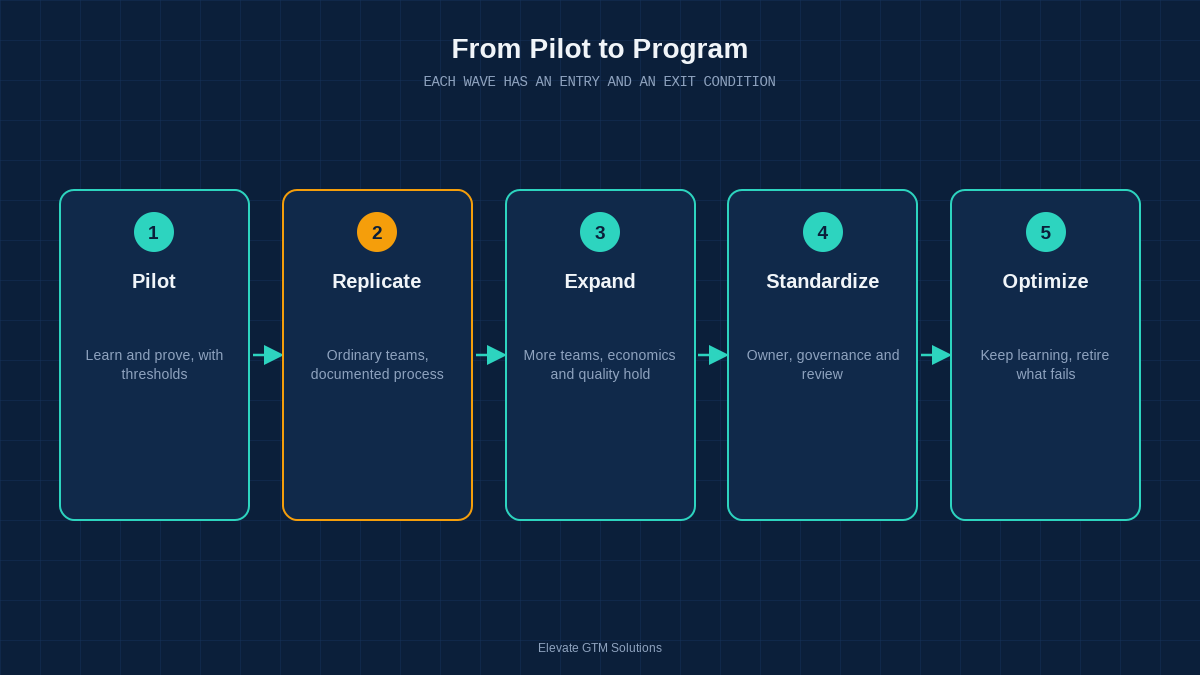
Many go-to-market pilots succeed and then disappear. A small team tries a new segment, a new channel, an outbound motion, a partner program or an AI-assisted workflow, and the results look good. Leadership says to roll it out. Six months later, the results are ordinary, the pilot team has moved on, the process lives in one person's head and nobody can explain why the pilot worked or why scaling did not.
The gap between a pilot and a repeatable program is where most of the value is lost. A pilot is run by motivated people with attention, favorable conditions and room to improvise. A program is run by ordinary teams with competing priorities, shared tools and a process that has to work without heroes. This guide gives you a framework: how to design a pilot so that it can inform a rollout, how to judge honestly whether it worked, how to check readiness to scale, how to scale in stages, how to protect quality while growing, what to measure, when to stop and how to avoid the common traps. It uses worked examples with invented numbers. Elevate GTM Solutions makes a GTM strategy platform whose scopes, versions and review rhythm support staged rollouts, and it does not run pilots for you, so we say plainly where people and process matter most. Nothing here guarantees that a pilot's results will repeat.
What Is a Pilot-to-Scale Framework?
A pilot-to-scale framework is a structured way to move from a bounded test of a new go-to-market approach to a repeatable program. It starts with a pilot designed with a defined scope, thresholds and evidence plan, evaluates the results honestly (including what may have flattered them), checks readiness to scale across process, people, enablement, data, economics and support, then expands in stages with gates, owners and a way to detect quality loss. It ends with a decision at each gate to continue, adjust, pause or stop. The aim is to scale what is repeatable, not just what was impressive.
How big should a pilot be? Large enough to teach you something and small enough to stop cheaply. Often one segment, one region or one team.
When should we scale? When the pilot has met its thresholds, you understand why it worked and the process works without the pilot team's heroics.
Why pilots fail to scale
| Cause | What it looks like |
|---|---|
| Hero effect | The pilot team was unusually strong or motivated |
| Selection bias | The pilot used the easiest accounts or friendliest buyers |
| Novelty effect | Results faded when the newness wore off |
| Hidden support | The pilot had extra help that will not exist at scale |
| Undocumented process | The method lived in people's heads |
| Different conditions | Scale meets other segments, regions or seasons |
| Unclear thresholds | "It went well" with no agreed standard |
| Tool and data gaps | Systems cannot support more volume or complexity |
| Weak enablement | New people cannot learn the method quickly |
| Misaligned incentives | The program rewards behavior the pilot did not need |
| Premature rollout | Leadership enthusiasm outpaces evidence |
Most of these can be addressed in the design of the pilot.
Designing a pilot that can inform scale
| Element | Practice |
|---|---|
| Question | State what you want to learn, such as whether a new motion produces qualified opportunities at acceptable cost |
| Scope | One segment, region, product or team, with a clear boundary |
| Representative conditions | Include ordinary accounts and ordinary sellers, not only the best |
| Duration | Long enough to see the measures, with a fixed end date |
| Team | A small, named group, and a record of who else helps and how much |
| Thresholds | Success, adjust and stop, set in advance |
| Evidence plan | Buyer conversations, call notes, objections, win and loss reasons |
| Measures | Leading and lagging, plus cost and effort |
| Documentation | The process, written as it is learned |
| Support log | Every bit of extra help the pilot received |
| Budget cap | A limit, and the decision rule if exceeded |
| Review points | Monthly, with a final decision date |
Our guide to the GTM experimentation framework covers hypotheses and thresholds, and What Is a Market Entry Strategy? covers pilots for new markets.
Evaluating a pilot honestly
Before deciding to scale, look hard at the results.
| Check | Question |
|---|---|
| Thresholds | Did we meet the success thresholds we set, or are we moving the goalposts? |
| Representativeness | Were the accounts and sellers typical of those we will add? |
| Hero effect | Would an average seller get the same results with the documented process? |
| Novelty | Are results holding in later weeks, or fading? |
| Hidden support | What help did the pilot get that scale will not provide? |
| Cost | What did it really cost, including people time? |
| Quality | Are customers retained and satisfied, or was the measure only early activity? |
| Cause | Do we understand why it worked, from buyers and from the process? |
| Alternatives | Could another approach have done as well for less? |
| Risks | What went wrong or nearly did? |
A worked example, with invented numbers
| Measure | Threshold | Pilot result | Reading |
|---|---|---|---|
| Qualified conversations per seller per month | At least a stated number | Above | Met |
| Meeting to opportunity rate | At least a stated rate | At the threshold | Met, narrowly |
| Win rate on pilot opportunities | At least a stated rate | Above, from a small number of deals | Encouraging, small sample |
| Cost per qualified opportunity | At most a stated figure | Under, excluding the founder's time | Needs recalculation with all time |
| Support from managers | None expected at scale | Substantial weekly help | A risk to scaling |
| Early retention of pilot customers | Equal to or better than current | Too early to tell | Gate the scale decision on a later read |
The honest reading: promising, with three open questions. The team should extend the pilot, document the process and test it with ordinary sellers before rolling out widely.
Readiness to scale
| Area | Questions |
|---|---|
| Process | Is the method documented in a short playbook that a newcomer can follow? |
| People | Do we have owners, and enough capable people to run it? |
| Enablement | Can we train new people to the standard quickly? |
| Targeting | Is the ideal customer defined, and the target list ready? |
| Message | Are pillars, proof and forbidden claims settled? |
| Data and systems | Do the CRM, tools and reporting support volume and tagging? |
| Economics | Do acquisition cost and payback hold at the larger scale? |
| Customer experience | Can onboarding and support absorb more customers? |
| Governance | Do we have decision rights, exception handling and a review rhythm? |
| Risk | Have we reviewed legal, compliance and brand risks? |
| Measurement | Do we have a baseline and measures by cohort? |
A "no" in several rows means you are not ready. The gaps are your plan.
A scorecard for the scale decision
| Criterion | Score 1 (weak) to 5 (strong) |
|---|---|
| Evidence that results are real | |
| Evidence that results are repeatable by ordinary teams | |
| Understanding of why it worked | |
| Documented process | |
| Enablement ready | |
| Systems and data ready | |
| Economics at scale | |
| Customer experience capacity | |
| Owners and governance in place | |
| Risks reviewed |
Decide with leadership what total or minimum on each line justifies moving forward. Any 1 should be addressed before scaling.
Scaling in stages
| Stage | Scope | Purpose | Gate question |
|---|---|---|---|
| Pilot | A small team and scope | Learn and prove | Did we meet thresholds and understand why? |
| Replication | A second team or segment using the documented process | Test repeatability | Do ordinary teams get comparable results? |
| Expansion | Several teams or segments | Test at moderate scale | Do economics and quality hold? |
| Standardization | The program becomes the default | Embed | Is the process owned, governed and reviewed? |
| Optimization | Continuous improvement | Keep it healthy | Are we learning and retiring what stops working? |
Add scope in waves, not all at once. The replication stage is where many hidden pilot advantages show up.
Protecting quality as you scale
| Risk | Practice |
|---|---|
| Dilution of targeting | Keep the fit criteria and tiers, and review the list |
| Inconsistent message | Use approved pillars, a style guide and sampling |
| Slow onboarding of new people | A structured path, a call library and coaching |
| Process drift | Document the process, review adherence and update it |
| Overloaded systems | Test volume and fix data quality |
| Customer experience decline | Watch time to first value, support load and satisfaction |
| Lost learning | Keep buyer conversations and the experiment log going |
| Metric gaming | Pair measures and review quality |
Quality checks should be built into the program, not added after problems appear.
Roles during scale
| Role | Responsibility |
|---|---|
| Executive sponsor | Removes blockers, protects resources, makes gate decisions |
| Program owner | Runs the rollout, owns the plan and communication |
| Pilot lead | Transfers know-how, documents the process and coaches replication teams |
| Team leaders | Adopt the process, give feedback and own results in their teams |
| Enablement | Builds training, content and the call library |
| RevOps | Configures systems, data, routing and reporting |
| Finance | Reviews economics and budgets |
| Legal and security | Reviews compliance and data |
| Product and success | Ensure the product and onboarding can support scale |
Name them before scaling, and agree how much time each can give.
What to measure during scale
| Level | Measures |
|---|---|
| Adoption | Share of eligible teams using the process, adherence to the documented steps |
| Activity quality | Message consistency, call quality sampled, qualified conversation rates |
| Conversion | Meeting to opportunity, opportunity to win, by cohort |
| Efficiency | Cost per qualified opportunity and payback, with all costs |
| Customer outcomes | Time to first value, early retention, satisfaction |
| Learning | Experiments run, changes made from evidence |
| Variation | Differences between teams, regions and sellers, and the reasons |
Compare each new cohort with the pilot's results and with a baseline. If new cohorts consistently perform worse, find out why before adding more.
When to pause, adjust or stop
| Signal | Response |
|---|---|
| Replication teams miss thresholds by a wide margin | Pause expansion, find causes, adjust the process or enablement |
| Economics worsen as volume rises | Review targeting, capacity and cost |
| Customer experience declines | Slow down, fix onboarding and support |
| The pilot team cannot be spared | Transfer know-how first, or limit scope |
| Leadership pressure outruns evidence | Show the scorecard and agree what evidence would justify the next step |
| A compliance or brand incident occurs | Pause and review |
| The approach works for one segment only | Keep it there, and stop forcing it elsewhere |
Stopping is a legitimate outcome of a pilot. A program that is stopped early after good learning costs less than one that runs on hope.
Communicating through the stages
| Stage | Message | Audience |
|---|---|---|
| Pilot start | What we are testing and why, and what we need | Pilot team, sponsor, adjacent teams |
| Pilot results | What worked, what did not, what we do not yet know | Leadership and teams |
| Replication | What is changing, who is involved and how to ask for help | Replication teams |
| Expansion | The documented process, training and expectations | Everyone affected |
| Standardization | Ownership, governance and how to propose improvements | The whole organization |
Be honest about uncertainty. People trust a rollout that admits what is unproven.
Rolling out an AI-assisted workflow, specifically
AI tools are often piloted before they are scaled. A few extra points apply.
| Topic | Practice |
|---|---|
| Baseline | Measure the current process before the tool |
| Scope | Start with one task and one team |
| Controls | Define what the tool may do, what needs approval and what it must never do |
| Quality sampling | Review a sample of outputs weekly |
| Edits and errors | Track how often humans correct outputs and why |
| Data | Confirm what data the tool can access and how it is used |
| Cost | Include usage costs and review time |
| Training | Teach people how to brief the tool and how to check it |
| Logs | Keep records of actions and outputs |
| Exit | Know how to switch it off |
AI pilots often show large time savings and hidden review costs. Measure both before scaling.
A pilot charter, filled in
This invented example shows a charter for a pilot of a partner-sourced pipeline motion.
| Field | Entry |
|---|---|
| Question | Can partner introductions create qualified opportunities at an acceptable cost? |
| Scope | One region, three partners, one product, twelve weeks |
| Team | A partnerships lead, one account executive and a marketer part-time |
| Representative conditions | Partners include one large, one mid-sized and one small, and introductions go to ordinary sellers |
| Thresholds | Success: a stated number of qualified introductions and a stated conversion to opportunity, at a cost under a stated figure including people time. Stop: fewer than a stated number of introductions after two fixes |
| Evidence plan | Conversations with introduced buyers and with partner contacts, and notes on objections |
| Support log | Time from managers, founders and product, recorded weekly |
| Documentation | The partner brief, introduction template, qualification questions and follow-up steps |
| Budget cap | A stated amount, with a rule to pause if exceeded |
| Reviews | Monthly, with a final gate at week twelve |
| Decision owner | Head of revenue |
Documenting the process while you learn
The best time to write a process is while you are discovering it, since the reasons are fresh.
| Document | Contents |
|---|---|
| Playbook | Goal, steps, examples of good practice, what not to do, qualification questions, objection responses |
| Decision log | Choices made during the pilot and why |
| Template pack | Messages, briefs, checklists and call guides that worked |
| Call library | Recorded examples with notes on what to listen for |
| Metrics definitions | How each measure is calculated, so comparisons hold |
| Roles and handoffs | Who does what and how work passes |
| Known problems | Issues found and how they were handled |
A newcomer should be able to follow the playbook with help from a coach, without relying on the pilot lead's memory.
The replication test
A replication test is the most informative step between pilot and scale.
| Element | Practice |
|---|---|
| Teams | Two or three ordinary teams or sellers not involved in the pilot |
| Support | Normal support, not pilot-level help |
| Materials | The playbook, templates and call library only |
| Duration | Long enough to see the leading measures, often six to eight weeks |
| Measures | The same as the pilot, compared with it and with the baseline |
| Observation | A coach watches for steps that are unclear or skipped |
| Feedback | Weekly conversations with the teams |
| Decision | Proceed, fix and repeat, or stop |
If replication results are well below the pilot's, the difference tells you what depended on the pilot team. Fix those dependencies before expanding.
Economics at scale
| Question | Practice |
|---|---|
| What did the pilot really cost? | Include all people time, including managers and founders, tools and data |
| What will scale cost? | Include training, tools, data, management time and support |
| Do unit economics hold? | Compare acquisition cost and payback in the replication cohort |
| What changes at volume? | Costs that rise with volume, such as data credits or support |
| What is the downside? | The cost of a stage if it fails, and how quickly you could stop |
| What is the upside? | The value if it works, with ranges and low confidence labeled |
Be wary of pilot economics that exclude the cost of the people who made it work.
A staged rollout plan, illustrated
| Wave | Scope | Entry condition | Exit condition |
|---|---|---|---|
| Pilot | One team, one segment | Charter approved | Thresholds met, process documented |
| Replication | Two ordinary teams | Playbook and call library ready | Comparable results, gaps fixed |
| Expansion 1 | Four more teams | Enablement tested, systems ready | Economics and quality hold |
| Expansion 2 | Remaining teams in the segment | Governance in place | Adoption and results stable |
| Standard | Default for the segment | Owner and review rhythm set | Reviewed quarterly |
| Next segment | A new segment as a new pilot | Evidence of fit | Repeat the framework |
Each wave has an entry condition and an exit condition. Waves can overlap only if the earlier gate has been passed.
Resistance and adoption
| Source of resistance | What helps |
|---|---|
| "The pilot team is special" | Run replication with ordinary teams and share the results honestly |
| "This adds work" | Remove duplicate steps, automate admin and show time saved |
| "We have our own way" | Involve team leaders in refining the process |
| "We are measured differently" | Align incentives and metrics |
| "We do not trust the data" | Share definitions and quality checks |
| "Leadership will change its mind" | Show governance, a review rhythm and a visible owner |
Treat objections as information. They often point to real problems with the process.
Questions teams ask
"How long should a pilot last?" Long enough to see the leading measures and, where possible, early outcomes, often one to two quarters, with a fixed end date.
"What if leadership wants to scale before the pilot ends?" Show the scorecard and agree which evidence is needed. Offer a staged plan that begins preparation, such as documentation and enablement, without committing to full rollout.
"Can we pilot several things at once?" Run few pilots, on separate questions, with separate teams, or you will not know what caused what.
"What if the pilot works in one segment and not another?" Scale where it works, and treat the other segment as a separate question.
"How do we keep the pilot team motivated after handing off?" Give them roles in coaching and improvement, and recognize their contribution.
"What if the pilot was an AI tool and results are mixed?" Check quality and review costs, narrow the scope to where it helps, add controls and measure again.
Terms used in this guide
| Term | Meaning |
|---|---|
| Pilot | A bounded test of a new approach |
| Replication | Testing the documented process with ordinary teams |
| Gate | A decision point with defined evidence |
| Hero effect | Results that depend on unusually strong people |
| Hidden support | Help the pilot received that scale will not provide |
| Standardization | Making the approach the default way of working |
| Program owner | The person accountable for the rollout |
Common mistakes
| Mistake | What happens | Fix |
|---|---|---|
| No thresholds | Any result is called success | Set them in advance |
| Scaling on a hero's results | Ordinary teams disappoint | Test replication with typical teams |
| Ignoring hidden support | Costs and results are overstated | Keep a support log |
| Skipping documentation | The method cannot be taught | Write the process during the pilot |
| Rolling out everywhere at once | Problems appear at scale | Scale in waves |
| Measuring only activity | Quality hides problems | Include outcomes and customer measures |
| Moving the pilot team away too soon | Know-how lost | Transfer first |
| No owner after the pilot | The program drifts | Name a program owner |
| Treating the pilot as a decision | Pressure replaces evidence | Use gates |
| No stop criteria | Sunk cost drives decisions | Write them down |
A pilot-to-scale plan template
| Field | Entry |
|---|---|
| Pilot question | What we want to learn |
| Scope and duration | Boundaries and dates |
| Team and support | Named people and extra help |
| Thresholds | Success, adjust and stop |
| Evidence plan | How we will learn from buyers |
| Documentation owner | Who writes the process |
| Readiness checklist | Process, people, enablement, targeting, message, data, economics, customer capacity, governance, risk, measurement |
| Replication plan | Who, when and how to test with ordinary teams |
| Expansion waves | Scope and gates |
| Budget and cap | Limits and rules |
| Review dates | Monthly and at each gate |
| Decision owner | Who decides at each gate |
A hypothetical example
This is an illustration, not a real company.
A software company piloted a signal-based outbound program with two sellers and one marketer for a quarter. Qualified conversations per seller were well above the team average, and leadership wanted to roll it out to the whole sales team. The head of revenue operations reviewed the pilot against its thresholds. Results were above threshold, but the two sellers were among the strongest, the pilot had received weekly help from a manager and the founder had joined a few calls.
She recommended a replication stage: two average sellers would run the documented process with normal support for six weeks. In the meantime the pilot lead wrote a six-page playbook, the enablement lead recorded a call library and RevOps cleaned the fields the signals depended on. Replication results were lower than the pilot but above the old approach, and the data showed that the main difference was how quickly sellers responded to signals, which was fixed by routing and alerts.
The company then expanded in two waves, tracking each cohort against the pilot and a baseline, and kept the experiment log going. After two quarters, the program was the default for one segment, was dropped for another where signals had little predictive power and had a named owner and a monthly review. The pilot had not scaled by itself. The team had turned a promising result into a process.
What to do this week
Pick a pilot you are running or considering. Write its thresholds and its evidence plan. List what extra help the pilot receives. Draft the readiness checklist and score it honestly. Decide who will document the process and who will own the program.
Pilot reviews: agendas and questions
A mid-pilot review
| Time | Topic |
|---|---|
| 0 to 10 minutes | The thresholds and the data so far, with counts |
| 10 to 25 minutes | What buyers are saying: themes, objections, surprises |
| 25 to 35 minutes | Support: what help is the pilot receiving, and from whom? |
| 35 to 45 minutes | Documentation: what has been written, what is missing? |
| 45 to 55 minutes | Risks and fixes |
| 55 to 60 minutes | Decisions: continue, adjust or stop, with owners |
A gate review
| Question | Evidence required |
|---|---|
| Did we meet thresholds? | The data, with counts and caveats |
| Do we understand why? | Buyer evidence and process notes |
| Is it repeatable by ordinary teams? | Replication results, or a plan for them |
| Is the process documented and teachable? | The playbook and call library |
| Do economics hold? | Cost including all people time, and payback estimates |
| Are customers well served? | Time to first value, early retention and satisfaction |
| Are we ready to scale? | The readiness scorecard |
| What are the risks? | Named, with responses |
| What is the decision? | Continue, adjust, pause or stop, with owner and date |
Keep the review short and the evidence visible. Write the decision and the reasons in the log.
Roles and rituals during rollout
| Ritual | Cadence | Purpose |
|---|---|---|
| Rollout sync | Weekly | Status, blockers, support needs |
| Coaching sessions | Weekly | Help new teams learn the process |
| Quality sampling | Weekly | Review samples of calls, messages or outputs |
| Cohort review | Monthly | Compare each cohort with the pilot and baseline |
| Sponsor review | Monthly or at gates | Decisions and resources |
| Retrospective | After each wave | What to change before the next |
Metrics by wave, with illustrative reading
| Wave | What to look at | A reading to watch for |
|---|---|---|
| Pilot | Thresholds, support log, buyer evidence | Results that depend on heroic effort |
| Replication | Gap between ordinary teams and the pilot | A large gap points to a missing process step |
| Expansion | Stability of results across cohorts, economics and quality | A downward trend by cohort |
| Standard | Variation between teams and adherence | Drift in process |
| Optimization | Learning rate and retirement of weak parts | A program that has stopped changing |
In plain language
A pilot answers a question. A program is a promise that the answer will keep holding when ordinary people do the work. To move from one to the other, design the pilot to be representative, record the help it gets, write the process while you learn it, test it with ordinary teams, check the economics honestly and expand in waves with gates. Expect results to dip when the pilot team steps back, and use the dip to find what the process was missing. Be ready to narrow or stop. A program that works in one segment and is wisely left there is a success.
A second hypothetical: a pilot that was stopped
This is another invented illustration.
A company piloted an AI-assisted outreach workflow with one team for two months. Time spent on research dropped sharply, and meetings booked rose slightly. The program owner reviewed the support log and the quality sample. Managers had spent several hours a week correcting messages, a few messages had included claims about prospects that could not be verified and complaint rates, though low, were higher than the baseline.
The sponsor and the program owner agreed to pause expansion. They added controls: required sources for any statement about a prospect, a list of forbidden claims, approval for first-time sends and weekly sampling. They narrowed the use to research summaries and draft messages, with human review, and ran a second pilot for six weeks. Complaints returned to baseline and manager correction time fell. They then began replication with two ordinary teams.
Stopping expansion for six weeks cost little. Rolling out a workflow with unchecked claims to the whole team could have cost far more.
Quick reference
| Question | Short answer |
|---|---|
| What is a pilot for? | Answering a defined question with bounded cost |
| Why do pilots fail to scale? | Hero effects, selection bias, hidden support, undocumented process, premature rollout |
| What is replication? | Ordinary teams running the documented process with normal support |
| How to scale? | In waves, with gates, quality checks and cohort comparisons |
| When to stop? | When thresholds are missed after fixes, economics fail or experience suffers |
| What makes it stick? | An owner, a playbook, enablement, governance and a review rhythm |
Final thoughts
Scaling is not more of the pilot. It is the pilot made independent of the people who ran it. Do the unglamorous work of documenting, testing with ordinary teams, checking economics and protecting quality, and you will keep more of what the pilot found. Be willing to narrow or stop, and treat a well-run pilot that ends in a clear no as a success of the method.
A checklist before starting a pilot
- The question the pilot will answer is written.
- Scope, duration and budget cap are fixed.
- Conditions are representative, not only favorable.
- Thresholds for success, adjustment and stopping are set.
- The evidence plan includes buyer conversations.
- A support log will record all extra help.
- Someone is responsible for documenting the process.
- A replication plan is outlined.
- The sponsor and decision owner are named.
- Compliance, data and brand risks have been reviewed.
Summary for busy leaders
If you remember three things: design the pilot to be representative and record every bit of extra help it receives; write the process while you learn it and test it with ordinary teams before expanding; and scale in waves with gates, economics that include all people time and quality checks by cohort. Be ready to narrow or stop, and make one person accountable for the program after the pilot ends.
Questions to ask at a gate
- Did we meet the thresholds we set before the pilot?
- What help did the pilot receive that scale will not?
- Do ordinary teams get comparable results with the documented process?
- What does it cost with all people time included?
- What are customers experiencing, and is it as good as before?
- Who owns the program, and what would make us pause?
Key takeaways
- Most pilots fail to scale because of hero effects, selection bias, hidden support, undocumented process and premature rollout.
- Design the pilot with representative conditions, thresholds, an evidence plan and a support log.
- Evaluate results honestly, and test replication with ordinary teams before expanding.
- Check readiness across process, people, enablement, targeting, message, data, economics, customer capacity, governance and risk.
- Scale in waves with gates, protect quality and compare each cohort with the pilot.
- Stopping or narrowing after good learning is a legitimate result.
Where Elevate GTM Solutions fits
Elevate GTM Solutions is an AI-native GTM operating system for B2B companies. Its scopes (products, markets or segments), versions you can compare side by side, workflows, weekly plans, task ownership and recurring review rhythm support staged rollouts, and its modules hold the decisions a scaled program depends on: ideal customer and segments, positioning, messaging with proof, channel plans, enablement inputs and measurement. It does not run pilots, train people or provide analytics, and it connects to HubSpot, Salesforce, LinkedIn, Notion and Claude for supported actions. A free first strategy build is available, and published plans, billed annually, are Enable at USD 499 per month and Growth at USD 1,499 per month, with custom Scale pricing.
For related reading, see Enterprise GTM Operating System Implementation Roadmap, GTM Experimentation Framework, What Is a GTM Playbook? and What Is Elevate GTM Solutions?. See the pricing page, or request a demo.
Frequently Asked Questions
What is a pilot-to-scale framework?
A structured way to move from a bounded test of a new go-to-market approach to a repeatable program: design the pilot with thresholds, evaluate results honestly, check readiness to scale, expand in gated stages and protect quality.
Why do successful pilots fail to scale?
Hero effects, selection bias, novelty, hidden support, undocumented processes, different conditions at scale, weak enablement, misaligned incentives and rollout driven by enthusiasm instead of evidence.
How big should a pilot be?
Large enough to teach you something and small enough to stop cheaply, often one segment, region or team, with a fixed duration and a budget cap.
How do I know if a pilot really worked?
Compare results with thresholds set in advance, check representativeness, hero effect, novelty and hidden support, recalculate cost with all time and check customer outcomes.
What is a replication stage?
A test in which ordinary teams run the documented process with normal support, to see whether results hold beyond the pilot team.
What should I check before scaling?
Process, people, enablement, targeting, message, data and systems, economics, customer capacity, governance, risk and measurement.
How do I scale without losing quality?
Scale in waves, keep fit criteria and approved messaging, train new people with a structured path, sample outputs, track customer outcomes and compare each cohort with the pilot.
When should I stop a pilot?
When it misses stop thresholds after fixes, the economics do not work, customer experience suffers or the approach works only for a narrow segment. Stopping after good learning is a legitimate outcome.
How is piloting an AI tool different?
Measure the baseline first, limit scope, define controls and approvals, sample outputs, track edits and errors, include usage and review costs and plan how to switch it off.
Who should own the program after the pilot?
A named program owner with an executive sponsor, supported by the pilot lead during transfer of know-how.
What is a replication test?
A test in which ordinary teams run the documented process with normal support, using only the playbook, templates and call library, to see whether the pilot's results hold.
How do I document a pilot's process?
Write the playbook, decision log, templates, call library, metric definitions, roles and handoffs while you learn, so a newcomer can follow it with a coach.
How do I check economics before scaling?
Include all people time in the pilot cost, estimate scale costs including training and management, compare acquisition cost and payback in the replication cohort and note costs that rise with volume.
What if the team resists rolling out the pilot approach?
Involve team leaders, show replication results honestly, remove duplicate work, align incentives and treat objections as information about the process.