
By the Elevate GTM Solutions Team · Updated November 10, 2026 · 22 min read
How Big Is a B2B Buying Group? What Gartner, Forrester and Other Research Show, and How to Use It
"The average buying committee has six to ten people." "It now has thirteen, plus nine more outside influencers." "It is getting smaller and more focused." All three statements circulate in sales decks and conference talks, and each traces to research of some kind. They are not as contradictory as they sound, and they are not as precise as they look. The numbers depend on who is counted, what is being bought, who was surveyed and when.
This review collects the buying group research we could verify as of November 2026, says what each source measured, explains why the numbers differ, and then turns them into practical guidance: how to map a buying group, how to measure your own, how to handle the conflict that research suggests is common, and how to avoid false precision. Elevate GTM Solutions makes a GTM strategy platform, so we have an interest in teams taking buying groups seriously. We do not sell buyer research, and we have tried to report each source as its authors describe it. Findings are paraphrased, links are in the sources section, and where only a secondary summary was available, we say so. Many of the underlying reports sit behind paywalls, so some details are public only in press releases and summaries.
How Many People Are in a B2B Buying Group?
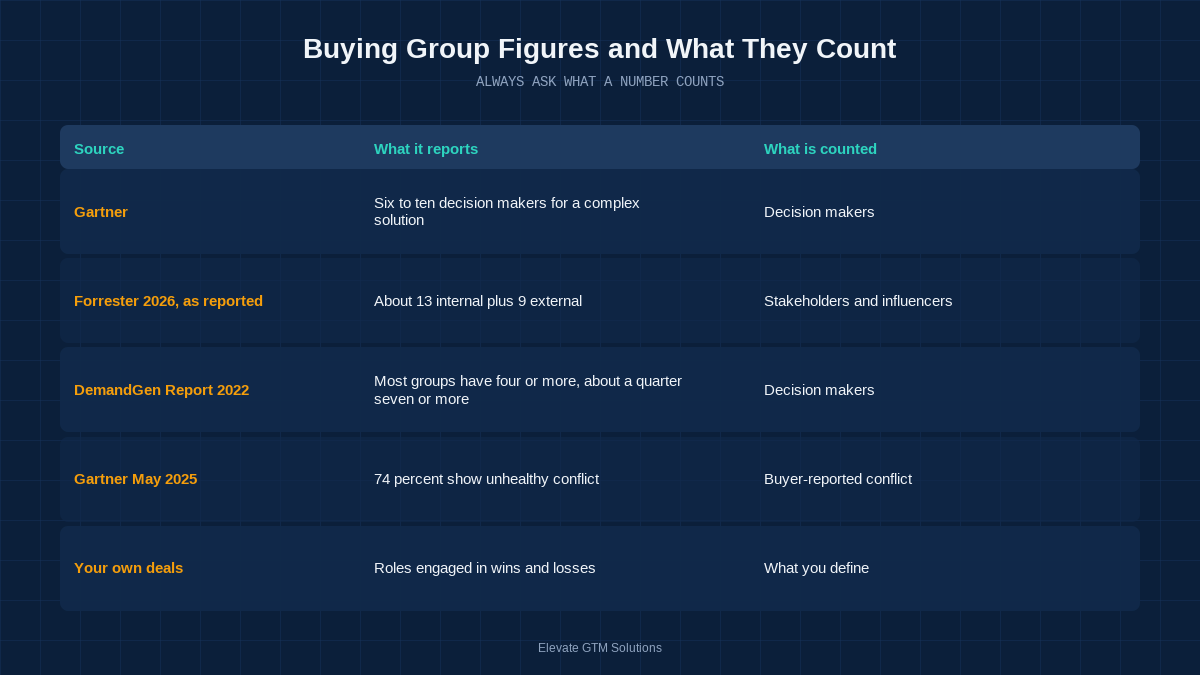
It depends on what you count. Gartner's long-quoted figure for a complex B2B solution is six to ten decision makers, each bringing several pieces of independently gathered information. Forrester's 2026 State of Business Buying, as reported, counts about thirteen internal stakeholders plus nine external influencers for enterprise-scale purchases. A 2022 DemandGen Report study found that most buying groups include four or more people and that about a quarter include seven or more. Another vendor's 2025 survey suggested committees for software are becoming more focused. Differences in definitions, deal sizes and survey methods explain much of the spread. Plan for several people, find out who they are in your deals and measure your own.
Is there one right number? No. Count your own wins and losses by deal size and segment.
Does a bigger group mean a harder sale? Often, and research suggests the bigger risk is disagreement within the group.
Why the size of the group matters
| If the group is larger or more varied | Consequence for go-to-market |
|---|---|
| More people judge the purchase | Single-threaded selling is riskier |
| Roles have different concerns | One message does not serve everyone |
| More research is done independently | Public information shapes opinions before sellers arrive |
| More chance of disagreement | Deals can stall without a competitor winning |
| More approvals | Security, legal and finance steps lengthen cycles |
| More people to equip | The champion needs help explaining the case internally |
The research, source by source
| Source | What it reports | Who and when | Notes |
|---|---|---|---|
| Gartner, The New B2B Buying Journey | Typical buying group for a complex solution is six to ten decision makers, each with four or five pieces of information gathered independently | Gartner sales research, widely cited | Detailed survey sits behind a paywall, and no sample size is public on the summary pages |
| Forrester, State of Business Buying 2026 | About thirteen internal stakeholders plus nine external influencers for enterprise-scale purchases, as reported | Drawn from Forrester's 2025 Buyers' Journey Survey of a large global sample, reported at nearly eighteen thousand buyers | Reported through secondary summaries here, and Forrester's own pages are the primary source |
| Gartner press release, May 2025 | Seventy-four percent of buyer teams show unhealthy conflict. Groups that reach consensus are two and a half times more likely to report a high-quality deal. Groups experiencing buying group relevance are three times more likely | Survey of 632 B2B buyers, August to September 2024 | Self-reported, and the construct of unhealthy conflict is defined in the release |
| CEB research, mid-2010s, as summarized | Average buying group of about five, rising to nearly seven within two years | Mid-2010s | Often quoted as the origin of the committee growth story |
| DemandGen Report, 2022 B2B buyer study | Most buying groups include four or more decision makers, and about a quarter include seven or more | 2022 survey | Summarized by a research vendor |
| 6sense Buyer Experience reports, as summarized | Buyers made first contact with a seller in most cases and were well through their process when they did, with the eventual winner usually on the buyer's day-one shortlist | Multi-year survey series, with the share of the process completed before contact falling in the 2025 report | Summarized by a trade publication, and 6sense is an account intelligence vendor |
| G2 Buyer Behavior Report, 2025 | Software buying committees appear more streamlined, IT is involved in a large share of decisions, and department leads make a larger share of final decisions | Online survey of 1,169 B2B decision makers, April 2025 | G2 is a software review marketplace |
What exactly is being counted
The numbers differ partly because the word "buying group" is used for different things.
| Definition | Who is included | Typical result |
|---|---|---|
| Decision makers | People with a vote or veto | Smaller |
| Stakeholders | Anyone involved in evaluating or approving | Larger |
| External influencers | Consultants, peers, analysts, partners | Adds to the total |
| Everyone who touched research | Includes users and casual reviewers | Largest |
A figure of six to ten and a figure of twenty-two can both be correct for the same purchase, because they count different things. Always ask what a number counts before using it in planning.
Why the numbers differ
| Factor | Effect |
|---|---|
| Deal size | Larger and riskier purchases involve more people |
| Type of purchase | A security platform involves different people from a design tool |
| Company size | Larger companies add layers |
| Survey population | Buyers in enterprise-heavy samples report bigger groups |
| Definition | Decision maker versus influencer |
| Time | Practices changed after 2020, and so did software budgets and oversight |
| Self-report | Buyers may count more or fewer people than were really involved |
| Source incentives | Vendors may emphasize complexity or simplicity |
The conflict finding
The 2025 Gartner release is notable less for group size than for what happens inside groups. According to the release, most buyer teams showed what Gartner calls unhealthy conflict: conflicting objectives, disagreement on the best course, or being overruled by outside decision makers. Teams that reached consensus were more likely to describe the deal as high quality, and so were teams that felt the process addressed their shared interests.
Three cautions apply. The finding is self-reported by buyers. Disagreement is not always unhealthy, since different functions bring different exposures. And the release does not prove that vendors can fix conflict. What it supports is a practical idea: deals can stall because the buyers disagree with each other, not because they prefer a competitor, and a seller who helps the group reach agreement may be more useful than one who only persuades individuals.
Contact timing and the day-one shortlist
Several vendor surveys, including 6sense's summarized series, report that buyers contact sellers late and often start with a shortlist. G2's survey similarly found that many buyers bring salespeople in during later stages. Taken together, these reports suggest that much of the influence on a buying group happens before a seller is involved, through public information, peers, review sites and, increasingly, AI assistants. The numbers vary by survey, and the direction is consistent. For go-to-market, that means your public presence is part of how you reach the buying group. Our review of AI search citation studies and of review sites and software buying cover where that research stands.
Reading the research with care
| Question | Why it matters |
|---|---|
| Who counted, and what? | Decision makers and stakeholders give very different totals |
| What deal size and segment? | A mid-market tool and an enterprise platform differ |
| Who was surveyed? | Buyers who recently purchased, or sellers describing buyers? |
| When was the fieldwork? | Behavior changes |
| Is the method public? | Paywalled reports leave claims unchecked |
| Who paid for it, and what do they sell? | Incentives shape emphasis |
| Does a headline match the body? | Summaries drift from reports |
A sensible habit is to quote the range, name the source and year and say what is counted.
What buying group research implies for go-to-market
Map the group in your own deals. Record who attended calls and who influenced the decision. After a few dozen deals, you will have your own distribution.
Multi-thread early. If most deals involve several roles, reaching only one person is a risk.
Equip the champion. Give them a short summary they can forward, the problem in their words and answers to the objections other roles are likely to raise.
Address each role's concern. Different roles worry about different things: cost, integration, risk, usability and effort.
Watch for conflict. Ask in discovery how the group will decide and where they disagree, and offer neutral material that helps them compare options.
Plan for security and procurement steps. Prepare documents early, so they do not appear as surprises late in the deal.
Make public information consistent. Buyers research before they talk to you. Accurate pricing, descriptions and reviews matter.
A worksheet to map a buying group
| Role | Name | Concern | Influence | Relationship | Next step |
|---|---|---|---|---|---|
| Champion | The daily problem | ||||
| Economic buyer | Cost and return | ||||
| Technical evaluator | Integration and security | ||||
| End users | Usability | ||||
| Finance or procurement | Terms and risk | ||||
| Security or legal | Compliance | ||||
| Executive sponsor | Strategic fit | ||||
| Skeptic or blocker | Past experience or competing priorities |
Fill it in for every active deal above a threshold. Gaps in the table are the deal's risks.
How to measure your own buying groups
| Step | Practice |
|---|---|
| 1. Define what you count | For example, everyone who attended a meeting or was named as influencing the decision |
| 2. Record it consistently | A CRM field for contact roles on every opportunity |
| 3. Analyze after thirty to fifty deals | Group by deal size and segment |
| 4. Compare wins and losses | Did wins have more roles engaged? |
| 5. Ask buyers | In win-loss interviews, ask who was involved and how the decision was made |
| 6. Review quarterly | Update the playbook with what you learn |
A small example, with invented numbers
| Deal size band | Deals | Average roles engaged in wins | Average roles engaged in losses |
|---|---|---|---|
| Smaller | 18 | 3.1 | 2.4 |
| Mid-sized | 24 | 4.8 | 3.2 |
| Larger | 12 | 6.5 | 3.9 |
In this invented table, wins involve more engaged roles at every size, and the gap widens with deal size. The team would treat this as a hypothesis, check it against buyer interviews and test a multi-threading change. With counts this small, they would not claim a causal effect.
Using the research in your ICP and account plans
| Use | Practice |
|---|---|
| Qualification | Ask who else is involved and how decisions are made, in early calls |
| Account tiering | Weight access to the buying group in the access score. See our account tiering framework |
| Messaging | Write role-specific pillars and objection responses |
| Content | Provide material for each role, including a forwardable summary |
| Forecasting | Treat deals with a single engaged role as earlier in the process |
| Enablement | Train sellers to map groups and to help champions |
An interview guide for mapping buying groups
Win-loss interviews are the best way to learn how your own buyers decide. Add these questions.
| Theme | Questions |
|---|---|
| Who | Who was involved at any point, even briefly? What was each person's role? |
| Origin | Who first raised the problem? Who started the search? |
| Information | What did each person read or ask? Where did they look? |
| Disagreement | Where did people disagree? How was it resolved? |
| Authority | Who could say no? Who made the final call? |
| Process | What approvals were needed? Who ran security, legal and procurement? |
| Timing | What made the timing urgent, or not? |
| Our role | What did we do that helped the group agree? What did we miss? |
| AI and online sources | Did anyone use an AI assistant or review sites? What did they learn? |
| Hindsight | Who should we have talked to earlier? |
Record names and roles in the CRM contact roles field, and summarize patterns monthly.
A content checklist by role
Different roles need different material. Use the table to check coverage.
| Role | Likely questions | Helpful material |
|---|---|---|
| Champion | How do I explain this to colleagues? | A forwardable summary, a short comparison, an objection guide |
| Economic buyer | What does it cost, and what return can we expect? | A plain pricing explanation and a business case outline with honest assumptions |
| Technical evaluator | Will it work with our systems? | Integration descriptions and an implementation plan |
| End users | Will it make my work easier? | A hands-on trial, a short demo, examples of the first week |
| Security and legal | Is our data safe? What are the terms? | A security overview, data handling and AI use descriptions, standard contract terms |
| Finance and procurement | What is the commitment? | Clear terms, exit and renewal conditions |
| Executive sponsor | Does this fit our priorities? | A one-page strategic summary |
| Skeptic | Why not do nothing or build it ourselves? | An honest comparison with alternatives |
If you cannot produce an item for a role that appears often in your deals, that is a gap to fill.
A mutual plan for groups that disagree
A mutual plan lists the steps both sides agree to, with dates, owners and the people who must be involved.
| Step | Owner | Who must be involved | Date | Status |
|---|---|---|---|---|
| Agree the problem statement | Champion and seller | Economic buyer | ||
| Demo to the group | Seller | End users, technical evaluator | ||
| Technical review | Technical evaluator | Seller's solutions contact | ||
| Security review | Security | Seller's security contact | ||
| Business case review | Economic buyer | Champion, finance | ||
| Contract and procurement | Procurement | Legal, seller | ||
| Decision meeting | Executive sponsor | Whole group |
Use it to surface who is missing and which steps are unowned. Treat it as a shared document, not a pressure tool.
Consensus signals to track in your deals
| Signal | What it may suggest |
|---|---|
| More than one role has attended a meeting | The group is engaging |
| The champion forwards material to others | Internal spread |
| A skeptic has been named and engaged | Risk is being managed |
| A dated decision meeting exists | Real timing |
| Security and legal have started | The deal is progressing |
| Only one contact has been active for a long time | Single-threading risk |
| Meeting invitations repeatedly decline or slip | Possible disagreement or low priority |
These are indicators from experience, not measured predictors. Test them against your own wins and losses.
Glossary
| Term | Meaning |
|---|---|
| Buying group or committee | The people involved in a purchase decision |
| Decision maker | A person with a vote or veto |
| Stakeholder | Anyone involved in evaluating or approving |
| Influencer | A person who shapes the decision without deciding |
| Champion | An advocate for your solution inside the buyer organization |
| Economic buyer | The person who controls the budget |
| Multi-threading | Building relationships with several people in an account |
| Unhealthy conflict | Gartner's term for conflicting objectives, disagreement on course or being overruled |
| Mutual plan | A shared list of steps, owners and dates |
Quick reference
| Question | Short answer |
|---|---|
| How big is a buying group? | It depends on what you count. Published figures range from about four to over twenty |
| Where do the numbers come from? | Gartner, Forrester, DemandGen Report, vendor surveys and others, with varied methods |
| What does Gartner's 2025 survey say about conflict? | Most buyer teams reported unhealthy conflict, and consensus was associated with better reported deal quality |
| What should I do? | Map roles in your own deals, equip champions and help groups agree |
| What should I avoid? | Quoting a number without its definition |
Common mistakes
| Mistake | What happens | Fix |
|---|---|---|
| Quoting a number without its definition | A false benchmark | State what is counted and by whom |
| Targeting the biggest title only | Missing the real influencers | Map roles |
| Assuming the champion can carry the case alone | The deal stalls | Equip the champion and reach others |
| Treating all roles alike | Generic messaging | Role-specific concerns |
| Ignoring conflict | Deals end in no decision | Help the group align |
| Believing that smaller means simpler | Misreading a trend | Check your own data |
| Skipping public presence | Buyers form views before you arrive | Keep information accurate and findable |
How AI affects buying groups
Surveys reported by G2 suggest that many software buyers now use AI chatbots in research, and that chatbots influence shortlists. If so, individual members of a buying group may arrive at a meeting with different AI-generated impressions, which can add to disagreement. Practical responses are to check what assistants say about your product, make your public information consistent and offer a clear, neutral summary that helps the group reconcile what they have each read. These are inferences from survey reports, not measured effects.
A hypothetical example
This is an illustration, not a real company.
A software company sold scheduling software to firms of various sizes and relied on a single champion in each deal. Win rates were healthy for small accounts and low for larger ones. The head of revenue operations added a required field for roles engaged and reviewed fifty closed deals. In small accounts, wins typically involved an owner and a dispatcher. In larger accounts, wins often involved an operations leader, a finance contact and an IT contact, and losses frequently had only the champion engaged.
The team changed its playbook: sellers asked early who else would be involved, offered a short forwardable summary, prepared a one-page document for IT and finance and added a mutual plan that named steps for each role. After two quarters, larger deals involved more roles, and the team noted fewer deals ending in no decision. They treated the improvement as encouraging and did not claim it proved cause. The point was not to match a published number. It was to find out how their own buyers decided.
A second hypothetical: a group that stalled
This is another invented illustration.
A software company had a strong champion at a mid-sized customer prospect. Calls went well, the trial succeeded and the champion said the deal was nearly done. Weeks passed. The seller asked about next steps and learned that the finance lead had concerns about ongoing costs and that the IT lead had not been told about the trial. Neither had been on a call.
The seller asked the champion for introductions and offered a short call with each. The finance lead wanted a clear pricing explanation and an exit clause. The IT lead wanted to see the integration approach and a security overview. The seller sent both documents, held the calls and proposed a mutual plan that named a decision meeting. The deal closed about six weeks later than the champion had predicted. The team added a question to discovery, who else will need to agree, and a standard pack for finance and IT, and tracked how often deals lacked those roles by the proposal stage.
The champion had not been wrong about the product. The group had not yet agreed.
Questions sales leaders ask
"How many people should we try to reach?" Enough to cover the roles that matter in your deals. Your own win data will show the pattern, and published ranges are a starting hypothesis.
"What if the champion refuses to introduce others?" Ask why, offer to help them prepare, and consider whether the champion lacks influence or is worried about losing control. Offer material that makes it easy to share.
"Is multi-threading always good?" Reaching more people helps when it adds relevant roles. Reaching many people with a pushy message can annoy the champion. Coordinate with the champion.
"How do we handle a blocker?" Try to understand the concern, offer evidence and an honest comparison, and ask what would change their view. Sometimes the right answer is to step back.
"How early should we ask about the buying process?" In discovery. People often welcome the question.
"What do we do when the group is large and slow?" Use a mutual plan, agree the next dated step in each meeting and prepare the documents later steps will need.
Questions marketing leaders ask
"Should we target roles or accounts?" Both: choose accounts by fit, then reach several roles with content suited to each.
"How do we measure buying group engagement?" Count roles engaged per account over a period, using contact roles and activity. Be cautious about attribution and personal data rules.
"What content do multiple roles share?" Clear explanations, honest comparisons, pricing information and proof. Role-specific content adds depth.
"How should we use buying group research in planning?" Treat published figures as hypotheses, replace them with your own data and design programs that reach more than one role.
"What about AI chatbots?" Check what assistants say about your company, and keep public information consistent, since different members of a group may arrive with different impressions.
In plain language
A buying group is the set of people who shape a purchase. Research suggests that groups are larger than a single champion, that they often disagree and that buyers contact sellers late. The exact numbers depend on definitions and samples, so use published figures as starting points and measure your own deals. Map the roles, equip the champion, address each role's concern and help the group reach agreement. Keep public information accurate, because members research before they talk to you.
A checklist before you quote buying group statistics
- You know what the number counts: decision makers, stakeholders or everyone who touched research.
- You know the source, the year and the sample.
- You have checked whether the report is paywalled and whether you are quoting a summary.
- You have noted the publisher's incentives.
- You are quoting a range, not a single figure.
- You have compared it with your own deals.
- You have not combined figures from different sources into one claim.
Summary for busy leaders
If you remember three things: published buying group figures range widely because they count different things, so quote a range with its definition; Gartner's 2025 survey suggests most buyer teams experience conflict and that consensus is associated with better reported deal quality, so help groups agree; and the best evidence for your market is your own deals, so map roles, ask buyers and measure.
Role concerns by deal type, illustrated
These are invented illustrations of how the mix of concerns can change with the purchase.
| Deal type | Likely concerns, by role |
|---|---|
| A workflow tool for one team | The team lead cares about fit with daily work, the budget holder about cost, IT about basic security |
| A platform that touches customer data | Security and legal take a leading role, finance cares about commitment, operations about migration |
| A tool that replaces an incumbent | Users worry about switching effort, IT about integration, finance about overlap costs |
| A tool with AI features | Security asks how data is used, users ask about accuracy, leaders ask about differentiation |
| An expansion purchase | The existing champion matters most, finance asks about price changes, success asks about adoption |
Use illustrations like these to prepare, then ask the buyers what applies in their case.
Final thoughts
Buying group research is most useful as a reminder. Purchases of any weight involve several people, they often disagree and they research before they speak to you. The published numbers are rough, and your own deals are the best data. Map the roles, equip the champion, help the group agree and keep your public information accurate. That approach holds up whether the true average is six, ten or thirteen.
Where buying group evidence helps at each sales stage
| Stage | How to use buying group knowledge |
|---|---|
| Qualification | Ask who else will be involved, and how decisions are made |
| Discovery | Learn each role's concern, and the problem in each person's words |
| Evaluation | Arrange sessions for the roles that matter, and prepare role-specific material |
| Validation | Check that technical, security and finance concerns are addressed before the proposal |
| Proposal | Address the group's shared criteria, not only the champion's |
| Negotiation | Know who signs, who can block and what procurement needs |
| Onboarding | Include the roles who will use and support the product |
Questions executives ask
"Can we get a single number for our board deck?" Offer a range with a definition and a source, and add your own measured range as soon as you have one. A single borrowed number invites a hard question you cannot answer.
"Does a larger group mean we should price higher?" Not by itself. Larger groups often mean longer cycles and more cost per deal, and price should reflect value and economics.
"Should we hire for multi-threading?" Consider coaching and a repeatable process before adding roles. A seller who knows how to map and reach a group is more valuable than a larger team doing the same single-threaded work.
Limits of this review
We reviewed what we could verify as of November 2026. Several reports are paywalled, and we relied on press releases and summaries for some figures. Surveys are self-reported and differ in definitions and populations. The vendors that fund much of this research have interests. Nothing here measures how any particular company's buyers behave.
What to do this week
Pull your last twenty closed deals and count how many roles were engaged in each. Write the definition of a buying group you will use. Pick one open deal and fill in the mapping worksheet. Ask three recent buyers who was involved in their decision and where they disagreed.
Key takeaways
- Published buying group sizes range from about four to well over twenty, mostly because they count different things.
- Gartner's 2025 survey suggests most buyer teams experience unhealthy conflict, and consensus is associated with better reported deal quality.
- Several vendor surveys suggest buyers contact sellers late and use public information, reviews and AI assistants early.
- Map and measure buying groups in your own deals, and quote ranges with definitions.
- Equip champions, address each role's concerns and help the group reach agreement.
Where Elevate GTM Solutions fits
Elevate GTM Solutions is an AI-native GTM operating system for B2B companies. It helps teams hold what the research implies you should decide: the ideal customer, the buying roles and their concerns, positioning and messaging pillars by role, qualification criteria, account priorities and enablement inputs, across 15 modules, with workflows, weekly plans and a recurring review rhythm for bringing win and loss evidence in. It does not provide buyer research or measure buying groups for you, and it connects to HubSpot, Salesforce, LinkedIn, Notion and Claude for supported actions. A free first strategy build is available, and published plans, billed annually, are Enable at USD 499 per month and Growth at USD 1,499 per month, with custom Scale pricing.
For related reading, see Account Tiering Framework, Win-Loss Analysis Framework, B2B Sales Cycle Length: What the Benchmarks Say and What Is Elevate GTM Solutions?. See the pricing page, or request a demo.
Sources
All accessed in November 2026. Findings are paraphrased. Some reports are paywalled, so we note where we relied on summaries.
- Gartner, B2B buying journey sales insights: https://www.gartner.com/en/sales/insights/b2b-buying-journey
- Gartner press release, 7 May 2025, 74 percent of B2B buyer teams demonstrate unhealthy conflict: https://www.gartner.com/en/newsroom/press-releases/2025-05-07-gartner-sales-survey-finds-74-percent-of-b2b-buyer-teams-demonstrate-unhealthy-conflict-during-the-decision-process
- Forrester, State of Business Buying (figures as reported by secondary summaries, for example https://komo.ai/glossary/buying-committee)
- DemandGen Report, check the date on your buying group stats: https://www.demandgenreport.com/?p=54785
- Summary of 6sense Buyer Experience findings: https://ppc.land/buying-committee/
- G2, 2025 Buyer Behavior Report: https://learn.g2.com/2025-g2-buyer-behavior-report and https://company.g2.com/news/buyer-behavior-in-2025
Frequently Asked Questions
How many people are in a B2B buying group?
It depends on what is counted. Gartner's long-quoted figure is six to ten decision makers for a complex solution. Forrester's 2026 report, as reported, counts about thirteen internal stakeholders plus nine external influencers. A 2022 study found most groups include four or more people.
Why do buying group numbers differ?
Different definitions (decision makers versus all stakeholders), deal sizes, company sizes, survey populations and years, and the incentives of the organizations that publish them.
What did Gartner find about buying group conflict?
In a survey of 632 B2B buyers, Gartner reported that 74 percent of buyer teams showed unhealthy conflict, and that groups reaching consensus were two and a half times more likely to report a high-quality deal.
Are buying groups getting bigger or smaller?
Sources disagree. Several describe growth since the mid-2010s, while a 2025 G2 survey of software buyers suggested more streamlined committees. Definitions and populations differ, so measure your own.
When do buyers contact sellers?
Several vendor surveys report that buyers contact sellers late in their process and often have a shortlist already. Figures vary by survey and year.
How should I use these numbers in planning?
Quote a range with its definition and source, and replace it with your own data from closed deals as soon as you have enough.
How do I map a buying group?
List the roles in each deal, such as champion, economic buyer, technical evaluator, users, finance, security and any skeptic, record concerns and relationships and plan a next step for each.
What should sellers do about conflict inside the buying group?
Ask how the group will decide and where they disagree, give the champion neutral material to share and help the group compare options on shared criteria.
Does AI change buying groups?
Surveys suggest more buyers use AI assistants in research, so members may arrive with different impressions. Check what assistants say about you and keep public information consistent.
Where can I read the original research?
The sources section lists the pages we used. Some reports are paywalled, and press releases and summaries are the public record for those.
What questions help map a buying group in an interview?
Who was involved, who raised the problem, what each person read, where they disagreed, who could say no, what approvals were needed and who we should have reached earlier.
What material should I prepare for each role?
A forwardable summary for the champion, a business case outline for the economic buyer, integration details for technical evaluators, a trial for users, security and contract documents for security and legal, clear terms for procurement and an honest comparison for skeptics.
What is a mutual plan?
A shared list of steps, owners and dates that both sides agree, including the roles who must be involved, used to surface missing people and unowned steps.