
By the Elevate GTM Solutions Team · Updated November 13, 2026 · 26 min read
How to Price a New B2B Product: Value, Models, Packaging and How to Test a Price Without Guessing
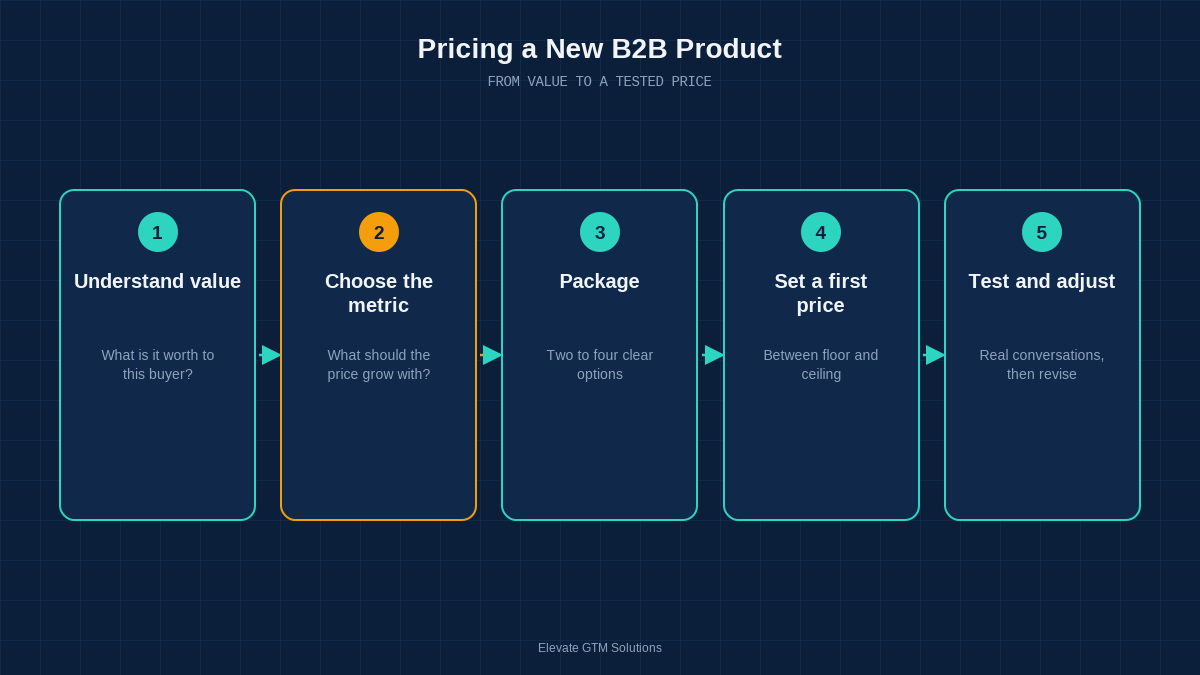
Pricing is the decision most teams make last and regret first. The product is built, the message is written, the launch date is set, and someone asks, "So what do we charge?" The usual answers are a competitor's price, a number that feels reasonable or whatever the founder said in a meeting. Then the price is on the website, sellers start negotiating it away and nobody knows whether it is too high, too low or just wrong in shape.
Price is not a number you pick at the end. It is a statement about who the product is for, what it is worth to them and how they should buy it. It affects who shows up, how long deals take, how much you can invest in winning them and whether customers feel they got a fair deal. This guide walks through how to approach pricing a new B2B product: how to understand value, how to choose a pricing model, how to package, how to find a first price, how to test it and how to change it later without damaging trust.
We make a GTM strategy platform with a pricing strategy module, so we have an interest in the topic. We use no benchmark prices or margins, and none appear here as targets, because pricing varies widely by product, market and buyer and published figures rarely match your situation. The examples are invented. This guide is not financial or legal advice.
How do you price a new B2B product?
Start with value, not cost or competitors. Work out what problem the product solves, for whom, and what that is worth to the buyer in money saved, revenue gained, risk reduced or time freed. Choose a pricing model that grows with the value the customer gets, such as per user, per usage or per outcome, and package it into a few clear options aimed at different buyers. Use competitor prices and your costs as boundaries, not as the answer: your cost sets the floor, the buyer's alternatives set a reference and the value sets the ceiling. Set a first price from conversations with real buyers, test it in real sales discussions and pilots, record what happens and adjust. Expect to change it. A new product's first price is a hypothesis.
Should we price low to win customers? Usually not by default. A low price can signal low value, attract the wrong buyers and be hard to raise later.
Should the price be public? It depends on your buyer and motion. Simple, lower-priced products often benefit from public prices. Complex or large deals often need quotes.
The short version
| Step | The question | The output |
|---|---|---|
| 1. Understand value | What is this worth to the buyer, and compared with what? | A value story with evidence |
| 2. Choose the metric | What should the price grow with? | A pricing metric such as seats, usage or outcomes |
| 3. Package | What should be included at each level? | Two to four clear options |
| 4. Find the range | What are the floor, reference and ceiling? | A price range with reasoning |
| 5. Set the first price | What do we try first? | A price and terms |
| 6. Test | What do buyers say and do? | Evidence from real conversations |
| 7. Adjust | What should change? | A revised price, with a plan for existing customers |
What price really does
Before the mechanics, remember what a price communicates.
It signals who the product is for. A low price says "for small teams and quick decisions." A high price says "for serious, important work." Buyers draw conclusions before they read a feature list.
It sets the kind of sale you can run. If the average deal is small, you cannot afford long, consultative sales. If it is large, a checkout page may look odd. Price and motion must match. See what is a GTM motion.
It shapes who buys. Price-sensitive buyers churn faster in some markets. Buyers with large budgets may avoid a product that seems too cheap to be serious.
It decides what you can afford. The price must support the cost of winning and serving customers. Our research page on CAC payback discusses how to think about that.
It is hard to change. Raising a price on existing customers is painful. Cutting it can anger people who paid more. Get close to right early.
Step 1: understand value
Value is what the product is worth to a specific buyer, not what it cost you to make. It comes from the buyer's situation.
Find the value drivers
For each target segment, ask what the product changes.
| Driver | Example question |
|---|---|
| Money saved | What does the buyer spend on this problem now, in tools, people and mistakes? |
| Revenue gained | What new or protected revenue does the product enable? |
| Time freed | How many hours do people spend on this task, and what are those hours worth? |
| Risk reduced | What does a failure cost: fines, outages, lost customers? |
| Speed | What is the value of finishing sooner? |
| Quality or confidence | What is the value of better decisions or fewer errors? |
Estimate with the buyer, not for the buyer. In customer conversations, ask how they handle the problem today, what it costs and what they would do if the product did not exist. Write down what they say, with their numbers where they will share them, and avoid inflating them.
Identify the real alternatives
A buyer compares your price with what they would do otherwise, which may not be a competing product. The alternative may be a spreadsheet, a service provider, a hire, a tool they already own or doing nothing. Each sets a reference point. A product that replaces a part-time analyst is compared with that person's cost. A product that replaces a dozen-hour weekly task is compared with the time.
Segment by value
Different buyers get different value. A large team with a costly problem gets more than a small team with an occasional one. If value varies widely across customers, a single flat price leaves money on the table with some and scares away others. This is a reason to offer more than one package. See ICP and market sizing for ways to describe the segments.
Step 2: choose the pricing metric
The pricing metric is the unit the price grows with. A good metric lines up with the value the customer gets, is easy to understand and is hard to game.
| Metric | How it works | Fits when | Watch for |
|---|---|---|---|
| Per user (seat) | Price grows with the number of people | Each person gets individual value | Customers limiting seats and sharing logins; discouraging adoption |
| Per usage | Price grows with volume of activity | Value tracks volume, such as messages, records, API calls | Unpredictable bills; customers worry about runaway costs |
| Per outcome | Price tied to a result | The result is measurable and attributable | Disputes over measurement; revenue timing |
| Flat subscription | One price for a defined offer | Simple product, similar customers | Leaves value on the table with large customers |
| Tiered plans | Packages at different levels | Customers vary in size and needs | Complexity if too many tiers |
| Platform fee plus usage or seats | A base fee plus growth | Larger deployments | Harder to explain |
| Per project or scope | Price by project, product or segment | Strategy, planning or services-like products | Scope creep |
| One-time fee | Single payment | Self-contained deliverables | No recurring revenue; support costs continue |
Ask three questions of any metric you are considering.
- Does it grow when the customer's value grows? If customers get much more value but pay the same, you have the wrong metric.
- Can the customer predict their bill? Surprise bills damage trust. If usage-based, offer caps, alerts or committed tiers.
- Does it discourage the behavior you want? Per-seat pricing can discourage rolling the product out widely. Per-usage pricing can discourage using it.
Our AI GTM platform pricing guide describes how common models behave in one category, which may help you see the tradeoffs.
Step 3: package
Packaging decides what customers can buy and how they compare options.
Offer a small number of packages. Two to four is typical. More than that, and buyers freeze or ask for a call.
Differentiate by value, not by arbitrary limits. Tiers should separate customers who get different value, such as larger teams, more advanced needs or more support. Avoid tiers that only restrict features that cost you nothing but frustrate buyers.
Name them for the buyer. Names like "Starter," "Team" and "Enterprise" tell buyers where they belong.
Make the middle option attractive. Buyers often choose the middle of three. Design it for your most common good customer.
Keep a clear path up. Customers should see what they gain by moving to the next level.
Decide what is an add-on. Some capabilities belong in the base, and others, such as advanced security, premium support or extra volume, may be paid add-ons. Do not nickel-and-dime essential functions, because buyers resent it.
Decide what is free, if anything. A free tier or trial can drive adoption in product-led motions. It carries real costs and should have a plan for converting users. See what is product-led growth.
Consider contract terms. Monthly or annual? Multi-year discounts? Minimum commitments? Terms are part of the price. Annual contracts improve cash flow and reduce churn risk, and they raise the buyer's commitment.
Step 4: find the range
Three boundaries help.
The floor: your costs and your economics. Estimate what it costs to serve a customer and to win one. A price below what covers those costs will not last. Be careful with costs that fall as you scale, and do not assume scale you do not have yet.
The reference: alternatives and competitors. What do buyers pay today to solve this problem, with competing products or other means? This is where buyers anchor. Check competitor pricing pages and ask buyers what they pay, treating any one data point with caution. Remember that list prices are not what customers pay after negotiation.
The ceiling: value. The price should be a fraction of the value the buyer receives. How big a fraction depends on how confident the buyer is in the value, how much risk they bear and how much better you are than the alternatives. A common idea is that the buyer should get several times the value they pay for. We give no ratio, because it varies, and the real test is whether the buyer sees it that way.
The range between floor and ceiling is usually wide. Where you place the price within it depends on strategy. A premium position needs proof, brand and service to match. A lower position needs volume and efficiency to work.
Use buyer research, carefully
Several simple methods help.
Open conversations about value. Ask buyers what the problem costs them and what a solution would be worth. Do not ask "what would you pay?" first. People anchor low.
Price reaction conversations. Show a price and watch. Does the buyer flinch, nod or ask about packaging? Record the exact words.
Comparison questions. "At what price would this seem so cheap you would doubt it? At what price would it seem too expensive to consider?" These questions, sometimes called price sensitivity questions, give a rough range. Treat the answers as directional, because people do not always behave as they say.
Choice exercises. Ask a buyer to choose between package options at different prices. This shows tradeoffs more clearly than direct questions.
Small samples mislead. Ten conversations give you hypotheses, not facts. Look for patterns across segments.
Step 5: set a first price
You need a number to start. Use a simple process.
- Write the value story for your best-fit segment, with the buyer's own numbers where you have them.
- Note the floor, the reference and the ceiling.
- Choose a first price in the range that fits your positioning, and write the reasoning.
- Decide the discount rules. Who can approve what, and in exchange for what? Never discount without getting something, such as a longer term, a reference or a case study.
- Decide which terms you will not negotiate.
- Write down what result would make you change the price.
Resist pricing to avoid any rejection. If no buyer ever says "that's expensive," the price is probably too low. A healthy price meets some resistance and still wins deals where value is clear.
Early customers and price
Early customers often get a discount in exchange for feedback, references or a commitment. That is reasonable if you are clear about it. Say it is a design partner or launch price, set a term and say what the price will be afterward. Do not let early deals become the permanent price list by accident.
Step 6: test the price
You can learn a lot before and after launch.
In sales conversations
- Track what price you quoted, what the buyer said and what happened.
- Record reasons for objection and whether they were about price, value or packaging. Many "price" objections are really "I do not see the value" or "I cannot get approval."
- Look at win rate and discount depth by segment.
Through structured tests
- Offer different packages to different segments and compare responses, where it is fair and legal to do so.
- Run pilots with defined success criteria and a priced path to full use. See pilot to scale framework.
- Test price pages carefully. If your motion has volume, you can test different presentations. Do not show different prices to similar customers at the same time in ways that could look unfair or breach rules. Check the law and your own principles.
Our GTM experimentation framework describes a simple way to write down a test.
What to look at
| Signal | What it may mean |
|---|---|
| Nearly everyone accepts at once | Price may be too low |
| Almost nobody gets past the quote | Price, value story or buyer fit is off |
| Heavy discounting | The list price is not credible, or sellers lack a value story |
| Buyers choose the lowest package | Packaging is wrong, or the higher ones lack a clear benefit |
| Buyers ask for something not in the offer | An add-on or package opportunity |
| Customers who pay more succeed more | The price may be filtering for commitment |
| Customers who pay less churn more | Low price may attract weak fits |
Read these as questions, not verdicts, and look across segments.
Public prices or quotes?
| Approach | Fits when | Watch for |
|---|---|---|
| Public prices | Lower prices, self-serve, product-led motion, buyers who research alone | Competitors see them; harder to customize; large buyers may want a conversation anyway |
| Starting-at prices | Mixed segments | Buyers may anchor on the low number |
| Quote only | Complex or large deals, variable scope | Buyers skip vendors that hide prices; sales time is spent on unqualified buyers |
| Hybrid | A public entry level and quotes for larger needs | Needs clear boundaries between levels |
Buyers often dislike having to ask for a price. If you do not publish one, explain what drives it and give a rough sense. Our guide to AI GTM platform pricing explains why many vendors in one category choose custom quotes and what to ask. Honest explanation builds more trust than silence.
Discounts and negotiation
Discounts are part of enterprise sales, and they can damage your pricing if handled loosely.
Set the rules before you negotiate. Define approval levels and the conditions for discounts.
Trade, do not give. Exchange a discount for something: a longer term, a reference, a case study, a larger commitment, faster payment.
Protect the list price. If everyone gets forty percent off, the list price is fiction. Either lower it or tighten the rules.
Avoid precedent. A special deal for one buyer becomes a story other buyers tell.
Know what you will not discount. Some things, such as core terms or support levels, are worth more than the price.
Watch for patterns. If one seller gives deep discounts, they may not have a value story. Coach, do not just restrict.
Changing the price later
Prices change. Do it with care.
Raising prices.
- Do it for new customers first, where you can watch the reaction.
- For existing customers, give notice, explain what has changed in value, and consider a grandfather period.
- Check your contract terms and the law for notice rules.
- Look for lift in what you deliver, so the increase feels earned.
Lowering prices.
- Understand why. A cut without a strategy invites doubt.
- Consider adding value or a new package instead.
- Be fair to existing customers who paid more.
Changing the model. Moving from per-seat to usage, or adding tiers, affects every customer. Model the effect on existing accounts before you announce it, and have a transition plan.
Communicate plainly. Customers accept changes they understand and resist those that look like a surprise.
A worked example, invented for illustration
Imagine a company launching software that helps procurement teams check supplier contracts for risky terms. It has no price yet. In twelve conversations, buyers describe the problem: contract reviews take legal and procurement staff many hours per contract, and mistakes have caused costly disputes. Most mention they currently use a mix of spreadsheets, outside counsel and manual reading.
The company notes that the value drivers are time and risk. Smaller procurement teams review few contracts, so time savings are modest. Larger teams review many, and one avoided dispute could pay for a lot. It decides that a pure per-seat price misses the point, because the value tracks the number of contracts reviewed. It chooses a pricing metric based on contracts reviewed per year, with a platform fee that covers setup and support.
It creates three packages: one for small teams with a low volume, one for mid-size teams with a higher volume and added integrations, and one for large teams with custom terms and security reviews. It sets a first price from its value story, checks it against what buyers pay outside counsel for similar work and what spreadsheet-based processes cost in staff time, and keeps it clearly below those figures. It offers a ninety-day pilot with defined success criteria and a priced path to full use. It writes discount rules: only for a longer term or a case study.
In the first quarter, buyers keep asking whether unused volume carries over. The company adds a simple rollover rule. It also learns that small teams hesitate at the platform fee, so it adjusts the entry package. It treated the first price as a hypothesis, and the adjustments came from what buyers said.
Pricing and your GTM strategy
Pricing is part of go-to-market, not a separate task.
- Positioning: price signals position. A premium price with a bargain message confuses buyers. See positioning.
- Segment: different segments may need different packages.
- Motion: self-serve needs simple, public pricing. Sales-led can support complex quotes.
- Channel: partners need margin or fees. Your price has to leave room. See how to build a partner and channel GTM strategy.
- Enablement: sellers need a value story and clear discount rules. See what is GTM enablement.
- Competition: price is one way to differentiate, rarely the only one. See how to win against a dominant competitor.
- Moving upmarket: price and packaging change with the buyer. See how to move upmarket.
Common mistakes
Pricing from cost alone. Customers do not pay for your costs. They pay for their value.
Copying a competitor. Their price reflects their costs, brand and strategy.
Pricing to avoid objections. A price nobody questions is probably too low.
Too many tiers. Complexity stalls buyers.
A metric that fights adoption. Per-seat pricing that discourages wide rollout, or usage pricing that makes people afraid to use the product.
No discount rules. The list price becomes fiction.
Giving away the roadmap in packaging. Locking key features behind a higher tier that most buyers need.
Treating the first price as final. It is a hypothesis.
Changing prices without a plan for existing customers.
Ignoring legal and tax questions. Contract terms, notice periods, taxes and regional rules vary. This guide is not legal advice.
Pricing conversations with a buyer
A good pricing conversation is part of the sale, not the end of it.
Start with value. Before you mention a price, make sure the buyer can say what the problem costs them and what success looks like. Quote after that, so the price meets a value story.
Quote with the structure. Show the package, the metric, the term and what is included. A bare number invites a bare comparison.
Anchor on the alternative. Compare with what the buyer does today: the people, the tools, the mistakes. Do not anchor on a competitor's list price, which may not be what the buyer would pay.
Stay quiet after the number. A pause lets the buyer think. Filling it with a discount weakens your position.
Ask what is behind an objection. "It is too expensive" can mean the budget is fixed, the value is unclear, the buyer lacks authority or a cheaper alternative exists. Each needs a different response.
Offer options, not cuts. If the buyer cannot afford the package, offer a smaller scope, a phased start or a different term, not just a lower price for the same thing.
Write down what you traded. Keep a record of every concession and what you received. It protects your pricing logic.
Pricing and the cost to serve
A price must cover the cost of serving the customer, and that cost may vary by customer in ways your first model did not predict.
- Support load. Some customers need much more help than others.
- Infrastructure and usage costs. For products with heavy compute or data costs, usage can scale your costs faster than your revenue.
- Implementation effort. Large or complex customers can need weeks of setup.
- Third-party costs. Data, licenses or services you pass through.
Track cost to serve by segment as soon as you have data. If one kind of customer costs far more than it pays, change the package, add a usage component or an implementation fee, or choose not to serve that customer. This is one reason a single flat price is risky for products whose cost varies by use.
For AI-enabled products, usage costs can be significant and can change as underlying services change. Do not assume that cost will fall. Build a margin that survives uncertainty, and consider usage limits or credits. This guide is not financial advice.
Ethics and trust in pricing
Buyers remember how a price felt. A few principles protect trust.
- Be clear. Hidden fees and confusing terms cause resentment and churn.
- Be consistent. Customers talk. Large unexplained differences between similar buyers cause trouble.
- Be fair at renewal. Sudden large increases with no added value damage relationships. Give notice and explain.
- Follow the rules. Pricing, advertising and contract rules vary by country, and some forms of price discrimination and misleading discounts are restricted. Take legal advice for your markets.
- Keep your word to early customers. If you promised a launch price for a period, honor it.
Trust in a price is part of the product. Companies that treat it that way tend to keep customers longer.
Price research methods compared
Each method has uses and limits. Combining two or three gives a more reliable picture than relying on one.
| Method | How it works | Strength | Limit |
|---|---|---|---|
| Customer value interviews | Ask buyers what the problem costs and what a solution is worth | Reveals real value drivers | People may overstate or understate |
| Price sensitivity questions | Ask at what price the product seems too cheap or too expensive | Quick, gives a rough range | Stated answers differ from behavior |
| Choice exercises | Buyers choose between packages at different prices | Shows tradeoffs | Needs enough respondents; artificial |
| Competitor and alternative review | Collect public prices and what buyers pay for substitutes | Sets reference points | List prices are not net prices |
| Pilot pricing | Charge pilots at different levels | Real money and real behavior | Small sample; pilots differ from full deals |
| Sales conversation tracking | Record price quotes and outcomes | Real market response | Slow; influenced by seller skill |
| Cost-to-serve analysis | Estimate costs by segment | Sets the floor | Says nothing about value |
Whichever you use, record the sample size, the segment and the date, and avoid treating a handful of answers as proof. Our GTM experimentation framework describes a simple way to write down a test and its result.
Glossary
Pricing metric. The unit a price grows with, such as seats, usage or outcomes.
Packaging. How features, volume and services are grouped into options customers can buy.
Value-based pricing. Setting price by the value delivered to the buyer, not by cost or competitor prices.
Willingness to pay. The most a buyer would pay for a product.
List price. The published or standard price before discounts.
Discounting. Reducing the price from the list price.
Tiered pricing. Offering several packages at different price levels.
Usage-based pricing. Charging by volume of use.
Freemium. A model that offers a free version with limits and charges for more.
Anchor. A reference point that influences how a price is judged.
Grandfathering. Letting existing customers keep an old price for a period after a change.
Deal desk. A function that reviews and approves pricing and contract terms.
Where Elevate GTM Solutions fits
Elevate GTM Solutions is an AI GTM platform for creating, executing and adapting go-to-market strategy. Its homepage lists a "Pricing Strategy" module and the use case "Change pricing and packaging," alongside modules such as "Product Positioning," "ICP & Segmentation," "Competitive Intelligence" and "Unified GTM Strategy." The homepage says "15 connected GTM modules" and names sixteen, so count what you see when you look.
How that could help: pricing depends on positioning, segment and motion, and a platform that holds these together is designed to keep price consistent with the rest of the strategy and to let you compare options side by side. That is the company's design intent. The test is whether the pricing options it generates fit your actual buyers, costs and competitors, and whether your team can explain each option to a customer.
A platform does not know what your customers will pay. That comes from buyer conversations, tests and your own numbers. Treat any generated price or package as a hypothesis to test. Third-party listings we reviewed show Elevate's own plans as monthly subscriptions, one-time modules and a guided program, and we have not read the company's pricing page, so confirm current prices with the company. For more, see what Elevate GTM Solutions is.
What to do this week
- Write the value story for your best-fit segment: the problem, what it costs the buyer now and what changes.
- List the real alternatives buyers use today and what each costs them.
- Choose a pricing metric and test it against the three questions.
- Draft two to four packages and name them for the buyers.
- Write the floor, the reference and the ceiling, and a first price with your reasoning.
- Write discount rules and approval levels.
- Plan ten buyer conversations to test the price and record the exact reactions.
Key takeaways
- Start with value to the buyer, not cost or competitor prices. Use those as boundaries.
- Choose a pricing metric that grows with the customer's value, is predictable and does not discourage use.
- Offer two to four clear packages, differentiated by value.
- Set a first price from buyer conversations, treat it as a hypothesis and test it in real sales discussions and pilots.
- Set discount rules before negotiating, and trade discounts for something.
- Change prices with notice and a plan for existing customers.
- Price is part of positioning, motion and channel. Decide them together.
Sources
- Elevate GTM Solutions: descriptions of the Pricing Strategy module, the "Change pricing and packaging" use case and related modules, as stated on the company's homepage. Plan prices for Elevate itself come from third-party listings and should be confirmed with the company.
- Related Elevate guides linked in the text, including the AI GTM platform pricing guide and the CAC payback research page.
- The steps, the pricing metric table and the packaging principles reflect common practice and our judgment. They are not drawn from a single study, and the right approach varies by product and market.
- This guide is not financial or legal advice. Contract terms, notice periods, taxes and pricing rules vary by country.
- The worked example is invented for illustration. We cite no benchmark prices, margins or ratios.
Frequently Asked Questions
How do you price a new B2B product?
Start with the value to the buyer, choose a pricing metric that grows with that value, package it into two to four options, use your costs and competitor prices as boundaries and set a first price from buyer conversations. Test it in real sales discussions and pilots and adjust.
Should you price based on cost, competitors or value?
Value sets the ceiling, competitors and alternatives set a reference and your costs set the floor. Pricing from cost alone ignores what the buyer gains, and copying a competitor ignores your own position and economics.
What is a good pricing metric for B2B software?
One that grows with the value the customer gets, is easy to predict and does not discourage use. Common choices are per seat, per usage, per outcome, flat subscription, tiers or a platform fee plus usage. Test each against those three questions.
How many pricing tiers should we have?
Usually two to four. More tiers confuse buyers. Differentiate by real differences in value, such as team size, advanced needs or support, and name them for the buyer.
Should we show our price publicly?
Simple, lower-priced products and self-serve motions often benefit from public prices. Complex or large deals often need quotes. A hybrid, with a public entry level and quotes for larger needs, is common. If you do not publish prices, explain what drives them.
How do we test a price before launch?
Hold open conversations about the problem's cost and value, show prices in real discussions and note reactions, ask comparison questions about too cheap and too expensive and run choice exercises. Treat small samples as hypotheses.
Should we offer a discount to early customers?
It can make sense in exchange for feedback, references or commitment, if you label it clearly, set a term and say what the price will be afterward. Do not let early discounts become the permanent price by accident.
How do we handle discounting in enterprise deals?
Set rules and approval levels before negotiating, trade discounts for something such as a longer term or a case study, protect the list price and avoid special deals that become precedent. If everyone gets a deep discount, revisit the list price.
How often should we change our pricing?
Review it regularly, at least yearly, and after major changes in product, segment or market. Change it based on evidence, give notice, consider a transition period for existing customers and explain what value has changed.
Is usage-based pricing better than per-seat?
Neither is better in general. Usage-based fits when value tracks volume, and per-seat fits when each person gets individual value. Watch for bill surprises with usage and for limited rollout with seats.
What if buyers say our price is too high?
Find out whether the objection is about price, value or approval. Many price objections are really a missing value story or a budget process issue. If it repeats in your best-fit segment, test different packaging before cutting the price.
Can software help with pricing strategy?
A GTM platform can help keep pricing consistent with positioning, segments and motion and compare options. It cannot know what your customers will pay. Use any generated pricing as a hypothesis to test with real buyers.