
By the Elevate GTM Solutions Team · Updated November 13, 2026 · 25 min read
How to Win Against a Dominant Competitor in Your Category: Where to Fight, What to Say and What Not to Try
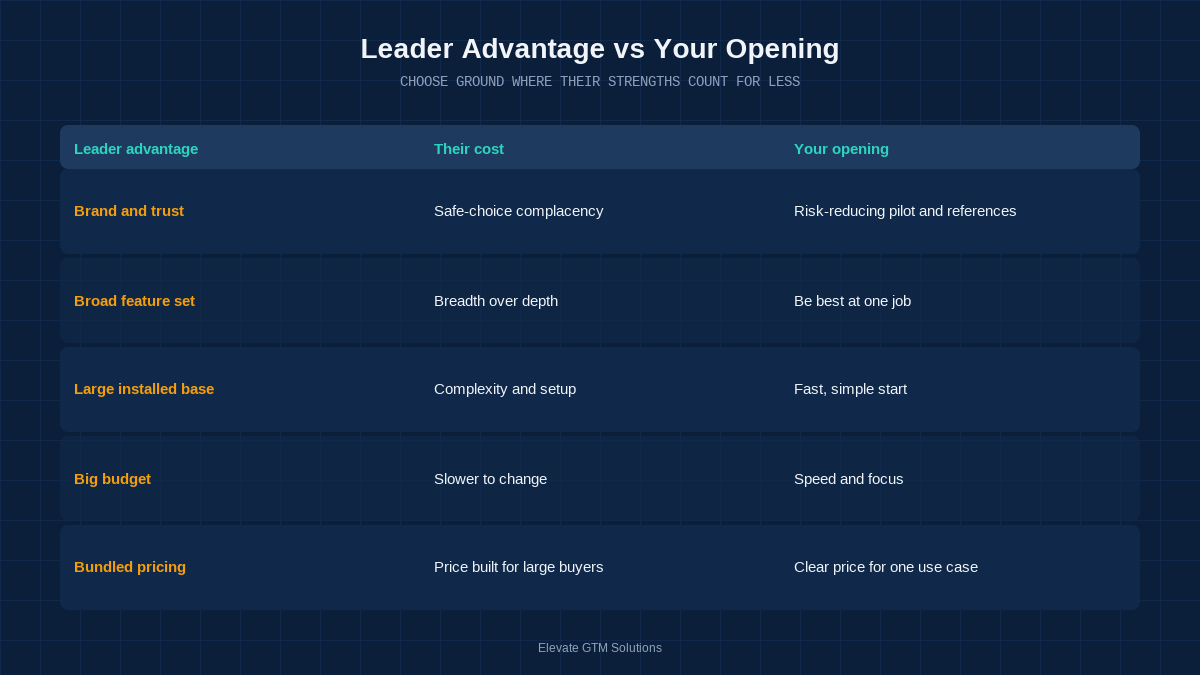
Every smaller company eventually faces the same slide in a sales meeting: a market map with one huge logo in the middle. The prospect already uses the leader, or is about to buy it, or asks, "Why would we choose you over them?" The honest answer is rarely "we are better at everything." If you are better at everything, you would not be the smaller one.
Winning against a dominant competitor is less about beating them head-on and more about choosing the ground. The leader has brand, budget, partners, a large customer base and the comfort of being the safe choice. You have speed, focus and the freedom to make a trade the leader cannot. This guide explains how to use that: how to find where you can win, how to position against a bigger rival without sounding petty, how to handle the sales conversation, how to use win-loss evidence, and what to avoid.
We make a GTM strategy platform. "Win against a dominant competitor" is one of the use cases on our site, and we have comparison pages that name larger vendors, so we have a stake. We have tried to keep the guidance honest, including saying that sometimes the right move is not to compete directly. The examples are invented to show the reasoning, no competitor is named in them, and we cite no benchmark numbers.
How do you win against a dominant competitor?
Do not fight on the leader's strongest ground. Find the segment, use case or buyer where the leader is weak, slow or a poor fit, and win there first. Position around a real difference that matters to that buyer, such as speed, focus, price model, flexibility, service or fit for a specific situation, and avoid claiming you are better at everything. Make the leader's strengths irrelevant instead of denying them. Equip sellers with an honest comparison, proof from customers who chose you and a plan for the common objections, especially "nobody gets fired for buying the leader." Use win-loss interviews to learn why you win and lose, and put your effort where the wins are. Be ready to coexist with the leader when buyers use both.
Should we attack the leader directly? Rarely. Name the difference that matters, show proof and let the buyer draw the conclusion.
Can a small company beat a market leader? Yes, in specific segments, situations and moments. Beating them everywhere is a different and much harder goal.
The short version
| Question | What to decide |
|---|---|
| Where is the leader weak or a poor fit? | Pick a segment, use case or situation |
| What is our real difference? | One claim a buyer in that segment cares about and can verify |
| What do we need to neutralize? | The leader's real strengths and the "safe choice" instinct |
| What will we say, and what will we not? | An honest comparison with proof |
| How will we know it works? | Win rate and reasons in the target segment |
If you cannot answer the first two, no amount of sales training will help. You will be a cheaper, slightly different version of the leader, and buyers rarely switch for that.
Understand what dominance gives them, and what it costs them
Before choosing a strategy, take an honest inventory of the leader's position. The advantages are real.
| Leader's advantage | What it does in a deal |
|---|---|
| Brand and trust | Buyers see them as the safe choice |
| Installed base | Many prospects already use them or know people who do |
| Ecosystem and partners | Integrations, consultants and community around them |
| Budget | Large marketing, sales and product teams |
| Completeness | A wide feature set that covers many needs |
| Momentum | Analysts, peers and the market keep talking about them |
Dominance also has costs, and they are your openings.
| Leader's cost | Where it shows up |
|---|---|
| Breadth over depth | Strong at many things, specialized at few |
| Complexity | More setup, more configuration, more need for experts |
| Price and packaging | Large bundles, tiered pricing, contract terms built for big buyers |
| Speed of change | A big company moves slower on new ideas |
| Attention | Mid-size and niche customers may get less of it |
| Legacy | Older architecture and decisions that limit what is easy |
| Priorities | The roadmap serves the largest customers |
None of these is a guarantee for any specific competitor. Check each against evidence about the rival you face: customer reviews, your own win-loss notes, job postings, product release history and what buyers say in calls. Treat what you hear from your own sellers as a hypothesis, because sellers tend to remember the losses to the leader as unfair and the wins as skill.
Find where you can win
The strongest move is usually to narrow, not to broaden. Look for ground where the leader's advantages count for less.
Segments the leader serves poorly
A leader built for large customers may be too expensive and complex for small ones. A leader built for general use may not fit a specific industry's rules and vocabulary. A leader built for one region may be weak in another. Look at your own best customers. Which types chose you over the leader, and why?
Use cases the leader treats as secondary
Large products have a core job and a long tail. Buyers whose main need sits in the tail may get a worse experience than they expect. If your product does that one job better, that is a wedge.
Situations that favor you
Some moments change the odds: a leader's price increase, a poor integration, a service problem, a merger that creates uncertainty, a buyer who is dissatisfied with their current vendor, or a new requirement the leader does not meet. Watch for these moments and be ready.
Buyers who want something different
Some buyers want the safest option. Others want flexibility, closer contact with the vendor, a clearer price or a product built around one kind of work. Know which buyers you attract and focus there. Our guide on ICP and the ICP scoring framework describe how to find the profile of buyers who choose you.
Where not to fight
Be honest about places you will not win right now. Large, standardized purchases where the buyer wants one vendor for everything, where compliance requires incumbents, or where a procurement rule favors the leader, are bad places to spend your best people. It is more useful to say "we do not compete there" than to lose repeatedly.
Build the position
Positioning against a leader requires discipline. See positioning for the basics. These principles apply specifically.
Choose one difference that matters. Not five. A buyer must be able to repeat it. "Built for finance teams that need month-end done in two days" beats "more flexible, faster, cheaper and easier." Each extra claim dilutes the others and invites doubt.
Make it verifiable. A claim a buyer can test in a trial, check with a reference or see in a demo is worth more than a claim they must take on trust. If you cannot prove it, soften it or drop it.
Frame the category differently, only if you can back it. Sometimes the best way to avoid a head-on fight is to describe the problem so that the leader's strengths matter less. For example, if buyers think of the purchase as "a big suite," you might frame it as "the best tool for one job." This works only if the framing is true and buyers recognize the problem. A made-up category with no buyer pull is a distraction.
Respect the leader's strengths. Do not tell a buyer the leader is bad. They will not believe you, and they may like the leader. Say what the leader is good at, and say where your product fits better. "They are a strong choice if you need X. If your priority is Y, here is why we may be a better fit" is credible.
Avoid naming the competitor in public marketing unless there is a reason. Naming them in headlines gives them attention. Comparison pages can serve buyers who are already comparing, and they should be accurate, dated and fair. Our own comparison pages, such as Elevate vs Demandbase and Elevate vs HubSpot, try to follow that standard.
Tell the truth about your limits. If the leader is better at something, and buyers will find out, it is better that you say it first. It builds trust that carries over to your other claims.
A positioning test
Write your position in this form and read it aloud.
"For [specific buyer] who [specific situation], we are the [category] that [specific difference]. Unlike [type of alternative, not necessarily named], we [proof]."
Then ask three questions. Would a buyer in that situation nod? Could a competitor say the same? Can we prove it? If the answers are yes, no and yes, you have something.
The sales conversation
Even strong positioning can lose in the room. Prepare sellers for the real conversation.
Learn the objections and answer them honestly
| Objection | A poor answer | A better approach |
|---|---|---|
| "Nobody gets fired for buying the leader." | "That's an outdated way to think." | Acknowledge the safety instinct. Reduce risk with references, a pilot, clear exit terms and a named point of contact. |
| "They have more features." | "We have the ones that matter." | Ask which features the buyer will use in the first year. Show depth where they matter. |
| "We already use them." | "You should switch." | Ask what is not working. Offer to coexist or to pilot one use case. |
| "You are too small." | "Size doesn't matter." | Address the real concern: stability, support, continuity. Offer financial references, escrow or contract protections where you can. |
| "They are cheaper in a bundle." | "Our price is fair." | Compare total cost for the use case, including what the bundle includes that the buyer will not use. |
| "Our team already knows them." | "You will learn ours quickly." | Show the learning curve honestly. Offer training and migration help. |
Qualify early
Spend time on deals where your difference matters. Ask in the first calls: what triggered the search, what are they trying to achieve, what have they tried, who decides, what does the leader do for them today. If the answers show that your difference does not matter, it may be better to step back than to burn weeks.
Find the champion and the trigger
Deals against a leader are usually won by an internal champion with a reason to change. Look for dissatisfaction, a new leader who wants a fresh approach, a new requirement or a budget change. Help the champion make the case to others.
Offer a low-risk path
Buyers fear the cost of being wrong more than they value the upside of being right. Reduce the risk: a pilot on a defined use case, a short initial term, a phased rollout, a clear path to leave, references from companies like theirs. This is often more persuasive than a price cut.
Do not trash the competitor
Sellers sometimes respond to loss by criticizing the leader. Buyers hear it as insecurity. Coach sellers to speak about the buyer's goals and your fit.
Use proof from people like them
Case studies and references from customers in the same segment, who switched from the leader or chose you over it, are the most effective material you have. Collect them with permission, and be accurate. Never invent or exaggerate a quote or a result. Our GTM enablement guide explains how to keep sales materials current.
Use win-loss evidence
Your best source of truth about why you win or lose against the leader is the buyers themselves. See the win-loss analysis framework.
A simple approach:
- For every deal where the leader was in the running, record the outcome and reason in the CRM.
- Interview buyers, not only sellers. Third-party interviews often get more honest answers.
- Look for patterns by segment, deal size, trigger and competitor mention.
- Compare what sellers believed with what buyers said.
- Adjust positioning, targeting and enablement based on what you learn.
Questions worth asking buyers: What did you consider? What mattered most in the decision? What almost changed your mind? What would have made the other choice better? What did you worry about?
Be wary of single stories. Five interviews do not make a trend, and the buyers who agree to talk are not typical. Treat the first batch as hypotheses.
Competitive intelligence that actually helps
You cannot win against a competitor you do not understand. See what is competitive intelligence for the discipline in more depth. For this purpose, a short list of sources is enough.
- Their public materials: pricing pages, release notes, documentation, case studies, job postings.
- Reviews: read them for patterns, with the usual caution that reviews skew toward extremes. See our review sites evidence page.
- Your own wins and losses: the richest source.
- Customers who use both: they know the differences better than anyone.
- Conversations with buyers.
Keep a one-page profile for the leader: who they sell to, what they are known for, where they are strong, where buyers complain, how they price and how they respond to challengers. Update it quarterly. Do not use private or improperly obtained information. It creates legal risk and often turns out to be wrong.
Product and pricing choices that help
Go deep where the leader is wide. A focused product can be the best at one job. Resist the urge to match the leader feature for feature, because you will lose that race.
Make switching easy. Import tools, migration help and parallel running reduce the cost of moving. Many buyers stay with a vendor because leaving looks painful.
Coexist where sensible. Integrations with the leader and its ecosystem let buyers add you without removing it. Being a good neighbor can be a way in.
Choose pricing that tells your story. If the leader sells large bundles, simple and transparent pricing for one job can stand out. If the leader's price is low and rising, a stable multi-year price may appeal. See how to price a new B2B product.
Do not discount your way in. Heavy discounting attracts price-focused buyers who leave when someone cheaper appears, and it trains the market to expect a low price. Compete on fit and let price support it.
When the leader responds
If you start winning, expect a reaction.
- Price moves or bundles. They may discount or bundle features. Stay focused on your segment and on total cost for the buyer's use case.
- Feature copying. If you win on one feature, they may add it. A lasting advantage comes from focus, service and fit, not only a feature.
- Fear, uncertainty and doubt. They may raise worries about your size or stability. Prepare honest, documented answers.
- Acquisition. The leader may buy a competitor or try to buy you. Know your own view before the question arises.
Do not let a competitor's reaction rewrite your plan. Watch the facts: are win rates in your target segment changing, and why?
Measuring progress
| Measure | What it tells you |
|---|---|
| Win rate when the leader is in the deal, by segment | Whether you are gaining where you focused |
| Reasons for win and loss from buyers | Whether your difference matters |
| Share of pipeline from the target segment | Whether you reach the right buyers |
| Discount depth against the leader | Whether you are winning on fit or on price |
| Sales cycle length in competitive deals | How hard the decision is |
| Retention of customers who switched from the leader | Whether the promise holds after the sale |
| Mentions of the leader in inbound inquiries | Whether the market sees you as an alternative |
Record a baseline now and review quarterly. Our guide on measuring GTM success explains how to build a scorecard.
A worked example, invented for illustration
Imagine a company that sells scheduling software to healthcare clinics. The market leader sells a large practice-management suite, and most clinics have heard of it. A review of the company's last forty competitive deals finds it won most where the clinic had fewer than ten providers and a front desk that handled scheduling by phone, and lost most where the clinic wanted one system for billing and records as well. Buyers who chose the company mentioned setup in days, simple pricing and a person who answered the phone. Buyers who chose the leader mentioned having one vendor.
The company stops pitching itself as an alternative to the whole suite. It targets small clinics with phone-heavy scheduling, positions around "scheduling that works the way your front desk does," builds an integration so the clinic can keep its existing records system, offers a thirty-day pilot and trains sellers to disqualify clinics that want a single suite. It collects references from three clinics that switched. After two quarters, the win rate in the target segment improves, discounting falls and the company walks away from deals it would have lost.
Nothing in that story required the company to be better than the leader overall. It required the company to know where it was better and to say so.
Common mistakes
Fighting everywhere. A broad target against a strong leader spreads you thin.
Feature chasing. You cannot out-feature a company with ten times your engineers.
Five-point differentiation. Buyers remember one claim.
Attacking the leader. It looks defensive and hurts credibility.
Discounting to win. It attracts the wrong buyers and sets a low anchor.
Relying on seller anecdotes. Ask buyers.
Ignoring switching costs. Make the move easy.
Overlooking coexistence. Many buyers will keep the leader. Let them add you.
Not preparing for the response. The leader will notice if you win.
Never saying no. Chasing every deal against the leader wastes your best people.
A one-page plan for a competitive segment
Teams often talk about competing and never write the plan down. This format fits on one page and forces the choices.
- Target segment. Who, in plain terms, and why the leader serves them less well.
- Our one difference. The single claim, with the proof a buyer can check.
- What we respect about the leader. Its real strengths and how we address them honestly.
- Top five objections. One honest answer each, plus proof.
- Low-risk entry offer. A pilot, a short term or a limited scope buyers can say yes to.
- Where we will not compete. Deals we will disqualify and the signs that identify them.
- Proof we have and proof we need. References, case studies and data, with owners and dates for the gaps.
- How we will learn. Which deals we will interview, who owns the win-loss notes and when we review.
- What would change the plan. The facts that would make us choose another segment or approach.
Review it with sales, product, customer success and marketing together every quarter. A plan one team wrote alone will not be followed by the others.
Handling the leader's customers who are unhappy
Some of your best opportunities are customers who already use the leader and are frustrated. Treat them with care.
Do not assume frustration. Ask open questions about what works and what does not. Many users of a leading product like it, and a pitch that assumes they are unhappy will offend them.
Look for specific pain. A change in pricing, a missed support promise, a feature gap that matters to them or an internal change such as a new leader. Specific pain is a better opening than general criticism.
Offer a bridge. Parallel running, import tools and a clear plan make switching less frightening. Be honest about what they will lose as well as what they gain.
Respect contracts. Many buyers are locked into terms for a period. Ask when the term ends and plan the relationship around that date. Never encourage a buyer to breach an agreement.
Do not use confidential information. If a buyer shares details about the leader's pricing or terms, use what they volunteer for their own decision and do not circulate it as general intelligence in ways that could cause legal problems. Take advice if unsure.
When a partnership beats a fight
Sometimes the best strategy against a dominant player is to work with it. If the leader has an ecosystem, being a strong integration partner can bring you customers who would never have switched. If the leader has a gap it does not plan to fill, you may become the specialist its own sales team recommends. These relationships carry dependence risk, since the leader can change its terms or build the feature itself, so do not rely on one. They can still be a profitable way to grow while you build strength elsewhere.
Messaging examples, in invented form
Abstract advice is easy to nod at. Here is how the same principles look in sentences. The scenario is invented and names no real company.
Weak. "We are the better alternative to the market leader, with more features, a lower price and better support." This claims everything, invites disbelief and names no buyer.
Better. "For clinics with fewer than ten providers, we are the scheduling tool that is live in days, not months, and we answer the phone." This names a buyer, makes two checkable claims and avoids attacking anyone.
Weak response to an objection. "Size doesn't matter." Better. "That is a fair worry. Here is how we handle continuity: a named contact, a standard data export and references from clinics who have used us for several years. We can start with one location so you see it before committing."
Weak opener on a call. "Why aren't you happy with your current vendor?" Better. "What is working well with your current setup, and what do you wish were easier?"
Notice what the better versions share: they are specific, respectful and verifiable. They let the buyer reach the conclusion.
Internal alignment for a competitive push
A competitive strategy fails when only one team believes in it.
Product. Needs to know what the segment values and which gaps block deals, and to decide what not to build. Share win-loss evidence with product leaders directly, not through summaries alone.
Marketing. Needs one position, one set of proof and one list of claims it can support. See positioning.
Sales. Needs training, honest battlecards and a rule for qualifying in or out of competitive deals.
Customer success. Needs to make switchers successful. A customer who switched from the leader and struggles becomes the leader's best reference.
Leadership. Needs to protect the focus. The temptation to chase every large deal against the leader is strong, and it dilutes the plan.
Hold a short quarterly review across these teams, with the win-loss data, a list of what you learned and a list of what you will change.
Glossary
Dominant competitor. A rival with a large share of the market and the brand, budget and customer base that come with it.
Positioning. The choice of who you serve, what you offer and why you are better for them, expressed so buyers remember it.
Differentiation. A real, verifiable difference that matters to a defined buyer.
Win-loss analysis. A structured review of why deals were won or lost, based on buyer interviews and data.
Competitive intelligence. The practice of collecting and using information about competitors to make better decisions.
Battlecard. A short document that helps sellers handle a specific competitor.
Switching cost. The effort, risk and expense of moving from one vendor to another.
Wedge. A narrow entry point, such as a segment or use case, from which to grow.
Pilot. A limited trial before a full commitment.
FUD. Fear, uncertainty and doubt, a tactic of raising worries about a rival.
Ideal customer profile (ICP). A description of the companies and people most likely to buy and succeed with your product.
Where Elevate GTM Solutions fits
Elevate GTM Solutions is an AI GTM platform for creating, executing and adapting go-to-market strategy. Its homepage lists "Win against a dominant competitor" as a use case, and its modules include "Competitive Intelligence," "Product Positioning," "Product Messaging," "ICP & Segmentation" and "Sales Enablement." It describes competitive narratives and value and buyer-priority frameworks among its outputs. The homepage says "15 connected GTM modules" and names sixteen, so count what you see when you look. The site also publishes comparison pages with several larger vendors.
How that could help: positioning against a leader needs a defined segment, a single clear difference, supporting messages and sales material that all agree, and a platform that holds those in one place is designed to keep them consistent as you refine them. That is the company's design intent, and the test is whether the competitive narratives it produces are specific to your real differences and your buyers, and whether sellers use them.
A platform cannot tell you where the leader is weak. That comes from your wins and losses, your customers and the market. Treat any generated competitive narrative as a draft to check against buyer interviews. For more, see what Elevate GTM Solutions is and GTM intelligence.
What to do this week
- Pull your last twenty competitive deals and record the outcome and the stated reason for each.
- Interview three recent buyers, at least one who chose the leader.
- Write the profile of the buyers where you win most often.
- Draft your position using the test sentence, and check that you can prove it.
- List the six most common objections and write an honest answer to each.
- Decide one segment or situation where you will focus, and one where you will not compete.
- Design a low-risk pilot offer for buyers who hesitate.
Key takeaways
- Do not fight the leader on its strongest ground. Choose a segment, use case or moment where its advantages count for less.
- One difference, honestly stated and easy to verify, beats a list of claims.
- Respect the leader's strengths and make them irrelevant to your buyer instead of denying them.
- Reduce buyer risk with pilots, references, clear exits and easy migration. It often beats discounting.
- Use buyer interviews, not seller memory, to learn why you win and lose.
- Expect the leader to respond, and keep your focus on your target segment.
- Be willing to say no to deals where your difference does not matter.
Sources
- Elevate GTM Solutions: descriptions of modules and use cases, as stated on the company's homepage.
- Related Elevate guides linked in the text, including the win-loss analysis framework, ICP scoring framework and the review sites evidence page.
- The lists of leader advantages and costs, the objection table and the positioning test reflect common practice and our judgment. They are not drawn from a single study, and they do not describe any specific competitor.
- The worked example is invented for illustration. We cite no benchmark figures.
Frequently Asked Questions
How do you win against a dominant competitor?
Avoid fighting on the leader's strongest ground. Find the segment, use case or buyer where it is a poor fit, win there first, and position around one real difference that matters to that buyer. Use honest comparison, proof from customers who chose you and low-risk trials, and learn from win-loss interviews.
Can a small company beat a market leader?
Yes, in specific segments, situations and moments. Beating a leader everywhere is much harder. Smaller companies win with focus, speed, fit for a particular situation and service the leader cannot match at scale.
Should we name the competitor in our marketing?
Usually not in headlines, because it gives them attention. Comparison pages can serve buyers who are already comparing, and they should be accurate, dated and fair. In sales conversations, focus on the buyer's goals and your fit.
How do we handle "nobody gets fired for buying the leader"?
Acknowledge the instinct instead of arguing with it, then reduce the risk. Offer references from similar companies, a limited pilot, clear exit terms and a named contact. Risk reduction often persuades more than price cuts.
What if the leader is better at some things?
Say so. A buyer will find out, and honesty makes your other claims more credible. Explain who the leader suits and where your product fits better, and focus on buyers for whom your strengths matter.
Should we match the leader's features?
Usually not. You cannot win a feature race against a much larger team. Go deep where the leader is wide, make switching and coexisting easy and be the best at the job you chose.
How do we find out why we lose to the leader?
Interview buyers, not just sellers, and record outcomes and reasons in the CRM. Look for patterns by segment, trigger and deal size. Compare what sellers believed with what buyers said, and treat small samples as hypotheses.
Is discounting a good way to win against a leader?
Rarely. Heavy discounts attract price-focused buyers who leave when someone cheaper appears, and they set a low anchor. Compete on fit and low-risk entry, and let price support the case.
What should we do when the leader responds with price cuts or bundles?
Stay focused on your target segment and compare total cost for the buyer's use case. Watch whether win rates in your segment change, and avoid rewriting your strategy because of a competitor's move.
Can we work alongside the leader?
Often yes. Many buyers will keep the leader and add a specialist. Integrations with the leader and an easy start can let you in without asking the buyer to remove anything.
How long does it take to see results?
Early signals in win rate and loss reasons in a focused segment can appear within a couple of quarters, depending on your sales cycle. Revenue and retention take longer. Set a baseline and review quarterly.
Can software help us compete with a dominant competitor?
A GTM platform can help keep segments, positioning, messaging and sales material consistent and can generate competitive narratives as drafts. It cannot tell you where the leader is weak. That comes from your wins, losses, customers and buyer interviews.