
By the Elevate GTM Solutions Team · Updated November 13, 2026 · 25 min read
What Is Competitive Intelligence? How Sales and Marketing Should Collect, Use and Share It Without Crossing the Line
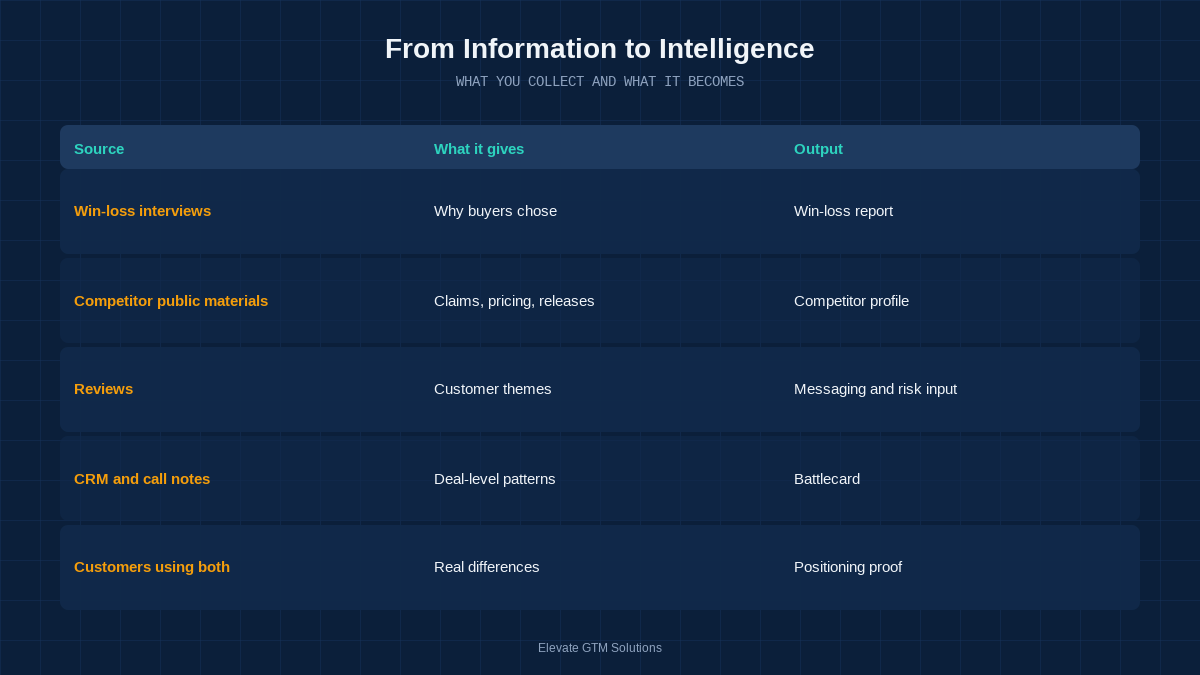
Most companies have competitive intelligence in the way most households have a drawer of takeaway menus: plenty of it exists, nobody can find the right one when needed, and half is out of date. A seller loses a deal and writes "went with the competitor" in the CRM. A product marketer keeps a spreadsheet of rival features that was accurate last spring. Someone posts a competitor's press release in a chat channel and gets three emoji reactions. Meanwhile, a prospect asks a pointed question about a rival's new pricing and the room goes quiet.
Competitive intelligence, often shortened to CI, is the practice of turning that scattered information into something the company can use to decide, sell and build. Done well, it helps sales answer objections, helps marketing position the product, helps product teams choose what to build and helps leaders see shifts in the market early. Done badly, it is a stale battlecard folder and a lot of anxiety.
This guide explains what competitive intelligence is, how it differs from related ideas, what to collect, where it comes from, how to do it ethically and legally, how to turn it into something people use, who should own it and how to know if it is working. We make a GTM strategy platform with a competitive intelligence module, and we have comparison pages that mention other vendors, so we have a stake. Examples are invented, no real company is described in them, and we cite no benchmark figures. This guide is not legal advice.
What is competitive intelligence?
Competitive intelligence is the ongoing, ethical collection and analysis of information about competitors, customers, markets and trends, turned into insight that helps a company make better decisions. The word "intelligence" matters: raw facts about a competitor are information. Intelligence is what those facts mean for you and what you should do about it. In go-to-market, it supports positioning, sales conversations, pricing, product priorities, partnerships and early warning of market shifts. It draws on public sources, your own win-loss and customer data and conversations with buyers, and it stays within legal and ethical limits. The test of good competitive intelligence is whether someone makes a different, better decision because of it.
Is competitive intelligence the same as spying? No. It relies on public and legitimately obtained information, and ethical practice rejects deception, theft and misuse of confidential material.
Is it only about competitors? No. Good CI also covers buyers, substitutes, partners and market trends.
The short version
| Question | Answer |
|---|---|
| What is it? | Turning information about the competitive landscape into insight for decisions |
| Who uses it? | Sales, marketing, product, leadership, partnerships |
| Where does it come from? | Public sources, win-loss interviews, customers, your own data, partners |
| What does it produce? | Competitor profiles, battlecards, win-loss reports, market alerts, recommendations |
| What makes it good? | It is accurate, current, specific, easy to find and tied to decisions |
| What can go wrong? | Staleness, bias, information overload, ethical and legal missteps |
Competitive intelligence and its neighbors
The terms overlap, and people use them loosely.
| Term | What it focuses on | Typical user |
|---|---|---|
| Competitive intelligence | Competitors and the competitive landscape | Sales, product marketing, strategy |
| Market intelligence | The wider market: size, trends, segments, regulation | Strategy, marketing, product |
| Market research | Primary studies of buyers' needs and attitudes | Marketing, product |
| Customer intelligence | What customers do, want and say | Success, product, marketing |
| Sales intelligence | Information about prospects and accounts | Sellers |
| GTM intelligence | The broader set of signals that inform go-to-market decisions | GTM teams. See GTM intelligence |
| Win-loss analysis | Why you won or lost specific deals | Sales, product marketing |
Competitive intelligence is one part of a larger picture. For a comparison of tools across the wider area, see best market intelligence platforms.
Why it matters
Sales conversations. Buyers compare you with others. Sellers who understand the alternatives can answer honestly and specifically instead of improvising.
Positioning. You cannot choose a position without knowing the others. See positioning.
Product decisions. Knowing where competitors are strong and weak helps you choose what to build and what to leave.
Pricing. Buyers anchor on alternatives. Understanding how rivals price helps you decide how to price. See how to price a new B2B product.
Early warning. A competitor's new segment, funding, acquisition or partnership can change your market. Seeing it early gives you time.
Focus. CI can also tell you which competitors matter and which do not. Many companies spend energy on rivals buyers rarely consider.
For the specific case of facing a much larger rival, see how to win against a dominant competitor.
Who counts as a competitor
A narrow view misses threats.
| Type | What it is | Example, invented |
|---|---|---|
| Direct | Sells a similar product to the same buyer | Another scheduling tool for clinics |
| Indirect | Solves the same problem differently | A practice-management suite with a built-in scheduler |
| Substitute | An entirely different way to get the result | A part-time assistant and a spreadsheet |
| Inertia | The decision to do nothing | "We'll stick with what we have" |
| Emerging | A new entrant or a company moving into your space | A larger platform adding a similar feature |
Many lost deals go to inertia, not to a rival. A CI program that tracks only named competitors can miss the biggest "competitor" of all. Ask buyers what else they considered, including doing nothing.
What to collect
Collect what supports decisions. A short list beats an exhaustive one.
Competitor profiles
For each major competitor, keep a one-page profile.
- Who they sell to: segments, company sizes, industries and regions.
- What they offer: products, packaging and main claims.
- How they price: model, public prices, typical terms.
- Where they are strong and weak: based on evidence, with sources.
- How they sell and market: channels, messages, events, partners.
- Their customers' words: what reviews and buyers say.
- Direction: recent releases, hires, funding, partnerships and acquisitions.
- How they respond: what they do when challenged.
Deal-level information
- Which competitors appear in your deals, and how often.
- Win rate against each.
- Reasons for wins and losses, from buyers.
- What objections come up and how they are handled.
Market signals
- Changes in buyer needs, regulation or technology.
- New entrants and category shifts.
- Shifts in how buyers research and buy. See our evidence page on review sites and purchase influence.
Your own position
CI is a comparison. Keep an honest view of your own strengths and weaknesses, based on customer evidence and not on internal belief.
Where it comes from
Public sources
| Source | What it gives | Caution |
|---|---|---|
| Competitor websites and pricing pages | Claims, packaging, positioning | Marketing, not truth. Capture dated copies |
| Product documentation and release notes | What the product actually does | Often more reliable than marketing pages |
| Job postings | Hints about priorities and growth | Hints only |
| Press releases and news | Announcements, partnerships, funding | Spin; check facts |
| Reviews on software directories | Customer experience themes | Skew to extremes; see below |
| Social media and community forums | Customer and employee voices | Anecdotal |
| Conference talks and webinars | How competitors describe their strategy | Promotional |
| Regulatory filings and public reports | Facts for companies that publish them | Limited for private firms |
| Analyst reports | A structured view of the market | Methods and incentives vary; read the method |
Your own data
- Win-loss interviews are the best source. Buyers can tell you what mattered and what almost changed their minds. See the win-loss analysis framework.
- CRM fields capturing competitor mentions and loss reasons, if kept consistently.
- Sales call recordings and notes where competitors come up, with consent rules observed.
- Support and success conversations with customers who also use rivals.
- Inbound questions and search terms.
People
- Customers who use both know the real differences.
- Partners hear what buyers say.
- Your own team, including sellers, who hear things first.
- Advisors and analysts, with the usual cautions.
What reviews can and cannot tell you
Reviews on directory sites are useful for patterns, such as repeated complaints about setup or praise for support. They also have limits: people who write reviews tend to have strong feelings, vendors sometimes solicit them, and some listings have few or no reviews. Treat a handful of reviews as stories and look at themes only when many agree.
Doing it ethically and legally
This is where competitive intelligence can go wrong. The line is not always obvious, so write down rules and train people.
Ethical practice generally means:
- using public sources and information legitimately obtained;
- being honest about who you are when you ask questions;
- not misrepresenting yourself to get information;
- not inducing people to break confidentiality or contracts;
- not using information you know was leaked or stolen;
- respecting trade secrets and intellectual property;
- following competition and antitrust rules about sharing information with competitors.
Things to avoid:
- pretending to be a customer to extract confidential information;
- hiring someone for the sake of their former employer's secrets;
- accessing systems or documents without permission;
- sharing prices or plans with competitors, directly or through intermediaries, in ways that could breach competition law;
- using scraped or purchased personal data without checking privacy rules.
Rules vary by country. This guide is not legal advice, and a lawyer should review your program, particularly for anything involving personal data, scraping, recordings and information shared in industry groups.
A useful test: would you be comfortable if the competitor, a journalist and your own customers read exactly how you got the information? If not, do not do it.
Also be careful with what you say publicly about competitors. Claims must be accurate and supportable. Misleading comparisons can create legal risk.
Turning information into something people use
Collecting is the easy part. Most programs fail at delivery.
Start from decisions
Ask the people who would use it what decisions they make. A seller facing a rival asks, "How do I answer this objection?" A product leader asks, "Should we build this?" A marketer asks, "What claim can we make that we can prove?" Build outputs for those questions.
The common outputs
| Output | What it is | Who uses it |
|---|---|---|
| Competitor profile | One page of what you know, dated and sourced | Everyone, as a reference |
| Battlecard | A short, practical guide for sellers on one competitor: positioning, strengths, weaknesses, questions to ask, objection answers and proof | Sellers |
| Win-loss report | Patterns from buyer interviews and CRM data | Sales, product marketing, product |
| Market alert | A short note on a significant change | Leadership, sales |
| Comparison page or sheet | A public, fair comparison for buyers | Buyers, sellers |
| Product input | Gaps and opportunities, with evidence | Product |
| Positioning brief | Recommended claims and the proof for each | Marketing |
What makes a battlecard useful
- Short. One page or less. If sellers do not use it in a live call, it is too long.
- Honest. Includes the competitor's real strengths and how to respond to them.
- Specific. Concrete questions to ask, concrete proof to cite.
- Dated. Shows when it was last checked and by whom.
- Easy to find. In the place sellers already work, such as the CRM.
- Fair. Does not rely on rumor or unprovable claims.
- Refreshed. Reviewed on a schedule, with an owner.
A battlecard that says "they are slow and expensive" without proof is worse than none. Sellers repeat it and lose credibility.
Share and discuss
Hold a short regular review, such as monthly, where sales, product marketing and product discuss what changed and what was learned. A conversation turns information into shared understanding. Feed insights into planning. See what is GTM enablement for how to keep materials current.
Close the loop
Ask sellers whether the material helped, and look at whether win rates improve in the segments where you focused. Retire what nobody uses.
Who owns it
Common patterns:
| Model | When it fits | Watch for |
|---|---|---|
| One person, part-time, in product marketing | Smaller companies | Stretched thin; loses priority |
| A dedicated CI analyst or team | Larger companies, many competitors | Can become disconnected from sellers |
| Shared across functions | Culture of contribution | Nobody owns freshness |
| Platform and a lead | Tool-supported programs | The tool does not keep itself current |
Whatever the model, name an owner for the program and for each competitor profile. See who owns GTM strategy. The owner is accountable for quality, freshness and delivery, not for collecting every fact.
Tools
The category is broad. Some tools monitor competitor websites and news. Some centralize battlecards and deliver them to sellers. Some analyze conversations and reviews. Some are part of larger market intelligence or strategy platforms. Examples in the broader area include Klue, which focuses on competitive enablement; see Elevate vs Klue for a comparison. Descriptions of vendors here reflect general positioning, and you should check current details on each vendor's site.
What to ask of any tool:
- How does it find and verify information, and how do you avoid false alerts?
- Can sellers find and use the output in their normal workflow?
- How are cards kept current, and by whom?
- How does it handle sources and privacy?
- What does it cost in total, including the people time to maintain it?
A tool does not replace judgment. Automated alerts can create noise, and a platform full of stale cards is a very expensive version of the old spreadsheet. Start with a small process that works, then add tools to scale it. See also the questions to ask AI GTM vendors.
Measuring whether it works
| Measure | What it tells you | Caution |
|---|---|---|
| Win rate in competitive deals, by competitor | Whether you are improving where it matters | Many things affect it; read with loss reasons |
| Seller use of cards and profiles | Whether the material is actually used | Use is not the same as value |
| Seller feedback | Whether the material helps in real calls | Ask specific questions |
| Freshness | Share of profiles reviewed within the agreed period | Freshness without usefulness is empty |
| Time to respond to a competitor move | How quickly the company reacts | Ties to the alert process |
| Decisions influenced | Examples where CI changed a decision | Keep a short log |
| Loss reasons recorded | Quality of the data | Needs consistent tagging |
The most honest measure is the decision log: a list of specific choices, such as a message change, a product priority or a price decision, that CI informed.
A worked example, invented for illustration
Imagine a company that sells scheduling software to clinics. Its sellers meet two direct rivals and one suite vendor. The product marketer starts by asking sellers and recent buyers three questions: who else did you consider, what mattered most and what almost changed your mind?
From fifteen interviews and CRM tags, the marketer learns that the suite vendor appears in about half of competitive deals, that the company wins when clinics are small and phone-based and that buyers who chose the suite mentioned wanting one vendor. The marketer writes a one-page profile for each competitor and a battlecard for the suite vendor with honest strengths, three questions sellers can ask to find out whether one vendor matters to the buyer and a short list of proof points from customers who kept their records system and added the scheduler.
The card is stored in the CRM, dated and reviewed quarterly. The company holds a thirty-minute monthly review. After two quarters, sellers report that they disqualify earlier in suite-focused deals and win more in small-clinic deals. The marketer logs two decisions the work informed: a change to the homepage message and a decision to build an integration with common records systems. The program is small. It changed decisions.
Common mistakes
Collecting without a decision in mind. A pile of facts is not intelligence.
Stale battlecards. Sellers lose trust in material that is wrong once.
Long documents nobody reads. Make it short and place it where people work.
Relying on seller memory. Interview buyers.
Tracking only named rivals. Include substitutes and inertia.
Trashing competitors. Unsupported claims hurt credibility and may create legal risk.
Crossing ethical or legal lines. Impersonation, confidentiality breaches and improper data use can do real damage.
Treating reviews as truth. Look for themes across many.
No owner. Nobody keeps it fresh.
Buying a tool before a process. A tool without a process is an expensive archive.
Never closing the loop. Without feedback, you cannot tell what helps.
Competitive intelligence for different roles
The same information serves different people differently. Tailor delivery.
Sellers need short, practical help in the middle of a deal: what is this competitor's pitch, what questions expose the difference, what is the honest answer to their strongest argument and which reference helps. Put it in the CRM or the sales tool, not in a long document.
Product marketers need patterns: how competitors position, which claims they repeat, which segments they chase and where messaging is converging. They turn it into positioning and proof.
Product teams need evidence about gaps and opportunities: what customers ask for, what competitors ship and what buyers say decided the deal. They need the evidence, not the opinions of sellers who lost.
Pricing and finance need to know how competitors package and price, how often they discount and how buyers react.
Executives need a short, regular view of what is changing in the market and what it means for strategy: new entrants, acquisitions, funding, regulation and shifts in how buyers decide.
Customer success benefits from knowing which competitors are courting their customers and what customers hear.
One program can serve them all, with outputs shaped for each audience. Ask each group what decision they will make with the material and how often they need it.
Signals worth watching, and what they may mean
Signals are hints, not conclusions. Write down what you will do when you see one.
| Signal | What it may suggest | A reasonable response |
|---|---|---|
| A competitor changes its pricing page | A pricing or packaging experiment | Check against deals; do not react before you see an effect |
| A burst of hiring in a function or region | A planned push | Monitor; check overlap with your target accounts |
| A new integration or partnership announced | A move toward an adjacent need or channel | Assess overlap and customer impact |
| Repeated review complaints on one theme | A real weakness, or a vocal group | Test with buyers before building a pitch around it |
| A funding round or acquisition | Greater resources or a change of direction | Brief sales; reconsider positioning if needed |
| New messaging on their website | A shift in target or claim | Compare with what buyers say; update your proof |
| Leadership changes | A strategy shift | Watch for follow-on changes |
Avoid overreacting. Many signals fade. Record them, review them monthly and act when several point the same way or when your own deal data confirms an effect.
Biases that distort competitive analysis
Competitive work is vulnerable to predictable errors.
Confirmation bias. Looking for evidence that supports what you already believe about a rival.
Recency bias. Over-weighting the last lost deal.
Seller attribution. Sellers tend to credit wins to skill and blame losses on price or on the competitor. Interview buyers.
Mirror imaging. Assuming the competitor thinks like you.
Underestimating rivals. Dismissing a smaller or newer company until it takes deals.
Overestimating rivals. Treating every announcement as a threat.
Survivorship. Studying only the competitors that are visible and ignoring the ones that quietly win in a segment you do not watch.
Good practice includes asking someone to challenge conclusions, writing down predictions and checking them later, and keeping a record of what you believed and what proved true.
Building a lightweight program in thirty days
You do not need a team or a tool to start.
Week one: decide the questions. Interview a few sellers, a product manager and a leader. What competitive questions come up most? What decisions would better information change? Write the top five.
Week two: gather the first facts. Pick the three competitors that appear most often. Collect their public pricing, positioning, recent releases and review themes. Interview three recent buyers who evaluated them.
Week three: produce the first outputs. Write a one-page profile for each competitor and one honest battlecard for the most common one. Put them in the CRM or the place sellers already use.
Week four: test and set the rhythm. Walk sellers through the card, ask what is missing, fix it and set a monthly review. Name an owner. Start the decision log.
At the end of the month, you will have a small, real program. Grow it from what people use. Resist adding sources, competitors and documents faster than you can keep them fresh.
Competitive intelligence and AI
AI tools can summarize competitor websites, cluster reviews and draft battlecards. They save time on the first draft. They also make mistakes, invent details and present guesses as facts. Treat any AI-generated competitive statement as unverified until you check it against a source. Keep a record of where each claim came from. Do not paste confidential or personal information into tools without checking your own data rules. Many errors in competitive material now come from fluent text that nobody checked. See how to tell if a GTM platform is really AI-native for tests on sourcing and accuracy.
Questions to ask buyers in a win-loss interview
A good interview feels like a conversation, not an audit. These questions work for wins and losses alike.
- What problem were you trying to solve, and what triggered the search?
- Who was involved in the decision, and what did each person care about?
- Which options did you consider, including doing nothing or building it yourselves?
- What mattered most in the final decision? What almost changed your mind?
- How did each option compare on the things you cared about?
- What did you worry about, and what reduced that worry?
- What could we or the other vendor have done differently?
- How did you first hear about us, and what did you read or ask along the way?
Do not argue or defend. Thank them, record their words and look for patterns across interviews. Ask for permission to record, follow privacy and consent rules and have someone other than the seller on the deal run the conversation where possible, since buyers speak more freely to a neutral person.
Glossary
Competitive intelligence (CI). The ongoing, ethical collection and analysis of information about competitors and markets, turned into insight for decisions.
Battlecard. A short sales guide for handling a specific competitor.
Win-loss analysis. A structured review of why deals were won or lost.
Market intelligence. Information about the wider market, including trends, size and segments.
Direct competitor. A company selling a similar product to the same buyer.
Substitute. A different way to get the same result.
Inertia. A buyer's decision to do nothing or keep the current approach.
Primary research. Information gathered directly, such as interviews and surveys.
Secondary research. Information gathered from existing sources.
Positioning. The choice of who you serve and why you are better for them.
Competitive enablement. Giving sales and others the competitive information and skills to use in their work.
Antitrust and competition law. Rules that limit certain kinds of cooperation and information exchange among competitors.
Where Elevate GTM Solutions fits
Elevate GTM Solutions is an AI GTM platform for creating, executing and adapting go-to-market strategy. Its homepage lists a "Competitive Intelligence" module among its modules, alongside "Market Research," "Product Positioning," "Product Messaging," "ICP & Segmentation" and "Sales Enablement." It describes competitive narratives among its outputs and lists "Win against a dominant competitor" as a use case, with a GTM Intelligence platform page. The homepage says "15 connected GTM modules" and names sixteen, so count what you see when you look.
How that could help: competitive intelligence matters most when it feeds positioning, messaging and enablement, and a platform built on one shared model is designed to carry competitive findings through to those outputs. That is the company's design intent, and the test is whether the competitive material it generates is accurate, sourced and specific to your deals.
A platform cannot interview your buyers, verify a claim about a competitor or keep a battlecard honest. You should check any generated competitive statement against sources and against what buyers say, and remove anything you cannot support. For related reading, see what is GTM intelligence, what Elevate GTM Solutions is and best market intelligence platforms.
What to do this week
- List the competitors that appeared in your last twenty deals, including substitutes and "do nothing."
- Interview three recent buyers: who else did you consider, what mattered, what almost changed your mind?
- Write a one-page profile for the competitor that appears most often, with dated sources.
- Draft one short, honest battlecard and put it where sellers work.
- Write down your ethical and legal rules for collecting information, and have counsel review them.
- Name an owner and schedule a monthly thirty-minute review.
- Start a decision log of choices that CI informed.
Key takeaways
- Competitive intelligence turns information about the landscape into insight that improves decisions. Facts alone are not intelligence.
- Define competitors broadly, including substitutes and inertia.
- Your own win-loss interviews and deal data are the best source.
- Stay ethical and legal: use public or legitimately obtained information, do not deceive and get legal review.
- Make outputs short, honest, dated and easy to find, and tie them to decisions.
- Name an owner and keep material fresh, because one wrong card costs credibility.
- Measure by decisions influenced and by results in competitive deals, not by volume of material.
Sources
- Elevate GTM Solutions: descriptions of modules, platform pages and use cases, as stated on the company's homepage.
- Klue: named as an example of a competitive enablement tool, with a description based on general positioning. Confirm current details with the vendor.
- Related Elevate guides linked in the text, including the win-loss analysis framework and the review sites evidence page.
- The definitions, the source tables and the program outline reflect common practice and our judgment. Practitioners and analysts use the terms differently.
- This guide is not legal advice. Rules on information gathering, competition law, privacy and recordings vary by country.
- The worked example is invented for illustration. We cite no benchmark figures.
Frequently Asked Questions
What is competitive intelligence?
Competitive intelligence is the ongoing, ethical collection and analysis of information about competitors, customers, markets and trends, turned into insight that supports decisions. In go-to-market it informs positioning, sales conversations, pricing and product priorities.
What is the difference between competitive intelligence and market research?
Market research usually studies buyers' needs and attitudes through surveys and interviews. Competitive intelligence focuses on competitors and the competitive landscape. They overlap, and good programs use both.
Is competitive intelligence legal?
It can be, when it relies on public and legitimately obtained information and follows competition, privacy and confidentiality rules. Practices such as impersonation, inducing breaches of confidentiality or using stolen information are unethical and may be illegal. Have counsel review your program.
Where does competitive intelligence come from?
Public sources such as websites, documentation, release notes, job postings, news and reviews, plus your own win-loss interviews, CRM data and call notes, customers who use both products and partners. Win-loss interviews with buyers are usually the best source.
What is a battlecard?
A short, practical guide that helps sellers handle a specific competitor: how to position against them, their real strengths, questions to ask, answers to common objections and proof points. Good ones are one page, honest, dated and placed where sellers work.
Who should own competitive intelligence?
One named owner, often in product marketing in smaller companies and a dedicated analyst or team in larger ones. The owner is accountable for quality, freshness and delivery to the people who use it, not for collecting every fact.
How often should competitive material be updated?
On a schedule that fits how fast your market moves, with each profile and battlecard showing a last-reviewed date and owner. Set alerts for major events such as pricing changes or acquisitions, and hold a short monthly review.
How do you measure competitive intelligence?
Look at win rate in competitive deals by competitor, whether sellers use and value the material, freshness of profiles, speed of response to competitor moves and a log of decisions the work influenced. The decision log is the most honest measure.
Who counts as a competitor?
Direct competitors, indirect competitors that solve the same problem differently, substitutes such as spreadsheets or services, new entrants and inertia, the decision to do nothing. Many lost deals go to inertia, so ask buyers what else they considered.
Can reviews be trusted for competitive research?
They are useful for patterns, such as repeated complaints or praise. They also skew toward strong opinions and can be solicited. Treat a few reviews as stories and look for themes across many.
Do we need a competitive intelligence tool?
Not at first. A small process with a clear owner, short battlecards in the CRM and a monthly review can work. Tools help scale it, but a tool without a process becomes an expensive archive.
Can an AI GTM platform do competitive intelligence?
It can help organize competitive information and draft narratives and positioning. It cannot verify claims or interview your buyers. Check any generated competitive statement against sources and buyer evidence before using it.
Contents