
By the Elevate GTM Solutions Team · Updated November 13, 2026 · 25 min read
What Is the Best Platform to Align Sales, Marketing and Customer Success on One Strategy? Five Kinds of Tool, and the Alignment Work They Cannot Do
Most companies that say they want "alignment" already have the software for it. They have a CRM, a marketing automation tool, a customer success platform, a chat app and a dashboard for each team. What they do not have is a shared answer to three questions: who are we trying to win, what do we say to them, and what does each team do about it?
That is why the search for "the best platform to align sales, marketing and customer success" often ends badly. A platform can hold a shared plan, show the same numbers to everyone and move work between teams. It cannot make three teams agree on the plan. If you buy the platform first, you get a very tidy place to keep a disagreement.
This guide separates the two jobs. It describes what alignment actually requires, sorts the tools into five kinds with what each can and cannot do, gives you a way to choose, and lays out the human work that has to come with it. We make a GTM strategy platform, and we say where it fits and where it does not. We name other vendors as examples with descriptions drawn from general positioning, and we ask you to confirm current details. We use no benchmark numbers, and examples are invented.
What is the best platform to align sales, marketing and customer success on one strategy?
Alignment needs three things: one shared strategy, shared definitions and numbers, and agreed handoffs. Software supports each, but no single product does all three, and none can create the agreement. For the shared strategy, a GTM strategy platform or a well-maintained planning document keeps segments, positioning, messaging and priorities in one place. For shared data and handoffs, your CRM is the system of record, and its health matters more than any add-on. For customer success, a customer success platform tracks health and renewals, and it should connect to the CRM. For shared performance views, a single reporting layer helps, as long as the definitions are agreed. The best platform for you is the one that closes your specific gap, and the first step is to name the gap.
Is there one tool that does all of it? Some products cover several parts, with different depth. None replaces agreeing on definitions and handoffs.
Where should we start? With a one-page shared strategy and a written handoff agreement. The tool comes second.
The short version
| What alignment needs | The question | What helps |
|---|---|---|
| One shared strategy | Do we agree on who, what and why? | A strategy platform or a single living document |
| Shared definitions | Do we mean the same by lead, qualified, customer, churn? | A written definitions page, enforced in the CRM |
| Shared data | Do we see the same facts? | A CRM with clean fields, connected systems |
| Agreed handoffs | Who owns the customer at each moment? | Written service levels, routing rules, tasks in the CRM |
| Shared performance view | Are we reading the same scoreboard? | One reporting layer with agreed measures |
| A regular rhythm | Do we meet and decide together? | A standing cross-team review |
Notice that only two or three of these rows are mainly about software. The rest are about decisions and habits.
Why alignment breaks
Before looking at tools, understand what usually goes wrong. The cause decides the cure.
Different goals. Marketing is measured on leads, sales on closed revenue, customer success on retention. Each can do well while the company does badly. Marketing generates leads sales does not want. Sales closes deals customer success cannot keep.
Different definitions. What counts as a qualified lead, a customer or a churned account may differ between teams. Each can be right by its own definition and wrong together.
Different pictures of the customer. Marketing targets one profile. Sales sells to whoever says yes. Customer success serves the survivors. Nobody checks whether those are the same people.
Different tools and data. Each team lives in its own system, with its own version of the facts.
Unclear handoffs. Leads move from marketing to sales, customers from sales to success, and expansion opportunities from success back to sales. At each handoff, information is lost and nobody owns the gap.
Different cadence. Marketing plans quarterly, sales monthly, success by renewal date. Nobody looks at the whole picture together.
No single owner. When nobody owns the strategy across the three teams, each team optimizes for itself. See who owns GTM strategy.
Software can help with the fourth and the sixth. It cannot fix the others. That is why the first part of any alignment effort has to be human.
The human work that has to come first
Do these before or alongside any tool purchase. Each takes less time than a procurement process.
1. One page of shared strategy
Write, together, a single page that all three teams sign off on.
- Who we serve best. The ideal customer profile, with the segments in priority order. See ICP.
- What we promise them. The positioning in a sentence or two. See positioning.
- What each team does. Marketing, sales and customer success each get a short list of what they will do to carry it out.
- How we will know it is working. Three to five shared measures. See how to measure whether your GTM strategy is working.
If this page takes weeks to agree, that is the real alignment problem showing up, and it is better to find it now.
2. A definitions page
Write down, in plain language, the terms that cause fights: lead, qualified lead, opportunity, customer, active customer, churn, expansion. Date the page, name an owner and put the same definitions in the CRM.
3. A handoff agreement
For each handoff, write down: what has to be true for it to happen, what information goes across, who accepts it, how fast and what happens if it is not accepted. The sales and marketing SLA framework is a good template. Add the other two handoffs: sales to customer success after a deal closes, and customer success to sales on expansion and renewal risk. See GTM strategy handoff.
4. A shared cadence
Hold one cross-team review on a regular schedule, monthly at a minimum. Same numbers, same room, same questions. The agenda is short: what the numbers say, what we heard from customers, what we are changing, what is blocked.
5. Shared incentives, where you can
You may not be able to redesign pay plans. Even so, look for one shared measure that all three teams influence, such as net revenue retention or the share of revenue from the target segment. A shared number changes conversations.
Once these exist, tools make them easier to keep. Without them, tools make the confusion more visible.
Five kinds of platform
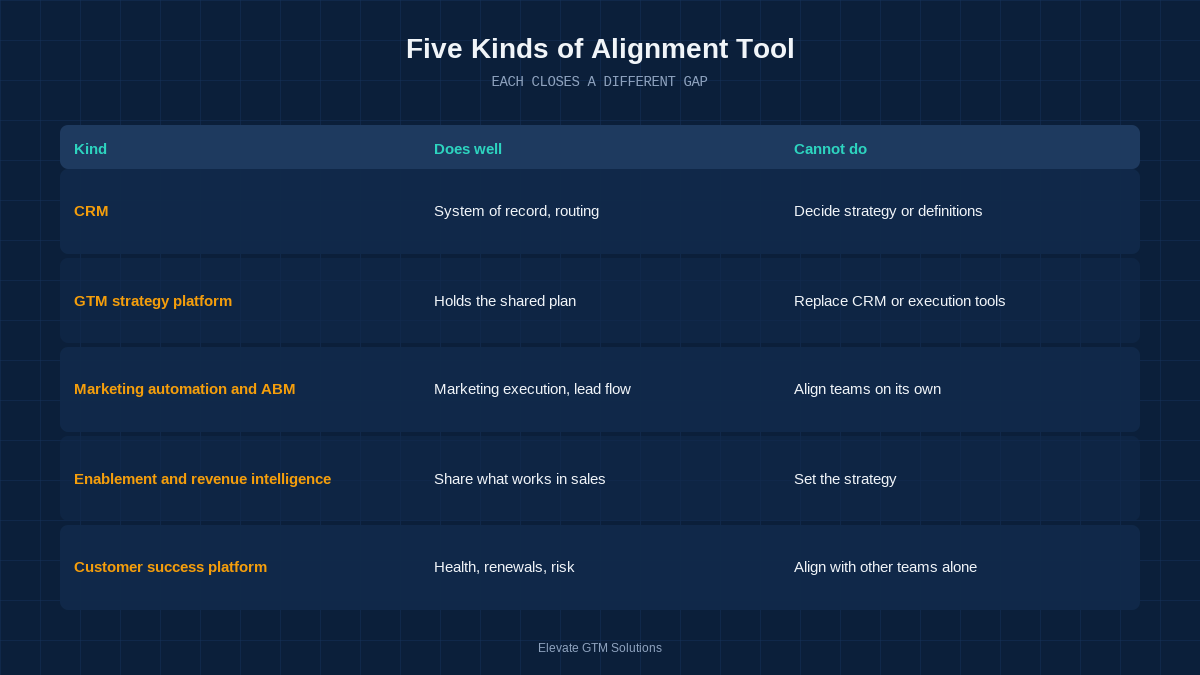
1. The CRM as the shared system of record
For most companies, the CRM is the center. If marketing, sales and customer success all work in one CRM, with agreed fields and stages, you have most of the data alignment you need.
Examples: Salesforce and HubSpot, among others. See GTM platform vs CRM, Elevate vs HubSpot and Elevate vs Salesforce.
What it does well. Holds accounts, contacts, deals and history. Supports routing, tasks and reports. Connects to most other tools.
What it does not do. Decide strategy. Keep itself clean. Create agreement on definitions. Handle customer health scoring in depth unless you add on.
Fits when. You have, or can name, someone who owns it. It is the base layer in nearly every case.
2. A GTM strategy platform
This kind keeps the shared strategy in one place: segments, positioning, messaging, pricing, channels and plans, and ties them together so a change in one shows up in the others.
Example: Elevate GTM Solutions is one. See what is a GTM operating system and unified GTM strategy.
What it does well. Gives the three teams one source for the plan instead of three decks. Makes it easier to update and compare options. Can generate a first draft quickly.
What it does not do. Replace a CRM, supply contact data or run campaigns. It does not decide for you, and a generated plan is a draft to test against your own customers and deals.
Fits when. Your gap is a shared plan: teams use different pictures of the customer and different messages, and the strategy lives in slide decks that go stale.
3. Marketing automation and account-based platforms
These run marketing programs, score leads and, in some cases, coordinate advertising and outreach to chosen accounts.
Examples: HubSpot's marketing tools, other marketing automation systems and account-based platforms such as Demandbase and 6sense. See Elevate vs Demandbase, Elevate vs 6sense and GTM platform vs marketing automation.
What they do well. Marketing execution and lead flow, plus visibility into what leads do before sales gets involved.
What they do not do. Align the teams on their own. They can make marketing's view richer without changing what sales and success see.
Fits when. Marketing execution is the bottleneck and your alignment problem is mainly lead flow and handoff.
4. Sales enablement and revenue intelligence
Sales enablement tools organize content and training. Revenue intelligence tools analyze deals and conversations. Both can help share what is learned in the field.
Examples: Highspot and Seismic in enablement, which announced a merger that completed in August 2026; Gong and Clari in revenue intelligence, with Clari and Salesloft having combined in December 2025, per public announcements. Verify current status with each vendor. See GTM platform vs sales enablement platform, GTM platform vs revenue intelligence and Gong vs Highspot vs Seismic.
What they do well. Share what works in sales, surface risks in deals and make calls and content easy to find.
What they do not do. Set the strategy that enablement and coaching should carry. They also tend to focus on sales more than on marketing and customer success.
Fits when. Sales execution and learning are the bottleneck, and you have enough volume for the analysis to help.
5. Customer success platforms
These track customer health, usage, renewals and risk, and organize the work of customer success teams.
What they do well. Give customer success a view of accounts at risk and a way to act, and in the best cases feed signals back to sales and product.
What they do not do. Align success with the other teams by themselves. A health score that sales and marketing never see is a silo with a nice interface.
Fits when. Retention and expansion are major levers and the customer base is big enough that manual tracking breaks down. Whatever you choose should write to the CRM and read from it.
What to look for in any tool that claims to align teams
| Feature | Why it matters | How to test it |
|---|---|---|
| A shared source of truth for the plan | Teams stop working from different decks | Ask how a change to the target segment shows up elsewhere |
| Read and write with your CRM | Avoids a second version of the facts | Test a small set of records; see GTM platforms that integrate with Salesforce |
| Role-based views | Each team sees what it needs without noise | Log in as a marketer, a seller and a CSM |
| Visible definitions | Everyone sees what a term means | Check if definitions can be stored and shown next to the numbers |
| Handoff support | Tasks and notifications cross team lines | Walk a lead and a renewal through it |
| Audit trail | You can see who changed what | Ask for a demonstration |
| Easy to update | A plan nobody can update goes stale | Time a change from idea to published |
| Clear permissions and controls | Prevents accidental breakage | See the governance checklist |
| Honest pricing and exit | Avoids lock-in | See AI GTM platform pricing guide |
How to choose: a seven-step method
Step 1: name the alignment gap. Which of the six needs in the first table is weakest for you? Write it as a sentence: "Marketing and sales disagree on which leads are qualified" is a very different gap from "customer success finds out about churn risks after the renewal call."
Step 2: check what you already have. Most companies can improve alignment with what they own. A cleaner CRM and a handoff agreement cost little.
Step 3: decide the kind of tool the gap calls for. Use the five kinds above. A definitions problem calls for a document, not a platform.
Step 4: involve all three teams in the choice. If marketing picks the tool alone, sales and success will resist it. Put a representative from each on the evaluation.
Step 5: run a trial on a real scenario. For instance, change your top priority segment and see how long it takes for the new message and plan to reach all three teams. Or trace one lead from first touch to closed deal to renewal.
Step 6: check integration and ownership. Who will own the tool? Does it connect cleanly to your CRM? What does maintenance look like?
Step 7: pilot small. Start with one segment or one region. Review at ninety days. See our pilot to scale framework.
A worked example, invented for illustration
Imagine a software company with a marketing team of four, a sales team of twelve and a customer success team of five. Marketing reports on leads, sales on closed revenue, and success on renewals. In a quarterly meeting, each team shows a good slide. Revenue growth is flat.
A review turns up three issues. First, marketing's best-performing leads come from small companies, while sales wins its largest deals from mid-size ones, and customer success sees the highest renewal rates in a third group, medium-size companies in one industry. Nobody had compared the three. Second, "qualified" means a form fill to marketing and a held meeting to sales, so marketing is celebrating leads sales calls junk. Third, expansion opportunities that customer success spots never reach sales, because nobody owns the handoff.
What helps here? A shared ideal customer profile based on the third group, since it is the one that stays and grows. A definitions page and a handoff agreement. A shared measure: revenue retained and expanded from the target segment. A monthly cross-team review. A CRM field for expansion opportunities that routes to a seller. A strategy platform or a shared planning document so the three teams work from one plan. Notice that the tool is the smallest part of the fix.
How a shared strategy changes daily work
Alignment becomes real when it changes what people do on a Tuesday.
Marketing targets the segments in the shared plan, uses the shared messaging and reports on the shared measures. Campaign ideas are checked against the ICP.
Sales prioritizes accounts using the shared list, uses the shared messaging and records the reasons for wins and losses in a consistent way. Feedback goes back to marketing and product.
Customer success onboards against what was promised in the sale, flags risk using agreed signals and sends expansion leads to sales through the agreed path. What they learn about why customers stay feeds the ICP.
Everyone can see the same plan, the same definitions and the same scorecard.
When something changes, such as a new competitor or a pricing change, the update goes to the shared plan first, and each team adjusts. See continuous GTM optimization for how to keep that loop going.
Common failure modes
Buying a platform to force agreement. The tool shows the disagreement more clearly. It does not resolve it.
Treating the CRM as someone else's job. If nobody owns it, alignment decays within months.
Letting each team build its own dashboard. Three versions of the truth.
Aligning on lead volume and nothing else. Marketing and sales agree on a number that neither customers nor revenue care about.
Leaving customer success out. Many alignment efforts cover marketing and sales and forget what happens after the sale, where the ideal customer is proven.
Skipping the owner. Without someone accountable across the three teams, each reverts to its own goals.
Overbuilding. Elaborate workflows nobody understands.
Never revisiting. The plan and the definitions need a regular review.
Measuring whether alignment improved
Alignment is hard to see, so choose a few observable signs.
| Sign | What to look at |
|---|---|
| Fewer disputes over lead quality | Share of leads sales accepts; reasons for rejection |
| Faster handoffs | Time from marketing handoff to first sales action; time from close to onboarding start |
| Consistent messaging | Spot-check calls, emails and web pages for the agreed message |
| Better fit of customers | Share of new customers in the target segment; their retention |
| Fewer surprises at renewal | Number of at-risk accounts spotted early versus late |
| Expansion routed properly | Share of expansion opportunities that reach a seller within an agreed time |
| Shared understanding | A short quarterly survey: can people in each team describe the ICP and the promise in similar words? |
Choose a few and record a baseline now. Review them quarterly.
What each team needs from the others
Alignment is easier when each team says plainly what it needs. A one-page exchange like this often surfaces the real issues faster than a tool evaluation.
| From | To | What it needs |
|---|---|---|
| Marketing | Sales | Honest feedback on lead quality, with reasons; the words buyers use; which messages work on calls |
| Marketing | Customer success | Customer stories and proof that customers are willing to share; knowledge of who succeeds |
| Sales | Marketing | Which segments close, which objections come up and which content helps |
| Sales | Customer success | What was promised, who the real decision makers and users are, and any risks noted in the deal |
| Customer success | Sales | Expansion opportunities, renewal risk, and what customers say about why they bought |
| Customer success | Marketing | Reasons customers stay and leave, plus references and case studies |
| Product | All three | What is coming, what is not, and what customers are asking for |
Hold a short session in which each team reads the column about what it will receive and says whether that is realistic. Where it is not, agree on what will change. This kind of conversation costs an afternoon and often removes friction that months of tooling did not.
Handoff details that cause the most loss
The common failure is not a missing handoff. It is a handoff with missing information.
Marketing to sales. The seller receives a name and a form entry. What they needed was what the person did, what they read and what they asked about. Agree on a short standard set of fields that travel with every lead.
Sales to customer success. The customer success manager receives a signed contract and starts a conversation that begins with, "So, why did you buy?" The buyer has already told sales. Agree on a short handover note: goals, success criteria, stakeholders, promises made, risks and the timeline the customer expects. A tool can store it, but someone must write it.
Customer success to sales. An expansion opportunity or a risk is spotted and mentioned in a chat message. It is forgotten within a week. Agree on a field or a task in the CRM, with a named owner and a response time.
Customer success to marketing. A happy customer is never asked to be a reference. Agree on a simple process: who asks, how often, what the customer is offered and who keeps the list.
Write each of these as a short form with required fields. A form is a tool you already have.
Running the cross-team review
The monthly review is where alignment happens or fails. A good one is short, specific and honest.
Before the meeting: One person circulates the scorecard and the list of open decisions two days ahead. Nobody presents slides.
In the meeting: Look at the numbers together. Each team spends two minutes on what moved and why. Then spend most of the time on one or two issues that cross team lines, such as a segment that converts but does not renew, or a message that wins in one region and fails in another.
Decisions: End with decisions, owners and dates, written where all three teams will see them.
Follow-up: Start the next meeting by checking last month's decisions.
If the review turns into a series of status reports, shorten it and add a rule: no updates without a question to answer or a decision to make.
When the answer is organizational, not technical
Some alignment problems are about who reports to whom and what each leader is rewarded for. If sales leadership is paid on bookings, and customer success on retention, and neither shares a target, they will pull in different directions even with perfect tools. In that case the most useful move is an organizational one: a shared revenue leader, a shared target or an explicit agreement about tradeoffs.
You may not be able to change the structure. Even so, naming the issue helps. A tool evaluation that tries to solve a reporting-line problem will disappoint everyone. See how to structure a GTM team for options.
Glossary
Alignment. Agreement and coordination among sales, marketing and customer success on goals, definitions and handoffs.
GTM strategy. The plan for reaching target customers, winning them and keeping them.
System of record. The system treated as the authoritative source for a type of data, usually the CRM for accounts and deals.
Service level agreement (SLA). A written commitment between teams about what is handed over, how fast and to what standard.
Handoff. The point where responsibility for a lead, account or customer passes from one team to another.
Net revenue retention. Revenue from existing customers after churn, downgrades and expansion, compared with a starting period.
Customer success platform. Software for tracking customer health, usage and renewals.
Revenue intelligence. Tools that analyze sales activity and conversations to improve forecasting and coaching.
Sales enablement. Giving sellers the knowledge, content and process they need to sell well.
Ideal customer profile (ICP). A description of the companies and people most likely to buy and succeed with your product.
Single source of truth. One agreed place for a fact, so teams do not argue about which version is right.
Silo. A team or system working apart from others, with its own data and goals.
Where Elevate GTM Solutions fits
Elevate GTM Solutions is an AI GTM platform for creating, executing and adapting go-to-market strategy. Its homepage describes a unified platform with integrated strategy, execution, messaging and continuous visibility, and describes a shared model across Marketing, Sales, Product and RevOps. Its modules include "Marketing Alignment," "Sales Enablement," "Customer Success," "Customer Advocacy" and "Unified GTM Strategy," and its use cases include "Align cross-functional teams." The homepage says "15 connected GTM modules" and names sixteen, so count what you see when you look.
That places Elevate in the second kind above: it is designed to be the shared place for the strategy and the plan. The design idea is that positioning, messaging, pricing and channel decisions come from the same inputs, so a change shows up across the modules instead of in one deck. That is the company's description, and the test is whether your three teams actually read and use it. It is not a CRM, a marketing automation system, a revenue intelligence tool or a customer success platform, and it would sit alongside those. The company's materials do not, to our reading, claim to replace them.
Elevate cannot create the agreement itself. It can make a shared plan easier to keep, but your teams still need to decide it together, write the definitions and own the handoffs. For integrations, check the company's current integrations page against your CRM and tools, because third-party listings we reviewed show a short list. See what Elevate GTM Solutions is, AI-native GTM operating system and AI tools for GTM execution and alignment.
What to do this week
- Name your alignment gap in one sentence, using the six needs in the first table.
- Write the one-page shared strategy draft: who, promise, what each team does, how we will know.
- Write the definitions page: lead, qualified, opportunity, customer, churn, expansion.
- Draft the three handoffs: marketing to sales, sales to customer success, success back to sales.
- Pick one shared measure all three teams influence.
- Book a monthly cross-team review with the same numbers for everyone.
- Only then look at tools, and involve one person from each team.
Key takeaways
- Alignment needs a shared strategy, shared definitions and data, agreed handoffs, a shared scoreboard and a regular rhythm. Software helps with some, never with the agreement itself.
- Name the specific gap first. Different gaps need different fixes.
- The CRM is the system of record in most cases, and its health matters more than any add-on.
- A strategy platform can hold the shared plan. It does not replace a CRM, execution tools or the work of agreeing.
- Include customer success from the start. It is where your ideal customer shows up in the data.
- Involve all three teams in tool choice, trial a real scenario and pilot small.
- Measure alignment with observable signs and review quarterly.
Sources
- Elevate GTM Solutions: descriptions of modules, use cases and positioning, as stated on the company's homepage.
- HubSpot, Salesforce, Demandbase, 6sense, Gong, Highspot, Seismic and Clari: named as examples of categories, with descriptions based on general positioning. The Highspot and Seismic merger and the Clari and Salesloft combination are drawn from public announcements and should be verified against current sources.
- Related Elevate guides linked in the text, including the sales and marketing SLA framework and GTM strategy handoff.
- The six needs, the five kinds and the seven-step method reflect common practice and our judgment. The worked example is invented for illustration. We cite no benchmark figures.
Frequently Asked Questions
What is the best platform to align sales, marketing and customer success?
There is no single best one, because alignment needs a shared strategy, shared definitions and data, agreed handoffs and a regular rhythm, and no product does all of that. Your CRM is the system of record, a strategy platform or shared plan holds the strategy, and customer success and reporting tools connect to the CRM.
Can software fix misalignment between sales and marketing?
Software can make agreements easier to keep, but it cannot create them. Misalignment usually comes from different goals, definitions and pictures of the customer. Settle those first, then use a tool to keep the plan, data and handoffs visible.
Why include customer success in alignment?
Customer success sees which customers stay and grow, which is the best evidence of who your ideal customer is. If success is left out, marketing and sales target a profile that may not match the customers who renew.
What should we do first to align the three teams?
Write a one-page shared strategy covering who you serve, what you promise, what each team does and how you will measure success. Add a definitions page and a handoff agreement. Then choose tools to support them.
Is a CRM enough to align teams?
For many companies the CRM provides most of the shared data, provided fields and stages are agreed and someone owns it. It does not decide strategy or settle definitions. Add other tools only where a specific gap remains.
What is a GTM strategy platform, and how does it help alignment?
It is a product that keeps segments, positioning, messaging, pricing and plans in one place so a change shows up across them. It helps when teams work from different decks and pictures of the customer. It does not replace a CRM or execution tools.
How do we handle handoffs between marketing, sales and customer success?
Write each handoff down: what must be true for it to happen, what information goes across, who accepts it, how fast and what happens if it is not accepted. Cover marketing to sales, sales to customer success and success back to sales for expansion and renewal risk.
What shared metrics should all three teams use?
Pick one or two that all three influence, such as net revenue retention, revenue from the target segment or time from first touch to full onboarding. A shared number changes conversations, and each team can still keep its own working measures.
How do we measure whether alignment is improving?
Track observable signs: how many leads sales accepts, how fast handoffs happen, how consistent messages are, how many new customers fit the target segment and how many renewal risks are spotted early. Record a baseline and review quarterly.
Who should own cross-team alignment?
One named leader should own the shared strategy across the three teams, often a chief revenue officer, a GTM lead or a head of revenue operations. Without a single owner, each team tends to optimize for itself.
How long does it take to align the teams?
Writing the shared page, definitions and handoffs can take weeks, mostly because of the discussion. Habits take longer, usually a few quarters of regular reviews. Start with one segment or region and expand after a ninety-day review.
Does Elevate GTM Solutions align sales, marketing and customer success?
It is designed to be the shared place for strategy, with modules covering marketing alignment, sales enablement and customer success, according to its homepage. It does not replace a CRM, marketing automation or a customer success platform, and it cannot create agreement between teams on its own.