
By the Elevate GTM Solutions Team · Updated November 13, 2026 · 26 min read
What Is Land and Expand? How to Plan a Go-to-Market Strategy Around a Small First Deal and a Bigger Account Later
"Land and expand" is one of the most repeated phrases in B2B software, and one of the least examined. The idea is simple: win a small first deal, prove value, then grow the account over time. The execution is not simple, because a land that is too small never expands, a land with the wrong person never reaches the budget holder and an expansion plan built after the contract is signed usually starts too late.
Most of what is published about it comes from customer success and sales vendors, and it tends to describe expansion as something that happens after the sale. This guide treats it as a go-to-market choice that shapes who you target, what you sell first, how you price, how you organize and what you measure from the beginning. It covers what land and expand is, when it works and when it does not, how to design the land, the expand paths, the metrics, the organization, the failure modes and a plan you can run. We make a GTM strategy platform, so we have an interest. We cite no benchmark figures for retention or expansion, because published ones vary widely in definition, and the worked example uses invented numbers.
What is land and expand?
Land and expand is a go-to-market strategy in which a company wins a customer with a deliberately limited first purchase, such as one team, one use case, one product or a small number of seats, then grows revenue from that customer over time by adding users, usage, products, teams or regions. The first deal, the land, is designed to be easy to say yes to and to prove value quickly. The expansion is planned from the start, not left to chance. It works best when the product can be adopted in parts, when the value grows with use and when the first user can credibly help sell to others. It works poorly when the initial deal is too small to matter, when the product only makes sense company-wide or when nobody owns the growth of the account.
Is it only for software? No, though it is most common there. Services, equipment, data and platforms can all follow the pattern if the first purchase can be small and the relationship can grow.
What is the main risk? Landing customers who never expand. A large number of small, stuck accounts can cost more to serve than they produce.
The short version
| Question | Answer |
|---|---|
| What is it? | A strategy of winning a small first deal and growing the account deliberately |
| Why do companies use it? | It lowers buyer risk, shortens the first sale and makes growth depend on proven value |
| What makes it work? | A product that can be adopted in parts, value that grows with use and a path to more buyers |
| What makes it fail? | Land too small to matter, wrong first user, no expansion owner, product with no natural next step |
| How is it measured? | Net revenue retention, gross retention, time to expand, land size and expansion rate by cohort |
| Who owns expansion? | It varies. The key is that somebody does, with incentives that match |
| How does it relate to product-led growth? | They overlap. Product-led growth often lands through self-serve and expands through sales, but land and expand also works with a sales-led land |
| When is it a poor fit? | When the product's value only appears at full scale or when the first deal cannot cover the cost to win it |
Why companies choose it
Land and expand solves a real problem: large purchases are risky for buyers. Getting a budget approved, a security review passed and a contract signed for a big deployment can take a long time, and many deals die in the process. A smaller first step reduces what the buyer has to believe. They are not betting the department on an unproven vendor. They are trying something.
For the seller, the logic is similar but runs the other way. A shorter first sale produces revenue sooner and gets the product into a real environment, where its value can be shown with the customer's own data. A customer who has used the product for six months is a far better prospect for a bigger purchase than a stranger reading a deck.
There is also an economic motive. If the cost of acquiring a customer is fixed, spreading it over a larger lifetime value improves the return. A company that expects accounts to grow can tolerate a higher cost to land. That calculation is only valid if accounts actually do grow, which is why the strategy deserves scrutiny. See CAC payback benchmarks for cautions on payback arithmetic.
What is the difference between land and expand and other models
| Model | First purchase | Growth path | Typical tension |
|---|---|---|---|
| Land and expand | Small, scoped | Added seats, usage, modules, teams, regions | First deal may be too small to fund its own acquisition |
| Enterprise big deal | Large, company-wide | Renewal, modest upsell | Long cycle, high risk, heavy procurement |
| Product-led growth | Self-serve signup, often free | Upgrade, team adoption, sales assist for large accounts | Conversion from free to paid. See what is product-led growth |
| Sales-led growth | Sales process from the start | Account management and upsell. See what is sales-led growth | Depends on sales capacity |
| Transactional | One-time purchase | New purchases | Little relationship value |
These are not exclusive. Many companies land through a product-led motion and expand through sales, or land through sales and expand through usage. The question is not which label you wear but what happens after the first purchase, and whether you planned for it. See also product-led vs sales-led GTM.
When land and expand works
Check these conditions before committing the company to it.
The product can be adopted in parts. A team can start with one workflow, one department or one location. If the product only delivers value when everyone uses it, the land is artificial.
Value is visible early. The first user needs to see a result within weeks, not quarters, because proof is what makes the next sale possible.
Value grows with use. More users, more data, more modules or more locations should make the product more valuable, not just more expensive.
There is a natural next step. Another team with the same problem, an adjacent problem the product also solves or a larger deployment of the same use case.
The first user can influence others. A champion who is respected, willing to advocate and connected to the people who will decide the next purchase.
The first deal can cover its cost. Or the company has deliberately chosen to fund the land from future expansion, and has the cash and the evidence to justify it.
You can see usage. You need data to tell which accounts are growing, stalling or at risk.
When it does not work
The product is an all-or-nothing purchase. A platform that replaces a company-wide system cannot be dipped into.
The first deal is too small to matter. If the land is so small that the buyer does not care whether it succeeds, there is no real adoption and no champion.
The champion has no power. A user who loves the product but cannot influence budgets or colleagues will not carry the expansion.
Switching is easy. If competitors can replace you with a few clicks, early adoption does not create a durable position.
The market is small. If there are only a few places to expand within, the ceiling arrives quickly.
The company cannot afford to wait. Land and expand shifts revenue later. A company with limited cash needs to check that it can fund the gap.
Designing the land
The land is the most important design choice, because everything else follows from it. A good land is small enough to buy easily and meaningful enough to matter.
Choose the entry point
There are several common entry points. Pick based on where the product proves value fastest and where the buyer can say yes without a long process.
| Entry point | Example | Strength | Risk |
|---|---|---|---|
| One team | A single sales team adopts a tool | Fast to start, easy to measure | May be isolated from decision makers |
| One use case | One workflow is automated | Clear before and after | The use case may not be strategic |
| One product or module | The customer buys the first module only | Simple to explain | Later modules must be genuinely needed |
| One location or region | A single office or country | Contained rollout | Local differences may not generalize |
| A pilot | Time-limited paid trial | Low commitment | Pilots can drift without a conversion plan |
| A small seat count | A few licenses | Low price | Low engagement |
Choose the first user carefully
The first user determines whether anything follows. Look for someone who:
- Feels the problem acutely and owns a result tied to it.
- Has credibility with others who share the problem.
- Has access to, or influence over, the people who control larger budgets.
- Is willing to be a reference, when the results warrant it.
A common mistake is selling to whoever says yes first. A junior user with no influence is easy to land and rarely leads anywhere. Often it is better to land a slightly harder, more influential first user.
Set the success criteria before signing
Agree with the customer, in writing, what success looks like in the first ninety days. For example, a metric that should move, a number of active users or a workflow that should be completed. Without that, the expansion conversation has nothing to stand on. It also surfaces a bad fit early, which is cheaper than finding out at renewal.
Price the land with the expansion in mind
The price should be low enough to approve without a long process and structured so that growth is natural. See how to price a new B2B product. A few principles:
- Choose a pricing metric that grows with value, such as users, usage, locations or modules, so expansion revenue tracks real adoption.
- Avoid steep discounts on the land that become the expected price at expansion.
- Make the next tier visible, so buyers can see what growth looks like.
- Consider contract terms that allow adding scope at predictable rates.
- Be careful with free or heavily discounted lands. They attract users who value price more than outcomes.
Planning the expansion
Expansion needs a plan from the day the land is signed. These are the main paths, and a given product may support several.
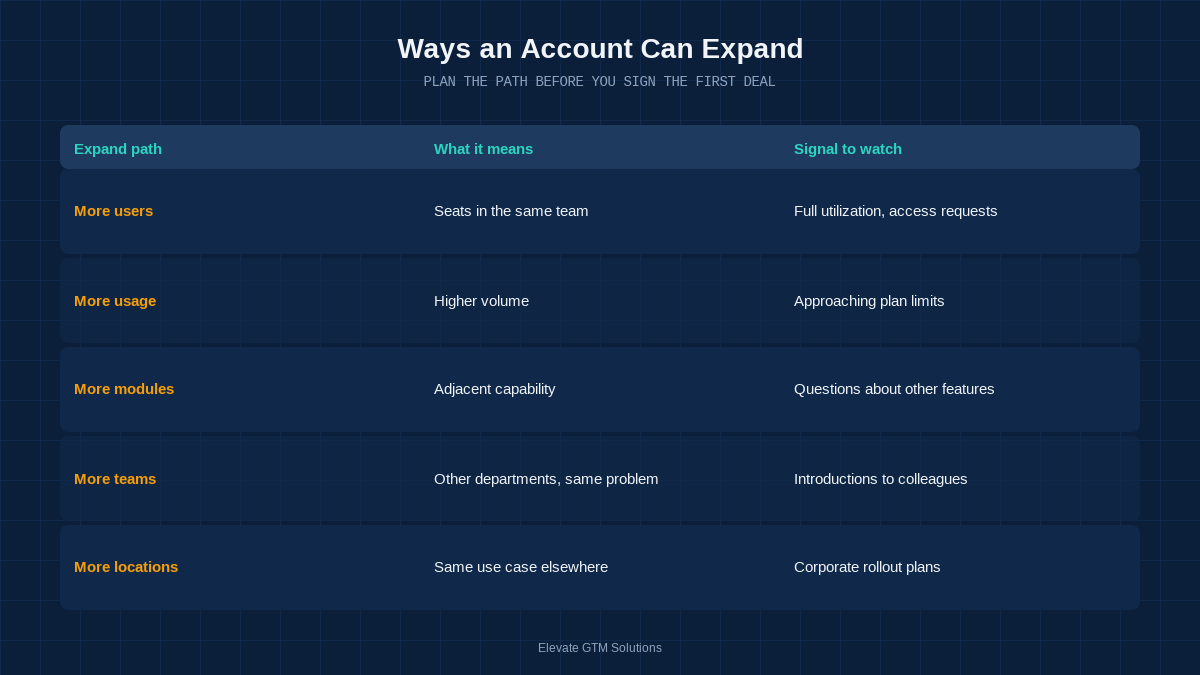
| Expand path | What it means | Signal to watch |
|---|---|---|
| More users | Additional seats in the same team | Full seat utilization, requests for access |
| More usage | Higher volume of the same activity | Approaching plan limits |
| More modules or products | Adjacent capability for the same buyer | Questions about features outside the current scope |
| More teams | Other departments with the same problem | Mentions from users, introductions to colleagues |
| More locations or regions | Same use case in new places | Corporate rollout plans |
| Higher tier | More advanced features or service | Use of limits and admin features |
| Renewal at higher value | A larger commitment at the next term | Strong results and executive involvement |
Map the account
For each important account, write a simple expansion map:
- Who bought, and who uses the product?
- Which other teams share the problem?
- Who controls the budget for those teams?
- What results can we show that are meaningful to them?
- What is the next step and who owns it?
- What are the risks, such as a champion leaving or a competitor in the account?
See account tiering framework for prioritizing which accounts deserve this effort.
Read the signals
Expansion rarely arrives as a surprise if you watch for the signs.
Usage signals. Frequent logins, growing numbers of active users, approaching limits, use of advanced features.
Relationship signals. New stakeholders joining calls, an executive asking about results, colleagues requesting demos.
Business signals. Hiring in the relevant area, new funding, reorganizations, new product launches.
Support signals. Questions about capabilities outside the current plan, or requests for integrations.
Risk signals. Declining usage, champion departure, slow responses, support escalations. These point to the opposite outcome. See what is signal-based selling.
Who owns expansion
The most common failure in land and expand is that nobody clearly owns growth after the first signature. Several models exist.
| Model | How it works | Strength | Watch for |
|---|---|---|---|
| Account executive keeps the account | The seller who landed expands it | Relationship continuity | Seller's attention moves to new deals |
| Customer success owns expansion | CSMs handle growth in existing accounts | Close to usage and value | Success staff may lack sales skills or incentives |
| Dedicated expansion sellers | Specialists work installed accounts | Focus and skill | Handoff friction, customer confusion |
| Hybrid | Success identifies, sales closes | Uses each strength | Needs clear rules about who leads and who is paid |
Whatever you choose, align incentives. If customer success is judged on retention but not rewarded for growth, expansion will be a side activity. If sellers are paid only for new customers, accounts will be neglected. See how to structure a GTM team and best platform to align sales, marketing and customer success.
The handoff from the sales team that landed the deal to the team that will grow it also matters. The new owner needs to know what was promised, who the stakeholders are, what success was defined as and what the buyer cares about. A weak handoff wastes the goodwill the sale created. See GTM strategy handoff.
The metrics that matter
Use a small set of measures, defined clearly, and compare cohorts.
Net revenue retention. Revenue from a group of customers now, divided by their revenue a year ago, including expansion, contraction and churn. Above 100 percent means existing customers are growing in total.
Gross revenue retention. The same, excluding expansion. It shows how much revenue you keep before growth. It cannot exceed 100 percent.
Expansion rate. The share of accounts, or of revenue, that grew in a period.
Land size. The average value of the first deal. Track it by segment and source.
Time to first expansion. How long from land to the first increase. A shortening interval suggests the motion is improving.
Expansion by path. Which expand paths produce revenue: seats, usage, modules, teams.
Cost to expand. The sales and success cost of generating each unit of expansion revenue. Often lower than new-customer cost, but check.
Cohort behavior. Compare customers by land source, size and segment. A cohort that lands cheaply but never expands is a cost.
Two cautions. First, net revenue retention can hide problems: a few large accounts expanding can mask many small ones that churn. Look at the distribution, not just the average. Second, definitions vary between companies, so be careful when comparing your figures with someone else's.
A worked example, invented for illustration
A company has 100 customers who together paid $1,000,000 in annual recurring revenue a year ago. Over the year, some customers left, some reduced their plans and some grew.
| Movement | Invented amount |
|---|---|
| Starting revenue from the group | $1,000,000 |
| Lost to churn | minus $80,000 |
| Lost to downgrades | minus $40,000 |
| Gained from expansion | plus $260,000 |
| Ending revenue from the same group | $1,140,000 |
Net revenue retention is $1,140,000 divided by $1,000,000, or 114 percent. Gross revenue retention is the starting revenue minus churn and downgrades, $880,000, divided by $1,000,000, or 88 percent.
The two numbers tell different stories. The company grows from its installed base, which is good. It also loses twelve percent of revenue before expansion, which is a warning that the land may be attracting some customers who are a poor fit. A company that celebrated only the 114 percent might miss the leak. These figures are invented and are not benchmarks.
How land and expand shapes the rest of your GTM
Choosing this strategy changes more than the sales process.
Ideal customer profile. Choose customers with room to grow: several teams that share the problem, a growing business, a culture of adopting tools by team. A perfect-fit small customer with no room to expand is a different value from a perfect-fit large one. See what is an ICP.
Positioning. Lead with the use case that proves value fastest, then show the larger vision. A pitch that starts with the whole platform scares buyers who want a small step.
Product. Make it easy to start, to see value and to add users or capabilities. Admin features, sharing and integrations often determine expansion.
Marketing. Content for the champion who lands, and different content for the executive who expands.
Sales process. Qualify for expansion potential, not just the first deal. Ask, early, who else has this problem.
Customer success. Onboarding focused on the agreed success criteria, and regular reviews that show results to the people who control budgets.
Pricing. As above, structured so growth is natural.
Measurement. Cohort tracking, expansion signals and shared dashboards. See GTM metrics and KPIs.
How it fits with other motions
With product-led growth. Many product-led companies land through self-serve signups and expand by selling to teams or companies once usage grows. The challenge is spotting which free or small accounts have the potential to become larger ones.
With account-based marketing. For large target accounts, a company may land one team while running an account-based program to build awareness across the rest of the organization. See account tiering framework.
With moving upmarket. Land and expand can be a way to enter larger customers without betting on a big first deal. See how to move upmarket from SMB to enterprise.
With partner channels. Partners may land customers and expansion may flow through them or around them. Agree who owns the account relationship. See how to build a partner or channel GTM strategy.
Failure modes and what to do about them
Land too small to matter. The buyer does not care whether it works. Fix: set a minimum viable land that addresses a real problem, and walk away from trivial deals.
Wrong champion. The user is enthusiastic and powerless. Fix: map influence during qualification and aim at users with access to budget.
No success criteria. Value is assumed and never shown. Fix: agree on measurable outcomes before signing.
Single-threaded relationship. One contact holds the account, and when they leave, the account stalls. Fix: build relationships with several stakeholders early.
Discounted land becomes the baseline. Buyers expect the same low price at expansion. Fix: tie discounts to specific terms and show the value-based price from the start.
No owner. Everyone assumes someone else is handling growth. Fix: name an owner for every account tier.
Expansion without delivery. Selling more before the first deployment works destroys trust. Fix: expand only when the earlier scope is succeeding.
Product with no natural next step. If customers have no reason to buy more, nothing helps. Fix: either build adjacent value or change the strategy.
Over-reliance on a few accounts. Net retention looks fine because three large customers grew. Fix: report the distribution.
Ignoring churn. Focus on growth while the base leaks. Fix: track gross retention alongside net.
A plan you can run in a quarter
Weeks 1 and 2: Review the base. List current customers, land size, current spend, usage and any signals. Identify which accounts have grown, which have stalled and why.
Weeks 3 and 4: Define the land and the expansion paths. Decide the entry point, the ideal first user and the success criteria. List the expand paths your product supports and the signals for each.
Weeks 5 and 6: Set ownership and incentives. Decide who owns growth in each account tier, and make sure incentives match. Agree on the handoff process from the sales team to the account owner.
Weeks 7 to 9: Build account maps for the top accounts. Use them in regular reviews. Start with a small number, such as your ten most promising accounts.
Weeks 10 to 12: Run, measure and adjust. Track net and gross retention, time to first expansion and expansion by path. Review what worked and update the plan.
Start with the accounts you already have. Existing customers are the fastest test of whether your product expands naturally.
Common mistakes
Treating "land and expand" as a slogan. Without a designed land and a named owner, it is just a hope.
Landing anyone who will sign. Easy first deals with the wrong users rarely expand.
Planning the expansion at renewal. By then, the best moments have passed.
Discounting to land and never resetting. The discount becomes the price.
Overselling expansion before delivering the first value. It burns trust.
Measuring only net retention. Look at gross retention and the distribution.
Ignoring the champion's career. Champions leave, get promoted or get reorganized. Plan for it.
Forgetting the executive sponsor. Expansion often needs someone who controls budget. Give them reasons to care.
Failing to retire accounts that will not grow. Not every account should be nurtured. Some should be served efficiently and left alone.
A sample account plan, invented for illustration
A one-page plan keeps an expansion effort honest. Here is a sample for an invented account, a regional logistics company that bought a workflow tool for one dispatch team.
Account snapshot. Landed nine months ago with one dispatch team of fifteen users. Current usage is steady, with fourteen of fifteen seats active weekly.
What success looked like at signing. Reduce the time dispatchers spend reassigning late deliveries. The team reports the time has fallen by roughly a third in their own estimate, and the operations manager has shared it internally. (The figure is invented.)
Stakeholders.
- Champion: the dispatch supervisor. Respected, enthusiastic, no budget authority.
- Economic buyer: the director of operations. Has seen two summary reports, has not yet met our team.
- Other teams with the same problem: two other depots and the customer service group.
- Risk: the supervisor has mentioned a possible move to another site.
Expansion paths.
- Add the two other depots, which have the same dispatch problem.
- Add the reporting module the director has asked about twice.
- Extend to customer service for delivery status inquiries.
Next actions.
- Ask the supervisor to introduce us to the other depot managers this month.
- Offer the director a thirty-minute review of results, with the numbers the team has already produced.
- Prepare a pricing option for three depots with the reporting module.
- Build a second champion in case the supervisor leaves.
Owner. The customer success manager leads, with the original account executive joining for pricing and contract.
Review. Every two weeks until the first expansion closes.
This is a one-page document, but it contains the things that most often go missing: a named economic buyer, a second champion, concrete next steps and a single owner.
Questions to ask during the first sale
Land and expand is won or lost early. These questions, asked in the sales process, make expansion more likely and surface weak lands before you sign them.
- Who else in the company has this problem, and how do they handle it today?
- If this works for your team, what would you want to do next?
- Who would need to approve a larger rollout, and what would they need to see?
- What would success look like in the first ninety days, in a number we could both check?
- Has your company bought tools this way before, by team, and how did it go?
- Who might be against this, and why?
- What would make you recommend it to a colleague in another department?
- What happens if you leave the company or change roles?
None of these slows a deal down. Asking them also tells the buyer you plan to be around.
How to handle accounts that will not expand
Not every account should be on an expansion plan. Treating all accounts as growth opportunities spreads effort thin and annoys customers who are content.
Serve them efficiently. Customers who are happy at their current size and have no room to grow can be handled with lighter-touch service, self-serve resources and regular but brief check-ins.
Protect retention. A stable account that renews every year is worth keeping. Do not push expansion in a way that risks the relationship.
Check the fit. If a segment consistently lands and never expands, your ICP may be pulling in the wrong customers. Compare cohorts and adjust targeting.
Reconsider the cost to serve. If the land is small and the support burden is large, the account may be unprofitable. Look at the economics honestly. Possible responses are a price change, a lighter service tier or a decision to stop targeting that type of customer.
Do not confuse silence with satisfaction. Low usage and no contact are risk signals, not signs of contentment. Check in before the renewal conversation.
The aim is to put expansion effort where it will pay off, and to keep the rest of the base healthy at a reasonable cost.
Glossary
Land. The initial, deliberately limited purchase that starts a customer relationship.
Expand. Growth in revenue from an existing customer through more users, usage, products, teams or regions.
Net revenue retention. Revenue from a group of customers now divided by their revenue a year ago, including expansion, contraction and churn.
Gross revenue retention. Revenue retained from the same group, excluding expansion. Cannot exceed 100 percent.
Champion. A customer contact who advocates for your product internally.
Economic buyer. The person who controls the budget for a purchase.
Expansion path. A specific way an account can grow, such as seats, modules or teams.
Cohort. A group of customers who share a characteristic, such as landing in the same quarter or segment.
Single-threading. Relying on one contact within an account.
Where Elevate GTM Solutions fits
Elevate GTM Solutions is an AI GTM platform for creating, executing and adapting go-to-market strategy. Its homepage describes modules including "ICP & Segmentation," "Account-Based Marketing," "Pricing Strategy," "Customer Success," "Customer Advocacy," "Sales Enablement" and "Measure & Optimize," and it names Marketing, Sales, Product and RevOps as its audience. The homepage says "15 connected GTM modules" and names sixteen, so count what you see.
Land and expand touches many of those areas: the segments with room to grow, the pricing structure, the account plans and the way success and advocacy feed back into sales. A shared model across teams is designed to keep those decisions consistent, which matters when sales, marketing and customer success all play a part in growing an account. A platform does not choose your land, find your champion or own the expansion for you. Those are decisions and relationships that your team carries. Use it to organize the plan, and test whether the people who need it actually use it. See what Elevate GTM Solutions is and GTM strategy handoff.
What to do this week
- Pull your customers and sort them by land size and current spend. Note which have grown and which have not.
- For your five most promising accounts, write who bought, who uses it, which teams share the problem and who controls budget.
- Write your success criteria for new customers, as they would be agreed in the first ninety days.
- Decide who owns expansion in each account tier, and check whether incentives match.
- List the expansion paths your product supports and the signal for each.
- Calculate net and gross revenue retention for the last year and compare.
- Review your pricing for whether growth is natural and whether discounts have become baselines.
- Pick one account that is stalled and write what would make it grow.
Key takeaways
- Land and expand is a go-to-market strategy where a deliberately small first purchase leads to deliberate growth of the account over time.
- It works when the product can be adopted in parts, value grows with use, the first user can influence others and the company can see usage.
- It fails when the land is too small to matter, the champion has no power, nobody owns growth or the product has no natural next step.
- Design the land: pick the entry point, choose an influential first user, agree on success criteria and price so growth is natural.
- Plan the expansion from the start, with an account map, expand paths and signals.
- Name an owner for expansion and align incentives, and treat the handoff from the landing team seriously.
- Track net and gross revenue retention, time to first expansion and cohort behavior, and look at the distribution.
- Start with your current customers. They show quickly whether your product expands.
Sources
- Elevate GTM Solutions: descriptions of modules and audience, as stated on the company's homepage.
- Related Elevate guides linked in the text, including what is product-led growth, account tiering framework and CAC payback benchmarks.
- Many software and customer success vendors publish guides to land and expand, and some quote retention and expansion figures without a consistent method, so we cite none. Definitions of retention vary between companies.
- The entry points, ownership models, failure modes and plan reflect our judgment and common practice. The worked example uses invented numbers and is not a benchmark.
Frequently Asked Questions
What is land and expand in simple terms?
It is a strategy where you win a customer with a small first purchase, show value and then grow the account over time through more users, usage, products, teams or regions. The growth is planned from the start, not left to chance.
Is land and expand only for SaaS?
It is most common in software, but it can apply wherever a first purchase can be small and the relationship can grow, including services, data and equipment.
What makes a good land?
A deal small enough to approve easily and meaningful enough to matter. It addresses a real problem, involves an influential first user, has agreed success criteria and is priced so that growth is natural.
Who should own expansion?
It varies. The account executive, customer success, a dedicated expansion team or a hybrid can all work. What matters is that someone owns it, incentives match and the handoff from the landing team is clear.
How is land and expand different from upselling?
Upselling is a sales tactic applied to an existing customer. Land and expand is a go-to-market strategy that shapes who you target, what you sell first, how you price and how you organize, starting before the first sale.
What metrics should I track?
Net revenue retention, gross revenue retention, expansion rate, land size, time to first expansion, expansion by path and cohort behavior. Look at the distribution as well as the average.
What is the difference between net and gross revenue retention?
Net retention includes expansion, so it can exceed 100 percent. Gross retention excludes expansion and shows how much revenue you keep before growth. It cannot exceed 100 percent. Use both.
When does land and expand not work?
When the product only delivers value at full scale, the first deal is too small to matter, the champion has no influence, switching is easy or the company cannot afford to wait for later revenue.
How does it relate to product-led growth?
They overlap. Product-led companies often land through self-serve and expand through sales to teams or companies. Land and expand can also start with a sales-led first deal.
Should I discount the land?
Be careful. Heavy discounts can attract price-focused buyers and set a baseline that is hard to reverse. If you discount, tie it to specific terms and show the full price from the start.
How early should I plan the expansion?
Before the first deal is signed. Ask in qualification who else has the problem, agree on success criteria and structure pricing for growth. Planning at renewal is usually too late.
Which customers should I focus expansion effort on?
The ones with the most potential: multiple teams sharing the problem, healthy usage, an influential champion and a growing business. Use account tiering to decide where to put effort.