
By the Elevate GTM Solutions Team · Updated November 13, 2026 · 26 min read
How to Combine Two Go-to-Market Teams After an Acquisition: A Sequenced Plan for Customers, Product, People and Process
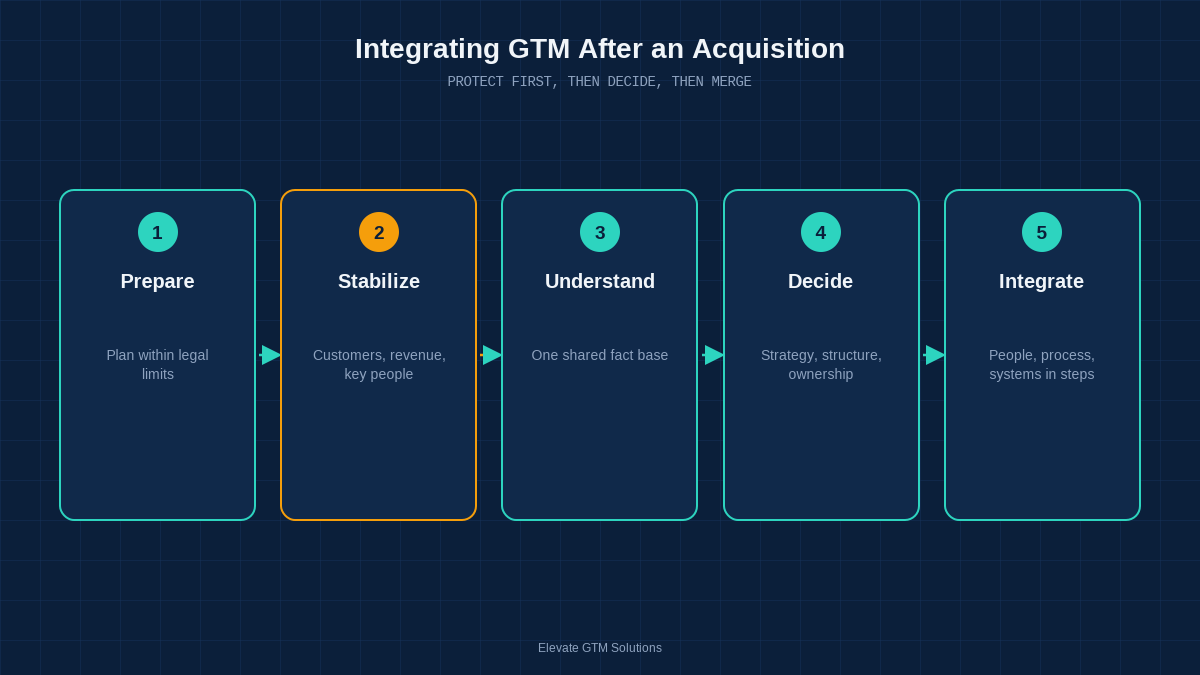
On the day an acquisition closes, the press release says the combined company will offer customers "the best of both." Inside the company, nobody can yet say who owns which customer, whether to keep two websites, what happens to the overlapping sales team, whose CRM is the real one or what the combined product is called. Sellers from both sides are calling the same accounts. Customers are asking whether the product they bought will survive. The best people on both teams are quietly updating their résumés.
Integrating go-to-market after an acquisition is one of the hardest operational tasks in business, partly because the deal's value often depends on cross-selling and growth that only a well-run integration delivers, and partly because the work lands on the same people who have a quarterly number to hit. This guide offers a practical sequence: what to do before and on day one, how to protect customers and revenue, how to decide on the combined strategy, how to merge the team, process and systems, how to handle the message and the brand, and how to measure whether it is working.
We make a GTM strategy platform, and "Integrate GTM after an acquisition" is one of the use cases on our site, so we have an interest. The advice applies with or without software. Acquisitions raise legal, tax, employment and competition questions that vary by country and by deal. This guide is not legal or financial advice, and the legal team, not a go-to-market guide, decides what you can do before closing. Examples are invented, and we cite no benchmark figures on deal success or cross-sell rates, because the numbers in circulation vary too widely to be a safe target.
How do you combine two GTM teams after an acquisition?
Sequence it. Before and at close, protect customers and revenue: decide what customers hear, freeze unnecessary changes to their experience and keep both sales teams selling. In the first weeks, build a shared picture: one customer list with owners, one view of the pipeline, one set of facts about both products, teams and results. Then decide the combined strategy: who you serve, what you offer, how you position it and how you sell it, based on evidence about both customer bases. Next, merge the organization, process and systems in steps, starting with the decisions that cause the most confusion, such as account ownership, compensation and the CRM. Communicate often and honestly, and measure customer retention, pipeline, cross-sell and team stability. Change the minimum needed to keep selling, then integrate more as you learn.
What should we do first? Protect existing customers and revenue, and tell people what is decided and what is not yet.
How long does it take? Months to a year or more for a full integration. The first ninety days set the tone.
The short version
| Phase | When | Main job | Biggest risk |
|---|---|---|---|
| Prepare | Before close | Plan what can be planned, within legal limits | Plans that assume too much |
| Stabilize | Day one to day thirty | Protect customers and revenue, give clear interim rules | Confusion and attrition |
| Understand | Days thirty to sixty | Build one shared view of customers, products, pipeline and people | Decisions made on anecdote |
| Decide | Days sixty to ninety | Choose the combined strategy and structure | Politics over evidence |
| Integrate | Months three to twelve | Merge process, systems, brand and teams in steps | Doing everything at once |
| Review | Ongoing | Measure and adjust | Declaring victory early |
First, what kind of acquisition is it?
The right approach depends on what the deal was meant to achieve.
| Type | What it is | GTM implication |
|---|---|---|
| Product add-on | The acquired product complements yours for the same customers | Cross-sell, shared message, unified offering |
| Market expansion | The target brings new customers, segments or regions | Keep the acquired go-to-market mostly intact, share learning |
| Capability or talent | You bought technology or a team | Minimal go-to-market integration at first |
| Consolidation | Two similar companies combine | Most overlap, most hard decisions about duplication |
| Platform build | Several acquisitions assembled into one offering | Strong need for one strategy and one product story |
Write down, in plain words, the reason for the deal and what must be true for it to pay off. If the answer is "cross-sell to each other's customers," the integration plan must make that easy. If the answer is "a new region," protecting the acquired team's way of selling matters more than rapid consolidation.
Before close: plan within the rules
What you can do before closing is limited by law. In many places, the two companies must continue to operate independently and must not coordinate on pricing, customers or markets before close. Sharing sensitive competitive information may be restricted. Work with legal counsel on what planning teams may see and discuss, and use clean-team arrangements where advised.
Within those limits, preparation can include:
- Defining the deal thesis and integration goals, at a level that does not require sharing restricted information.
- Naming integration leaders on each side and a single executive owner.
- Preparing the communication plan for customers, employees and partners, with legal review.
- Listing the decisions that will need to be made in the first thirty days.
- Identifying key people and customers whose loss would hurt most, to the extent allowed.
- Planning the day-one message and the interim rules for selling.
This guide is not legal advice. Rules on what may be shared before closing vary by country and by deal.
Day one to day thirty: stabilize
The first month has one priority: do not lose customers, revenue or key people through confusion.
Tell customers what they need to know
Customers worry about four things: will the product continue, will support change, will the price change and who do I call. Answer those in plain language, early, from a person they know.
What to send. A short message from an executive, with a named contact and a clear statement of what is not changing for now. Avoid vague promises. Say "nothing changes in your contract, support or price for now, and we will tell you in advance before anything does," if that is true and approved.
Who to call personally. Your largest and most strategic customers, from both sides. Ask what worries them and what they need to hear.
What to avoid. Announcing combined products before they exist, promising features, or implying that one product will be discontinued before the decision is made. Whatever you say, customers will hold you to it.
Keep both sales teams selling
Sellers are the first to feel the uncertainty. They worry about territories, quotas and commissions, and prospects stall when they hear about the deal.
- Announce interim rules for the quarter. Who owns which accounts, how deals are credited, whether quotas change.
- Guarantee something for the near term, such as no changes to compensation plans for a stated period, if that is the decision.
- Set a rule for shared accounts. If both teams are calling the same company, decide who leads and how credit is shared. Overlap is common and will cause friction on day two.
- Give a simple pitch. A short, honest statement sellers can use: who we are now, what is staying the same, what is coming and when.
Retain the key people
The loss of a handful of top sellers, engineers or customer leaders can cost more than any synergy. Identify them early on both sides. Talk to them personally. Be honest about what is decided and what is not. Retention arrangements are a legal and financial matter to handle with HR and counsel.
Do not assume the acquired team is the only one at risk. People in the acquiring company also leave when responsibilities or reporting lines change without explanation.
Freeze needless change
Do not rename products, redesign websites, change contracts or merge systems in the first weeks unless required. Every change competes for attention with keeping customers and revenue. List the changes that can wait and say so.
Days thirty to sixty: build one shared picture
Before deciding anything big, get the facts on one page. Most integration disputes are arguments about facts that nobody has assembled.
The shared fact base
| Area | What to assemble |
|---|---|
| Customers | One list across both companies, with overlap flagged, size, product, tenure, health and revenue |
| Segments | Who each company serves best, and where they overlap |
| Products | What each does, who uses it, where they compete and where they complement |
| Pipeline | Open opportunities, stages, expected timing and overlap with the other company |
| Win-loss | Why each team wins and loses, and against whom |
| Pricing | Price lists, discount patterns and contract terms |
| Team | Roles, locations, tenure, quotas, results and compensation structures |
| Systems | CRM, marketing tools, support systems, data quality and ownership |
| Messaging | Positioning, proof, case studies, websites and brand |
| Metrics | Definitions of key terms on each side, such as lead, qualified, customer and churn |
The last row is often the biggest surprise. Two companies can use the same words for different things. "Customer" might mean a paid account in one company and any signed contract in the other. Agree on shared definitions before comparing numbers. See how to measure whether your GTM strategy is working.
Look for overlap and for gaps
- Same customer, two vendors. The same company buys from both. This is a cross-sell opportunity and a concentration risk.
- Same segment, similar product. Duplication, with hard decisions ahead.
- Different segments. Potential for expansion, and a case for leaving go-to-market largely separate at first.
- Gaps. Segments, regions or needs that neither serves, which the combined company could address.
Learn from both sides
Resist the instinct to treat the acquirer's methods as the default. Sometimes the acquired team has a better process, message or segment focus. Use evidence. Compare win rates, cycle length, retention and customer feedback, and adopt what works regardless of origin.
Days sixty to ninety: decide the combined strategy
With a shared fact base, decide on the combined go-to-market. This is a strategy question first and an organization chart question second. See unified GTM strategy.
The strategy decisions
- Who do we serve? The combined ideal customer profile and priority segments, based on where both companies succeed. See ICP.
- What do we offer? Separate products, bundles, a unified product or a roadmap toward one. Be honest about timing.
- How do we position it? One story for the combined company, or distinct positions for each product. See positioning.
- How do we price and package? Keep existing prices for existing customers, and decide on new packages for new deals. See how to price a new B2B product.
- How do we sell? Shared sellers across both products, specialists for each, or segment-based teams. See what is a GTM motion.
- How do we serve customers? One success and support organization, or two for now.
- What do we stop? Duplicate programs, products, regions or segments that do not make sense in the combined plan.
Sales structure options
| Option | How it works | Fits when | Watch for |
|---|---|---|---|
| Keep separate | Each team sells its own product to its own customers | Different segments, low overlap, early days | No cross-sell; customers see two vendors |
| Overlay | Specialists for one product support the other team's sellers | Products complement; one team owns the account | Specialists feel like outsiders; credit disputes |
| Merge by segment | Teams reorganize around customer type, selling both products | Products serve the same buyers | Retraining, quota changes, attrition risk |
| Merge by product | Dedicated teams per product, coordinated accounts | Products are complex and need depth | Customers face multiple contacts |
| Fully integrated | One team, one product line, one process | Products are combined | Largest disruption; needs a ready product |
Most companies move through these in steps rather than choosing the end state on day one. A common path is keep separate, then overlay, then merge by segment as the product and the team mature.
Account ownership and compensation
These two decisions cause more friction than any other, so settle them early.
Account ownership. For every account, one named owner. For overlapping accounts, a written rule: the larger relationship leads, or the acquirer's team leads, or the first to register leads. The rule matters less than its being clear, fair and applied consistently.
Compensation. Sellers pay attention to how they are paid. Decide how to credit cross-sell, whether to protect existing quotas for a period, how to handle overlap and when plans change. Involve HR and finance, and follow local employment law. Changing pay plans is legally and emotionally sensitive. Do not announce changes you have not approved, and do not leave sellers guessing.
Process and systems
The CRM
Two CRMs is a common reality. Merging them is a significant project. Start with the minimum.
- Short term: a shared view that lets leaders see both pipelines and flag overlap, even if the data sits in two systems.
- Medium term: agree on shared definitions, stages and key fields.
- Longer term: consolidate into one system, with a migration plan, data cleanup and a rehearsal. See GTM platforms that integrate with Salesforce for how field mapping can fail, which applies to any migration.
A rushed migration that corrupts data does more harm than running two systems for a while.
Marketing systems and data
Contact data, consent records and marketing tools need care. Merged lists can break consent rules if people agreed to hear from one company and not the other. Take legal advice on how to use each side's contact data. This guide is not legal advice, and privacy rules vary by country.
Handoffs and service levels
Define handoffs between marketing, sales, success and support across the combined company. See the sales and marketing SLA framework and GTM strategy handoff.
Enablement
Sellers need to learn the other company's products, customers and message. Cross-training is one of the highest-value early investments. See what is GTM enablement. Keep it practical: short sessions, real customer stories and an easy place to ask questions.
Message and brand
Customers and prospects see the message first.
Decide the story. What is the combined company, and what does it mean for customers? Write it in a paragraph that survives repetition.
Do not over-promise. Describe what exists today and what is planned, with honest timing. "Integrated product coming" without a date and a plan becomes a source of distrust.
Choose the brand approach on purpose. Options include keeping both brands for a time, a house of brands, a gradual transition to one name or a single brand from a set date. The right choice depends on brand strength, customer loyalty and how soon the products converge. Whatever you choose, tell customers what to expect and when.
Update the proof. Case studies and references from both sides can support a combined story, with customer permission.
Align the website and sales materials. A website that shows two products with no relationship confuses buyers, and a website that merges them before the product does misleads them.
Measuring the integration
Choose a few measures and review them often. Compare with a pre-deal baseline for each company.
| Area | Example measures | Caution |
|---|---|---|
| Customers | Retention and churn by company and segment, support volume, satisfaction themes | Watch the first renewal cycle closely |
| Revenue | Pipeline, bookings, average deal size, discounting | Separate the effects of integration from seasonal and market effects |
| Cross-sell | Number of customers who buy the second product, time to first cross-sell | Early numbers are small; use ranges |
| Team | Attrition by role and company, ramp time, seller activity and quota attainment | Regretted attrition matters most |
| Process | Time to resolve overlapping accounts, data quality, handoff speed | Track disputes as a signal |
| Customer experience | Time to answer a customer question, number of contacts per customer | Customers do not care about your org chart |
| Learning | Decisions made, open questions, assumptions confirmed | Keep a decision log |
Write down what the deal was meant to achieve and track against that. Be wary of the temptation to declare success on the day systems are merged. The test is whether customers stay and buy more.
A worked example, invented for illustration
Imagine a company that sells accounting software to small businesses and acquires a company that sells payroll software to a similar audience. The deal thesis is cross-sell: customers who use one should buy the other.
At close, the company sends a message to customers from both sides: nothing changes for now, here is who to call. It meets its top forty customers personally. It tells sellers that for the next two quarters, quotas, territories and compensation stay as they are, and that any account that uses both companies' products is flagged and owned by the larger relationship.
In the first sixty days, the integration team builds a shared fact base. It finds that thirty percent of accounts overlap, which is an opportunity and a surprise: it had thought overlap was small. It also finds that the two companies define "active customer" differently. It agrees on one definition. Win-loss data shows the payroll company wins best with companies that have employees in more than one state, a segment the accounting company does not target.
At day ninety, the company decides to keep the products separate for now, create an overlay of payroll specialists to support accounting sellers, add a joint offering for multi-state businesses and defer a full merger of sales teams until the integrated product exists. It trains sellers on both products, starts planning a CRM consolidation with a data cleanup phase and agrees on a combined message that describes what exists today and what is planned, with dates.
Cross-sell grows slowly at first, and the company reports it in ranges. Attrition is tracked by company. A year later, the CRM migration happens, rehearsed twice. The company did less than the press release implied, in a sequence customers and sellers could follow.
Common mistakes
Announcing combined products too early. Customers hold you to it.
Ignoring the customers while focusing on the org chart. Customers feel the integration first.
Merging sales teams on day one. Disruption lands on the quarter you most need.
Leaving account ownership vague. Overlap becomes a fight.
Changing compensation without clarity. Sellers leave.
Assuming the acquirer's way is better. Compare with evidence.
Rushing the CRM migration. Data problems last for years.
Merging contact lists without checking consent. Privacy rules can bite.
Losing the key people. The deal's value often lives in a few of them.
Declaring victory early. Integration continues through the first renewal cycle and beyond.
Treating it as a one-time project. It is a series of decisions over a year or more.
Communication: a simple plan
People fill silence with the worst story. A plan for communication is part of the integration, not an add-on.
Employees. Tell people what is decided, what is not yet decided and when they will hear more. Repeat it. Hold small meetings where people can ask questions, and answer honestly, including with "we do not know yet." Managers need talking points and a chance to raise concerns before their teams hear.
Customers. Plan a first message and a follow-up, with named contacts, and keep a log of questions customers ask so the answers can be improved.
Partners. Partners who sell or support either product need to know whether their terms, products and contacts will change. Silence can push them toward competitors.
Investors and the board. Share a regular update with the same structure: what we expected, what happened, what we are doing.
Rhythm. A weekly note from the integration lead to the leadership group, and a monthly note to all employees, is often enough. Consistency matters more than length.
Whatever you say must be reviewed by legal and HR where it touches employment, competition or securities matters. This guide is not legal advice.
A first-hundred-days checklist
By day thirty: customer and employee messages sent; interim rules on account ownership and credit in place; top customers and key people contacted personally; shared definitions drafted; integration owner and weekly rhythm set; list of changes that can wait published.
By day sixty: one combined customer list; shared fact base on pipeline, win-loss, pricing and team; overlap flagged; early read on customer sentiment and attrition; enablement sessions started so sellers can talk about both products.
By day one hundred: combined strategy decisions written down, including target segments, positioning, offer, pricing approach and selling structure; compensation and territory decisions communicated; plan for CRM and systems integration with a phase order; metrics baseline and scorecard agreed; first review with the board or leadership held.
If a box cannot be ticked, it shows where attention is needed. Treat the list as a map, not a grade.
Learning from other kinds of integrations
Even if your deal is unusual, the failure patterns repeat. Integrations tend to suffer when leaders announce more than they can deliver, when the acquired team is treated as a source of headcount to cut and not a source of knowledge, when compensation confusion makes the best sellers leave and when the work of merging systems crowds out customer attention. They tend to go better when someone senior owns the integration full time, when customers hear early and plainly, when the shared fact base replaces anecdote and when the team celebrates small, real wins such as the first successful cross-sell, which proves the thesis and builds confidence.
Product and roadmap questions that shape go-to-market
Go-to-market plans depend on product decisions that may not be made for months. Plan around the uncertainty.
What is the product plan? Will the products stay separate, share a platform, merge or one be retired? Until this is decided, sellers should not promise integration dates.
What is the honest timeline? If a combined product is a year away, say so. Offer what exists: bundles, integrations or joint packages that work today.
What happens to support and success? Customers expect continuity. Decide who supports which customers and how issues escalate.
What are customers asking for? Cross-product requests are early evidence for roadmap priorities. Log them.
Which product is the lead in shared accounts? For overlapping accounts, decide which product leads the conversation and which follows, and align the account plan.
Give sellers a short "what we can say today" sheet, updated as decisions are made. Sellers who guess will sometimes guess wrong in front of a customer.
Pricing, packaging and contracts in the combined company
Pricing changes after a deal are sensitive. Customers dislike surprises, and existing contracts bind both sides.
- Honor existing contracts until they end, unless the terms allow changes and the customer is told properly.
- Avoid sudden price changes for existing customers in the first months.
- Create new packages for new deals that reflect the combined offer, after the strategy is decided.
- Align discount rules and approval levels across both teams, so a customer buying from both does not see wildly different treatment.
- Check legal terms. Contracts may include change-of-control or assignment clauses, exclusivity and data terms. Counsel should review them. This guide is not legal advice.
See how to price a new B2B product for the principles behind packaging.
Glossary
Acquisition. One company buying another.
Integration. Combining operations, people, products and systems after a deal.
Deal thesis. The reasons the deal should create value and what must be true for it to do so.
Cross-sell. Selling an additional product to an existing customer.
Overlay. Specialists who support another team's sellers on a particular product.
Account ownership. The rule that assigns one seller or team to lead each customer relationship.
Clean team. A restricted group allowed to see sensitive information before a deal closes, under legal rules.
Churn. Customers or revenue lost over a period.
Regretted attrition. Loss of people the company wanted to keep.
Shared definitions. Agreed meanings of terms such as lead, qualified and customer.
CRM migration. Moving data and processes from one customer relationship system to another.
Where Elevate GTM Solutions fits
Elevate GTM Solutions is an AI GTM platform for creating, executing and adapting go-to-market strategy. Its homepage lists "Integrate GTM after an acquisition" as a use case, along with "Align cross-functional teams," and its modules include "Unified GTM Strategy," "ICP & Segmentation," "Product Positioning," "Product Messaging," "Pricing Strategy," "Sales Enablement" and "Customer Success." The homepage says "15 connected GTM modules" and names sixteen, so count what you see when you look.
How that could help: the strategy decisions in this guide, who you serve, how you position, how you price and how you sell, depend on each other, and a platform that holds them in one model is designed to help a combined team work from one plan and compare options before committing. That is the company's design intent, and the test is whether the output reflects the evidence from both customer bases.
A platform cannot protect customers on day one, settle account ownership, design compensation or migrate a CRM. Those need leaders, legal and HR advice and careful operations. Use any generated combined strategy as a draft to test against the shared fact base. For more, see what Elevate GTM Solutions is.
What to do this week
- Write the deal thesis in plain words: what must be true for this deal to pay off.
- Name one executive owner and an integration lead from each side.
- Check with legal counsel what planning and information sharing is allowed before close.
- Draft the customer message and an interim rule for account ownership and credit.
- List the top forty customers and the key people on both sides to contact personally.
- Begin the shared fact base, starting with one combined customer list and shared definitions.
- List changes that can wait, and tell the team they are waiting.
Key takeaways
- Sequence the work: protect customers and revenue first, build a shared fact base, decide strategy, then integrate people, process and systems in steps.
- Define what the deal was meant to achieve, and let that decide how much to integrate and how fast.
- Tell customers plainly what is and is not changing, and avoid promising combined products that do not exist yet.
- Settle account ownership and compensation early, with HR and legal input.
- Use evidence from both companies, not assumptions about whose way is better.
- Merge the CRM carefully, and check consent and privacy rules before combining contact data.
- Measure retention, pipeline, cross-sell and team stability against a pre-deal baseline, and keep reviewing through the first renewal cycle.
Sources
- Elevate GTM Solutions: descriptions of modules and use cases, as stated on the company's homepage.
- Related Elevate guides linked in the text, including unified GTM strategy, the sales and marketing SLA framework and GTM strategy handoff.
- The phases, the sales structure options and the fact base reflect common practice and our judgment. They are not drawn from a single study, and each deal differs.
- This guide is not legal, tax, employment or financial advice. Pre-closing conduct, competition rules, employment, privacy and consent rules vary by country and by deal, and counsel should advise on them.
- The worked example is invented for illustration. We cite no benchmark figures on deal success or cross-sell rates.
Frequently Asked Questions
How do you combine two GTM teams after an acquisition?
Sequence the work. Protect customers and revenue first, then build a shared fact base, decide the combined strategy and integrate people, process and systems in steps. Communicate often, measure retention, pipeline, cross-sell and team stability, and change the minimum needed at first.
What should happen on day one after an acquisition?
Tell customers plainly what is and is not changing, name who they should call, give both sales teams interim rules for accounts and credit, contact key customers and people personally and freeze unnecessary changes. Have legal review the messages.
How do you decide who owns overlapping accounts?
Write one clear rule and apply it consistently, such as the larger relationship leads, with credit shared on cross-sell. The specific rule matters less than its being fair, clear and communicated early, to prevent friction between sellers.
Should we merge the sales teams immediately?
Usually not. Immediate merging disrupts the quarter you most need. Many companies move in steps from separate teams to an overlay of specialists, then to segment-based teams as the products and people are ready.
How do you keep key sellers and customers after a deal?
Identify them early, talk to them personally, be honest about what is decided and what is not, and give clear near-term rules on territory and pay. Retention arrangements are a legal and financial matter for HR and counsel.
When should we merge the CRM systems?
After you have shared definitions and a data cleanup plan, and after the first urgent decisions are made. In the short term, build a shared view across both systems. A rushed migration that corrupts data does more harm than running two systems for a while.
Can we combine both companies' contact lists for marketing?
Only after taking legal advice. People may have agreed to hear from one company and not the other, and privacy and consent rules vary by country. This guide is not legal advice.
What should we tell customers about the combined product?
Describe what exists today and what is planned, with honest timing. Avoid promising features or implying a product will be discontinued before a decision is made, because customers will hold you to what you say.
How long does GTM integration take after an acquisition?
Months to a year or more for a full integration, depending on the deal type. The first ninety days set the tone, and the first renewal cycle is an important test of whether customers stay.
How do we measure whether the integration is working?
Track customer retention and satisfaction, pipeline and bookings, cross-sell, team attrition by company, process measures such as time to resolve account disputes and customer experience. Compare each with a pre-deal baseline.
Whose way of selling should win?
Whichever the evidence supports. Compare win rates, cycle length, retention and customer feedback from both teams, and adopt what works regardless of which company it came from.
Can software help with post-acquisition GTM integration?
A GTM platform can help hold segmentation, positioning, pricing and channel decisions in one model so a combined team works from one plan. It cannot protect customers, settle ownership, design pay or migrate systems. Use generated plans as drafts to test against your fact base.