
By the Elevate GTM Solutions Team · Updated November 13, 2026 · 25 min read
How to Enter a New Market or Region Without Wasting Budget: A Test-First Plan for B2B Companies
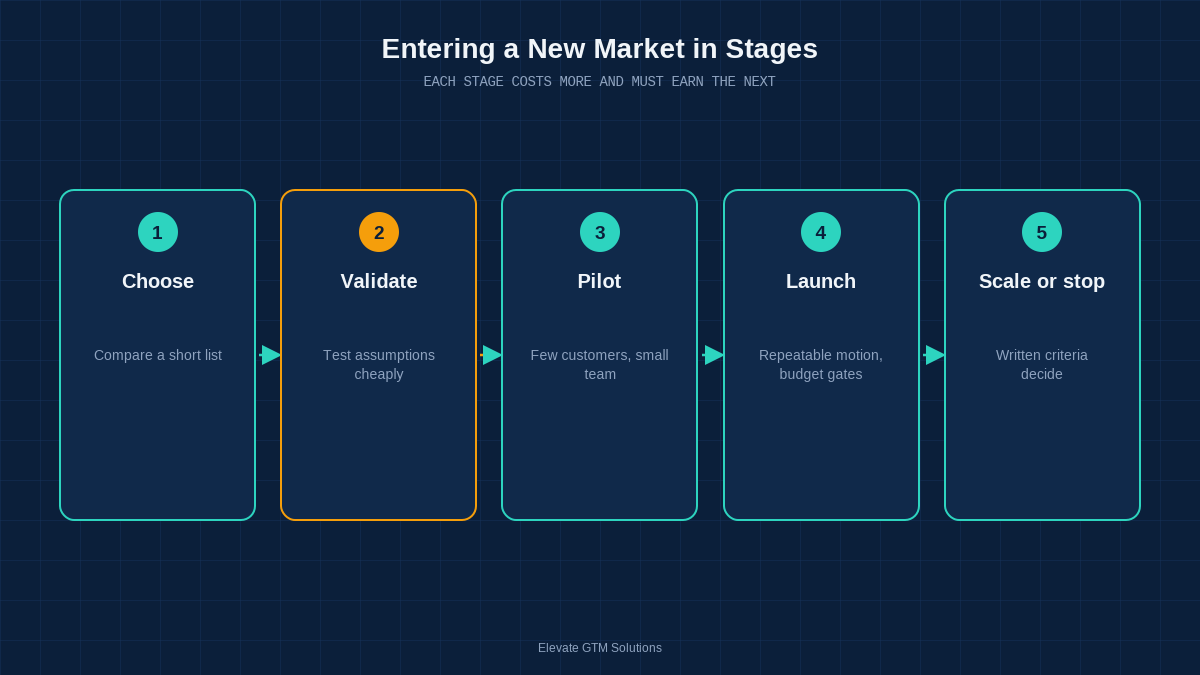
Entering a new market is one of the most expensive ways to learn something you could have learned cheaply. A company opens an office, hires a local team, translates the website, buys media, and a year later discovers that buyers there evaluate vendors differently, want a different price model, trust different proof and already use a local competitor that fits better. The budget did not fail. The assumption that the new market would behave like the old one did.
The alternative is not to avoid new markets. It is to enter in steps, spend small amounts to learn the most important unknowns first, and commit larger budgets only when the evidence supports it. This guide is a practical plan for doing that. It covers what "new market" can mean, how to choose where to go, which questions to answer before spending, how to run a low-cost test, what to adapt and what to keep, when to scale and when to stop.
We make a GTM strategy platform, and "Enter a new market" is one of the use cases on our site, so we have an interest. We already have guides on what is a market entry strategy and on global versus local GTM strategy, which explain the concepts. This guide is the practical companion: how to spend carefully while you learn. The examples are invented, and we cite no benchmark numbers on cost, timelines or success rates, because they vary too much by industry and region to be a safe target. Rules on tax, employment, data and trade vary by country, and this guide is not legal or financial advice.
How do you enter a new market without wasting budget?
Enter in stages and let evidence release the money. First, choose the market using data about demand, fit, competition and your ability to serve it, and rank a few candidates instead of falling for one. Second, write down what you must be true for the entry to work, such as buyers having the problem, being reachable, accepting your price and being servable, and test those assumptions cheaply with conversations, small campaigns and a few pilot customers before hiring or building. Third, adapt only what the evidence says must change: message, price, proof, language, compliance, channels and support. Fourth, run a limited launch with a small team, clear targets and a date for review. Scale only when win rate, economics and customer success meet the criteria you set in advance, and have a rule for stopping.
What does "new market" mean? A new region, a new customer segment, a new industry or a new use case. Each carries different risks.
How long should a test last? Long enough to cover a realistic sales cycle for a few deals, which is often several months.
The short version
| Stage | Goal | Typical spend | Decision at the end |
|---|---|---|---|
| 1. Choose | Pick the best candidate from a few options | Time and desk research | Which market to test |
| 2. Validate | Test the key assumptions cheaply | Interviews, small campaigns, partner conversations | Whether to proceed |
| 3. Pilot | Win and serve a few customers | A small team or partner, limited marketing | Whether it works repeatably |
| 4. Launch | Build a repeatable motion | Scaled team and programs | Whether to widen |
| 5. Scale or stop | Grow, or exit with the lessons | Larger investment, or wind-down | Keep, adjust or stop |
The principle is simple. Each stage costs more than the last, and each stage must earn the right to the next.
What kind of "new market" is it?
The risks differ by type. Be specific.
New region or country. Same product and customer type, new place. Risks: language, law, tax, currency, local competitors, buying habits, time zones, trust, data rules and the cost of being far from customers.
New segment. Same product, new kind of customer, such as larger companies or a different company size. Risks: different needs, buying process, price expectations and proof. See how to move upmarket from SMB to enterprise.
New industry or vertical. Same product, new industry. Risks: specialized vocabulary, regulation, existing tools, industry trust networks and the need for industry proof.
New use case. Same customers, a different problem to solve. Risks: different champions, different budgets, a different competitor set.
New product in an existing market. This is closer to a product launch than a market entry. See the first 90 days after a product launch.
Many entries are a mix, such as a new country and a new segment at the same time. Mixing multiplies unknowns. Where you can, change one major thing at a time.
Stage 1: choose the market
A single exciting prospect is not a market. Choose by comparison.
Build a short list
List three to five candidates. For each, gather facts.
| Factor | Questions |
|---|---|
| Demand | Do enough buyers have the problem, and are they actively looking for solutions? |
| Size | Is the reachable market big enough to justify the effort? See market sizing |
| Fit | Does our product meet the needs as they exist there, without major changes? |
| Competition | Who serves it now, and where are they weak? |
| Accessibility | Can we reach and sell to buyers with the channels we have or can build? |
| Economics | Can we win customers at a cost that works at local prices? |
| Compliance | What rules apply to us and to customers? |
| Service | Can we support customers well, including language, time zones and local needs? |
| Strategic value | Does it open further markets or help our existing business? |
| Evidence we already have | Inbound inquiries, existing customers, partner interest, language of past deals |
Use evidence you already own
Your own data is the cheapest research.
- Where do your inbound inquiries come from today?
- Which regions or segments already have customers, and how do they perform?
- Which markets have you lost deals in, and why?
- Who has asked a partner or a seller about entry?
If a region already produces unplanned customers with good retention, it is a better candidate than one chosen from a report.
Score honestly and pick one
Rate each candidate on each factor from low to high, with a sentence of evidence. Do not weight by enthusiasm. Pick one to test first, and write why you did not pick the others. Entering two markets at once splits your attention and your learning.
Stage 2: write the assumptions and test them cheaply
Every market entry rests on assumptions. Most waste comes from untested ones. Write them down.
The assumption list
For the chosen market, complete these sentences.
- The problem exists. Buyers in this market have [problem] and care enough to act.
- They can be reached. We can reach [buyers] through [channels] at a cost of roughly [range].
- Our message lands. They understand and believe [message].
- They accept our price. They will pay roughly [range] in [terms].
- They trust our proof. They accept [references, security, certifications] as evidence.
- We can serve them. We can deliver and support the product in their language, time zone and context.
- Rules allow it. We can sell and operate legally under their regulations, and we know the main obligations.
- The economics work. Cost to win and serve is below what customers pay, at a speed we can afford.
For each, write how you will test it and what result would count as a pass or fail.
Cheap tests
| Assumption | Low-cost test |
|---|---|
| The problem exists | Ten to twenty interviews with target buyers, through your network, partners or an introduction service |
| Reachable | A small outreach test or a modest campaign to see response; ask local partners how buyers find vendors |
| Message lands | Show message variants in interviews; test a landing page in the local language |
| Price accepted | Show price options in conversations; see how to price a new B2B product |
| Trust in proof | Ask what evidence buyers expect, such as local references or certifications |
| Can serve | Run a few trial customers with your existing team and see what breaks |
| Rules | Take advice from a local lawyer or specialist before committing; ask about data, contracts, tax and employment |
| Economics | Build a simple model from the test results, in ranges |
Local help that is worth paying for
Small amounts spent early often save large amounts later.
- Local advisors or partners who know how buyers there decide.
- Legal and tax advice on setup, data handling, contracts and employment.
- Translation by native speakers of key materials, not machine output alone.
- A short research project if public data is thin.
Decision at the end of Stage 2
Review the assumption list. Mark each as confirmed, contradicted or unknown. If key assumptions failed, either change the plan or stop. A cheap "no" is a good result. If key assumptions held, proceed to a pilot with a defined scope.
Stage 3: the pilot
A pilot wins a few customers and tests whether you can serve them. It is not a launch.
Design it
- Small team. One or two sellers or a partner, a customer success contact and an executive sponsor. Often it is best to use existing staff or a partner before hiring.
- Narrow target. One segment, one use case, a defined list of accounts. See account tiering.
- Fixed period. Long enough for a realistic sales cycle for several deals. Set a review date up front.
- Defined success criteria. Pipeline, deals, time to value, early retention, cost to win, in ranges you write before starting. For example, "at least this many qualified opportunities and this many signed customers by the review."
- Documented lessons. Record every deal, loss and surprise. See the win-loss analysis framework.
Choose the entry vehicle
| Vehicle | Fits when | Cost and risk |
|---|---|---|
| Remote selling from home base | Language and time zone allow; product is easy to sell remotely | Low cost; limited local trust |
| Local partner or reseller | Local trust and services matter; see partner and channel strategy | Lower upfront cost; less control |
| Local contractor or agent | You need local presence without hiring | Moderate; quality varies |
| Local hire | You have proof and need ongoing presence | Higher cost and commitment |
| Local entity or office | You need a legal presence, staff and infrastructure | Highest cost and hardest to reverse |
Start with the lightest vehicle that can work, and move to heavier ones as evidence builds. Setting up a legal entity before you have customers is a common and avoidable cost. Take local advice on when it becomes necessary.
What to adapt, and what to keep
Do not change everything. Do not change nothing. Use evidence from Stage 2 to decide.
| Element | Questions |
|---|---|
| Message and positioning | Does the problem look the same here? Are the words, examples and priorities different? See positioning |
| Language | Do buyers expect materials in their language? Which materials matter most, such as the website, sales deck and contract? |
| Price and terms | Do currency, payment terms and expectations differ? |
| Proof | Do local references, certifications or case studies matter? |
| Product | Do local requirements, such as integrations, formats or regulations, block deals? Fix the few that block the most |
| Channels | Do buyers use different sources of information, events or associations? |
| Sales process | Are decision makers, timelines and procurement habits different? |
| Support | Do customers expect local-hours support and a local language? |
| Compliance | What changes in data handling, contracts, taxes, employment and marketing rules? |
Our guide on global versus local GTM strategy covers how to decide which parts to standardize.
Stage 4: launch with limits
If the pilot meets its criteria, build a repeatable motion. Do it in steps.
- Add people in small groups, and measure ramp time.
- Widen the target one step at a time. Another segment, another city, another use case.
- Build local proof. References and case studies from the first customers, with permission.
- Formalize the process. Pricing rules, onboarding, support and handoffs.
- Set budget gates. Release the next tranche only if the numbers justify it.
- Review monthly. Sales, marketing, product, success and finance in one room.
Stage 5: scale, adjust or stop
At each review, ask the same questions.
| Question | Evidence |
|---|---|
| Can we win repeatably? | Win rate beyond the first few deals; more than one seller winning |
| Do customers succeed and stay? | Time to value, usage, early retention |
| Is the economics workable? | Cost to win and serve in ranges; payback. See CAC payback |
| Is the market bigger than the test? | Pipeline coverage; evidence beyond early adopters |
| Can we support it without hurting the core? | Impact on product roadmap, support load and management attention |
| Are the lessons clear? | A written account of what worked and what did not |
Decide among three outcomes: scale, adjust and extend the test, or stop. Write a stop rule at the start, such as "If by this date we have fewer than this many qualified opportunities, we pause." Stopping early is not failure. It is how a company protects its core business and keeps the lessons.
What stopping looks like
- Honor commitments to the customers you won. Give notice, offer a transition and be fair.
- Preserve what you learned in writing.
- Close local arrangements in the way contracts and local rules require, with advice.
- Tell the team what you learned.
Measuring progress
| Stage of the funnel | Example measures |
|---|---|
| Awareness | Qualified inquiries and replies from target buyers in the new market |
| Pipeline | Qualified opportunities, stage progression, cycle length compared with home market |
| Win | Win rate, reasons for loss, competitors met |
| Delivery | Time to first value, support issues per customer, onboarding duration |
| Retention | Usage, renewals and expansion among the first customers |
| Economics | Cost to win, cost to serve, payback, in ranges |
| Learning | Assumptions confirmed, contradicted or unknown |
Compare each with your home market baseline. Our guide on measuring whether a GTM strategy works helps with building a scorecard. Do not benchmark against outside averages, because they blend very different markets.
A worked example, invented for illustration
Imagine a company that sells compliance software to mid-size banks in its home country. It receives repeated inquiries from banks in a neighboring country, and two sales calls there have gone well. Leadership wants to open an office.
Instead, the company writes its assumption list and tests it. It interviews fifteen compliance heads through a local advisor and a trade association. It learns that the problem is real, that local regulations differ in several key ways and that buyers expect the software and contract in the local language. It also learns that banks there often buy through a local integrator they already trust.
The company decides against an office. It signs a pilot arrangement with one integrator, translates its contract and the three most important sales documents with native review, builds the one regulatory report format that blocks deals and takes advice from a local lawyer on data handling. It targets thirty banks of a defined size. It sets success criteria for nine months: a number of qualified opportunities, a number of signed customers and a time to first value.
At the review, it has signed two customers and has four in progress, and the integrator's staff have learned the product. The cost to win is higher than at home, mostly because of translation and integrator margin. The company decides to extend the pilot for two quarters, add a second integrator and defer any local office until it has more customers. It spent a fraction of what an office would have cost, and it knows what it is scaling.
Common mistakes
Choosing a market on one inquiry. One lead is not demand.
Entering two markets at once. Learning splits and attention thins.
Opening an entity first. Legal and office costs come before evidence.
Translating everything. Translate what buyers need to see, and test the rest later.
Hiring ahead of proof. A local team with no repeatable motion burns money.
Assuming the same message works. Buyers may frame the problem differently.
Ignoring local rules. Data, contract, tax and employment rules can stop a launch. Get local advice.
Underestimating service. Support in the wrong language and time zone damages the first customers.
No review dates or stop rules. Spending continues because nobody decides to stop.
Treating the pilot as a launch. A pilot exists to learn.
Budgeting in tranches
A simple budgeting method keeps spending tied to evidence. Set the total you would be willing to lose, then release it in steps.
| Tranche | What it funds | Released when |
|---|---|---|
| 1. Learn | Research, interviews, advisor and legal advice, small tests | The decision to explore the market |
| 2. Pilot | A small team or partner, translation of key materials, limited marketing | Stage 2 assumptions are mostly confirmed |
| 3. Launch | Hiring in small groups, local programs, localized product work | The pilot meets its written criteria |
| 4. Scale | Larger team, entity or office if needed, broader marketing | Launch results hold across more than the first customers |
State the amount for each tranche and the evidence that releases it before you start. Record who decides. This turns an argument about "whether to invest" into a series of smaller questions that facts can answer. Keep a reserve for the surprises that come with every market, such as compliance work or a product change that blocks deals.
Finance should help set the structure, and the amounts depend on your company's size and risk appetite. We give no figures. This guide is not financial advice.
The first customers in a new market
The first few customers matter more than their revenue. They are your references, your teachers and your test of whether you can serve the market.
Choose them carefully. Pick buyers who fit your ideal profile, who have a real problem and who are willing to give feedback. Avoid customers who need extensive custom work you cannot repeat.
Over-serve them. Give them extra attention from people who know the product well, and learn from every interaction.
Record everything. What they asked for, what confused them, what they valued, what was hard to deliver. This record is the basis of your local playbook.
Ask for references. With permission, turn early customers into case studies in the local language and context. Local proof carries weight that home-market stories do not.
Be honest about what you cannot do. A first customer who feels misled is a risk in a small market where buyers talk to one another.
Local partners: how to choose and what to ask
A partner can accelerate entry and can also tie you to a poor fit. Before you commit, ask:
- Which customers does the partner serve today, and do they match ours?
- What do they sell that overlaps or conflicts with our product?
- How do they win business, and what do customers say about them?
- What would they need from us to succeed, and what can we really provide?
- How are conflicts, customer ownership and exits handled in the agreement?
- What do their other vendors say about the relationship?
Take local legal advice on the agreement, since rules on distribution, exclusivity and termination vary by country, and some countries restrict what you can do when ending an agency or distribution relationship. See how to build a partner and channel GTM strategy.
Mistakes that look like progress
Some activities feel productive and teach little.
Translating the whole website before anyone has bought. It looks like commitment. Translate what buyers need first, and see who responds.
Attending a large event. It creates contacts and a story for the team. Check first whether buyers actually discover vendors there.
Hiring a country manager before there is a motion. A senior hire with no proven playbook will spend the first year building one at your expense.
Counting leads from a campaign. Leads from a new region may not be qualified. Count qualified conversations and what happens next.
Judging the market from home-market habits. If buyers there use different sources and decide differently, copying your home playbook gives misleading results.
Waiting for certainty. The opposite error exists too. A well-designed small test gives you the evidence you need. Do not wait for a research report to answer questions that ten conversations could settle.
A short decision template
Use this at each review to keep the discussion short and honest.
- What did we expect? The criteria written at the start.
- What happened? Numbers in ranges and examples from real deals.
- What surprised us? Anything that contradicted an assumption.
- What do we now believe? Updated assumptions with evidence.
- What are the options? Scale, adjust and extend, or stop, each with its cost.
- What is the decision, and who owns it? Written, with a date.
- What would change our mind next time? The next review's criteria.
A one-page record of each review becomes the history of the entry. It prevents the same debate from restarting every quarter and gives new team members the reasoning behind each decision.
If you only have a few weeks
Some teams need a quick, low-cost read on a market before a budget meeting. A compressed version of Stage 2 still produces something useful.
Week one. Mine your own data for inquiries, customers, lost deals and partner mentions from the market. Write the eight assumptions.
Week two. Book and hold eight to ten buyer conversations, using your network, a partner or an introduction. Ask about the problem, how they buy, what proof they expect and who they use today. Take advice from a local lawyer on the one or two biggest compliance questions.
Week three. Run a very small outreach test with a localized message to a defined list, and see who replies and what they ask. Draft a rough economics model in ranges.
Week four. Summarize: assumptions confirmed, contradicted and unknown, with quotes. Recommend one of three options: stop, run a defined pilot or collect more evidence on named questions.
This will not prove a market. It will tell you whether it is worth proving, at a small fraction of the cost of acting on a hunch.
Glossary
Market entry. Starting to sell in a market you do not currently serve.
Market. A defined group of buyers, by region, segment, industry or use case.
Assumption. A belief the plan depends on that has not been proven.
Pilot. A limited test of a new market or motion before full commitment.
Entry vehicle. The way you reach a new market, such as remote selling, a partner, a local hire or an entity.
Localization. Adapting a product, message or materials to a specific place or culture.
Beachhead. A small, winnable segment from which you expand.
Cost to win. The sales and marketing cost of acquiring a customer.
Payback. The time it takes for a customer's gross margin to repay the cost of winning them.
Stop rule. A written condition under which you pause or end an investment.
Go-to-market (GTM). The plan and work of taking a product to customers.
Where Elevate GTM Solutions fits
Elevate GTM Solutions is an AI GTM platform for creating, executing and adapting go-to-market strategy. Its homepage lists "Enter a new market" as a use case, with others such as "Expand an existing product" and "Launch a new product," and describes adapting strategy by region, vertical or segment and comparing strategies side by side. Its modules include "Market Research," "ICP & Segmentation," "Competitive Intelligence," "Distribution Channel Strategy," "Pricing Strategy," "Launch & Execute" and "Unified GTM Strategy." The homepage says "15 connected GTM modules" and names sixteen, so count what you see when you look. Its stated scope includes more than 250 product categories, which is the company's own claim.
How that could help in a market entry: the stages above involve connected decisions about segment, message, price, channel and measurement, and a platform built on one shared model is designed to let you adapt those for a new region or segment without starting over. That is the company's design intent, and the test is whether the output reflects the real differences in the market you are entering.
A platform cannot interview buyers in a new country, check local law or tell you how people there decide. Those need people and local advice. Treat any generated market plan as a draft to test with the cheap methods in Stage 2. For more, see what Elevate GTM Solutions is.
What to do this week
- List three to five candidate markets and gather the evidence you already own for each: inquiries, customers, lost deals, partner interest.
- Score them on the factors above, with a sentence of evidence each, and pick one.
- Write the eight assumptions for that market, and a pass or fail test for each.
- Book ten to twenty conversations with target buyers, using partners and your network.
- Get local legal and tax advice on selling there before you commit to any structure.
- Choose the lightest entry vehicle that could work.
- Write the success criteria, the review date and the stop rule before spending.
Key takeaways
- Enter in stages and let evidence release the budget: choose, validate, pilot, launch, then scale or stop.
- Choose by comparing a short list, and use your own inquiry, customer and loss data first.
- Write down the assumptions and test them cheaply before hiring, building or opening an entity.
- Use the lightest entry vehicle that can work, and adapt only what the evidence says must change.
- Set success criteria, review dates and a stop rule in advance.
- Stopping early with the lessons is cheaper than scaling a wrong assumption.
- Rules on tax, data, contracts and employment vary. Take local advice before committing.
Sources
- Elevate GTM Solutions: descriptions of modules and use cases, as stated on the company's homepage. The 250-category figure is the company's own claim.
- Related Elevate guides linked in the text, including what is a market entry strategy, global versus local GTM strategy and the market sizing framework.
- The five stages, the assumption list and the table of entry vehicles reflect common practice and our judgment. They are not drawn from a single study, and the right approach varies by market.
- This guide is not legal, tax or financial advice. Rules vary by country.
- The worked example is invented for illustration. We cite no benchmark figures on cost, timelines or success rates.
Frequently Asked Questions
How do you enter a new market without wasting budget?
Enter in stages. Choose a market by comparing a short list using evidence you already own, test the key assumptions cheaply with interviews and small campaigns, run a limited pilot with a small team or partner and scale only when win rate, economics and customer success meet criteria you set in advance.
What does entering a new market mean?
It can mean a new region or country, a new customer segment, a new industry or a new use case. Each carries different risks, and entries that mix several at once multiply the unknowns, so change one major thing at a time where you can.
How do you choose which market to enter first?
Compare three to five candidates on demand, size, fit, competition, accessibility, economics, compliance, ability to serve and strategic value. Start with evidence you have, such as inquiries, existing customers, lost deals and partner interest, and pick one to test.
How much should a market entry test cost?
It should cost far less than a full launch, and we give no figure because it varies widely. Use interviews, small campaigns, partners and a few pilot customers before hiring or setting up an entity, and release larger budgets in tranches tied to evidence.
Do we need a local office to enter a new country?
Often not at first. Remote selling, a local partner, an agent or a contractor can test demand at lower cost. Take local legal and tax advice on when a legal entity or office becomes necessary, and move to heavier options as evidence builds.
What should we adapt for a new market?
Adapt what evidence says must change: message, language for key materials, price and terms, proof such as local references, a few product requirements that block deals, channels, sales process, support and compliance. Keep the rest standard to control cost.
How long should a market entry pilot run?
Long enough to cover a realistic sales cycle for several deals, which is often several months. Set a review date, written success criteria and a stop rule before you begin.
What are the biggest mistakes in entering a new market?
Choosing on one inquiry, entering two markets at once, setting up an entity first, hiring ahead of proof, assuming the same message works, ignoring local rules, underestimating service needs and having no review dates or stop rules.
When should we stop a market entry?
When the stop rule you wrote in advance is met, such as too few qualified opportunities by a set date, or when key assumptions are contradicted and cannot be fixed cheaply. Honor commitments to customers you won and record the lessons.
How do we know if the new market is working?
Compare pipeline, win rate, time to first value, early retention and cost to win with your home market baseline, in ranges. Also track assumptions confirmed, contradicted or unknown. Do not rely on outside averages.
Should we use a partner to enter a new market?
Often yes as a first step, especially where local trust and services matter. A partner lowers upfront cost and brings knowledge, with the tradeoff of less control over the message and the customer relationship.
Can a GTM platform help with entering a new market?
It can help adapt segmentation, positioning, messaging, pricing and channel choices for a region or segment and compare options. It cannot interview local buyers or check local law. Use generated plans as drafts to test cheaply.