
By the Elevate GTM Solutions Team · Updated November 13, 2026 · 28 min read
Does B2B Thought Leadership Still Build Trust When Buyers Use AI to Summarize It?
Most B2B companies publish a lot and are not sure it does anything. Blog posts go out, reports get downloaded, webinars are recorded, and the only feedback is a page-view count that cannot tell you whether a single buyer was persuaded. For several years, the communications firm Edelman and LinkedIn have run an annual survey of business decision-makers that tries to answer the question directly: does thought leadership change what buyers think and do? The 2026 edition adds a question that matters now more than before: what happens to thought leadership when buyers use AI to summarize it?
This page explains whether thought leadership still builds trust when buyers use AI to summarize it, and what B2B teams should publish. The evidence is the 2026 Edelman-LinkedIn B2B Thought Leadership Impact Report, as described on Edelman's own site, with references to earlier editions. We say who ran it, how many people were asked, what was found and what the survey cannot tell you. We add our own reading, clearly labeled, and describe how a team can use the findings, including where a go-to-market platform like ours fits and where it does not.
A disclosure. We make Elevate GTM Solutions, and we publish a lot of content, so we have an interest in a story that says content matters. We have no data of our own. Every figure here comes from Edelman's published summary of its 2026 report, which we read, and from excerpts of earlier editions. We did not read the full 2026 report. Edelman is a communications agency and LinkedIn sells advertising and sponsored content, and both have an interest in the answer being "thought leadership works." We keep that in view. Our examples are invented and labeled.
Does thought leadership still build trust when buyers use AI to summarize it?
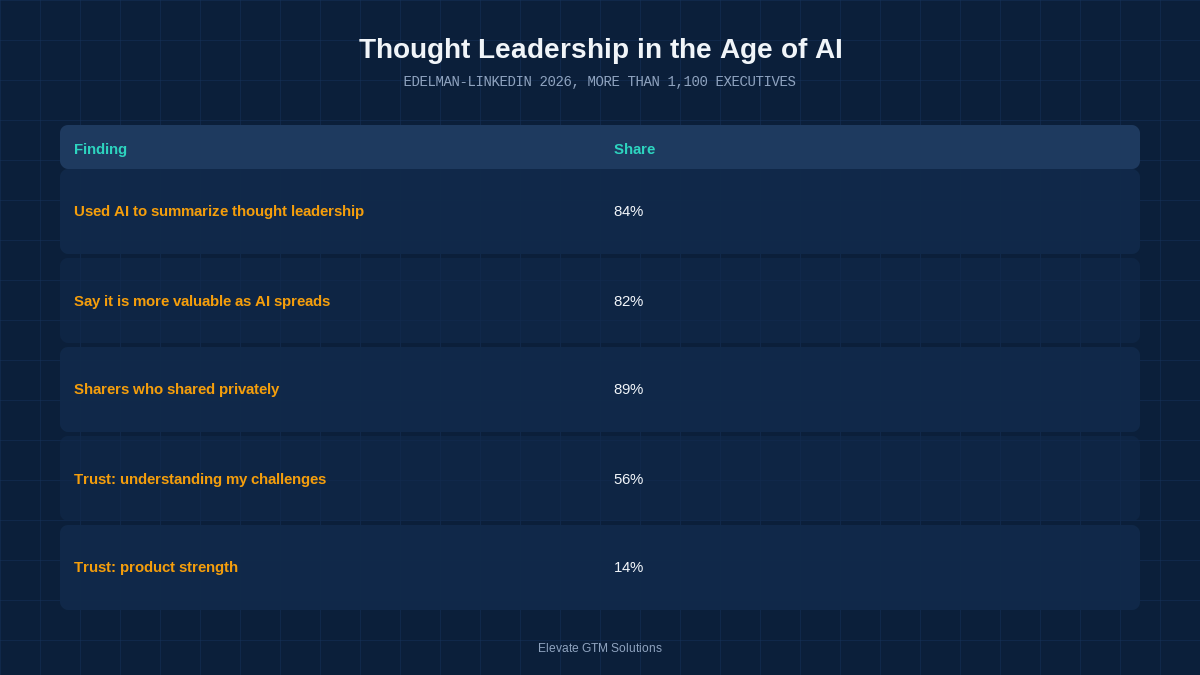
According to a survey run by interested parties, yes, but it is now summarized by AI and shared mostly in private. The 2026 Edelman-LinkedIn B2B Thought Leadership Impact Report, based on a survey of more than 1,100 business executives in seven countries, found that 84% of B2B decision-makers used AI to summarize thought leadership during vendor evaluation and that 82% say thought leadership is becoming more valuable as AI becomes a common source of business answers. Among those who shared thought leadership, 89% shared it privately, through email, direct messages, work chats or meetings, and 67% shared it through social media or other public channels. Seventy-six percent say thought leadership shared in their buying group helped them judge whether a vendor understood their needs, 52% say it helped decide which vendor to select, and 59% of final decision-makers say poor or absent thought leadership contributed to a vendor being removed from consideration. The strongest trust driver, at 56%, was demonstrating a clear understanding of the buyer's challenges, priorities and constraints, against 14% for demonstrating product strength. The survey is self-reported and from an interested party, but its direction is consistent with other research on buying groups and validation.
Does thought leadership matter if AI summarizes it? According to the report, buyers use AI to summarize it and also say it is becoming more valuable. Content that survives summarization and carries original evidence is the safer bet.
Where does it get shared? Mostly in private. 89% of those who shared it did so through email, direct messages, work chats or meetings.
The short version
| Question | Answer |
|---|---|
| Who ran it? | Edelman and LinkedIn, 2026 B2B Thought Leadership Impact Report |
| Sample | More than 1,100 business executives across seven countries |
| AI and thought leadership | 84% of decision-makers used AI to summarize it during vendor evaluation |
| Is it more valuable? | 82% say it is becoming more valuable as AI becomes a common source of business answers |
| Where is it shared? | 89% of sharers did so privately; 67% via social or other public channels |
| Why share it? | 73% cited useful data, research or evidence; 57% cited relevance to a decision already underway |
| Buying group effect | 76% say it helped assess whether a vendor understood their needs; 52% say it helped select a vendor |
| Cost of doing it badly | 59% of final decision-makers say poor or absent thought leadership contributed to a vendor being removed from consideration |
| Biggest trust driver | 56% said demonstrating a clear understanding of their challenges, priorities and constraints; 14% said product strength |
| Main caution | Self-reported by an agency and a platform that benefit from the answer |
Does thought leadership still work when AI reads it first?
Thought leadership, in B2B, means content that offers a real point of view or original evidence to help buyers think about a problem, as opposed to content that mainly describes a product. Its purpose is to build trust before a sales conversation.
Two things have changed. Buyers, and the AI tools they use, now summarize content rather than read it in full. And much of the sharing that influences a purchase happens out of sight, in email, direct messages and meetings, not in public posts.
What survives summarization. Specific claims with named sources. Original data or a clear, defensible opinion. Plain definitions. Structure that makes the main point easy to find. What does not. Generic opinion, filler introductions and claims that sound like every other vendor.
What private sharing means for measurement. Page views and social shares miss most of the activity. A better signal is asking buyers, in discovery calls and onboarding, what they read and what they forwarded, and tracking how often your content comes up unprompted.
What builds trust, in our reading. Showing that you understand the buyer's situation, constraints and priorities usually does more than showing how strong your product is. That points toward content built from real customer problems and honest limits.
The sections below set out what the 2026 Edelman-LinkedIn report found, who sponsors it and how much weight a sponsor-run survey can carry.
Why this evidence is useful, and why to be careful with it
It is useful because it asks buyers about content in the context of a purchase decision, which most content metrics cannot do. It asks who shared what with whom, what made a vendor look credible and what removed a vendor from the list. Those are the things a content team wants to know.
Be careful with it for two reasons. First, the survey is of people who say they have read thought leadership and are asked about its influence. People tend to credit information with more influence than they can demonstrate, and a survey cannot measure what a person did not notice. Second, the sponsors benefit from a favorable finding. Edelman sells thought leadership strategy and production. LinkedIn sells reach for it. Neither is neutral on whether it works.
That does not make the findings false. The direction matches other research. But hold the percentages loosely and the underlying behaviors, such as private sharing and AI summarizing, more firmly.
The evidence: the 2026 Edelman-LinkedIn report
We read Edelman's published summary of the report. The page says the report is based on a survey of more than 1,100 business executives across seven countries. It does not name the countries or give further methodology, which would be in the full report. Findings as described:
AI summaries. 84% of B2B decision-makers used AI to summarize thought leadership during vendor evaluation.
Value under AI. 82% say thought leadership is becoming more valuable as AI becomes a common source of business answers.
Private sharing. Of the decision-makers who shared thought leadership, 89% did so privately, through email, direct messages, work chats and meetings. Only 67% shared through social media or other public channels. The two figures overlap, because people do both.
Reasons for sharing. 73% cited useful data, research or evidence. 57% pointed to relevance to a decision or discussion already underway.
Buying group effect. 76% say thought leadership shared or discussed within their buying group helped them assess whether a vendor understood their needs and priorities. 52% say it helped their buying group decide which vendor to select.
Negative effect. 59% of final decision-makers say poor or absent thought leadership contributed to a vendor being removed from consideration.
Trust drivers. Asked which aspect of thought leadership does the most to increase trust in a company, 56% said demonstrating a clear understanding of their challenges, priorities and constraints. Only 14% said demonstrating the strength of products or services.
Edelman's recommendations, as given in the article. Make content substantive, with original research, firsthand expertise and a clear view of buyers' challenges, since AI can summarize but not originate an argument. Provide evidence buyers can use to evaluate vendors and justify recommendations to colleagues. Show that you understand the buyer's business, not just your products. And measure beyond public engagement, because most private sharing is invisible. Use brand-lift research and qualitative feedback from buyers and sales teams.
Earlier editions
The 2026 report is the latest in a series. A few points from earlier editions help with context.
The 2024 report, based on a survey of nearly 3,500 management-level professionals across seven countries, was titled "Reaching Beyond the Ready." It opens by noting that at any given time most business buyers are not in the market for a given product, and its theme was engaging buyers who are not yet ready to buy. We saw the report only through an excerpt, so we do not cite the exact figure it gives.
The 2025 report, described as the seventh annual edition and drawing on nearly 2,000 global professionals including visible and hidden decision-makers, focused on reaching deeper into the buying group and turning silent influencers into advocates. We saw only the landing page.
The 2021 report, based on 3,593 global business executives, said a glut of low-quality content during the pandemic was diluting the perceived value of thought leadership, and that earning trust requires strong thought leadership, especially for companies that are not established market leaders.
Across editions, the themes are consistent: content can build trust and consideration, quality matters more than volume and poor content can hurt. The new element in 2026 is AI as an intermediary.
How much weight the findings can carry
These are survey self-reports. A decision-maker saying thought leadership helped them assess a vendor is a statement of belief. It may be true and may overstate.
The sample is executives, selected in ways we do not know. Earlier editions used the LinkedIn platform to reach respondents. If the 2026 edition did, the sample is of people who are on LinkedIn and willing to answer surveys, which is not all buyers.
The base for each percentage is unclear. "Of those who shared" and "of final decision-makers" are subgroups, and the page does not give their sizes. A figure of 59% among final decision-makers could rest on a small number.
The 84% on AI summaries describes use during evaluation, not all the time. It says nothing about what the AI summaries said or whether they were accurate.
"Thought leadership" is defined by the sponsors. What counts is content that gives perspective and expertise, as distinct from product marketing. Buyers may not draw the same line.
The sponsors benefit. Say it plainly and move on.
Elevate's reading
Our interpretation, not data.
One. The most important number is the 56% to 14%. Buyers said that showing you understand their challenges, priorities and constraints builds more trust than showing your product is strong, by a wide margin. That matches the trust and confidence themes in Gartner's research, which we cover in why B2B buyers regret purchases. It suggests that most companies' content emphasizes the wrong thing.
Two. Private sharing changes what content is for. If 89% of those who share do it privately, the content most likely to reach a buying group is something a champion can forward in an email or paste in a chat. That favors clear summaries, a few strong data points and a short, specific argument over long pieces designed to be consumed once on a page. And it means you will not see most of the effect in your analytics.
Three. AI summaries make weak content invisible. If 84% use AI to summarize thought leadership, content that says what everyone says gets compressed into what everyone knows. Content with your own evidence, your own method or a view that others do not share survives summarization with something left. Edelman's phrase that AI can summarize but not originate an argument is useful.
Four. Evidence is the shareable part. 73% of those who shared cited useful data, research or evidence. If your company has no original data, as we do not, the honest options are to synthesize others' evidence carefully, as this page does, to share what you have learned from real work and to be clear about what is yours and what is not. Fabricating authority does the opposite of building trust.
Five. Relevance to a live decision matters. 57% shared content because it was relevant to a decision under way. Content timed and shaped for a specific stage of a buying decision is more likely to travel than general commentary. That connects to the buyer-journey findings in how B2B buyers use AI and sales reps.
Six. Absence has a cost. 59% of final decision-makers say poor or absent thought leadership contributed to a vendor being removed. A thin presence, or a presence full of generic content, is a risk. Worth noting is that "contributed to" is a weaker claim than "caused."
What this means for different roles
Head of marketing. Audit the last ten pieces you published. For each, ask whether a champion could forward it to a colleague and whether it shows you understand a buyer's constraint. Retire or rework what does not.
Product marketing. Your positioning needs to survive paraphrase. If an AI summary of your content removes what makes you different, the content is not carrying it.
Sales. Collect what buyers forward. Ask champions what they sent to colleagues and why. That is your best, cheapest signal.
Customer success. Customers who are advocates share content privately too. Ask what they send and to whom.
Executives. Put your own view in writing. First-hand perspective is what Edelman says buyers want, and it is not something a content agency can invent on your behalf.
Founders. If you lack data, share what you have learned from actual work and be explicit about what you have not verified.
Revenue operations. Add a way to record "content mentioned by buyer" in deals, so private sharing leaves a trace.
A worked example, invented for illustration
Imagine a company that sells security software to regional banks. It publishes four blog posts a month, mostly about product updates and general industry trends. Page views are steady. Sales says the content never comes up on calls.
The head of marketing reads the Edelman summary and changes three things. First, she picks the five questions that compliance officers at regional banks actually ask when evaluating a vendor, and writes one short, specific piece on each, with the constraints named: examination timelines, small teams, legacy systems. Second, she adds a one-page summary at the top of each piece, written so a compliance officer could paste it into a message to a colleague. Third, she asks sales to note, on every call, whether the buyer mentioned anything they had read or forwarded.
She makes no prediction about the result. After a quarter she will review how often content came up in conversations, whether forwarded summaries appear in deal notes and whether the pieces that are specific to a constraint get more private use than the older posts. The measures are rough, but they are about the right behavior.
How a go-to-market platform can help, and where it cannot
Elevate GTM Solutions is a go-to-market strategy platform. Its homepage describes building, executing and evolving strategy with connected modules for market research, ideal customer profile and segmentation, competitive intelligence, account-based marketing, product positioning, product messaging, pricing, customer acquisition, distribution channels, marketing alignment, launch, measurement, sales enablement, customer success and customer advocacy, plus a unified strategy. The flow, as we describe it, runs from GTM Insights and Strategy Context through Strategy Builder, a Workflow Engine, Strategy Insights, GTM Activation, GTM Playbooks, GTM Pulse and executive dashboards.
Here is how that connects to the Edelman findings, without overclaiming.
Knowing the buyer's constraints. The 56% finding says understanding the buyer's challenges and constraints is the most trusted signal. The ideal customer profile, segmentation and market research modules are where a team writes down what it knows about the buyer. The platform cannot supply understanding you do not have. It can give it a place to live and be challenged.
Positioning that survives paraphrase. The product positioning and messaging modules are for stating what is different and why it matters, in a form that can be reused across content, sales and success.
A few focus assets. GTM Activation turns a strategy into a handful of focus assets, such as a webinar, an email campaign, a landing page and an FAQ. An FAQ built around a buyer's real questions is a form of buyer-useful content. See how to turn a GTM strategy into focus assets.
Consistency across content. If marketing, sales and success work from one strategy, buyers who read your content, then talk to a seller, then talk to support, are likelier to get consistent answers.
What it cannot do. It cannot produce original research, firsthand expertise or a point of view you do not hold. It does not track private sharing. It will not make weak content strong, and we have no published data linking its use to content performance.
Questions to ask yourself
- Which buyer constraint have we shown we understand better than competitors?
- Which of our pieces would a champion forward, and why?
- What do we publish that survives an AI summary with something distinctive left?
- Where does our own evidence come from, and where do we cite others?
- How would we know if content was shared privately?
- Which stage of a buying decision does each piece serve?
- What would a final decision-maker find if they looked at what we publish?
- Do our executives have a published point of view?
- How do we separate product marketing from perspective?
- What would we stop publishing?
Common mistakes
Publishing volume. More posts do not build trust. The 2021 edition's point about a glut of low-quality content still applies.
Talking about the product. Only 14% chose product strength as the most trust-building element.
Ignoring private channels. The sharing that matters mostly happens where you cannot see it.
Hiding the evidence. If you have data, show it. If you have none, say what is opinion.
Writing for search engines only. Pages designed to rank may be designed to be skimmed, not forwarded.
Treating the survey as proof. It is a self-reported view from interested sponsors.
Pretending to expertise. Buyers and AI summaries can both tell the difference.
What to do this week
Open your five most-visited pages. For each, write the one sentence a buyer could paste into a message to a colleague. If you cannot write it, the page does not yet say anything specific enough to share. Rewrite the weakest one first.
How to write content that survives summarization
If most decision-makers run what you publish through an AI summarizer, the question for each piece is what is left after the summary. Here are practical ways to make sure something is.
Lead with the claim. State the point in the first two sentences, in plain words. A summarizer tends to keep what comes first. A claim buried in paragraph nine may be dropped.
Include a specific that cannot be generic. A named method, a stated limit, a number with its source and date, a worked example. "Most companies struggle with alignment" survives as something everyone already knows. "In a survey of 210 chief sales officers, 60% said their revenue number was largely outside their control" survives as something a reader can check and repeat.
Say what you do not know. Honest limits are rare, so they stand out. They also make the rest easier to believe. A sentence such as "we have no data of our own on this" does more for trust than a confident paragraph that cannot be checked.
Take a position, and give the reason. A summary of a balanced survey is bland. A view with a reason, such as "we think the first fix is a named owner, because the research on alignment points at diffuse responsibility," gives a reader something to agree or disagree with, and gives a champion something to forward.
Use the buyer's words. Terms your buyer uses in an email to a colleague are the terms that will appear when they paste your summary. Industry jargon the buyer would never write gets dropped.
Make the structure explicit. Clear headings, short answer blocks and tables help both people and summarizers. A buyer who gets a summary and wants to check the original needs to find the relevant section quickly.
Date it. Say when it was written and what it is based on. A summary that carries "as of November 2026" helps a buyer judge whether it still holds.
Avoid claims you cannot support. A summarizer will repeat an overclaim as confidently as a fact, and a buyer who checks it will remember. Edelman's finding that buyers value understanding over product strength cuts against the urge to overstate.
A content audit you can do in one day
Edelman's recommendations are to be substantive, to offer usable evidence, to show understanding and to measure beyond public engagement. You can turn them into a one-day audit of what you already have.
Morning: list and sort. Export the list of your published pages and assets. Sort into three groups: product description, general commentary and buyer-specific perspective. Most companies find the first two groups are most of the list. Do not judge yet. Just count.
Late morning: choose ten. Pick the ten pieces with the most traffic or the most use by sales. These matter most, so they get the closest look.
Midday: apply five tests to each.
First, the forward test: could a buyer paste one paragraph or a short summary into a message to a colleague, and would it make sense without the rest? Second, the constraint test: does it name a specific constraint the buyer faces, such as time, budget, regulation or legacy systems, and not just a general challenge? Third, the evidence test: does it contain something a reader could check, such as a source, a method or an example? Fourth, the difference test: if you removed your company name, would a reader know it came from you? Fifth, the date test: does it say when it was written and is it still true?
Afternoon: sort the ten. Keep as is, rework or retire. Rework means adding the missing element, such as a short summary at the top, a named constraint or a source. Retire means removing it or redirecting it to a better piece. Retiring weak content is hard for teams that have been told volume matters. The 2021 edition's point about a glut of low-quality content is a reason to do it.
End of day: choose three to write. From what you learned, pick three pieces to write next, each aimed at a specific buyer question at a specific stage of a decision, and each with a person who can supply real expertise.
You will not have proof that this works. You will have a sharper list and a clearer idea of what you stand for, which is the starting point for everything else in the report.
Making private sharing visible
Edelman says most sharing is private and therefore invisible, and recommends brand-lift research and qualitative feedback. For most companies, full brand-lift research is out of reach. These smaller steps help.
Ask on every call. Add one question to your discovery or follow-up call: "Has anything you read about us or our category been useful to your team?" Record the answer in the deal notes, verbatim where possible. After a quarter you will have a list of what travels.
Ask new customers. In onboarding, ask what they read, who sent it and what made them take a call. It is the cheapest research there is.
Give each piece a way to be traced without being intrusive. A short, memorable name for a guide or a report, which a buyer can mention in a conversation, is often more useful than tracking links in private messages.
Watch for forwarded summaries. If a buyer pastes your summary into an email to you, that is a signal. Save it.
Share with sellers. Tell sales which pieces to send and when. Content that sellers use in deals is content that reaches buying groups. Our page on what is GTM enablement covers how.
Avoid false precision. You will not be able to count private sharing. Say so in reports. A rough, honest picture is more useful than a dashboard of numbers that look exact.
Review quarterly. Read the collected comments together and ask what they say about what to write next. Edelman says qualitative feedback is part of the answer, and a quarterly read is a way to turn it into decisions.
What thought leadership cannot do
A report from sponsors who sell the practice will naturally stress what it achieves. A balanced reading also asks what it cannot do.
It cannot fix a product that does not fit. Buyers who trust you for understanding their problem will still leave if the product does not solve it, and Gartner's research on purchase regret suggests that disappointment after purchase is costly.
It cannot replace a seller's judgment at the moments where buyers want a person. Gartner's May 2026 survey found most buyers want to validate AI-generated insights with a rep, which means content opens a door and a person still has to walk through it.
It cannot work on its own schedule. Buyers read it when a decision is live, as the 57% figure on relevance to an ongoing decision suggests. Most of what you publish will be read by people who are not buying, and the return is slow and hard to attribute.
It cannot substitute for knowing the buyer. Edelman's most telling number is that understanding the buyer's constraints builds more trust than product strength. That understanding comes from listening, and no amount of publishing will supply it if you have not done the listening.
And it cannot be measured precisely. Honest teams say so, use the rough signals available and avoid dashboards that imply otherwise.
Glossary
Thought leadership. Content that offers perspective, expertise and evidence on topics a buyer cares about, as distinct from product promotion.
Dark social or private sharing. Sharing through email, direct messages, work chats or meetings, which analytics generally cannot see.
Buying group. The people who take part in or influence a purchase decision.
Brand lift. A measure of change in awareness or perception caused by a campaign, often through survey.
Hidden decision-makers. People who influence a purchase without being visible to the seller, a term from Edelman's 2025 report.
Summarization. Condensing content into a shorter form, increasingly done by AI tools.
Champion. A person at the buyer who supports your solution internally.
Where Elevate GTM Solutions fits
Elevate GTM Solutions is a go-to-market strategy platform for building, executing and evolving strategy through connected modules. In relation to the Edelman findings, its role is limited: it gives teams a place to record what they know about the buyer, state positioning and turn strategy into a few buyer-useful assets. It does not create thought leadership. For related reading, see GTM intelligence, positioning and AI search visibility audit.
Key takeaways
- The 2026 Edelman-LinkedIn report, of more than 1,100 executives in seven countries, found 84% used AI to summarize thought leadership and 82% say it is becoming more valuable under AI.
- 89% of those who shared thought leadership did so privately, so most of its effect is invisible to analytics.
- 56% said understanding their challenges, priorities and constraints builds the most trust, against 14% for product strength.
- 59% of final decision-makers say poor or absent thought leadership contributed to a vendor being removed from consideration.
- Edelman's advice: substantive content, usable evidence, buyer understanding and measurement beyond public engagement.
- The sponsors benefit from favorable findings and the survey is self-reported. Hold the percentages loosely and the behaviors more firmly.
Sources
- Edelman, Thought leadership isn't just what you say, it's what people do with it, insight article on the 2026 Edelman-LinkedIn B2B Thought Leadership Impact Report.
- Edelman, 2025 B2B Thought Leadership Impact Report, landing page (summary only).
- Edelman and LinkedIn, 2024 B2B Thought Leadership Impact Report: Reaching Beyond the Ready (read through a search-result excerpt).
- Edelman and LinkedIn, 2021 B2B Thought Leadership Impact Study (read through a search-result excerpt).
Frequently Asked Questions
Does thought leadership still build trust when AI summarizes it?
According to the 2026 Edelman-LinkedIn report, 84% of decision-makers used AI to summarize thought leadership and 82% say it is becoming more valuable. Both figures are self-reported in a survey whose sponsors benefit from that answer, so the safer reading is that content with specific claims and original evidence holds up better than generic opinion.
What is the Edelman-LinkedIn B2B Thought Leadership Impact Report?
An annual survey by the communications firm Edelman and LinkedIn that asks business decision-makers how thought leadership affects their perceptions and buying behavior. The 2026 edition is based on more than 1,100 business executives across seven countries.
How many decision-makers use AI to summarize thought leadership?
According to the 2026 report, 84% of B2B decision-makers used AI to summarize thought leadership during vendor evaluation. At the same time, 82% say thought leadership is becoming more valuable as AI becomes a common source of business answers.
Where do buyers share thought leadership?
Mostly in private. Of decision-makers who shared it, 89% did so through email, direct messages, work chats or meetings, and 67% through social media or other public channels. That means most sharing does not show up in public engagement numbers.
Does thought leadership affect vendor selection?
The report says 76% of respondents found it helped them assess whether a vendor understood their needs and priorities, and 52% say it helped their buying group decide which vendor to select. These are self-reported views.
Can poor content hurt a vendor?
59% of final decision-makers say poor or absent thought leadership contributed to a vendor being removed from consideration. "Contributed to" is a weaker claim than "caused," and the base for the percentage is not given in the summary we read.
What builds the most trust?
56% of respondents said demonstrating a clear understanding of their challenges, priorities and constraints. Only 14% chose demonstrating the strength of products or services.
What does Edelman recommend?
Make content substantive with original research and firsthand expertise, provide evidence buyers can use to justify recommendations, show understanding of the buyer's business and measure beyond public engagement with brand-lift research and qualitative feedback.
Should we trust a survey run by a PR firm and an ad platform?
Treat it with care. Both sponsors benefit from a finding that thought leadership works, the data are self-reported and the full methodology is in the report, which we did not read. The direction matches other research on buying groups and validation, so use the behaviors, such as private sharing and AI summarizing, as hypotheses to test with your own buyers.
Can a GTM platform help with thought leadership?
It can give a team a place to record what it knows about the buyer, state positioning and turn strategy into a few buyer-useful assets. It cannot create original research or a point of view and does not track private sharing. Elevate GTM Solutions has no published data on content performance.
How current is this research?
The 2026 report was released in late 2025 or 2026 according to the coverage we saw, and the summary we read is on Edelman's site. Earlier editions go back several years. Check for newer editions before you quote a figure.
What should we do first after reading this?
Take your five most-visited pages and write, for each, the one sentence a buyer could paste into a message to a colleague. If you cannot, the page is not specific enough to share. Rewrite the weakest one first, and start asking buyers on calls whether anything they read about you was useful to their team.