
By the Elevate GTM Solutions Team · Updated November 24, 2026 · 27 min read
Go-to-Market Software With a Free Trial or Free Plan: What You Can Really Test Before You Pay, and How to Run the Trial
Searching for go-to-market software "with a free trial" returns a strange mix. A CRM with a free tier sits next to a data tool that gives you a handful of credits, a work-management app with a launch template, an AI writing assistant with a two-week trial and a few strategy products that offer a free first output. All of them are described as "GTM software." They are not interchangeable, and a free offer means something different in each one.
This guide explains what the word "free" covers in this market, which kinds of go-to-market tools tend to offer something you can try, how to find current offers without trusting a stale list, and how to run a trial so it answers the question you actually have. It also describes, plainly, what Elevate GTM Solutions offers for free and what it does not. We do not name trial lengths or credit limits for other vendors, because those change often and an out-of-date number is worse than none. Check each vendor's own pricing page on the day you start.
Is there go-to-market software with a free trial?
Yes, in several categories. Many CRMs and marketing suites have a free tier. Data and outreach tools usually offer limited credits or a short trial. Work-management tools offer free plans and launch templates. Strategy platforms are fewer, and most offer a demo or a free first output rather than a long trial. The trial only helps if you test it on your own real product and customer, with the people who will use the output, and judge it against a written list of what you need.
How do I find current offers? Start with each vendor's pricing page, then use review directories that let you filter for a free trial, and treat the directory as a pointer, not as proof.
What should I watch for? Credit-card requirements that convert automatically, sample data that hides real problems, and free plans that lock the one feature you came for.
The short version
If you only read one section, read this one.
- "Free" can mean a free trial, a free plan that never expires, a freemium tier, a free first output, a free demo or a cheap one-time purchase. Know which one you are being offered.
- A free plan tells you about the basics. A free trial tells you about the whole product, but only for a short time. A free first output tells you about quality, but not about daily use.
- The best trial is a small, real test with a written pass mark. Pick one product, one customer type and one goal. Decide in advance what a good result looks like.
- For strategy tools, judge the output against what you already know. If it could describe any company, it has told you nothing. If it names your buyers, your alternatives and your constraints correctly, it is worth a second look.
- Trials of outreach, data and CRM tools mostly test whether the tool fits your data and your team's habits. Trials of strategy tools mostly test whether the thinking is good enough to act on. Different tests, different traps.
- Ask what happens when the trial ends: what you keep, what you lose, and whether anything renews without a reminder.
- Sometimes a small one-time purchase is a better test than a trial, because it removes the clock and gives you a finished piece of work to judge.
What "free" actually means in this market
Vendors use the word loosely. Seven different things hide behind it, and the difference matters for what you can learn.
A free trial
A time-limited period of access to a paid product, often with a card on file and automatic conversion at the end. You usually get the real product, sometimes with limits on seats, data or exports. A trial is the best way to learn whether a product fits your daily work, and the worst way to learn whether it holds up in month six.
A free plan
A permanent tier with fewer features, fewer users or lower limits. Free plans tell you whether the basics are good and whether the interface suits you. They tell you little about the features you will pay for, because those are usually the ones held back.
Freemium
A free plan used as the first step of a paid ladder. The vendor expects some users to outgrow it. Check the limits that cause the jump: contacts, seats, records, exports, history, integrations.
Free credits
Common in data and enrichment tools. You get a fixed amount of usage, such as lookups or actions, to try the product. Credits show you the data quality and the workflow. They run out quickly, so plan which jobs you will spend them on.
A free first output
Used by tools that generate something: a plan, a draft, a report, a campaign. You get one result at no cost. This tests quality directly and quickly, which is useful, but one output is a sample of one. Ask yourself whether you would get the same quality on your second and tenth try.
A free demo or pilot
A guided walkthrough, or a short supervised use on your data. The vendor controls the setting, so you learn less about unsupervised use, but you can bring your own scenario and watch what happens.
A cheap one-time purchase
Not free, but sometimes a better test. A low-priced single deliverable has no clock, no renewal and no card-on-file trap. It also gives you a finished piece of work to judge.
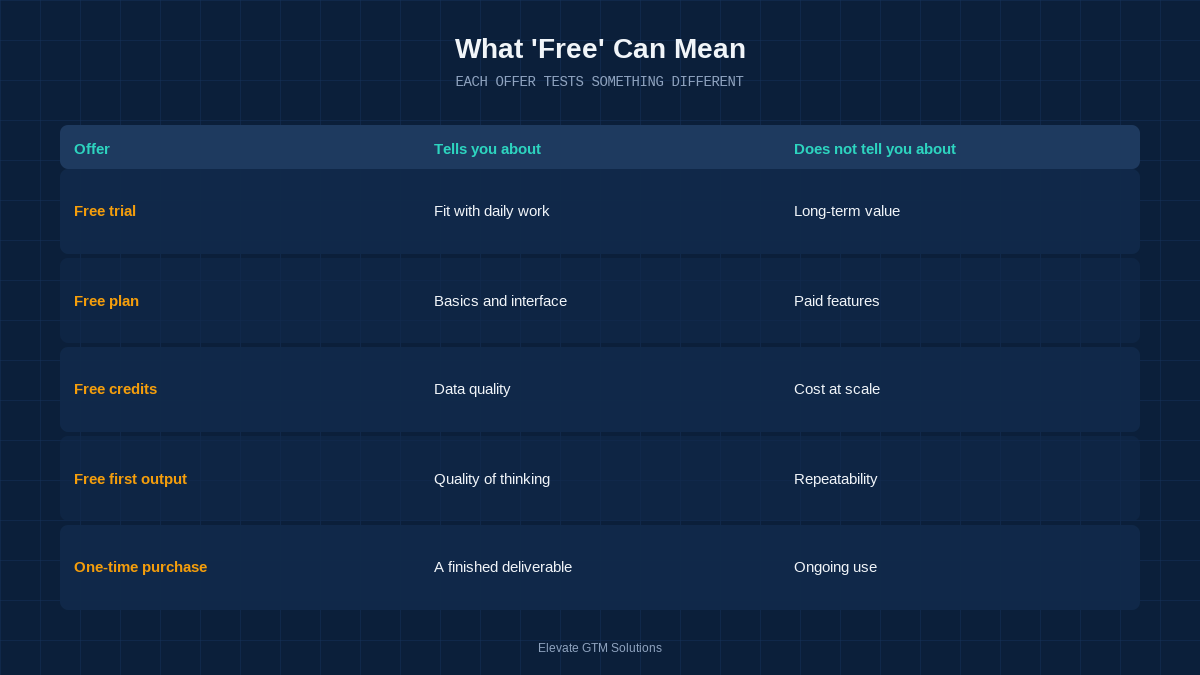
Here is a quick way to see what each tells you.
| Offer | Tells you about | Does not tell you about |
|---|---|---|
| Free trial | Fit with daily work, full feature set | Long-term value, renewal terms |
| Free plan | Basics, interface, ease of start | The paid features you actually want |
| Free credits | Data quality, workflow | Scale, cost at your volume |
| Free first output | Quality of the thinking or draft | Repeatability, collaboration, rollout |
| Demo or pilot | How it works on your scenario | Unsupervised use |
| One-time purchase | A finished deliverable, at fixed cost | Ongoing platform use |
Why go-to-market software is hard to trial
Trials work well for simple tools. A password manager either autofills your logins or it does not. Go-to-market software is different because the value shows up later and across several people.
A CRM trial is mostly a data question. Can you import your records, do the fields map, does the team actually update it? None of that is visible on day one, and a team that "tries" a CRM for a week without moving real work into it learns very little.
An outreach or enrichment trial is a quality question. Is the contact data accurate for your market, does it find the people you sell to, do the sequences send reliably? You need real prospects and a few weeks to see replies.
A strategy tool trial is a thinking question. The product produces a document, and the document is only valuable if it is right for your company and if your team will act on it. A document can look polished and be wrong. You need people who know your customers to read it critically.
Because of this, "I tried it for two weeks and liked it" is a weak result. A good trial answers a written question with evidence.
Which kinds of go-to-market tools tend to offer something you can try
This list is a pattern, not a directory. Offers change, so confirm each one on the vendor's own site.
CRM and marketing suites
Several well-known CRM and marketing platforms offer a free tier alongside paid plans. Typical limits are the number of users, the number of contacts, the reporting depth and the automation features. A free CRM is a reasonable way to test whether your team will actually keep records, but it is not a go-to-market strategy tool. It stores what you do. It does not decide what you should do. See GTM platform vs CRM for the difference.
Data and enrichment tools
These usually give a small bundle of credits or a short trial. They are good for testing data accuracy in your market. Test with accounts you already know well, so you can check the answers.
Outreach and sequencing tools
Trials are common, often short, and often restrict sending volume or integrations. They test deliverability and workflow more than strategy. Be careful about sending real outreach during a trial if you have not checked consent and sender rules for the regions you target.
Work-management and launch-planning tools
Free plans and downloadable launch templates are common. They are good for running a launch as a set of tasks with owners and dates. They do not create the strategy that the tasks carry out. If your problem is coordination, they may be enough. If your problem is that nobody has decided who the customer is, they will organise the confusion neatly.
AI writing and content tools
Free trials and limited free plans are common. They test whether the writing sounds like you and whether the workflow fits. They do not test whether the messaging is right, because the tool only knows what you give it.
Strategy and planning platforms
This is the smallest group. Many offer a demo, a pilot or a free first output instead of a long self-serve trial, partly because the product depends on the customer's context and partly because the output takes work to review. A few allow low-cost one-time purchases. Expect to spend more of your own time on review here and less on setup.
Revenue planning and capacity tools
These are generally enterprise products sold through sales conversations, with demos rather than free trials. If you need territory, quota and capacity planning, plan for a sales process.
How to find current offers without trusting a stale list
Lists of "free GTM tools" go out of date quickly. Use the sources in this order.
- The vendor's pricing page. It is the source of record. Look for the words "free," "trial" or "credits," and read the footnotes about what happens at the end.
- Review directories with a free-trial filter. Directories such as Capterra, GetApp, Software Advice, G2 and SourceForge let you narrow by pricing model, and some show a country version so you can see products listed for Canada or elsewhere. Their data comes largely from the vendors, so a listing may lag behind the vendor's site. Use the directory to build a shortlist, then check the vendor's page.
- Pricing-transparency directories. Some trackers list which vendors publish usable pricing. They are useful for seeing who shows prices at all.
- Peer reports. Ask in the communities where your buyers and peers talk. Note how recent the answer is.
- A direct question. Email or chat with the vendor and ask: what can I test without paying, for how long, with what limits, and what happens afterwards.
One practical point for Canadian and other non-US buyers: check the currency. Many vendors price in US dollars only, and a trial that converts to a US-dollar annual plan will cost more once exchange rates and tax are added.
What to test in a trial
Whatever the category, convert your goal into questions you can answer yes or no. Here are ten tests that apply to most go-to-market tools.
- The real scenario test. Use a real product, a real customer type and a real goal, not sample data.
- The specificity test. Does the output refer to your situation, or could it describe any company?
- The error test. Find at least three things in the output that are wrong or doubtful. If you cannot, you did not look hard enough. Note how easy they are to correct.
- The ownership test. Can the person who owns the decision change the output without calling the vendor?
- The handoff test. Can the output be given to a seller, a marketer or a product manager and used without a call to explain it?
- The integration test. Does it connect to the tools you already use, in the direction you need? Ask for the exact actions that are supported, because "integrates with" is not a specification.
- The collaboration test. Can two or three people work on it, comment and review?
- The repeat test. Do it a second time with a different product or segment. Is the quality consistent?
- The exit test. What can you export, in what format, and what happens to your data afterwards?
- The cost test. Work out what the paid version costs for your size, including seats, scopes, credits and any services you would need.
Score each from zero to two: zero if it fails, one if it partly works, two if it clearly works. Add the scores and compare tools on the same scale. It is crude, but it forces a decision that is more honest than a feeling.
A two-week plan for running a trial
Two weeks is enough for most trials if you prepare before day one. Longer trials get used less intensely, not more.
Before day one
- Write the question the trial must answer in one sentence. For example: "Can this produce a go-to-market plan for our new product that our sales lead would accept without a rewrite?"
- Name the owner and two reviewers.
- Collect the inputs: the product description, the customer you sell to, the main competitors, current pricing, a few customer conversations or win-loss notes.
- Write the pass mark: which of the ten tests must score two.
- Check the end-of-trial terms: card required, automatic renewal, data deletion.
- Put the end date and a reminder in a calendar.
Days one to three
The owner sets up the tool and runs the first real scenario. Capture what was easy and what was confusing. Do not polish yet. Save the first output exactly as produced.
Days four to seven
The two reviewers read the output independently. Each lists what is right, what is wrong and what is missing. Compare lists. Note disagreements, because they show where the output is vague enough to be read two ways.
Days eight to ten
Run the second scenario, a different product or segment. Test the integration and export steps. Try the collaboration features with all three people.
Days eleven to thirteen
Score the ten tests. Estimate the cost of the paid version. Ask the vendor the questions you gathered and note how clear and quick the answers are.
Day fourteen
Decide. Yes, no or "extend the test with a specific question." Write a short note saying why, so the next person does not repeat the work. Cancel anything you will not keep before the trial renews.
Traps in free trials
- Auto-renewal. The most common complaint is a card charged for a full year after a trial nobody finished. Set the reminder on day one.
- Sample data. A beautiful demo workspace tells you nothing about messy real data. Use your own.
- Feature gating. The feature you came for may be unavailable in the free tier. Ask before you start.
- Evaluating the demo, not the product. The vendor chooses the demo scenario. Choose your own.
- Too many people. A trial with eight testers produces eight opinions and no decision. Use one owner and two reviewers.
- Sending real outreach without checks. Test deliverability on controlled lists first.
- Judging polish as quality. A formatted document or a slick dashboard can hide weak content.
- No pass mark. Without one, every trial ends in "interesting, let's keep talking."
- Stopping at the first output. One result is a sample of one. Run it twice.
- Forgetting the exit. If you cannot export your work, you are not trying a tool, you are starting a dependency.
Testing a strategy tool: what to look for in the output
Because strategy tools produce a document, here is a closer look at how to judge one.
Does it name your buyers correctly? A good output identifies who buys, who influences and who blocks, using terms your customers would recognise.
Does it describe the alternatives you actually compete with? Include the "do nothing" option, the spreadsheet and the incumbent, not just the obvious named rivals.
Does it make choices, or list options? A strategy that says "target mid-market, enterprise and SMB" has not decided. Look for what it says to prioritise and what it says to leave out.
Does it separate evidence from assumption? If everything reads with equal confidence, treat that as a warning. You need to know which parts to test first.
Could someone act on it on Monday? Look for owners, sequences and measures, not just analysis.
Does it survive a hostile read? Give it to your most sceptical seller. If they find three real errors, that is useful information about how much review the output needs. If they find none, ask whether they read it carefully.
Is the next step clear? Many reports are good and leave readers asking "then what?" Look for a path from the report to activities, owners and a review rhythm.
For more on judging the quality of what an AI tool produces, see how to build a GTM strategy with AI and can AI build a full GTM strategy in minutes.
Free versus low-cost: when paying a little is the better test
A free trial has a clock and a card. A small one-time purchase has neither. If a vendor sells a single deliverable at a fixed low price, buying one can be a cleaner test than a two-week trial. You get a finished piece of work, you can judge it at your own pace, and nothing renews.
The trade-off is that a one-time purchase tests output, not ongoing use. It cannot tell you whether the collaboration features, workflows and dashboards will serve you over months. So use it to answer "is the quality good enough to look further?" and use a pilot or a subscription decision to answer the bigger questions.
Questions to ask a vendor before you start
- What exactly can I use for free, and for how long?
- What limits apply: users, records, credits, exports, integrations?
- Is a card required, and does anything renew automatically?
- What happens to my data and my outputs when the trial ends?
- Which features are held back until I pay?
- Can I bring my own data, or only sample data?
- What does the paid plan cost for a team of my size, in which currency, and what is excluded?
- Who supports me during the trial, and how quickly do they reply?
- Is there a named contact for security and data questions?
- Which of your customers is most like us, and can I speak to one?
The last question is the most revealing. Vendors with real customers like you can usually arrange a conversation. Vendors without them often cannot.
A worked example, invented for illustration
Maya runs marketing at a twenty-person software company in Toronto. The company is about to launch a second product. Nobody owns the go-to-market plan, and the sales lead has said the last one "lived in a slide deck." Maya has no budget approved and wants to test options before asking.
She writes the question: "Can a tool produce a launch plan for the new product that the sales lead would accept with light edits?" She names herself as owner and asks the sales lead and the product manager to review. She collects the product brief, three customer notes and the current price list.
She shortlists three kinds of tool: a work-management app with a launch template, an AI writing assistant and a strategy platform with a free first output. She checks each vendor's pricing page for terms and notes one needs a card.
Over two weeks she finds that the work-management app organises tasks well but gives no view on positioning or pricing. The writing assistant produces readable messaging quickly, but it repeats her inputs back with more adjectives. The strategy tool's output names a segment she had not prioritised, which the sales lead disputes, and misses a competitor the product manager considers the main threat. That gives her three specific conversations to have, which is more useful than a polished plan.
Her decision: use the work-management app to run the launch, use the strategy output as a starting point to argue with, and ask the vendor how the missing competitor can be added. She cancels the card-based trial before it renews. The whole test cost her about six hours of her own time and nothing else.
None of this is a real customer. It is an illustration of a test with a written question, a small team and a pass mark.
Where Elevate GTM Solutions fits
Elevate GTM Solutions is an AI-native GTM operating system and platform for B2B teams, based in Toronto. You describe your market, industry, product and segment, and the platform builds a structured go-to-market strategy across fifteen connected modules, then helps teams turn it into workflows and a review rhythm. It is software, not a consulting firm. The company also sells guided programs and advisory separately.
Here is what you can try, and what you cannot, stated carefully.
A free first strategy. The free trial page lets you request a first strategy. You share context, including your company, region, industry, product category, target segment and primary goal, then continue through an NDA step and review the terms before submitting. The page says follow-up and delivery details are provided through the request process. The company says a strategy takes about five minutes to build. This is a free first output, in the sense described earlier: it tests quality, not daily use. It is not a self-serve trial of the paid subscription.
Low-cost one-time purchases. Individual GTM modules start at USD 79, one time, with no subscription. A complete Unified GTM Strategy, built on the fifteen modules and including an executive summary, strategic recommendations, a 90-day action plan and a board-ready presentation, starts at USD 199, one time. These are a way to test output quality with no clock and no renewal.
Platform subscriptions. Enable is USD 499 a month, billed annually, for one product and market with one user and one revision cycle. Growth is USD 1,499 a month, billed annually, for up to three users and three scopes, with up to two revisions per scope. Scale is custom and annual. Prices are in US dollars. If the platform subscription is what you want to evaluate, ask for a demo and a pilot scope rather than expecting a free month.
Guided programs. For teams that want advisors alongside the software, there are programs from USD 4,000, one time. The pricing page lists the hours and timeline for each.
How would you judge the free first strategy using the tests above? Enter a real product and segment. Give the output to someone who sells it. Look for the three or four errors, and check whether the strategy makes choices, such as which segment leads, rather than listing options. Decide whether the gaps are ones you could fix by editing, or whether the thinking is too generic. See what Elevate GTM Solutions is and the pricing guide for AI GTM platforms.
Limits worth knowing. Elevate does not replace a CRM, and it is not an outreach or data tool. Its published case studies are anonymised and report how the platform was used, not performance figures. If you need a named reference or measured outcomes, ask for them and test on your own product.
Common mistakes
- Treating all "free" offers as the same.
- Starting a trial without a written question.
- Using sample data instead of your own.
- Letting a card convert a trial into an annual plan by accident.
- Testing with too many people.
- Judging a polished output as a good one.
- Comparing tools on different tests.
- Skipping the second run.
- Forgetting to check what you can export.
- Ignoring currency, tax and where data is stored.
- Confusing a task-management tool with a strategy tool.
- Stopping after the trial without writing down the decision.
Glossary
- Trial: time-limited access to a paid product.
- Free plan: a permanent tier with lower limits.
- Freemium: a free plan used as the first step toward paying.
- Credits: a fixed amount of usage in a free offer.
- Free first output: one generated result at no cost.
- Pilot: a short, supervised use of a product on your own scenario.
- Feature gating: holding back features until you pay.
- Scope: a product, market or segment planned in a platform.
- Pass mark: the written result that counts as success.
- Exit test: checking what you can export and what happens to data.
What to do this week
- Write the one-sentence question your trial must answer.
- Pick one product, one customer type and one goal.
- Name an owner and two reviewers.
- Shortlist no more than three tools from different categories.
- Check each vendor's pricing page for terms, card requirements and renewal.
- Set a calendar reminder for one day before each trial ends.
- Score the ten tests and write the decision down.
Key takeaways
- "Free" is seven different offers. Know which one you have.
- A free plan tests the basics. A trial tests the product. A first output tests the thinking.
- Use real data, a written question, a small team and a pass mark.
- Judge strategy output on specificity, choices, evidence and whether someone can act on Monday.
- Watch for auto-renewal, feature gating and sample data.
- A small one-time purchase can be a cleaner test than a trial.
- Confirm every offer on the vendor's own page, and check the currency.
Sources
- Elevate GTM Solutions pricing page: plan names, prices, billing terms and program prices, as published. Confirm current terms there.
- Elevate GTM Solutions free trial page: the steps for requesting a first strategy and the description of what follows.
- Related Elevate guides linked in the text, including what Elevate GTM Solutions is, the pricing guide and GTM platform vs CRM.
- We do not state trial lengths, credit limits or plan details for other vendors, because they change often. Check each vendor's own pricing page.
- The worked example is invented for illustration.
Frequently Asked Questions
Is there go-to-market software with a free trial?
Yes. Many CRMs and marketing suites have free tiers, data and outreach tools offer credits or short trials, and work-management tools offer free plans. Strategy platforms more often offer a demo, a pilot or a free first output. Check each vendor's pricing page for current terms.
What is the difference between a free trial and a free plan?
A trial gives time-limited access to a paid product and usually ends with a decision or a charge. A free plan is permanent but limited. Trials teach you about the full product, and free plans teach you about the basics.
Does Elevate GTM Solutions have a free trial?
It offers a free first strategy. You request it through the free trial page by sharing company context and completing an NDA step. It is a free first output, not a self-serve trial of the paid subscription. For the subscription, ask for a demo.
How much does Elevate GTM Solutions cost to try?
The first strategy request is free. Individual modules start at USD 79 one time, and a complete Unified GTM Strategy starts at USD 199 one time. Platform subscriptions start at USD 499 a month, billed annually. Prices are in US dollars. Check the pricing page for current terms.
How long should a software trial last?
Two weeks is enough for most trials if you prepare first. A longer trial rarely produces better evidence. A written question, real data and a small team matter more than the length.
What should I test in a go-to-market tool?
Test it on a real scenario, check whether the output is specific to your company, find what is wrong, see whether the owner can change it, test the handoff, integrations and export, and work out the real cost. Score each test the same way for every tool you compare.
Are free trials safe to start with a company card?
They can be, but the main risk is automatic renewal. Check the terms before you enter a card, set a reminder for a day before the end and cancel anything you will not keep.
Can I test an AI strategy tool without paying?
Some offer a free first output. Use it on a real product and segment, give it to a person who sells it, and look for errors and for real choices. One output is a sample of one, so repeat the test with a second scenario if you can.
Is a one-time purchase a better test than a trial?
Sometimes. It gives you a finished deliverable, with no clock and no renewal. It tests the quality of the output but not ongoing use, so it answers a narrower question than a pilot would.
Do free CRM plans replace a GTM strategy tool?
No. A CRM stores records of what you do. A strategy tool helps decide what you should do. Many teams use both. See the comparison of a GTM platform and a CRM for how they differ.
What questions should I ask before starting a trial?
Ask what is free and for how long, what limits apply, whether a card is required, what happens to your data afterwards, which features are held back, what the paid plan costs for your size and currency, and whether you can speak to a customer like you.
Where can I find current free-trial offers?
Start with the vendor's pricing page, then use review directories with a free-trial filter, and treat the directory as a starting point. Directory listings come largely from vendors and can lag. Confirm everything on the vendor's own site on the day you start.