
By the Elevate GTM Solutions Team · Updated November 13, 2026 · 27 min read
Can AI Build a Full Go-to-Market Strategy in Minutes? What a Fast First Draft Contains, What It Cannot Know and How to Validate It
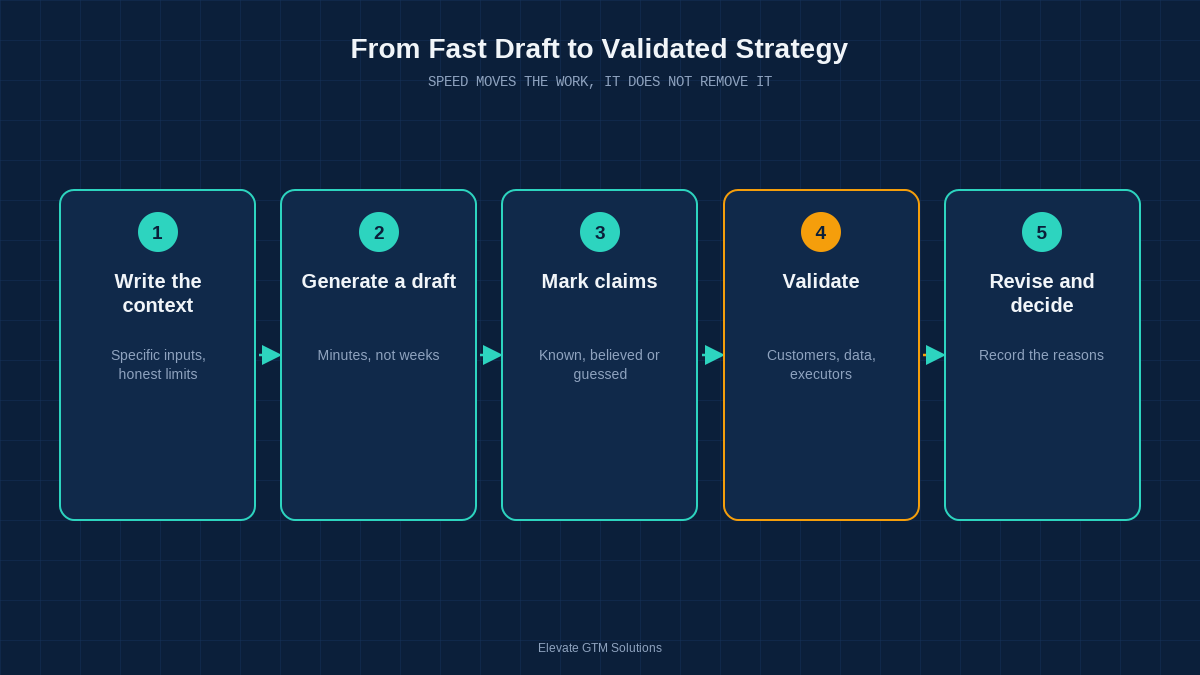
Some tools now claim to produce a complete go-to-market strategy in a few minutes, and the claim deserves a straight answer, because both the enthusiasts and the skeptics are partly right. A system can assemble a structured, coherent first draft very quickly: a view of the market, a proposed customer segmentation, positioning, messaging themes, pricing considerations, channel options and a launch outline. What it cannot do in minutes is know whether your customers will respond, whether your sales team can execute it or whether the assumptions that fed it are true. The honest framing is that a fast draft changes where you spend your time. You spend less of it staring at a blank page and more of it testing the draft against reality.
We make a GTM strategy platform, Elevate GTM Solutions, so we have an interest in this question. Our homepage describes building a strategy in "5 min OR LESS," and in this guide we explain what that means and what it does not. We cite no statistics, we describe other approaches in general terms and the examples are invented and labeled. Where we describe Elevate, we use what our own site and product describe, and we suggest you confirm details with us directly.
Can AI build a full go-to-market strategy in minutes?
AI can produce a structured first draft of a go-to-market strategy in minutes: a market view, customer segments, positioning, messaging themes, pricing considerations, channel options and a launch outline. It cannot, in minutes, know whether your customers will buy, whether your team can execute or whether your inputs are accurate. So treat a fast draft as a starting hypothesis, not a validated plan. The quality of the draft depends mostly on the quality of the context you give it, and its value depends on what you do next: test the assumptions with customers and data, have the people who will execute it challenge it and revise it as evidence arrives. A draft in five minutes followed by two weeks of validation is a better process than six weeks of drafting followed by no validation.
Is a five-minute strategy a finished strategy? No. It is a well-organized starting point that still needs checking.
What decides how good the draft is? The specificity and accuracy of the inputs you provide, and how honestly you review the output.
The short version
| Question | Answer |
|---|---|
| Can AI draft a GTM strategy in minutes? | Yes, a structured first draft, if it has enough context to work from |
| Is that draft a validated strategy? | No. It is a hypothesis to test |
| What does a draft usually contain? | Market view, segments, positioning, messaging, pricing considerations, channels, launch outline, measures |
| What can the draft not know? | Whether customers will buy, whether your team can execute, whether your inputs are true |
| What decides the quality? | Input specificity, honest review and a validation plan |
| Where does the time go instead? | Into checking assumptions with customers, data and the people who execute |
| What is the main risk? | Mistaking a fluent draft for a proven plan |
| What is the main benefit? | Speed to a concrete thing that people can argue with and improve |
Why speed is the real change
Most teams that struggle with strategy do not struggle with ideas. They struggle with the time it takes to get a coherent first version onto a page that others can react to. A blank document invites delay. A workshop produces sticky notes. A consultant produces a report weeks later. Meanwhile the market moves.
A fast, structured draft changes the dynamics in four ways.
It gives people something to react to. Disagreement about a concrete draft is far more productive than disagreement about an abstract question. A sales leader who says "this segment is wrong because our best customers are actually in that one" is giving you evidence. A sales leader asked "who are our customers?" in a meeting often is not.
It lowers the cost of trying alternatives. If a first draft takes weeks, you will only ever create one. If it takes minutes, you can produce several versions with different assumptions, and see which assumptions matter.
It makes revision normal. When producing a strategy is slow, people treat it as a precious artifact and avoid changing it. When it is fast, updating is routine.
It exposes missing inputs. A draft that comes out vague tells you which parts of your own context are unclear. Often the real finding is that the team has not decided who the customer is.
Speed does not remove the need for judgment. It moves judgment from producing the draft to evaluating it. See how long it takes to build a GTM strategy and how to build a GTM strategy with AI.
What a fast draft usually contains
The exact contents depend on the tool and the context you provide. A reasonably complete draft covers the following.
| Component | What it should say | What to check |
|---|---|---|
| Market view | The market, its segments and the forces shaping demand | Whether the facts match your own knowledge and any research you hold |
| Customer segments | Who you serve first and why | Whether segments reflect real customer behavior, not just firmographics |
| Ideal customer profile | The traits of your best-fit customers | Whether it matches the customers who actually succeed and renew |
| Positioning | How you are different and for whom | Whether the differentiation is real, provable and meaningful to buyers |
| Messaging themes | What you say to each persona | Whether the language sounds like your buyers, not like marketing |
| Pricing considerations | Models and levers to consider | Whether it fits your costs, market norms and sales process |
| Channels | Where and how to reach buyers | Whether your team can staff and sustain them |
| Launch outline | The sequence of activities | Whether timing, owners and dependencies are realistic |
| Measures | What to track to know it is working | Whether the measures can be collected and are agreed across teams |
A draft that is thin in any of these is a prompt to supply more context, not a reason to accept it.
What a draft cannot know
This is where expectations go wrong. Several things lie outside what any system can know from the inputs you give it.
Whether customers will actually buy. A segment can look attractive on paper and fail in the market. Only conversations and trials show demand.
Whether your inputs are true. If the product description overstates readiness, or the ideal customer is guessed, the draft will be built on those errors and will sound confident anyway.
What your team can execute. A plan that needs ten outbound sellers is useless to a team with two. The draft does not know your capacity, culture or skills unless you tell it.
Local and recent facts. Events from the last few weeks, a competitor's quiet change in pricing or a regulation in one region may not be in the draft.
Internal politics and constraints. Decision rights, budget cycles and executive preferences shape what can happen. A draft does not see them.
Your history. Past campaigns that failed, customer relationships and unspoken commitments all matter and may not be in the context.
None of this is unique to AI. A human consultant who has never met your customers faces the same limits. The difference is that a human tends to say so, and a fluent draft may not.
Garbage in, confident out
The most important property of a fast draft is how much it depends on what you give it. A vague input produces a generic output that reads smoothly and says little. A specific input produces something that can be useful.
Consider two ways to describe the same company, invented for illustration.
Vague: "We sell software to businesses that want to improve their operations."
Specific: "We sell scheduling software to mid-size independent clinics, usually fifteen to eighty staff, that currently use paper or a spreadsheet. Our best customers have three or more locations. Our main alternative is doing nothing. Our weakest area is integration with legacy records systems. We have around forty customers, most from referrals."
The first produces something any company could have written. The second gives the system and the reader enough to propose a segment, a message and a list of risks.
Before you ask for a draft, write down:
- What you sell and what it does, in plain terms, including what it does not do.
- Who your best current customers are, and why they bought.
- Who you lose to, and why.
- What you know with evidence, and what you only believe.
- Your constraints: team size, budget, timeline, regions.
- What you want the strategy to decide: a launch, an entry into a new market, a fix to performance or a repositioning.
See GTM Insights and context for why a shared context matters.
How to review a draft honestly
The review is where the value is created. A structured review takes an hour or two and is worth more than any additional polish.
Mark every claim: known, believed or guessed
Go through the draft and label each statement. "Known" means you have evidence, such as customer data or a research result. "Believed" means it seems right, but nobody has checked it. "Guessed" means the draft supplied it and you cannot say whether it is true. The guessed and believed items are your validation list.
Look for the unsupported specifics
Precise-sounding claims about market size, buyer behavior or competitor positioning deserve special suspicion. If a figure appears, ask where it came from. A draft is allowed to propose hypotheses and should not be treated as a source of facts.
Test the segments against real customers
Take your five best customers and your five worst. Do the draft's segments and profile describe the first group and exclude the second? If not, the segmentation needs work.
Read the messaging aloud
Would a buyer say these words? Messaging that sounds like a brochure usually fails in conversation. Compare it with the language customers used in sales calls and support tickets.
Challenge the plan with the people who will run it
Show the draft to a seller, a marketer, a product manager and a customer success lead. Ask each what would not work. Their objections are cheap now and expensive later.
Check the sequence and the dependencies
Look at timing, owners and prerequisites. A launch outline that assumes assets that do not exist yet is a common failure.
Decide what would change your mind
For each major choice, write down what evidence would make you pick a different option. This turns the draft into an experiment.
A validation plan for the first two weeks
A fast draft pays off only if validation follows. A simple plan:
Days one and two: review internally. Do the mark-up of known, believed and guessed. Share with the four roles above and collect objections.
Days three to eight: talk to customers and prospects. Aim for a modest number of conversations, perhaps eight to fifteen, across the segments the draft proposes. Ask about their problems, how they buy and what they use today. Do not pitch. Listen for language and for disconfirming evidence.
Days nine and ten: check the data. Look at your own win and loss records, pipeline by segment and customer retention by segment. See whether the data supports the draft's priorities.
Days eleven to fourteen: revise and decide. Update the strategy using what you learned, record the decisions and the reasons and set a small number of measures and a review date.
Two weeks is an example. The point is that validation has a named owner, a time box and an output. See GTM strategy handoff and how to measure GTM strategy success.
Where speed helps and where it can hurt
Speed is useful in some situations and risky in others.
| Situation | Effect of a fast draft |
|---|---|
| A new product with few customers | Helpful for structuring hypotheses, with heavy emphasis on validation |
| A new market or region | Helpful for a first view, though local knowledge matters more |
| A repositioning | Helpful for generating options to test |
| A high-stakes enterprise launch | Useful as input, and should be reviewed with more rigor and time |
| A regulated industry | Useful as a structure, and claims and messaging need careful review |
| A team that has never defined an ICP | Useful for provoking decisions, and likely to expose missing inputs |
| A leadership team that disagrees | Useful to focus the argument, and unlikely to settle it by itself |
The risk of speed is that people stop thinking once something looks complete. A well-formatted document carries authority. Make the review step explicit so that authority is earned.
Common objections, answered honestly
"If it takes five minutes, it can't be good." Time spent is a poor measure of quality. A draft assembled from good inputs by a system with a sound structure can be a better starting point than a rushed human draft. The question is what happens after.
"AI strategies are generic." They are when the inputs are generic. Specific inputs and an honest review produce specific output.
"We should hire a consultant instead." Consultants bring outside judgment and experience that a draft does not. A fast draft and a consultant can work together, with the draft providing a starting point to challenge. See GTM platform vs GTM consultant.
"Our market is too specialized." Specialized markets need more of your knowledge in the inputs and more review. They are not a reason to avoid a structured draft.
"What if the draft is wrong?" Parts of it will be. That is why you validate. A wrong hypothesis found in week two costs far less than one found in month six.
A worked example, invented for illustration
Imagine a company of about forty people selling workflow software to mid-size logistics firms. These details are invented and describe no real company.
The head of marketing writes a one-page context: what the product does and does not do, the five best customers, the main competitor and the main reason deals are lost, which is a long integration process. She asks for a first draft and receives it in minutes. It proposes two segments, regional carriers and third-party logistics providers, suggests positioning around implementation speed and offers messaging themes for operations managers and finance leads.
She does the mark-up. The claim that third-party logistics providers are the larger opportunity is "believed," because nobody has checked the pipeline. The implementation speed claim is "guessed," because the company's own data shows implementation averages longer than the draft assumed. She flags the finance messaging as "known," since customers have said finance cares about reporting.
Over the next two weeks, she speaks with twelve customers and prospects and reviews win and loss data. She discovers that regional carriers close faster and renew more often. The implementation speed claim is dropped, and a message about visibility into delivery costs, which customers brought up repeatedly, replaces it. The revised strategy focuses on regional carriers first and sets three measures.
Notice that the draft did not replace her work. It gave her something concrete to test, and the test changed the strategy.
How a platform can support the process
Tools differ in how well they support this loop. When you evaluate one, ask:
| Question | Why it matters |
|---|---|
| What context does it ask for, and can you add your own evidence? | Inputs decide the output |
| Does it separate facts you provided from suggestions it generated? | You need to see what is known and what is proposed |
| Can you edit, add collaborators and track versions? | Validation is a team activity |
| Does the strategy connect to the work that follows? | A draft that stays in a document ages quickly |
| Can you revise it as evidence arrives without starting over? | Iteration is the point |
| How are outputs exported and shared? | Leaders and teams need usable formats |
| What does it not do? | Honest limits are a good sign |
See questions to ask AI GTM vendors and how to tell if a GTM platform is really AI-native.
Questions to ask yourself before you generate a draft
- What decision do I need this strategy to support?
- What do I know with evidence, and what do I only believe?
- Who are my five best and five worst customers, and what separates them?
- Who will challenge the draft, and when?
- What would change my mind about the main choices?
- Who owns validation, and by what date?
- How will I record the decisions and the reasons?
- What will I do if the draft and the evidence disagree?
Common mistakes
Treating the draft as the answer. A draft is a hypothesis. Plan the test.
Giving vague context. Specific inputs are the largest quality lever.
Skipping the known, believed, guessed mark-up. Without it, guesses harden into assumptions.
Reviewing alone. The people who will execute the plan see problems that planners miss.
Letting polish stand in for proof. A good-looking document earns no extra credibility.
Talking to customers only to confirm. Look for disconfirming evidence.
Not recording decisions. If the reasons are lost, the next revision starts from scratch.
Never revisiting it. The advantage of speed is that you can update often.
What a good first draft looks like in practice, by section
It helps to know what "good enough to start with" means for each part, so that you can tell a useful draft from a decorative one.
Market view. A good one names the segments of the market, describes what is changing and says what is uncertain. A weak one is a paragraph of generalities that could describe any industry. Test: could a competitor's strategy contain the same paragraph?
Segments. A good draft proposes a small number of segments, ranks them and says why. A weak one lists six segments with equal weight. Test: does it help you say no to someone?
Positioning. A good statement names the buyer, the alternative they use today and the specific way you are better. A weak one uses words like "best-in-class" and "end-to-end." Test: could the sentence be proven wrong?
Messaging. Good messaging differs by persona and links each claim to proof you can show. Weak messaging gives one message to everyone. Test: would an operations manager and a finance lead recognize themselves?
Pricing considerations. A good section lays out options and the trade-offs between them, and says what data would settle the choice. A weak one asserts a price. Test: does it say what you would need to learn?
Channels. A good draft ties each channel to a segment and to a team's capacity. A weak one lists every channel. Test: could your current team run it?
Launch outline. A good outline has sequence, owners and dependencies. A weak one is a list of activities. Test: does each step have a person and a date?
Measures. Good measures are few, definable and tied to decisions. Weak ones are a dashboard of everything. Test: for each measure, what would you do differently if it moved?
Using several drafts to find what matters
One advantage of a fast process is that you can generate more than one draft and compare them. This is not about picking the prettiest. It is a way to find which assumptions drive the result.
Change one input at a time. Write the same context with a different primary segment, or with a different main competitor, or with a different constraint on team size. Read the drafts side by side and note what changes and what stays the same.
What stays the same across versions holds up, so you can spend less time worrying about it. What changes is sensitive to your assumptions, and that is where validation effort belongs. If switching the primary segment rewrites the whole plan, you have found the decision that matters most. See how to compare multiple GTM strategies before committing budget.
Who should be in the room when you review a draft
Strategy review works better with a small, mixed group than with a large meeting.
| Role | What they bring to the review |
|---|---|
| Founder or executive sponsor | The business goal and the constraints on budget and risk |
| Sales lead | What buyers actually say, and what the team can sell |
| Marketing lead | Messaging, channels and how demand is created |
| Product lead | What the product does well, what it does not and what is coming |
| Customer success lead | Why customers stay, why they leave and what they ask for |
| Revenue operations | Whether the data can measure what the plan needs |
| An outsider, where possible | Questions that insiders no longer ask |
Keep the group to the people who will own or be affected by the decisions, and give each a specific question to answer, such as "what would not work in my area?" Ask them to write the objections down before the meeting, so that the loudest voice does not set the agenda.
A short checklist before you rely on a draft
Before the strategy leaves the review stage and goes to the wider team, check that you can answer yes to each of these.
- Every major claim is labeled known, believed or guessed.
- The guessed items each have a named owner and a way to test them.
- The segments describe your best customers and exclude your worst.
- The messaging uses language your buyers use.
- The plan fits the team's real capacity.
- Sequence, owners and dates exist for the first thirty days.
- There are three to five measures, each with a definition and a source.
- The reasons for each major choice are written down.
- A review date is on the calendar.
If you cannot tick most of these, the draft is still a draft, and that is fine. The danger is acting as though it were more.
What to do when the draft disagrees with your instincts
Sooner or later a draft will propose something that feels wrong. Maybe it ranks a segment you have ignored above the one you love, or it suggests a message that makes you wince. Two reactions are tempting and both are mistakes: dismissing it because it clashes with your experience, and accepting it because it looks authoritative.
A better response is to treat the disagreement as a question and find the cheapest way to answer it.
Ask what would have to be true. If the draft is right that the overlooked segment is better, what would you expect to see in your data? Higher win rates, faster cycles, better retention? Check whether you do.
Ask what you might be missing. Your instinct may be based on a handful of memorable deals. The draft may be based on the pattern in what you supplied. Either can be wrong, and the data often settles it quickly.
Run a small test. Contact ten accounts in the unfamiliar segment and see what happens. A cheap experiment beats a long debate.
Write down the result. If the instinct was right, note what the draft got wrong, since that points to a missing input. If the draft was right, note what you learned. Either way, the next draft is better.
Teams that handle disagreement this way tend to get more from fast drafts than teams that treat them as oracles or as toys.
How often to redraft
A strategy drafted in minutes can be redrafted in minutes, and that changes how often it makes sense to revisit it. A reasonable rhythm is a light review monthly, to check the measures and note anything in the market that changed, and a fuller redraft each quarter or whenever something significant happens: a new competitor, a major customer win or loss, a product release or a change in pricing. Each redraft should start from the previous version and the decisions recorded in it, not from a blank page, so that learning accumulates instead of being repeated.
Glossary
GTM strategy. The set of decisions about who you serve, why they buy, how you reach them, how you price and how you measure. See GTM strategy.
First draft. A structured initial version of a strategy, meant to be tested and revised.
Hypothesis. A proposed explanation or choice that has not yet been tested.
Validation. Checking a draft against customer conversations, data and the people who will execute it.
Context. The facts, constraints and goals supplied as input. See what is a GTM context layer.
ICP. The ideal customer profile. See ICP.
Disconfirming evidence. Information that contradicts a belief you hold.
Where Elevate GTM Solutions fits
Elevate GTM Solutions is an AI GTM platform for building, executing and evolving go-to-market strategy. The homepage describes building a first unified strategy "in minutes," with "5 min OR LESS" in the headline claim, and a free offer that includes personalization to your business and an executive GTM report. In practice, we describe the time as about five minutes for a first draft, and we say plainly that a first draft is not a validated strategy.
The way it works, as we describe it, starts with GTM Insights, where you enter details about the market, industry, product and segment. You can use these before or after you create a strategy. Strategy Context captures triggers, signal sources and GTM velocity, and is saved as context. In the Strategy Builder you enter the company, product, industry and segment, and choose one of fifteen modules or the Unified GTM option, which our homepage lists as the sixteenth entry. The result is a structured strategy and an executive report.
What it does not do: it does not verify your inputs, talk to your customers or know your team's capacity. Validation is your job, and the platform is designed to make revision easier, since a strategy can be edited, collaborators can be added and the work moves through stages. We suggest you try the free offer with a real product, then run the mark-up and the two-week validation described above. Confirm current features, limits and pricing with us directly. See what Elevate GTM Solutions is and what is a GTM operating system.
What to do this week
- Write a one-page context for one product: what it does and does not do, best customers, lost deals and constraints.
- Generate a first draft, from any tool or by hand, and label every claim known, believed or guessed.
- List the five claims that would change the strategy most if they turned out to be wrong.
- Schedule eight to fifteen customer or prospect conversations.
- Pull win and loss data by segment for the last four quarters.
- Show the draft to a seller, a marketer, a product manager and a customer success lead and collect objections.
- Decide who owns validation and set a date to revise.
- Write down what evidence would make you change your main choice.
Key takeaways
- AI can produce a structured first draft of a GTM strategy in minutes, and it is a hypothesis, not a validated plan.
- A draft cannot know whether customers will buy, whether your inputs are true or whether your team can execute.
- Input quality is the largest lever: specific context produces specific output.
- Review honestly by marking claims known, believed or guessed, testing segments against real customers and challenging the plan with the people who will execute it.
- Plan validation, with an owner, a time box and an output.
- Speed is most useful when it makes revision normal and cheap.
- Choose tools that separate your facts from their suggestions, support collaboration and keep the strategy connected to execution.
- A draft in five minutes followed by two weeks of validation beats a long drafting process with no validation.
Sources
- Elevate GTM Solutions: the "5 min OR LESS" claim, the free offer and the module and product descriptions, as stated on the company's homepage and in its product flow.
- Related Elevate guides linked in the text, including how to build a GTM strategy with AI and GTM strategy handoff.
- The review method and validation plan reflect our judgment and common practice. The worked example and the context examples are invented. We state no statistics and make no claims about other vendors.
Frequently Asked Questions
Can AI build a full go-to-market strategy in minutes?
It can produce a structured first draft in minutes: a market view, segments, positioning, messaging themes, pricing considerations, channels and a launch outline. It cannot know whether customers will buy or whether your inputs are true, so treat the draft as a hypothesis to validate.
Is a five-minute strategy a finished strategy?
No. It is a well-organized starting point. It needs review by the people who will execute it, checking against customer conversations and data and revision as evidence arrives.
What makes the draft good or bad?
Mostly the specificity and accuracy of the context you provide, and how honestly you review the output. Vague inputs produce generic drafts that read smoothly and say little.
What should I provide before generating a draft?
What you sell and do not do, your best and worst customers, who you lose to and why, what you know with evidence versus what you believe, your constraints and the decision the strategy must support.
How do I validate a fast draft?
Mark each claim as known, believed or guessed, test segments against real customers, read the messaging aloud, challenge the plan with sellers, marketers, product and customer success, then talk to customers, check win and loss data and revise within a set period.
What can a draft never know?
Whether customers will actually buy, whether your inputs are accurate, what your team can execute, very recent local facts, internal constraints and your own history.
Does speed make strategy worse?
Not by itself. Speed helps when it makes alternatives cheap to try and revision normal. It hurts when people stop thinking because a polished document looks finished.
Should I use a consultant instead?
They solve different problems. A consultant brings outside judgment and experience. A fast draft gives you something concrete to challenge. Many companies use both.
How long should validation take?
A focused first round can take about two weeks: internal review, a set of customer conversations, a data check and a revision. Longer sales cycles may need more time to see results.
What does Elevate's five-minute claim mean?
We describe it as about five minutes to build a first draft in the platform. A first draft is not a validated strategy, and the homepage wording is "5 min OR LESS." Confirm current details with us.
Can I try it without paying?
Elevate offers a free GTM strategy. Confirm what is included and any limits with us directly before relying on it.
What if the draft and my evidence disagree?
Trust the evidence. Record what differed and why, revise the strategy and note which assumptions turned out wrong, since that is useful learning for the next revision.