
By the Elevate GTM Solutions Team · Updated November 13, 2026 · 25 min read
How Long Does It Take to Build a Go-to-Market Strategy? Realistic Timelines by Situation, and What Actually Eats the Time
Ask five people how long a go-to-market strategy takes and you will hear "a weekend," "six weeks," "a quarter" and "it never ends." They are all partly right, because they are describing different things. A one-page plan for a single product sold to one kind of customer is a different job from a multi-region strategy for a company with four product lines, and both are different from the ongoing work of keeping a strategy current.
This guide gives you honest ranges for common situations, explains what takes the time, shows how to shorten the process without cutting the parts that matter, lays out week-by-week plans for a four-week and a ten-week version and describes what to do after the first version exists. The ranges are our judgment, built from how this work usually unfolds, and they are not measured benchmarks. We found no trustworthy published study of strategy timelines and we do not invent one. We make a GTM strategy platform, so we have an interest in people finishing faster, and we say where speed is a bad idea. The examples are invented.
How long does it take to build a go-to-market strategy?
For a single product sold to one clear customer type, a usable first version usually takes about two to six weeks of calendar time, even though the actual working hours are much smaller. For a company with several products, segments or regions, expect roughly two to four months to reach a first version that leadership has genuinely agreed to. Large enterprises with many stakeholders can take longer, often because of alignment rather than analysis. These are rules of thumb, not benchmarks. Most of the time goes to decisions and agreement, not to writing. A rough first draft can exist in days, and tools that draft from your inputs can shorten research and writing. They do not shorten the time it takes leaders to decide who the customer is. Finally, a strategy is never finished. The first version is a starting point that you test and revise, usually within the first quarter.
What is the fastest sensible version? One week for a rough, testable draft, if the founder or a small team decides quickly and plans to validate it right away.
What makes it slow? Unclear ownership, leaders who disagree about the customer, scattered data and trying to make it perfect before testing.
The short version
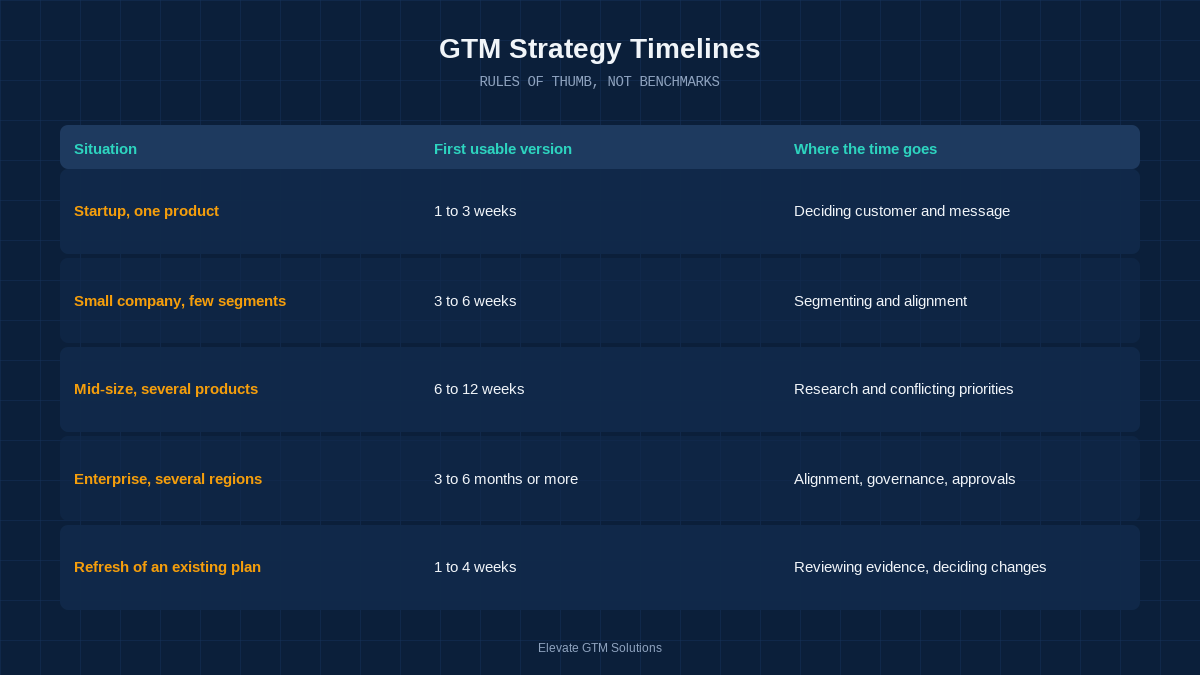
| Situation | Typical calendar time to a usable first version | Where the time goes |
|---|---|---|
| Startup, one product, one customer type | 1 to 3 weeks | Deciding the customer and the message, a handful of customer conversations |
| Small company, one product, a few segments | 3 to 6 weeks | Segmenting, choosing priorities, aligning sales and marketing |
| Mid-size company, several products or channels | 6 to 12 weeks | Research across products, conflicting priorities, pricing and channel choices |
| Enterprise, several regions and business units | 3 to 6 months or more | Stakeholder alignment, governance, local adaptation, approvals |
| Product launch plan within an existing strategy | 2 to 6 weeks | Launch-specific messaging, readiness and sequencing |
| Refresh of an existing strategy | 1 to 4 weeks | Reviewing evidence, deciding what changes |
Treat the ranges as starting estimates and adjust for your own situation. If your company is slow to decide, add time. If you have a small team with a clear point of view, subtract.
Why there is no single number
Three things stretch or shrink the timeline, and they have little to do with how fast anyone types.
Scope. "A GTM strategy" can mean a one-page plan, a ten-section document or an operating model for a global company. A narrow scope, such as one segment or one launch, finishes much faster.
Clarity. If the company already knows who its best customers are and why they buy, the work is mostly writing it down and planning. If it does not, the work includes discovering that, which takes real conversations and cannot be rushed by clever software.
Decision speed. Strategy is a series of choices: who we serve first, what we say, how we price, where we compete. Each needs someone with authority to decide. A company where the CEO decides in a meeting finishes in days. A company where six leaders must agree by consensus can take months to make the same choices.
What the time is spent on
It helps to separate the activities, because only some of them are compressible.
1. Gathering what you already know (days)
Closed-won and closed-lost deals, customer lists, support themes, sales notes and past campaigns. Most companies know more than they think but have it scattered. Collecting it takes days if someone owns it, longer if people must be chased.
2. Research (days to weeks)
Market size, competitor positioning, customer interviews, review analysis. Customer conversations are the long pole, because scheduling takes time even if each one is short. Desk research can be fast, and AI-assisted tools shorten it considerably.
3. Analysis and synthesis (days)
Turning raw material into segments, an ICP and a view of competitors. This is where experienced judgment saves the most time.
4. Decisions (days to months)
Which segments first, what the positioning is, what pricing and channels to use. The calendar time depends on the people, not the task.
5. Writing and packaging (days)
Turning decisions into something others can use: a plan, messaging, a one-page summary. Drafting tools help here.
6. Alignment and review (days to weeks)
Sales, marketing, product and customer success read it, argue and revise. Skipping this saves time and costs it later, because a plan the field has not seen will not be followed.
7. Rollout (weeks)
Enablement, tool changes, targets, communication. Many teams count the strategy as done when the document is done, and then wonder why nothing changed. Rollout is part of the work. See GTM strategy handoff.
| Activity | Compressible? | How |
|---|---|---|
| Gathering existing knowledge | Yes | Name an owner, use a shared folder, set a deadline |
| Desk research | Yes, a lot | Use AI-assisted research and keep scope narrow |
| Customer conversations | Somewhat | Run several in parallel, aim for a small number of good ones |
| Synthesis | Somewhat | Use a template and an experienced facilitator |
| Decisions | Only by deciding | Give one person authority and a deadline |
| Writing | Yes | Drafting tools and a short format |
| Alignment | Somewhat | Review in a live session instead of rounds of comments |
| Rollout | Not really | Start planning it while the strategy is being written |
What makes it slower
- No single owner. When "everyone" owns the strategy, nobody schedules the meetings or breaks ties. See who owns GTM strategy.
- Leaders who disagree about the customer. This is the biggest hidden delay. Analysis does not resolve a disagreement about values or ambition. Someone must decide.
- Data scattered across tools. Time disappears into finding and reconciling numbers.
- Waiting for perfect research. Teams postpone decisions until the data is complete, and it never is.
- Consensus as a requirement. Seeking full agreement from every stakeholder multiplies the calendar time.
- Scope creep. A segment plan turns into a company strategy, then into a rebrand.
- Too many reviewers. Every additional reviewer adds a round. Limit it to the people who must act on the plan.
- No deadline. Work without a date expands to fill the time available.
- A strategy built by a consultant who then leaves. The handoff can take longer than the work, because the team did not own the thinking. See GTM strategy without a consultant and when you still need a GTM consultant.
What makes it faster, without cutting what matters
- One decision-maker with a deadline. Consult widely, decide narrowly.
- A narrow first scope. One product, one segment, one quarter. Extend after it works.
- Use what you already have. Start from won and lost deals before commissioning research.
- Fewer, better conversations. Eight to twelve good customer conversations beat sixty survey responses for most early-stage questions. Treat that as a heuristic, not a rule.
- A template. Do not invent the structure. Use one, such as the GTM strategy framework or the GTM planning template.
- Drafting help. AI tools and platforms can produce a first draft of segments, positioning and competitive context from your inputs, which turns a blank page into something to criticize. See how to build a GTM strategy with AI.
- Live review. Put the draft on a screen with the stakeholders in the room and settle disagreements there.
- Plan the rollout in parallel. Start enablement and tool changes while the final wording is being settled.
A four-week plan for a single product or segment
This is a realistic shape for a small company. Adjust it to your people.
Week 1: Decide the scope and gather.
- Name the owner and the decision-maker.
- Decide the scope: one product and one or two segments.
- Gather won and lost deals, customer lists, sales notes and competitor material.
- Book customer conversations for week two.
- Write the questions the strategy must answer: who, why us, what do we say, how do we reach them, how will we know.
Week 2: Learn.
- Run six to ten customer conversations, including customers who chose you, customers who left and people who chose a competitor if you can reach them.
- Analyze closed-won and closed-lost deals for patterns.
- Gather market and competitor information. See market sizing framework.
- Draft segments and a first ICP. See what is an ICP.
Week 3: Decide and draft.
- Decide the priority segment and the positioning. See positioning.
- Draft messaging for the main personas, the pricing approach and the channel plan.
- Define five to eight metrics and the assumptions you want to test. See GTM metrics and KPIs.
- Write the one-page summary.
Week 4: Align and launch the first test.
- Review with sales, marketing, product and customer success in a live session.
- Fix what they catch.
- Set up the first test: a campaign, a set of outbound accounts or a pilot.
- Schedule the first review for thirty days out.
At the end you have a strategy that is good enough to test, not a final answer. That is the correct goal.
A ten-week plan for several products or regions
Weeks 1 and 2: Frame. Agree on the scope, the owner, the governance and the decisions that are global versus local. See global vs local GTM strategy. Gather material by product and region.
Weeks 3 to 5: Research and segment. Run conversations in each major region or product line, analyze deals, assess competitors and size segments. Produce a shared segment model and an ICP for each product.
Weeks 6 and 7: Decide. Run decision meetings. Pick priorities by product and region, decide pricing principles, channel approaches and the common messaging platform with room for local adaptation.
Weeks 8 and 9: Draft and align. Write the plan, messaging and metrics. Review with regional and product leaders. Resolve conflicts.
Week 10: Finalize and roll out. Publish the plan, assign owners, plan enablement and set the review rhythm.
Large companies often add governance steps, such as budget approval and legal review, that can add weeks. Plan for them early. See enterprise GTM operating system implementation roadmap for the technology side.
A one-week sprint, and when it is wise
A one-week version is possible when a small team has a strong point of view and needs a testable draft. A rough shape:
- Day 1: Write the hypotheses. Who is the customer, what problem, why us, how do we reach them.
- Day 2: Review your won and lost deals and last twenty customer conversations.
- Day 3: Draft segments, ICP and positioning.
- Day 4: Draft messaging, channels, pricing approach and metrics.
- Day 5: Review with two or three trusted people and set up the first test.
A sprint makes sense if you will test it immediately and revise, if the scope is narrow and if the cost of being wrong is low. It is a bad idea when the decisions are expensive to reverse, such as a major pricing change, a market entry or an acquisition integration, where a test-first plan with stages is wiser. See how to enter a new market without wasting budget.
Worked examples, invented for illustration
Company A: a six-person startup selling scheduling software to dental clinics. The founder knows the customers well. In two weeks, she interviews eight clinic managers, reviews fifteen early customers, decides to focus on multi-chair clinics and writes a two-page plan. The draft takes a few days. Most of the two weeks is spent scheduling interviews. The first test begins in week three.
Company B: a 120-person company with two products and three sales channels. The CEO wants a strategy for the next fiscal year. The team spends three weeks gathering and analyzing, then discovers that sales and marketing disagree about which product to lead with. That disagreement takes four more weeks and a decision from the CEO. The writing takes one week. Total: about two months, of which the argument is half.
Company C: a global company with four business units. A central team builds a shared framework in eight weeks, then each unit adapts it, which takes another two months. Legal and finance reviews add three weeks. The first complete version is ready in roughly five months. The shared definitions turn out to be the most valuable part, because they made later planning cycles shorter.
In all three, the time was driven by decisions and alignment more than by research or writing.
What to do while you wait for the "right" answer
Decisions often stall because someone wants more certainty. Some ways to move forward without pretending to know:
Write the assumption and test it. "We believe multi-chair clinics convert at a higher rate than single-chair." Choose a cheap test and a date.
Decide the reversible parts now. Messaging and channel experiments are easy to change. Pricing and entry into new markets are harder. Move fast on the first, deliberately on the second.
Set a decision date. If a decision is not made by the date, the owner decides.
Separate "what we believe" from "what we know." Mark each claim in the plan. It keeps the document honest and shows where to learn next.
See the GTM experimentation framework for ways to turn assumptions into tests.
What "good enough to start" looks like
A first version is good enough when:
- It names a specific priority segment and explains why.
- It states who the buyer and the user are, in words they would recognize.
- It says what you do better than the main alternative, honestly.
- It states a price approach and a channel approach, even if provisional.
- It lists five to eight metrics and the assumptions behind them.
- Sales, marketing and customer success have read it and can say it back.
- Someone owns it, and a review date is set.
If you can tick these, stop polishing and test. A strategy that is better but untested is usually worse than a decent one that has met customers.
What happens after the first version
The first version is the beginning of a cycle, not the end. A typical rhythm:
First thirty days. Run the first test. Collect the results and the surprises.
Days thirty to ninety. Revise based on evidence. Many teams find that the priority segment, the message or the channel needs adjustment. That is normal. See first 90 days after a product launch.
Each quarter. Review the strategy. How much time this takes depends on the company, but a half-day review with preparation is common for smaller teams, with more for larger organizations. See continuous GTM optimization.
Each year. Take a fresh look at the assumptions, the market and the competitive landscape.
Treating strategy as a living artifact changes the question from "how long does it take?" to "how fast can we get to a testable version, and how fast can we learn from it?" See the death of static GTM strategy.
Where AI and platforms change the timeline
Software and AI shorten some steps considerably and leave others unchanged.
| Step | Effect of AI or a platform |
|---|---|
| Gathering and organizing existing information | Can reduce time substantially if data is accessible |
| Desk research and competitor summaries | Faster first drafts. Needs checking for errors and out-of-date material |
| Segment and ICP drafts | Quick starting points to react to |
| Messaging drafts | Quick variations. Quality depends on inputs and editing |
| Customer conversations | No substitute. AI can help prepare and summarize |
| Decisions | No change. People decide |
| Alignment | Little change. Shared visibility can reduce confusion |
| Rollout | Some help with enablement and tool handoff |
A reasonable expectation is that drafting and research shrink from weeks to days, while decision-making and alignment stay as slow as your organization is. Be wary of any promise to produce "your complete GTM strategy in minutes" as a final answer. A quick first-pass draft is useful, and a validated strategy is something you earn through testing.
Common mistakes
Planning for months before talking to a customer. Talk to customers in the first two weeks.
Treating the document as the goal. The goal is a changed way of working. Count rollout in the timeline.
Starting with too wide a scope. A strategy for "everything" is rarely sharp enough to act on.
Seeking unanimous approval. Consult widely and decide clearly. Waiting for everyone to agree is a common source of delay.
Skipping the field. If sales and customer success have not helped shape it, it will not be used.
Believing a fast draft is a finished strategy. A draft needs testing. Plan the test before you call it done.
Never setting a review date. Without it, the strategy decays and the next "strategy project" starts from zero.
Underestimating the cost of disagreement. If leaders do not agree, name that early. It will otherwise surface as delay.
Copying someone else's timeline. Their scope, clarity and decision speed are not yours.
Calendar time is not working time
One reason estimates confuse people is that they mix two different measures. Calendar time is how long it takes from start to finish. Working time is the hours people actually spend. A strategy that takes five calendar weeks may need fewer than a hundred working hours in total, spread across several people, because most of the elapsed time is waiting: for interviews to be scheduled, for a leader to find a free hour, for a draft to be read.
That has a practical consequence. If you want it done faster, attack the waiting, not the work.
| Source of waiting | How to reduce it |
|---|---|
| Scheduling customer conversations | Ask for them in the first week, offer short slots, ask the account owner to introduce you |
| Leader availability | Book the decision meetings at the start, before there is anything to decide |
| Review rounds | Replace written comment cycles with one live session |
| Data requests | Give one person authority to pull from every system, and ask for the raw export instead of a polished report |
| Approvals | Find out who must approve and agree a date up front |
| Handoffs between authors | Keep one writer for the whole document |
A typical small-team strategy needs a few people for a few hours a week. Treat the calendar as the constraint and protect it.
Who contributes what
A strategy built by one person in a room is quick and fragile. A strategy built by twelve people is slow and broadly owned. The useful middle is a small core group and a defined set of reviewers.
| Role | Contribution | Approximate involvement for a small company |
|---|---|---|
| Owner | Runs the process, writes the draft, chases the gaps | The largest share of working time |
| Decision-maker | Settles segment, positioning and priorities | A few focused sessions |
| Sales lead | Deal patterns, objections, competitor encounters | Interviews and one review |
| Customer success lead | Why customers stay, leave and expand | Interviews and one review |
| Product lead | Roadmap, capabilities, honest limits | One or two sessions |
| Finance lead | Pricing constraints, targets, budget | One or two sessions |
| Marketing lead | Channels, messaging, existing programs | Working sessions and one review |
Involvement figures are indicative and depend on your company. The principle is that everybody who has to act on the plan sees it before it is final, and nobody outside that group holds a veto.
A guide for the customer conversations
Customer conversations are usually the slowest ingredient and the one most worth protecting, so it is worth doing them well. A short, open conversation of thirty minutes is enough. These questions work for most B2B products.
For customers who chose you:
- What was happening in your business when you started looking?
- What did you try before? What made you move?
- Who else was involved in the decision, and what did each person care about?
- Who else did you consider, and why did you not choose them?
- What nearly stopped you from buying?
- What do you tell colleagues when they ask what we do?
- What would you lose if we disappeared?
For customers who left or did not renew:
- When did you first feel it was not working?
- What did you expect that did not happen?
- What are you using now?
- What would we have needed to do differently?
For people who chose a competitor, if they will talk:
- What did the competitor show you that stood out?
- What worried you about us?
- What would have changed your mind?
Record what they say in their own words. Those words are often better messaging than anything written in a meeting room. See the win-loss analysis framework for a longer method.
Inputs to prepare before you start
Collecting these in advance removes a surprising amount of delay. None needs to be polished.
- A list of customers with the fields you have: industry, size, product, start date, status.
- Closed-won and closed-lost opportunities for the last year or two, with notes where they exist.
- A short list of the competitors that appear in real deals.
- Current pricing and packaging, and any recent discount patterns.
- Existing messaging: the website, the sales deck, the last campaign.
- Current targets and the budget that exists, even roughly.
- The last version of any previous strategy, plan or positioning document.
- Names of three or four customers who may agree to talk.
If the list shows large gaps, that is information: those are the places where the strategy is most likely to be guesswork.
Time-boxing each decision
A decision with no time box takes as long as the room allows. Set a limit for each, and decide who breaks the tie. These are examples, not rules.
| Decision | Suggested time box | If unresolved |
|---|---|---|
| Priority segment | One working session | The decision-maker chooses, and the team writes the assumption to test |
| Positioning statement | Two short sessions | Use the most specific version and test it with five customers |
| Pricing approach | One session for principles, a later session for numbers | Keep the current price and plan a test |
| Primary channel | One session | Choose one channel to test and one to hold back |
| Metrics | One session | Start with five and add later |
| Owners and cadence | Same session as the plan | The decision-maker assigns them |
The aim is not to rush judgment but to prevent drift. A written assumption and a test date is a legitimate outcome of a decision meeting.
Signs you are going too slowly, and too quickly
Too slowly:
- You are on your third round of research and the conclusions have not changed.
- The strategy document has more authors than readers.
- Nobody can say who decides.
- Weeks pass between working sessions.
- People are asking for "just one more data point" without saying which decision it affects.
Too quickly:
- You have not spoken to a customer.
- The plan is based entirely on what the leadership team believes.
- Sales and customer success first saw it on launch day.
- There is no written assumption and no date to check it.
- The decision is hard to reverse and you have not staged it.
The right speed is the fastest one at which you can still change your mind based on evidence.
Glossary
GTM strategy. The set of decisions about who you serve, why they would buy, how you reach them, how you price and how you measure success. See what is a GTM strategy.
First usable version. A strategy specific enough to act on and test, though not final.
Decision-maker. The person with authority to settle choices when stakeholders disagree.
Scope. The boundaries of the strategy: which products, segments and regions it covers.
Assumption. A belief written down so that it can be tested.
Rollout. The work of putting the strategy into use: enablement, tool changes, targets and communication.
Sprint. A short, time-boxed effort to produce a testable draft.
Where Elevate GTM Solutions fits
Elevate GTM Solutions is an AI GTM platform for creating, executing and adapting go-to-market strategy. Its homepage describes a free strategy that can be generated in about five minutes, and modules covering the steps above, including "Market Research," "ICP & Segmentation," "Competitive Intelligence," "Product Positioning," "Product Messaging," "Pricing Strategy," "Distribution Channel Strategy" and "Measure & Optimize." The homepage says "15 connected GTM modules" and names sixteen, so count what you see.
That five-minute figure is worth interpreting carefully. A first-pass draft from your inputs is the kind of step that AI can speed up, and it is a useful way to get something to react to. It is not a validated strategy, and it does not replace customer conversations, the decision about your priority segment or the alignment with your own sales and marketing teams. Used well, a platform shortens the research and drafting stages from weeks toward days, and leaves you more calendar time for the decisions that actually take it. See what Elevate GTM Solutions is and how to build a GTM strategy with AI.
What to do this week
- Write the scope in one sentence: which product, which segment, which timeframe.
- Name the owner and the decision-maker, and set a decision date.
- Gather your last twenty won and lost deals and any customer notes.
- Book six to ten customer conversations for the next two weeks.
- Write the five questions the strategy must answer: who, why us, what do we say, how do we reach them, how will we know.
- Choose a template and decide how long the first version should take. Pick a date.
- Plan the rollout now: who will be trained, which tools will change.
- Put a review on the calendar thirty days after the first test begins.
Key takeaways
- A usable first version of a GTM strategy often takes about two to six weeks for a single product and segment, two to four months for several products or regions and longer for large enterprises. These are rules of thumb, not benchmarks.
- Most of the time goes to decisions and alignment, not to writing or research.
- Narrow scope, one decision-maker with a deadline, existing data, a template and drafting tools all shorten the timeline without cutting what matters.
- AI and platforms can compress research and drafting from weeks to days. They do not shorten customer conversations, decisions or alignment.
- A one-week sprint is possible for small, reversible decisions and unwise for expensive, hard-to-reverse ones.
- A first version is good enough when it names a priority segment, states the buyer, says why you win, sets provisional price and channel and lists metrics and assumptions.
- A strategy is never finished. Test it, revise within the first quarter and review it regularly.
Sources
- Elevate GTM Solutions: descriptions of modules and the free strategy offer, as stated on the company's homepage.
- Related Elevate guides linked in the text, including the GTM planning template, GTM strategy framework and first 90 days after a product launch.
- We found no reliable published benchmark for how long GTM strategies take, and several pages that quote precise figures did not show their method, so we cite none. The ranges, plans and heuristics reflect our judgment and common practice.
- The worked examples are invented for illustration.
Frequently Asked Questions
How long does it take to build a go-to-market strategy?
For one product sold to one clear customer type, a usable first version often takes about two to six weeks of calendar time. For several products, segments or regions, roughly two to four months is common, and large enterprises can take longer. These are rules of thumb, not measured benchmarks.
What is the fastest way to create one?
Narrow the scope, name one decision-maker with a deadline, start from your won and lost deals, talk to a handful of customers, use a template and use drafting tools. A rough testable version can exist in about a week for small, reversible decisions.
Why does it take so long in some companies?
Usually because of decisions and alignment, not analysis. Common causes are no clear owner, leaders who disagree about the target customer, scattered data, a push for unanimous agreement and scope that keeps growing.
Can AI build a GTM strategy in minutes?
AI can produce a first-pass draft quickly from your inputs, which is useful to react to. A validated strategy still needs customer conversations, decisions about priorities and alignment with your teams, and none of those happen in minutes.
How many customer conversations do I need?
For many early-stage questions, six to twelve good conversations reveal most of the main themes, but it varies by market. Include customers who chose you, who left and, if possible, who chose a competitor.
Should I wait until the strategy is perfect before launching?
No. Aim for good enough to test, with written assumptions and a review date. Waiting for perfect research usually delays learning and rarely improves the answer.
How long does a GTM strategy for a product launch take?
If it sits within an existing strategy, a launch plan often takes about two to six weeks, depending on readiness work. See the first 90 days guide for what to do afterwards.
How often should I update my GTM strategy?
Review it at least quarterly and take a fresh look yearly. Change it sooner if your evidence changes, such as a new competitor, a pricing shift or results that contradict your assumptions.
What is the biggest time sink?
Disagreement among leaders about who the customer is or which product leads. Analysis cannot settle it, so someone with authority has to decide. Naming the disagreement early avoids a long hidden delay.
Do enterprises need much longer?
Often, mainly because of alignment, governance and approvals across business units and regions. Starting with a shared framework and clear global-versus-local decision rights can shorten later cycles.
Is the rollout part of the timeline?
Yes. A strategy that exists only in a document has not changed anything. Include enablement, tool changes, targets and communication in your estimate, and plan them in parallel with the writing.
Can one person do it alone?
In a small company, often yes for a first draft, especially a founder who knows the customers. Review with sales, marketing and customer success is still worth doing, because they see parts of the picture that the author does not.