The Death of Static GTM Strategy
The quarterly plan is not wrong on the day it is written. It is wrong by the sixth week. Here is why go to market strategy is shifting from a fixed document to a continuously adjusted loop.
Published 2026-07-25
Every go to market team has sat in the same meeting. A strategy document gets presented, ICP defined, messaging locked, channel budget allocated, territories assigned. Everyone nods. The plan goes into a shared drive. Three months later, the team reconvenes, and roughly half the assumptions in that document no longer match what is actually happening in the market.
Nobody did anything wrong. The plan was reasonable when it was written. The problem is not the quality of the thinking that went into it. The problem is the format itself: a static document, reviewed on a fixed calendar, trying to describe a market that does not wait for the next scheduled review to change.
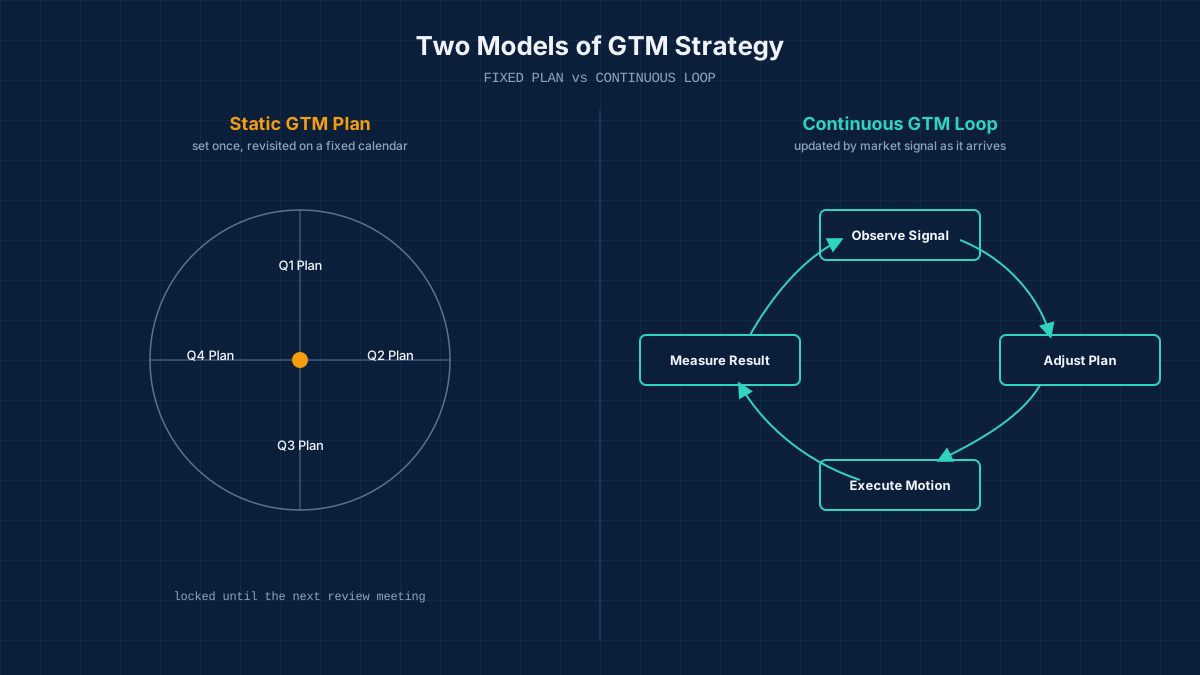
This piece argues that static GTM strategy, the annual or quarterly plan treated as a fixed reference point until the next planning cycle, is not simply due for an update. It is the wrong shape for the problem. What is replacing it is not a better planning template or a shorter review cycle. It is a fundamentally different model: strategy as a continuous loop that adjusts as signal arrives, rather than a document that waits to be revisited.
This is not an argument against planning, discipline, or having a clear direction. Teams without a plan drift too, just without the appearance of order that a document provides. The argument here is narrower and more specific: the format of a fixed document, reviewed on a fixed calendar, is the wrong container for a set of assumptions that are now changing faster than that calendar allows. The direction can, and often should, stay stable. The tactical layer underneath it, who to target, what to say, where to spend, needs a shorter feedback loop than a quarterly document can offer.
What a Static Plan Actually Assumes
It is worth being precise about what a static GTM plan quietly assumes, because most of the assumptions are reasonable individually and only become a problem in combination. A plan built on any one of these assumptions alone might hold up fine. The trouble is that real quarterly plans rest on all of them at once, which means a single unnoticed shift in any one area is rarely fatal, but the accumulated effect of several shifting simultaneously, which is the normal case rather than the exception in an active market, is what actually produces the drift teams eventually notice at the next review.
A static plan assumes the market holds still long enough for the plan to remain accurate. It assumes the people executing the plan will notice when reality diverges from it, even though noticing is not their job and nothing in the plan tells them what divergence looks like. It assumes the cost of being wrong for the length of a full quarter is acceptable, because correcting course before the next scheduled review is not built into how the team operates. And it assumes that the review meeting itself, once it happens, will surface the right adjustments, even though by the time it happens the team is reasoning from memory and anecdote rather than from data collected as things actually changed.
| Assumption | Why it used to be reasonable | Why it is less true today |
|---|---|---|
| The market moves slowly relative to the planning cycle | Buying cycles, channels, and competitors changed gradually | Intent signal, competitor moves, and channel performance now shift weekly or faster |
| Someone will notice drift before the next review | Smaller teams had more informal, frequent cross functional contact | Larger, more specialized teams rarely have a shared, real time view across functions |
| Being wrong for a quarter is an acceptable cost | Sales cycles were long enough that a quarter of drift rarely lost a deal | Faster cycles and more responsive competitors mean drift compounds into lost pipeline sooner |
| The review meeting will catch what needs to change | Fewer signal sources meant a team could reasonably synthesize them from memory | Signal volume has outgrown what any group can reconstruct accurately in a single meeting |
None of these assumptions were unreasonable when static planning became standard practice. They describe a market that, for most of the history of modern B2B software, moved slowly enough that a quarterly or annual cadence was a fair approximation of continuous. That is no longer a safe approximation, and the gap between the two is the actual subject of this piece.
The Hidden Cost of a Stale Plan
The cost of a static plan going stale rarely shows up as a single, attributable loss. It accumulates quietly across a quarter, spread across several categories that are each individually easy to dismiss as normal cost of doing business.
| Cost category | How it shows up | Why it is easy to miss |
|---|---|---|
| Misallocated spend | Budget continuing to flow to a channel or segment past the point it stopped performing well | Spend looks normal on a dashboard that only reports totals, not marginal efficiency |
| Lost deals to stale messaging | Win rate softening gradually as the pitch stops matching current buyer priorities | Attributed to individual rep performance or deal specifics rather than a systemic messaging issue |
| Delayed competitive response | Reps caught flat footed by a competitor's new positioning mid quarter | Shows up as anecdote in deal reviews, rarely aggregated into a clear pattern |
| Compounding correction cost | Larger, more disruptive adjustments needed once drift is finally caught | The cost of the correction is visible, the cost of the delay that made it necessary is not |
The last row matters most. A plan that drifts quietly for ten weeks does not just cost ten weeks of suboptimal execution, it usually requires a larger, more disruptive correction once the drift is finally addressed, because more has accumulated than would have if it had been caught and adjusted incrementally along the way. This is the same dynamic that shows up in any system with a delayed feedback loop: the longer the delay between a problem occurring and it being noticed, the larger and more disruptive the eventual correction tends to be.
The Planning Cadence Gap
The clearest way to see why static planning breaks down is to compare two rates directly: how fast the market actually changes, and how fast a static plan gets updated.
Market change, in the sense that matters for GTM, includes buyer intent shifting between topics, competitors repositioning or cutting prices, channels becoming more or less efficient as platforms change their algorithms and costs, and product usage patterns revealing new expansion or churn signal. All of these move continuously, and increasingly, all of them move faster than they did five or ten years ago, driven partly by how much more instrumented buyer behavior has become and partly by how much faster competitors can now respond using their own AI powered tooling.
A static plan updates on a fixed schedule regardless of what is happening in the market. It moves in steps: flat for the length of a quarter, then a jump at the review meeting, then flat again. The chart below makes the mismatch visible. Market change is a rising curve. A static plan is a stair step. The distance between the two grows every week the plan sits unrevised, and it does not reset until the next scheduled review, no matter how large the gap has become by then.
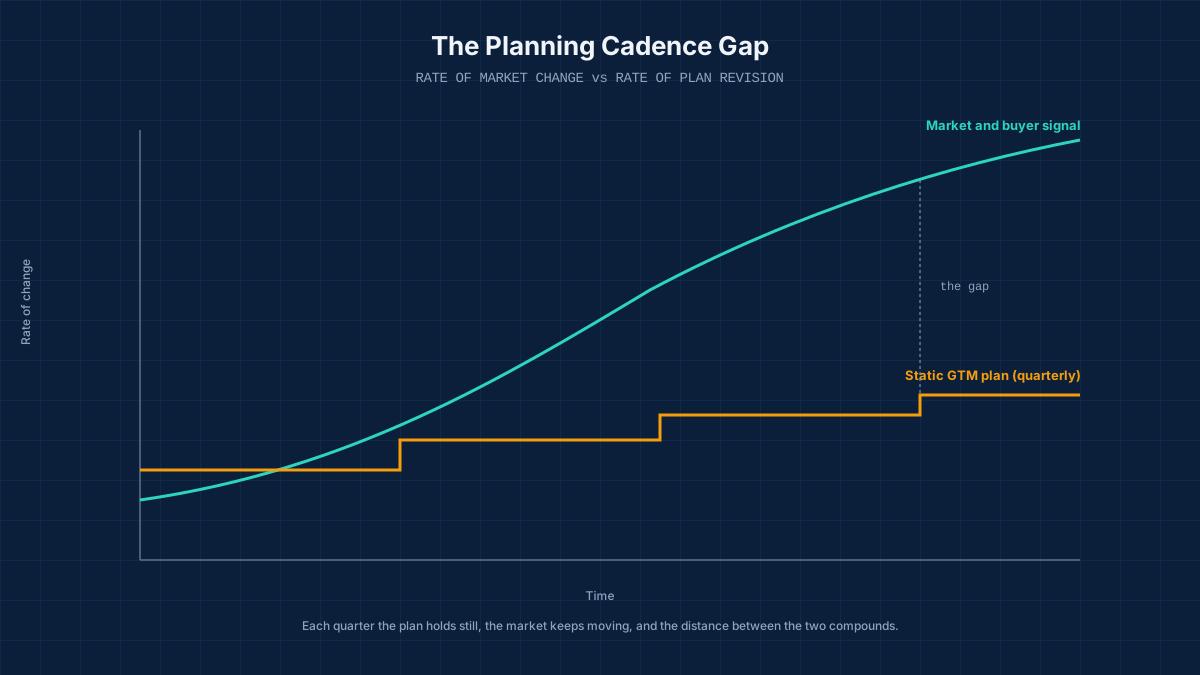
This is the structural argument against static planning, independent of how good any individual planning process is. Even a well run quarterly planning cycle, staffed by smart people using good data at the moment of planning, is architecturally guaranteed to drift for most of the quarter, because nothing in the process updates the plan between reviews. The problem is not the quality of the planning. It is the shape of the cadence.
Where Static Plans Break Down in Practice
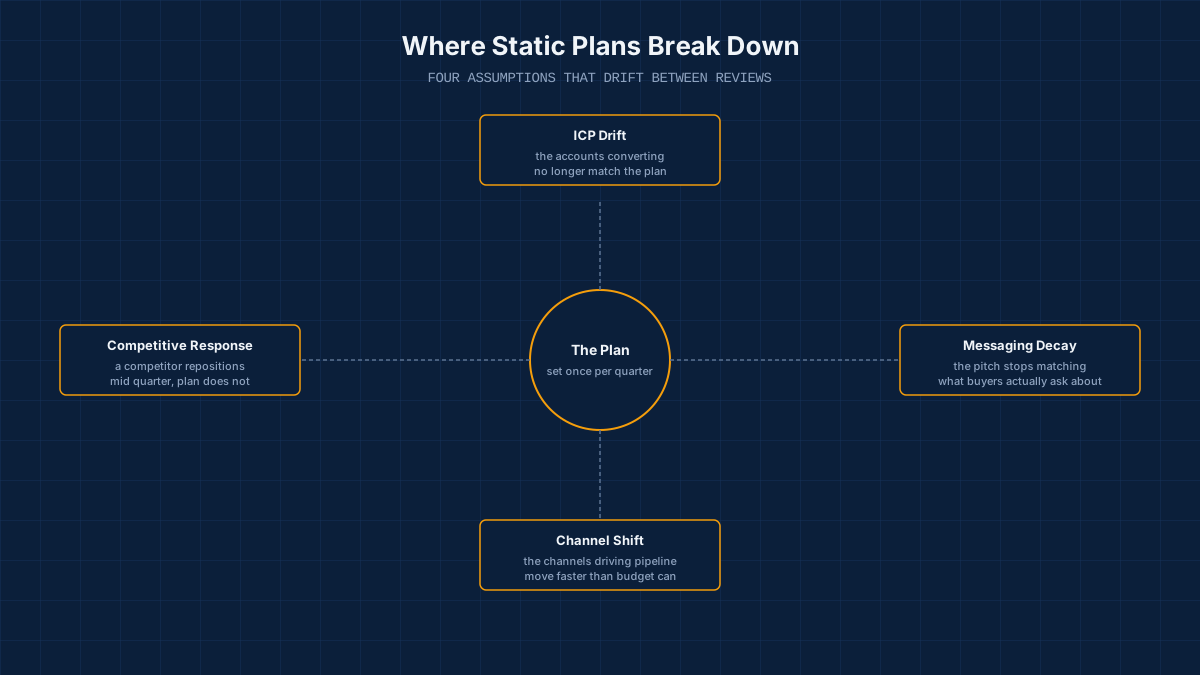
Four categories of assumption tend to drift fastest, and they drift largely independently of each other, which is part of what makes the problem hard to catch with a single review meeting.
ICP drift. The accounts actually converting rarely stay perfectly aligned with the ICP defined at the start of a planning cycle. A product led motion picks up unexpected traction in a segment nobody targeted deliberately. A feature launch shifts which company sizes get the most value. An adjacent use case, discovered by a handful of customers organically, turns out to convert at a notably higher rate than the segments the plan was built around. By the time a quarterly review catches this, a meaningful share of the quarter's outbound effort may have gone toward an ICP definition that no longer matches where the best pipeline is actually coming from, and the sales content, qualification criteria, and even comp incentives built around the old definition can actively work against the segment that is actually performing.
Messaging decay. The pitch that resonated at the start of a quarter is built around the objections and priorities buyers had at that moment. Buyer priorities shift, sometimes because of macro conditions, sometimes because a competitor's messaging changes what buyers expect to hear, sometimes because the market simply becomes more sophisticated about a category over a few months, so that a message explaining a concept buyers already understand starts to read as slow or condescending rather than helpful. Messaging built around last quarter's buyer psychology quietly loses effectiveness well before anyone schedules a message testing review, and because win rate erosion tends to be gradual, it is easy to attribute to individual deals or reps rather than to a systemic issue with the message itself.
Channel shift. Paid channels change cost and performance characteristics on their own schedule, often driven by platform algorithm changes outside any GTM team's control, alongside shifts in competitor bidding behavior and audience saturation as a campaign runs longer. A channel that was efficient at the start of a quarter can become notably less efficient within a few weeks, and a static budget allocation, set once per quarter, has no mechanism to notice or respond until the next planning cycle, which means a team can spend a significant share of a quarter's budget at declining efficiency without any built in trigger to reallocate sooner.
Competitive response. Competitors do not wait for a planning calendar to reposition, cut price, or launch a comparable feature. A plan built around a competitive landscape from the start of the quarter can be materially out of date by the middle of it, particularly in categories where competitive moves happen frequently, and reps in live deals are often the first to encounter a competitor's new positioning, well before that information makes its way back into any strategy document.
The table below summarizes how each of these typically gets caught, or does not, under a static planning model.
| Drift type | Typical detection point under static planning | Typical cost of the delay |
|---|---|---|
| ICP drift | Next quarterly business review, if flagged explicitly | Outbound and content effort misallocated for weeks |
| Messaging decay | Win rate decline noticed after the fact, cause unclear | Lower conversion with no clear diagnosis of why |
| Channel shift | Budget review at quarter end | Spend continues at declining efficiency until then |
| Competitive response | Deals lost to the specific competitor, reported anecdotally | Sales left without updated talking points during live deals |
What makes this table worth studying closely is the middle column. In every case, detection depends on either a scheduled event that may be weeks away, or on an individual noticing and reporting something informally, which is an unreliable mechanism at any team size beyond a handful of people who all sit near each other. Neither detection path is designed to catch drift quickly. Both were adequate when drift itself accumulated slowly. Neither is adequate now that it does not.
How Fast Assumptions Actually Go Stale
It helps to put rough numbers on this, even illustrative ones, because the abstract idea of drift is easier to dismiss than a concrete comparison against a known review cadence.
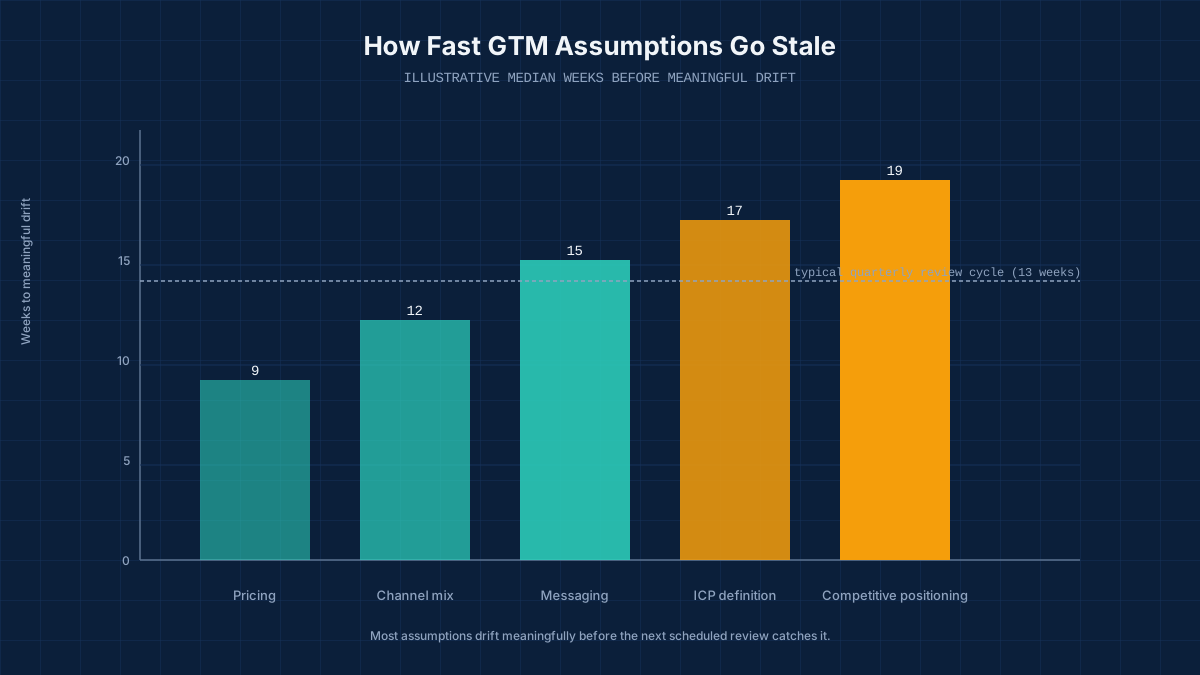
Pricing assumptions tend to hold up longest, since pricing changes are usually deliberate and infrequent. Channel mix and messaging drift faster, often within ten to fifteen weeks, close enough to a typical quarterly cycle that meaningful drift is common before the next scheduled review. ICP definition and competitive positioning, the two categories most sensitive to what is actually happening in live deals, tend to drift fastest of all, frequently before a single quarter has even finished. None of these figures should be read as precise benchmarks, they vary by category, deal complexity, and market maturity, but the pattern they illustrate is consistent across most B2B software categories: the assumptions with the most direct effect on win rate are also the ones most likely to be stale by the time anyone scheduled to look at them again.
From Annual Offsite to Continuous Loop
This is not the first time a planning cadence has compressed under pressure from a faster moving environment, and the earlier stages of that compression are useful context for where it is heading next.
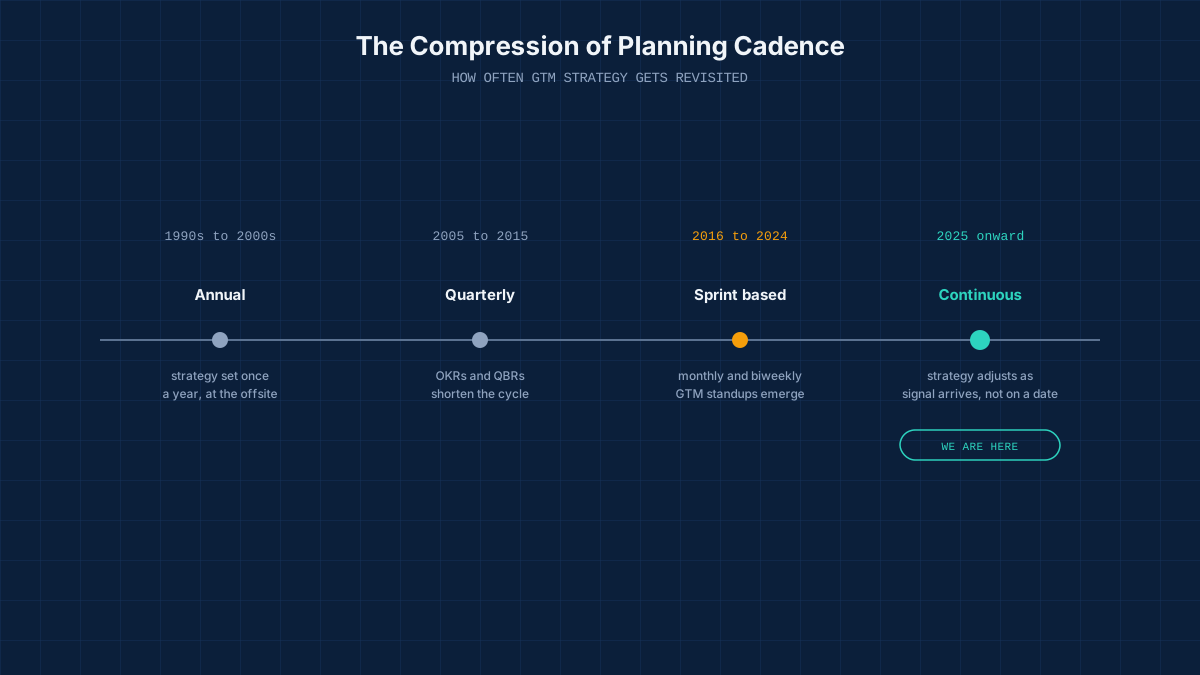
In the 1990s and early 2000s, GTM strategy for most B2B companies was set once a year, often at a leadership offsite, and treated as largely fixed until the next one. That worked reasonably well when channels were few, buying cycles were long, and competitive landscapes changed slowly.
Through the 2010s, quarterly OKRs and quarterly business reviews became standard practice, shortening the effective planning cycle from a year to a quarter. This was a real improvement, and it reflected an accurate read that the market had sped up enough to make annual planning too slow. But it kept the same fundamental shape: a plan that holds still between reviews, just with more frequent reviews.
From roughly 2016 onward, the fastest moving teams pushed further, adopting monthly or even biweekly GTM standups specifically to catch drift faster than a quarterly cycle allowed. This represents the practical limit of what a manually run, meeting based review process can sustain. Reviewing GTM assumptions weekly, using only human synthesis of the available data, quickly becomes more overhead than most teams can absorb without dedicating meaningful headcount purely to keeping the review current.
A useful parallel comes from software development, a discipline that faced an almost identical version of this problem decades earlier and has since largely resolved it. Waterfall development planned an entire release in advance, locked scope, and only reassessed once the release shipped, often months later. That model broke down for the same reason static GTM planning is breaking down now: the gap between when an assumption stopped being true and when the process would next notice grew too large relative to how fast the underlying environment, in that case customer needs and technical constraints, was changing. Agile and, later, continuous delivery practices replaced fixed release planning with short iterations and constant feedback, not because planning itself was a bad idea, but because a fixed plan reviewed infrequently could not keep pace with how quickly requirements and constraints actually shifted. GTM strategy is arguably a decade or more behind software development in making this same transition, which is itself a reasonable basis for expecting it to happen, since the underlying pressure, a fast moving environment outrunning a slow review cycle, is structurally the same problem in a different function.
The next stage of this compression is not a faster meeting cadence. It is removing the meeting from the critical path entirely, replacing scheduled human review with a system that ingests signal continuously and surfaces the specific adjustments worth a person's attention, rather than requiring a person to reconstruct the full picture from scratch on a fixed schedule.
What a Continuous GTM Loop Actually Looks Like
A continuous loop does not mean strategy changes chaotically or that a team abandons commitment to a direction. It means the underlying assumptions feeding that direction are checked against live signal continuously, and adjustments happen at the pace the signal justifies, rather than being held back until a scheduled date regardless of what has changed.
Concretely, this usually involves four shifts relative to a static planning model.
Signal replaces anecdote as the trigger for a strategy conversation. Under static planning, a strategy adjustment usually gets triggered by someone noticing a problem informally, a rep mentioning a recurring objection, a marketer noticing declining channel performance, and raising it at the next scheduled review. The reliability of this depends entirely on someone happening to notice and happening to remember to raise it, which is a weak mechanism once a team has grown past the size where informal cross functional visibility is realistic. Under a continuous model, defined thresholds in the underlying data, a shift in win rate by segment, a drop in channel efficiency past a set point, trigger the conversation automatically, closer to when the shift actually happened, and independent of whether any individual person happened to notice.
Smaller, more frequent adjustments replace large, infrequent ones. A quarterly review tends to produce a handful of larger changes, because three months of accumulated drift usually requires a bigger correction to address, and because a review meeting naturally produces a batch of decisions rather than a steady stream of them. A continuous model produces smaller, more frequent adjustments, which are individually easier to make, easier to reverse if wrong, and less disruptive to a team already executing against the current direction. This mirrors a general pattern in systems with feedback loops: shorter loops produce smaller, more stable corrections, while longer loops produce larger, more destabilizing ones, because more has to be corrected for at once.
Ownership shifts from a planning event to an ongoing discipline. Static planning concentrates strategic thinking into a specific meeting, owned by whoever runs that meeting, with the implicit expectation that strategic judgment mostly happens there and gets executed everywhere else. A continuous model distributes responsibility for noticing and responding to drift more broadly, typically supported by a shared, always current view of the underlying signal that anyone on the team can check rather than a document that only gets updated by whoever owns the next review. This does not mean strategy becomes leaderless. It means the leader's role shifts from being the sole synthesizer of quarterly information toward setting the thresholds and guardrails that a broader team then operates within continuously.
The plan becomes a living reference rather than a static artifact. Instead of a slide deck that describes a point in time and slowly becomes less accurate, the plan becomes closer to a live dashboard, continuously reflecting the current ICP, current messaging performance, and current channel mix, with a clear record of what changed and why, rather than a document version that goes stale the moment it is published. This has a secondary benefit worth naming: a living reference is also a better onboarding tool, since a new hire reading it sees the current state of strategy rather than a snapshot that may already be several adjustments out of date.
Objections and Counterarguments
This argument is easy to overstate, and it is worth being explicit about where it does not fully hold.
"Constant change is bad for team morale and execution focus." This is a legitimate concern, and it is the strongest argument against a naive version of continuous strategy. A team that changes direction every week on thin signal will burn out and lose confidence in leadership's judgment faster than a team working against a stable, if imperfect, quarterly plan. Reps in particular need enough stability in their targeting and messaging to actually get good at executing it, and a system that reshuffles priorities before anyone has had a chance to build real proficiency undermines its own goal. The distinction that matters is between continuous monitoring and continuous whiplash. A well built continuous model surfaces drift constantly but only triggers an actual strategy change when a signal crosses a meaningful, predefined threshold, which in practice usually results in fewer, better timed adjustments, not more chaotic ones, compared to a static model that either ignores drift entirely or overcorrects everything at once during a single quarterly review. The goal is not maximum change frequency, it is matching the frequency of change to the actual frequency of meaningful drift, which is often lower than a poorly designed continuous system would produce, and also lower than the anxiety around this objection tends to assume.
"Some parts of strategy should not change quickly, and treating everything as fluid is a mistake." This is true, and worth stating directly rather than glossing over. Core positioning, target market category, and fundamental value proposition are usually the wrong things to adjust on a weekly cadence, because they are meant to be durable and because changing them too often confuses both the market and the internal team, eroding the very consistency that makes a brand or a category position legible over time. The continuous model described here applies most usefully to the more tactical layer underneath those durable choices, messaging emphasis, channel allocation, account prioritization, competitive response, not to the foundational strategic choices that should genuinely remain stable for longer periods. A useful mental model is a two speed system: a slow, deliberately stable layer for foundational choices, and a fast, continuously adjusted layer for tactical execution underneath it, with clear rules about which decisions belong to which speed.
"Smaller teams do not have the signal volume or resourcing to justify this." Fair, and similar to the caveat that applies to GTM operating systems more broadly. A small team with a single, well understood ICP and a short list of channels may not accumulate enough signal volume for continuous adjustment to outperform a well run quarterly cycle, and the overhead of building and maintaining a continuous monitoring system can easily exceed its benefit at that scale. The case for continuous strategy strengthens specifically as signal volume, channel count, and market complexity increase, which tends to correlate with company stage and market maturity rather than being universal from day one, and teams at an earlier stage are usually better served focusing on getting a static plan right and reviewed diligently before investing in a continuous replacement for it.
"This just shifts the burden from planning meetings to monitoring dashboards, without actually reducing the work." There is truth here worth acknowledging. Continuous strategy does not eliminate the work of interpreting signal and deciding what to do about it, and a poorly designed continuous system can become its own kind of overhead, a dashboard nobody trusts or checks regularly, functionally no better than a stale slide deck, or worse, since it creates a false sense that drift is being caught when in practice nobody is actually looking at it. The honest answer is that continuous strategy only outperforms static planning when the underlying signal is genuinely trustworthy and the thresholds for triggering a change are well calibrated. Done poorly, it adds noise. Done well, it replaces a fixed quarterly reconstruction of reality with a system that stays roughly current by design, which is a meaningfully lower total burden even if it does not feel that way in the first few months of building it, since most of the effort concentrates upfront in defining good thresholds rather than being spread evenly across every week going forward.
Early Evidence This Shift Is Already Underway
This is not purely a forward looking prediction. A few patterns already visible in how GTM teams operate point toward the same shift.
RevOps and GTM leaders increasingly describe planning as a cadence problem, not a content problem. Conversations about GTM strategy at industry events and in operator communities have shifted noticeably from debates about what the plan should say to debates about how often it should be allowed to change. That shift in the framing of the problem, from content to cadence, usually precedes a shift in tooling and process, because it reflects teams recognizing the actual bottleneck.
Weekly and biweekly GTM syncs have become common at growth stage companies specifically to catch drift faster. These meetings exist because quarterly reviews were demonstrably too slow, and they represent the limit of what a manual, meeting based process can sustain before the overhead of the meetings themselves becomes the constraint. Teams running these syncs are, in effect, manually simulating a faster feedback loop with human labor, which is exactly the kind of workload a continuous system is suited to absorb.
Dashboards tracking leading indicators of drift, not just lagging pipeline metrics, are becoming more common. A growing number of RevOps teams now track metrics specifically designed to catch ICP or messaging drift early, win rate by segment over time, message engagement by variant, channel efficiency trend lines, rather than relying solely on end of quarter pipeline totals. Building these dashboards is itself evidence that teams have identified the problem this piece describes, even before they have adopted a fully continuous strategy model to act on what the dashboards show.
Together, these patterns describe a market already reaching, informally and with existing tools, toward the shape of a continuous loop, well before most teams have named it that or adopted purpose built systems to support it.
What This Means for GTM Teams
For a team evaluating this shift, a few practical implications stand out.
Strategy documents need an owner for currency, not just an owner for creation. Under static planning, a strategy document's job effectively ends once it is presented. Under a continuous model, someone needs explicit responsibility for keeping the underlying view current, which is a different, ongoing role rather than a one time deliverable.
The review meeting's purpose changes, it does not disappear. A continuous model does not eliminate the value of a team getting together to discuss direction. It changes what that meeting is for. Instead of reconstructing three months of drift from memory, spending the first half of the meeting simply establishing what has happened before anyone can discuss what to do about it, the meeting becomes a chance to discuss and align on adjustments the system has already surfaced, which is a faster, more focused use of the same time. Teams that make this transition often report the meeting itself getting shorter even as the quality of the decisions made in it improves, because the analytical work of detecting drift has already happened before anyone sits down.
Confidence in a direction and willingness to adjust tactics are not in tension. One of the more counterintuitive effects of moving to a continuous model is that teams often report feeling more confident in their overall direction, not less, once tactical adjustments are handled continuously. Under static planning, doubt about whether the current plan is still right tends to build quietly over the course of a quarter, since there is no mechanism to check it until the review. Under a continuous model, the underlying assumptions are being checked constantly, so when the core direction has not needed significant adjustment, that itself becomes a visible, reassuring signal rather than an untested assumption everyone is quietly hoping still holds.
| Element | Under static planning | Under a continuous loop |
|---|---|---|
| Trigger for change | Scheduled review date | Signal crossing a defined threshold |
| Size of typical adjustment | Large, infrequent | Small, frequent |
| Primary artifact | A slide deck or document | A live, continuously updated view |
| Review meeting's job | Reconstruct what changed since last time | Align on adjustments already surfaced |
| Main risk | Drift goes uncaught for a full cycle | Overreacting to noise without good thresholds |
Data quality becomes a strategic dependency, not just an operational one. A continuous model is only as good as the signal feeding it. Teams that have not invested in clean, timely data across their GTM stack will find continuous strategy adjustment harder to trust than teams that have, which makes the data quality work described elsewhere in this content series a direct prerequisite for this shift, not a separate initiative. A continuous model built on unreliable data does not fail safely, it fails by confidently recommending adjustments based on noise, which is arguably worse than a static plan that at least everyone knows to treat with appropriate skepticism by the end of the quarter.
Trust has to be built gradually, not assumed. Teams moving from static to continuous planning rarely succeed by switching over all at once and asking the organization to immediately trust a new, unfamiliar system's recommendations. The more durable path runs a continuous monitoring layer alongside the existing planning cadence for a period, comparing what it would have recommended against what the team actually decided in its scheduled reviews. This builds a track record that makes it much easier, later, to shift real decision authority to the faster loop, and it also surfaces early whether the underlying data and thresholds are well calibrated before anything depends on them.
What to Do Now
Teams do not need to abandon planning meetings to start moving in this direction, and a full continuous model is not usually the right first step.
Start by picking one or two assumptions to monitor continuously, rather than trying to convert the entire plan at once. ICP fit and messaging performance are usually the highest leverage places to start, since they tend to drift fastest and have the most direct effect on pipeline quality, and starting narrow makes it far easier to validate that the underlying signal is trustworthy before expanding scope.
Define explicit thresholds before building anything else. A continuous model only works if there is a clear, agreed definition of how much drift justifies a change, decided in advance rather than argued about in the moment. Without this, a continuous system either triggers too often and gets ignored, training the team to tune it out the same way an overly sensitive alert system gets muted, or triggers too rarely and behaves like a static plan with extra steps. Setting these thresholds is itself a useful exercise, since it forces explicit agreement on what actually counts as meaningful drift, a question static planning rarely forces anyone to answer precisely.
Keep the quarterly review, but change its job. Rather than eliminating the scheduled meeting, redesign it around discussing adjustments that continuous monitoring has already surfaced, which tends to make the meeting shorter, more focused, and more clearly connected to what actually happened during the quarter rather than a reconstruction from memory. This also gives the team a natural checkpoint to evaluate whether the continuous monitoring itself is working well, adjusting thresholds that turned out to be miscalibrated before committing further.
Expect resistance, and treat it as informative rather than as an obstacle to push through. Teams that have operated under static planning for years often have good reasons for skepticism toward a more continuous model, memories of chaotic, poorly run attempts at constant iteration that felt like whiplash rather than discipline. That skepticism is usually pointing at a real risk, not a lack of imagination, and addressing it directly, with clear thresholds and a gradual rollout, tends to work better than dismissing the concern.
Where Elevate GTM Solutions Fits
This piece has argued that the core problem with static GTM strategy is structural: a plan captured in a document, reviewed on a fixed calendar, cannot keep pace with a market that keeps moving between reviews. Elevate GTM Solutions is built directly around closing that specific gap.
Elevate is the AI-native GTM platform and GTM operating system designed to move a company beyond static plans and one-time strategy documents, keeping GTM strategy, positioning, and messaging connected to current market and competitive context as that context changes, rather than locked into a deck from the last planning cycle. Where this piece has described a continuous loop, checking assumptions against live signal and adjusting at the pace the signal actually justifies, Elevate is built to run that loop directly: unifying GTM context, applying GTM intelligence to flag where strategy has drifted from current reality, and keeping structured execution workflows tied to whatever the current, updated strategy actually says, rather than the version that was accurate when it was last written down.
This does not replace the judgment a team brings to genuinely foundational, slower moving strategic choices, a point this piece has made deliberately. What a platform like Elevate changes is how much of the tactical layer beneath those choices, messaging emphasis, positioning nuance, market and competitive context, stays current automatically, rather than depending on someone remembering to revisit a static document before it goes stale.
Conclusion
Static GTM strategy is not dying because the people writing quarterly plans are doing a bad job. It is dying because the format assumes a rate of market change that stopped being accurate years ago, and every year the gap between how fast the market actually moves and how often the plan gets revisited grows a little wider. That gap is not evenly distributed either. It grows fastest in exactly the categories, fast moving, competitive, signal rich B2B markets, where the cost of drifting off course for a full quarter is highest, which means the teams with the most to lose from static planning are often the same teams for whom the fix matters most urgently.
The alternative is not chaos or the absence of a clear direction. It is a shift from strategy as a document, reviewed and revised on a fixed calendar, to strategy as a continuous loop, checked against live signal and adjusted at the pace the signal actually justifies. That shift asks more of a team's data and systems than static planning ever did, and it is not the right first step for every organization at every stage. Teams without reliable signal, without the data hygiene to trust what that signal says, or without the organizational patience to build thresholds carefully rather than rushing to automate everything at once, will likely find a continuous model frustrating rather than helpful until those foundations are in place.
But for teams operating in fast moving, signal rich markets, with the data maturity to support it, the choice is no longer between a good static plan and a bad one. It is between a plan that quietly goes stale on a predictable schedule, correct on the day it is written and progressively less so with every week that follows, and a loop that does not. The teams that make this shift early will spend the next few years building the muscle and the systems to run strategy this way. The teams that wait will keep scheduling the same quarterly meeting to explain, after the fact, why the plan stopped matching reality somewhere around week six.
Contents
Related Research
GTM Research
Explore research, benchmarks, technology landscapes, and perspectives on the evolution of go-to-market.
View Research Library →