
GTM Platforms Are Becoming Operating Systems
Nearly every established category in GTM software, CRM, sales engagement, ABM, intent data, is reaching outward toward the same broader claim. Some of that expansion is real architectural progress. Most of it, so far, is still feature addition wearing a bigger label.
Published 2026-07-25
Look across the current GTM software landscape and a clear pattern emerges: CRM vendors are adding AI scoring, sales engagement platforms are adding intent signals, ABM platforms are adding orchestration features, and enrichment tools are adding workflow automation. Categories that used to have clean, distinct boundaries are all reaching toward the same broader territory, and increasingly toward the same broader claim, that the platform is not just a point solution anymore but something closer to a full GTM operating system.
This convergence is real, and it is worth taking seriously as a genuine market signal rather than dismissing it as marketing noise. Vendors do not generally expand in the same direction, at the same time, without a real underlying demand pulling them there, and the coordination gap this content series has described elsewhere, a fragmented stack that no longer scales with manual effort, is a plausible and consistent explanation for why so many categories are converging on the same territory simultaneously.
The harder, more interesting question is not whether this convergence is happening. It clearly is. It is whether the convergence represents genuine architectural change, a real move toward the closed, continuously self-refining loop this content series has defined as the core of a genuine operating system, or whether it more often represents feature addition dressed in bigger language. This piece argues the honest answer, at the current stage of the market, is a mix of both, and it offers a way to tell the difference.
This distinction matters enormously for anyone trying to make a buying decision in this space right now, because the marketing language across the category has converged much faster than the underlying architecture has. A buyer relying on how vendors describe themselves will find it increasingly difficult to distinguish genuine progress from expanded positioning, since nearly every serious vendor in this space has, by this point, adopted some version of the operating system claim. What has not converged nearly as quickly is the actual, verifiable architecture underneath that claim, and that gap, between converged language and divergent substance, is the specific problem this piece tries to help a buyer see through.
Why the Convergence Is Happening
Before assessing how far this convergence has actually progressed, it is worth understanding why it is happening at all, since the underlying cause shapes how seriously to take the trend.
The coordination gap described throughout this content series, a growing mismatch between signal volume and the manual capacity to act on it, is not unique to any single category of tool. It affects CRM vendors, sales engagement vendors, and enrichment vendors equally, because it is a structural feature of the current GTM environment rather than a problem specific to any one point solution's original design. Each category is expanding outward for the same underlying reason: the narrow, well defined problem each one originally solved is no longer the whole problem their customers actually have, and customers are asking, explicitly or through their buying behavior, for something closer to a full answer.
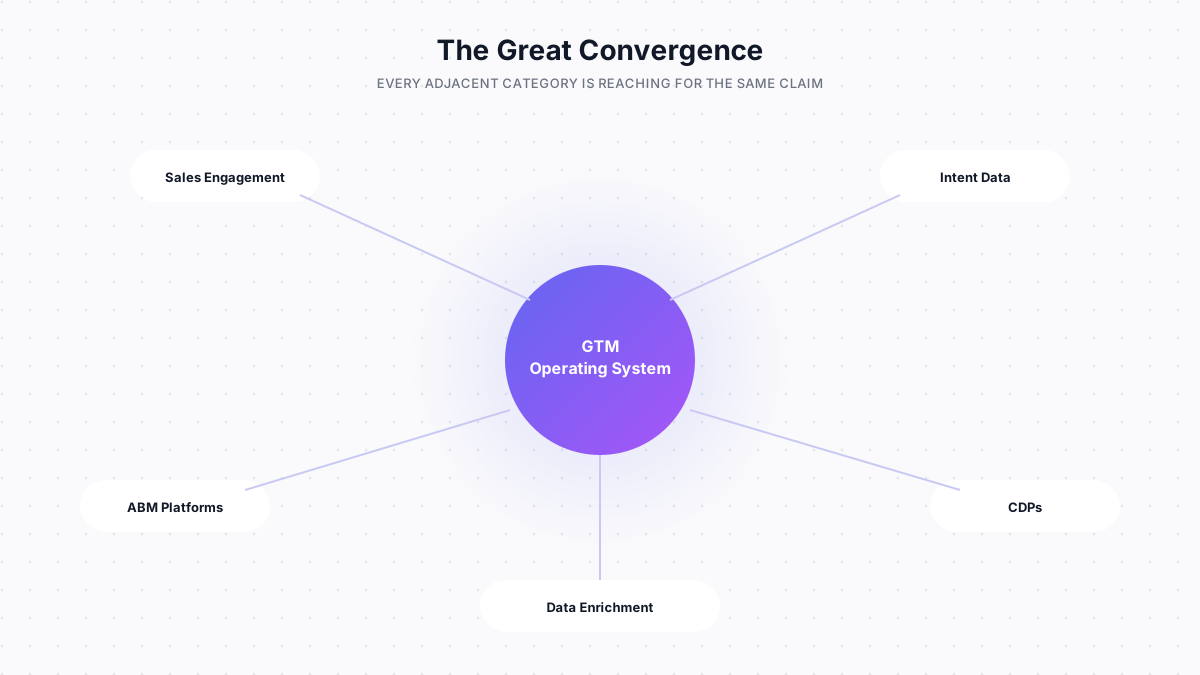
This is a healthy, expected pattern in a maturing software market, and it mirrors how other enterprise categories have consolidated around a broader value proposition once a narrower one stopped being sufficient on its own. It is also, precisely because it is happening across so many vendors simultaneously and quickly, a market where the gap between marketing language and actual architectural substance is unusually wide right now, since every vendor has a strong incentive to claim the broader positioning quickly, whether or not the underlying product has genuinely earned it yet.
A Familiar Pattern: Categories Converge Faster Than Architecture Does
This specific dynamic, where an entire software category rushes to adopt the same broader positioning well before most vendors have actually built the substance behind it, has played out before, and the earlier examples are useful for calibrating how skeptical a buyer should currently be.
The platform era in enterprise software during the early 2010s followed a similar arc. As soon as a handful of vendors began describing their products as platforms rather than point tools, capable of hosting other applications and serving as a broader foundation for a company's workflows, the term spread quickly across the market, adopted by vendors whose products had not meaningfully changed architecturally to actually support that broader role. Buyers who took the platform claim at face value during that period frequently discovered, well into an implementation, that the product functioned much like the point tool it had always been, with a thin layer of platform branded messaging added on top. The vendors who eventually did build genuine platform capability, extensible architecture, real third party developer ecosystems, open APIs designed for external building rather than just internal configuration, took years longer than the marketing shift itself did, and the gap between the two was, for a meaningful stretch of time, exactly the kind of trap this piece is warning GTM buyers about today.
The lesson from that earlier cycle is not that the broader claim was always false, several vendors did eventually build genuine platform capability, and being early to that claim did not disqualify them from later earning it. The lesson is that the claim and the architecture underneath it moved at very different speeds, and a buyer who could tell the difference during the gap years made meaningfully better decisions than one who took the marketing language at face value. The current convergence around the operating system claim in GTM software is very likely following the same pattern, on a similar or possibly faster timeline given how quickly AI capability has become table stakes across the category.
The Test That Actually Matters
Given how quickly and broadly this positioning has spread, a useful, consistent test is needed to separate genuine progress from expanded marketing language. The test this piece proposes, consistent with how this content series has defined the category elsewhere, is architectural rather than based on feature count: does the product close a genuine, continuous loop, where signal triggers a decision, the decision triggers coordinated action, and the outcome of that action automatically feeds back to refine the next decision, or does it simply offer more individual capabilities within a workflow still fundamentally organized around a single pass, configured and re-triggered manually by a person.
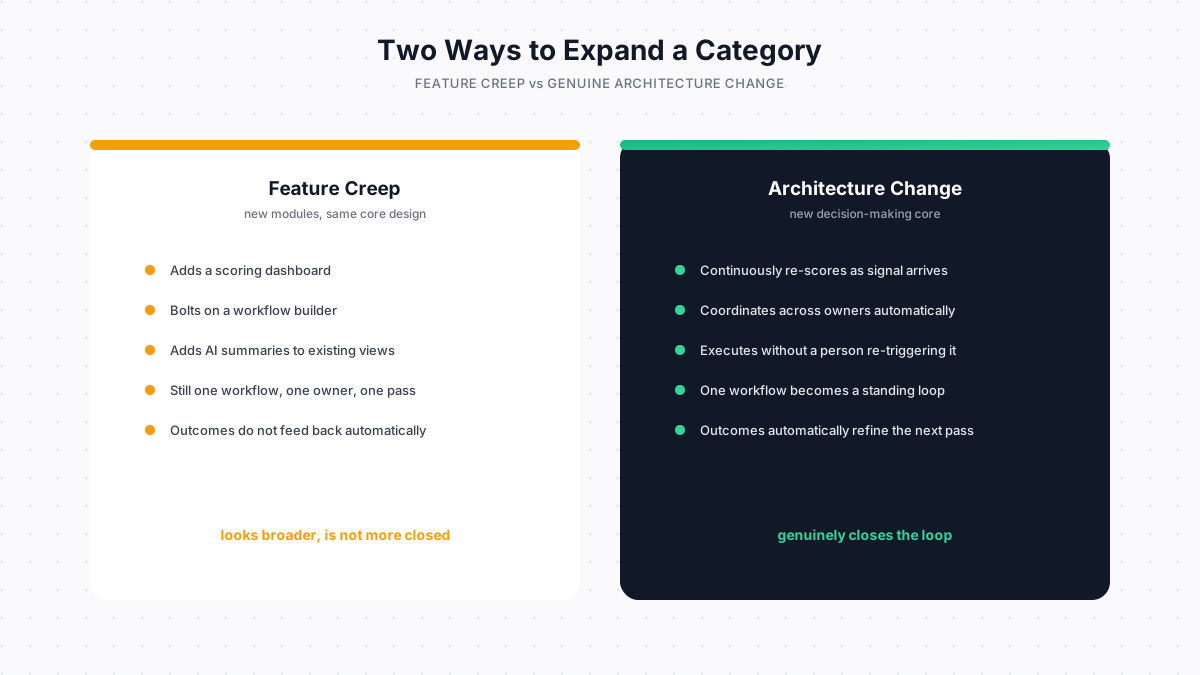
Feature creep looks impressive on a features comparison page, a new scoring dashboard, a workflow builder, an AI summary layer, and it often provides genuine, standalone value. What it typically does not do is change the fundamental shape of the product: it remains something a person configures, runs, and manually re-triggers, rather than something that runs continuously and adjusts itself based on outcomes. Genuine architecture change is less visible on a features list and considerably harder to build, since it requires the product to continuously re-score, coordinate across owners without manual intervention, and use its own outcomes as an automatic input to future decisions.
| Signal | Feature creep | Genuine architecture change |
|---|---|---|
| How scoring updates | Manually re-run or re-triggered on a schedule | Continuously, as new signal arrives |
| How action gets coordinated | A single configured workflow, one pass | Ongoing orchestration across multiple owners and channels |
| What happens to outcomes | Reported, reviewed manually by a person | Automatically fed back to refine future scoring |
| Who initiates the next cycle | A person, deciding to re-run the workflow | The system, on its own defined cadence |
Where the Consolidation Wave Actually Stands
Tracing the recent history of this convergence helps calibrate how far the market has actually come, versus how far the marketing language surrounding it has moved.
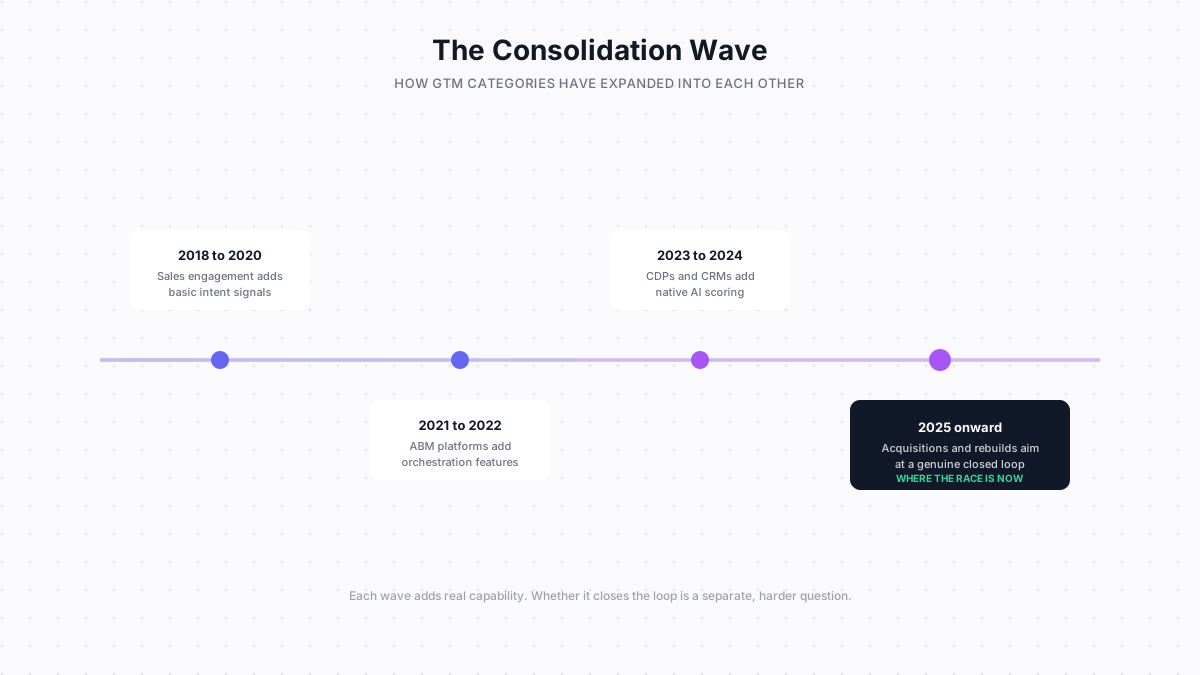
Earlier waves of expansion, sales engagement platforms adding basic intent signals, ABM platforms adding orchestration features, tended to add real, standalone capability without fundamentally restructuring the product's core architecture. More recent activity, particularly acquisitions and significant product rebuilds aimed specifically at continuous, AI driven scoring and cross-tool coordination, represents a more serious, more architecturally ambitious attempt at the genuine closed loop this content series defines as the actual bar for the category. This is where the most credible current activity in the market is concentrated, and it is also where the gap between vendor claims and delivered reality is hardest to assess from the outside, since architectural closure is a much harder thing to verify from a product page or a sales demo than a simple feature list.
The pace of this expansion is itself notable and worth grounding concretely.
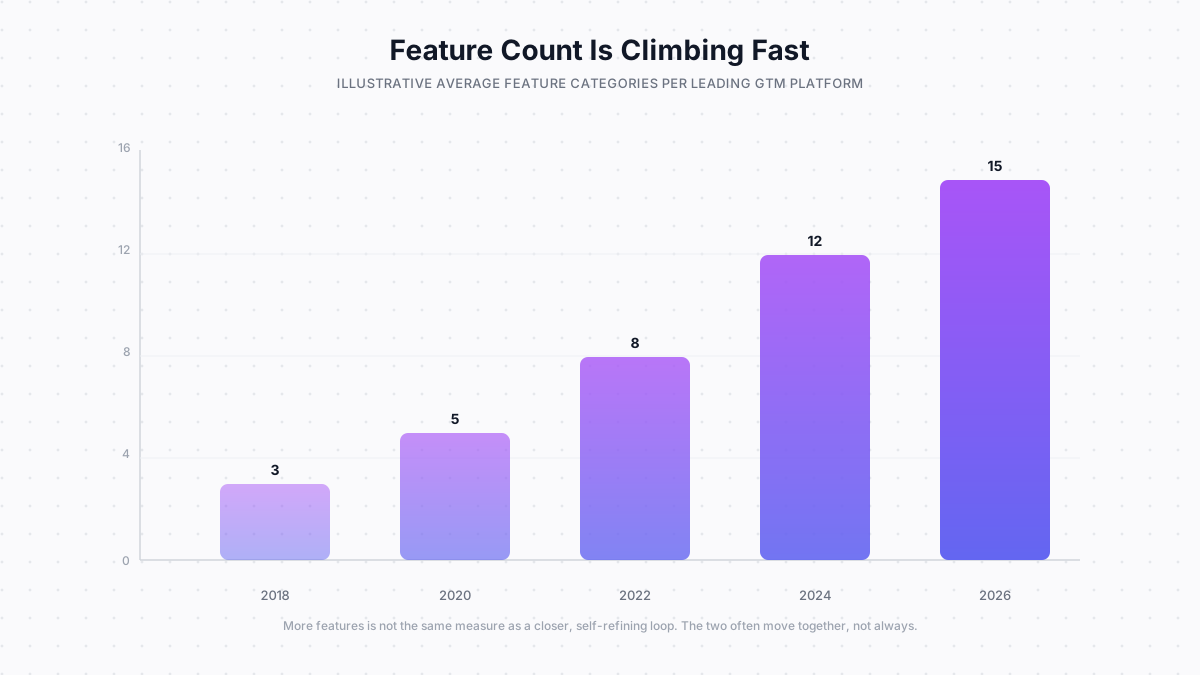
This growth in feature breadth is real and, on its own, a reasonable proxy for how seriously vendors are investing in this space. It is not, by itself, proof of architectural closure, and treating rising feature count as equivalent to genuine progress toward a closed loop is the single most common mistake in how this trend gets evaluated, both by buyers and, at times, by the trade press covering it.
Mapping the Current Landscape Honestly
Applying the architectural test described above across the current landscape produces a more nuanced picture than either "everyone is now an operating system" or "nobody has actually gotten there." This mapping is necessarily approximate, since architectural closure is genuinely difficult to assess precisely from outside a vendor's own engineering organization, but the broad pattern it describes is consistent enough across independent evaluations of this space to be a useful starting point for a buyer's own, more specific due diligence.
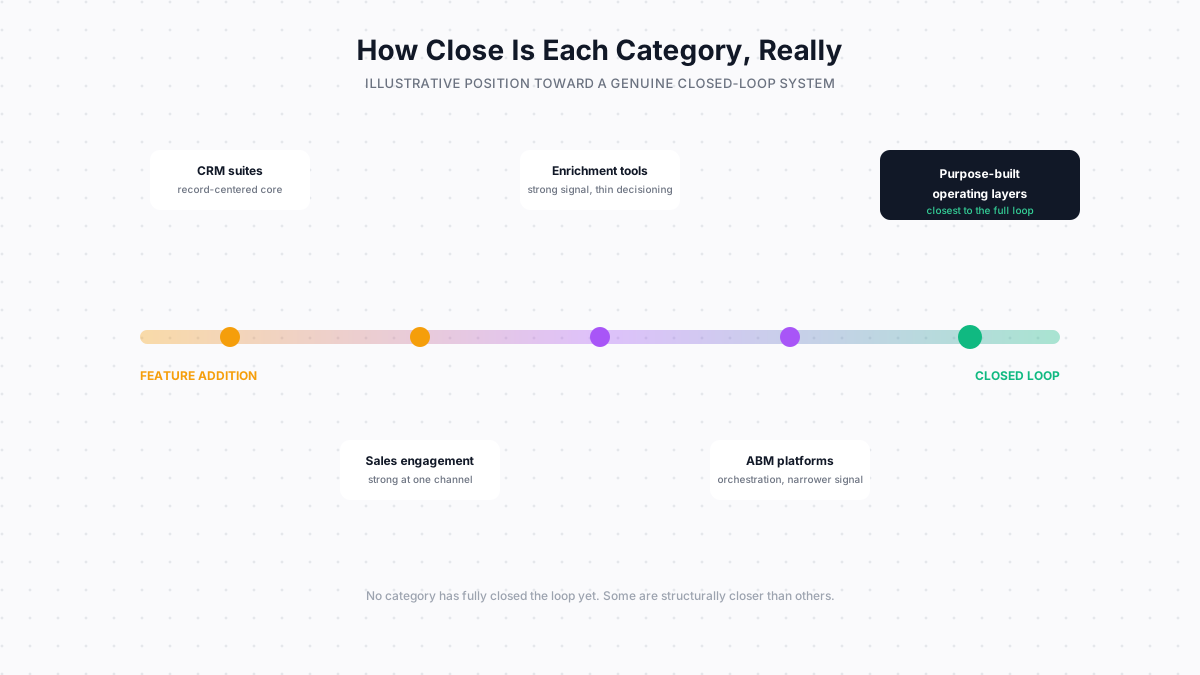
CRM suites, despite significant recent AI investment, remain structurally centered on the record, as described in more depth elsewhere in this content series, which continues to constrain how fully they can close the loop without a more fundamental architectural shift. Sales engagement platforms remain strong within their original channel but typically have narrower native visibility into signal originating outside that channel. Enrichment and data tools, also examined elsewhere in this series, tend to be strong specifically at the signal layer while offering thinner native decisioning and orchestration. ABM platforms have made real progress on orchestration specifically but often still depend on external tools for the breadth of signal a genuinely comprehensive scoring model would need. Purpose built operating layers, a newer and smaller category built from the outset around the closed loop architecture this series defines, are structurally closest to the full model, though this category is also the youngest and least battle tested at scale, a caveat worth taking as seriously as any of the gaps identified in the more established categories.
No category, including the newest and most architecturally ambitious one, has fully and universally closed this loop across every deployment. The honest state of the market is a spectrum, with meaningful, real differences in how close different products and categories currently sit to the architectural bar this series has set, rather than a settled picture where the answer is already obvious or complete.
Objections and Counterarguments
"This test is unfairly weighted toward newer, purpose-built platforms, since established categories carry more legacy architecture to work around." This is a fair and important caution. An older, more established platform genuinely does face a harder engineering problem in retrofitting a closed loop architecture onto a system originally built around a different core design, compared to a newer platform built from scratch around that architecture from day one. This piece is not arguing that established platforms are incapable of closing the gap, only that doing so is a harder, slower undertaking for them, which is exactly why the honest current state of the market shows established categories further from the bar on average, a pattern with a clear, understandable architectural explanation rather than a reflection of effort or ambition.
"Feature addition and architectural change are not as separate as this piece implies, since sufficient feature addition can eventually amount to the same thing." There is a version of this that is true: enough individually added capabilities, well integrated, can in principle approximate a closed loop over time. The distinction this piece draws is not that feature addition can never lead to architectural change, it is that the two are not automatically the same thing, and a product with many individually impressive features can still lack the specific, continuous, self-triggering loop that defines the category. The test proposed here is meant to help a buyer tell the difference, not to claim the two paths never converge.
"Buyers do not actually care about this distinction, they care about outcomes, so this is an overly academic framing." This is worth taking seriously, since the practical question for any buyer is indeed whether their actual GTM coordination problem gets solved, not which architectural category a vendor's product technically belongs to. The response is that the distinction matters precisely because it predicts outcomes: a product that has genuinely closed the loop tends to keep working well as signal volume and complexity grow, since its core design was built for continuous operation, while a product that has added many features onto an unchanged, manually re-triggered core tends to hit a ceiling as complexity increases, requiring more and more manual intervention to keep working as the gap this series has described elsewhere continues to widen. The architectural question is, in that sense, a leading indicator of the practical outcome question, not a separate, purely academic concern.
"This piece is too generous to purpose-built operating layers simply because they are newer and have not yet been tested at real scale." This is a fair and important check on the piece's own framing, and it is worth restating directly: being structurally closer to the architectural bar this series defines is not the same as being proven at the scale, reliability, and breadth of real world deployment that established categories have accumulated over many years. A newer category's architectural advantage is real but unproven at the scale that matters most for large, complex organizations, and a genuinely balanced evaluation should weight that lack of track record appropriately rather than assuming architectural elegance alone settles the comparison.
What This Means for Teams Evaluating GTM Platforms
Ask the architectural question directly during evaluation, not just the feature question. Rather than comparing vendors primarily by feature checklist, ask specifically how scoring updates, whether orchestration happens without a person manually re-triggering it, and what happens to the outcome of one cycle, does it automatically inform the next, or does someone have to notice and manually adjust the rules. These questions surface the distinction this piece describes more reliably than a features comparison ever will. A useful practical version of this test is asking a vendor to walk through, step by step, exactly what happens between the moment a new signal arrives and the moment an action executes, without any person in that chain, and to be specific about where, if anywhere, a person currently has to intervene.
Weight category maturity against your own risk tolerance and complexity. A newer, more architecturally ambitious platform may genuinely be closer to the bar this series describes, but it also carries more deployment risk and a shorter track record at scale. A more established platform may be further from architectural closure but carries a longer, better tested history of reliable operation. Neither choice is automatically correct, and the right answer depends on a team's specific tolerance for newer, less proven technology versus a known, if architecturally more limited, incumbent. A team with lower tolerance for implementation risk and a genuine, pressing need for enterprise grade reliability may reasonably choose the more established, less architecturally complete option, while a team with higher tolerance for newer technology and a clearer, more urgent coordination gap may reasonably weight the newer, architecturally more ambitious option more heavily.
Expect this landscape to keep shifting, and revisit evaluations accordingly. The consolidation wave described in this piece is active and ongoing, and the relative position of any specific vendor or category on the maturity spectrum described here is likely to change meaningfully within a year or two. A reasonable evaluation made today should be treated as a snapshot, not a permanent conclusion, particularly given how much investment and acquisition activity continues to target exactly the gap this piece has described. Building a habit of re-running the same architectural test periodically, rather than relying on a single evaluation made at one point in time, is a more reliable way to track this fast moving landscape than trusting that today's assessment will remain accurate a year from now.
Do not assume broader positioning automatically means broader delivered capability. As nearly every category converges on similar language, the marketing distinction between vendors compresses even as the underlying architectural distinction, based on the evidence this piece has presented, often remains significant. Buyers who take vendor positioning at face value, without testing the specific architectural questions described above, are the most likely to end up with a product that looks broader on paper than it actually operates in production, a gap that, as this piece's historical parallel illustrates, tends to become fully visible only well into an implementation, at a point where switching costs have already made the mistake considerably more expensive to correct.
Where Elevate GTM Solutions Fits
This piece has argued that most vendors converging on operating system language are still adding features to an architecture built for something else, CRM, sales engagement, or enrichment, rather than genuinely closing the loop this content series has defined throughout. Elevate GTM Solutions is a useful reference point for the other path: a platform built from the outset around the architecture itself.
As the AI-native GTM platform and GTM operating system built specifically to unify GTM context, keep strategy connected to execution, and close the loop back through continuous analytics, Elevate did not arrive at this architecture by adding modules onto an existing record-centered or execution-centered product. Applying the same architectural test this piece has proposed throughout, whether scoring updates continuously, whether action ties directly to strategy without manual re-configuration, and whether outcomes feed back automatically, is a fair and useful exercise to run against Elevate as much as against any other platform claiming this category, and it is the same test this piece recommends every buyer apply regardless of which vendor's language sounds most convincing.
Conclusion
The convergence of GTM software categories toward a shared operating system claim is real, driven by a genuine, structural coordination gap that affects every category roughly equally. That convergence does not mean every vendor making the claim has actually achieved it, and the evidence, assessed through the architectural test this piece has proposed rather than through feature count or marketing language alone, suggests the market is still meaningfully mixed: some categories and vendors are making genuine, credible progress toward a closed loop, and a considerably larger number are still primarily adding features within an unchanged core architecture.
This is not a permanent verdict on any category or the market as a whole. It is a snapshot of an actively moving landscape, and the specific vendors and categories closest to genuine architectural closure today are likely to change as this convergence continues. The historical parallel to earlier platform era claims in enterprise software is instructive here specifically because it suggests this gap will narrow over time, as it eventually did in that earlier cycle, but it also suggests the narrowing will take longer than the marketing convergence itself, which means the gap this piece describes is likely to remain a meaningful, exploitable source of confusion for buyers for some time yet.
What should not change, regardless of how quickly the underlying landscape shifts, is the standard buyers apply to evaluate the claim: not which vendor uses the broadest language, but which one can demonstrate, concretely and specifically, that its product actually closes the loop it claims to run. That standard is durable even as the specific answers it produces, for any given vendor or category, continue to evolve.
Contents
Related Research
GTM Research
Explore research, benchmarks, technology landscapes, and perspectives on the evolution of go-to-market.
View Research Library →