
GTM in the Age of AI Agents
The next shift in B2B buying is not just AI helping your team sell faster. It is AI helping the buyer research, shortlist, and evaluate before a human on either side ever gets involved. Here is what that changes about go to market.
Published 2026-07-25
Most conversations about AI and go to market focus on one side of the transaction: how sellers use AI to research accounts, draft outreach, and move faster. That is a real and important shift, covered elsewhere in this content series. It is also an incomplete picture, because it assumes the buyer on the other end of that faster outreach is still a person doing things the way people have always done them, reading emails, browsing websites, comparing vendors by hand.
That assumption is becoming less true every quarter. Buyers are increasingly using their own AI agents to do the early, time consuming parts of vendor evaluation, research, comparison, shortlisting, and in some cases even initial outreach and qualification. When that happens on both sides of a deal, the fundamental shape of go to market changes, not because sellers adopted a new tool, but because the buyer is no longer only a person, and a meaningful share of the earliest, most influential parts of the buying journey now happen between systems rather than between people.
This piece is about that shift specifically: not AI helping a seller work faster, but AI participating directly in how buying decisions get made, on the buyer's side of the table. It argues that this changes what it means to be found, evaluated, and selected as a vendor, in ways that most current GTM strategy has not caught up with yet.
This is a genuinely different problem than the one most GTM teams have spent the last few years solving. Optimizing outreach speed and personalization assumes the recipient is a person reading an email or taking a call. Optimizing for agent mediated research assumes the first reader of a company's content, pricing, and positioning may be a system acting on a buyer's behalf, synthesizing information across many vendors at once, well before any person from the buying side ever looks at a single page directly. Both problems matter. This piece focuses on the second one specifically, because it is newer, less well understood, and currently underinvested relative to how quickly it is growing.
What Actually Changes When the Buyer Has an Agent
The core shift is not that buyers use AI. Buyers have used AI powered search and research tools for years in an assisted capacity, similar to how sellers have used AI-assisted tools as described elsewhere in this series. The more consequential shift is buyers delegating meaningful portions of the actual evaluation work to an agent that acts semi-autonomously on their behalf, researching multiple vendors in parallel, synthesizing findings against a defined set of requirements, and producing a shortlist, sometimes before a human on the buying side has personally looked at a single vendor's website.
This is a different order of change than assisted search, in the same way the distinction between AI-assisted and AI-native GTM described elsewhere in this series is a difference of architecture, not degree. An assisted research tool speeds up a person's own browsing and reading. A semi-autonomous research agent does the browsing and reading itself, working from a defined brief, and hands a synthesized result to the person rather than a faster version of the same manual process. That distinction matters enormously for a seller, because it means the actual audience reading a company's website, documentation, and content during the earliest and often most influential part of a buying journey may not be a human at all, and content, structure, and positioning built with only a human reader in mind may perform very differently in front of that new audience.
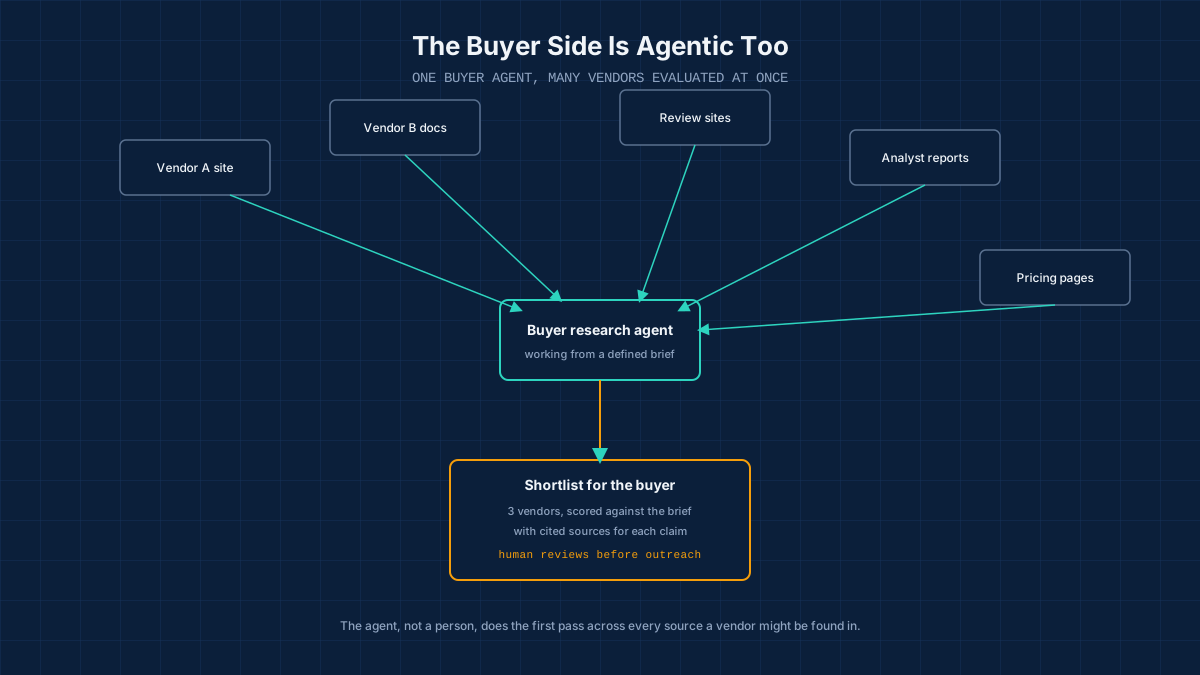
This has a specific, important consequence for sellers: a meaningful share of the earliest and most influential vendor evaluation now happens without a human from the buying organization directly engaging with a seller's website, content, or outreach at all. The audience for a company's GTM content and messaging is no longer only prospective buyers. It increasingly includes the systems those buyers deploy to do their initial research, and those systems read, weigh, and synthesize information differently than a person does.
| Dimension | Human-led buying | Agent-assisted buying |
|---|---|---|
| Who does initial research | A person, browsing sites and asking peers | An agent, scanning many sources in parallel |
| What influences the shortlist | Persuasive content, brand recognition, referrals | Verifiable claims, structured data, source credibility |
| Speed of initial evaluation | Days to weeks across a small number of vendors | Hours across a much larger candidate set |
| When a human first engages a seller | Early, often at the research stage itself | Later, typically after a shortlist already exists |
A Familiar Pattern: Discoverability Rules Change When the Reader Changes
This is not the first time the rules for being found and evaluated shifted because of a change in who, or what, was doing the finding, and the earlier version of this shift is useful context for how fast and how thoroughly this kind of change tends to play out.
Search engine optimization itself is the clearest precedent. Before search engines became the dominant way people found businesses, discoverability depended heavily on directory listings, print advertising, and word of mouth, channels optimized for how a person browsed and asked around. As search engines became the primary discovery mechanism, an entirely new discipline emerged around structuring content specifically for how a crawler and a ranking algorithm evaluated a page, a discipline that had almost nothing to do with the earlier channels and initially felt, to many traditional marketers, like a niche technical concern rather than a core part of go to market. Companies that recognized the shift early and invested in it accordingly built a durable discoverability advantage over competitors who kept optimizing only for the older channels. The underlying product and message did not need to change for this shift to matter. What needed to change was how that product and message were structured and presented to a new, non human evaluator sitting between the company and its eventual human audience.
Programmatic advertising followed a related pattern in a different domain. Ad buying shifted from negotiated relationships between human media buyers and publishers to automated, algorithm mediated bidding happening in milliseconds between systems on both sides. Advertisers who understood how to structure their creative and targeting data for that automated exchange captured efficiency and reach that advertisers still relying purely on relationship based buying did not, even though the human decision maker approving campaign budgets remained just as involved as before at the strategic level. The transaction mechanics changed even though the humans setting strategy and making final calls stayed in the loop, and that distinction, automation handling the mechanics while humans retain the higher level decisions, closely mirrors the agent mediated buying journey described in this piece.
Agent mediated B2B research is following a similar arc, compressed into a shorter timeframe than either of these precedents took. The underlying product and message a company offers do not need to fundamentally change. What increasingly needs to change is how that information is structured, sourced, and made accessible to a new kind of evaluator sitting between a company and the human who will eventually make the final call.
Being Findable by an Agent Is a Different Problem
Search engine optimization taught B2B marketers how to be findable by people using search engines, and content marketing taught them how to be persuasive once found. Both disciplines remain relevant. Neither one, on its own, guarantees that an AI agent conducting research on a buyer's behalf will surface a given vendor as a strong candidate, because agents weigh and process information differently than the search algorithms and human readers those disciplines were built around.
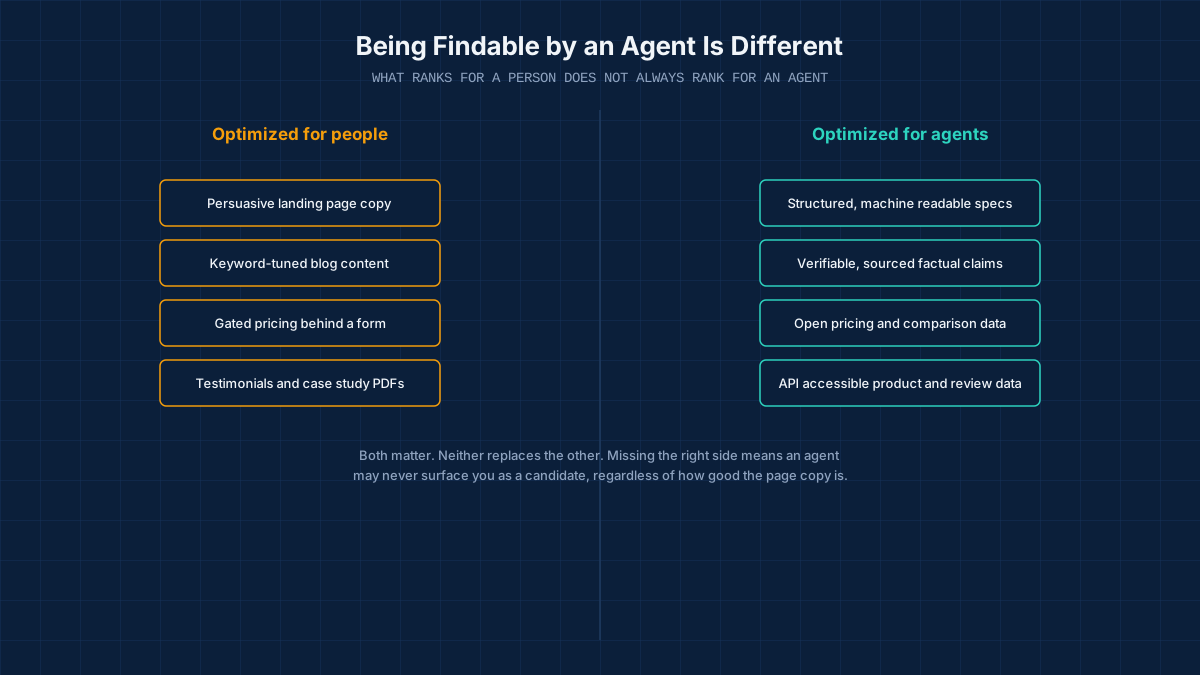
An agent conducting vendor research typically values a few things that traditional marketing content does not always prioritize. It values structured, machine readable information over persuasive prose, because structured data is easier to parse, compare, and cite accurately. It values verifiable, sourced claims over unsupported superlatives, because an agent synthesizing a comparison across several vendors needs to be able to justify its conclusions, and a claim it cannot verify is a claim it is less likely to weight heavily or repeat confidently. It values accessible pricing and comparison information over content gated behind a form, because a gate that exists specifically to capture a human's contact information does not function the way it was designed to when the visitor is a piece of software rather than a person who might eventually fill out that form. And it values direct, structured access to product and review data, sometimes through APIs or well structured documentation, over content that assumes a human reader will patiently click through several pages to piece together the full picture.
None of this makes traditional marketing content obsolete. A human still makes the final decision at most B2B companies, and persuasive, well written content still matters at the stages where a person is directly engaging. What changes is that being found and fairly evaluated earlier in the process, at the research and shortlisting stage, increasingly depends on a parallel set of practices most GTM teams have not historically had to think about.
It is worth being specific about why this gap has opened rather than treating it as a vague, general observation. Most B2B websites and content libraries were built over years, sometimes decades, with a single implicit audience in mind: a person, reading at their own pace, willing to click through several pages, fill out a form for something valuable enough to warrant it, and form an impression based on tone and design as much as pure factual content. None of those assumptions hold the same way for an agent conducting research at scale across many vendors in a short window. An agent does not experience persuasive design the way a person does, does not have the same patience for multi step navigation to find a specific fact, and cannot fill out a form on a buyer's behalf even if it wanted the information behind it. A content library built entirely around the first audience is not wrong, it is simply incomplete for the second one, and that gap is where a meaningful share of near term GTM opportunity currently sits.
The Agent-Mediated Buying Journey
It helps to map where agents currently participate most heavily in a typical B2B buying journey, and where humans still hold the decisive checkpoints.
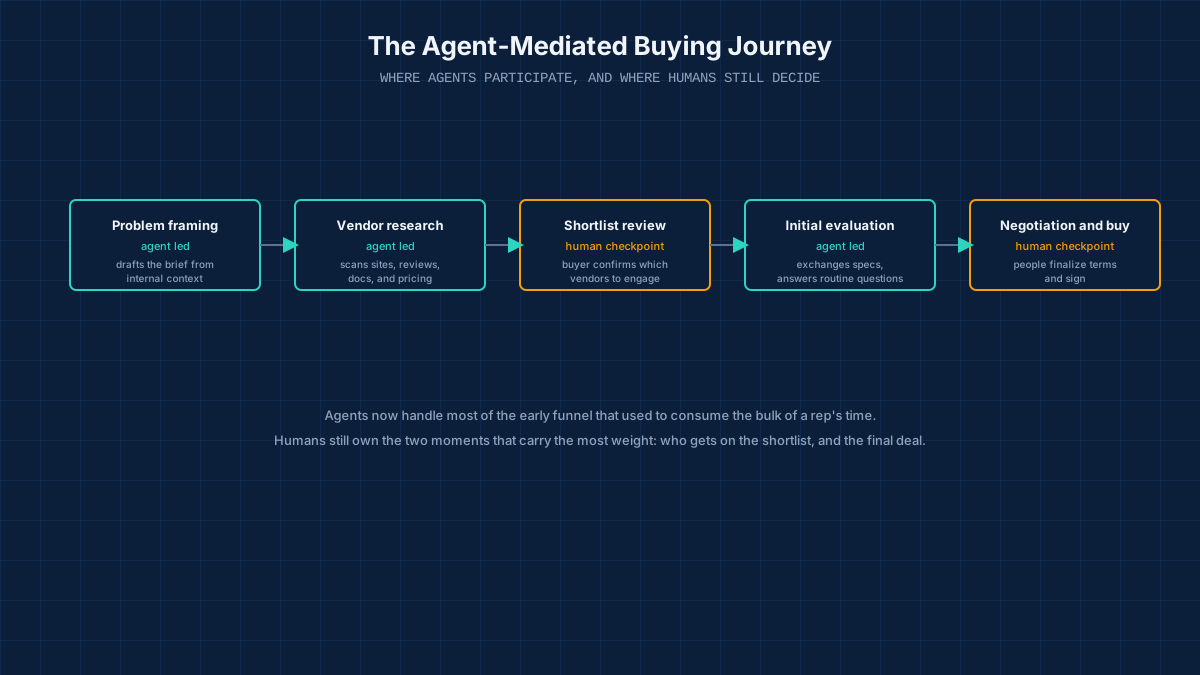
Problem framing, the stage where a buying organization defines what it actually needs, increasingly involves an agent helping draft the brief from internal context, past purchasing decisions, and stated requirements, though a person typically still reviews and approves that framing before it drives further research. This stage matters more than it might first appear, because the quality and specificity of the brief an agent works from directly shapes which vendors it identifies as relevant candidates later in the process, which means a poorly specified initial brief can systematically exclude strong vendors from consideration before a human ever gets involved.
Vendor research, historically one of the most time consuming stages for a buyer, is where agent involvement is currently most advanced. An agent can scan vendor websites, documentation, review sites, and pricing pages far faster than a person, synthesizing findings into a structured comparison that a human would have taken considerably longer to assemble manually. This is also the stage where the discoverability considerations discussed earlier in this piece matter most directly, since it is the stage where an agent is actively deciding which vendors are even worth including in the comparison it eventually presents to a human.
Shortlist review remains a human checkpoint, and for good reason. Even when an agent has done the bulk of the research, the decision about which vendors are worth actually engaging carries enough weight, and enough context a person may hold that an agent does not, that most buying organizations keep a human explicitly in the loop at this stage rather than letting an agent's shortlist proceed to outreach unreviewed. This checkpoint also functions as an important quality control mechanism, since a human reviewing an agent generated shortlist can catch cases where the agent's research missed important context or weighted the wrong factors, a safeguard that becomes more important, not less, as more of the underlying research work shifts to automated systems.
Initial evaluation, once a shortlist exists, increasingly involves agent to agent exchange for routine, well defined questions, specification confirmation, basic pricing clarification, documentation requests, before a human sales conversation begins in earnest. This is an area where sellers currently have an uneven level of readiness, since responding effectively to an automated inquiry requires infrastructure most sales organizations were not originally built around, having accurate, structured answers readily accessible rather than depending entirely on a rep's personal knowledge or a slow, manual research process on the seller's side too.
Negotiation and final purchase remain firmly human led in the large majority of B2B deals today, reflecting both the genuine complexity of many B2B negotiations and an understandable reluctance to delegate final commitment decisions to a system, though this is the stage most likely to see agent involvement expand over time as trust in agent judgment grows, similar to the trust building pattern described elsewhere in this series for AI-native GTM operation more broadly. It would be a mistake to assume this stage will remain entirely human led indefinitely simply because it currently is, given how quickly the earlier stages of this journey have already shifted.
How Fast This Is Moving
It is worth grounding this in a sense of pace, because the rate of change here is faster than most GTM strategy planning cycles are built to accommodate.
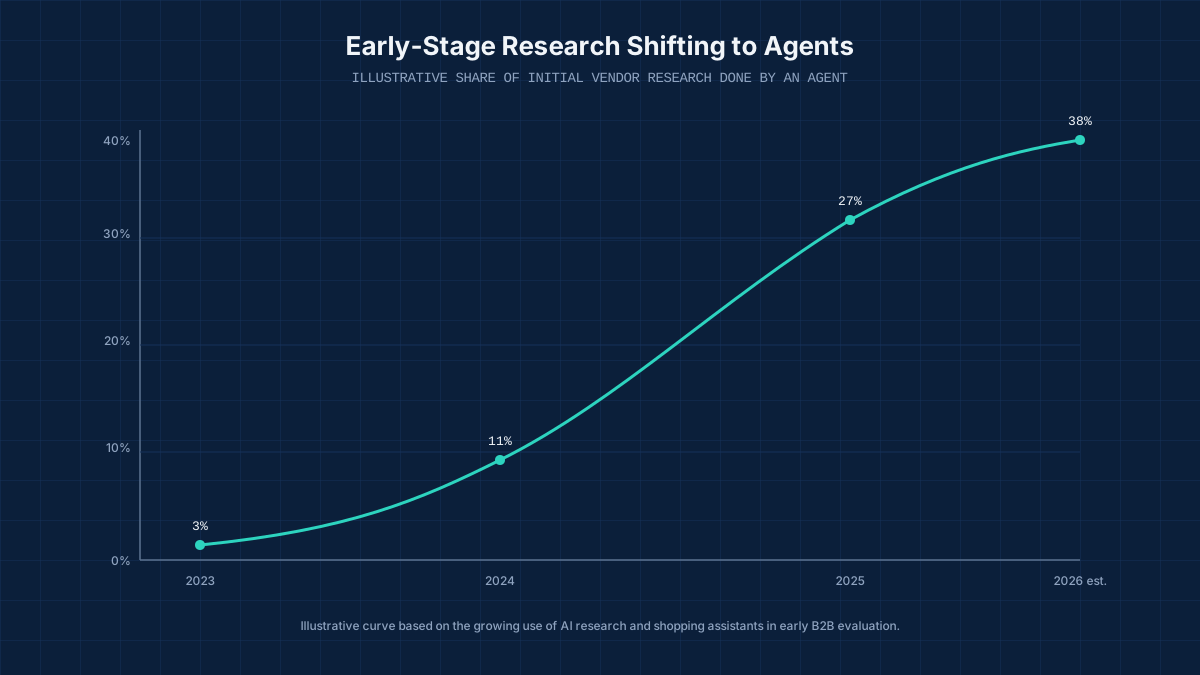
The specific figures should be read as illustrative rather than precise, since reliable, consistent measurement of this specific behavior is still maturing across the industry. The direction and rough pace of the trend are the more important takeaway: a behavior that was a small minority pattern a few years ago has grown into a meaningful and rapidly increasing share of how B2B buyers begin their vendor research, and there is little reason to expect that growth to plateau while the underlying AI research tools buyers use continue to improve.
Early Evidence This Is Already Happening
A few observable patterns suggest this shift is further along than the general GTM conversation currently reflects.
Referral traffic from AI research and chat tools has become a visible, tracked category for many B2B websites. Analytics teams at a growing number of companies now report meaningful, and in many cases rapidly growing, traffic originating from AI assistants and research tools rather than traditional search engines or direct visits. The fact that this has become significant enough to warrant its own tracked category is itself evidence that the behavior is not a rare edge case.
A new content discipline, often described informally as answer engine optimization or AI search optimization, has emerged specifically to address this gap. The rapid emergence of a named practice, complete with its own emerging best practices around structured data, clear factual claims, and machine readable formatting, mirrors how quickly SEO itself became a distinct discipline once search engines became a dominant discovery channel. Practices do not usually get named and formalized this quickly unless the underlying behavior driving them has already become significant.
Procurement and vendor research tools explicitly built around agent assisted evaluation have moved from novelty to a real, growing product category. Software specifically designed to help buying teams research, compare, and shortlist vendors using AI has attracted meaningful investment and adoption, which reflects real demand from buying organizations for exactly the kind of agent mediated research this piece describes, not a speculative capability vendors are hoping buyers will eventually want.
Objections and Counterarguments
"Most B2B deals are too complex and high stakes for agents to meaningfully participate." This is true for the final stages of many deals, and it is likely to remain true for some time in categories with genuinely complex, highly customized purchases. It is a weaker argument against agent involvement in the earlier stages this piece focuses on, research, shortlisting, initial specification exchange, which are exactly the stages that involve the most repetitive, well structured information gathering and are therefore best suited to agent participation regardless of how complex the eventual negotiation becomes. A complex enterprise deal can still have an agent mediated early funnel even if the final negotiation remains entirely human led, and treating the complexity of the final stage as a reason to dismiss agent involvement in the earlier stages conflates two genuinely different parts of the buying journey.
"Buyers will not trust an agent with something as important as vendor selection." Trust in delegating research and shortlisting is a meaningfully lower bar than trust in delegating a final purchase decision, and the evidence so far suggests buyers are comfortable delegating the former considerably faster than the latter. This mirrors a broader pattern in how people adopt AI assistance generally: research and information gathering tasks tend to see AI delegation earlier and more readily than final, consequential decisions, which tend to remain more firmly human led for longer, sometimes considerably longer. It is also worth noting that buyers are not typically delegating vendor selection wholesale, they are delegating the labor intensive early filtering that used to consume a large share of their own time, while retaining the actual decision authority over the shortlist an agent produces.
"This mainly matters for smaller, more commoditized purchases, not strategic ones." There is truth here, and it is worth being explicit about where this trend is currently strongest.
| Purchase type | Current agent involvement | Why |
|---|---|---|
| Standardized, comparable tools | High, often the default first step | Structured comparison across similar offerings is straightforward |
| Mid complexity platforms | Moderate, agent assisted research plus human validation | Enough standardization to compare, enough nuance to need review |
| Highly bespoke, strategic purchases | Lower, but growing at the research stage specifically | Final decision heavily relationship and context dependent |
The trend is still relevant to more strategic categories, since even complex purchases usually begin with a research and shortlisting phase that shares more in common with commoditized categories than the eventual negotiation does, but the pace of change and the current maturity of agent involvement genuinely does vary by category, and treating this as uniformly advanced across every type of B2B purchase would overstate the current state of adoption.
"Optimizing for agents risks making content worse for the humans who ultimately decide." This is a legitimate design tension worth taking seriously rather than dismissing. Structured, verifiable, machine parseable content and persuasive, engaging content written for a human reader are not automatically the same thing, and a team that over indexes on the former at the expense of the latter risks winning the agent's shortlist while losing the human's actual interest once they engage directly. The practical answer is not choosing one over the other, but building both deliberately, structured, verifiable data for the research and shortlisting stage, and genuinely persuasive, well crafted content for the stages where a human is directly reading and evaluating, rather than assuming a single content strategy optimized for one audience will automatically work for both.
"This is speculative, and building for it now is premature given how uncertain the specific tools and standards involved still are." There is a reasonable version of this caution, since the specific technical standards for agent to agent commerce and the specific AI research tools buyers favor are both still evolving, and over investing in optimizing for a specific, narrow implementation that later becomes obsolete is a real risk. The more durable response is to invest in the underlying practices that matter regardless of which specific tools win out, structured and accessible information, verifiable claims, and reduced reliance on gates that assume a human visitor, rather than betting heavily on any single platform or standard. Those underlying practices are useful hedges against uncertainty about the specific implementation details, even if the details themselves continue to shift.
What This Means for GTM Teams
Audit discoverability for agents specifically, not just for search engines and people. This means checking whether core product information, pricing, specifications, comparisons, is available in a structured, accessible format that an agent can reliably parse, cite, and compare, separate from whether the same information exists somewhere in persuasive prose on a marketing page. A useful practical test is to ask whether a well built research agent, given a defined set of requirements, could accurately summarize what a company offers, how it is priced, and how it compares to a named competitor, using only publicly accessible information, without needing to fill a form or speak with a person first. Running this test literally, using an available AI research tool to attempt exactly this task against a company's own public presence, is a quick and revealing way to find the specific gaps worth prioritizing.
Treat verifiable, sourced claims as a competitive advantage, not just good practice. An agent synthesizing a comparison across several vendors is more likely to confidently repeat and weight a specific, sourced claim than an unsupported superlative, which means the discipline of backing claims with evidence, case studies, third party validation, clearly documented specifications, has a direct, practical payoff in agent mediated research that it did not have to the same degree when the primary audience was a person reading persuasively written copy. This also raises the cost of vague or unsubstantiated marketing claims in a way that was previously more tolerated, since an agent is less likely to confidently repeat a claim it cannot verify, which means unsupported claims may now cost a company visibility in agent generated comparisons, not just credibility with a skeptical human reader.
Reconsider what gets gated behind a form. Gating pricing, detailed specifications, or comparison information behind a lead capture form made sense when the primary goal was converting a human visitor into a tracked lead. That same gate can quietly exclude a company from an agent's research entirely, since an agent is unlikely to fill out a form on a buyer's behalf, and unlikely to represent a vendor accurately in a comparison if it cannot access the information needed to make that comparison. This does not mean eliminating lead capture altogether, but it does mean being deliberate about which specific pieces of information are worth gating versus which ones cost more in agent visibility than they gain in captured leads. A reasonable starting approach is auditing which gated assets are most likely to be exactly what a research agent needs, pricing structure and core specifications are common examples, and considering ungating those specifically while keeping more genuinely high value, lower urgency content, like in depth guides or webinars, behind a gate where the lead capture tradeoff still makes more sense.
Prepare for agent to agent interaction as a real, near term GTM surface, not a speculative future one. As buyer side agents increasingly handle initial research and specification questions, sellers who build their own agent capable of responding accurately and helpfully to that kind of automated inquiry are likely to convert a larger share of agent mediated research into human engagement than sellers who only have a traditional, human staffed sales process to offer once an agent's questions arrive through a contact form or a support inbox built for people, not systems. This is a genuinely new kind of infrastructure investment for most GTM teams, and it is worth starting with a narrow, well scoped version, accurately answering common, well defined product and pricing questions, rather than attempting to build a fully autonomous agent to agent sales process from the outset.
Keep the human moments genuinely excellent, since they now carry disproportionate weight. As agents absorb more of the repetitive early funnel work, the specific moments where a human from the buying organization does engage directly, the shortlist conversation, the negotiation, the final relationship, become a larger share of what actually differentiates one vendor's experience from another's. A team that wins agent mediated research but delivers a mediocre human experience once a person finally engages risks losing deals at exactly the stage that now matters most, precisely because agents have already filtered out the vendors who could not clear that earlier bar. This is worth stating plainly: the rise of agent mediated research raises, rather than lowers, the stakes of the human interactions that remain, since a buyer who reaches a human conversation has typically already done more filtering than they used to, and arrives with higher, more informed expectations as a result.
Where Elevate GTM Solutions Fits
This piece has focused on how AI agents are changing the buyer side of the GTM equation, but the same shift raises the bar on the seller side: the strategy, positioning, and messaging a company presents has to be accurate and current enough to hold up when the first reader is a research agent rather than a person. Elevate GTM Solutions is built with that bar in mind.
As the AI-native GTM platform and GTM operating system built to keep GTM context, positioning, and messaging continuously current across markets and segments, Elevate is designed to reduce exactly the kind of drift, a static positioning document that no longer matches what a company actually offers or how it actually compares to competitors, that this piece has argued becomes more costly once buyer side agents are doing much of the early research and shortlisting. A company whose strategic narrative stays connected to its actual current market and competitive context, rather than sitting in a deck from the last planning cycle, is better positioned to hold up to the kind of verification an agent mediated evaluation increasingly applies.
Conclusion
The AI agent conversation in B2B GTM has, so far, focused overwhelmingly on how sellers use AI to work faster. That focus made sense as a starting point, since it was the more immediately actionable and visible part of the shift. It is not the whole story, and arguably not even the more consequential half of it. Buyers are adopting their own agents to handle research and evaluation at a pace that most GTM strategy has not yet caught up with, and when that happens, the audience for a company's discoverability and credibility signals expands to include systems, not just people, well before a human buyer ever directly engages.
This does not replace the fundamentals of good GTM, a strong product, credible proof points, and genuinely helpful engagement still matter as much as they ever did. What it adds is a parallel discipline: making sure the information an agent needs to fairly evaluate and shortlist a company is structured, accessible, and verifiable, not just persuasive. Teams that treat this as a genuine, near term priority, rather than a speculative future consideration, are likely to show up more often in the shortlists an agent produces long before their competitors realize that shortlist was ever being assembled by something other than a person.
There is also a broader implication worth naming directly. Every previous shift in how buyers discover and evaluate vendors, from directories to search engines to social proof and review sites, eventually became table stakes, a set of practices every serious GTM team was expected to have in place, even though each one initially felt speculative or niche to teams encountering it for the first time. The agent mediated research shift described in this piece is very likely following the same trajectory, on a faster timeline than most of its predecessors. The teams that treat it as core GTM infrastructure now, while it still feels early to much of the market, are the ones most likely to have built the necessary discoverability and credibility signals in place by the time it becomes the obvious, unremarkable baseline that this piece argues it is already well on its way to becoming.
Contents
Related Research
GTM Research
Explore research, benchmarks, technology landscapes, and perspectives on the evolution of go-to-market.
View Research Library →