
By the Elevate GTM Solutions Team · Updated November 13, 2026 · 27 min read
How Do You Compare Multiple Go-to-Market Strategies Before You Commit Budget? A Practical Framework for Choosing Between Options
Most go-to-market decisions are made with a single plan on the table. Someone writes a strategy, the leadership team debates it and the debate is really about whether this one plan is acceptable, not about whether it is better than the alternatives. The alternatives, if they exist, live in the heads of the people who lost the argument. That is a weak way to commit a year's budget.
A stronger approach is to develop two or three real options, write each down in the same format, compare them on the same criteria and choose with the trade-offs visible. This guide explains how to do that: how to create options that are genuinely different, what to compare, how to score without fooling yourself, how to test the assumptions that matter most, how to decide and how to avoid the usual mistakes. It also explains how a platform that lets you create several strategies and compare them can help, and where it cannot.
We make a GTM strategy platform, Elevate GTM Solutions, so we have an interest. We cite no statistics, we describe other approaches in general terms and the examples are invented and labeled. Where we describe Elevate, we limit ourselves to what we are confident the product does, and we suggest you confirm the details with us directly.
How do you compare multiple GTM strategies before committing budget?
Start by creating two or three options that differ on a real choice, such as which segment to lead with, which motion to use or which market to enter first. Write each in the same format. Compare them on the same criteria: size and quality of the opportunity, fit with your strengths, cost and time to first evidence, execution difficulty, risk and what you would learn. Score each criterion and write the reason, then look at where the options differ most and which assumptions drive those differences. Test the assumptions that matter most cheaply before you commit the full budget, and choose with the trade-offs written down, including what would make you change course. The aim is a better decision and a record of why, not a perfect score.
How many options should you compare? Two or three. More than that produces noise, and fewer than two produces a rubber stamp.
Is a scoring matrix enough? No. Scores organize your thinking, and the real value is in the reasons and in the tests of the assumptions that drive the result.
The short version
| Question | Answer |
|---|---|
| Why compare options at all? | A single plan invites yes or no debate. Alternatives expose trade-offs |
| How many options? | Two or three that differ on a real choice |
| What makes options real? | They differ on who you serve, how you sell or where you start, not just on wording |
| What do you compare? | Opportunity, fit, cost and time to evidence, difficulty, risk, learning value |
| How do you score? | Same scale, written reasons, and a look at where the options differ most |
| What do you test first? | The assumptions that drive the biggest differences between options |
| How do you decide? | With trade-offs visible, a staged commitment and stated reasons to change course |
| What is the main mistake? | Treating a score as the answer |
Why a single plan is a weak basis for a decision
A single plan gets judged against an unstated alternative, usually "do nothing" or "what we did last year," and both are poor standards. Several problems follow.
Anchoring. Whatever is on the table first becomes the reference, and discussion drifts to small edits.
Hidden trade-offs. Choosing a segment means not choosing others, and a single plan does not show what was given up.
Advocacy over analysis. The author defends the plan. Critics find faults. Nobody is asked which plan is best.
False certainty. A single polished plan looks more certain than it is.
No learning value. If the plan fails, nobody knows whether another approach would have worked.
Comparing options changes the question from "is this plan acceptable?" to "which of these choices is best given what we know and what we can learn cheaply?" See GTM strategy and GTM planning template.
Creating options that are really different
The most common failure is producing three versions of the same plan. The test of a real option is that choosing it means giving something up.
Pick the choice you are actually unsure about
Most strategic uncertainty falls into a few categories.
| Type of choice | Example options |
|---|---|
| Who to lead with | Regional carriers vs third-party logistics providers |
| Which motion | Product-led entry vs sales-led enterprise vs partner-led |
| Where to start | Home market first vs a new region first |
| How to position | Compete on speed vs compete on depth vs compete on price |
| How to package and price | Per-seat vs usage-based vs platform fee |
| How fast to move | A focused launch to one segment vs a broad launch |
| Whether to build, buy or partner | Direct sales vs a channel partner program |
Pick the one or two choices where reasonable people on your team disagree. Then build options around them.
Keep everything else constant where you can
If you change five things at once, you cannot tell which one matters. Where possible, vary one major choice per set of options and hold the rest steady. A set of options built around "which segment first" is clearer than a set that also varies pricing, channels and timing.
Include one uncomfortable option
If every option is something the leadership team already likes, you have not explored. Include one option that challenges the current direction, even if you expect to reject it. Rejecting it with reasons is useful, and sometimes it turns out to be the best.
Write each option in the same format
A common format works well. For each option, write:
- The target segment and the ideal customer profile.
- The positioning and the main message.
- The motion and channels.
- The pricing approach.
- The resources required: people, budget, tools.
- The timeline to first evidence.
- The measures that would show it is working.
- The main risks and the assumptions it depends on.
Consistent format makes comparison possible. It also makes it obvious where an option is thin.
What to compare
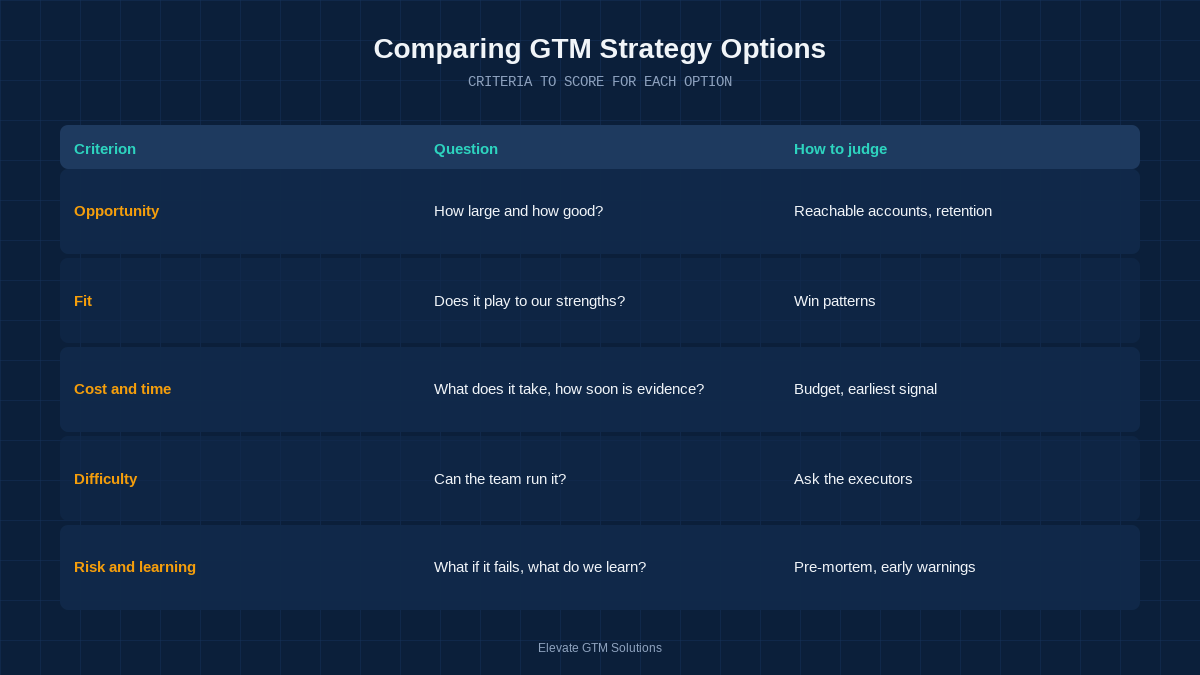
Criteria should reflect what your company actually cares about. A useful set to adapt:
| Criterion | The question | How to judge |
|---|---|---|
| Opportunity size | How large is the realistic prize if this works? | Count reachable accounts and plausible contract values, with ranges |
| Opportunity quality | How good is the customer: margin, retention, expansion? | Use your own data where you have it |
| Fit with strengths | Does this play to what you do best? | Compare with win patterns and product strengths |
| Competitive position | How strong is your edge against the alternatives buyers use? | Use win and loss reasons |
| Cost to execute | What does it cost to run for the period? | Include people, programs and tools |
| Time to first evidence | How soon will you know whether it is working? | Estimate the earliest reliable signal |
| Execution difficulty | Can your team run it with current skills and capacity? | Ask the people who would run it |
| Dependencies | What must be true elsewhere: product readiness, partners, regulation? | List them |
| Risk | What is the downside if it fails, and how reversible is it? | Describe the worst case and how to limit it |
| Learning value | Will it teach you something useful even if it does not hit the target? | Describe what you would learn |
Not every criterion will matter equally. Weight them, but do it before you score, so that the weights do not drift toward whichever option you prefer.
Scoring without fooling yourself
Scoring brings structure and can mislead if done carelessly. A few practices keep it honest.
Use a simple scale. One to five is enough. Finer scales suggest precision that does not exist.
Write the reason for every score. A score without a reason is an opinion. The reasons are what you will debate and learn from.
Score independently first. Ask several people to score alone before discussing. Differences in scores point to differences in assumptions, which is the useful part.
Use ranges for uncertain items. If you cannot say whether opportunity size is a three or a four, write "three to four" and note why.
Look at the spread, not only the total. Two options with the same total can be very different: one even, one with strong highs and serious lows. Read the pattern.
Test sensitivity. Change a weight or a key score and see whether the ranking changes. If it does, the decision depends on that input, and you should investigate it.
Do not let the total decide. Scores organize the discussion. The decision comes after you have looked at the trade-offs, the assumptions and the cost of being wrong.
A scoring template
| Criterion | Weight | Option A | Reason | Option B | Reason | Option C | Reason |
|---|---|---|---|---|---|---|---|
| Opportunity size | 3 | ||||||
| Opportunity quality | 3 | ||||||
| Fit with strengths | 2 | ||||||
| Competitive position | 2 | ||||||
| Cost to execute | 2 | ||||||
| Time to first evidence | 2 | ||||||
| Execution difficulty | 2 | ||||||
| Risk | 3 | ||||||
| Learning value | 1 |
Fill it in a shared document and keep the reasons visible.
Find the assumptions that drive the differences
Once you have scored, look at where the options differ most and ask what would have to be true for each to win. Those statements are your key assumptions.
For each option, complete this sentence: "This option wins if ..." For example, "Option A wins if regional carriers convert at least as well as they appear to in our early data, and if implementation can be shortened to six weeks." "Option B wins if third-party logistics buyers will accept our current integration limits."
List the assumptions across options and rank them by two questions. How much would the decision change if the assumption were false? How cheaply can we test it? The assumptions that are both high-impact and cheap to test are where you spend your effort first.
Testing before you commit
Committing the full budget before testing is the expensive path. A staged approach is usually better.
Customer conversations. Speak with eight to fifteen people per option's target segment, asking about their problems, alternatives and buying process. Look for disconfirming evidence.
Existing data. Review win and loss records, pipeline by segment, retention and sales cycle length for relevant segments.
Small experiments. A modest outbound test, a landing page, a webinar or a pilot with a few accounts can show interest at low cost.
Capacity checks. Ask the people who would run each option whether they can, and what they would need.
Pre-mortem. For each option, imagine it failed in a year and write down the most likely reasons. Patterns across the stories point to real risks.
Set a time box, perhaps four to six weeks, and decide in advance what evidence would change your ranking. See pilot to scale framework and GTM experimentation framework.
Deciding
At the end of the testing, decide with the trade-offs in front of you.
Choose, and write down why
Record the chosen option, the options rejected and the main reasons. Write what you gave up. This is the record that future you will want.
Stage the commitment
Rarely does a decision have to be all or nothing. Commit a first stage of budget to the chosen option with defined checkpoints, and keep a small reserve to test a second option or to respond if the first stalls.
Define the exit and the change conditions
State in advance what results at the checkpoint would lead you to continue, adjust or switch. Without this, sunk cost keeps weak options alive.
Assign owners and dates
Every option, including the chosen one, needs an owner, a timeline and measures. The first thirty days should be specific.
Keep the alternatives alive on paper
Store the rejected options and what you learned. If the chosen option stalls, you are not starting again from zero. See pilot to scale framework and GTM strategy handoff.
A worked example, invented for illustration
Imagine a company of about sixty people selling field-service scheduling software. The details are invented and describe no real company.
The leadership team disagrees about where to focus next year. The head of sales wants to push into enterprise utilities. The head of marketing thinks small and mid-size HVAC and plumbing contractors are an easier market. The product lead believes a partner program with equipment manufacturers could reach both.
The head of strategy creates three options in a common format. Option A is enterprise utilities with a direct sales motion. Option B is mid-size contractors with a product-led trial and inside sales. Option C is a partner-led approach through equipment manufacturers. She adds a reserve for testing.
Scoring happens independently, then together. Opportunity size favors A on paper, with long, large deals. Opportunity quality shows mixed signals: A has strong retention in the few accounts the company has, B has high churn historically, C is unknown. Cost to execute is high for A because of long cycles and specialist sellers, lower for B and uncertain for C. Time to first evidence is long for A, short for B and medium for C. Execution difficulty is high for A, because the team has little enterprise experience. Risk is concentrated for A, spread for B and dependent on a few partners for C.
The sensitivity check shows the ranking between A and B flips if opportunity quality for B is rescored from two to three, so the churn assumption for B becomes the key test. The team also identifies that A wins only if the company can win at least two enterprise deals in the first year, which is cheap to probe by talking to current utility prospects.
They run a five-week test: twelve customer conversations in each segment, a look at churn by customer size in the existing data and a small pilot offer to five contractors. They find that churn for B is concentrated in the smallest accounts and much lower for mid-size ones. They also learn that utilities require security reviews that would delay A by months. Partner conversations show interest from two manufacturers.
The decision is staged: lead with mid-size contractors, start a pilot with one manufacturer partner and keep enterprise utilities as a prepared option for the following year. The reasons, the trade-offs and the conditions for changing course are written down.
Notice that the winner was not obvious at the start, that the sensitivity check pointed to the right test and that the rejected option was kept for later.
How a platform can help, and what it cannot do
A platform that lets you create several strategies and compare them can reduce the cost of this process in practical ways. Writing each option in a consistent format is easier when a structure is provided. Creating a second or third option is faster when you do not start from a blank page. Keeping the options in one place with their context makes review and discussion simpler, and collaborators can see the same material.
In Elevate, you can create multiple strategies, for different products, segments, markets or assumptions, and compare them. We describe this as a way to see the options together, not as a way to decide for you.
What a platform cannot do:
- It cannot tell you which assumptions are true. Only customers, data and experiments can.
- It cannot know your team's capacity or appetite for risk unless you provide them.
- It cannot replace the judgment of the people who will have to execute the chosen option.
- It cannot make the decision. A comparison is an input to a decision made by people.
See how to build a GTM strategy with AI and can AI build a full GTM strategy in minutes.
Common mistakes
Three versions of the same plan. If choosing an option does not mean giving something up, it is not a real option.
Changing everything at once. Vary one major choice so you can tell what matters.
Weighting after scoring. Weights adjusted afterward drift toward the favorite.
Scores without reasons. The reasons are the useful part.
Letting the total decide. Look at spread, sensitivity and assumptions.
Skipping the test. Committing full budget on untested assumptions is the costliest path.
Excluding the uncomfortable option. Challenge the current direction at least once.
No exit conditions. Without them, weak options persist.
Throwing away the alternatives. Keep them documented. They are your fallback and your learning.
Treating the choice as permanent. Review at each checkpoint.
Questions to ask yourself
- What choice are we actually unsure about?
- Do my options differ on that choice in a way that means giving something up?
- Which criteria matter most to us, and did we set weights before scoring?
- Where do people's scores differ, and what assumptions explain it?
- Which assumptions would change the decision if false, and how cheaply can we test them?
- What would we need to see to switch options?
- How will we stage the budget?
- Who owns each option, and where will we keep the ones we do not choose?
How to size an opportunity without false precision
Opportunity size is the criterion most likely to be treated as a number when it is really a range. A few habits keep it honest.
Count accounts before dollars. Start with how many organizations fit the segment and can be reached with the channels in the option. A big total market that your channels cannot reach is not your opportunity.
Use a range for contract value. If current customers in a similar segment pay between a low and a high figure, use both, and note what would push a deal to each end.
Apply a realistic conversion path. Work from reachable accounts to conversations, to qualified opportunities, to wins, using your own history where you have it and an explicit assumption where you do not. Mark the assumptions.
Separate year-one from steady state. An enterprise segment may look larger over five years and smaller in the first twelve months because of cycle length. Show both.
Show the spread. A pessimistic, middle and optimistic case tells readers more than a single figure, and it reveals which input drives the difference.
If you cannot defend an input, say so in the reason column. A candid "unknown, high impact" is more useful than an invented number. See how big is a B2B buying group and B2B sales cycle length evidence for cautions on cycle and buying-group assumptions.
Running the comparison meeting
The meeting where options are compared often decides how useful the whole exercise is. A workable structure for ninety minutes:
Before the meeting. Circulate the written options and the independent scores, with reasons. Ask participants to read them and write their top two concerns for each option.
Ten minutes: the choice and the criteria. Restate what is being decided and why. Confirm the criteria and weights, which were agreed beforehand.
Thirty minutes: where scores differ. Skip the criteria where everyone agrees. Spend time on the ones with spread, asking each person to explain their reasoning. Capture the assumptions behind the differences.
Twenty minutes: assumptions and tests. Rank the assumptions by impact and cost to test, and agree which tests to run, who owns them and when results will return.
Twenty minutes: risks and the uncomfortable option. Review the pre-mortem results. Ask directly what would make the team regret each option.
Ten minutes: next steps. Decide the time box, the owners and the date of the decision meeting.
Do not try to decide in the first meeting. The first meeting produces a test plan. The second, after the tests, produces the decision.
Communicating the decision
A decision that is poorly communicated loses much of its value. After choosing, tell the wider team four things in plain language: what you chose, what you did not choose and why, what you expect to learn and when you will review, and what each function is being asked to do differently. Keep it to a page. Invite people to say what they think is wrong, since the people who run the plan often spot problems first.
Share the rejected options too. People who argued for them are more likely to commit if they can see that their option was taken seriously and that its reasons were recorded fairly.
Comparing options when you are small
A company of ten or fifteen people does not need a scoring workshop. The same principles apply in a lighter form.
Write two options on a single page each, using the common format. Have two or three people read them and mark where they disagree. Pick the one or two assumptions that matter most and talk to ten customers or prospects about them over a couple of weeks. Decide, write three sentences on why and set a date, perhaps six weeks out, to check. The point is the discipline of comparing alternatives and testing what matters, not the apparatus.
Comparing options when you are large
At larger scale, the risk shifts from too little process to too much. Options can multiply across regions and product lines, and each has stakeholders. Useful practices include limiting each decision to three options, agreeing criteria and weights at the executive level so that regional teams do not each invent their own, using the same format across business units so that comparisons are possible and assigning a single owner to each decision. Governance matters here: who can propose an option, who scores, who decides and how disagreements escalate. See enterprise GTM business case.
Reading a pre-mortem well
A pre-mortem is simple to run and easy to waste. Ask each participant to write, privately, three reasons why the option failed a year from now. Collect them without discussion, group similar ones and count how often each theme appears.
Themes that appear across several people and several options are structural risks, such as a dependence on a single integration or a hiring plan that may not materialize. Themes that appear for one option only are specific risks that should lower its score or require a mitigation. Themes mentioned by only one person deserve a second look, because that person may know something others do not.
For each major risk, write a mitigation and an early warning sign, the earliest observable event that would tell you the risk is materializing. Early warning signs turn risks into things you can monitor.
Examples of useful early warning signs
| Option type | Possible risk | Early warning sign |
|---|---|---|
| New segment with direct sales | Sales cycles longer than planned | Few qualified opportunities after the first eight weeks of outreach |
| Product-led trial | Users sign up and do not activate | Low share of trials reaching the key action in the first week |
| Partner-led entry | Partners do not prioritize your product | Few partner-sourced conversations after the first quarter |
| New region | Messaging does not translate | Reply rates and meeting rates well below the home market in comparable outreach |
| Repositioning | Existing customers are confused | Support and customer success report questions about the changes |
| Pricing change | Deals stall at the pricing stage | Rising share of opportunities lost at proposal |
Pick early warning signs that your data can actually show, and name who watches them.
When to stop comparing
Comparison has diminishing returns. You have probably done enough when the remaining uncertainty cannot be reduced by thinking, only by acting, when the top assumptions have been tested to a level that would change the decision if they failed and when further delay costs more than a wrong choice would. At that point, decide, stage the commitment and let the market teach you. Over-analysis is a form of avoidance and a real cost when markets move.
A one-page summary format for leaders
Executives rarely read long option papers. A one-page summary per decision keeps attention on what matters. Include the decision to be made and the date, the options in one line each, the scores with the two or three criteria that separate them, the key assumptions and the tests run, the recommendation with the main trade-off stated plainly, the staged budget and checkpoints and the conditions that would change the plan. Put the detailed options in an appendix. A leader who can read the page in five minutes and ask sharp questions will give you a better decision than one who skims forty pages.
Glossary
Strategic option. A complete alternative plan that differs from others on a real choice.
Scoring matrix. A table that rates options against criteria, with weights.
Sensitivity analysis. Changing inputs or weights to see whether the ranking changes.
Key assumption. A belief that must be true for an option to succeed.
Pre-mortem. Imagining that a plan failed and listing the most likely reasons.
Staged commitment. Releasing budget in steps against evidence.
Time to first evidence. How soon the earliest reliable signal of success or failure appears.
ICP. The ideal customer profile. See ICP.
Where Elevate GTM Solutions fits
Elevate GTM Solutions is an AI GTM platform for building, executing and evolving go-to-market strategy. In the platform you can create more than one strategy and compare them, which supports the process in this guide: you can write options in a consistent structure, keep them together with their context and look at them as a group.
As we describe the product, a strategy starts from the context entered in GTM Insights and Strategy Context, is created in the Strategy Builder from fifteen modules or the Unified GTM option, and moves through the stages Draft, Defined, Launched and Optimizing in the Workflow Engine, where collaborators can be added. Once you have chosen, GTM Activation turns selected reports into focus assets, and GTM Pulse and executive dashboards support follow-through.
What it does not do: it does not decide for you, verify your assumptions or run your tests. We suggest you create two or three options for a real decision, use the scoring approach above and test the key assumptions with customers and data before committing. Confirm what the comparison view shows and its current limits with us directly. See what Elevate GTM Solutions is.
What to do this week
- Write down the strategic choice your team disagrees about most.
- Draft two or three options that differ on that choice, in the same format.
- Add one option that challenges the current direction.
- Agree criteria and weights before scoring.
- Ask three or four colleagues to score independently and write reasons.
- List the key assumptions behind each option and rank them by impact and cost to test.
- Plan a four to six week test of the top assumptions, with a named owner.
- Draft the exit conditions and the staged budget.
Key takeaways
- A single plan invites yes or no debate. Two or three real options expose trade-offs.
- Real options differ on a choice that means giving something up, and are written in the same format.
- Compare on opportunity, fit, cost, time to evidence, difficulty, risk and learning value, with weights set before scoring.
- Write the reason for every score, score independently first and test sensitivity.
- Find the assumptions that drive the differences and test the high-impact, cheap ones first.
- Decide with trade-offs written down, stage the budget and define the conditions for changing course.
- Keep the rejected options documented.
- A platform that lets you create and compare several strategies can lower the cost of the process. It cannot decide or verify assumptions for you.
Sources
- Elevate GTM Solutions: descriptions of the platform and its product flow, as stated on the company's homepage and in its product flow.
- Related Elevate guides linked in the text, including pilot to scale framework and GTM experimentation framework.
- The comparison method, criteria and scoring practices reflect our judgment and common decision-making practice. The worked example is invented. We state no statistics and make no claims about other vendors.
Frequently Asked Questions
How do you compare multiple GTM strategies?
Create two or three options that differ on a real choice, write them in the same format, compare them on the same criteria with weights set before scoring, find the assumptions that drive the differences, test the important ones cheaply and decide with the trade-offs written down.
How many options should I compare?
Two or three. One invites a rubber stamp and more than three tends to create noise.
What makes two strategies genuinely different?
Choosing one means giving something up, such as a different lead segment, motion, market or positioning. Variations in wording or timing alone are not options.
What criteria should I use?
Opportunity size and quality, fit with strengths, competitive position, cost to execute, time to first evidence, execution difficulty, dependencies, risk and learning value. Adapt them to your company and weight them before scoring.
Is a scoring matrix reliable?
It organizes thinking, and it can mislead. Use a simple scale, write reasons, score independently first, check the spread and test sensitivity. Do not let the total decide.
How do I test assumptions before committing?
Talk to customers in each target segment, review your own win, loss and retention data, run small experiments, check capacity with the people who would execute and run a pre-mortem on each option.
How long should the comparison take?
A focused cycle of four to six weeks is often enough to test the main assumptions. Longer sales cycles may need more time to see revenue effects.
What should I do with the options I reject?
Keep them documented with the reasons and what you learned. If the chosen option stalls, you do not start from zero.
Can a platform compare strategies for me?
A platform can make creating and viewing several strategies easier. The decision, the testing of assumptions and the judgment about risk remain with your team.
Can I create multiple strategies in Elevate?
Yes. In Elevate you can create more than one strategy and compare them. Confirm the details of the comparison view and any limits with us directly.
How do I avoid sunk cost bias?
Define in advance what results at each checkpoint would lead you to continue, adjust or switch, and review honestly against those conditions.
Does comparing options slow decisions down?
It can add a few weeks. That cost is usually small compared with committing a year's budget to an untested single plan.