Why Clay Isn't a GTM Operating System
Clay is one of the most respected data enrichment and workflow tools in modern GTM, and for good reason. It is also not, on its own, a GTM operating system. Here is an evidence-based look at what Clay does well, and where the boundary of its category actually sits.
Published 2026-07-25
Clay has become one of the default reference points in conversations about modern GTM tooling, and it has earned that position honestly. It solves a real, painful problem, fragmented, low coverage prospect data, well, and it does so with a flexible, spreadsheet like interface that lets RevOps and growth teams build enrichment and research workflows without writing custom integration code for every data provider they want to use.
That success has led to a common but imprecise habit in how the market talks about Clay: describing it, informally, as a GTM operating system, or as the platform that runs a company's entire go to market motion. This piece takes that claim seriously enough to examine it carefully, and argues that it does not hold up, not because Clay is a weak product, but because a GTM operating system, as defined elsewhere in this content series, is a different and broader category of system than an enrichment and workflow platform, however excellent that platform is at the job it is actually built to do.
This is not a piece arguing Clay is bad at what it does. It is a piece arguing that being excellent at one layer of a broader system is a different, narrower claim than being the system itself, and that the distinction matters for any team trying to evaluate what it still needs to build or buy around a tool like Clay.
This distinction is worth making carefully rather than dismissively, because the confusion is understandable. Clay's workflows genuinely touch several parts of a GTM motion, data unification, AI powered research, and even some drafting and export logic, which can make the product feel comprehensive to a team using it heavily for the first time. The goal of this piece is not to diminish that real value, but to separate what the product's own public positioning and third party descriptions actually claim from the looser, informal shorthand the broader market sometimes applies to it, since that looser shorthand can lead teams to under-invest in the parts of a GTM operating layer a tool like this was never built to provide.
What Clay Actually Does
Before assessing what Clay is not, it is worth being precise about what it is, based on how the product is publicly described and commonly used.
Clay is a data enrichment and workflow automation platform built around a spreadsheet like interface. Users import a list of contacts or accounts, then build columns that each perform a specific action, pulling data from one of a large number of connected data providers, running an AI research step against a company's website or public information, or applying conditional logic based on what earlier columns returned. A commonly cited feature, waterfall enrichment, queries multiple data providers in sequence for a given field until one returns a usable result, which increases data coverage compared to relying on any single provider alone. An AI research feature, often referred to as an agent capability within the product, can browse and summarize information about a company or contact to support personalization. Once a workflow completes, the enriched, researched data typically gets exported or synced into a CRM, a sales engagement platform, or another downstream tool where outreach actually happens.
| Capability | What it does |
|---|---|
| Waterfall enrichment | Queries multiple data providers in sequence to maximize field coverage |
| AI research columns | Uses an AI agent to browse and summarize context about a company or contact |
| No-code workflow building | Lets operations teams chain enrichment and logic steps without custom code |
| CRM and tool sync | Exports or syncs enriched, researched data into downstream sales and marketing tools |
This is a genuinely useful and, by most public accounts, well executed set of capabilities. Data fragmentation and low enrichment coverage are real, common problems in B2B GTM, and a flexible tool that lets a team combine many data sources without building custom integrations for each one addresses a specific, well understood pain point directly.
A Familiar Pattern: Excellent Point Solutions Get Mistaken for Platforms
The confusion this piece addresses, a genuinely strong tool in one part of a stack getting informally described as if it covers the whole stack, is not unique to Clay, and it is not new to GTM software specifically. It tends to happen predictably whenever a point solution becomes unusually good at its own job.
Marketing automation platforms went through a similar arc roughly a decade earlier. A tool built to manage email campaigns, landing pages, and lead scoring became, for many marketing teams, so central to daily work that it was sometimes described informally as the marketing team's entire operating system, even though it did not natively own sales handoff logic, revenue attribution across the full funnel, or coordination with what the sales team was doing with the leads it produced. That gap did not mean the marketing automation platform was a weak product, several were, and remain, genuinely excellent at the job they were built for. It meant that treating a strong point solution as if it were a full operating layer led some teams to under-invest in the connective tissue between marketing and sales that the tool itself was never designed to provide, a gap that an entire subsequent category of RevOps tooling eventually grew specifically to address.
Customer relationship management software itself, the original subject of the broader comparison this content series draws throughout, followed a related pattern for even longer. A system built to record accounts, contacts, and deals became so central to how sales teams worked day to day that its role as a system of record was sometimes conflated with a much broader claim about running the entire go to market motion, a conflation this series has argued elsewhere is precisely the gap a genuine operating layer exists to close.
The pattern in each case is the same: a tool becomes excellent and indispensable within its own well defined scope, and that excellence, combined with how central the tool becomes to daily workflow, creates an informal tendency in the market to describe it as covering more than it actually does. Recognizing this pattern is useful specifically because it suggests the confusion around Clay is not a one-off case of overhyped marketing, but a predictable outcome of genuine product excellence within a narrower category than the informal conversation around it sometimes assumes.
Where the Category Boundary Actually Sits
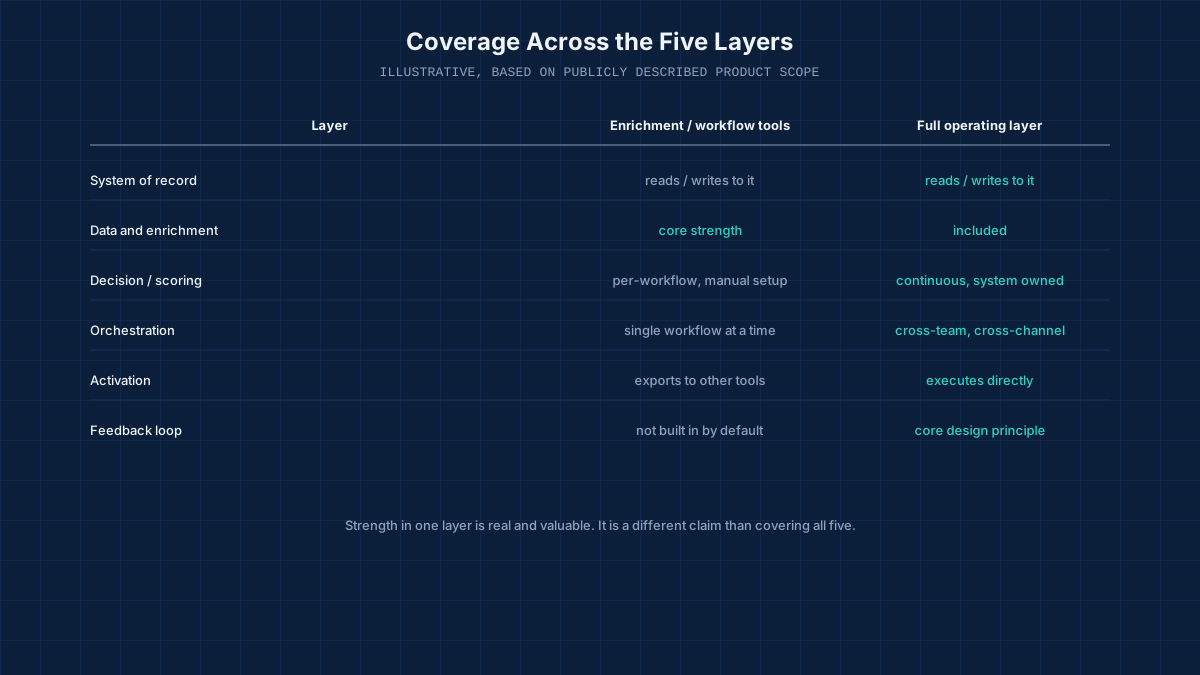
The GTM operating system model described elsewhere in this content series defines the category around five layers: a system of record, a data and signal layer, a decision layer that scores and prioritizes accounts continuously, an orchestration layer that sequences action across channels and owners, and an activation layer that executes. The defining architectural principle is not any single layer, it is the closed loop connecting all five, where outcomes feed back in to refine future decisions automatically.
It is worth being clear about why this specific distinction, a closed loop versus a well built set of individual capabilities, is the right test to apply, rather than simply counting how many features a product offers. A tool can offer enrichment, AI research, and drafting capabilities, genuinely touching three or four different functional areas of GTM work, without those capabilities being connected into a continuous, self-refining loop. Feature breadth and architectural closure are different properties, and a product can score highly on the first while not yet exhibiting the second, which is precisely the situation this piece argues describes Clay's publicly stated scope.
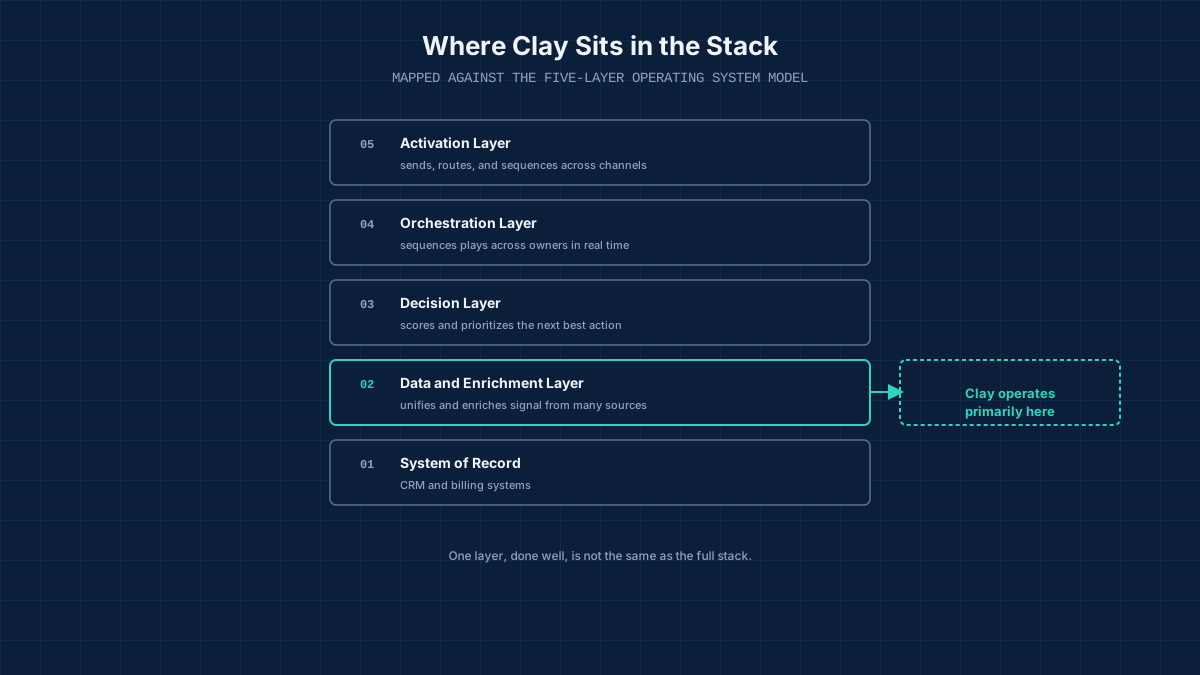
Mapped against that model, Clay's core, publicly described capabilities sit most clearly within the data and enrichment layer, and to a meaningful extent within the reasoning portion of what would be called the intelligence layer elsewhere in this model, since its AI research columns do genuine synthesis and interpretation of raw data. What is less clearly present, based on how the product is publicly described, is a system-owned decision layer that continuously re-prioritizes accounts as new signal arrives without a person re-running or reconfiguring a workflow, an orchestration layer that sequences action across multiple channels and owners as a coordinated whole rather than as a single configured workflow, and a built-in feedback mechanism that automatically uses the outcome of one enrichment and outreach cycle to refine how the next one gets scored.
| Layer | What the layer requires | How Clay's public capabilities map to it |
|---|---|---|
| System of record | Authoritative account, contact, deal data | Reads from and writes to a CRM, does not replace one |
| Data and enrichment | Continuously unify signal from many sources | Core strength, waterfall enrichment across many providers |
| Decision layer | Continuously score and prioritize without manual re-triggering | Scoring logic is built per workflow, largely configured and run by a person |
| Orchestration layer | Sequence action across channels and owners as one coordinated system | Individual workflows can trigger actions, but cross-channel sequencing is typically handled by other connected tools |
| Feedback loop | Automatically use outcomes to refine future scoring | Not a built-in default behavior, teams can build this manually if they choose to |
None of this is a criticism of the product for not being something it does not claim to be in its own core positioning, which is built around data enrichment and workflow automation rather than around the specific operating system framework this content series uses. It is a clarification of category boundaries that matters specifically because informal market usage of the term GTM operating system has become loose enough that a genuinely excellent tool in one layer sometimes gets described, by users and third party commentary rather than by the vendor itself, as if it were the whole system.
The Workflow Ends at Export
A useful way to see the boundary concretely is to trace a typical Clay workflow from start to finish, based on how the product's flow is publicly described in documentation and third party reviews.
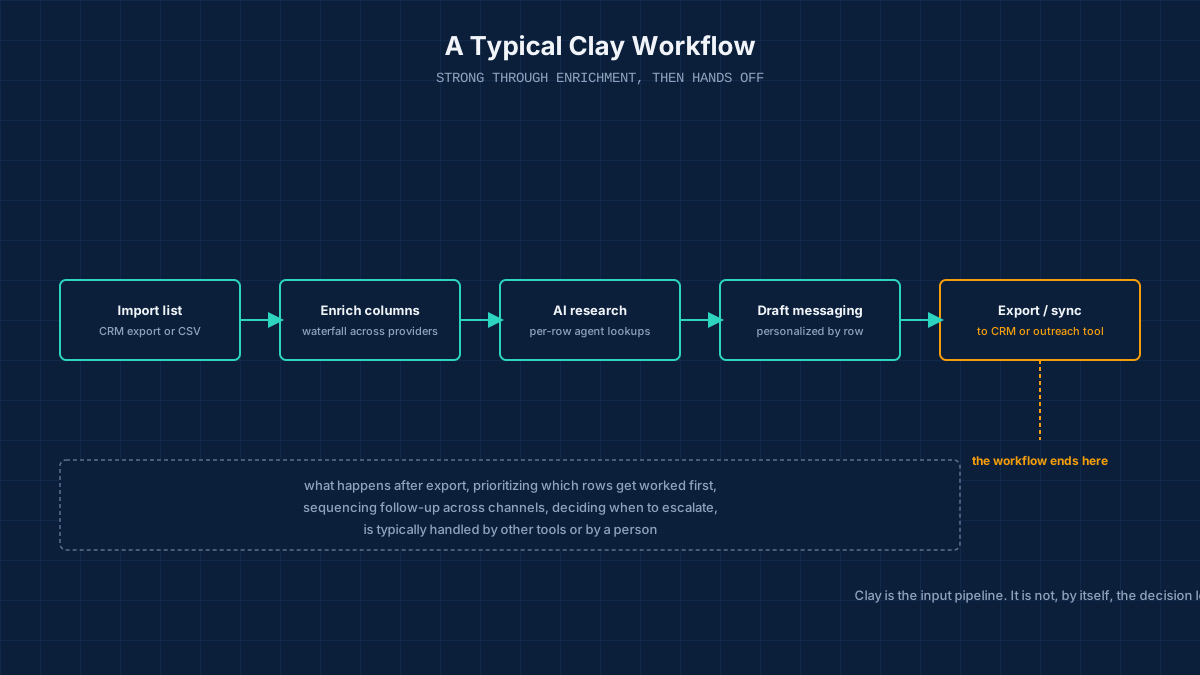
A list gets imported, enrichment columns pull and combine data from multiple providers, an AI research step adds synthesized context, and a drafting step may generate personalized messaging. This sequence is where Clay's publicly described strengths are most concentrated, and by most third party accounts, it performs this sequence well. The workflow then exports or syncs the enriched output into a CRM or an outreach tool, and that is typically where Clay's direct involvement in the process ends.
What happens after that export, deciding which of the enriched rows actually get worked first as new signal arrives after the initial run, coordinating outreach across email, ads, and direct sales touches so they do not collide or contradict each other, deciding which accounts need to escalate to a human and to whom, and using what happened with this batch to refine how the next one gets scored, is typically handled by other tools, by manual RevOps work, or not handled in a systematic way at all.
This gap is worth dwelling on specifically because it is easy to miss from inside a workflow that otherwise feels comprehensive. A RevOps builder configuring a Clay workflow makes real, consequential decisions at each step, which data sources to prioritize, what research prompts to use, how to structure the drafted output, and that hands-on configuration work can feel like it constitutes the full operating logic of a GTM motion. What it actually constitutes is the configuration of a single pass through the enrichment and research layer. The decisions about what happens to that output next, at scale, continuously, and in coordination with everything else happening across the GTM motion, are a different kind of decision, made at a different layer, and they are not automatically included just because the workflow that produced the underlying data was itself well built.
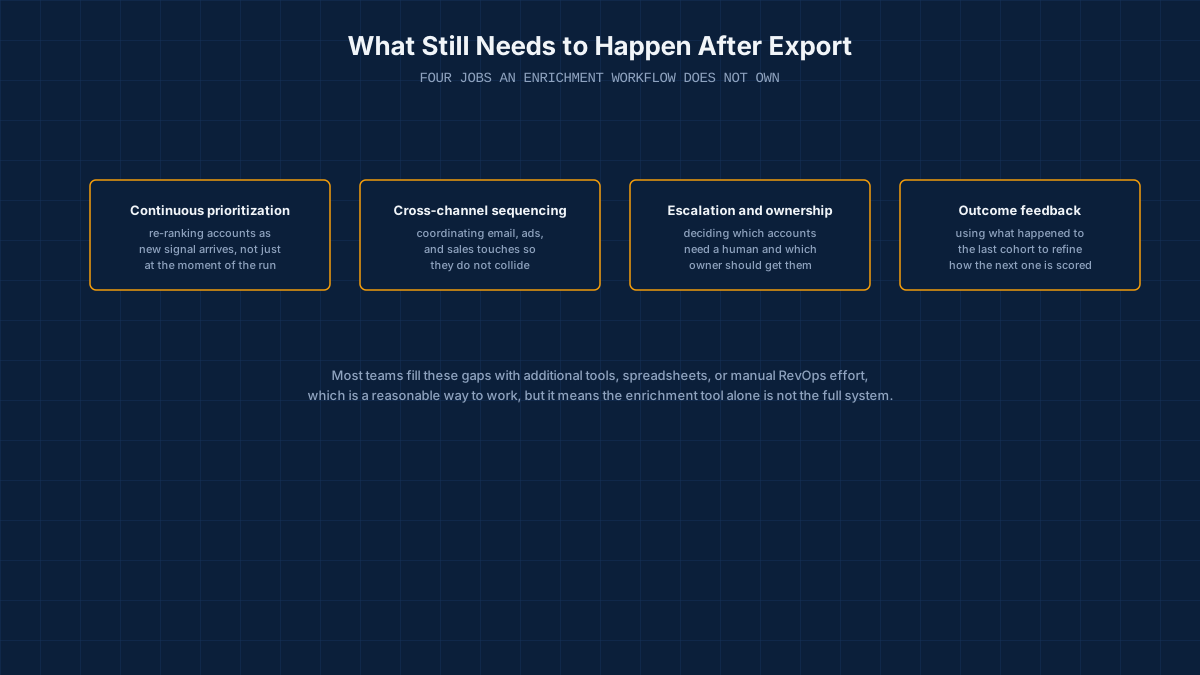
This is not a flaw specific to Clay. It is a structural feature of the enrichment and workflow automation category generally, and it is the same reason this content series distinguishes a data and enrichment layer from a full operating system elsewhere in the broader industry analysis: a tool that excels at getting clean, enriched, well researched data into a downstream system is solving a genuinely difficult and valuable problem, and it is a narrower problem than continuously deciding what to do with that data and coordinating the response across an entire GTM motion.
What This Distinction Is Not Arguing
It is worth being explicit about what this piece is not claiming, since the boundary being described here is easy to overstate in either direction.
This is not an argument that Clay is a weak or poorly built product. By most third party accounts and reviews, its enrichment coverage, workflow flexibility, and AI research capabilities are genuinely strong relative to competitors in the enrichment category specifically, and its rapid growth and adoption among sophisticated RevOps and growth teams is real market evidence that it solves a problem those teams value highly. A product does not reach the scale and reputation Clay has reached in a competitive, well funded market segment without doing something genuinely well, and this piece takes that market signal seriously rather than dismissing it.
This is also not an argument that every GTM team needs a separate, dedicated operating system layer on top of Clay immediately. As described elsewhere in this content series, the right scope of a coordination layer depends heavily on a team's actual signal complexity and stage, and a smaller team may reasonably use Clay's workflows, combined with manual judgment and a few connected tools, as a perfectly adequate lightweight substitute for a more formal operating layer, in the same way this series describes a minimal, right sized coordination layer as appropriate for earlier stage companies. A team at that stage reading this piece should not conclude that Clay is insufficient for their needs, only that they should understand clearly which parts of their GTM coordination are currently being handled by manual judgment rather than by the tool itself, whether or not that gap currently needs to be closed.
What this piece is arguing is narrower and more specific: that describing Clay itself, as currently and publicly positioned, as a full GTM operating system overstates what the product's own stated scope covers, and that a team relying on Clay as its complete answer to GTM coordination is likely still doing real, uncounted manual work in the layers Clay's public feature set does not natively own, continuous prioritization, cross-channel orchestration, and closed loop feedback, whether or not that work is currently visible to them as a gap. That last point is worth emphasizing specifically, since the most common failure mode this piece is trying to address is not a team knowingly accepting a gap and deciding it is fine for now, it is a team not realizing the gap exists at all, because the parts of the process a strong enrichment tool handles well are so visible and impressive that the parts it does not handle can go unnoticed until a specific, costly failure makes them obvious.
Objections and Counterarguments
"Clay has expanded well beyond pure enrichment, and this characterization understates how much of the stack it now covers." This is a fair challenge worth taking seriously, since the product has genuinely broadened its feature set over time, adding capabilities like intent signal unification and analytics features that extend beyond pure enrichment. The response is not to dismiss that expansion, but to note that broadening a workflow and enrichment tool's feature set is a different kind of change than adopting the specific architectural principle that defines an operating system in the framework this series uses, a continuously closed loop where outcomes automatically refine future scoring and orchestration happens across channels as a coordinated whole rather than through individually configured workflows. A product can add real, valuable capability in multiple directions without necessarily closing that specific loop, and the distinction this piece draws is about that architectural closure, not about total feature count. It is also worth noting explicitly that product scope is not static, and a fair minded evaluation should expect this specific gap to narrow over time as products in this category continue to develop, which is exactly why this piece frames its claim around currently, publicly described capabilities rather than a permanent, fixed judgment about the category.
"Teams can and do build the missing layers themselves on top of Clay, so the platform effectively becomes an operating system in practice." This is often true, and it is a meaningful point. A sufficiently resourced GTM engineering team can use Clay as the enrichment and workflow layer within a broader, custom built system that adds scoring, orchestration, and feedback logic around it, connecting it to other tools that handle those functions. When that happens, the resulting system, taken as a whole, may reasonably be described as an operating system. The distinction this piece draws still holds at the product level: Clay itself, as a standalone tool, is not that system, the system is the combination of Clay plus the additional layers a team builds or buys around it, and conflating the tool with the full assembled system risks understating how much additional work goes into closing the loop, work that is real and valuable but should be credited accurately rather than assumed to already be included. This distinction matters most for teams earlier in their GTM engineering maturity, who may reasonably assume a well regarded enrichment tool has already done work that, in reality, still needs a dedicated build effort layered on top of it.
"This distinction is mostly semantic, and does not change what a team should actually do." There is a reasonable version of this objection, since regardless of what a tool is called, a team still needs to evaluate whether its actual capabilities meet its actual needs. The practical answer is that the distinction is not purely semantic because it affects buying and build decisions directly. A team that believes it already has a full operating system in place because it has adopted a strong enrichment and workflow tool is less likely to invest deliberately in the decision, orchestration, and feedback layers that tool does not natively provide, which means the distinction matters precisely because it shapes what a team decides is still missing and worth building or buying. A team operating under an inaccurate assumption about its own stack's completeness tends to discover the gap reactively, usually at the moment a coordination failure becomes visible and costly, rather than proactively, which is a meaningfully worse position to be in.
"Competitive comparisons like this one are inherently biased toward whoever is writing them." This is a legitimate general concern about competitive content, and it is worth addressing directly rather than deflecting. This piece has tried to ground its claims in publicly available, third party descriptions of Clay's product scope rather than unverifiable internal claims, to acknowledge Clay's genuine strengths explicitly and specifically, and to draw a category distinction based on architecture rather than a general claim that the product is inferior. Readers evaluating this piece should weigh it accordingly, and should independently verify current product capabilities directly with the vendor, since product scope for any actively developed platform can expand over time in ways a static piece of content cannot fully capture.
What This Means for Teams Evaluating Clay or Similar Tools
Use Clay, or a comparable enrichment and workflow tool, for what it is built to do well. If the core problem is fragmented, low coverage prospect and account data, and the operational burden of stitching together multiple data providers manually, a flexible enrichment and workflow platform addresses that problem directly and, by most public accounts, effectively. This is a real and valuable capability worth adopting on its own merits, independent of any broader claim about what category the product belongs to.
Map explicitly which layers of the operating system model a tool like Clay covers, and which it does not. Rather than assuming a strong enrichment tool automatically closes the full GTM coordination loop, walk through the five layer model deliberately and identify, honestly, where continuous prioritization, cross-channel orchestration, and outcome feedback are actually happening today, whether that is inside Clay's workflows, inside another connected tool, or, quite commonly, nowhere systematic at all. This mapping exercise is worth doing explicitly and in writing, rather than trusting an intuitive sense of the stack's completeness, since the gaps this piece describes are precisely the kind that are easy to overlook from inside a workflow that otherwise feels thorough.
Decide deliberately whether to build, buy, or accept the gap. Once the gap between an enrichment tool's scope and a full operating layer is mapped explicitly, a team has three honest options: build the missing decision, orchestration, and feedback logic themselves, typically using GTM engineering resources to connect Clay's output to additional tools and rules, buy a dedicated coordination layer designed to close that loop natively, or consciously accept that the gap exists and rely on manual RevOps judgment to bridge it, which may be entirely reasonable at a smaller scale as described elsewhere in this series. What matters is that the choice is made deliberately, rather than by default, based on an inaccurate assumption that the enrichment tool already covers it. Each of these three paths carries a different cost and a different timeline, and the right choice depends heavily on a team's current signal complexity, GTM engineering resources, and how urgently the coordination gap is actually costing pipeline today versus how urgently it feels like it should be addressed.
Revisit the evaluation as both the market and the specific tool evolve. Product categories in fast moving parts of the GTM software market do not stay static, and a tool's scope today is not necessarily its scope in a year. Teams should periodically re-run this same layer by layer evaluation against whatever tools they currently rely on, rather than treating an assessment made at one point in time as permanently accurate. This is particularly relevant for a product like Clay specifically, given how quickly its feature set has expanded historically, and a fair, evidence-based evaluation should expect and account for continued expansion rather than assuming the boundaries described in this piece are fixed indefinitely.
Where Elevate GTM Solutions Fits
This piece has argued that Clay's genuine strength sits at the data and enrichment layer, and that the decision, orchestration, and feedback layers of a full operating system sit outside its core, publicly described scope. Elevate GTM Solutions occupies a different part of the stack entirely, one worth naming for readers weighing what still needs to be built or bought around a tool like Clay.
Elevate is the AI-native GTM platform and GTM operating system built around the strategic layer that sits above execution tools: GTM context, positioning, messaging, market and competitive intelligence, and the structured strategy that determines which accounts, segments, and messages an execution layer like Clay should actually be built around in the first place. The two are not competitors in any direct sense. A team using Clay for enrichment and workflow automation still needs a clear, current answer to what its ICP is, how it should be positioned against a shifting competitive set, and which markets or segments deserve priority, questions Elevate is built to answer continuously rather than through a static planning document. Read together, this piece and the broader case for Elevate describe two different, complementary layers of the same underlying architecture: Elevate keeping the strategic layer current, and tools like Clay executing well within whatever that strategy defines.
Conclusion
Clay's strength in data enrichment and workflow automation is real, well documented by independent sources, and worth taking seriously as a genuine solution to a genuine, widespread GTM problem. That strength does not, by itself, make it a GTM operating system in the fuller sense this content series has defined that category: a continuously closed loop spanning signal, decision, orchestration, and action, with outcomes automatically feeding back to refine future decisions.
This distinction is not a knock against a well built product for not being something outside its stated scope. It is a reminder, useful for any team evaluating its GTM stack, that excellence in one layer of a broader system is a real and valuable thing to have, and a genuinely different claim from having the whole system in place. The pattern this piece describes, a strong point solution getting informally credited with more scope than its own architecture actually delivers, is common enough across enterprise software categories that it deserves to be checked deliberately rather than assumed away, and Clay's current position in the GTM conversation is a clear, current example of exactly that pattern playing out.
Teams that map this honestly, crediting a tool like Clay for what it does well while clearly identifying what still needs to be built, bought, or consciously left to manual judgment, are in a stronger position than teams that assume a strong point solution has quietly become the whole operating layer simply because it has become indispensable within its own part of the stack. The cost of getting this distinction wrong is not usually visible immediately. It shows up later, in the same way the coordination gaps described throughout this content series tend to show up, as signal that gets acted on late, accounts that fall through the cracks between an excellent enrichment run and whatever happens, or fails to happen, after the export button gets clicked.
Contents
Related
GTM Comparisons
Compare GTM platforms, technologies, approaches, and capabilities to make better GTM technology decisions.
View Comparison Library →