AI GTM Platform vs Traditional GTM Software
Every vendor briefing now claims the AI-native label, which means the label alone tells a buyer almost nothing. Here is the real, architectural distinction between an AI GTM platform and traditional GTM software, including where each one actually fails.
Published 2026-07-31
A VP of marketing at a mid-sized B2B software company spent six weeks evaluating GTM platforms last quarter and ended the process with a shortlist of five vendors and a genuine problem: three of them, including one that was unmistakably a workflow and campaign management tool with a summarization feature bolted onto its dashboard, all described themselves using nearly identical language. Continuous intelligence. AI-native architecture. Strategy that adapts as your market changes. By the end of week six, she could not reliably tell which of the five actually generated go-to-market strategy on an ongoing basis and which ones simply helped her execute a plan her own team had already written.
That confusion is not a failure of diligence. It is what happens when a category label spreads faster than its definition gets precise. Every vendor in a crowded, fast growing market has a strong incentive to claim the more exciting label, regardless of whether the product underneath actually earns it. Meanwhile, the distinction the label is supposed to describe, whether a system generates GTM strategy continuously from live signal or whether it helps a team execute a strategy a person already decided, is real, consequential, and worth being precise about, because the two architectures fail in genuinely different ways.
This piece makes that distinction concrete enough to use in an actual evaluation, not just repeat as a marketing claim. It is not an argument that one category is universally better. It is a full breakdown of what changes when a platform is built around continuously generated strategy versus one built around structured execution of a plan a person authored, so the choice can be made on architecture and fit rather than on which vendor said "AI" with more confidence.
What Actually Separates the Two Categories
Traditional GTM software, CRM systems, marketing automation platforms, and the workflow tools built around them, is built around execution: it helps marketing, sales, and customer success run campaigns, manage pipeline, and track performance consistently, but it generally depends on a person to decide what the strategy itself should say. The strategic inputs, the ICP, the positioning, the messaging, the segment priorities, originate with a person or a team and get entered into the system as a fixed configuration. The platform's job is to execute that configuration reliably, not to question or update it.
An AI GTM platform is built around continuous intelligence generation as its core operating principle. It collects market, competitive, and performance signal on an ongoing basis and uses AI to produce recommendations and strategic guidance directly, rather than waiting for a person to manually synthesize that signal on a quarterly cycle. The human's role shifts from author to reviewer for a meaningful share of the lower stakes decisions, while still holding final authority over the calls that are rare, expensive, and hard to reverse.
The distinction is not about whether a product has an AI feature somewhere in its interface. Nearly every GTM tool sold today has one: a predictive score, a summarization button, a chatbot layered onto a dashboard. The real test is architectural. Does intelligence generation sit at the center of what the system does, continuously reshaping what it recommends, or does AI sit at the edge of a system whose core job is still executing a plan a person wrote somewhere else, in a planning meeting or a positioning workshop.
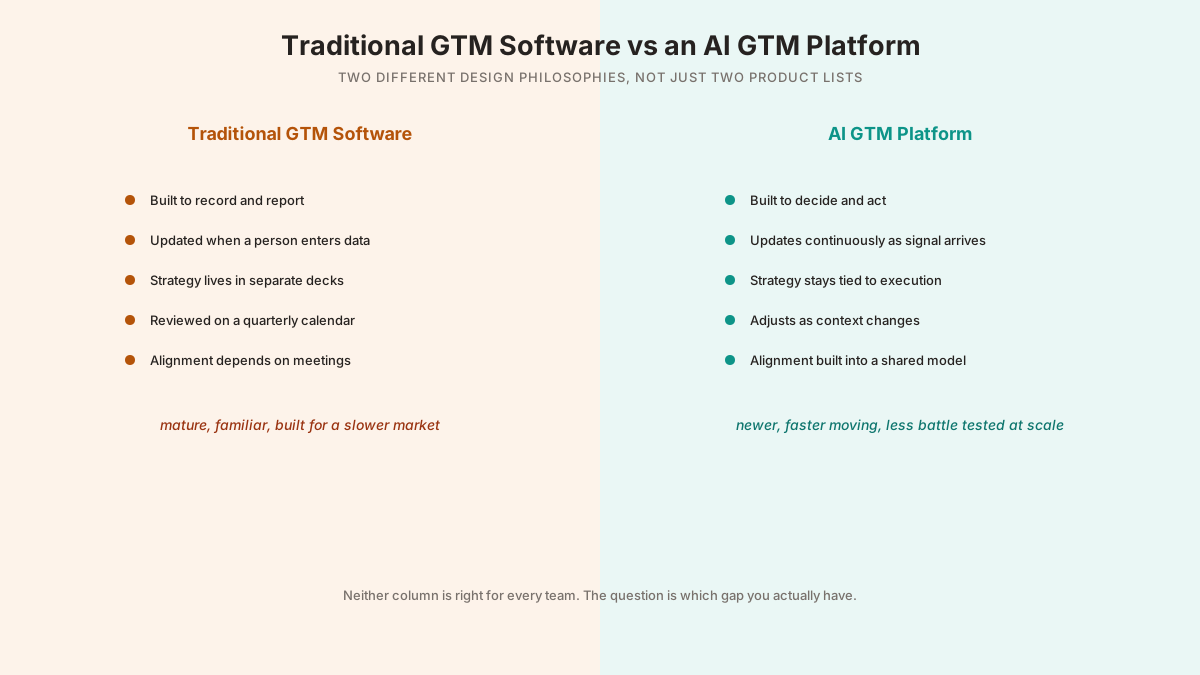
| Question | Traditional GTM software | AI GTM platform |
|---|---|---|
| Where does strategy originate | A person or team, entered as a fixed configuration | Generated continuously from live signal, reviewed by a person |
| How does it update | When someone manually revises it | Automatically, as new signal changes the recommendation |
| What is the human's role | Author of the plan the system executes | Reviewer of recommendations the system generates |
| What does the update cycle look like | Quarterly or at the next scheduled planning cycle | Continuous, with high stakes calls still escalated to a person |
Why the Distinction Actually Matters
Getting this right matters because the two architectures do not just differ in capability, they fail in genuinely different ways, and choosing the wrong one for your situation is not just a suboptimal purchase. It means building a GTM motion on top of a system whose failure mode nobody has planned for.
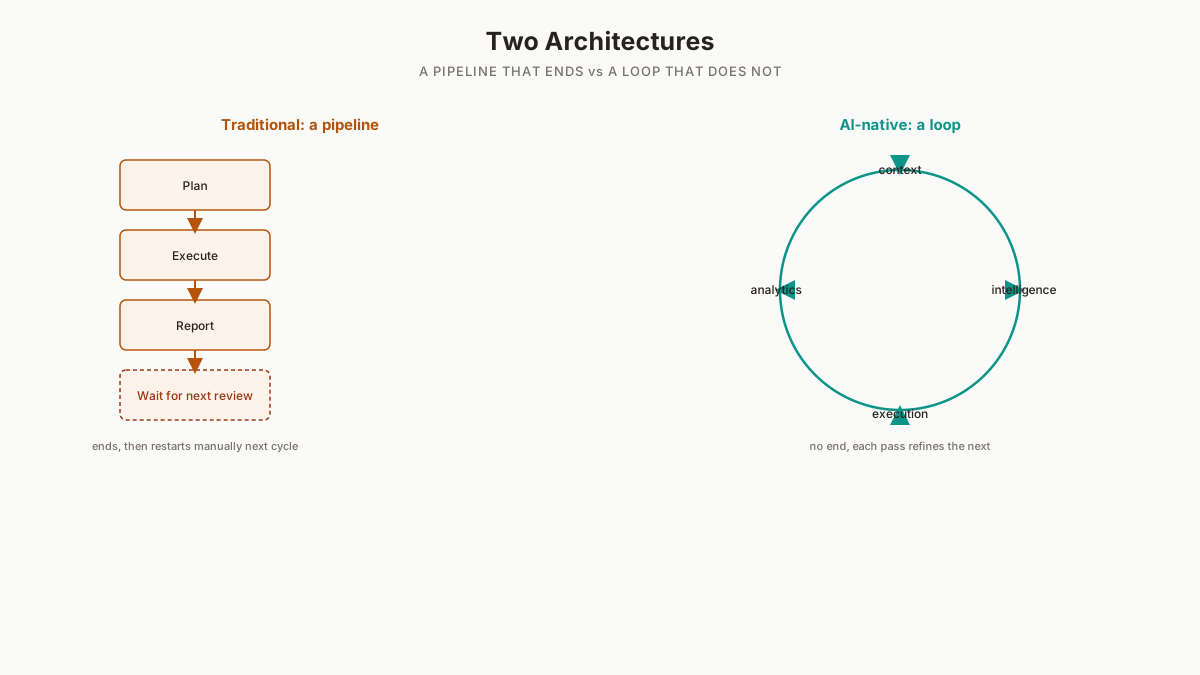
Traditional software's failure mode is visible and comparatively slow. Strategy goes stale between planning cycles. A competitor repositions and nobody updates the messaging for six weeks. A segment's win rate quietly declines and the team keeps running the same playbook until the next quarterly review finally surfaces the problem. This is a real, ongoing cost, but it is a legible one. Someone eventually notices, usually because a number that used to look fine now looks bad in an obvious, discussable way.
An AI GTM platform's failure mode is quieter and, in some ways, more dangerous, precisely because the system keeps looking like it is working. A model built on last quarter's ICP will keep confidently recommending against that ICP even after the market has moved, and unlike a stale slide deck that visibly contradicts what the CRM shows, a confidently wrong recommendation looks exactly like a confidently right one. The system does not announce that its assumptions have gone stale. It keeps producing fluent, plausible sounding guidance built on a picture of the business that no longer exists.
This has a direct budgeting consequence that rarely shows up in a feature comparison. A traditional platform's total cost is comparatively easy to forecast: licensing plus the headcount required to do research, positioning, and analysis manually. An AI GTM platform's true cost includes something harder to price up front, the ongoing supervision required to keep its recommendations trustworthy, whether that is a fractional strategy role, a scheduled validation review, or a leadership habit of spot checking outputs against what the field is actually reporting. Teams that budget only for the license and skip budgeting for supervision are the ones most likely to trust a quietly stale recommendation for months before anyone notices.
There is also a data requirement divergence that follows directly from this architectural difference, and it is worth naming separately from the cost question. Traditional software needs clean workflows and consistent data entry to execute reliably, since a CRM with sloppy stage definitions produces a messy pipeline report, but the underlying strategy itself is not corrupted by that mess, it was written by a person and simply gets reported on inconsistently. An AI GTM platform needs clean, representative, sufficiently voluminous data to generate anything trustworthy at all, since a small company with thin historical data, inconsistent CRM hygiene, or a business that has changed shape dramatically in the last year gives the system a much weaker foundation to learn from. This is one of the most common reasons an AI GTM platform underperforms its promise in practice, not because the underlying AI is poorly built, but because the inputs it is learning from do not represent the business as it actually exists today.
Where the Two Categories Actually Diverge
Five specific areas of GTM work show the architectural difference most clearly, and each one reveals a different practical tradeoff worth understanding before a buying decision.
Market research and intelligence. Traditional software typically treats market research as an input that happens outside the tool: an analyst runs interviews, a research firm delivers a report, and someone manually loads the conclusions into the platform's targeting and messaging configuration. An AI GTM platform folds this function into the system itself, continuously ingesting signal from call transcripts, support tickets, review sites, competitor pricing pages, and usage data, surfacing patterns without anyone specifically requesting a research cycle. The tradeoff is depth versus speed, since a skilled human analyst catches subtle qualitative nuance a pattern matching system will miss, while the system processes a volume and frequency of signal no analyst team could keep pace with manually.
Positioning and messaging. In traditional software, positioning is written once by a person or team and distributed as a fixed asset revisited on a deliberate schedule. In an AI GTM platform, positioning is treated more like a hypothesis under continuous test, with message variants generated and tested against real engagement and conversion data, often surfacing which specific phrasing is working, and which has quietly stopped working, faster than a manual test cycle would. The risk on the AI-native side is that testing velocity can drift the message away from a coherent narrative if nobody is enforcing that every variant still expresses the same underlying point of view.
Execution workflows. This is where the two categories often look most similar on the surface, since both embed campaign briefs, sequencing, and CRM fields into daily workflows. The real difference is in how those workflows change. A traditional platform's workflows change when a person edits them. An AI GTM platform's workflows can change automatically as the underlying recommendation shifts, which means execution consistency depends on trusting the system's judgment about when a change is warranted, not just trusting a person's judgment.
Analytics and forecasting. Traditional GTM analytics is fundamentally a reporting function: dashboards describe what happened, and a person interprets the numbers and decides what to do about them. AI GTM platform analytics is built to close that interpretation gap directly, surfacing not just that conversion dropped in a segment, but a specific hypothesis about why, and in some cases a recommended next action. This is genuinely useful when the hypothesis is accurate, and genuinely risky when a team starts treating a plausible sounding automated explanation as validated fact without checking it against what a person closer to the deals actually observed.
Optimization cadence. A traditional platform's optimization loop runs on the same cadence as its planning cycle: someone reviews performance, decides what to change, and implements the change manually. An AI GTM platform's optimization loop runs continuously, testing and adjusting lower stakes decisions on an ongoing basis, which compounds into meaningfully more efficient execution over time, provided the loop is actually optimizing toward the right underlying goal rather than a proxy metric that has quietly drifted away from what the business actually needs.
| Area | Traditional approach | AI GTM platform approach |
|---|---|---|
| Market research | Periodic, analyst driven | Continuous, signal driven |
| Positioning | Fixed asset, scheduled revisions | Hypothesis under continuous test |
| Execution | Updated by a person | Can update automatically |
| Analytics | Descriptive reporting | Prescriptive recommendation |
| Optimization | Reviewed on a planning cadence | Continuous, always running |
What Each Category Genuinely Offers
Traditional GTM software offers real, specific advantages. It is predictable, since strategy changes only when a person deliberately changes it, which makes the system easy to audit and easy to explain to a board or a new hire. It requires less historical data to execute reliably, since it is applying a rule a person defined rather than learning a pattern from data. Accountability stays clear, since something going wrong always traces back to a specific person's decision, which tends to produce faster, less ambiguous postmortems. It carries lower supervision overhead per decision, since there is no need to build a review cadence for AI generated recommendations the platform is not producing. And it is easier to onboard a new hire into, since a new strategist can review a static, human authored playbook and understand the full logic behind current campaigns and targeting in a way that is harder to do when that logic is distributed across a continuously updating model.
An AI GTM platform offers a different, equally real set of advantages. It responds faster to market shifts, since a competitor repositioning or a segment's declining win rate can get flagged and acted on within days rather than the weeks or months a manual quarterly cycle would take. It gets more out of a thin GTM team, since a lean organization without a dedicated market intelligence function gets a meaningful share of that function's ongoing value automatically, provided someone still supervises the output. It optimizes continuously rather than periodically, so small gains a quarterly review would miss individually compound meaningfully when caught daily. It reflects something closer to a live picture of the market rather than a point in time snapshot from the last planning session. And it applies the same current logic consistently as a team scales, rather than depending on each new hire absorbing the current strategy correctly during onboarding.
| Traditional GTM software strengths | AI GTM platform strengths |
|---|---|
| Predictable, easy to audit and explain | Responds to market shifts within days, not quarters |
| Works reliably with thin historical data | Extends thin GTM headcount meaningfully |
| Clear, single point of accountability | Continuous rather than periodic optimization |
| Lower supervision overhead per decision | A live picture of the market, not a point-in-time snapshot |
| Easier onboarding for new strategy hires | Consistent logic applied as the team scales |
What This Looks Like in Practice
A few concrete scenarios make the tradeoffs easier to reason about than an abstract comparison alone.
A company selling into a genuinely stable, slow moving enterprise category, regulated infrastructure software, kept a traditional GTM platform for several years without seriously evaluating an AI-native alternative, and the choice held up well. Buyer requirements changed on a multi-year cycle, competitors rarely repositioned meaningfully, and the company's own strategy function was strong enough to catch the occasional real shift well before it became costly. Adding an AI GTM platform here would have added supervision overhead without meaningfully improving on what a competent human team was already doing.
A much smaller company selling into a fast moving developer tools category had no dedicated market intelligence function and could not justify hiring one at that stage. An AI GTM platform continuously surfaced a shift in how a competitor was positioning against a specific integration, catching the repositioning roughly six weeks before the company's own sales team noticed it anecdotally in lost deal conversations. The gain here was not that the system was smarter than a human analyst would have been. It was that no human analyst existed in that organization, and the realistic alternative was not a strong manual process, it was no process at all.
A different company adopted an AI GTM platform and, within two quarters, effectively stopped running its own qualitative win-loss interviews, reasoning that the platform's continuous signal synthesis had made the manual process redundant. The platform's recommendations drifted toward a segment that looked strong in the data it had access to, but the actual reason those accounts had converted well, a temporary promotional price the sales team had been running, was never fed back into the system as context. The platform kept recommending that segment as strong long after the promotion ended and the segment's real economics reverted, because nothing in its input data explained why the strong performance had happened in the first place.
A hybrid approach split the difference deliberately at another company: core strategic decisions, the ICP, the positioning narrative, the pricing model, stayed under direct human ownership on a quarterly review cadence, while an AI GTM platform handled the highest frequency, lowest stakes decisions, lead scoring, ad variant selection, outbound sequencing timing. This captured the efficiency of continuous optimization on decisions where being wrong for a few days was cheap, while keeping the decisions where being wrong for a few days was expensive under direct human review.
A vendor evaluation at a fifth company exposed the label gap directly. During a platform bake-off, the buyer asked all three finalist vendors the same specific question: walk through exactly what changes automatically in the system this week, without a person touching it. Two vendors, both marketing themselves using AI-native language, described features that amounted to a predictive lead score and a summarization tool, changes a person still had to review and manually apply before anything happened downstream. The third vendor described an actual closed loop: messaging variants tested and reweighted automatically, targeting criteria adjusted based on live conversion data, with a weekly digest surfacing the changes for human sign-off rather than requiring a person to initiate them. The buyer picked the third vendor not because its marketing was more convincing, but because it was the only one that could answer the specific question honestly.
Common Mistakes Buyers Make
Assuming an AI GTM platform means unsupervised operation. The most common mistake is treating the platform as something that removes the need for a strategy function entirely, rather than something that changes what that function spends its time doing, from generating recommendations from scratch to reviewing and validating recommendations the system generates.
Buying based on marketing language rather than actual architecture. Because the AI-native label has become valuable to claim, plenty of platforms that are fundamentally traditional execution tools with a machine learning feature layered on top market themselves using the same language as platforms genuinely built around continuous intelligence generation. Asking a vendor to walk through specifically what changes automatically, versus what a person still has to manually update, is the fastest way to tell the difference.
Adopting an AI GTM platform without the data maturity to support it. A company with inconsistent CRM hygiene, thin historical data, or a business model that has changed shape dramatically in the last year is handing the system a weak foundation to learn from, and the resulting recommendations will reflect that weak foundation, however confidently they are presented.
Sticking with traditional software purely out of inertia in a fast moving category. The opposite mistake is just as costly: competing in a category where positioning and buyer priorities shift every few months, while running a fully manual quarterly review purely because that is what the team has always done, accepts a lag that faster moving competitors on AI-native systems are not accepting.
Failing to build a validation cadence for AI generated recommendations. Treating a system's output as automatically correct, rather than building an explicit, scheduled process for checking a sample of its recommendations against real outcomes, is how the quiet failure mode described earlier actually happens. The fix is not distrust of the system, it is the same discipline a good analyst would apply to their own conclusions.
Splitting the automation decision along the wrong line. Some teams draw the human versus AI boundary based on which decisions feel important, rather than which decisions are actually high frequency and reversible versus rare and hard to undo. The right line is frequency and reversibility, not perceived importance. Which specific ad variant runs this week feels like a meaningful call in the moment, but it is cheap and fast to reverse if wrong, making it a reasonable candidate for automation. A decision to exit a segment representing a fifth of revenue can feel routine by comparison, but it is expensive and slow to undo, which makes it exactly the kind of call that should stay with a person.
| Mistake | What it looks like | Fix |
|---|---|---|
| Assuming AI-native means unsupervised | Nobody checks recommendations against real outcomes | Build an explicit validation cadence, not just trust in the output |
| Buying based on marketing language | A traditional tool with an AI feature marketed as AI-native | Ask specifically what changes automatically versus what a person updates |
| Adopting AI-native without data maturity | Thin, messy, or unrepresentative historical data | Fix CRM hygiene and data volume before layering recommendations on top |
| Staying traditional out of inertia | A fast moving category running on a quarterly manual cycle | Re-evaluate cadence against how fast the category is actually moving |
| No validation process for AI outputs | Recommendations trusted without spot checking | Sample and check outputs against real outcomes on a fixed schedule |
| Drawing the automation line by importance, not frequency | High stakes decisions automated because they seemed simple | Automate by frequency and reversibility, not by how important a call feels |
Where an AI GTM Platform Still Needs a Person
The durable version of this comparison is not that AI-native platforms replace traditional software. It is that AI-native platforms shift a meaningful share of lower stakes, high frequency decisions to a continuously learning system, while decisions that are rare, expensive, and hard to reverse, whether to reposition entirely around a new category, whether to walk away from a segment that has been a reliable revenue source, still need to sit with a person accountable for the outcome.
A system can tell you, with real precision, that win rate in a specific segment declined eight points over two quarters, or that a competitor's new pricing is testing well against a specific objection your reps are hearing. It cannot tell you, on its own, whether the right response is to defend that segment more aggressively or deliberately let it go in favor of a better one, because that call depends on strategic priorities and risk tolerance that live outside the data the system has access to. AI-native systems are well suited to detecting drift, a segment's numbers moving, a message losing effectiveness, faster and more consistently than a manual review ever could. They are not well suited, on their own, to deciding what the strategic response to that drift should be.
How to Actually Choose Between Them
Most teams do not need to settle this in the abstract, and trying to decide which category is universally better tends to produce a worse outcome than working through the specific factors that determine fit for a given team.
Start with how fast your category actually moves. A market where positioning, buyer priorities, and competitive dynamics shift meaningfully within a quarter rewards continuous updating far more than a stable, slow moving category, where a quarterly cadence may already be fast enough to keep up.
Honestly assess your standing strategy capacity. A company with a strong, well resourced strategy function may get relatively little incremental value from an AI-native layer, since a skilled human team is already doing much of what the system would otherwise generate. A lean team without that capacity gets proportionally more value, provided someone still supervises the output.
Check your data maturity before committing. An AI GTM platform is only as good as the signal it learns from. Messy CRM hygiene, thin historical volume, or a business that has changed shape significantly in the last year all weaken the foundation the system needs, and it is usually worth fixing those fundamentals before layering continuous intelligence on top of them.
Draw the automation line by frequency and reversibility, not category loyalty. Many teams get the most value from a hybrid approach, automating high frequency, low stakes decisions while keeping rare, expensive, hard to reverse calls under direct human ownership, regardless of which platform category handles the rest.
Build the validation cadence before you need it. Whichever category you choose, decide in advance who checks the system's outputs against real outcomes, and on what schedule, rather than discovering during a postmortem that nobody was ever explicitly responsible for that check.
| Stage | Focus | Ready to move on looks like |
|---|---|---|
| 1 | Assess category velocity | A specific, evidence-based view of how fast your market actually moves |
| 2 | Assess standing strategy capacity | An honest read on whether your team already does what an AI layer would add |
| 3 | Check data maturity | CRM hygiene and historical data volume strong enough to support recommendations |
| 4 | Draw the automation line | A written list of which decisions are automated and which stay human |
| 5 | Build a validation cadence | A named owner checks recommendations against real outcomes on a fixed schedule |
The single highest leverage question in this decision is almost never which category is better. It is how fast your market actually moves, and how much standing capacity you have to generate and supervise strategy. An honest answer to that question, worked out before comparing feature lists, usually makes the right platform category obvious.
How This Relates to a GTM Operating System
This comparison sits directly on top of the foundational GTM disciplines this content series has covered elsewhere, and it does not replace the need to get any of them right. An AI GTM platform still depends on a genuinely accurate ICP and a coherent positioning narrative to generate useful recommendations from. Feed it a vague or untested strategic foundation and it will optimize confidently against the wrong target, the same way a talented human analyst would if handed the same bad inputs, just faster and with more apparent confidence.
It is also closely related to, but distinct from, the broader idea of a GTM operating system described throughout this content series. An AI GTM platform is the specific category of tool this comparison is about, a system with continuous intelligence generation added to core GTM functionality. A GTM operating system is the structural discipline, achievable with or without AI, that connects intelligence, strategy, execution, and analytics into one loop. Elevate GTM Solutions is built as exactly this combination, an AI-native GTM platform and GTM operating system where the continuous intelligence layer this piece has described is connected directly into structured execution and analytics, rather than sold as a standalone recommendation engine a team still has to manually wire into the rest of its stack. Choosing an AI-native platform can meaningfully strengthen a GTM operating system's intelligence and optimization layers, but it does not substitute for the organizational discipline of actually building the loop, assigning ownership, and keeping every function working from the same shared model, a discipline this content series has covered in more depth elsewhere.
Frequently Asked Questions
What is the real difference between an AI GTM platform and traditional GTM software? The real difference is architectural, not cosmetic. Traditional software executes a strategy a person defined and updates it when someone manually changes the configuration. An AI GTM platform continuously analyzes signal and generates strategic recommendations on an ongoing basis, shifting the human's role from author to reviewer for a meaningful share of decisions.
Is a platform with an AI feature automatically an AI GTM platform? No. Most GTM tools sold today have some AI feature somewhere. That does not make them AI-native. The real test is whether intelligence generation sits at the center of what the system does, or whether AI sits at the edge of a system whose core job is still executing a human authored plan.
Which approach is better for a small team with no dedicated strategy function? An AI GTM platform tends to close a genuine gap for a lean team without standing intelligence capacity, provided someone still periodically validates its recommendations against real outcomes.
Which approach is better for a company in a stable, slow moving category? Traditional software, paired with a genuinely strong human strategy function, is often sufficient in a category where positioning and buyer priorities shift slowly, since the incremental value of continuous updating is smaller when the market itself is not moving fast enough to make a quarterly cadence feel like a meaningful lag.
Does adopting an AI GTM platform remove the need for a human strategist? No. It changes what that person spends their time doing, from generating recommendations from scratch to reviewing, validating, and occasionally overriding recommendations the system generates. Rare, expensive, hard to reverse strategic calls still need a person accountable for the outcome.
What data do you need before an AI GTM platform is worth adopting? Reasonably clean CRM hygiene, sufficient historical data volume, and a business that has not changed shape so dramatically in the last year that its historical data no longer represents its current reality.
Can a company use both approaches at once? Yes, and many effective implementations do exactly this, keeping core strategic decisions under human ownership on a deliberate cadence while using an AI layer for high frequency, lower stakes decisions where continuous optimization adds real value and a wrong call is cheap and quickly reversible.
How do you avoid buying a traditional platform marketed as AI-native? Ask the vendor specifically what changes automatically as new data arrives, versus what still requires a person to manually update. If the honest answer is that a person still updates almost everything and the system only surfaces a suggestion, that is a traditional platform with an AI feature, not an AI-native architecture.
How long does it take to see real value from an AI GTM platform? It depends heavily on data maturity going in. A company with clean CRM hygiene and a reasonable volume of historical data can often see useful recommendations within the first month or two, since the system has something substantive to learn from immediately. A company with messy or thin data usually needs a longer runway, sometimes a full quarter or more, spent partly on data cleanup before the system's outputs become trustworthy enough to act on with confidence.
Should a company switch from traditional software to an AI GTM platform mid-year? Only if there is a specific, evidence-based reason, a documented pattern of missing shifts a continuous system would likely have caught, or a resourcing change that has left the strategy function without the capacity it used to have. Switching disrupts execution continuity in the short term, so the decision is usually better made at a natural planning boundary, like the start of a new fiscal year, unless the cost of staying on the current system is demonstrably compounding faster than the disruption of switching.
Final Thoughts
Go back to the VP of marketing staring at five vendor decks that all claimed the same architecture while representing genuinely different products underneath. That confusion is not going away on its own, because the incentive to claim the label is stronger than the incentive to define it precisely, and most comparison charts are built to sell a platform rather than help a buyer reason clearly about fit. The distinction that actually matters is not whether a vendor uses the phrase AI-native. It is whether the system is built to continuously generate and update strategic recommendations from live signal, or built to reliably execute a strategy a person decided, with AI features layered around the edges of that same fundamentally human authored plan.
Neither architecture is universally correct. Traditional software, paired with a genuinely strong human strategy function, can outperform an AI GTM platform in a stable category where a quarterly cadence is already fast enough to keep up. An AI GTM platform can close a real, otherwise unfillable gap for a lean team competing in a market that moves faster than any manual review cycle can track. The costly mistake is not picking the wrong category in some abstract sense. It is picking either one without being honest about how fast your market actually moves, how much standing capacity you have to generate or supervise strategy, and whether your underlying data and organizational discipline are mature enough to support the approach you have chosen.
None of this requires resolving the question permanently on the first purchase. Platform categories, and the specific vendors within them, keep evolving quickly enough that a decision made today is worth revisiting on a real cadence rather than treated as settled for years. The durable habit is not picking the right platform once. It is building the organizational discipline, an honest read on category velocity, a clear eyed assessment of standing strategy capacity, and a real validation cadence for whatever the system recommends, that keeps the platform decision correct as both the market and the vendor landscape keep shifting underneath it.
Contents
Related Comparisons
GTM Comparisons
Compare GTM platforms, technologies, approaches, and capabilities to make better GTM technology decisions.
View Comparison Library →