
By the Elevate GTM Solutions Team · Updated November 13, 2026 · 28 min read
Do Customer Advocacy and Referrals Actually Drive B2B Pipeline, or Is It Just a Nice Story?
Almost every B2B leader will tell you their best deals came from customers. A happy customer mentions you to a peer, a former colleague joins a new company and asks for you by name, a prospect asks to speak with someone who already uses the product. These moments feel more valuable than any campaign, and many companies say referrals are their best source of business. Yet most companies cannot say how many deals referrals actually produced, what they cost to earn or how to get more of them on purpose.
This page explains what the research says about whether customer advocacy and referrals drive B2B pipeline, why the evidence is better on influence than on volume and how a team can build advocacy as a program, not a hope. The evidence is analyst research, mainly Gartner's survey of 771 B2B buyers and Forrester's recent guidance on customer advocacy, with Gartner Digital Markets data on software reviews. For each source we say who was asked, when, what it shows and what it cannot show. Then we add our own reading, clearly labeled, and describe where a go-to-market platform like ours can help and where it cannot.
A disclosure. We make Elevate GTM Solutions, a go-to-market strategy platform. We do not sell an advocacy, reference or review product, and we have no referral data of our own. We read Gartner's June 2023 release and Forrester's September 2025 blog in full. We saw other items only as abstracts or search excerpts, and we flag each. Our examples are invented and labeled.
Do customer advocacy and referrals drive B2B pipeline?
The research strongly supports that customers influence buying decisions, and offers little public, independent proof of how much pipeline referral programs generate. A Gartner survey of 771 B2B buyers, fielded in November and December 2022 and released June 8, 2023, found buyers value third-party interactions, such as customer references, customer reviews and consultations with third-party experts, 1.4 times more than digital supplier interactions. Gartner's Rick LaFond said "Buyers want to feel confident throughout their purchase journey, and third-party sources can help get them there." Forrester's Amy Bills wrote in September 2025 that B2B buyers rank industry peers among their top five trusted sources and that interaction with like-minded customers is one of the top three social media interactions in the buying process. Forrester advises treating advocacy as a strategic program with objectives, helping customers reach measurable value first, rewarding advocates with access and recognition and keeping them informed. Numbers such as the average referral being worth a specific dollar amount circulate widely, and we could not trace them to a primary source.
Do referrals produce more pipeline than other channels? The sources we could verify do not compare channels. They show that buyers trust customers more than suppliers, which makes referrals plausible, but you need your own attribution to know.
Is advocacy the same as a referral program? No. Referrals are one output. Advocacy also includes references, reviews, case studies, community participation and advisory roles.
The short version
| Question | Answer |
|---|---|
| Main source | Gartner survey of 771 B2B buyers, fielded November to December 2022, released June 8, 2023 |
| Core finding | Buyers value third-party interactions 1.4 times more than digital supplier interactions |
| What counts as third-party | Customer references, customer reviews and consultations with third-party experts (Gartner) |
| Forrester, September 2025 | Industry peers sit in buyers' top five trusted sources; like-minded customers are one of the top three social interactions; no statistics given |
| Forrester's advice | Help customers reach value, make advocacy rewarding, keep advocates informed, set strategic objectives |
| Software reviews (Gartner Digital Markets, 2021 SMB survey) | 66% say reviews significantly affect their purchase decision; 85% trust online reviews as much as a personal recommendation |
| What is missing | Independent, public, method-stated data on how much pipeline referral programs generate or what they cost |
| Main limit | The reliable evidence concerns trust and influence, not pipeline volume or return |
Advocacy, referrals, references and reviews: what each one is
These terms are used loosely, and the loose use causes confusion about what to measure.
Advocacy is the umbrella. It is any action a customer takes that helps others decide to buy from you, such as recommending, reviewing, speaking, joining a council or being named.
Referral. A customer or contact introduces a specific prospect. It is the most direct route to pipeline, and the easiest to attribute.
Reference. A prospect in the late stage of a deal speaks to a customer. It rarely creates pipeline and often decides deals. It is also the most tiring for customers, because the same few are asked again and again.
Review. A customer writes about the product on a third-party site or in a survey. It influences prospects who never speak to anyone.
Case study or story. A customer's outcome, told in the company's content or in the customer's own words.
Community and peer conversation. Customers talking to each other and to prospects, in a forum, at an event or in a private group. It is hard to see and hard to attribute and, according to Forrester, matters to buyers.
Advisory role. Customers who give product or strategy input, sit on councils or speak at events.
Each type has a different job, a different cost to the customer and a different way of being measured. A referral can be tracked to a deal. A review is felt as a general lift in trust. Treating them all as one number is why advocacy budgets are hard to defend.
Why this belongs in a go-to-market plan
A go-to-market plan usually spends its energy on acquiring attention from people who have never heard of you. Advocacy works the other way. It uses the trust already earned from people who have bought. That shifts three decisions: which customers you invest in, what you promise and deliver after the sale and how you give new buyers a way to hear from someone like them.
It also changes the order of work. Advocacy is a result of customer outcomes. A program built before customers are getting value produces thin proof and annoyed customers. The plan has to connect delivery, customer success and marketing.
Advocacy also sits close to buying-group dynamics. Buyers often check with peers before they shortlist, which we cover in whether B2B buyers choose vendors before they talk to sales.
The evidence: Gartner's survey of 771 B2B buyers
The source is a Gartner press release dated June 8, 2023, titled "Gartner Marketing Survey Finds B2B Buyers Value Third-Party Interactions More Than Digital Supplier Interactions." We read it in full. The survey covered 771 B2B buyers in November and December 2022.
The headline. Buyers value third-party interactions 1.4 times more than digital supplier interactions. The third-party interactions named are customer references, customer reviews and direct consultations with third-party experts. Gartner says they are especially well suited to giving customers value affirmation, meaning confidence that they are making a good choice.
The analyst view. Rick LaFond, Director Analyst in Gartner's marketing practice, said: "Buyers want to feel confident throughout their purchase journey, and third-party sources can help get them there." He also said social channels are extremely underleveraged by B2B brands.
Where the digital supplier channels fall short. Buyers rank the supplier's website as the most-used digital channel, followed by the supplier's social media, an online search for the supplier and interactive tools. Gartner recommends improving digital experiences given how low these channels rank.
Social media. YouTube leads the social channels that influenced a recent purchase, followed by Facebook, Instagram, Twitter, LinkedIn and TikTok. The text gives no percentages for these.
The advice. Use social channels to show how a brand meets customer needs at each buying stage, not only for short brand videos. Do not rely only on third parties for the social strategy. B2B chief marketing officers should make better use of third-party interactions, which buyers rely on.
What we could not confirm. The release does not rate customer references, reviews and expert consultations separately, so we cannot say which is most valuable. It gives no pipeline numbers. The survey was fielded in late 2022, which predates much of today's AI-assisted research. "Value" is how buyers rated the interaction, not what they bought.
The evidence: Forrester on customer voices and advocacy
In a blog dated September 22, 2025, titled "Your Successful Customers Have Power Over Buyers: Don't Leave It To Chance," Forrester's Amy Bills writes about customer advocacy. We read it in full. It gives no statistics. It makes four main points.
First, buyers rank industry peers among their top five trusted sources, and interaction with like-minded customers is one of the top three social media interactions during the buying process. Customer input tends to be recent, realistic and independent of the seller's messaging.
Second, the starting point is customer success: understand customers' needs, agree on measurable outcomes and build a plan to reach them. That produces references and case studies.
Third, advocacy must be rewarding for the customer. Bills suggests symbolic and experiential value, such as executive access, invitation-only events and networking opportunities, over one-off favors. Customers should also be kept informed through product updates, previews within regulatory limits, talking points and advisory board participation, so what they say about you is accurate.
Fourth, advocacy should be strategic. Set objectives such as reputation, demand generation and pipeline acceleration, then align programs and measurement to them, treating advocacy as part of the advocates' own experience.
Forrester also publishes, behind a paywall, a Trend Report titled "B2B Customers Are Willing Advocates In The Right Conditions," based on its Buyers' Journey Survey, 2025. We saw only the description, which says the data illuminate demographic and firmographic differences to help shape an advocate engagement approach. We cannot report its findings. Another Forrester best-practice report describes research indicating that 80% of B2B buying decisions are influenced by direct or indirect customer experience and engagement. We saw that only as a search-result excerpt of the description, and we cannot see the method.
The evidence: Gartner Digital Markets on software reviews
Gartner Digital Markets, which runs software review sites, publishes buyer surveys. An article on its site cites its 2021 SMB Software Buying Behaviors Survey: 66% of software buyers say reviews significantly impact their purchase decision, 85% say they trust online reviews as much as a personal recommendation and 71% focus on reviews. The article also notes the 2022 Global Software Buyer Trends Survey, in which 33% of buyers say reviews in their native language are very important. A separate piece from the same unit says 92% of buyers are more likely to trust reviews written in the past year, and that customer reviews were the number one source influencing decisions for software buyers it surveyed.
We saw these through search-result excerpts of Digital Markets pages. We could not read the full methodology. Two cautions apply. The surveys concern software buyers, often smaller companies, so they may not describe a complex enterprise purchase. And the publisher earns revenue from reviews, so it has reason to emphasize them.
Numbers that circulate, and that we could not trace
Articles on referrals quote striking figures. One compilation lists an average B2B referral worth a specific dollar amount in pipeline, referral leads needing half the touchpoints, referral deals being larger and referral programs returning several times their cost, attributing various items to Forrester, SaaSquatch and others. Another says 84% of decision-makers start buying with a referral, and another that 92% give most credence to peer reviews.
We could not locate these in primary sources with a stated method, sample and date. Several appear in vendor blogs that sell referral or advocacy software. We do not use them. The honest summary is that buyers say they trust peers, which is well supported, while a precise return on referral programs is not publicly established.
How much weight the evidence can carry
It is strong on trust and weak on volume. Gartner and Forrester agree that buyers lean on customers and peers. Neither shows how many deals a program creates.
Trust is not purchase. A buyer who says customer input matters may still choose on price, fit or incumbency.
The surveys are not recent in all cases. The Gartner survey was fielded in 2022 and the Digital Markets data come from 2021 and 2022. Buyer behavior, including the use of AI summaries, has moved on.
Several sources sell the remedy. Review platforms, advocacy software vendors and analyst firms all benefit when advocacy is seen as important. The advice is sensible, and the interest is real.
Referrals are hard to attribute. A prospect who was told about you by a customer may later arrive through search or an ad, and your system will credit the last click. Measured referrals are usually an undercount.
Selection bias. Customers who agree to be references are the happiest. Their stories do not represent the whole base.
Elevate's reading
Our interpretation, not data.
One. Advocacy is a delivery outcome before it is a marketing program. Forrester starts with helping customers achieve value. We agree. A request for a referral to a customer who has not yet seen results costs goodwill.
Two. Decide what each type of advocacy is for. Referrals feed pipeline. References close deals. Reviews and stories shape the shortlist. If you ask for one when you need another, you get the wrong asset.
Three. Protect your best customers from over-asking. A short list of willing references used for every deal gets tired fast. Rotate, give notice and cap requests per customer per quarter.
Four. Give something back that the customer values. Forrester suggests access, events and networking rather than gifts. For many B2B buyers, a chance to talk to peers is worth more than a discount.
Five. Keep advocates accurate. If customers are repeating your story, make sure they have current information. A customer describing a feature you removed or a price you changed damages trust on both sides.
Six. Measure the part you can, and admit the rest. Count referrals, reference calls tied to won deals, review volume and recency and stories published. Treat the broader influence as something you infer, not something you can see on a dashboard.
What this means for different roles
Chief executive or founder. Know your five best customers and what they would say about you. Make time to ask them directly, and make sure the product and service deserve it.
CMO or head of marketing. Own the program design: what you ask for, from whom, when and what you give back. Keep a simple record of every request.
Head of customer success. You hold the relationship. Identify customers who have reached agreed outcomes and flag them. Decide when the first ask is appropriate.
Head of sales. Use references at the right stage and protect them. Ask for introductions at moments of success, not at renewal pressure.
Revenue operations. Create a field that records referral source and a way to tag reference use, so the work can be counted. Expect undercounting.
Product marketing. Turn outcomes into stories and proof points that match the segments you are trying to win, and keep them current.
Legal. Check what customers have agreed to about naming, quotes and logos. Incentives for referrals can have rules attached in some industries and countries. Have counsel review. This page is not legal advice.
A worked example, invented for illustration
Imagine a software company selling workforce planning tools to mid-sized manufacturers. Marketing believes referrals are its best channel but cannot say how many deals they produced. Sales relies on three reference customers, and one of them has stopped returning calls.
The head of customer success reviews the base and finds 18 customers who have reached the outcomes they agreed at the start. Marketing groups them by what they could offer: eight are willing to take a reference call, five would write a review, four would be named in a story and three would join a customer council.
The company changes its approach. It caps reference requests at two per customer per quarter. It invites the council members to a small invitation-only session with the product team. It adds a referral source field to its records, asks sellers to fill it for new deals and asks new customers during onboarding how they heard of the company. It publishes two stories and asks five customers for reviews, with a note about the timing.
After two quarters the team counts referral-sourced deals, reference calls linked to won deals and review volume. We make no claim about what a real company would find. The example shows the pattern: tie the ask to delivered value, spread the load, give something back and count what can be counted.
How a go-to-market platform can help, and where it cannot
Elevate GTM Solutions is a go-to-market strategy platform. As described on our homepage, its modules cover customer segmentation, positioning, messaging, account-based marketing, sales enablement, measurement and more, within a unified strategy. It is not an advocacy, reference-management or review platform.
Here is how that relates to the research, without overclaiming.
Planning the role of advocacy. A strategy platform can hold the decision about where advocacy fits: which segments you want to reach through peers, which proof points matter at each stage and what the program is supposed to achieve.
Connecting proof to messaging and sales enablement. Stories, references and reviews are inputs to messaging and sales materials. Keeping them in the same connected place as positioning helps sellers use them consistently. That depends on the team maintaining the content.
Visibility. A weekly pulse and executive dashboards can show whether the advocacy actions in the plan are happening. We have no data showing improved referral or pipeline results.
What it cannot do. It does not manage reference requests, run a referral program, collect reviews or track customer sentiment. It does not know which customers are ready to advocate. It cannot replace the delivery and success work that earns advocacy. We have no Elevate customer data on advocacy outcomes. For questions to ask any vendor claiming to improve this, see questions to ask AI GTM vendors.
Questions to ask before building an advocacy program
- Which customers have reached the outcomes we agreed at the start?
- What do we want advocacy to do: build reputation, create pipeline or close deals?
- Which forms of advocacy match that goal?
- How many requests do we make of each customer, and who keeps track?
- What do advocates get in return that they actually value?
- How do we keep advocates informed so what they say stays accurate?
- How will we record referral sources and reference use?
- What have customers agreed to about being named or quoted?
- How do we avoid over-representing our happiest customers?
- What would make us change or stop the program?
Common mistakes
Asking too early. A customer who has not seen results will say no or will say yes and quietly regret it.
Using the same three references for every deal. They tire, and buyers sense a script.
Offering gifts when customers want access. Forrester points to access and networking as stronger rewards than one-off favors.
Treating a referral program as the whole of advocacy. Reviews, stories, community and advisory roles matter as well.
Counting only what is easy. Referral fields capture some influence. Do not conclude that the rest is zero.
Letting stories go stale. Buyers say recent reviews are more trustworthy, and the same applies to case studies.
Ignoring legal terms. Check what customers agreed about names, logos and quotes, and any rules on incentives.
Believing circulating statistics. If a number has no named report, sample and date, treat it as a claim.
What to do this week
List the customers who have reached the outcomes they set at the start. Pick three, call each one, thank them and ask what would make them willing to help, and what they would like in return.
How to choose who to ask, and when
Asking well matters as much as asking.
Check delivery first. Is the customer using the product, have they reached an outcome and are they currently free of open problems?
Match the ask to the person. A senior sponsor may be a good reference. A daily user may write a better review. A peer who attends events may be a good referral source.
Choose the moment. The best moments are right after a visible win, such as a launch, a milestone or a positive result. The worst are during an escalation or just before a renewal negotiation.
Make it small. Start with a short, specific request. A fifteen-minute call is easier to agree to than a full case study.
Explain what you will do with it. Say how the story or quote will be used, who will see it and how they can change or withdraw it.
Close the loop. Tell the customer what happened as a result. Advocates who never hear back stop helping.
How to measure advocacy honestly
A short set of measures fits most teams.
- Activity. Requests made, accepted and completed, by type, and the number of times each customer was asked.
- Coverage. The share of target segments for which you have a current story, a reference and recent reviews.
- Sourced pipeline. Opportunities where a customer introduction or referral is recorded as the source.
- Influenced deals. Won deals where a reference call, review or story was part of the process, based on seller notes and buyer comments.
- Freshness. The age of your newest review and story in each segment.
- Customer health. Whether advocates remain satisfied and keep buying.
- Asked at onboarding. What new customers say about how they heard of you, in their own words.
Expect the numbers to understate influence. Report them as a floor, not a total, and say so.
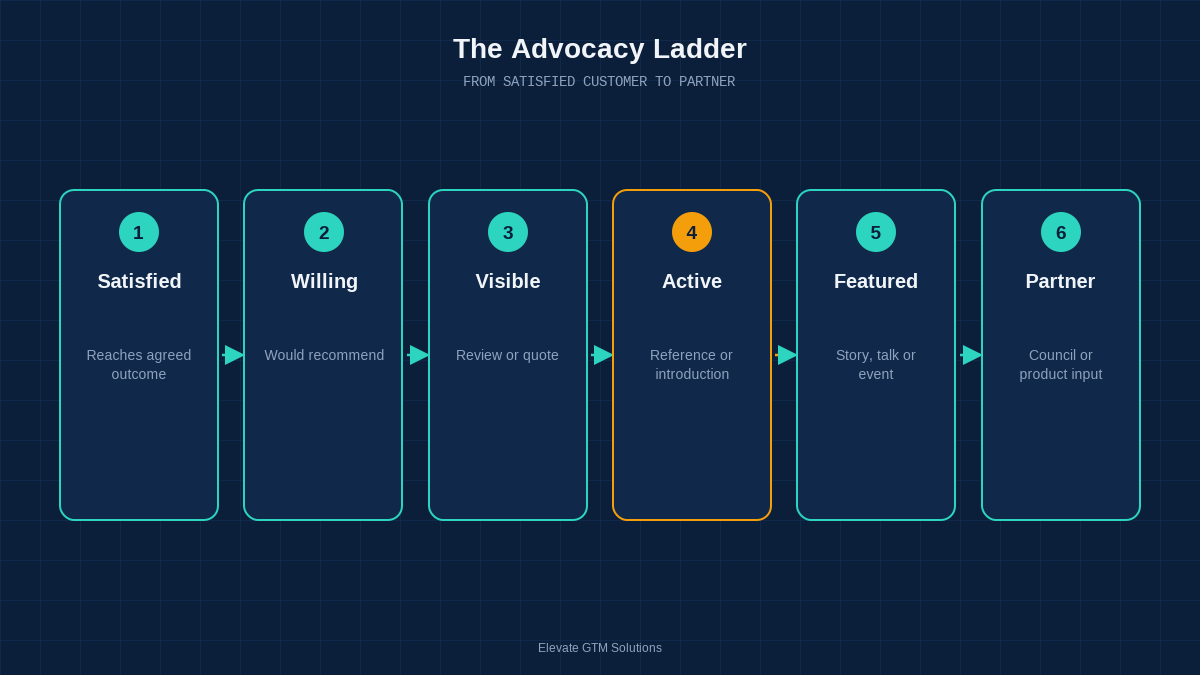
A simple advocacy ladder
Think of advocacy as a ladder, with each step asking a little more of the customer.
- Satisfied. The customer reaches an agreed outcome.
- Willing. They say they would recommend you, for example in a survey or a call.
- Visible. They write a review or share a short quote.
- Active. They take a reference call or make an introduction.
- Featured. They appear in a story, a talk or an event.
- Partner. They sit on a council or help shape the product.
Customers move up when the previous step went well and they received something worthwhile. A program that jumps to step five for everyone burns goodwill.
How advocacy changes when buyers use AI to research
Buyers now often start with an AI summary, and those summaries draw on what has been written about you elsewhere, including reviews, articles and community posts. That raises the value of customer voice that exists in public and is recent. A private reference call is invisible to an AI tool, while a dated, specific review is not.
Three practical consequences follow. Ask satisfied customers for reviews on the sites your buyers use, and keep them coming so the newest ones are recent. Publish stories with concrete detail, such as the customer's size, the problem and the measured outcome they agreed to share. And make sure what customers say matches what your own pages say, since buyers and their tools will compare them. We have no data on how AI summaries weigh these sources, so treat this as a reasonable inference, not a finding.
Glossary
Advocacy. Any action by a customer that helps others decide to buy from you.
Referral. An introduction of a specific prospect by a customer or contact.
Reference. A conversation between a prospect and a customer, usually late in a deal.
Third-party interaction. A source of information outside the seller, such as reviews, references or experts.
Value affirmation. A buyer's confidence that a purchase is worth making.
Attribution. Assigning credit for a result to a source. Referral influence is often missed by it.
Customer council. A group of customers who give structured input to the company.
Sourced versus influenced. Sourced means the opportunity started from a source. Influenced means the source played a part along the way.
Where Elevate GTM Solutions fits
Elevate GTM Solutions is a go-to-market strategy platform that its homepage describes as a way to build, execute and evolve strategy, with connected modules and a flow from insights and strategy context to a strategy builder, workflow engine, activation, playbooks, weekly pulse and executive dashboards. It speaks to this research in a narrow way: it can hold the plan for where advocacy fits and connect proof points to messaging and enablement. It does not run reference or referral programs. For related reading, see how big a B2B buying group is and how B2B buyers use AI and sales reps.
Key takeaways
- A Gartner survey of 771 B2B buyers, fielded in November and December 2022, found buyers value third-party interactions such as customer references, reviews and expert consultations 1.4 times more than digital supplier interactions.
- Forrester's September 2025 guidance says peers rank among buyers' top five trusted sources and advises treating advocacy as a strategic program built on customer success, rewards that customers value and accurate information.
- Gartner Digital Markets surveys of software buyers report that two thirds say reviews significantly affect their decisions and 85% trust online reviews as much as personal recommendations, with the caveats noted above.
- We found no independent public data on how much pipeline referral programs produce, and widely circulated figures could not be traced.
- Referral influence is usually undercounted, so measure what you can and present it as a floor.
- Earn advocacy through delivery, spread the requests and give customers something they value.
Sources
- Gartner, Gartner Marketing Survey Finds B2B Buyers Value Third-Party Interactions More Than Digital Supplier Interactions, press release, June 8, 2023 (survey of 771 B2B buyers, November to December 2022).
- Forrester, Amy Bills, Your Successful Customers Have Power Over Buyers: Don't Leave It To Chance, blog, September 22, 2025.
- Forrester, B2B Customers Are Willing Advocates In The Right Conditions, trend report description (paywalled; description only).
- Forrester, Recruiting And Retaining Customer Advocates, best practice report description (paywalled; search excerpt only).
- Gartner Digital Markets, How B2B Software Buyers Use Reviews to Make a Purchase Decision (cites the 2021 SMB Software Buying Behaviors Survey; search excerpt only).
- Gartner Digital Markets, Does Social Proof Still Work? What Software Buyers Really Think in 5 Stats (search excerpt only).
Frequently Asked Questions
Do customer referrals drive B2B pipeline?
Customers clearly influence buying, but we found no independent, method-stated public data on how much pipeline referral programs generate. Gartner's survey of 771 B2B buyers shows buyers value third-party interactions 1.4 times more than digital supplier interactions. Measure referral-sourced deals in your own records.
What is the difference between advocacy and referrals?
Advocacy is anything a customer does that helps others decide to buy, including reviews, references, stories, community participation and advisory roles. A referral is one form: an introduction of a specific prospect. Each has a different purpose and a different way of being measured.
Which matters more, references or reviews?
Gartner's release groups customer references, customer reviews and expert consultations together and does not rate them separately, so we cannot say. References tend to help close deals, while reviews shape shortlists. Use each where it fits the stage and segment.
What does Forrester recommend for customer advocacy?
In September 2025, Forrester advised helping customers reach measurable value first, making advocacy rewarding with access and recognition rather than one-off favors, keeping advocates informed so they stay accurate and setting strategic objectives such as reputation, demand generation and pipeline acceleration.
Are the big referral statistics online reliable?
Often not. Figures such as a specific average referral value, half as many touchpoints, or 84% of buyers starting with a referral usually lack a named report, sample and date, and many come from vendors that sell referral software. We could not trace them and do not use them.
How often can we ask a customer to be a reference?
The research gives no number. A practical approach is to set a cap per customer per quarter, such as two requests, rotate your references, give notice and tell customers how the conversation went.
Why are referrals hard to measure?
A prospect told about you by a customer may later arrive through search or an ad, and the system credits the last touch. Referral influence is therefore usually undercounted. Add a referral source field, ask new customers how they heard of you and report counts as a floor.
Do software reviews influence B2B buyers?
Gartner Digital Markets surveys of software buyers report that 66% say reviews significantly affect their decisions and 85% trust online reviews as much as a personal recommendation. Those surveys concern software buyers, often smaller companies, and the publisher earns revenue from reviews, so read them with care.
What should customers get in return for advocating?
Forrester suggests symbolic and experiential value such as executive access, invitation-only events, networking with peers and advisory board participation, rather than one-off favors. Ask customers what they value. Check legal rules before offering incentives for referrals.
When is the right time to ask?
After a visible win, such as a launch or an agreed outcome being reached, and when the customer has no open problems. Avoid escalations and the weeks before a renewal negotiation. Keep the first ask small.
Can a go-to-market platform help with advocacy?
It can hold the plan for where advocacy fits and connect proof points to messaging and sales enablement. Elevate GTM Solutions is a strategy platform with those modules. It does not manage references, run referral programs or collect reviews, and we have no data showing improved referral results.
What should we do first?
List the customers who have reached the outcomes they set at the start, pick three, thank them and ask what would make them willing to help and what they would like in return. Add a referral source field to your records so you can start counting.