
By the Elevate GTM Solutions Team · Updated November 13, 2026 · 28 min read
Do B2B Buyers Choose Vendors Before They Talk to Sales? What the Day One Shortlist Data Really Says
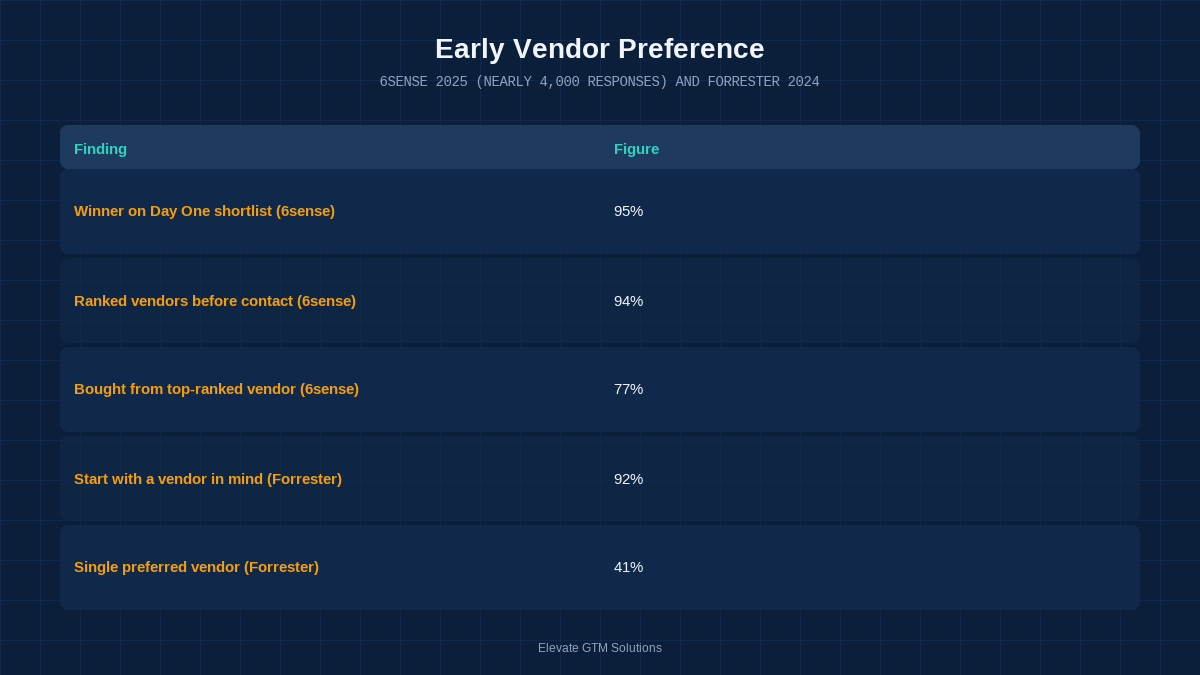
One statistic has done more to change how B2B marketers talk about their jobs than almost any other: in 6sense's buyer research, the winning vendor was already on the buyer's "Day One" shortlist 95% of the time. It is quoted in board decks, conference keynotes and LinkedIn posts, usually with a sentence like "95% of deals are decided before sales gets involved." That sentence is not quite what the research says. The real finding is more interesting, and more useful, than the slogan.
This page explains what the Day One shortlist data says, what it does not say and what a go-to-market team should do about it. The evidence is a buyer study from 6sense, supported by Gartner research on third-party influence and Gartner Digital Markets data on how software buyers narrow their options. For each source we say who was asked, when and how many, and what it cannot tell you. Then we add our own reading, clearly labeled, and describe where a go-to-market platform like ours can help and where it cannot.
A disclosure. We make Elevate GTM Solutions, a go-to-market strategy platform. We have no shortlist data of our own. The main study here comes from 6sense, a company that sells account-based marketing and intent software, and we say what that means for how to read it. We could not open 6sense's report itself. Our account of it comes from a research round-up by an independent analyst and from excerpts of the report's summary, which we flag. We read Gartner's June 2023 release in full. Our examples are invented and labeled.
Do B2B buyers choose vendors before they talk to sales?
Mostly they narrow the field before talking to sellers, and the winner usually comes from that early list, but the evidence stops short of "the deal is decided." In 6sense's 2025 B2B Buyer Experience Study, which drew nearly 4,000 buyer responses, buying groups filled four of five shortlist spots on Day One, 94% ranked their shortlist vendors by preference before contacting any vendor, they contacted their top-ranked vendor first about 80% of the time and they bought from their top-ranked vendor 77% of the time. The study's summary says 95% of the time the winning vendor was already on the Day One shortlist, up from 85% in an earlier edition, and that nearly all shortlisted vendors were ones the buyer already had experience with. Gartner's 2023 survey of 771 buyers found buyers value third-party interactions such as customer references and reviews 1.4 times more than digital supplier interactions. The practical meaning: your brand, reputation and past customers decide whether you get a seat on the list, and sales mostly competes for a position within it.
Does 95% mean sales doesn't matter? No. It means the winner was on the early list. Sales still decides which vendor on the list wins, and the study says about 80% of the time the buyer's pre-contact favorite is the one chosen.
Can a new vendor still win? Yes, but the data say it is uncommon. About 5% of winners came from outside the Day One list.
The short version
| Question | Answer |
|---|---|
| Main source | 6sense 2025 B2B Buyer Experience Study; nearly 4,000 buyer responses (as described by an independent round-up) |
| Day One shortlist | Buying groups filled four of five shortlist spots on Day One |
| Winner on that list | 95% of the time, up from 85% in the prior edition (6sense summary) |
| Ranked before contact | 94% ranked shortlist vendors by preference before contacting any vendor |
| Contacted first | The top-ranked vendor, about 80% of the time |
| Bought from | The top-ranked vendor, 77% of the time |
| Prior experience | Buyers had prior experience with about 3.2 of the roughly 3.4 Day One vendors (6sense summary excerpt) |
| First seller contact | About 61% of the way through the journey, down from 69% |
| Independent support | Gartner 2023 (771 buyers): third-party interactions valued 1.4 times more than digital supplier interactions |
| Forrester (2024 Buyers' Journey Survey, via trade summary) | 92% start with at least one vendor in mind; 41% already have a single preferred vendor |
| What is missing | The 6sense report's full method and question wording; a sample size for the Forrester figures |
| Main limit | The study is run by a vendor of intent and account-based marketing tools, and relies on buyers recalling a completed purchase |
What "Day One shortlist" means, and what it does not
The phrase needs care, because the slogan version distorts it.
What it means. In 6sense's research, buyers are asked about a recent purchase. The Day One shortlist is the group of vendors the buying group had in mind at the start of the formal buying process, before they contacted anyone. The finding is about where the winning vendor came from.
What it does not mean. It does not mean the purchase was decided on Day One. Buyers still evaluate, validate and sometimes change their minds. It does not mean 95% of deals are "decided before sales is involved." That is a common paraphrase, and some articles repeat it, but the study reports that the winner was on the early list, not that the choice was locked. Even the study's own summary says the buyer's favorite at the end of the selection phase is the eventual winner about 80% of the time, which leaves some room for change.
What it hides. Being on the list is not the same as being ranked first. The study reports that buyers rank shortlist vendors by preference before contacting any of them and buy from their top-ranked vendor 77% of the time. The prize is not only a seat but a good seat.
Who is excluded. Buyers who named one vendor and went straight to purchase. A commentary we saw, which we could not trace to the report, says the share of buyers who identify only one vendor doubled from 4% to 8% year over year. We treat it as a pointer.
Why this belongs in a go-to-market plan
If the winner usually comes from an early list, the go-to-market plan has to answer a question that is easy to miss: how do we get onto lists before a buyer has any reason to talk to us?
The answer is rarely a sales tactic. It is brand awareness in the right segment, reputation among peers, presence in the places buyers research, past customers who remember you and consistent messaging. These are long-cycle investments, and they pay back in deals that arrive later. A plan that measures only the pipeline created this quarter will underfund them.
It also has consequences for sellers. If buyers already have a favorite when they call, the seller's job changes depending on whether they are the favorite or the challenger. We discuss the broader point about seller time in how much time buyers spend with sellers.
The evidence: 6sense's 2025 B2B Buyer Experience Study
6sense published its 2025 study as the third edition of its buyer research, following editions in 2023 and 2024. We could not open the report page. What follows draws on an independent analyst's research round-up on CustomerThink, which we read in full, and on excerpts of the report's executive summary.
Method. The primary survey had nearly 4,000 B2B buyer responses, with a supplementary survey of 766 responses on AI and economic uncertainty. 49% of respondents were at vice president level or above. By region, North America was 46%, continental Europe 20%, the United Kingdom and Ireland 20% and Asia-Pacific 14%. 49% worked at firms with annual revenue between 10 million and 500 million dollars. 42% were in technology and 38% in services. Purchases were 41% services, 33% software and 26% physical goods. The round-up gives no fieldwork dates.
The shortlist findings. Buyers evaluated an average of five vendors. Buying groups filled four of five shortlist spots on Day One. 94% ranked shortlist vendors by preference before contacting any vendor. 79% initiated contact with prospective vendors. They contacted their top-ranked vendor first about 80% of the time and bought from it 77% of the time.
The summary claims. The executive summary excerpt we saw says that 95% of the time the winning vendor is already on the Day One shortlist, and that four out of five deals are still won by the "pre-contact favorite." It says that about 80% of the time the vendor favored at the end of the selection phase is the one ultimately purchased after validation. It says buyers have prior experience with about 3.2 of the vendors on their list of roughly 3.4 on Day One, and that in 85% of cases, rising to 95% in 2025, buyers purchase from one of the vendors on their Day One shortlist.
Timing. The average first contact with sellers came 61% of the way through the buying process, down from 69% in earlier studies. 58% cited a need to evaluate vendors' AI implementation, and nearly 62% cited economic uncertainty. The average buying cycle was 10.1 months in 2025 versus 11.3 in 2024. The round-up says the global drop is partly due to a larger share of physical-goods purchases, which have shorter cycles.
Secondary reports. Trade summaries add that 85% of buyers reported prior experience with the winning vendor and 75% said they personally know sellers from the vendor organizations they evaluate. We saw these only in a summary and could not confirm them in the report.
What we could not confirm. We have not seen the questions, the fieldwork dates or how respondents were recruited. One aggregator cites a larger sample, 4,510 buyers of purchases above 25,000 dollars, and a different month, which conflicts with the "nearly 4,000" stated by the study's own recap. We use "nearly 4,000" and flag the discrepancy. The 77% and 80% figures differ slightly between sources, which may reflect different editions or wording.
How to read a vendor-run study
6sense sells software that identifies accounts showing buying signals and supports account-based marketing. A finding that vendors are chosen before sellers are involved supports the case for such tools, which help marketers reach buyers early. That is a reason to read the study with care. It is not a reason to dismiss it.
Three things make us treat it as informative:
- The headline is consistent across three annual editions, according to the round-up, and across a very different source, Gartner, which finds buyers lean on third parties and spend limited time with suppliers.
- The independent analyst who summarized it raised no methodological objection, though he also praised it without scrutinizing it.
- The direction fits what practitioners report: buyers arrive with opinions.
Three things limit it:
- It relies on buyers recalling a completed purchase, which invites hindsight. A buyer who chose a vendor may recall it as having been on the list from the start.
- It reflects buyers who completed a purchase. It excludes buying efforts that ended with no decision, and those are a large share of B2B pipelines.
- The sample leans toward technology and services purchases, and respondents are mostly from North America and Europe.
The evidence: Gartner on third-party influence
Gartner's June 8, 2023 release, "Gartner Marketing Survey Finds B2B Buyers Value Third-Party Interactions More Than Digital Supplier Interactions," reports a survey of 771 B2B buyers fielded in November and December 2022. We read it in full. It found buyers value third-party interactions such as customer references, customer reviews and consultations with third-party experts 1.4 times more than digital supplier interactions. Rick LaFond, a Director Analyst, said "Buyers want to feel confident throughout their purchase journey, and third-party sources can help get them there." He said social channels are extremely underleveraged by B2B brands.
This does not measure shortlisting. It does show that buyers lean on sources outside the vendor, which is consistent with a world in which reputation and peer voice shape who is considered. See do customer advocacy and referrals drive B2B pipeline for the detail.
The evidence: Forrester's Buyers' Journey Survey on early preference
A second analyst source reaches a similar conclusion by a different route. A Digital Commerce 360 article dated July 7, 2025 summarizes a Forrester report titled "B2B Marketing and Sales Are Too Late to Influence Decisive Buyers," based on Forrester's 2024 Buyers' Journey Survey. We read the article in full. The article does not state the sample size.
The numbers. 92% of B2B buyers start with at least one vendor in mind, and 41% already have a single preferred vendor before formal evaluation begins. 48% of first-time buyers enter with a preferred vendor. 63% of solo decision-makers begin with a single vendor in mind, and 42% of buyers in deals under 10 million dollars report the same. 47% of C-suite buyers show early preference versus 34% of individual contributors. By region, 45% of North American buyers, 43% of European buyers and 36% of Asia Pacific buyers start with a preferred vendor.
The framing. Forrester says "B2B buying today is a process of confirmation, not selection," and that "Decisive buyers already know who they want to work with before they start gathering requirements or talking to vendors." The report says short-term lead generation alone cannot move decisive buyers and that vendors must focus on becoming the category leader in buyers' minds before the request for proposal arrives.
The advice. Adopt a preference marketing strategy that shapes perception before active demand appears, align brand and demand teams, track brand preference as a core measure, widen outreach to the full network of influencers around the buyer and build playbooks based on whether a vendor is seen as a leader, a contender or a long shot.
How it compares with 6sense. The two use different measures. 6sense reports that buyers fill four of five shortlist spots on Day One and buy from their top-ranked vendor 77% of the time. Forrester reports that 41% have one preferred vendor and 92% have at least one in mind. Neither says the same thing, and they should not be averaged. Together they support a cautious reading: most buyers arrive with some vendors in mind, a large minority arrive with a clear favorite and the share varies by buyer type, deal size and region.
What we could not confirm. We saw the report only through a trade article, with no sample size. Forrester sells research and advice to marketers, and a message that brand and preference matter more than late-stage lead capture suits that business, though it is also consistent with the other evidence on this page.
The evidence: Gartner Digital Markets on shortlisting
Gartner Digital Markets, which operates software review sites, published a 2025 report called "Making the List." An excerpt of the report says 41% of buyers use customer reviews when doing research to pare down their shortlist options, and that 62% of buyers say the product trial is their top factor in the final purchase decision. A Capterra and TrustRadius figure quoted by an aggregator says 63% of software buyers' shortlists include two to three products and 96% include five or fewer, which we could not confirm at the source.
These figures concern software buyers on the publisher's own sites. The publisher earns revenue from reviews and has reason to emphasize them. They suggest that shortlists are short, which raises the stakes of getting on one.
Numbers that circulate, and that we could not trace
"95% of deals are decided before a salesperson picks up the phone." This paraphrase appears in several articles. It is not what the 6sense summary says. The study reports that the winning vendor was on the Day One shortlist, not that the deal was decided.
"The number one ranked vendor wins 77% of deals." The 77% appears in the independent round-up for the top-ranked vendor. Another site attributes 77% to the pre-contact number one in a different phrasing. We use 77% as reported and cite the round-up.
"Buyers who named one vendor doubled from 4% to 8%." We saw this in a newsletter and could not trace it to the report.
"94% of buyers use large language models during buying." This appears in an aggregator that cites 6sense, with a different sample from the one in the round-up we read. We could not confirm it and do not use it. The round-up itself says it did not report how much buyers use AI themselves.
How much weight the evidence can carry
It is strong on direction and weaker on precision. Several sources agree buyers arrive with preferences. The exact percentages depend on one vendor's survey.
Hindsight may inflate the numbers. Buyers may recall their final choice as having been present from the start.
It covers completed purchases. Deals that stall or end in no decision are missing, and in many B2B pipelines they are the majority.
The sample leans technology and services. Results for industrial products or regulated purchases may differ.
The vendor has an interest. 6sense sells tools that help marketers act early in the journey.
It describes the buyer, not your market. Your segment may behave differently. Check against your own wins and losses.
Elevate's reading
Our interpretation, not data.
One. The goal is to be remembered, not only found. The shortlist reflects prior experience. Awareness is necessary, but a good memory of you, from a customer, a peer or a past job, is what earns a seat.
Two. Reputation is a segment-level asset. You do not need to be famous. You need to be known by the people in your target segments when they start to look. That is a focus decision.
Three. Early signals matter, but you cannot always see them. Most of the preference formation happens out of sight. Ask buyers in win and loss interviews who was on their list on Day One and why.
Four. Win and loss analysis becomes the key measurement. The question to ask is not only "why did we win" but "were we on the list at the start, and where did we rank?"
Five. Customer advocacy is a shortlist strategy. Peers are among the first people buyers ask. Happy customers build the memory that gets you on the list.
Six. Sellers should know where they stand. A seller who is the buyer's favorite needs a different conversation from one who is the challenger. Ask early.
What this means for different roles
Chief executive or founder. Ask how many of your wins were on the buyer's list at the start. If you do not know, find out.
CMO or head of marketing. Protect budget for long-cycle brand and reputation work in your target segments. Report on aided awareness among those segments, not only on leads.
Head of sales. Ask in discovery who else is on the list and who the buyer prefers. Adjust your approach for favorite versus challenger.
Head of customer success. Your customers are the memory that earns a seat. Treat renewals and references as shortlist work.
Product marketing. Define what you want to be known for in each segment, in plain language that survives a conversation between peers.
Revenue operations. Add fields to record the buyer's initial list, your ranking and the source of your first awareness, from the buyer in the buyer's words.
Partnerships. Channel partners and communities are places buyers form preferences. Count them as part of reach.
A worked example, invented for illustration
Imagine a software company selling procurement tools to mid-sized manufacturers. It runs outbound sequences and paid search and wins about one in five qualified opportunities. The chief executive reads the Day One statistic and asks the head of marketing whether the company is already being left off lists.
The head of marketing interviews twenty recent buyers, ten who chose the company and ten who chose a competitor. She asks each who they had in mind before they contacted anyone, how they had heard of those vendors and where the company ranked. Seven of the ten who chose the competitor had never heard of the company before it contacted them. Seven of the ten who chose the company had met a customer of the company at an industry event or in a peer group.
The company changes its plan for the next year. It shifts part of its budget from broad outbound to three peer communities and two industry events where its target segment gathers. It asks twelve satisfied customers to take part in events and write reviews. It adds three questions to its first-call template: who else are you considering, who do you prefer today and why. And it adds a field to its CRM to record the buyer's answer.
The team tracks, over the next four quarters, the share of won deals where the company was on the buyer's initial list, its rank when it was and win rates by rank. We make no claim about what a real company would find. The example shows the pattern: interview buyers about the list, invest in the places where preference forms and record the answers.
How a go-to-market platform can help, and where it cannot
Elevate GTM Solutions is a go-to-market strategy platform. As described on our homepage, its modules cover customer segmentation, positioning, messaging, account-based marketing, competitive intelligence, customer acquisition, sales enablement, measurement and more, within a unified strategy. It is not an intent data provider, a survey tool or a CRM.
Here is how that relates to the research, without overclaiming.
Choosing where to be known. Segmentation and ideal customer profile work can narrow the audience in which you need to build reputation, so you can focus long-cycle effort.
Making the message memorable and consistent. Positioning and messaging held in one connected place help every channel say the same thing. Consistency is part of how reputation forms.
Planning for long-cycle and short-cycle work together. The plan can include both the brand and advocacy actions that earn a place on the list and the sales actions that compete once you are on it. That depends on the team using it.
Visibility. A weekly pulse and executive dashboards can show whether those actions are happening. We have no data showing improved shortlist rates or win rates.
What it cannot do. It does not observe what buyers are thinking, identify accounts in market or measure your presence on shortlists. It does not replace win and loss interviews. We have no Elevate customer data on shortlist outcomes. For questions to ask any vendor, see questions to ask AI GTM vendors.
Questions to ask about your own shortlist position
- In our last twenty wins, were we on the buyer's list at the start?
- In our last twenty losses, did the buyer know us before we contacted them?
- Where did we rank when the buyer made first contact?
- Where do buyers in our segments form their first impressions?
- Who do they ask, and what do those people say about us?
- What do we want to be known for, and is it clear to a stranger?
- How much of our budget supports long-cycle awareness and reputation?
- How do we learn about buying efforts that end without a decision?
- How do our sellers adapt when the buyer already has a favorite?
- What would change if we measured presence on lists, not just leads?
Common mistakes
Repeating "95% decided before sales" as a fact. The study says the winner was on the Day One list. Say that.
Concluding that sales is irrelevant. Sellers still decide which vendor on the list wins.
Treating the number as precise. It comes from one vendor's survey of recalled purchases.
Cutting demand creation to fund lead capture. If the list forms early, late-stage capture misses the decisive period.
Ignoring stalled deals. The study covers completed purchases, not those that ended in no decision.
Assuming your market behaves like the sample. Check with your own win and loss interviews.
Over-investing in being found and under-investing in being remembered. Prior experience is a large part of the list.
Never asking the buyer about the list. Most teams never record it.
What to do this week
Pick your last five wins and five losses. For each, ask the buyer, or the seller who worked on it, who was on the buyer's initial list and where you ranked. If nobody knows, add the question to your next ten discovery calls.
How to build a win and loss program that measures the shortlist
A modest program gives you your own evidence.
- Choose a sample. Aim for ten to twenty recent decisions, including losses and no-decisions.
- Use someone neutral. Buyers say more to a person who did not sell to them.
- Ask about the beginning. Who did you have in mind before you contacted anyone, and why?
- Ask about sources. Where did you first hear of each vendor, and who did you ask?
- Ask about ranking. Who was your favorite at the start, and did that change?
- Ask what changed their mind. If anything did, what was it?
- Record the answers. Use a simple template and the buyer's own words.
- Review quarterly. Look for patterns by segment, deal size and competitor.
- Act on three findings. Choose three changes to messaging, channels or enablement.
After two or three cycles you will have your own version of the Day One finding, which is more useful than any benchmark.
How to earn a place on the list
The research points to a set of practices, which we describe as reasonable inferences, not proven tactics.
Be clear about who you are for. A narrow, credible position in a segment is easier to remember and repeat than a broad one.
Keep customers successful. Prior experience is the strongest feature of the shortlist in the study.
Make customer voice visible. Reviews, stories and peer conversations are where buyers look, according to Gartner's 2023 data.
Show up where your segment learns. Events, communities, newsletters and publications that your buyers already use.
Be consistent. The same story across your site, your sellers and your customers builds recall.
Make evaluation easy. Clear pages on pricing approach, integration and security help buyers keep you on the list.
Support your champions. Give the people who like you something to share with colleagues.
None of these is quick. The plan has to accept a lag between effort and results.
Glossary
Day One shortlist. In 6sense's research, the set of vendors a buying group has in mind at the start of the formal buying process.
Pre-contact favorite. The vendor a buyer prefers before speaking to any seller.
Selection phase. The part of the buying process in which buyers narrow their options, in 6sense's framing.
Validation phase. The part in which buyers check the preferred choice before committing.
Buying group. The set of people involved in a purchase decision.
Aided awareness. The share of a target audience that recognizes your name when prompted.
Win and loss analysis. Structured interviews with buyers about why a deal was won or lost.
Intent data. Signals that suggest an account may be researching a category or a vendor.
Where Elevate GTM Solutions fits
Elevate GTM Solutions is a go-to-market strategy platform that its homepage describes as a way to build, execute and evolve strategy, with connected modules and a flow from insights and strategy context to a strategy builder, workflow engine, activation, playbooks, weekly pulse and executive dashboards. It speaks to this research in a narrow way: it can hold the choices about where to build reputation, what to be known for and how long-cycle and short-cycle work fit together. It does not identify accounts in market. For related reading, see what is B2B intent data and does it improve targeting and how B2B buyers use AI and sales reps.
Key takeaways
- In 6sense's 2025 study of nearly 4,000 buyer responses, buying groups filled four of five shortlist spots on Day One, 94% ranked vendors before contacting any, and they bought from their top-ranked vendor 77% of the time.
- The study's summary says the winning vendor was on the Day One shortlist 95% of the time, up from 85%. That is not the same as "95% of deals are decided before sales."
- Buyers had prior experience with most vendors on their list, which makes reputation and past customers central.
- Gartner's 2023 survey of 771 buyers found they value third-party interactions 1.4 times more than digital supplier interactions.
- Forrester's 2024 Buyers' Journey Survey, as summarized in trade press, found 92% of buyers start with at least one vendor in mind and 41% with a single preferred vendor, a different measure that points the same way.
- The study is vendor-run and relies on buyers recalling completed purchases, so treat the percentages as indicative and verify with your own win and loss interviews.
- The practical move is to build reputation in the segments you care about, keep customers successful and record where you stood on the buyer's list.
Sources
- CustomerThink, David Dodd, Research Round-Up: 6sense Study Provides Critical Insights on B2B Buyer Behavior, summary of 6sense's 2025 B2B Buyer Experience Study (nearly 4,000 responses).
- 6sense, 2025 B2B Buyer Experience Report, executive summary (read through search-result excerpts only; the page could not be opened).
- Gartner, Gartner Marketing Survey Finds B2B Buyers Value Third-Party Interactions More Than Digital Supplier Interactions, press release, June 8, 2023 (771 buyers, November to December 2022).
- Gartner Digital Markets, Making the List, 2025 report (search excerpt only).
- Digital Commerce 360, Forrester: B2B buyers choose vendors before the buying process begins, July 7, 2025 (summary of Forrester's report "B2B Marketing and Sales Are Too Late to Influence Decisive Buyers," based on its 2024 Buyers' Journey Survey; sample size not stated).
- Sales and Marketing, The 2025 Global B2B Buyer Experience Report insights, trade summary (search excerpt only; source of the 85% and 75% prior-relationship figures).
- Think Tank, 95% of deals are effectively decided before a salesperson picks up the phone, trade article (search excerpt only; cited as an example of the common paraphrase).
Frequently Asked Questions
Do B2B buyers choose vendors before talking to sales?
Mostly they narrow the field first. In 6sense's 2025 study of nearly 4,000 buyer responses, buying groups filled four of five shortlist spots on Day One and 94% ranked vendors before contacting any. That is not the same as the deal being decided, since sellers still compete within the list.
What does the 95% Day One shortlist figure mean?
In 6sense's summary, 95% of the time the winning vendor was already on the buyer's Day One shortlist, up from 85% in an earlier edition. It describes where the winner came from. It does not say 95% of deals were decided before sales got involved.
Does this mean sales doesn't matter?
No. About 80% of the time the buyer's favorite at the end of selection is the eventual winner, and buyers bought from their top-ranked vendor 77% of the time, which leaves room for change. Sales decides which vendor on the list wins, and what buyers value in sellers is covered in our related page.
Is the 6sense study reliable?
It is informative but vendor-run. 6sense sells account-based marketing and intent software, the study relies on buyers recalling completed purchases, and we could not open the report itself. Its headline is consistent across editions and with Gartner's research, but verify the numbers against your own win and loss interviews.
Why do the 77% and 80% figures differ?
The 80% describes buyers contacting their top-ranked vendor first and the pre-contact favorite remaining the favorite after selection, while 77% is the share who bought from their top-ranked vendor. Sources round and word them differently, so cite the recap you read.
How can a new vendor get on the list?
The data suggest it is hard but not impossible. About 5% of winners in the summary came from outside the Day One list. Practical routes include clear positioning in a narrow segment, peer and customer voice, presence where your segment learns and consistent messaging, though these are inferences, not proven tactics.
What role do reviews and references play?
Gartner's 2023 survey of 771 buyers found buyers value third-party interactions, such as customer references and reviews, 1.4 times more than digital supplier interactions. A 2025 Gartner Digital Markets excerpt says 41% of software buyers use customer reviews to pare down their shortlist.
Do these findings apply to my market?
Not necessarily. The 6sense sample leans toward technology and services purchases and North America and Europe, and it covers completed purchases only. Interview your own recent buyers about who was on their list at the start.
How should we measure shortlist presence?
Run win and loss interviews and ask who the buyer had in mind before contacting anyone, where they first heard of you and where you ranked. Record the answers in your CRM in the buyer's words, and look for patterns by segment.
Can a go-to-market platform help us get on shortlists?
It can help you choose which segments to build reputation in, keep positioning and messaging consistent and plan long-cycle and short-cycle work together. Elevate GTM Solutions is a strategy platform. It does not identify accounts in market or measure shortlist presence, and we have no data showing improved shortlist rates.
What should we do first?
Take your last five wins and five losses and find out who was on the buyer's initial list and where you ranked. If nobody knows, add that question to your next ten discovery calls.
Does Forrester find the same thing as 6sense?
Partly, by a different measure. Forrester's 2024 Buyers' Journey Survey, as summarized in trade press, found 92% of buyers start with at least one vendor in mind and 41% with a single preferred vendor. The measures differ, so do not average them, but both point to early preference.