
By the Elevate GTM Solutions Team · Updated November 13, 2026 · 28 min read
What Is B2B Intent Data, and Does It Actually Improve Targeting?
Intent data promises something every sales and marketing team wants: a way to know which accounts are in the market before they raise a hand. The pitch is simple. Buyers leave traces as they research, and software can read those traces and tell you who is looking. Teams buy it, load it into their systems and wait for the pipeline to improve. Sometimes it does. Often the result is a longer list of accounts, a more crowded sales queue and a quiet suspicion that the signals were not as clear as promised.
This page explains what intent data is, where it comes from, what the better evidence says it delivers and how to test whether it works for you. The evidence is analyst research, mainly Forrester's 2023 survey on B2B intent data as described in its published blog posts, supported by one vendor-sponsored benchmark. For each source we say what it measured, what it did not and how much weight it can bear. Then we add our own reading, clearly marked, and describe where a go-to-market platform like ours helps and where it does not.
A disclosure. We make Elevate GTM Solutions, a go-to-market strategy platform that includes account-based marketing and customer acquisition modules, so we have an interest in how targeting is discussed. We do not sell intent data and we have no data of our own. The main Forrester survey is older now, its full report is for Forrester clients and we read only public blog posts and summaries. We say so wherever it matters. Our examples are invented and labeled.
What is B2B intent data, and does it improve targeting?
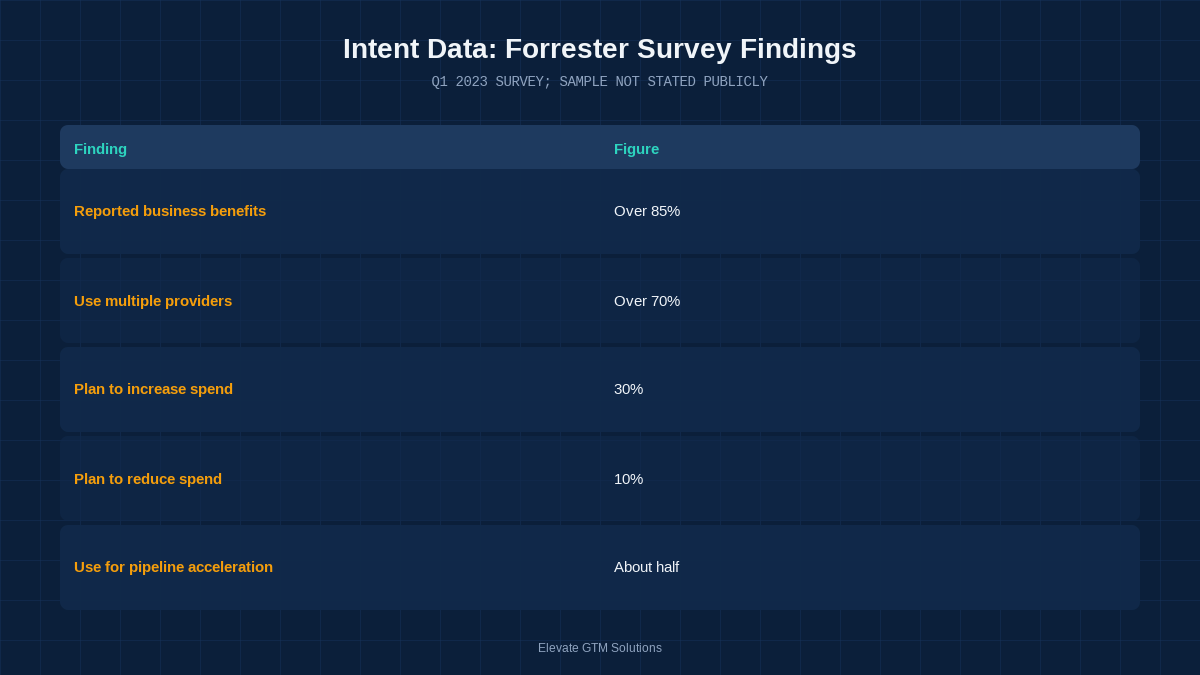
B2B intent data is information about the topics and behaviors that suggest an account or a person may be researching a purchase. It comes from your own channels, from review platforms and from third-party networks. Forrester's Q1 2023 Global B2B Intent Data Survey, as summarized by analyst Brett Kahnke in October 2023, found that over 85% of companies using intent data had achieved business benefits, that over 70% were using multiple providers, and that 30% of those investing planned to increase spend while only 10% planned to reduce it. The same summary says that when asked about specifics, more companies expected benefits than achieved them, especially for sales use cases and overall revenue growth, and that identifying the right contacts within accounts showing intent was the top execution challenge. So intent data seems to help most teams somewhat, and it falls short of expectations in the places where expectations are highest. It is better used to prioritize accounts you already have reason to pursue than as proof that a buyer is ready.
Does intent data work? Most users report some business benefit in Forrester's survey, but fewer report the specific benefits they expected, and the page gives no measured lift.
What is the main mistake? Forrester lists several, including treating intent signals as qualifiers and ignoring data decay.
The short version
| Question | Answer |
|---|---|
| What is intent data? | Signals suggesting an account or person is researching a purchase |
| Main types | First-party (your own channels), second-party (review platforms) and third-party (networks of sites) |
| Benefit reported | Over 85% of companies using intent data say they achieved business benefits (Forrester, Q1 2023 survey) |
| Provider use | Over 70% use multiple providers; almost half receive data from three or more sources (Forrester) |
| Spend plans | 30% of investing companies plan to increase spend, 10% plan to reduce it (Forrester) |
| Use cases | Only half use intent for pipeline acceleration; fewer than a third use it for any customer use case (Forrester) |
| Expectation gap | More companies expected benefits than achieved them, especially for sales use cases and revenue growth (Forrester) |
| Top challenge | Identifying the right contacts within accounts that show intent (Forrester) |
| Main limit | The survey sample is not stated publicly, the full report is client-only and independent accuracy audits were not found |
How intent data works, and why it is not a mind reader
A buyer who is starting to research a problem does things that can be observed. They read articles on certain topics, compare products on review sites, visit vendor websites, download guides and ask questions in communities. Intent data collects some of those traces and turns them into signals about accounts and topics.
First-party intent comes from your own channels: visits to your pricing page, product usage, email replies, webinar attendance, chat conversations. It is usually the clearest because you know exactly what happened and who did it. Forrester's list of intent data mistakes includes undervaluing first-party signals, because teams spend on external data while ignoring what their own systems already know.
Second-party intent comes from another company's platform, such as a review site that shares which accounts are reading about your category or your competitors. It reflects behavior in a setting where people are often actively evaluating products.
Third-party intent is gathered across many websites, often through content consumption networks, and aggregated into topic-level surges for accounts. It covers a wide field and is the hardest to verify, because you cannot see the underlying behavior.
All three share the same limits.
Signals are about topics and accounts, not decisions. An account reading a lot about a category may be a buyer, a student, a competitor, a consultant or a team doing background research for a project that never gets funded. Intent suggests interest. It does not prove a plan to buy.
Identification is hard. Many signals attach to a company, not to a named person. Forrester's survey summary says that identifying the right contacts within intent-showing accounts was the top execution challenge, because few providers deliver signals from known contacts. Knowing that an account is active does not tell a seller whom to call.
Signals decay. Forrester's guidance warns that intent data goes stale quickly, so historical signals must account for age or nearly every account will appear active. A surge three months ago is not the same as one this week.
Different sources capture different stages. Early research, comparison and final evaluation leave different traces. Forrester lists failing to map signal types to the buying cycle as a mistake, because knowing which sources catch early and which late behavior changes how you act.
Quality varies and is hard to audit. Providers collect signals in different ways. Forrester tells marketers to understand how each provider collects its signals and not to treat "intent data" as one product. In our search for this page, we found vendors publishing their own accuracy claims and did not find independent audits of accuracy.
Privacy responsibilities do not disappear. Forrester lists relying on vendors for privacy compliance as a mistake and says a company must maintain its own lawful basis for holding prospect and customer data. Requirements differ by region, and a lawyer should review your use.
A fair summary: intent data is a way to narrow a long list of accounts and to time outreach. It is not a replacement for knowing who your best-fit customers are, and it is weakest as a standalone trigger.
Why intent data belongs in a go-to-market plan
Targeting is one of the largest choices in a go-to-market plan, and teams often spend on it with less evidence than they spend on almost anything else. Intent data sits at the junction of three decisions. Who is worth pursuing, which is a question of fit. When to reach them, which is a question of timing. And what to say, which is a question of relevance. Intent data speaks mostly to timing and, in part, to relevance through topics. It says little about fit.
That is why it works best on top of a clear ideal customer profile and a tiered account list. Without that base, intent surges simply point at accounts that were never good prospects. See our ICP scoring framework and account tiering framework.
The evidence: what Forrester's Q1 2023 intent data survey reported
The central source is Forrester's Q1 2023 Global B2B Intent Data Survey, described in a blog post by principal analyst Brett Kahnke published on October 26, 2023, and in a September 27, 2023 trend report whose public summary notes it also draws on Forrester's Q4 2022 Global B2B Marketing Tech Tide Survey. The full report is available to Forrester clients. We read the public blog post and the report summary. The post does not state how many people responded.
Adoption and benefits. "Over 85% of companies using intent data have achieved business benefits." The benefits named include increased response rates from outbound marketing and more successful sales prospecting.
Multiple providers. "Over 70% of companies using intent data are now leveraging multiple providers," and almost half receive data from three or more sources. That fits the idea that no single source is complete, and it also means that costs and data volumes add up.
Spend plans. 30% of companies investing in intent data plan to increase spend, and only 10% plan to reduce it. Appetite was growing as of the survey.
Use cases. Only half of respondents use intent for pipeline acceleration, and fewer than a third use it for any customer use case. In other words, most use stays at the front of the funnel.
The expectation gap. "When asked about specifics, more companies expected benefits than achieved them." The gap appeared across all surveyed benefits, especially sales use cases and overall revenue growth. This is the most useful sentence in the post. Teams buy intent data for revenue outcomes, and the survey suggests those are the outcomes least often delivered.
Reporting. The author says a common issue among Forrester clients is a lack of reporting capability to track the impact of intent data investments deeper into the B2B revenue waterfall. If you cannot trace intent through to revenue, you cannot tell whether it is working.
The top execution challenge. Identifying the right contacts within accounts that show intent, because few providers supply signals from known contacts.
What we could not confirm. The blog does not list the report's recommendations, which are for clients only. It does not give a sample size, the survey's regional split or how "business benefits" were defined. A benefit can be small. "Achieved business benefits" is a low bar, and the details are in the client report.
The evidence: Forrester's ten intent data mistakes
In a blog post dated February 17, 2023, Kahnke lists ten mistakes. The post contains no statistics. It is practical advice from an analyst who had begun a year-long research project on intent data.
- Not leveraging intent data at all. Companies that skip it fall behind competitors who can see which accounts are shopping.
- Settling for one source. Varied signals from multiple sources improve prediction better than duplicate purchases.
- Underleveraging existing investment. Teams often fail to fully adopt their tools or build processes to act on signals, and miss other uses.
- Using signals in a vacuum. Signals mean more when paired with engagement and technographic data.
- Treating signals as qualifiers. Intent should not replace the standard qualification process before sales handoff.
- Failing to map signal types to the buying cycle. Early and late behaviors call for different responses.
- Ignoring data decay. Stale signals make nearly every account look active.
- Undervaluing first-party intent. Teams overlook signals from their own direct interactions.
- Relying on vendors for privacy compliance. A company must keep its own lawful basis.
- Treating all intent data sources the same. Providers collect signals differently.
Notice that the list is mostly about process, not product. Seven of the ten are about how a team uses the data. That matches the expectation gap above: the data is rarely the whole problem.
Mistake one, not using intent data at all, comes from a firm that publishes research for clients who buy and use these tools, and we read it with that in mind. The remaining mistakes are widely sensible whichever way you decide on the first.
The evidence: a vendor-sponsored benchmark
A 2022 Ascend2 report, The State of Intent Data for Go-to-Market Teams, was sponsored by an intent data vendor, Intentsify. The excerpt we saw says the share of overall intent data users dropped from 59% in the 2021 survey to 54% in 2022, though the 2022 survey was expanded to include sales and customer success functions, which makes the two years hard to compare. We read only an excerpt. We include it as an example of the kind of sponsored benchmark that circulates widely, and we do not rely on it.
Numbers that circulate, and that we could not trace
Compilations of "B2B intent data benchmarks" circulate online with precise figures. We saw, for example, a claim that intent-prioritized accounts convert at 21.3% versus 8.4% for others, attributed to a Forrester 2024 B2B buying study, a median 28-day sales cycle compression and a "62% signal validation failure rate" attributed to a Gartner source. We could not find these in the primary sources and do not use them. A figure with two decimal places and a name attached is not evidence until you can find it in the named report.
The honest position, which also appears in vendor-neutral commentary, is that vendors publish their own accuracy claims and almost none publish methodology. We found no independent, audited accuracy benchmark for third-party intent data, and we say that as a statement about our search, not a claim that none exists.
How much weight the evidence can carry
It supports using intent data carefully, not buying it blindly. Most users report some benefit, and fewer report the specific outcomes they expected. That points toward modest, testable use.
The survey is from early 2023. Providers, privacy rules, AI-driven research and buyer behavior have all moved since. The patterns about process may hold. Specific percentages may not.
Reported benefit is a low bar. "Achieved business benefits" can mean a small gain in response rates. It is not a measurement of pipeline or revenue lift.
Users in a survey are a self-selected group. People who bought intent data and kept it are more likely to report benefits than people who tried it and stopped. The survey covers companies using intent data.
The analyst has a research interest in the topic. Forrester sells research and advice about intent data. Its guidance is useful, and a call to invest more in the category fits its business.
There is no measured lift in public sources. None of the public material we found gives a controlled comparison of accounts targeted with intent against similar accounts targeted without it. That is why the test described below matters.
Elevate's reading
Our interpretation, not data.
One. Intent is a timing signal, not a strategy. It helps you choose who to reach this week among accounts you already want. It cannot tell you which accounts you should want.
Two. The expectation gap is a clue about where teams over-trust it. Revenue outcomes are the least often delivered, probably because intent signals sit at the start of a long path with many handoffs, and every handoff loses some of the signal.
Three. First-party data is underused. Most teams already hold strong signals in their own web analytics, product usage, email engagement and sales conversations. Connecting those is cheaper than buying more.
Four. The contact problem is a structure problem. An account-level signal is only useful if someone knows which people to approach and why. That depends on knowing the buying group, which we discuss in how big a B2B buying group is.
Five. Intent belongs next to messaging, not before it. A signal says what topic an account seems to care about. If your outreach is generic, the signal is wasted. Relevance matters a great deal to buyers, as our page on AI outreach and personalization explains.
Six. Measure the lift or do not claim it. If you cannot compare treated and untreated accounts, you will be guessing, and the survey suggests guessing is common.
What this means for different roles
Head of demand generation. Decide in advance what a signal will trigger and what it will not. Write the rule down. A surge should lead to a specific action within a specific time.
Head of sales or sales development. Ask whether signals reach you with a named contact and a reason to reach out. A list of "hot accounts" with no context creates work and little else.
Revenue operations. Own data decay. Put an age on every signal and retire old ones automatically. Track where each signal came from so you can tell what is working.
Marketing operations. Keep a record of providers, contract dates and what each source adds that others do not. Overlap is common.
CMO or CRO. Ask for the test design before approving the renewal. A well-run test costs little and answers the question the vendor cannot.
Legal or privacy lead. Review how signals are collected, what data you hold about individuals and your lawful basis. Do not rely on vendor assurances alone.
A worked example, invented for illustration
Imagine a company that sells workflow software to mid-sized logistics firms. It has 600 target accounts, a three-person sales development team and a third-party intent subscription. For a year, sales development has worked the "surging" list each Monday. Meetings booked are flat, and sellers say the list feels random.
The head of demand generation designs a small test. She splits 300 of the best-fit accounts into two groups of 150 at random. One group is worked using intent surges plus the team's own first-party signals, such as pricing page visits and webinar attendance. The other is worked on a normal rotation, with no signal-based timing. Both groups get the same messaging and the same follow-up rules. The test runs ten weeks.
At the end she compares meetings booked, opportunities created and the time from first touch to first meeting for the two groups. She also asks sellers which signals they actually used. Suppose the first-party signals prove more useful than the purchased feed. Suppose the purchased feed helps only for one product line. Those are findings she can act on: keep the feed for that line, expand first-party tracking and drop the rest at renewal.
We make no claim about what a real test would show. The example shows the shape: a comparison group, a fixed window, the same messaging and a decision rule.
How a go-to-market platform can help, and where it cannot
Elevate GTM Solutions is a go-to-market strategy platform. As described on our homepage, it includes modules for ideal customer profile and segmentation, account-based marketing, competitive intelligence, customer acquisition and measurement, connected within a unified strategy. It is not an intent data provider.
Here is how that relates to the Forrester findings, without overclaiming.
A clear base for targeting. Intent works best on top of a defined ideal customer profile and tiered accounts. A platform that holds those definitions in one place gives a team something to filter signals against.
A place for the rules. Deciding what a signal triggers is a strategy question as much as a tool question. Writing the rules into the strategy and the playbooks, with an owner, makes it more likely they are followed.
Weekly visibility. The product flow we describe ends in a weekly pulse with suggested actions and executive dashboards, which can help a team see whether targeting changes are being acted on. We have no data showing that this improves results.
What it cannot do. It does not create intent data and it does not make third-party signals more accurate. It does not identify the contacts inside accounts. It does not run your test for you. It does not replace a privacy review. Our integrations work, such as pulling business data from connected platforms, is about importing information into a strategy. It is not a promise about intent coverage. We have no Elevate customer data on targeting outcomes. For a comparison of tool types, see GTM platform vs ABM platform.
Questions to ask before buying or renewing intent data
- What decision will a signal change, and who makes it?
- How does the provider collect signals, and can they explain it in plain language?
- Can signals be tied to named contacts, and how reliably?
- How fresh is the data, and how is age handled?
- What does this source add that our first-party data does not?
- Do we have a way to measure lift against a comparison group?
- What happens to accounts that are flagged but do not fit our profile?
- Who reviews privacy and lawful basis?
- How many overlapping providers do we already pay for?
- What will we stop doing if this works?
Common mistakes
Treating a surge as a qualified lead. Forrester names this directly. Intent says an account is interested. Qualification still has to happen.
Working a long list with no priority. If every account is "surging," none is. Cap the list and tier it.
Ignoring decay. Old signals make the whole base look active.
Buying more sources before using the ones you have. Overlap is common, and process is the usual bottleneck.
Skipping first-party signals. Your own website, product and email data are often the cleanest evidence.
Sending the same message regardless of the signal. A topic signal without a relevant message wastes the timing advantage.
Never testing. Without a comparison group you cannot separate the effect of intent from the effect of good accounts and good sellers.
Assuming the vendor handles privacy. You remain responsible for your own lawful basis.
What to do this week
List every intent or signal source you pay for, and next to each write one specific action it triggered in the last quarter and what came of it. If you cannot fill the column, you have found your first conversation.
How to run a fair intent data test
Because public evidence does not settle whether intent data helps a particular business, a small internal test is the most reliable way to find out.
- Choose a single question. For example, "Do intent-timed accounts produce more first meetings than accounts worked on a normal rotation?"
- Select accounts that already fit. Use your ideal customer profile so that the test is about timing, not about fit.
- Randomize. Split the accounts into two matched groups at random. Do not let sellers choose which accounts get the signals.
- Hold everything else equal. Same messages, same cadence, same sellers, as far as possible.
- Set a window. Eight to twelve weeks is common for early metrics, longer if your cycle is long.
- Pre-agree the measures. Meetings, opportunities, time to first meeting and, later, pipeline and revenue.
- Record how signals were used. Which signal, which action, how quickly.
- Review honestly. If the groups look the same, say so. If one source helped and others did not, cut accordingly.
A small test can be underpowered. If only a few dozen meetings result, the difference may be noise. In that case, treat the result as a direction to check again, not as proof.
How to build a simple signal playbook
A signal without an action is a notification. A playbook turns signals into predictable work.
Define the signal. Name it, say where it comes from and give it an age limit. For example, "pricing page visit by a known contact within seven days."
Define the account condition. The signal only applies to accounts in tiers one and two, or to named segments.
Define the action. Who does what, within what time, using which message. A rep calls, a marketer sends a specific piece of content, a customer success manager checks an expansion opportunity.
Define the stop rule. After how many attempts or days does the signal expire without a response?
Define the measure. What result counts, and how will it be attributed?
Review monthly. Which playbooks produced action, and which produced noise?
Keep the number of playbooks small. Three well-run playbooks beat twelve ignored ones.
Glossary
Intent data. Information suggesting that an account or person may be researching a purchase.
First-party intent. Signals from your own channels, such as your website, product and email.
Second-party intent. Signals shared by another platform, such as a review site.
Third-party intent. Signals aggregated across many external websites.
Surge. A rise in an account's activity on a topic compared with its normal level.
Data decay. The loss of value as a signal ages.
Technographic data. Information about the technology an account uses.
Qualification. The process of deciding whether an opportunity fits and is worth pursuing.
Lift. The measured improvement from an action compared with a similar group that did not receive it.
Where Elevate GTM Solutions fits
Elevate GTM Solutions is a go-to-market strategy platform that its homepage describes as a way to build, execute and evolve strategy, with connected modules including ideal customer profile and segmentation, account-based marketing and customer acquisition. It does not provide intent data. It is relevant to this research in a narrow way: it can hold the targeting definitions and the rules for acting on signals in one place and keep them visible. For a related look at why signals and messaging drift apart, see why outbound, intent and messaging stay disconnected in CRM stacks, and for experimentation, our GTM experimentation framework.
Key takeaways
- Intent data suggests interest in topics at the account level. It does not prove a buying decision.
- In Forrester's Q1 2023 survey, over 85% of companies using intent data reported business benefits, over 70% used multiple providers and 30% planned to raise spend against 10% planning to cut it.
- More companies expected benefits than achieved them, especially for sales use cases and revenue growth. The top execution challenge was identifying the right contacts inside accounts.
- Forrester's list of mistakes is mostly about process: treating signals as qualifiers, ignoring decay, undervaluing first-party data and using signals without context.
- Public evidence gives no measured lift and we found no independent accuracy audit. Precise benchmark figures that circulate online could not be traced to primary sources.
- The reliable way to find out is a small randomized test on accounts that already fit your profile.
Sources
- Forrester, Brett Kahnke, Intent Data Expectations Vs. Reality: What's Working, And Where Are The Gaps?, blog, October 26, 2023 (on Forrester's Q1 2023 Global B2B Intent Data Survey).
- Forrester, Brett Kahnke, The 10 Biggest Intent Data Mistakes For B2B Marketing And Sales, blog, February 17, 2023.
- Forrester, If Your B2B Organization Is Not Investing In Intent Data, You Are Falling Behind, trend report, September 27, 2023 (summary only; full report for clients).
- Ascend2, sponsored by Intentsify, The State of Intent Data for Go-to-Market Teams, 2022 (read through a search-result excerpt).
Frequently Asked Questions
What is B2B intent data?
It is information about topics and behaviors that suggest an account or person may be researching a purchase. It comes from your own channels (first-party), from partner platforms such as review sites (second-party) and from networks of external websites (third-party). It shows interest, not a decision to buy.
Does intent data actually work?
Most users report some benefit, but the evidence on size is thin. In Forrester's Q1 2023 survey, over 85% of companies using intent data said they achieved business benefits, yet more companies expected specific benefits than achieved them, particularly for sales use cases and revenue growth. No public source we found gives a measured lift.
What are the main types of intent data?
First-party signals come from your own website, product, email and sales conversations. Second-party signals come from another platform, such as a review site, that shares behavior with you. Third-party signals are collected across many websites and aggregated by a provider. First-party data is usually the clearest, and third-party the hardest to verify.
Why do teams struggle to use intent data?
Forrester's survey summary names identifying the right contacts inside accounts showing intent as the top execution challenge, and says many clients lack the reporting to track impact through the revenue process. Its list of mistakes adds treating signals as qualifiers and ignoring data decay.
Should we use more than one provider?
Over 70% of users in Forrester's survey did, and almost half used three or more sources. Forrester's guidance warns against settling for one source and also against treating all sources as the same. More providers also means more cost and overlap, so check what each adds.
Is intent data accurate?
Providers publish their own claims, and in our search we found no independent audit of accuracy. Forrester advises understanding how each provider collects signals. Treat accuracy as something to test in your own data, not as a given.
How do we avoid data decay?
Put an age on every signal and retire old ones automatically. Forrester warns that stale signals make nearly every account look active. Define how fresh a signal must be before anyone acts on it.
Can intent data replace lead qualification?
Forrester says not to treat intent signals as qualifiers, because they should not replace the standard qualification process before sales handoff. Use intent to prioritize and time outreach, then qualify as usual.
What about privacy and compliance?
Forrester lists relying on vendors for privacy compliance as a mistake and says a company must maintain its own lawful basis for holding prospect and customer data. Rules differ by region, so involve legal or privacy counsel. This page is not legal advice.
How do we test whether intent data works for us?
Choose accounts that already fit your ideal customer profile, split them randomly into two groups, work one with signal-based timing and the other on a normal rotation with the same messaging, and compare meetings, opportunities and speed over a fixed window. See the test steps above and our GTM experimentation framework.
Does Elevate GTM Solutions provide intent data?
No. Elevate GTM Solutions is a go-to-market strategy platform for building, executing and evolving strategy. It can hold your targeting definitions and the rules for acting on signals, but it does not supply or verify intent data.
What should we do first?
List every signal source you pay for and the specific action each triggered last quarter. Cut or test the ones with no clear action, and write down what each remaining signal will trigger and who owns it.