
By the Elevate GTM Solutions Team · Updated November 13, 2026 · 28 min read
Does AI Outreach and Personalization Work in B2B Sales, or Do Buyers Just Tune It Out?
AI has made one part of selling almost free: writing the first message. A tool can research an account, draft an email that mentions the company's latest announcement and send a hundred versions before lunch. Many teams have adopted it on the theory that more personalized outreach, sent at higher volume, will mean more meetings. Buyers, meanwhile, are receiving all of it. Their inboxes are fuller, and the messages look more alike than they did a few years ago, even though each one claims to be written for them.
This page explains what the research says about whether AI-driven outreach and personalization work in B2B sales, why volume and relevance are different things and how a team can use AI in outreach without wearing out its market. The evidence is analyst research, mainly Gartner's buyer surveys and guidance for chief sales officers. For each source we say who was asked, when and how many, and what it cannot tell you. Then we add our own reading, clearly labeled, and describe where a go-to-market platform like ours can help and where it cannot.
A disclosure. We make Elevate GTM Solutions, a go-to-market strategy platform that uses AI, so we have an interest in how AI in sales is discussed. We do not sell an outreach-sending tool and have no outreach data of our own. We read Gartner's June 2025 and November 2025 releases in full, and saw the Gartner abstracts and some trade summaries only in part, which we flag. Our examples are invented and labeled.
Does AI outreach and personalization work in B2B sales?
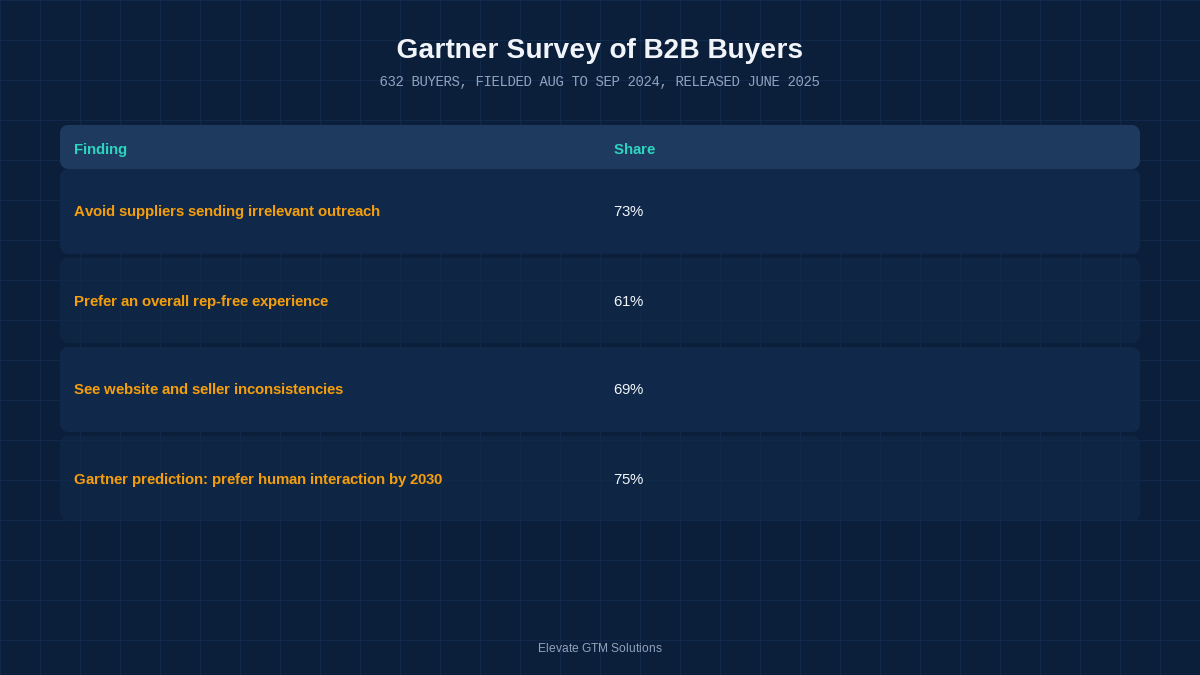
It can, but the research is clear that relevance, not volume, decides whether buyers respond. A Gartner survey of 632 B2B buyers, fielded in August and September 2024 and released in June 2025, found that 73% of buyers actively avoid suppliers who send irrelevant outreach, that 61% prefer an overall rep-free buying experience and that 69% report inconsistencies between a sales organization's website and what sellers tell them. Gartner's Robert Blaisdell said "Bad prospecting actively damages relationships with potential customers." In November 2025 Gartner advised chief sales officers to use AI to improve personalization of seller outreach while moving away from volume-based outreach and focusing on relevance. So AI can help a team become more relevant to the right accounts faster. Used only to send more messages, it risks accelerating the behavior buyers say they avoid.
Do buyers respond to personalized outreach? The Gartner survey does not measure response rates. It shows that irrelevant outreach is actively avoided by 73% of buyers, which makes relevance the condition for any response.
Should we use AI to write outreach? Gartner's guidance is to use it for relevance and tailoring, not for more volume. Whether a given message is relevant depends on your data and strategy, not on the tool.
The short version
| Question | Answer |
|---|---|
| Main source | Gartner survey of 632 B2B buyers, fielded August to September 2024, released June 25, 2025 |
| Avoidance | 73% of buyers actively avoid suppliers who send irrelevant outreach |
| Rep-free preference | 61% prefer an overall rep-free buying experience |
| Inconsistent messages | 69% report inconsistencies between the seller's website and what sellers say |
| Where reps still matter | Buyers prefer seller input for tasks needing contextual intelligence, such as whether a product fits their company (Gartner) |
| Gartner's 2026 advice | Use AI to personalize outreach in a more prescriptive, tailored way; move from volume to relevance (November 2025) |
| Gartner prediction | By 2030, 75% of B2B buyers will prefer sales experiences that prioritize human interaction over AI (August 2025) |
| What is missing | Public, independent reply-rate or pipeline data comparing AI outreach with other outreach |
| Main limit | The surveys measure buyer attitudes, not the results of any specific outreach program |
What "personalization" actually means, and why volume is a trap
The word personalization covers very different things, and the research makes more sense when you separate them.
Token personalization. Inserting a name, company and job title into a template. It is the cheapest and the easiest to spot. Buyers have seen it for years and mostly ignore it.
Situational personalization. Referring to something specific that happened to the account, such as a funding round, a hire, a product launch or a regulatory change. It takes more research, which is where AI is useful. It still fails if the situation does not connect to a problem you can help with.
Problem-level personalization. Speaking to a business problem that people in this role and segment have, using language they use. It depends on understanding the segment, not just the account.
Buying-group personalization. Recognizing that a purchase involves several people with different concerns and tailoring the message to each. Gartner's research points toward this level, and our page on how big a B2B buying group is shows why.
AI is good at the first two and can help with the others if it is given good inputs. The trap is that it makes the cheap levels so cheap that teams do far more of them. Imagine every company in your market doing the same. Each buyer now receives many messages that look personal, and none of them differ in the one way that matters, which is whether the sender understands the buyer's problem.
Volume has a cost that does not show on the sender's dashboard. Each irrelevant message teaches a buyer to ignore the sender's name. The sender sees emails sent and a handful of replies, and does not see the accounts that quietly moved them to the avoid list. Gartner's finding that 73% of buyers actively avoid suppliers who send irrelevant outreach describes that hidden cost.
Relevance is mostly decided before the message is written. Who you pick, when you reach them, what you know about their situation and what you can honestly offer are strategic choices. A well-written message to the wrong person at the wrong time is still irrelevant.
Consistency is part of relevance. Gartner found that 69% of buyers report inconsistencies between the sales organization's website and information from sellers. AI-generated messages can make this worse if each one invents its own version of your value. The analyst's advice is to synchronize company information across platforms, so website content aligns with sales messaging.
Why this belongs in a go-to-market plan
Outreach is one of the most visible parts of a go-to-market plan and one of the most automated. Decisions that used to be made by a seller one email at a time are now made once, in a template or a prompt, and applied to thousands of accounts. That raises the stakes of the strategy behind it. The positioning, the segment definitions, the claims you are willing to make and the rules for who gets contacted should be settled before the volume goes up, not after.
It also sits close to brand. Buyers who ignore or dislike your outreach are the same buyers who will later form a shortlist. We cover that link in whether B2B buyers choose vendors before they talk to sales.
The evidence: Gartner's June 2025 survey of B2B buyers
The most useful public source is a Gartner press release dated June 25, 2025, titled "Gartner Sales Survey Finds 61% of B2B Buyers Prefer a Rep-Free Buying Experience." We read it in full. It describes a survey of 632 B2B buyers conducted in August and September 2024.
The headline. 61% of buyers prefer an overall rep-free buying experience.
The relevant finding for outreach. The release says that although many organizations have increased investment in outreach to reach hard-to-access buyers, 73% of B2B buyers actively avoid suppliers who send irrelevant outreach.
Inconsistency. 69% of buyers report inconsistencies between information on the sales organization's website and information provided by sellers. Blaisdell said: "When sellers provide information that doesn't match the organization's messaging elsewhere, it can create mistrust."
Where sellers still matter. Buyers favor online self-service tools over sellers when searching for general information and learning new things. For tasks needing contextual intelligence, such as determining whether a product or service fits their company's needs, they prefer to seek seller input. Across all stages, the release reports buyers complete an average of 3.0 activities both online and with supplier representatives, 2.3 with supplier representatives and 1.8 via digital self-service tools.
The advice. Blaisdell: "CSOs must rethink their outreach strategy to improve engagement and deliver the experience customers demand." Alice Walmesley, a Director Analyst in Gartner's sales practice, said sellers should "offer unique guidance, acting as a sounding board for buyers" and that CSOs must encourage sellers "to create value by understanding what is most important for buyers." The release recommends avoiding irrelevant outreach, offering unique guidance rather than generic information and synchronizing information across platforms.
What we could not confirm. The release is a summary. It does not give response rates, the definition of "irrelevant," the question wording or the make-up of the 632 respondents beyond the fact that they are B2B buyers. A statement that a buyer avoids irrelevant outreach is an attitude. It is not a measure of what happened to any email.
A note on a common error. Several trade articles attribute the 73% figure to Gartner's 2026 survey, which found that 67% of buyers prefer a rep-free experience. The release we read that contains the 73% figure is the June 2025 one, based on the 2024 fieldwork. We cite it that way.
The evidence: Gartner's guidance for chief sales officers
In a Q&A dated November 24, 2025, titled "Three Critical Trends for Sales Leaders to Address in the Age of AI," Gartner's Robert Blaisdell set out trends for chief sales officers in 2026. We read it in full. Two points bear on outreach.
First, to counteract low engagement, CSOs should "leverage AI to enhance the effectiveness and personalization of seller outreach, making it more prescriptive and tailored to individual buyer needs." Second, this "means moving away from volume-based outreach and focusing on relevance, as buyers increasingly avoid suppliers who send too many or irrelevant messages."
Notice what the advice does not say. It does not say AI outreach fails, and it does not say it succeeds. It says AI can raise relevance if it is pointed at relevance, and that volume is the wrong target.
The evidence: other Gartner material we saw in part
We found several other Gartner items, which we read only as abstracts or excerpts.
- A 2026 abstract titled "Improve Pipeline Quality With AI-Driven Value Messaging" says buyers are actively avoiding doing business with organizations that send irrelevant outreach, but manual personalization does not scale. The summary, from February 26, 2026, suggests AI-driven messaging as a way to scale relevance. Trade commentary on it says personalization should move from individuals toward buying-group-level relevance. We saw this only in secondary summaries and the abstract.
- A November 11, 2026 abstract titled "AI Won't Fix Bad Personalization. Fix Your Strategy First" says senior marketing leaders want AI-driven personalization but lack the required infrastructure and risk scaling creepy and irrelevant outreach. The summary does not give figures.
- An August 2025 abstract titled "Tech CEOs Can't Count on GenAI to Revive Cold Calls and Emails" says tech CEOs relying on cold outreach often overlook actual buying habits.
- An August 25, 2025 Q&A says Gartner predicts that by 2030, 75% of B2B buyers will prefer sales experiences that prioritize human interaction over AI. That is a prediction, and we saw it through a search-result excerpt of the release. Treat it as an informed forecast and not a finding.
Together these suggest a consistent Gartner position: AI can help with relevance if the strategy and data are in order, and without that base it scales the problem.
The evidence: a buyer study cited secondhand
A 6sense study of nearly 4,000 B2B buyers, published in 2025, is cited in a MarTech article as finding that unsolicited outreach from sales development representatives plays a minimal role when buyers first engage. We could not read that part of the report, and the MarTech piece is commentary, so we treat it as a pointer and not as evidence. The wider 6sense findings on shortlists are discussed in our page on buyers choosing vendors before they talk to sales.
Numbers that circulate, and that we could not trace
Articles on AI outreach quote large multipliers, such as personalized campaigns producing three to four times the engagement of static ones, attributed to "Adobe and Gartner benchmarks," or detailed claims about reply-rate declines. We could not find these in primary sources, and several appear in vendor or aggregator posts without a named report. We do not use them. In our search we did not find independent, public data on reply rates or pipeline for AI-written outreach versus other outreach, and that absence is itself worth knowing before you buy on a promise.
How much weight the evidence can carry
It is strong on buyer attitudes and weak on outcomes. Gartner tells us what buyers say they dislike. It does not tell us whether a given AI-assisted program earns meetings. You need your own data for that.
The survey fieldwork is from 2024. AI tools, buyer habits and inbox volumes have all changed since. The 73% figure may be higher or lower now. The direction is more reliable than the number.
Attitudes are not behavior. A buyer who says they avoid irrelevant outreach may still reply to a message that happens to be well timed. Surveys capture the general feeling.
Gartner has a stake in the advice. It sells research and advice to sales leaders, and a narrative in which strategy and data come first suits that business. The advice is also sensible.
The word "irrelevant" is undefined. It is the buyer's judgment. A message you consider tailored may feel irrelevant to the recipient. The only way to learn this is to ask buyers and watch behavior.
Predictions are not findings. The 2030 forecast is an analyst's view of what will happen, and nobody can verify it yet.
Elevate's reading
Our interpretation, not data.
One. AI lowers the cost of a message, not the cost of understanding a buyer. The scarce input in relevant outreach is knowing who the buyer is, what they are trying to do and what you can honestly say about it. AI can speed up the research. It cannot supply the understanding if your strategy does not contain it.
Two. Relevance is a strategy output. The ideal customer profile, the segment's problems and the positioning are what a good message is made from. If those live in different heads, AI will fill the gaps with plausible generalities.
Three. A cap on volume is a feature. Deciding how many touches an account will receive, and from whom, protects the market. It also forces you to prioritize, which is what the tiering exercise is for. See our account tiering framework.
Four. Consistency is the cheapest improvement. If 69% of buyers notice mismatches between your website and your sellers, a single source of truth for claims, proof points and pricing language removes a common source of mistrust.
Five. People should be placed where judgment is needed. Buyers prefer seller input when a task needs contextual intelligence. That suggests reserving human time for fit questions, risk and consensus, and letting AI handle research and drafting. This matches what we describe in how B2B buyers use AI and sales reps.
Six. Measure what buyers do, not what you send. Replies, meetings that go somewhere and the share of contacted accounts that later move to an avoid list or unsubscribe are all more informative than emails delivered.
What this means for different roles
Head of sales or sales development. Set a simple relevance rule. Before an account is added to a sequence, a seller should be able to write one sentence about why this account, this role and this moment. If they cannot, the account waits.
CMO or head of marketing. Make the website and the sales messaging say the same things. Run a quarterly check that compares the claims on key pages with the claims in the top sequences.
Revenue operations. Own contact rules: frequency limits, suppression lists, and a shared record of who has been contacted by whom. A buyer receiving the same pitch from three people is a common failure.
Sales enablement. Give sellers short, reviewed building blocks, such as problem statements and proof points, so AI drafts start from approved material.
Legal and compliance. Rules on commercial email, calls and data use differ by country and sometimes by state. Have counsel review sequences, consent and opt-out handling. This page is not legal advice.
Leadership. Ask for a view of response and avoidance, not only volume. A sharp rise in messages sent with flat or falling meetings is a signal worth hearing early.
A worked example, invented for illustration
Imagine a software company selling compliance tools to regional banks. Its sales development team uses an AI tool that drafts an email for each of 2,000 target contacts, mentioning something from the bank's website. Open rates are acceptable. Replies are few, and several sellers report that prospects say they "get ten of these a day."
The head of sales development changes three things. She trims the list to 400 accounts that match the ideal customer profile and have a recent regulatory change that affects them. She replaces free-form AI drafting with a short set of reviewed problem statements, one per segment, which the AI tool personalizes with one verified fact about the bank. And she adds a rule: at most four touches over six weeks, from one named seller.
She also asks marketing to compare the claims in the emails with the website. They find that two product claims in the emails are not on the site and one is no longer accurate. These are fixed first.
She tracks replies, meetings that reach a second call and unsubscribes. We make no claim about what a real program would see. The example shows the pattern: fewer accounts, a stronger reason for each, consistent claims and a measure that includes avoidance.
How a go-to-market platform can help, and where it cannot
Elevate GTM Solutions is a go-to-market strategy platform. As described on our homepage, its modules cover ideal customer profile and segmentation, positioning, messaging, account-based marketing, customer acquisition, sales enablement and measurement, connected within a unified strategy. It is not an email-sending or sales engagement tool.
Here is how that relates to the Gartner findings, without overclaiming.
A source of truth for relevance. The inputs to relevant outreach are segment definitions, positioning and messaging. A platform that holds these in one connected place, and that adapts them by region, vertical and segment, gives sellers and tools a consistent starting point.
A way to reduce inconsistency. Because strategy, messaging and sales enablement sit in the same system, the claims used in sequences can be drawn from the same place as the website and the sales deck. That depends on the team using it.
Focus assets and playbooks. The product flow we describe includes a short list of focus assets and playbooks. These can serve as the reviewed building blocks that AI drafts start from.
Weekly visibility. A weekly pulse and executive dashboards can show whether the plan for outreach is being followed. We have no data showing improved response rates.
What it cannot do. It does not send messages, manage sequences or measure replies. It does not verify that a message is relevant to a particular buyer. It does not decide how much outreach is too much. It is not a substitute for a compliance review. We have no Elevate customer data on outreach outcomes. For questions to put to any vendor that claims AI personalization, see questions to ask AI GTM vendors, and for a test of AI claims, how to tell if a GTM platform is really AI-native.
Questions to ask before scaling AI outreach
- For each message, can a human state in one sentence why this account and this role?
- What is the maximum number of touches an account can receive, and from whom?
- Do the claims in our outreach match our website and our sales deck?
- How do we measure avoidance, such as unsubscribes, complaints and silence from previously active accounts?
- Who reviews AI-drafted messages, and what are they checking for?
- What data does the AI use, and is it accurate and permitted for this purpose?
- Which accounts should receive human-written outreach only?
- What happens when a buyer replies with a question the AI cannot answer?
- How does our approach handle buying groups and not only individuals?
- What would make us reduce volume?
Common mistakes
Using AI to send more. The research points the other way. The goal is relevance.
Personalizing the trivial. Mentioning a company's slogan or a recent post is not the same as understanding its problem.
Letting every seller prompt differently. Each person's AI drafts will invent slightly different claims. Provide approved building blocks.
Skipping the website check. Mismatched claims create mistrust that no subject line can repair.
Measuring opens. Open rates are a weak signal and can mislead. Focus on replies, meetings and what follows.
Ignoring who is already in conversation. Contacting an account in an active deal, or a customer, with a cold sequence is a common and avoidable error.
Treating consent and rules as an afterthought. Review them before scaling, not after a complaint.
Assuming buyers hate all outreach. Gartner's data says they avoid irrelevant outreach. Relevant, well-timed contact from someone who can add judgment is a different thing.
What to do this week
Read your ten most-sent outreach messages against your website. List every claim that differs. Fix those first, then decide how many accounts you will contact next month and why.
A relevance test you can apply to any message
A short test makes relevance concrete, so that people and AI tools can be held to it.
- Right person. Is this role plausibly involved in the problem we are describing?
- Right problem. Is the problem one our segment has, named in their language, not ours?
- Right moment. Is there a reason to write now, such as a change in the account's situation?
- Right proof. Does the message include one specific, true and checkable fact or example?
- Right ask. Is the request small and easy to answer, and does it give the reader something in return?
- Right consistency. Would the claims match what the reader finds on our website?
- Right volume. Has this person or account already heard from us recently?
A message that fails more than one of these is unlikely to be relevant, however well it is written. Use the test to review a sample of AI-drafted messages each week.
How to pilot AI in outreach without wearing out your market
Treat the first quarter as an experiment, not a rollout.
Start with a narrow segment. Choose one segment where you understand the problem well and where an account list is small enough to review by hand.
Write the building blocks first. Draft problem statements, proof points and approved claims, and have a manager review them. These become the raw material for AI.
Constrain the tool. Limit which data it can use, require a verified fact in each message and set a cap on touches.
Review a sample. Each week, read a random set of drafted messages with a seller and a marketer. Note what is generic, wrong or off-tone.
Track both sides. Replies and meetings, and also unsubscribes, complaints and accounts that go quiet.
Compare against a baseline. Keep a comparable group on your existing approach so you can see whether the pilot adds anything.
Decide in advance. Agree on what result would lead you to expand, adjust or stop.
Expand only when the pilot shows both better results and no rise in avoidance.
Glossary
Outreach. Proactive contact with a prospect, such as email, calls or messages.
Personalization. Tailoring a message to a recipient, which can range from inserting a name to addressing a specific business problem.
Relevance. The degree to which a message fits the recipient's role, problem and moment.
Rep-free experience. A buying experience completed without interacting with a sales representative.
Sequence. A planned series of outreach touches over time.
Buying group. The set of people involved in a purchase decision.
Contextual intelligence. Judgment about whether something fits a specific company's situation, which buyers often prefer to get from a person.
Agent. Software that performs tasks on its own, such as researching an account or drafting messages.
Where Elevate GTM Solutions fits
Elevate GTM Solutions is a go-to-market strategy platform that its homepage describes as a way to build, execute and evolve strategy, with connected modules for segmentation, positioning, messaging, account-based marketing, customer acquisition and sales enablement. It does not send outreach. It is relevant to the research in a narrow way: it can hold the definitions and claims that relevant outreach depends on and keep them consistent. For the wider question of agents in sales, see whether AI agents make sales teams more productive and AI agents in revenue organizations.
Key takeaways
- A Gartner survey of 632 B2B buyers, fielded in August and September 2024, found 73% actively avoid suppliers who send irrelevant outreach, 61% prefer a rep-free experience and 69% see inconsistencies between a seller's website and its sellers.
- Gartner's November 2025 guidance to chief sales officers is to use AI to improve personalization while moving from volume to relevance.
- Buyers prefer seller input for tasks needing contextual intelligence, such as judging whether a product fits.
- Gartner predicts that by 2030, 75% of B2B buyers will prefer experiences that prioritize human interaction over AI. That is a prediction.
- We found no independent public data on reply rates or pipeline for AI-written outreach, and widely circulated multipliers could not be traced.
- The practical response is fewer, better-chosen accounts, approved building blocks, consistent claims, caps on volume and measures that include avoidance.
Sources
- Gartner, Gartner Sales Survey Finds 61% of B2B Buyers Prefer a Rep-Free Buying Experience, press release, June 25, 2025 (survey of 632 B2B buyers, August to September 2024).
- Gartner, Three Critical Trends for Sales Leaders to Address in the Age of AI, Q&A with Robert Blaisdell, November 24, 2025.
- Gartner, Gartner Says By 2030 That 75% of B2B Buyers Will Prefer Sales Experiences That Prioritize Human Interaction Over AI, August 25, 2025 (read through a search-result excerpt).
- Gartner, Improve Pipeline Quality With AI-Driven Value Messaging, insights abstract, February 26, 2026 (abstract only).
- Gartner, AI Won't Fix Bad Personalization. Fix Your Strategy First., insights abstract, November 11, 2026 (abstract only).
- Gartner, Tech CEOs Can't Count on GenAI to Revive Cold Calls and Emails, insights abstract, August 19, 2025 (abstract only).
- MarTech, You're using AI to scale the wrong part of GTM (commentary citing 6sense's 2025 Buyer Experience Report; read through a search-result excerpt).
Frequently Asked Questions
Does AI outreach work in B2B sales?
It can help when it is used to raise relevance, and it can backfire when it is used to raise volume. A Gartner survey of 632 B2B buyers found 73% actively avoid suppliers who send irrelevant outreach. We found no independent public data on reply rates or pipeline for AI-written outreach, so test it on your own accounts.
Do buyers dislike being contacted by sellers?
Not all contact. Gartner's June 2025 survey found 61% prefer an overall rep-free experience, yet buyers still prefer seller input for tasks that need contextual intelligence, such as whether a product fits their company. What they avoid is irrelevant outreach, which 73% said they actively avoid.
What does Gartner recommend about AI and personalization?
In November 2025, Gartner advised chief sales officers to use AI to enhance the effectiveness and personalization of outreach, make it more prescriptive and tailored to individual buyer needs, and move away from volume-based outreach toward relevance. A later abstract says AI will not fix bad personalization if strategy and infrastructure are weak.
What is the difference between personalization and relevance?
Personalization is tailoring a message to a recipient, which can be as shallow as inserting a name. Relevance means the message fits the person's role, problem and moment. A message can be highly personalized and still irrelevant. Buyers respond to relevance.
Why does message consistency matter?
Gartner found 69% of buyers report inconsistencies between the sales organization's website and what sellers tell them, and an analyst said mismatched information can create mistrust. AI drafts can multiply inconsistencies if each invents its own claims. Use approved building blocks and keep website and sales messaging aligned.
Will most buyers prefer humans over AI?
Gartner predicts that by 2030, 75% of B2B buyers will prefer sales experiences that prioritize human interaction over AI. That is a prediction, which we saw through an excerpt of the release. A separate Gartner survey found 69% prefer to validate AI-generated insights with sales reps. See how B2B buyers use AI and sales reps.
How many touches is too many?
The research does not give a number. A practical approach is to set a cap per account, such as a few touches over several weeks from one named seller, track unsubscribes and silence, and lower the cap if avoidance rises.
Are the large personalization multipliers I see online reliable?
We could not trace figures such as three to four times the engagement to primary sources and do not use them. Treat any multiplier without a named report, sample and date as a claim, not evidence.
How should we measure AI outreach?
Measure replies, meetings that progress, and avoidance signals such as unsubscribes, complaints and previously active accounts going silent. Avoid relying on open rates. Compare against a similar group of accounts that did not receive the AI-assisted approach.
Are there legal rules for automated outreach?
Yes, and they differ by country and sometimes by state, covering commercial email, calls, consent and data use. Have counsel review your sequences and opt-out handling. This page is not legal advice.
Can a go-to-market platform make outreach more relevant?
It can hold the definitions, messaging and proof points that relevant outreach draws on and keep them consistent. Elevate GTM Solutions is a strategy platform with modules for segmentation, positioning, messaging and sales enablement. It does not send outreach, and we have no data showing improved response rates.
What should we do first?
Compare your most-used outreach messages with your website and fix every mismatch. Then cut your target list to accounts where you can state, in one sentence, why this account and why now.