
By the Elevate GTM Solutions Team · Updated November 13, 2026 · 28 min read
Do AI Agents Make Sales Teams More Productive, and How Do You Avoid "Agent Sprawl"?
Every sales and marketing team is being offered AI agents: software that researches accounts, drafts and sends outreach, updates the customer relationship system, summarizes calls and suggests what to do next. The pitch is simple. Agents do the work, so people do more of the work that only people can do. Gartner, the research firm, has published predictions and survey results that take the pitch seriously and then complicate it. Its headline claim is that by 2028 AI agents will outnumber sellers 10 to 1, and yet fewer than 40% of sellers will say the agents improved their productivity.
This page explains what AI agents can and cannot do for a sales team and how to avoid agent sprawl. The evidence is Gartner's predictions and survey results. We say what was predicted, what was surveyed, how many people were asked and when, and what the releases do not say. Then we add our own reading, clearly labeled, and describe how a team can decide what to buy, including how a go-to-market platform fits and where it does not.
A disclosure. We make Elevate GTM Solutions, a go-to-market strategy platform, and we use AI in it, so we have an interest in this topic. We have no data of our own about agents or productivity. All figures here come from Gartner press releases. We read the July 2026 release in full. We read the November 2025 release only through search-result excerpts, and we say so where it matters. Our examples are invented and labeled.
Do AI agents make sales teams more productive?
Not automatically: agents add activity, and productivity depends on the systems and workflows they sit inside. Gartner predicts that by 2028 AI agents will outnumber sellers by 10 to 1, but fewer than 40% of sellers will report that agents improved their productivity. In a July 2026 release, Gartner analyst Dan Gottlieb said "more agents will not automatically mean more productivity," that agents "are only as effective as the systems they operate within," and that "if those systems are fragmented, the agents will scale the fragmentation." Gartner warns of "agent sprawl," meaning more digital activity with little improvement in seller impact, and says sales chiefs who overhaul data, automation and user experience will be five times more likely to gain a return on AI by 2028 than those who take quick fixes. The recommendation is to build a connected context layer first, redesign how sellers work around AI, and measure capacity and outcomes, not only time saved.
Are AI agents a shortcut to sales productivity? Gartner says no: "AI agents should not be viewed as a shortcut to sales productivity."
What is agent sprawl? Gartner's term for adding many agents on top of fragmented data and workflows, producing more activity with little improvement in seller impact.
The short version
| Question | Answer |
|---|---|
| Who says this? | Gartner, in predictions released November 18, 2025 and July 28, 2026 |
| Core prediction | By 2028, AI agents will outnumber sellers 10 to 1, yet fewer than 40% of sellers will say agents improved productivity |
| Survey behind the 2026 release | 210 chief sales officers and senior sales executives, January to February 2026 |
| One survey finding | 60% say their revenue number is largely driven by factors outside their control |
| Headline ROI prediction | By 2028, CSOs who overhaul data, automation and user experience will be five times more likely to gain return on AI than those choosing quick fixes |
| Warning | "Agent sprawl": more activity, little change in seller impact |
| Gartner's three actions | Own AI-forward sales infrastructure, orchestrate winning sales behaviors, harvest AI's impact on capacity |
| What it is not | Evidence that any specific agent works or fails |
Why more agents do not automatically mean more productivity
An AI agent, in sales terms, is software that does a piece of work on its own: researching an account, drafting outreach, updating the customer system, summarizing a call, suggesting a next step. The appeal is obvious. If agents handle routine work, sellers have more time for the work only people can do.
Productivity does not follow automatically, for reasons that are easy to see once you look at a seller's week.
- More output is not more impact. Agents can produce more emails, more notes and more tasks. Selling well depends on judgment, relationships and timing, and an agent adding volume can add noise for the buyer and the seller.
- Agents are only as good as what they can see. If account data lives in five places and the definitions disagree, an agent working from it inherits the mess and spreads it faster.
- Review takes time. Someone has to check what an agent wrote or changed. If errors are expensive, that review is real work, and it can cancel out the time saved.
- Nobody decides what agents should take over. Without a clear choice about which tasks move to software and which stay with people, teams add agents wherever a vendor offers one.
The sensible way in, in our reading, is narrow. Pick one workflow where the work is repetitive and the outcome is easy to check. Make sure the data the agent needs is in one dependable place. Decide what a good result looks like before starting. Keep a person in the loop where a mistake would hurt a customer. Measure the outcome, such as meetings held or deals progressed, and not only hours saved.
The sections below set out what Gartner has predicted and surveyed, including its warning about "agent sprawl," and how far those findings can carry a buying decision.
Why a prediction is not a measurement
Before the details, a reminder about the kind of evidence this is. A Gartner prediction is an analyst's forecast, supported by surveys and the firm's research, about what will happen by a given year. It is not a result. "By 2028, fewer than 40% of sellers will say..." has not happened yet. It is a considered opinion from people who talk to many sales organizations, and it is useful for that reason.
Predictions also serve the firm's business. A forecast that says AI is huge but hard to get value from keeps both enthusiasts and skeptics interested in advice. We do not say that to dismiss it. We say it because teams sometimes quote predictions as if they were findings. The survey figures in the same releases are findings. The 2028 numbers are forecasts. Keep them apart.
The evidence: what Gartner has said, release by release
October 2025: the Hype Cycle
In a release on October 30, 2025, Gartner published its Hype Cycle for Sales Transformation, 2025. It placed AI agents for sales at the Peak of Inflated Expectations, and defined them as autonomous or semi-autonomous software entities that use advanced AI techniques to perceive, decide and act within digital sales environments. The release says that, powered by large language models, such agents promise to plan and carry out tasks autonomously, beyond the limits of traditional AI assistants.
What to take from it. The Peak of Inflated Expectations is a specific stage in Gartner's model. It does not say agents are bad. It says expectations are higher than what current products deliver, and that the usual next stage is disillusionment before things mature. We read it only through the headline and excerpt we saw.
November 2025: the 10 to 1 prediction
Gartner's November 18, 2025 release predicted that by 2028 AI agents will outnumber sellers by 10 times, yet fewer than 40% of sellers will report that agents improved their productivity. Melissa Hilbert, a VP Analyst in Gartner's Sales practice, is quoted as saying: "AI agents are everywhere, but there's a value ceiling," and "Beyond a certain point, more AI does not mean more productivity." The release also says layering additional prompts and tools onto already complex workflows risks overwhelming sellers and accelerating burnout, and that leaders should focus on integrating AI into cohesive strategies that prioritize data quality, process automation and user experience. It cites a Gartner report titled "Predicts 2026: Leading Sales in the Age of AI Contradictions."
What to take from it. The phrase "value ceiling" is the important one. The claim is not that agents do nothing. It is that there is a point beyond which adding more of them stops helping, and that point may be reached sooner in a messy environment. We saw this release only through excerpts and trade coverage, so we use its headline claims and the quotes shown, and we do not describe its internal detail.
July 2026: the follow-up with a survey
A July 28, 2026 release repeated the prediction with new survey data. Gartner surveyed 210 chief sales officers and senior sales executives from January through February 2026. Findings and statements in the release:
- 60% of CSOs say their revenue number is largely driven by elements outside their control.
- By 2028, CSOs who overhaul data, automation and user experience will be five times more likely to gain a return on investment from AI than those choosing quick fixes.
- Sales organizations are caught in a "productivity paradox," with rising investment in talent, tools and processes delivering flat returns.
- Without the right data foundation, workflow integration and seller experience, CSOs risk "agent sprawl," meaning more digital activity with little improvement in seller impact.
Dan Gottlieb, a VP Analyst in Gartner's Sales practice, is quoted: "Sales organizations are moving quickly toward a future where AI agents are embedded across the commercial function, but more agents will not automatically mean more productivity." And: "AI agents should not be viewed as a shortcut to sales productivity. They are only as effective as the systems they operate within. If those systems are fragmented, the agents will scale the fragmentation." And: "Sales leaders should be asking where agents can remove friction, improve decision quality and create capacity, not simply where agents can be deployed."
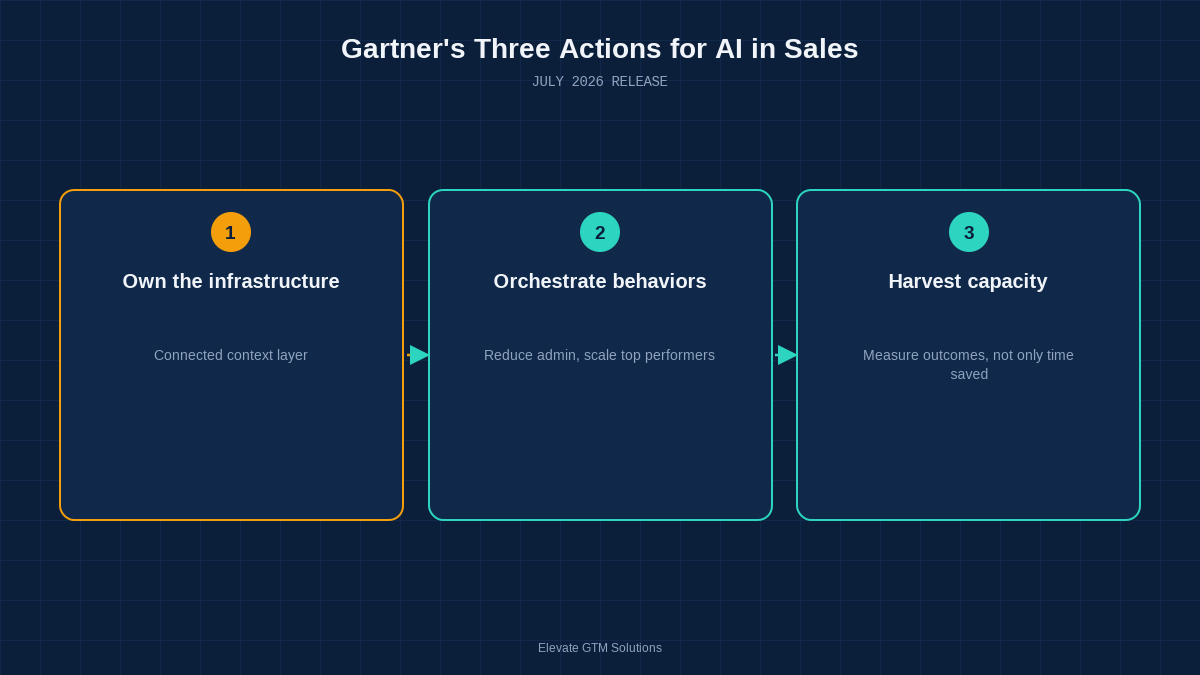
Gartner's three recommended actions, tied to its Sales Productivity Innovation Model:
- Own AI-forward sales infrastructure. Build a centralized context layer connecting enterprise data, systems and seller judgment, so agents produce more relevant, enterprise-specific output.
- Orchestrate winning sales behaviors. Use AI to reduce administrative burden, scale top-performer expertise and give managers data-driven insights for coaching and decisions.
- Harvest AI's impact on sales capacity. Measure how AI expands seller capacity, improves effectiveness and supports commercial outcomes, not just time savings.
The release cites a Gartner report titled "Using AI to Drive Breakthrough Sales Productivity."
What to take from it. Two things. The "five times" prediction is a forecast about future ROI among two groups of CSOs, not a result. And the 60% figure is a self-reported belief that outcomes are mostly outside the CSO's control. That is a statement about how CSOs feel about their revenue number. It does not measure what actually drives revenue, but it does tell you something about the environment in which agent adoption is being decided: leaders who feel they do not control the outcome are likely to buy tools that promise to hand them control.
Other Gartner headlines we saw but did not read in full
For completeness, we saw these titles in news listings and did not read the releases. We mention them only as headlines, and you should read them at the source before relying on anything more.
- A Gartner survey of 227 chief sales officers conducted in August and September 2025 was reported with the headline that sales organizations that provide sellers with AI-enabled next best actions are 2.6 times more likely to achieve commercial growth. The same listing says organizations that prioritize upskilling sellers on AI are also more likely to see an improvement, with the figure truncated in our view.
- A Gartner release headline says AI saves sellers nearly five hours per week, yet 72% of sales organizations fail to reinvest that time in high-value activities.
- A Gartner prediction, dated April 1, 2026, headlined that AI-driven sales enablement will deliver 40% faster sales stage velocity than traditional enablement methods by 2029.
We include them because they show that Gartner's message is not purely cautionary. It reports positive associations with AI, specifically when AI is built into how sellers work and the time saved is put to use. That is consistent with the July 2026 warning: the results come from redesign, not from the agent count.
How much weight the agent research can carry
It is about sales, broadly. The 10 to 1 ratio compares agents with sellers across sales organizations. It does not say there will be ten agents for every sales development representative, and it does not describe any single product.
It is not a controlled trial. The releases do not report an experiment in which one group of sellers got an agent and another did not. They report surveys and forecasts.
"Say agents improved productivity" is perception. Fewer than 40% will say it improved productivity. That is about what sellers will report, which is a combination of real effects and expectations. It is still useful, because sellers who do not feel helped do not use the tools.
Survey samples are small. 210 CSOs and senior sales executives is a reasonable sample for a senior group, but it is not representative of every company size and region. The release does not give a breakdown in the text we read.
Gartner sells to CSOs. The message that CSOs should invest in infrastructure and redesign is the kind of advice its subscribers buy. It also happens to be, in our view, sensible. Both can be true.
Elevate's reading
Our interpretation, not data.
One. "The systems they operate within" is the whole story. Gottlieb's line about fragmented systems is the one we would underline. An agent that drafts an email needs to know who the buyer is, what you promised them, what you are positioning against and what the account team already tried. If that knowledge sits in four tools and two heads, the agent will guess, and a fast guess is not an improvement. We call the connecting layer a context layer, and we describe it in what is a GTM context layer.
Two. Count agents by decisions improved, not by number deployed. Gottlieb asks where agents remove friction, improve decision quality and create capacity. That is a better question than "how many agents do we have?" For each agent you can ask what friction it removed, what decision it improved and what capacity it created, in a sentence you could show a skeptical seller.
Three. Saved time is not value. The headline about nearly five hours a week saved and most organizations failing to reinvest it is the quiet problem. Time saved on logging calls is only worth something if it moves to talking to buyers, thinking about accounts or coaching. Put another way: measure what sellers do with the hour.
Four. Strategy comes before agents. An agent executes. It does not decide who your ideal customer is, what to say to them or which segments to enter. If those decisions are unclear, an agent will produce confident activity in a direction nobody chose. We discuss this in how to tell if a GTM platform is really AI-native and in our existing research page on AI agents in revenue organizations.
Five. Sellers' experience is a measurable constraint. The November 2025 release warns that layering prompts and tools onto complex workflows risks overwhelming sellers and accelerating burnout. If a seller has to open six places to do one task, adding a seventh with an agent in it is not help.
Six. The 60% figure matters for how you buy. When a CSO feels the revenue number is mostly outside their control, the pull toward a new tool that promises control is strong. That is the moment to slow down and write down what problem the tool is meant to solve.
What this means for different roles
Chief sales officer. Ask for a one-page map of every AI tool sellers are expected to use, what each does and who owns it. If the map cannot be drawn on one page, you already have agent sprawl in the Gartner sense. Pick one workflow, redesign it around AI and measure the result before adding another.
Head of sales operations or revenue operations. You hold the data foundation Gartner talks about. Before any new agent goes live, check which fields it reads and writes, which of those are reliable and who fixes them when they are wrong. See our page on why sales forecasts miss and how to fix data quality.
Sales managers. Gartner's second action talks about giving managers data-driven insights for coaching. Ask whether an agent helps you coach or only adds more to review.
Marketing. Agents that draft content depend on positioning and messaging being clear. If they are not, the output sounds generic. Fix the inputs.
Sellers. Say what actually helps and what does not. Your answers are the "productivity" that Gartner predicts fewer than 40% of you will report. If the tool does not help you, that is data.
Finance. Ask what the agent costs per seat, per action or per outcome, and what the baseline was. Without a baseline, any claim of savings is a story.
A worked example, invented for illustration
Imagine a company with a 25-person sales team that buys three AI tools in six months: one that drafts outreach, one that summarizes calls and one that scores accounts. Each works on its own. After a quarter, sellers say they are busier and not better. The outreach tool writes to contacts the scoring tool ranks low. The call summaries sit in a place nobody opens. Two reps stop using the tools.
The head of sales reads Gartner's July 2026 release and treats it as a checklist. She does the following. First she draws the one-page map of tools and data. It shows three tools reading from three different versions of the account list. Second, she picks one workflow: first outreach to a defined segment. She writes down the segment, the message, the account list and the rules for when a human reviews a draft. Third, she connects the tools to the same list and sets one measure for the workflow, such as replies that lead to a meeting, plus a short monthly seller survey on whether the tool saves effort.
She does not claim any particular improvement. She is following the sequence Gartner recommends: connected data first, a redesigned workflow second and measurement of capacity and outcomes third. A month later she can say what worked on her own team's numbers, which is the evidence that matters.
How to evaluate an AI agent you are being sold
A buyer can use the following questions on any vendor, including us.
- What specific task does the agent do, and what does a human do before and after it?
- What data does it read, from where, and what happens when that data is wrong?
- What does it write back, and who can see and correct what it wrote?
- How does it know our ideal customer, our positioning and our rules? Where are those held?
- How do we see what it did and why?
- What is the baseline for the task today, and how will we measure change?
- What happens to the time it saves, and who decides how it is used?
- What does it cost, and how does the cost scale with use?
- Which of our existing tools does it overlap with?
- What happens if we turn it off after six months?
For a longer list focused on go-to-market platforms, see questions to ask AI GTM vendors.
How a go-to-market platform can help, and where it cannot
Elevate GTM Solutions is a go-to-market strategy platform. Its homepage describes it as a way to build, execute and evolve strategy, using connected modules that cover market research, ideal customer profile and segmentation, competitive intelligence, account-based marketing, positioning, messaging, pricing, acquisition, distribution, marketing alignment, launch, measurement, sales enablement, customer success and customer advocacy, plus a unified strategy view. The flow, as we describe it, runs from GTM Insights through Strategy Context, Strategy Builder, a Workflow Engine, Strategy Insights, GTM Activation, GTM Playbooks, GTM Pulse and executive dashboards.
Here is how that relates to what Gartner says, without overclaiming.
The upstream layer. Gartner's first action is a centralized context layer connecting data, systems and seller judgment. Our platform's role is narrower: it holds the strategic context, such as ideal customer, positioning, messaging and segment decisions, in one connected place so that work downstream starts from the same decisions. It is not a data warehouse and does not replace your customer relationship system.
Strategy to a small set of assets. GTM Activation, as we describe it, turns a strategy into a few focus assets. Gartner's warning against agent sprawl argues for fewer, clearer things. See how to turn a GTM strategy into focus assets.
A weekly measure of what is working. GTM Pulse provides weekly actions, recommendations and scores, which gives a team a regular place to ask whether work is improving outcomes and not only producing activity.
What it cannot do. It cannot fix data held in other systems. It cannot decide your strategy for you; it can draft one for a team to challenge. It cannot guarantee that sellers will find any tool helpful. Elevate GTM Solutions is itself AI-assisted, which means Gartner's caution about adding AI to fragmented workflows applies to us too. We have no published data showing productivity gains from our platform and do not claim any.
Designing one workflow around AI, step by step
Gartner's second action, orchestrating winning sales behaviors, is the least concrete in the release, so here is one way to turn it into work. Choose a single workflow and redesign it. Do not try to improve everything at once.
Pick a workflow with a clear start and end. First outreach to a defined segment is a common choice. So is account research before a first call, or follow-up after a demo. Pick one where you can say what a good result looks like.
Write down what a top performer does. Gartner talks about scaling top-performer expertise. Ask your best seller to walk through the workflow aloud and write down the decisions they make: who to contact first, what to check before writing, what they would never say. These are the rules an agent needs, and they rarely live in a document.
Split the work into judgment and routine. Judgment is choosing the angle, deciding whether an account is worth the effort and reading a reply. Routine is gathering public facts, drafting a first version and logging the activity. Give the routine to the agent. Keep the judgment with the person.
Decide where a human checks. An agent that sends without review needs a strong reason. An agent that drafts and a person that approves is slower and safer. Decide per workflow and write it down, so that a rep does not have to guess.
Give the agent the same inputs a good seller would have. Segment, positioning, the account's history, competitors in play and anything the team has promised. If those inputs are not in one place, you will see it in the quality of the output.
Choose two measures, one of outcome and one of effort. For first outreach: replies that become meetings, and the seller's own estimate of time spent per account. Add a monthly question to sellers: does this help?
Run it for a fixed period. Six weeks is enough to see whether the redesign is promising. At the end, decide whether to keep it, change it or drop it, and write down why.
Only then add a second workflow. This is the sequencing Gartner's "five times more likely" prediction rewards: overhaul one thing properly before multiplying it.
The questions this research raises that it does not answer
A good source tells you where its answers stop. These releases leave several open questions that matter to anyone making a purchase.
Which kinds of agent help most? The headlines talk about agents in general. A call summarizer, an account researcher and an outbound writer are different tools with different failure modes. The releases do not compare them.
How much does company size matter? A 25-person team and a 2,500-person team face different data problems. The survey sample of 210 senior sales leaders does not tell us how results differ.
What counts as an agent? Gartner defines agents for sales as autonomous or semi-autonomous software. In practice, vendors apply the word to almost anything that uses a language model. A buyer should ask what the product does without a human prompt.
What is the effect on buyers? The releases concern seller productivity. The buyer-side evidence is in different research, which we cover in how B2B buyers use AI and sales reps. A tool that makes sellers faster but makes buyers trust them less is a poor trade, and neither release addresses it.
How long until the value shows? Gartner's predictions look to 2028. Any given team may see results sooner or later, and the releases do not give a typical timeline.
If a vendor tells you the answers to these questions with confidence and without evidence, that is worth noting.
Common mistakes
Counting agents as progress. The number of agents deployed is an input, not an outcome.
Buying before mapping. Without a map of tools and data, you cannot tell what an agent will touch.
Skipping the baseline. If you do not know how long a task took before, you cannot say what changed.
Assuming saved time becomes valuable time. It becomes valuable only if it is redirected.
Ignoring seller experience. If sellers find it a burden, they will route around it.
Quick fixes. Gartner's "five times more likely" prediction is aimed at those who overhaul data, automation and user experience rather than patch.
Treating Gartner's forecast as fact. It is informed opinion and should be tested on your own team.
What to do this week
Draw one page. List every AI tool your sellers are expected to use. For each, write the task, the data it uses, the owner and what a seller would lose if it were turned off. If you cannot fill in a row, that row is where sprawl is hiding. Do not buy anything until the page is complete.
Glossary
AI agent. Gartner describes agents for sales as autonomous or semi-autonomous software that uses advanced AI techniques to perceive, decide and act within digital sales environments.
Agent sprawl. Gartner's term for adding many agents without the data, workflow integration and seller experience to make them effective, producing more activity with little change in seller impact.
Context layer. A connected layer that brings together enterprise data, systems and human judgment so agents can produce relevant outputs. In Gartner's wording, a centralized context layer.
Productivity paradox. Gartner's phrase for rising investment in talent, tools and processes delivering flat returns.
CSO. Chief sales officer.
Hype Cycle. Gartner's model of how a technology's expectations rise and fall, with the Peak of Inflated Expectations as the stage of highest hype.
Next best action. A recommended step for a seller to take with an account, based on data and rules.
Baseline. A measurement taken before a change so that the change can be judged.
Where Elevate GTM Solutions fits
Elevate GTM Solutions is a go-to-market strategy platform for building, executing and evolving strategy through connected modules. It is relevant to the Gartner findings in a narrow way: it concentrates the strategic context that agents and sellers need, produces a small set of assets from a strategy and gives teams a weekly view. It does not make an agent effective in a broken workflow. If you are comparing vendors, how to choose a GTM platform and questions to ask AI GTM vendors give questions to ask us and everyone else. For the buyer side of this change, see how B2B buyers use AI and sales reps.
Key takeaways
- Gartner predicts that by 2028 AI agents will outnumber sellers 10 to 1, yet fewer than 40% of sellers will say agents improved their productivity.
- Its July 2026 survey of 210 CSOs and senior sales executives found 60% say their revenue number is largely driven by elements outside their control.
- Gartner's analyst said agents "are only as effective as the systems they operate within," and that fragmented systems mean agents "will scale the fragmentation."
- Gartner warns of agent sprawl and says CSOs who overhaul data, automation and user experience will be five times more likely to gain ROI from AI by 2028 than those who choose quick fixes.
- The three recommended actions: build a centralized context layer, orchestrate winning sales behaviors and measure capacity and outcomes.
- These are forecasts and survey perceptions. Test them against your own team's numbers.
Sources
- Gartner, Gartner Predicts AI Agents Will Outnumber Sellers 10 to 1 by 2028, Yet Fewer Than 40% of Sellers Will Say Agents Improved Productivity, press release, July 28, 2026 (read in full through Gartner's mirror site).
- Gartner, Gartner Predicts By 2028 AI Agents Will Outnumber Sellers by 10X, press release, November 18, 2025 (read through search-result excerpts).
- Gartner, Gartner Hype Cycle Reveals How AI and Digital Advancements Are Primed to Aid Sales Transformations, press release, October 30, 2025 (read through search-result excerpts).
- Gartner, Gartner Predicts AI-Driven Sales Enablement Will Deliver 40% Faster Sales Stage Velocity, press release, April 1, 2026 (headline only).
Frequently Asked Questions
Do AI agents make sales teams more productive?
Not automatically. Gartner's July 2026 view is that more agents will not automatically mean more productivity, because agents are only as effective as the systems they operate within. In our reading, results depend on whether data is connected, work is redesigned around the agent and outcomes are measured. Start with one workflow and judge it by outcomes, not only hours saved.
What does Gartner predict about AI agents in sales?
Gartner predicts that by 2028 AI agents will outnumber sellers by 10 to 1, yet fewer than 40% of sellers will say the agents improved their productivity. It issued the prediction in November 2025 and repeated it in July 2026 with new survey data from 210 chief sales officers and senior sales executives.
What is agent sprawl?
Gartner's term for adopting many AI agents without the right data foundation, workflow integration and seller experience, so that the result is more digital activity with little improvement in seller impact. The analyst said that if systems are fragmented, agents will scale the fragmentation.
Are AI agents a shortcut to sales productivity?
Gartner says no. Analyst Dan Gottlieb said AI agents should not be viewed as a shortcut and that more agents will not automatically mean more productivity. Gartner's view is that results depend on the systems agents operate within.
What survey data did Gartner use in July 2026?
A survey of 210 CSOs and senior sales executives conducted from January through February 2026. It found 60% say their revenue number is largely driven by elements outside their control.
What does "five times more likely" mean in the release?
Gartner predicts that by 2028, CSOs who overhaul data, automation and user experience will be five times more likely to gain a return on investment from AI than those who choose quick fixes. It is a forecast about future outcomes, not a measured result.
What does Gartner recommend sales leaders do?
Three actions: own AI-forward sales infrastructure by building a centralized context layer; orchestrate winning sales behaviors by using AI to reduce administrative burden, scale top-performer expertise and support manager coaching; and harvest AI's impact on sales capacity by measuring capacity, effectiveness and outcomes, not just time savings.
Is a prediction the same as a finding?
No. The 2028 figures are forecasts. The survey figures, such as the 60% and the sample of 210, are findings from a specific group at a specific time. Keep the two separate when you quote Gartner.
How should I measure whether an agent helps?
Set a baseline for the task before the agent, then measure outcomes and seller capacity, not only time saved. Gartner's third action is to measure how AI expands capacity and supports commercial outcomes. Add a short seller survey on whether the tool actually helps.
Can a GTM platform prevent agent sprawl?
It can help by holding strategic context, such as ideal customer profile, positioning and messaging, in one place and turning a strategy into a small set of assets. It does not replace data governance, cannot fix other systems and cannot ensure sellers find a tool helpful. Elevate GTM Solutions has no published productivity results.
How current is this research?
The most recent release we read is dated July 28, 2026. The November 2025 release and the Hype Cycle were read through excerpts. Vendors and Gartner update this area often, so check for newer releases before quoting a figure.
What should we do first?
Draw one page listing every AI tool your sellers are expected to use, the task each does, the data it uses and who owns it. Any row you cannot fill in is where sprawl is hiding. Pick one workflow to redesign and measure before you add another tool.