
By the Elevate GTM Solutions Team · Updated November 13, 2026 · 28 min read
How Much Time Do B2B Buyers Actually Spend With Sellers, and What Should Go-to-Market Do With the 17% Figure?
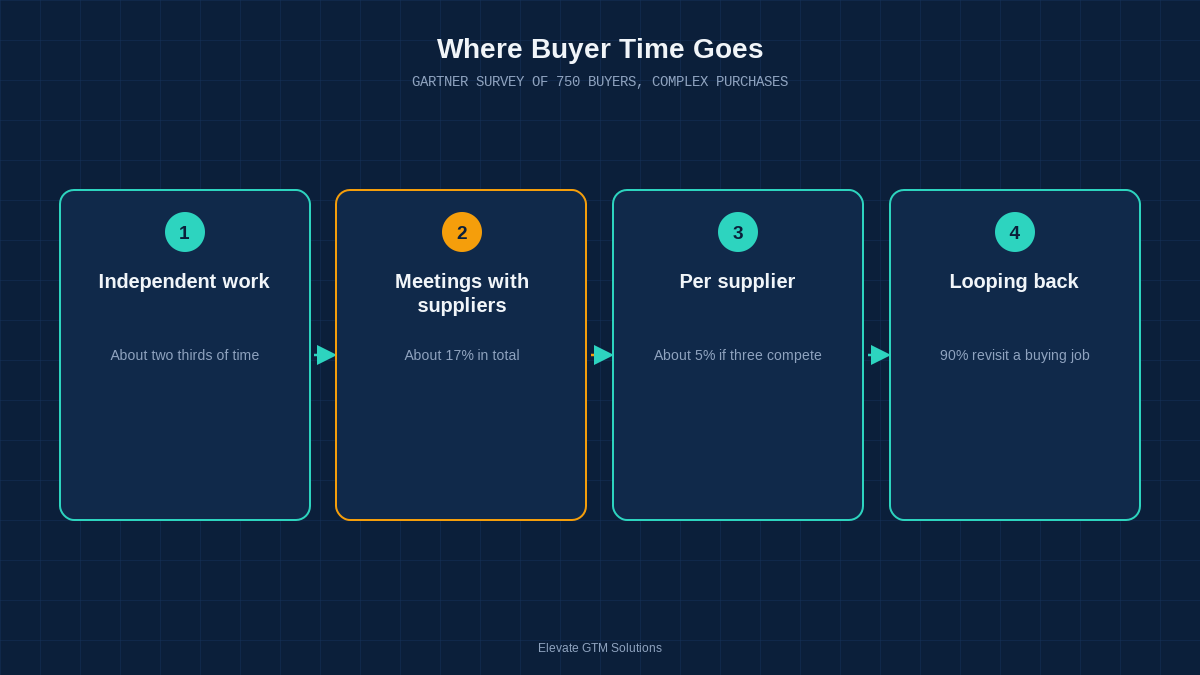
If you have been to a sales kickoff or read a go-to-market deck in the past few years, you have probably seen the number: B2B buyers spend only 17% of their buying journey meeting with potential suppliers. It is usually shown on a slide with a pie chart and followed by a line such as "so most of the decision happens without you." The number is real, and it comes from Gartner. It is also one of the most compressed statistics in B2B, because the slide rarely says who was surveyed, when, what kind of purchase it covered or what the other 83% consists of.
This page explains what the 17% figure says, what it does not say and what a go-to-market team should do about it. The evidence is analyst research, mainly Gartner's survey of 750 buyers and its later releases on digital selling and on rep-free buying. For each source we say who was asked, when and how many, and what it cannot tell you. Then we add our own reading, clearly labeled, and describe where a go-to-market platform like ours can help and where it cannot.
A disclosure. We make Elevate GTM Solutions, a go-to-market strategy platform. We have no buyer-time data of our own. We read the Gartner article from August 2018 and the Gartner release from September 2020 in full, and the Gartner release of June 2025 in full. Other items we saw only as excerpts, which we flag. Our examples are invented and labeled.
How much time do B2B buyers spend with sellers?
Gartner's research, based on a survey of 750 B2B buyers involved in complex purchases, found that buyers spend about 17% of their buying time meeting with potential suppliers, and about two thirds of their time researching, learning and meeting with peers independently of suppliers. The 17% covers all suppliers combined, so when three suppliers compete, each gets roughly 5% of the buyer's time. Gartner's Brent Adamson noted that 90% of buyers reported revisiting, or looping back to, at least one buying job, which means the process is not a straight line. The article does not state the year of the survey, and it covers complex purchases, not every B2B buy. The figure does not mean sellers matter little. It means the time sellers get is scarce, and the independent time before and around it is where a lot of the decision forms. Gartner's June 2025 survey of 632 buyers added that 61% prefer an overall rep-free buying experience, while buyers still prefer to seek seller input on questions that need contextual judgment.
Does 17% mean sellers are irrelevant? No. It means supplier meetings are a small share of total buying time, shared across all suppliers. What happens in those meetings can still decide the deal.
Is the 17% figure current? It comes from a survey Gartner described in 2018 as of buyers in complex purchases. It is repeated in 2020 and since, but we have not seen a fresh measurement. Treat it as a long-standing reference point, not a current reading.
The short version
| Question | Answer |
|---|---|
| Source | Gartner survey of 750 B2B buyers involved in complex purchases; described in an article dated August 15, 2018 (survey year not stated) |
| Core finding | Buyers spend about 17% of their time meeting with suppliers and about two thirds researching, learning and meeting with peers independently |
| Per supplier | With three potential suppliers, each gets roughly 5% of the buyer's time |
| Non-linear buying | 90% of buyers reported looping back to at least one buying job (Brent Adamson, Gartner) |
| Related Gartner prediction | By 2025, 80% of B2B sales interactions between suppliers and buyers will occur in digital channels (September 2020); 33% of buyers wanted a seller-free experience |
| Recent Gartner survey | 61% of 632 buyers prefer an overall rep-free experience (June 2025); buyers prefer seller input for contextual judgment |
| What is missing | A recent, public measurement of the same time split, and a split by deal size or industry |
| Main limit | A share of time is not a share of influence; the same 17% can be decisive or irrelevant depending on what happens in it |
What the 17% figure is, and what it is not
The number is easy to misread, so here is a careful statement of it.
What it is. In Gartner's survey of 750 B2B buyers involved in complex purchases, buyers allocated their buying time across activities. The share they spent meeting with suppliers was 17%. Gartner says buyers spent about two thirds of their time researching, learning and meeting with peers independently of suppliers.
What it covers. Complex purchases. The article does not tell us the size of the deals, the industries or the countries. A small, simple purchase probably looks different.
What it combines. All suppliers. The same buyer in a three-supplier evaluation gives each roughly 5%.
What it measures. Time, as buyers reported it. It does not measure influence. A single hour with a supplier might do more to decide the purchase than twenty hours of reading.
What the other 83% contains. Gartner says about two thirds is independent research, learning and meeting with peers. A trade article that summarized a Gartner report said 27% was independent online research and 18% independent offline research, together 45%. We saw that only in trade press and could not confirm it in the Gartner source. A commentator also notes that buyers have always spent much of their time in internal meetings, defining the problem and gaining alignment. The point is that a large share of buying is internal work that no seller sees.
What it does not say. It does not say buyers choose vendors before talking to sales. It does not say buyers do not want sellers. It does not say the share is falling. Those are separate questions, which we cover in whether B2B buyers choose vendors before they talk to sales and how B2B buyers use AI and sales reps.
Why this belongs in a go-to-market plan
A go-to-market plan has to answer a plain question: how will a buyer learn about us, evaluate us and feel confident enough to buy? If most of the buying time is spent away from sellers, the plan cannot rely on sellers to carry the story. It has to provide what buyers need in the independent time: clear information, credible proof, answers to the questions they are asking and ways to reach the right people in a buying group.
It also changes how sellers should be used. If supplier time is scarce, each meeting should be spent on what only a person can do: interpret, challenge, tailor and build consensus. Gartner's later findings support this, saying buyers prefer seller input for tasks needing contextual judgment.
This ties to buying-group research. A complex purchase involves several people, each doing their own independent work. See how big a B2B buying group is.
The evidence: Gartner's 2018 article on buyer time
The source is an article on Gartner's Smarter With Gartner site, dated August 15, 2018, titled "How B2B Sales Reps Maximize Customer Interactions." We read it in full.
The survey. Gartner surveyed 750 B2B buyers involved in complex purchases to understand how they proportionately spend their time. The article does not state the year of fieldwork.
The finding. Buyers are researching, learning and meeting with peers independently from suppliers about two thirds of the time. They spend just 17% of their time meeting with suppliers. If there are three potential suppliers, each gets only about 5% of a customer's time.
The analyst view. Brent Adamson, then a principal executive advisor at Gartner, said sales leaders must understand how customers proceed through the buying process, and that 90% of all buyers reported revisiting, or looping back, to at least one buying job. He said information now plays a role in driving sales effectiveness.
The advice. Sales leaders should understand how buyers move through the process and how it has changed, equip sellers to lead high-value conversations that set their offering apart, practice what Gartner calls buyer enablement by giving customers information that helps them complete key buying tasks, and have sellers act as guides who help buyers organize and interpret the information they find.
What we could not confirm. The article does not break out the remaining time. It does not give the survey year, the purchase sizes or the industries. A second Gartner source quoted by Brent Adamson in the Harvard Business Review describes the survey as pre-pandemic, which we saw only as a quotation on another site. The result is from before AI tools became common in research, so the independent share may now include different activities.
The evidence: Gartner's September 2020 release on digital selling
In a press release dated September 15, 2020, Gartner said that by 2025, 80% of B2B sales interactions between suppliers and buyers will occur in digital channels. We read it in full. It repeats the 17% figure, saying buyers typically spend only 17% of their time meeting with potential suppliers when considering a purchase, and concludes that with less face time, virtual selling through digital channels will predominate.
The release also says 33% of all buyers want a seller-free sales experience, rising to 44% among millennials. Cristina Gomez, a managing vice president in Gartner's sales practice, said "a digital-first buying posture will become the norm" and "sales reps become just one of many possible sales channels." The release recommends diversifying digital selling tools and channels, rethinking sales enablement to align with customers' preferred channels and purchasing journey, and prioritizing the seller experience and coaching.
What we could not confirm. The release gives no sample size or method for its buyer figures. The 80% statement is a prediction made in 2020 for 2025, and we did not verify whether it came true. It concerns the channel of interaction, not the amount of time.
The evidence: Gartner's June 2025 survey on rep-free buying
A Gartner survey of 632 B2B buyers, fielded in August and September 2024 and released June 25, 2025, found that 61% prefer an overall rep-free buying experience. We read the release in full. It also found that buyers favor online self-service tools when searching for general information and learning new things, and prefer to seek seller input for tasks needing contextual intelligence, such as determining whether a product fits their company. Across all stages, buyers reported an average of 3.0 activities completed both online and with supplier representatives, 2.3 with supplier representatives and 1.8 through digital self-service tools.
Compared with the 33% who wanted a seller-free experience in 2020, 61% in the 2024 survey suggests a change in stated preference, but we caution against drawing a trend line. The surveys differ in population, wording and method, and the 2020 release gives no sample size. See does AI outreach and personalization work in B2B sales for more on this survey.
Numbers that circulate, and that we could not trace
Articles on buyer time repeat several claims that deserve care.
"Buyers are 57% or 67% through the journey before they contact sales." These older figures from other firms are frequently repeated. A commentary we saw says the 67% statistic has since been debunked as a myth. We could not locate a primary source with a clear method for either, and we do not use them. A different measure, from a 2025 vendor survey of nearly 4,000 buyers, says first contact with sellers came at an average of 61% of the way through the buying process, down from 69% in earlier studies. We discuss it in our page on whether buyers choose vendors before they talk to sales, and it measures something different from time spent.
"You get 5% of the buyer's time." This is a simple division of 17% by three. It is illustrative. Real evaluations vary in the number of suppliers, and one commentator reports that buyers spend about twice as much time with their preferred vendor as with others. We saw that only as a blog comment on the research.
"Buyers spend 83% of their time ignoring you." This turns time away from suppliers into inattention. Much of that time is internal discussion and independent research that suppliers can influence through information, reputation and peers.
How much weight the evidence can carry
It is a sound reference point and an old one. The survey is from before 2018, and no fresh public measurement matches it.
It covers complex purchases. It tells you little about simple or low-value buys.
Time is not influence. A short, well-judged conversation can decide a deal, which is why Gartner's advice is about the quality of seller interactions.
Buyers' reported time is an estimate. People recall and allocate time imperfectly, and the survey asks them to do so.
Gartner has a stake. It sells research and advice to sales and marketing leaders, and a message that buying has changed fits that business. The finding is also widely repeated and consistent with other research.
AI changes the independent time. Buyers now use AI tools during research, which was not common when the survey was taken.
Elevate's reading
Our interpretation, not data.
One. The 17% is a prompt to use sellers better, not a verdict on sellers. If supplier time is scarce, spend it on judgment: fit, risk, consensus and tailoring. Do not spend it reading slides aloud.
Two. The other time is a design problem. Buyers are reading, comparing and talking to peers. Your job is to make sure what they find is clear, consistent and credible. That is content, proof, reviews, community and how your brand appears when someone asks an AI tool.
Three. Different people in the buying group do different independent work. The finance lead and the technical evaluator are not reading the same things. Our buying groups page covers why this matters.
Four. Looping back is normal. If 90% of buyers revisit at least one job, then a linear funnel is a poor model. Give people material for each job and make it easy to find again.
Five. Do not read the number as a reason to cut sellers. Gartner's own later data show buyers want seller input on contextual questions. Cutting the people who provide it removes the part buyers value.
Six. Measure what you can influence. Look at which content buyers use, which questions come up in first meetings and what buyers say shaped their view, rather than counting meetings.
What this means for different roles
Chief executive or founder. Ask how much of your buying journey you can see. If the answer is only the sales meetings, you are looking at roughly a sixth of it.
CMO or head of marketing. Treat the independent time as your primary audience. Audit what a buyer finds on your site, in reviews and in AI summaries.
Head of sales. Plan each meeting around judgment. Ask what buyers have already read, and fill gaps instead of repeating basics.
Head of enablement. Give sellers short, reviewed materials that buyers can pass to colleagues, and train them to guide, not present.
Product marketing. Write for the different jobs in a purchase, such as problem definition, supplier selection, validation and consensus.
Revenue operations. Capture buyer-reported sources, such as how they heard of you and what they read, so you can see more than meeting activity.
Customer success. Remember that existing customers also research independently before they expand or renew.
A worked example, invented for illustration
Imagine a software company selling workflow tools to hospital operations teams. Its sellers complain that buyers show up late and already compare vendors. The head of sales says, citing the 17% statistic, that the company is losing the deal before it sees it.
The head of marketing asks what buyers do in that time. She interviews twelve recent buyers. They describe reading two analyst summaries, asking peers at other hospitals, looking at reviews, checking security documentation and sharing a short summary internally. Several say they could not find a clear answer on integration with a common records system, and one says they chose a competitor partly because its security page was easier to read.
The company makes three changes. It publishes a clear integration page and a plain-language security summary. It asks five satisfied customers for reviews and one for a reference. And it asks sellers to open first meetings by asking what the buyer has read and what is still unclear, then to spend the time on fit and risk.
The team tracks how many first meetings start with specific questions, which pages are shared internally, and win rates for opportunities where buyers mention the new pages. We make no claim about what a real company would see. The example shows the pattern: learn what buyers do in the independent time, improve what they find, and use seller time for judgment.
How a go-to-market platform can help, and where it cannot
Elevate GTM Solutions is a go-to-market strategy platform. As described on our homepage, its modules cover customer segmentation, positioning, messaging, account-based marketing, customer acquisition, sales enablement, measurement and more, within a unified strategy. It is not a buyer research panel, an analytics tool or a content management system.
Here is how that relates to the research, without overclaiming.
Planning for the independent time. A strategy platform can hold a plan for what information buyers need at each job in a purchase, for which segments and through which channels, and keep it consistent with positioning and messaging.
Connecting content to sales enablement. The materials sellers use and the materials buyers find can be managed from the same strategy. That depends on the team maintaining it.
Visibility. A weekly pulse and executive dashboards give leaders a regular view of progress against the plan. We have no data showing improved win rates or shorter cycles.
What it cannot do. It does not observe buyers, measure how they spend their time or show what they read. It does not tell you your own seller share of the journey. We have no Elevate customer data on buyer behavior. For questions to ask any vendor, see questions to ask AI GTM vendors.
Questions to ask about your own buying journey
- How much of our buyers' journey can we see today?
- What do recent buyers say they read, watched and asked before they contacted us?
- Which jobs in the purchase, such as defining the problem or validating the choice, does our content support?
- What do different roles in the buying group look for?
- How do our first meetings start, and what do we assume buyers already know?
- Which meetings need a person, and which could be a clear page?
- How do we show up when a buyer asks an AI tool about our category?
- What proof do buyers need that sellers cannot provide alone?
- How will we capture what buyers tell us shaped their decision?
- What would we change if only a sixth of the journey involved us?
Common mistakes
Quoting 17% without context. Say whose time, which purchases and what the survey was.
Reading it as "buyers don't want sellers." Gartner's later data say they want seller input for contextual judgment.
Splitting it by three and treating it as fact. The 5% figure is an illustration.
Ignoring the independent time. If you cannot see it, ask buyers about it.
Cutting seller coverage. The meetings that remain matter more, not less.
Building a funnel and ignoring looping back. Most buyers revisit jobs. Give them what they need each time.
Using old statistics as current facts. The core survey predates AI-assisted research.
Treating all purchases alike. Complex, high-risk buys differ from simple ones.
What to do this week
Interview five recent customers and ask: before you first spoke to us, what did you read, who did you ask and what was still unclear? Write down the repeated answers. They are your first content and enablement priorities.
A buyer-time audit you can run in a quarter
A simple audit shows what the 17% means for your business.
- Pick a sample. Choose ten recent wins and ten recent losses.
- Interview. Ask the buyer to walk through the purchase from the first sign of the problem to the decision.
- Map the time. Note roughly how long each stage took and who was involved.
- Mark the contact points. Mark where the buyer spoke to you, to competitors, to peers and to no one.
- List what they read. Note the sources, such as your site, reviews, analysts, peers and AI tools.
- Find the gaps. Where did they struggle to find an answer, and where did they find a competitor's answer first?
- Check consistency. Compare what buyers say they read with what your sellers said.
- Set priorities. Pick three fixes, such as a missing page, an unclear claim or a missing reference.
- Measure again. Repeat the interviews after a quarter with the next ten buyers.
The result is your own version of the 17% figure, based on your market.
How seller time should change
If the supplier share of buying time is small, what sellers do in it should be different from what a document or website can do.
Diagnose. Ask what the buyer has already learned and where they are stuck. A skipped basics conversation respects their time.
Interpret. Help the buyer apply general information to their specific situation, which is the contextual judgment Gartner says buyers value.
Challenge. Offer a point of view where the buyer's current thinking has a gap. Gartner's guidance on unique insight points the same way.
Connect. Help the champion bring colleagues along, with material the others can read without a meeting.
Reduce risk. Address implementation, security and cost questions with specifics, and bring in the right expert.
Follow up with substance. A summary tailored to the discussion helps the buyer in the independent time that follows.
None of this is new. The research is a reminder that the time is limited and that every meeting should earn its place.
How AI changes the independent time
When Gartner took its survey, independent research meant search engines, websites, analyst reports and conversations with peers. Buyers now add AI tools to that list. Forrester's recent work, which we cover in how B2B buyers use AI and sales reps, describes generative AI as a common starting point for research, with buyers then turning to peers, experts and providers to confirm what the tools say.
If that holds for your buyers, three things follow. First, the independent time may be even less visible to you, because a conversation with an AI tool leaves no trace in your analytics. Second, what AI tools say about you depends on what is published about you in places they draw from, such as your own pages, reviews and articles. Third, the confirmation step is where sellers and customers can add the most value, because buyers go looking for a human who can say whether the summary applies to them.
We have no measurement of how much of the 17% or the two thirds has shifted. Treat this as a reasonable inference and test it by asking recent buyers whether they used AI tools and what they did next.
What this does not tell you
A few questions the 17% figure cannot answer, which are worth keeping in mind when it comes up in a meeting.
It does not tell you how much of the buying time your own buyers spend with you. That depends on your market, deal size and motion.
It does not tell you whether a small or large share is good for you. A vendor that is the buyer's favorite may get far more than an even share.
It does not tell you what content or channels matter. It only says where the time goes.
It does not tell you what has changed since the survey. Ask your recent buyers.
Glossary
Buying journey. The activities a buyer performs from recognizing a problem to making and completing a purchase.
Independent research. Learning and evaluation done without the supplier, such as reading, watching and asking peers.
Looping back. Returning to an earlier buying job, such as revisiting the problem definition after seeing options.
Buying group. The set of people involved in a purchase decision.
Buyer enablement. Providing information and support that help buyers complete the tasks of buying.
Rep-free experience. A buying experience completed without interacting with a sales representative.
Contextual intelligence. Judgment about whether something fits a specific company's situation.
Complex purchase. A purchase with high stakes and many people involved, in contrast to a simple, low-risk one.
Where Elevate GTM Solutions fits
Elevate GTM Solutions is a go-to-market strategy platform that its homepage describes as a way to build, execute and evolve strategy, with connected modules and a flow from insights and strategy context to a strategy builder, workflow engine, activation, playbooks, weekly pulse and executive dashboards. It speaks to this research in a narrow way: it can hold the plan for what buyers need to find and what sellers do with the time they get, and keep them consistent. It does not observe buyers. For related reading, see do AI agents make sales teams more productive.
Key takeaways
- Gartner's survey of 750 B2B buyers in complex purchases found buyers spend about 17% of their time meeting with suppliers and about two thirds researching, learning and meeting with peers independently. The survey year is not stated.
- The 17% covers all suppliers, so each of three suppliers gets roughly 5%, as an illustration.
- 90% of buyers reported looping back to at least one buying job, so the journey is not linear.
- Gartner's June 2025 survey of 632 buyers found 61% prefer an overall rep-free experience, while buyers still seek seller input for contextual judgment.
- Share of time is not share of influence. The figure argues for better use of seller time and better information for the independent time.
- Interview your own buyers to build your own version of the number.
Sources
- Gartner, How B2B Sales Reps Maximize Customer Interactions, Smarter With Gartner, August 15, 2018 (survey of 750 B2B buyers in complex purchases; year not stated).
- Gartner, Gartner Says 80% of B2B Sales Interactions Between Suppliers and Buyers Will Occur in Digital Channels by 2025, press release, September 15, 2020.
- Gartner, Gartner Sales Survey Finds 61% of B2B Buyers Prefer a Rep-Free Buying Experience, press release, June 25, 2025 (632 buyers, August to September 2024).
- Destination CRM, B2B buyers spend 17 percent of their time meeting with potential suppliers, trade summary of a Gartner report (search excerpt only; source of the 27% and 18% split, not confirmed in Gartner's own text).
- Partners in Excellence, Customers only spend 5% of their time with sellers, commentary (search excerpt only).
- Martech Zone, B2B buyer journey stages, commentary on a statistic described as debunked (search excerpt only).
Frequently Asked Questions
How much time do B2B buyers spend with sellers?
In Gartner's survey of 750 B2B buyers involved in complex purchases, buyers spent about 17% of their buying time meeting with suppliers and about two thirds researching, learning and meeting with peers independently. The 17% covers all suppliers combined. The article does not state the survey year.
Does the 17% figure mean sellers don't matter?
No. It is a share of time, not of influence. Gartner's own advice is to equip sellers for high-value conversations, and its June 2025 survey found buyers prefer seller input for tasks needing contextual judgment, such as whether a product fits their company.
Is the 17% figure still current?
It dates from a survey described in 2018 and repeated by Gartner in 2020, and we have not seen a fresh public measurement. It predates AI-assisted research. Use it as a long-standing reference point and run your own buyer interviews to see your own version.
Do three suppliers each get 5% of the time?
That is a simple division of 17% by three, which Gartner's article gives as an illustration. Real evaluations vary, and one commentator reports buyers spend about twice as much time with a preferred vendor. Treat 5% as illustrative.
What do buyers do with the other 83%?
Gartner says about two thirds of their time goes to researching, learning and meeting with peers independently. Trade press reports a split of 27% independent online research and 18% offline, but we could not confirm it in Gartner's text. A lot of the rest is internal discussion and alignment.
Do buyers move through the journey in a straight line?
No. Gartner's Brent Adamson said 90% of buyers reported revisiting, or looping back to, at least one buying job. A linear funnel is a poor model, so give buyers material for each job and make it easy to find again.
Do most buyers want to avoid sales reps?
Gartner's June 2025 survey of 632 buyers found 61% prefer an overall rep-free buying experience, and its 2020 release said 33% wanted a seller-free experience. The surveys differ in method, so do not treat them as a trend line. Buyers still seek seller input for contextual judgment.
Are the 57% and 67% pre-contact statistics reliable?
We could not trace either to a primary source with a clear method, and a commentary we saw calls the 67% figure debunked. We do not use them. Measure it in your own pipeline by asking buyers what they did before first contact.
How should sellers use the limited time?
Diagnose what the buyer has already learned, interpret general information for their situation, challenge their thinking where it has gaps, help the champion bring colleagues along and address risk with specifics. Gartner's guidance is to act as a guide who helps buyers organize and interpret information.
Can a go-to-market platform help with this?
It can hold the plan for what buyers need to find and what sellers do with their time, and keep content, messaging and enablement consistent. Elevate GTM Solutions is a strategy platform. It does not observe buyers or measure how they spend time, and we have no data showing improved win rates.
What should we do first?
Interview five recent customers and ask what they read, who they asked and what was unclear before they first spoke to you. Use the repeated answers to set your first content and enablement priorities.
How can we measure our own version of the 17%?
Interview ten recent wins and ten losses, walk through each purchase from first sign of the problem to decision, and note where the buyer spoke to you, competitors, peers or nobody and what they read. Repeat after a quarter to see what changed.