
By the Elevate GTM Solutions Team · Updated November 13, 2026 · 28 min read
What Separates B2B Growth Leaders From Laggards, and What Can a Go-to-Market Team Safely Copy?
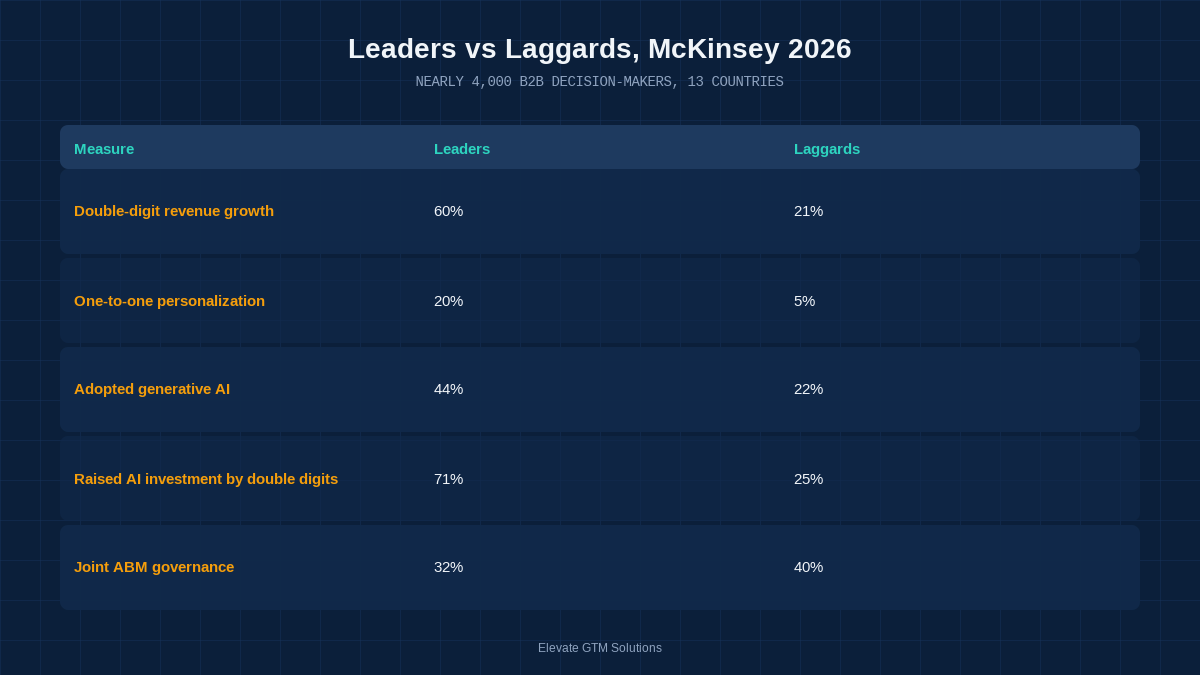
Reports on "what high performers do differently" are everywhere, and most of them are hard to use. They list ten traits, every trait sounds sensible and nothing tells you which one to start with. McKinsey's 2026 Global B2B Pulse Survey is more useful than most because it is specific about how it defines the two groups it compares and about the three things it says separate them: hyperpersonalization, AI adoption and who is accountable for account-based marketing.
This page explains what separates growth leaders from laggards and what a team can safely take from that. The evidence is McKinsey's 2026 Global B2B Pulse Survey. We say who ran the survey, how many people were asked, how McKinsey defines a leader and a laggard, what it found on each of three "engines" and what the survey cannot tell you. Then we add our own reading, labeled as ours, and describe how a team can use it, including where a go-to-market platform like ours fits and where it does not.
A disclosure. We make Elevate GTM Solutions and so have an interest in a story where connected data, AI and clear accountability win. We have no data of our own. Every figure here comes from McKinsey's article, which we read at the McKinsey Brazil site's copy of the English text, because McKinsey's main site was not reachable for us. Check the original for exact wording before you quote a number. Our examples are invented and labeled.
What separates B2B growth leaders from laggards?
In McKinsey's survey, leaders did three things more often than laggards: personalize to individual accounts, adopt generative AI and anchor account-based marketing accountability in sales. The data show association, not cause. McKinsey surveyed nearly 4,000 B2B decision-makers in 13 countries and compared "leaders," companies whose market share grew by more than 10% in the past year, with "laggards," whose share fell by more than 5%. Sixty percent of leaders reported double-digit revenue growth, against 21% of laggards. McKinsey attributes the gap to three engines: hyperpersonalization (leaders are four times more likely to use one-to-one personalization, 20% versus 5%), generative AI (44% of leaders have adopted it against 22% of laggards) and sales-anchored accountability for account-based marketing (companies that anchor ABM ownership in sales are five to ten percentage points more likely to be in top revenue growth bands). The survey is correlational: it shows what leaders do, not proof that doing it makes a company a leader.
How does McKinsey define a leader? A company whose market share grew by more than 10% versus the previous year. A laggard's share declined by more than 5%.
What is the survey's main caution? It describes association among surveyed companies. It does not show that copying leaders' practices will produce their results.
The short version
| Question | Answer |
|---|---|
| Who ran it? | McKinsey & Company, 2026 Global B2B Pulse Survey |
| How big? | Nearly 4,000 B2B decision-makers in 13 countries, across multiple industries |
| Leaders vs laggards | Leaders: market share grew more than 10%. Laggards: share fell more than 5% |
| Revenue growth | 60% of leaders report double-digit revenue growth, versus 21% of laggards |
| Engine one | Hyperpersonalization: leaders four times more likely to use one-to-one personalization (20% vs 5%) |
| Engine two | Generative AI: 44% of leaders have adopted, versus 22% of laggards |
| Engine three | ABM governance: sales-anchored ownership associated with top revenue growth bands |
| Why buyers switch | Inconsistent information across teams, then inability to reach knowledgeable reps, then cross-channel tracking gaps |
| What it cannot show | That any one practice causes growth |
What separates companies that grow from companies that slip
"What do high performers do differently?" is hard to answer, because growth has many causes: the market, timing, product, pricing, luck. A survey that compares fast growers with slow ones can show which practices cluster with growth. It cannot show which practices cause it. The sensible way to read any leaders-versus-laggards study is as a list of hypotheses worth testing on your own team.
The McKinsey survey on this page points at three themes. In plain terms:
- Relevance. How specific is what you say and send to each account? Tailoring to an individual buyer's situation is expensive to do by hand, which is part of why it is rare.
- AI as a working tool. Is AI removing work from your process, or only adding output? The question is where it sits in the workflow.
- Accountability for priority accounts. Who is named for the accounts that matter most, and how do sales and marketing share the work?
For a small team the lesson is not to copy a larger company's program. It is to ask three honest questions: how personal is our outreach to our best accounts, where could AI take routine work off our plate, and who is accountable when a priority account goes quiet?
The sections below set out what McKinsey measured, how it defines a leader and a laggard, and what the survey cannot tell you.
Why the McKinsey survey is worth reading closely
Three things set it apart.
First, the comparison is concrete. A leader grew market share by more than 10%. A laggard lost more than 5%. You can argue with the definition, but you know what it is, which is not true of many "top performer" studies.
Second, it names three levers that map to real decisions a team can make this year: how much to invest in personalization, how to adopt AI and who owns priority accounts. Those are budgeting and organization questions, not slogans.
Third, it includes buyers' side of the picture too, including why buyers switch suppliers, so a team can see how internal practices connect to what customers experience.
The evidence: McKinsey's 2026 B2B Pulse Survey
McKinsey's article, which appeared in late May 2026 on one version of its site and is dated June 2026 on the PDF we saw, is based on its 2026 Global B2B Pulse Survey. It reports responses from nearly 4,000 B2B decision-makers across 13 countries and multiple industries. The authors are members of McKinsey's Growth, Marketing and Sales Practice. McKinsey is a management consultancy that sells advisory work, including in this area, and the article is, among other things, a statement of the firm's view. We note that without discounting the data.
We did not see the survey questionnaire or the raw data, and the article does not publish them. So we know what McKinsey chose to report and in what terms.
The buyer picture: the "survival threshold"
The article begins with what it calls a new survival threshold, a set of buyer expectations that companies must meet to stay in the game. The findings reported:
Buyers use an average of ten channels across the purchasing journey. Interactions split roughly evenly across in-person, remote and digital channels, a pattern McKinsey calls the "rule of thirds."
Digital is already a major revenue channel. 71% of B2B companies offer e-commerce, and among them roughly a third of revenue flows through digital channels, which McKinsey calls the top revenue-generating channel.
Buyers will place sizable orders online. 73% of respondents would place orders over $50,000 online, up from 59% in 2022. At the top end, willingness to spend $500,000 or more online fell five percentage points compared with 2024, with differences by persona.
Why buyers switch suppliers. The top reasons, in order: inconsistent information across teams, the inability to reach knowledgeable representatives, and cross-channel tracking gaps. In other words, buyers leave because the seller side feels disconnected, more than because of price or product.
Three buyer personas. McKinsey describes adapters (53%, up from 44% in 2024), who are relationship-oriented and value trust and familiar suppliers; seekers (29%), who expect tightly integrated omnichannel experiences and are among the most likely to switch; and innovators (18%), early adopters of new tools including generative AI, who value speed and transparency.
What to take from this section. The switching reasons are the finding with the most direct relevance to a go-to-market strategy. Inconsistent information across teams is a coordination problem, not a technology problem, though technology can make it better or worse. A buyer who gets different answers from marketing, sales and support loses trust, and McKinsey ranks that first.
Leaders and laggards
McKinsey defines leaders as companies whose market share grew by more than 10% versus the previous year and laggards as those whose market share declined by more than 5% over the same period. Results reported:
- 60% of leaders report double-digit revenue growth, versus 21% of laggards.
- Leaders also report higher sales effectiveness. The article's text gives 90% of leaders reporting improved sales effectiveness. It describes the laggard figure inconsistently between its introduction and body, so we do not repeat a laggard number.
A word on the definitions. Market share change is a result, and the survey asks respondents to report it. A company that grew share for reasons unrelated to its go-to-market practices, such as a competitor failing or a favorable market shift, would still be a leader here. And a company with strong practices in a collapsing segment might be a laggard. The comparison is useful for the associations it shows, but it cannot sort cause from circumstance.
Engine one: hyperpersonalization
McKinsey's first engine is personalization taken beyond the basics.
The baseline is universal. More than 90% of organizations personalize content across channels. So personalization alone no longer separates companies.
One-to-one is the difference. Leaders are four times more likely to deploy one-to-one personalization: 20% versus 5%. Note the absolute numbers. Even among leaders, only a fifth do it. It is rare, and rarer still among laggards.
How leaders do it. According to the article, leaders personalize based on account context, buying history, behavioral signals and next-best-action insights. They build unified customer data, embed next-best-action insights in frontline tools, tie personalization to revenue outcomes and set governance guardrails.
What to take from it. The requirements listed are mostly not about content. They are about data and governance: unified customer data, insights in the tools people use and guardrails. A team that wants one-to-one personalization without those will find it hard. This links to the stack findings in our page on why B2B teams use so little of their martech: customer data challenges and governance appear there as top impediments as well.
Engine two: generative AI
Enthusiasm is high. Roughly three-quarters of respondents rate their enthusiasm for AI in B2B buying and selling at 8 to 10 out of 10.
Implementation is less advanced. 22% of organizations have fully implemented generative AI, up from 19% the year before, and another 31% are actively adopting it.
Leaders are ahead. Leaders are twice as likely to have adopted generative AI: 44% versus 22%. And 71% of leaders increased AI investment by double digits year over year, versus 25% of laggards. Leaders cite efficiency (59%), customer experience (53%) and innovation (48%) as primary benefits.
Different barriers. Laggards cite fragmented data, legacy technology stacks and employee hesitation. Leaders most often cite risk and legal considerations. In other words, laggards are stuck on foundations, and leaders have moved on to governance.
The flywheel. The article describes an "AI flywheel": enthusiasm drives usage, usage drives implementation, and measurable results drive reinvestment.
What to take from it. The barriers are the useful part. A company in the laggard column who cites fragmented data and legacy stacks has a foundation problem. Buying more AI does not address it, and Gartner's warnings about agent sprawl (see whether AI agents make sales teams more productive) point the same way. A company that cites risk and legal is further along and has a different set of tasks.
Engine three: ABM governance and sales accountability
Account-based marketing, targeting a defined list of accounts with coordinated effort from marketing and sales, is the third engine, and the finding is about who owns it.
Sales-anchored ownership is associated with better outcomes. Organizations that anchor ABM ownership in sales are five to ten percentage points more likely to appear in top revenue growth bands than those using shared or marketing-led models. Among leaders, 43% reach top revenue bands through sales-led ABM, versus 31%. And joint governance structures are used by 40% of laggards versus 32% of leaders.
Recommended practices. A single accountable leader for priority accounts, shared revenue incentives, integrated AI and personalization, and account-level measurement.
What to take from it. The most striking line is that joint governance, which sounds collaborative, is more common among laggards. We would be careful with that. It does not say that collaboration is bad. It suggests that shared ownership without a single accountable person is a common failure mode. This matches a theme in Forrester's work on go-to-market alignment, which we cover in keeping sales, marketing and product aligned on go-to-market.
How the engines work together
McKinsey argues the three engines compound: better personalization lifts conversion, which produces better data, which improves AI models, while governance speeds decisions and reallocates resources to high-impact accounts. This is the authors' argument. The survey data show association between each engine and leader status; the claim that they compound is an interpretation.
How much weight the survey can carry
It is correlational. Leaders do these things more. The survey cannot show that doing them makes a company a leader. Growth may make it easier to invest in AI and personalization, as much as the reverse.
Self-reported market share. Respondents report their company's share change. People may recall or round inaccurately.
Respondents are decision-makers, with unclear roles. The article says B2B decision-makers. It is not clear to us how many are sellers and how many are buyers, since it reports both buyer behavior and company practices. Check the original for how the groups were defined.
The article is from a consultancy that sells in this space. That is not disqualifying, and the numbers are specific. It does mean the recommendations point toward work McKinsey does.
Percentages are for the survey sample. 71% of surveyed companies offering e-commerce says nothing about your industry.
Date differences. The article's date appears as late May 2026 on one site and June 2026 on the PDF. That is a small inconsistency in what we found, not in the data.
Elevate's reading
Our interpretation, not data.
One. Consistency beats cleverness. The top reason buyers switch, inconsistent information across teams, is a strategy-execution problem. Cleverer personalization will not help if the underlying message differs between marketing and sales. The first task is a shared strategy that everyone can see.
Two. The leader-laggard gap in AI is a foundations gap. Laggards cite fragmented data, legacy stacks and hesitation. If your team lists the same, work on those first. A new AI tool added to the same foundations tends to join the pile.
Three. One-to-one personalization is hard and rare for a reason. Only 20% of leaders do it. For most companies the better question is how to personalize by segment and account tier well, before trying to reach one-to-one. See account tiering framework.
Four. Accountability is a design choice. The finding on sales-anchored ABM can be read narrowly, as a recommendation to put sales in charge. It can also be read broadly, as a reminder that somebody must own priority accounts. Either way, "everyone" is not an owner. We would add that the right owner depends on the company; a product-led company may differ from an enterprise sales-led one.
Five. Do not copy the leaders. A company that matches leaders' practices without matching their data, governance or product will not necessarily match their results. Use the survey to ask better questions about your own bottlenecks.
Six. The three engines map onto a connected strategy. Personalization needs account context, which comes from a clear ideal customer profile and segmentation. AI needs a defined strategy to act on. ABM accountability needs a shared list of priority accounts. All three start from decisions that a team makes before any tool runs. That is where we think a go-to-market platform earns its place, if it does.
What this means for different roles
CEO or general manager. Ask three questions. Do buyers get consistent answers from different teams? What is blocking our AI adoption: data, stack or people? Who is accountable for our top fifty accounts? If you cannot answer the third in one name, that is a finding.
Head of marketing. Look at where personalization is shallow. Is it first-name tokens and industry swaps, or does it use account context and behavior? Decide which accounts deserve more.
Head of sales. If your ABM is shared with marketing, ask whether anyone is accountable for the result at the account level. If not, McKinsey's data suggests that is worth fixing.
Revenue operations. Your work is the foundation: unified customer data, insights inside frontline tools and governance guardrails are all on McKinsey's list of what leaders do.
Customer success. Switching reasons include inconsistent information across teams and cross-channel tracking gaps. Success teams see these first. Feed what you see into the strategy.
Finance. The AI investment comparison, 71% of leaders increasing it by double digits against 25% of laggards, is a reminder to tie AI spending to measurable outcomes, as the flywheel describes.
A worked example, invented for illustration
Imagine a 120-person company selling analytics software to manufacturers. It has lost share to two competitors over the past year. The leadership team reads the McKinsey article and runs a simple self-assessment against the three engines.
On personalization, the company sends industry-tailored emails but nothing at the account level. Its data on accounts sits in the customer relationship system and a separate spreadsheet kept by the sales team. On AI, a few marketers use a writing tool individually, with no shared guidance, and the sales team distrusts a call summarizer that sometimes gets names wrong. On ABM, marketing runs a program for a list of 80 accounts, and sales has its own list of 60, with about 20 in common. Nobody is accountable for the overlap.
The team chooses three small steps. They agree on one list of priority accounts with a single named owner in sales. They write a one-page statement of the ideal customer and positioning that marketing, sales and support all use. And they choose one use of AI, first-call preparation, to try properly with a measure and a review at six weeks.
They do not predict a rise in market share. They are acting on the finding that the problems McKinsey describes are mostly about ownership, consistency and foundations, and then they will look at their own numbers.
How a go-to-market platform can help, and where it cannot
Elevate GTM Solutions is a go-to-market strategy platform. Its homepage describes building, executing and evolving strategy with connected modules, including market research, ideal customer profile and segmentation, competitive intelligence, account-based marketing, product positioning, product messaging, pricing, customer acquisition, distribution channels, marketing alignment, launch, measurement, sales enablement, customer success and customer advocacy, plus a unified strategy. The product flow, as we describe it, runs from GTM Insights and Strategy Context through Strategy Builder, a Workflow Engine, Strategy Insights, GTM Activation, GTM Playbooks, GTM Pulse and executive dashboards.
Here is how that connects to McKinsey's engines, without overstating.
Consistency. The top switching reason is inconsistent information across teams. A strategy held in one connected place, with collaborators and stages from draft to optimizing, gives marketing, sales and success a shared reference. It does not make people use it.
Segmentation and adaptation. Personalization starts with knowing who is who. Our platform adapts strategy by region, vertical and segment, which is a way into the account-context part of McKinsey's description. Real one-to-one personalization needs data beyond what we hold.
An AI starting point. Elevate can draft a first strategy in five minutes or less from the context you provide, which a team then challenges. That gives a team something concrete to review, but it does not replace the foundations McKinsey says laggards lack.
Account ownership. The marketing alignment and account-based marketing modules are places to record the strategy for priority accounts. They do not assign accountability; leadership does.
Visibility. Executive dashboards, as we describe them, offer visibility and guidance on next steps. They show what the team chooses to track.
What it cannot do. It cannot make a company a leader, fix fragmented data held elsewhere or settle who owns ABM. We have no data about our customers' growth and do not claim a link between using the platform and market share.
Questions to ask yourself
- Do buyers get the same answer from marketing, sales and support?
- Which of the three engines is our weakest, and why?
- What is stopping our AI adoption: data, stack, people or risk?
- Who is accountable for our priority accounts, by name?
- Is our personalization based on account context and behavior, or only on industry and name?
- Where do customer insights appear: in a dashboard nobody opens or inside the tools people use daily?
- What would we need to trust AI to act on our data?
- Which of our practices would we keep even if the survey said otherwise?
- How do we measure personalization against revenue?
- If we copied one leader practice, what would we need first?
Common mistakes
Copying leaders' practices without their foundations. Without unified data and governance, advanced tactics stall.
Reading correlation as cause. Leaders may invest because they are growing.
Treating joint governance as a virtue by default. The survey suggests shared ownership with no accountable person is common among laggards.
Chasing one-to-one too early. Only a fifth of leaders do it.
Buying AI on top of fragmented data. Laggards cite this as their barrier.
Ignoring why buyers switch. Inconsistent information across teams is first on McKinsey's list and cheap to start fixing.
What to do this week
Ask three people, one from marketing, one from sales and one from customer success, to write down in two sentences who your best-fit customer is and what you offer them. Put the answers side by side. If they differ, you have found the first thing to fix, and the cost was twenty minutes.
A self-assessment against the three engines
You can turn the article into a short working session. Gather the heads of marketing, sales, customer success and revenue operations for ninety minutes. Score each engine from one to five for your company, then write the evidence next to the score. A score without a sentence of evidence does not count.
Engine one, personalization. One is "same message to everyone." Two is "industry swaps and name tokens." Three is "segment-specific messaging with real differences." Four is "account-level context used by sellers and marketers." Five is "one-to-one, using behavior and history, tied to revenue." Evidence might be a sample of ten recent messages to ten different accounts, read side by side. If they look interchangeable, the score is two, whatever the tool claims.
Engine two, AI. One is "individual experiments." Two is "a few tools, no shared rules." Three is "a defined use case with an owner and a measure." Four is "several use cases with governance and review." Five is "AI embedded in workflows with measured results feeding reinvestment." Write the barrier next to the score, using McKinsey's categories: fragmented data, legacy stack, hesitation, or risk and legal. The barrier tells you the next task.
Engine three, accountability for priority accounts. One is "no list." Two is "separate lists in marketing and sales." Three is "one list, shared ownership." Four is "one list, one accountable person." Five is "one list, one owner, shared revenue incentives and account-level measurement." McKinsey's recommended practices are exactly these.
Add a fourth row: consistency. Since inconsistent information across teams is the top reason buyers switch, score how often a buyer would get the same answer from marketing, sales and support. Test it by asking each team the same three questions about your offer and comparing the answers.
Then choose one engine to improve, not three. The point of the exercise is to pick the weakest link and fix it, and to avoid a three-engine transformation program that nobody can run.
How the findings differ by type of company
The survey reports averages across nearly 4,000 respondents in 13 countries. Your company is a specific case. A few ways the same findings might read differently.
Smaller companies. One-to-one personalization may be less relevant than getting segmentation right, because the account list is short and sellers already know the accounts. The foundations that matter more are a clear ideal customer profile and one message. AI may help most with research and preparation. ABM accountability is easier: the owner is probably a founder or head of sales.
Enterprise sellers with long cycles. Account context is deeper and the buying group larger, so personalization and ABM matter more, and the single-accountable-owner finding may be harder to implement because several executives want a say. Cross-channel tracking gaps, one of the top switching reasons, are likely to be more painful where buyers use many channels.
Product-led companies. Buyers may reach you through a free product and not through sellers. Consistency of information across teams still matters, but the "teams" include product and in-app messaging. The sales-anchored ABM finding may apply only to the enterprise segment.
Companies selling to relationship-oriented buyers. McKinsey's adapters, the largest persona at 53%, value trust and familiar suppliers. For them, the ability to reach knowledgeable representatives matters, and over-automation could hurt.
Companies selling to seekers. Seekers expect tightly integrated omnichannel experiences and are among the most likely to switch. If your buyers look like this, cross-channel consistency and tracking are the priority.
Regions. The survey covers 13 countries, and the article's averages blur differences. If you sell mostly in one region, look for region-specific data.
None of this is in the article as advice for company types. It is our reading of how the averages might shift. Check each against your own customers.
What to measure if you try to follow the leaders
If you decide to act on any of the three engines, decide beforehand how you will know whether it worked. Here are measures that match each.
For personalization. Reply and meeting rates for personalized outreach compared with segment-level outreach to similar accounts, over at least a quarter, with a note on how many accounts were in each group. Also track time spent: if one-to-one takes five times the effort for a small lift, say so.
For AI. Baseline time and quality for one workflow before the change, then after. Add a short monthly seller or marketer question on whether the tool helps. Track what the saved time is used for.
For ABM accountability. Whether the priority account list has one owner, whether it is the same list across marketing and sales, and account-level progress, such as the number of engaged contacts per priority account and movement in stage. Review monthly.
For consistency. The monthly three-question test across teams, scored on how many answers match. Also track the share of lost and stalled deals where the buyer mentioned conflicting information, if you can capture it.
For leadership. One page each month with one measure per engine and one sentence about what you will change. Resist the urge to add more.
These are modest measures. They will not prove cause, but they will tell you whether a change moved something you care about, which is more than most teams know after a big program.
Glossary
Leader (McKinsey). A company whose market share grew by more than 10% versus the previous year.
Laggard (McKinsey). A company whose market share declined by more than 5% over the same period.
Hyperpersonalization. Personalization based on account context, buying history, behavioral signals and next-best-action insights, delivered across channels.
One-to-one personalization. Tailoring content or offers to an individual contact or account, rather than a segment.
Next-best-action. A recommended step for a seller or marketer to take with an account, based on data and rules.
ABM governance. The structure of ownership and accountability for account-based marketing.
Rule of thirds. McKinsey's term for buyer interactions splitting roughly evenly across in-person, remote and digital channels.
AI flywheel. McKinsey's description of enthusiasm driving usage, usage driving implementation and measurable results driving reinvestment.
Where Elevate GTM Solutions fits
Elevate GTM Solutions is a go-to-market strategy platform for building, executing and evolving strategy through connected modules. In relation to McKinsey's findings, its relevance is to the shared starting point: one strategy, adapted by segment, that teams can see and challenge. For comparison with other tools, see GTM platform vs ABM platform and how to choose a GTM platform. For the related Gartner view on agents and fragmented systems, see whether AI agents make sales teams more productive.
Key takeaways
- McKinsey's 2026 Global B2B Pulse Survey covers nearly 4,000 B2B decision-makers in 13 countries. Leaders grew market share by more than 10%. Laggards lost more than 5%.
- 60% of leaders report double-digit revenue growth, versus 21% of laggards.
- Three engines: hyperpersonalization (20% of leaders do one-to-one versus 5% of laggards), generative AI (44% versus 22% adopted) and sales-anchored ABM governance.
- Buyers' top reasons for switching: inconsistent information across teams, difficulty reaching knowledgeable reps and cross-channel tracking gaps.
- The survey is correlational and from a consultancy. Use it to ask better questions, not to copy leaders.
- The practical starting points are shared strategy, foundations for data and AI, and a named owner for priority accounts.
Sources
- McKinsey & Company, The surprising economics of B2B growth: The new survival threshold, and what it takes to thrive, 2026 Global B2B Pulse Survey, Growth, Marketing and Sales Practice, May to June 2026 (read through McKinsey's Brazil site).
Frequently Asked Questions
What do growth leaders do differently from laggards?
In McKinsey's 2026 survey of nearly 4,000 B2B decision-makers, leaders were more likely to use one-to-one personalization (20% versus 5%), to have adopted generative AI (44% versus 22%) and to anchor account-based marketing accountability in sales. The survey shows association, not cause, so treat these as practices to test on your own team, not a recipe.
What is McKinsey's 2026 Global B2B Pulse Survey?
A survey of nearly 4,000 B2B decision-makers in 13 countries across multiple industries, run by McKinsey's Growth, Marketing and Sales Practice and reported in an article published in mid-2026. It compares growth leaders with laggards and describes three engines of performance.
How does McKinsey define a leader and a laggard?
A leader is a company whose market share grew by more than 10% versus the previous year. A laggard is a company whose market share declined by more than 5% over the same period.
How big is the gap between leaders and laggards?
McKinsey reports that 60% of leaders have double-digit revenue growth, compared with 21% of laggards. Leaders are also twice as likely to have adopted generative AI, at 44% versus 22%.
What are the three engines?
Hyperpersonalization, generative AI and ABM governance anchored in sales accountability. McKinsey argues the three compound: better personalization improves conversion and data, which improves AI, while clear governance speeds decisions.
How common is one-to-one personalization?
Rare even among leaders. McKinsey reports that more than 90% of organizations personalize content across channels, but leaders are four times more likely to deploy one-to-one personalization, at 20% versus 5%.
Why do B2B buyers switch suppliers?
According to the survey, the top reasons are inconsistent information across teams, an inability to reach knowledgeable representatives and cross-channel tracking gaps.
Does sales-led ABM really outperform?
McKinsey reports that organizations anchoring ABM ownership in sales are five to ten percentage points more likely to appear in top revenue growth bands than those using shared or marketing-led models, and that joint governance is used by 40% of laggards versus 32% of leaders. The survey is correlational, and the better reading is that someone should be clearly accountable.
Should we copy what leaders do?
Not blindly. The survey shows association, not cause, and leaders may have the data and governance that make their practices work. Use it to find your own bottleneck.
Can a GTM platform help with these engines?
It can help by holding a shared strategy, adapting it by segment and giving teams a common view, which relates to consistency and account context. It cannot supply unified data from other systems, settle ABM ownership or create the results McKinsey describes. Elevate GTM Solutions has no published data linking its use to growth.
How reliable is this source?
It is a large, specific survey from a major consultancy, but the article gives limited method detail, the results are self-reported and correlational, and we read it through a regional McKinsey site. Read the original and treat the figures as indications.
What should we do first?
Ask one person each from marketing, sales and customer success to write two sentences on who your best-fit customer is and what you offer them. Put the answers side by side. If they differ, that inconsistency is the first thing to fix, since McKinsey lists it as the top reason buyers switch.