
By the Elevate GTM Solutions Team · Updated November 13, 2026 · 28 min read
How Do You Keep Sales, Marketing and Product Aligned on Go-to-Market, and Who Should Own It?
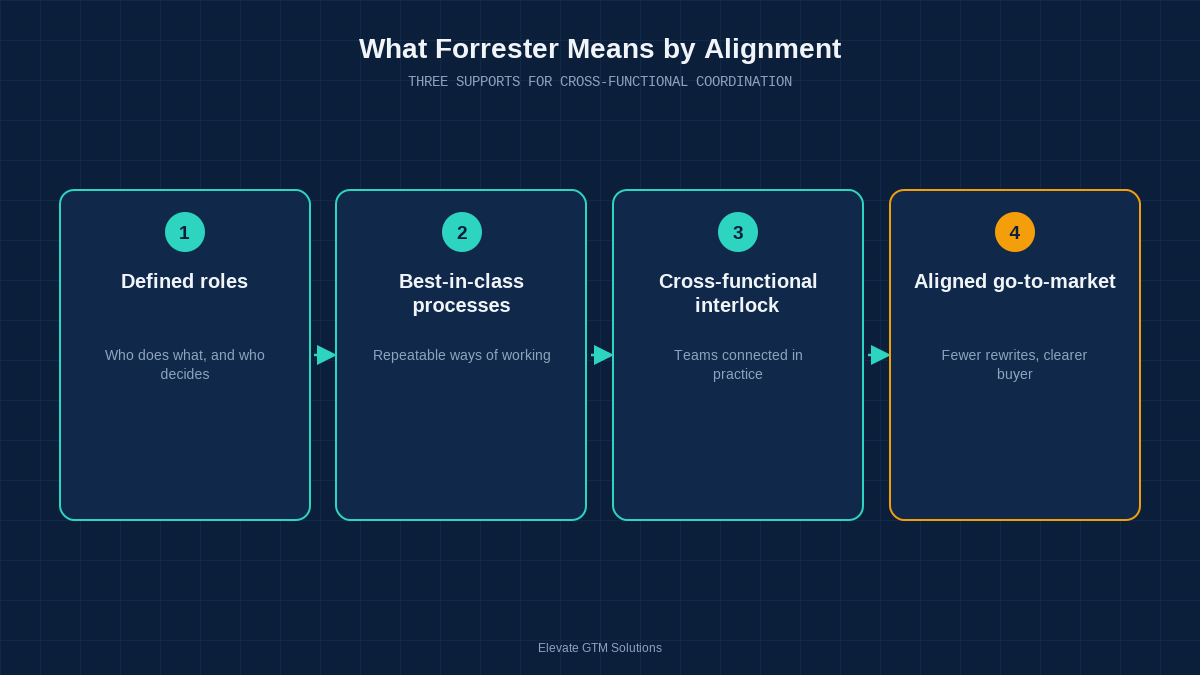
Ask who owns the go-to-market strategy at most B2B companies and you will get a pause, then a list. Marketing owns messaging. Sales owns the number. Product owns the roadmap. Customer success owns retention. Revenue operations owns the systems. The CEO owns "the plan." Everyone has a hand in it, and nobody can be asked to explain why it is not working.
Forrester, the research firm, has a short piece on exactly this called "Everyone Does It, No One Owns It." It makes a big claim: that alignment among sales, marketing and product is the only growth factor a company fully controls, and that it accounts for between 5% and 36% of B2B growth. That is a wide range, and the claim deserves a careful look, not a quick repeat.
This page explains what go-to-market alignment is, why it breaks and who should be accountable for it. The evidence is a Forrester post, "Everyone Does It, No One Owns It," read closely and set beside Gartner's July 2026 survey in which 60% of chief sales officers say their revenue number is largely outside their control, and McKinsey's finding on accountability for account-based marketing. We add our own reading, clearly labeled, and describe how a team can act, including where a platform like ours helps and where it does not.
A disclosure. We make Elevate GTM Solutions, a go-to-market strategy platform, and a platform exists partly to give go-to-market work a shared home, so we have an interest in a story about alignment. We have no data of our own. The Forrester post carries no author or date on the page we read, and we say what we could and could not verify. Our examples are invented and labeled.
Who should own go-to-market, and how do you keep teams aligned?
Alignment tends to fail because it belongs to everyone and so to no one. The fix is defined roles, shared processes and named accountability. In a post titled "Everyone Does It, No One Owns It," Forrester argues that many people and functions are involved in B2B go-to-market strategy and execution but no one owns it. It defines alignment as cross-functional coordination supported by defined roles and responsibilities, best-in-class processes and cross-functional interlock, and calls it the one growth factor a company fully controls, unlike market growth, competitiveness or efficiency. Drawing on eight years of benchmarking data, Forrester says alignment accounts for 5% to 36% of B2B growth, and that aligned B2B organizations achieve up to 19% faster revenue growth and 15% more profit. Its recommendations are a fact-based model with clear roles, including sales in that model, having portfolio marketing lead socialization, realistic expectations, executive buy-in and cross-functional workshops. The post does not name a single go-to-market owner.
Does Forrester say marketing should own go-to-market? It says portfolio marketing typically leads internal socialization of the model, but the post does not explicitly name one go-to-market owner.
How reliable is the 5% to 36% range? It comes from Forrester's benchmarking data as described in a short post. We could not see the underlying data, and the width of the range is itself a warning.
The short version
| Question | Answer |
|---|---|
| What is the source? | A Forrester blog post, "Everyone Does It, No One Owns It" (no author or date on the page we read) |
| Core claim | Many functions touch go-to-market but nobody owns it |
| What is alignment? | Cross-functional coordination supported by defined roles and responsibilities, best-in-class processes and cross-functional interlock |
| Headline figures | Alignment accounts for 5% to 36% of B2B growth; aligned organizations see up to 19% faster revenue growth and 15% more profit |
| Basis | Eight years of Forrester benchmarking data, per the post |
| Recommendations | Fact-based model with clear roles, include sales, portfolio marketing leads socialization, realistic expectations, executive buy-in, workshops |
| Does it name one owner? | No |
| Related finding | Gartner, July 2026: 60% of CSOs say their revenue number is largely outside their control |
What go-to-market alignment is and why it breaks
Alignment is agreement that holds up under pressure. It means that sales, marketing, product and customer success work from the same answer to four questions: who are we selling to, what do we say, how do we reach them and what counts as success. Most teams agree on this in a planning meeting. The test is whether the agreement is still there in the third week of a hard quarter.
It breaks in predictable places:
- Message. Marketing's story and the sales deck drift apart, and buyers hear both.
- Targets. Marketing is measured on leads, sales on revenue, and the definition of a good lead differs.
- Handoffs. A deal passes from marketing to sales to success, and context is lost at each step.
- Data. Each team has its own tools and its own numbers, so every review starts with an argument about whose number is right.
Why does it break? Mostly because alignment is nobody's job. Each function is accountable for its own piece, and the whole belongs to everyone, which in practice means no one. When something goes wrong, there is no person to ask.
Ownership does not have to mean one department running the others. In our reading it means a named person or small group accountable for the strategy as a shared document: keeping it current, settling conflicts between functions and checking whether the plan is being followed. We cover that question in more detail in who owns GTM strategy.
The sections below show what Forrester argues, with its 5% to 36% claim read carefully, and set it beside two other sources on the same problem.
Why ownership is the hard part
Alignment is easy to endorse and hard to do. Nobody argues against it. What goes wrong is that alignment, in most companies, is everyone's job and so no one's. A weekly meeting is called a sync. A shared document is created and drifts. A launch goes out with marketing's message and sales' deck saying different things, and in the debrief each team says the other did not follow the plan.
Forrester's piece borrows a familiar image, the cartoon children who blame "Not Me," "Ida Know" and "Nobody," to make the point that responsibility diffuses when many people share a task without a named owner. That framing is worth taking seriously because it describes a structural problem, not a motivational one. Capable, well-meaning people produce the same result when the structure leaves a gap.
The evidence: what Forrester's post argues
We read the post in full. The page we saw has no author or date, though it mentions a related Forrester webcast, "The Economics of Sales/Marketing/Product Alignment," presented by John Neeson. Here is what it argues.
The problem. Multiple people and functions have a hand in go-to-market strategy and execution, yet no one seems to own it. The author sees this as a missed opportunity and a sign of misalignment among sales, marketing and product.
The definition. Alignment, in the post's terms, is cross-functional coordination on go-to-market supported by defined roles and responsibilities, best-in-class processes and cross-functional interlock. The post describes alignment as the only growth factor that a company completely controls, unlike market growth, competitiveness and efficiency.
The numbers. From eight years of benchmarking data, the post says alignment is responsible for between 5% and 36% of B2B growth, that aligned B2B organizations achieve up to 19% faster revenue growth and that they achieve 15% more profit.
The recommendations. Adopt a fact-based model with clear roles, and the post points to the SiriusDecisions product marketing and management model, valued for including sales. Include sales, because misalignment between portfolio marketing and product management affects sales and other marketing functions. Assign portfolio marketing to lead the socialization and customization of the model. Set realistic expectations, because alignment takes time. Secure executive buy-in, starting with the right marketing, product and sales executives. Run cross-functional workshops to educate, include and support teams and keep momentum.
The benefits it lists. More efficient execution, with fewer briefings and less retooling at launch. Better collaboration through shared ownership of target markets and audiences. Buyer insight, since alignment can reveal that a company is unclear about who the buyer is or that sales and marketing are targeting different buyers, leading to stopping ineffective programs. And stronger credibility for portfolio marketing.
How much weight the Forrester numbers can carry
The figures in the post are the part most often quoted, so here is how to hold them.
"5% to 36%" is a range so wide it is almost a shrug. A factor that explains somewhere between a twentieth and over a third of growth tells you it matters, but not by how much for your company. We would not put either end in a business case.
The basis is benchmarking, not an experiment. Forrester says it comes from eight years of benchmarking data. Benchmarks compare organizations that differ in many ways. Organizations that are well aligned may also be better run, better funded or in better markets. The post does not say how it separates alignment from those things.
We cannot see the underlying data. The post is short and does not publish the benchmark questions, sample or method. So we do not know how alignment was measured, which organizations were compared or how growth was defined.
"Up to" figures are maximums. "Up to 19% faster revenue growth" describes the best case in the data, not a typical result.
The post is undated. We cannot tell how current the figures are. That does not make them wrong, but a reader should check.
Forrester sells to the people who buy alignment help. The post promotes a model and a webcast. The recommendations, including the SiriusDecisions model, are products and methods that Forrester offers. That is not unusual and it does not invalidate the idea. It means the post is advocacy, supported by data we cannot inspect.
Given all that, what the post is good for is the argument and the checklist. As a source of numbers, use it cautiously, and label them as Forrester's.
Two other sources on the same problem
The Forrester post is one view. Two other pieces of research bear on the same question.
Gartner, July 2026: revenue outside control
In a July 28, 2026 release, Gartner reported a survey of 210 chief sales officers and senior sales executives conducted from January through February 2026. It found that 60% of CSOs say their revenue number is largely driven by elements outside their control. Gartner presented this as part of what it called a productivity paradox, in which rising investment in talent, tools and processes delivers flat returns. We cover the release in more detail in whether AI agents make sales teams more productive.
How it relates. Forrester says alignment is the one factor a company controls. Gartner's data says many sales leaders feel the opposite about their number. Both can be true. A leader can feel the number is outside their control while overlooking the factor they do control, or can be right that the parts that affect their number sit with other teams. The two findings together suggest that part of the feeling of powerlessness is structural: the levers belong to someone else.
McKinsey, 2026: accountability for priority accounts
McKinsey's 2026 Global B2B Pulse Survey, which we cover in what separates B2B growth leaders from laggards, found that organizations that anchor ABM ownership in sales are five to ten percentage points more likely to appear in top revenue growth bands than those with shared or marketing-led models, and that joint governance structures are used by 40% of laggards versus 32% of leaders. McKinsey recommends a single accountable leader for priority accounts, shared revenue incentives and account-level measurement.
How it relates. This is where the evidence about ownership is most concrete, and it points in a more specific direction than Forrester's post. Forrester stops short of naming one owner. McKinsey, for priority accounts, says to name one. These are not in conflict, because they cover different scopes: Forrester is about the go-to-market model as a whole, and McKinsey is about priority accounts. But a team looking for guidance on ownership should notice that the more specific the scope, the clearer the research is that one accountable person helps.
Gartner on consensus inside the buyer's organization
A related thread comes from Gartner's research on buyer confidence, which we cover in why B2B buyers regret purchases. One of the three drivers of confidence it names is the buyer's sense of consensus. The same logic applies inside a seller: a team that has not agreed on who the buyer is and what to say will show it to buyers. Forrester's observation that alignment can reveal that sales and marketing are targeting different buyers is the seller-side version of that problem.
Elevate's reading
Our interpretation, not data.
One. Ownership of the strategy and ownership of each function are different things. Marketing can own messaging and sales can own the number without anyone owning the thing that connects them. Forrester's phrase "cross-functional interlock" points at that connecting work. It needs a name, a rhythm and a record.
Two. "Who owns go-to-market" is a design question, and the answer depends on the company. Forrester assigns portfolio marketing the job of leading socialization of the model, not ownership of the strategy. For a small company, the answer may be the founder. For a mid-size company, a chief revenue officer or head of go-to-market. For a product-led company, product or growth. What matters is that the answer is a person, that others know it and that the person has the authority to resolve conflicts. See who owns GTM strategy for a longer treatment.
Three. A model without a shared record decays. Workshops and models help, as Forrester says. But the output of a workshop usually lives in a slide deck. Six weeks later, the deck is out of date, and the teams are using their own versions. Alignment needs a living record that everyone can see and that changes when decisions change.
Four. The cost of misalignment shows up as rework. Forrester lists fewer briefings and less retooling at launch among the benefits. Anyone who has run a launch where marketing's assets had to be rewritten two days before release knows that cost. Counting it, even roughly, gives you a number that is yours and not Forrester's.
Five. Alignment is not agreement on everything. Forrester's model keeps roles distinct. Alignment means agreeing on who the buyer is, what you are saying, who does what and how decisions get made. It does not mean marketing and sales have the same view on every tactic.
Six. The 60% finding is a feeling worth taking seriously. If most sales leaders feel their number is outside their control, then asking what is in their control, and who owns it, is a useful exercise for a leadership team. See how to tell if your GTM strategy is broken.
What this means for different roles
CEO. Decide who owns go-to-market, write the name down and say it in a meeting. If you cannot choose, you have found the actual problem.
Head of marketing. Ask whether the strategy marketing follows is the same document sales follows. If not, the first step is not another campaign but a shared version.
Head of sales. Notice how much of your number depends on things other teams decide: targeting, messaging, pricing, product timing. List them. Then ask for a seat where those decisions are made.
Product leadership. Forrester's point that misalignment between portfolio marketing and product management affects sales means product has a direct role. Make launch timing, positioning inputs and feature priorities visible to the others.
Customer success. You hear what buyers say after they buy. Bring it back to the group that owns the model.
Revenue operations. You can make the interlock visible. Shared definitions, one account list and one set of stage names are the practical form of alignment.
Finance. Ask for the cost of rework at launches and of programs stopped late. It makes the case for alignment in your own terms.
A worked example, invented for illustration
Picture a 90-person company with product, marketing, sales and customer success teams, and no one in charge of go-to-market. The company launches a new module. Marketing writes messaging for mid-size buyers. Sales, under pressure to hit a quarterly target, sells it to large accounts using a different pitch. Customer success learns about it from a customer. Two weeks after launch, three decks exist.
The CEO reads the Forrester post and does four things. She names the head of marketing as the go-to-market lead for launches, with authority to settle disagreements among the four teams, and tells everyone. She runs one two-hour workshop with the four heads to agree on the buyer, the message and who does what, and writes the result in a single shared document. She sets a fifteen-minute weekly check-in where each head says whether anything has changed. And she tracks, for the next launch, how many assets had to be rewritten after the plan was agreed.
She does not forecast a gain in revenue. She is acting on the part of the Forrester argument that holds up without the numbers: that a named owner and a shared record reduce rework. After the next launch she will compare rework with this one, using her own count.
How a go-to-market platform can help, and where it cannot
Elevate GTM Solutions is a go-to-market strategy platform. Its homepage describes building, executing and evolving strategy using connected modules for market research, ideal customer profile and segmentation, competitive intelligence, account-based marketing, product positioning, product messaging, pricing, customer acquisition, distribution channels, marketing alignment, launch, measurement, sales enablement, customer success and customer advocacy, plus a unified strategy. The product flow, as we describe it, runs from GTM Insights and Strategy Context through Strategy Builder, a Workflow Engine with stages from Draft to Optimizing and collaborators, Strategy Insights, GTM Activation, GTM Playbooks, GTM Pulse and executive dashboards.
Here is how that relates to Forrester's argument, without overclaiming.
A shared record. The most direct relevance is a living place where the strategy sits and where stages and collaborators are visible. Forrester's "cross-functional interlock" needs something to interlock around. A platform can be that, if teams use it and the owner keeps it current. See GTM strategy workflow from draft to launched to optimizing.
Roles made visible. The workflow engine lets a team assign collaborators to a strategy. That helps show who is involved. It does not decide who owns the whole. A leader still has to name the owner.
One strategy, many views. Marketing, sales and customer success can look at the same underlying strategy. That reduces the chance of three decks, though it does not guarantee that everyone follows it.
Weekly rhythm. GTM Pulse offers weekly actions, recommendations, collaboration and scores. A weekly rhythm is the operational form of Forrester's cross-functional interlock. See what is a weekly GTM scorecard.
What it cannot do. It cannot settle a dispute between a head of sales and a head of marketing, cannot give anyone authority and cannot create executive buy-in. Those are leadership tasks. We have no data on alignment among our customers and do not claim any link between using Elevate and the growth figures Forrester describes.
What a go-to-market owner actually does
Naming an owner is easy. Saying what the job is takes more care, because a title without duties is the same gap in a new form. Here is a working description of the role, built from what Forrester's list of benefits implies and from the McKinsey recommendations on accountability. It is our synthesis and not a Forrester job description.
Keeps one version of the strategy. The buyer, the segments, the positioning and the plan for the year sit in one place, with a date and a history. The owner does not write all of it. The owner makes sure it exists, is current and is the thing teams point to when they disagree.
Settles disputes between functions. When marketing wants one message and sales wants another, someone decides, quickly, and writes down why. Without that, disputes are resolved by whoever pushes hardest or ignored until the quarter ends.
Runs the rhythm. A short weekly meeting, a monthly review and a quarterly reset. The owner keeps them short, makes sure the right people attend and cancels the ones that have stopped being useful.
Connects launches to the plan. Forrester names fewer briefings and less retooling at launch as a benefit. The owner is who makes sure product timing, marketing assets, sales training and customer success preparation are ready at the same time, not in sequence.
Watches for drift. Strategies drift when nobody looks. The owner notices that the sales deck has stopped matching the website, that a segment is getting no attention or that a program is running for a buyer who has changed.
Speaks for go-to-market to the executive team. Someone has to say "we are not ready" or "we should stop this program." If nobody's job includes saying it, it does not get said.
Does not own everything. The owner does not run sales, marketing, product and success. Each keeps its own domain. The owner is accountable for how the pieces fit, which is a smaller and harder job.
Two warnings. First, the role needs authority. An owner who can only ask has the same problem as the shared model. Second, the role can be a trap if it sits in one function and the others treat it as that function's agenda. A head of marketing can hold it well. They can also hold it badly, if sales hears every instruction as marketing's preference. A short written mandate from the CEO helps.
Where alignment tends to break
Forrester's post says alignment reveals problems such as unclear buyer identity. Here are the places we see it break most often. This is our observation, not Forrester's finding.
The buyer. Marketing describes the buyer one way. Sales describes the person who actually signs another way. Product designs for a third. Until the three descriptions are put side by side, each team optimizes for a different person.
The number. Marketing is measured on leads or pipeline. Sales is measured on closed revenue. Success is measured on retention. Each measure is reasonable, and each can be hit while the others fall. A shared view that shows all three together changes conversations.
The timing. Product ships when it is ready. Marketing prepares when it is told. Sales hears when the launch is announced. The gap between "ready" and "everyone ready" is where launches stumble.
The language. Teams use the same words for different things. "Qualified" means one thing to marketing and another to sales. Our page on a sales and marketing service level agreement framework covers how to make definitions explicit.
The feedback. Customer success hears what buyers say after they buy, and sales hears what they say before. Neither passes it to the group that writes positioning in a form that changes it.
The memory. A decision made in March is forgotten by September, when a new hire asks the same question and gets a different answer. A record of decisions with reasons prevents re-litigation.
How to start with a small team
A company of thirty people does not need a go-to-market council. It needs a few habits. Here is a starting set that costs little.
Week one. Write one page: who the buyer is, what you offer them, how you differ from the alternatives and what the plan is for this quarter. Ask each team lead to mark anything they disagree with. Resolve those marks in one conversation.
Week two. Name the owner in writing. Put the page in a shared place and tell everyone where it is. Agree that changes to the page happen through the owner.
Weeks three and four. Start a fifteen-minute weekly check-in. Each team lead answers three questions: what changed, what is blocked and what do you need from another team. Keep notes in one place.
Month two. Run a short retrospective on one launch or campaign. Count how many assets were reworked and why. Update the page where the answers point.
Month three. Decide what to keep, what to drop and what to add. Resist adding more meetings. If the weekly check-in works, the rest can be lighter.
If this works, you will not need Forrester's number. You will see it in less rework and fewer arguments about what the plan is.
Can you measure your own alignment?
Forrester reports alignment as a driver of growth, which invites the question of how it was measured. The post does not say. For your own company, a rough measure is better than none, as long as you treat it as a conversation starter.
One simple method is a four-question pulse that the heads of product, marketing, sales and success answer separately, in a sentence each, once a quarter. Who is our best-fit buyer? What is the one thing we want that buyer to believe about us? What is our most important goal this quarter? Who decides when we disagree? Put the four sets of answers side by side. Count the questions where the answers match closely. Four matches is strong. Two is typical. Zero is information.
Add one activity measure: the number of assets or plans reworked after being approved, in the last launch. Add one outcome measure that you already track. Over several quarters, you will see whether the pulse and the rework move with the outcome. You will not prove cause. You will learn something about your own company that no benchmark can tell you.
Questions to ask yourself
- Who owns go-to-market in our company, by name, and do the others agree?
- Where does our strategy live, and when was it last updated?
- Do marketing and sales describe the same buyer?
- How many assets did we rewrite after our last launch because teams were not aligned?
- Who decides when marketing and sales disagree?
- Which parts of the sales number depend on decisions other teams make?
- Is product involved in positioning and launch planning?
- What does our weekly rhythm look like, and who attends?
- Do we have a record of decisions and reasons?
- What would we stop doing if we were more aligned?
Common mistakes
Calling for alignment with no owner. It becomes a meeting series without outcomes.
Treating a workshop as the finish. The output decays without a living record.
Quoting 5% to 36% as a forecast. It is a wide range from benchmarks you cannot inspect.
Leaving sales out. Forrester says including sales is central.
Assuming marketing should own everything. The post gives marketing a leading role in socialization, not total ownership.
Confusing agreement with alignment. Teams can keep different roles and still be aligned on the buyer, message and process.
Underestimating the time. Forrester says to set realistic expectations because alignment takes time.
What to do this week
Write one sentence on who owns go-to-market and send it to the heads of product, marketing, sales and success, asking each to reply "agree" or to say why not. The replies will show you in ten minutes whether you have an owner or only an assumption.
Glossary
Alignment (Forrester). Cross-functional coordination on go-to-market, supported by defined roles and responsibilities, best-in-class processes and cross-functional interlock.
Cross-functional interlock. The practical connections among functions that let their work fit together, such as shared meetings, handoffs and decision rights.
Portfolio marketing. In Forrester's usage, the team covering product, solution, services, industry and business unit marketing.
Go-to-market owner. The person accountable for the coherence of go-to-market strategy and execution across functions.
Benchmarking. Comparing an organization's practices and results with those of others using a common set of measures.
Rework. Work redone because plans, messages or assets were not agreed in advance.
Joint governance. A shared ownership structure, for example for account-based marketing, without a single accountable leader.
Where Elevate GTM Solutions fits
Elevate GTM Solutions is a go-to-market strategy platform for building, executing and evolving strategy through connected modules. In relation to Forrester's argument, it offers a shared home for the strategy, visible stages and collaborators and a weekly rhythm. It does not name your owner or resolve disputes. For related reading, see how to structure a GTM team, what is GTM operations and GTM readiness framework.
Key takeaways
- Forrester argues many functions touch go-to-market but no one owns it, and that alignment is the one growth factor a company fully controls.
- It reports, from eight years of benchmarking data, that alignment accounts for 5% to 36% of B2B growth and that aligned organizations see up to 19% faster revenue growth and 15% more profit. We could not see the underlying data.
- The post does not name a single go-to-market owner. McKinsey's 2026 survey is more specific for priority accounts and recommends one accountable leader.
- Gartner's July 2026 survey found 60% of CSOs say their revenue number is largely outside their control.
- Name an owner, keep a shared record, include sales and set realistic expectations about time.
- Treat the percentages as Forrester's claims, not forecasts for your company.
Sources
- Forrester, Everyone Does It, No One Owns It, blog post (no author or date shown on the page we read).
- Gartner, Gartner Predicts AI Agents Will Outnumber Sellers 10 to 1 by 2028, press release, July 28, 2026.
- McKinsey & Company, The surprising economics of B2B growth, 2026 Global B2B Pulse Survey (read through McKinsey's Brazil site).
Frequently Asked Questions
Who should own go-to-market?
Forrester's post does not name a single owner. In our reading, the useful answer is a named person or small group accountable for keeping the strategy current, settling conflicts between functions and checking that the plan is followed, while sales, marketing, product and success keep their own decisions. In a small company that is often the founder or the head of revenue. See the section on what a go-to-market owner actually does.
What does "Everyone Does It, No One Owns It" argue?
That many people and functions are involved in B2B go-to-market strategy and execution but no one owns it, and that this is a missed opportunity and a sign of misalignment among sales, marketing and product.
How does Forrester define alignment?
As cross-functional coordination on go-to-market supported by defined roles and responsibilities, best-in-class processes and cross-functional interlock. The post calls it the only growth factor a company completely controls.
Should I rely on the 5% to 36% figure?
Treat it as Forrester's claim and not a forecast. The range is very wide, the basis is benchmarking, the data are not published in the post and the page we read has no date.
Does Forrester say who should own go-to-market?
Not explicitly. The post recommends a fact-based model with clear roles and says portfolio marketing typically leads internal socialization and customization of the model, but it does not name a single go-to-market owner.
What does McKinsey add about ownership?
McKinsey's 2026 B2B Pulse Survey found organizations that anchor ABM ownership in sales are five to ten percentage points more likely to appear in top revenue growth bands, and recommends a single accountable leader for priority accounts. That is narrower than Forrester's scope but more specific.
What did Gartner find about control over the revenue number?
A survey of 210 CSOs and senior sales executives from January through February 2026 found 60% say their revenue number is largely driven by elements outside their control, reported in Gartner's July 28, 2026 release.
Why does alignment fail even when everyone agrees on it?
Because it is usually everyone's job and therefore nobody's. Without a named owner, a shared record and a regular rhythm, agreement made in a workshop fades, and each team goes back to its own plan.
Who should own go-to-market in a small company?
That depends on the company. Often it is the founder or head of sales in a very small company, and a head of go-to-market or chief revenue officer in a larger one. What matters is that it is a named person with authority to resolve conflicts, and that others know it.
Can a GTM platform fix alignment?
It can provide a shared home for the strategy, show stages and collaborators and support a weekly rhythm. It cannot name an owner, resolve disputes or create executive buy-in, and Elevate GTM Solutions has no published data linking its use to alignment or growth.
How current is this research?
The Forrester post is undated on the page we read. The Gartner release is dated July 28, 2026, and the McKinsey article is from mid-2026. Check for newer Forrester material before you rely on the figures.
What should we do first?
Write one sentence naming who owns go-to-market and send it to the heads of product, marketing, sales and customer success, asking each to agree or say why not. The replies will show within minutes whether you have an owner or only an assumption.