
By the Elevate GTM Solutions Team · Updated November 13, 2026 · 27 min read
What Is a GTM Strategy Workflow, and How Should a Strategy Move From Draft to Defined, Launched and Optimizing?
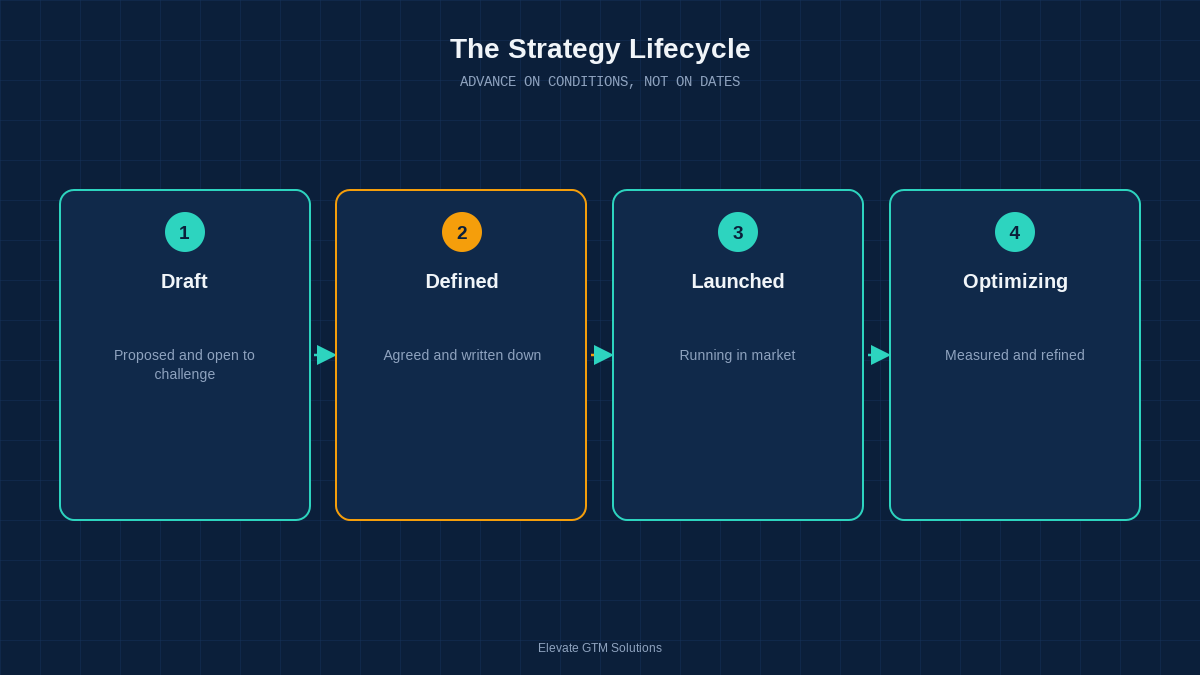
A go-to-market strategy that lives in a document has no lifecycle. It is written, presented, approved and then, in practice, forgotten, until someone notices months later that it no longer matches what the company does. A strategy that moves through defined stages has a lifecycle: people know whether it is still a proposal, an agreed plan, something in market or something being refined, and they know what is expected at each point.
This guide explains what a strategy workflow is, why stages matter, what should happen in each of four stages (draft, defined, launched and optimizing), who should be involved, what makes a strategy ready to advance, what makes it fall back, how collaboration should work and where teams go wrong. We make a GTM strategy platform, Elevate GTM Solutions, whose Workflow Engine uses these four stages, so we have an interest, and we describe what we do in a clearly marked section. We cite no statistics and our examples are invented and labeled.
What is a GTM strategy workflow, and how should a strategy move through stages?
A GTM strategy workflow is the path a strategy follows from first idea to ongoing refinement, with named stages, owners and conditions for moving between them. A simple and useful set is four stages. Draft: a proposed strategy that is open to challenge. Defined: a strategy that has been reviewed, agreed and written down well enough for teams to act on. Launched: a strategy that is being executed in market, with assets, plans and owners in place. Optimizing: a strategy in operation that is being measured and refined as evidence arrives. Each stage has an exit test, so that a strategy advances because specific things are true and not because a date arrived. Collaborators contribute at each stage, and a strategy can move backward when evidence shows it was not ready or is no longer right.
Why have stages? They make the status of a strategy visible and set expectations for what must be true at each point.
Can a strategy go backward? Yes. Moving back from launched to defined, or from defined to draft, is a sign that learning is happening.
The short version
| Stage | What it means | Who leads | Exit test |
|---|---|---|---|
| Draft | A proposed strategy, open to challenge | Strategy owner with a small group | Key assumptions listed, main objections collected, options considered |
| Defined | Reviewed, agreed and written down for action | Strategy owner with function leads | Segments, positioning, messaging, pricing, channels, owners and measures agreed |
| Launched | Being executed in market | Function leads and execution teams | Assets live, owners active, first measures flowing |
| Optimizing | In operation and being refined | Strategy owner, with RevOps and function leads | Regular review rhythm running, changes recorded, results informing decisions |
Why a strategy needs a workflow
Most companies treat strategy as an event and execution as a process. That mismatch causes recurring problems.
Nobody knows what status it is. Sales thinks the new positioning is final. Marketing thinks it is still a proposal. Product has not seen it. Without a stage, status is a matter of rumor.
Review is informal and uneven. Some people get consulted and others do not, and the people who have to run the plan often hear about it last.
Approval is unclear. A plan can be "approved" in one meeting by people who did not read it, and "not approved" in the minds of those who were not there.
Handoff is vague. The step between "we have a plan" and "teams are running it" is where many strategies die.
Learning has no home. Results arrive and nothing says when or how they change the strategy.
A workflow does not make a strategy good. It makes the status, the responsibilities and the learning visible. See GTM strategy handoff and who owns GTM strategy.
Stage one: draft
What a draft is
A draft is a proposal. It is complete enough to react to and incomplete enough that everyone knows it can change. It may come from a fast first pass, a workshop or an internal strategist, and it should be explicit about what is known, what is believed and what is guessed. See can AI build a full GTM strategy in minutes.
What should happen
- The context is written down: market, industry, product, segments, competitors, constraints.
- The strategy covers the core components: segments and ideal customer profile, positioning, messaging, pricing considerations, channels, launch outline and measures.
- Key assumptions are listed, with a plan for testing the important ones.
- Alternatives have been considered. See how to compare multiple GTM strategies before committing budget.
- A small group of people, including at least one who will have to execute it, review and challenge it.
Who is involved
The strategy owner leads. A few collaborators from sales, marketing, product and customer success contribute. The group should be small, so that drafting stays fast.
The exit test for draft
A draft is ready to become defined when the main objections have been heard and addressed or consciously set aside, when the key assumptions have been tested well enough that you are willing to act on them and when the owners of each part agree they can deliver it.
Common failures in this stage
Staying in draft forever because nobody wants to commit. Moving out of draft before the objections have been heard. Treating the draft as final because it looks polished.
Stage two: defined
What defined means
A defined strategy has been agreed. The choices are made, they are written down in enough detail that people can act on them and each part has an owner. It is the version that the company says it is going to do.
What should happen
- The segments and ideal customer profile are agreed, with the reasoning.
- Positioning and messaging are written in language that sellers and marketers will use.
- Pricing and packaging decisions are recorded, with any open questions marked.
- Channels, motions and resources are assigned.
- Measures are chosen, with definitions and data sources.
- Dependencies on other teams and on product readiness are listed.
- The decisions and reasons are recorded, including the options not chosen.
Who is involved
Function leads for marketing, sales, product, customer success and revenue operations, with an executive sponsor who can resolve disputes. This is the stage where cross-functional agreement matters most.
The exit test for defined
A strategy is ready to be launched when each function lead can say what they will do differently on Monday, when the assets and plans needed for the first phase are identified and funded, when the measures can be collected and when the sponsor has endorsed it.
Common failures in this stage
Agreement in the room and disagreement outside it. Definitions that mean different things to different teams. A strategy that is agreed and has no owner for execution. See sales and marketing SLA framework.
Stage three: launched
What launched means
A launched strategy is being executed in market. It is a sensible term whether the strategy is for a new product, a new market, a repositioning or a refresh of the core motion. The point is that real customers and prospects are being reached with the strategy's messages and plays.
What should happen
- Assets are live: messaging, decks, landing pages, sequences, battlecards, enablement material. See how to turn a GTM strategy into focus assets.
- Teams have been briefed and trained on what is changing and why.
- Owners are running their parts, with dates.
- First measures are flowing, even if the data is sparse.
- A communication rhythm exists, so people know where to find the current version and how to raise issues.
Who is involved
Execution teams and their leaders, with the strategy owner watching for early signals and answering questions. This is the stage with the most people involved.
The exit test for launched
A strategy moves to optimizing when the launch work is done, when early measures are available and when the team has begun the regular review. In practice this often happens a few weeks after launch, not on a ceremonial date.
Common failures in this stage
Launching without enablement. Treating launch as the finish line. Not telling anyone that the strategy has changed. See enterprise product launch readiness and first 90 days after a product launch.
Stage four: optimizing
What optimizing means
An optimizing strategy is one that is in operation and being improved. It is where most strategies spend most of their life, and where the benefit of a workflow shows up. The work is to read the results, find what is working and what is not and make changes in a controlled way.
What should happen
- A regular rhythm of review: weekly for actions, monthly for measures and context, quarterly for the strategy as a whole.
- Results are read against the measures and the assumptions that were listed in draft.
- Changes are small and recorded, with the reason.
- Larger changes go back through definition: a significant change to segments or positioning is treated as a revision, not a tweak.
- Learning is captured, such as win and loss patterns, objections and customer feedback.
Who is involved
The strategy owner, revenue operations and function leads, with executive visibility through dashboards or reports. See GTM metrics and KPIs and continuous GTM optimization.
The exit test for optimizing
There is usually no exit. Optimizing ends when the strategy is replaced by a new one, when the product or market has changed so much that a fresh draft is needed or when the company stops pursuing the segment.
Common failures in this stage
No review rhythm. Constant changes without records. Reading short-term noise as signal. Never going back to the core questions.
Moving backward
A workflow that only moves forward is not telling the truth. Strategies move backward when evidence requires it.
| From | To | Typical reason |
|---|---|---|
| Defined | Draft | A key assumption was disproved, or a major objection surfaced late |
| Launched | Defined | The plan as written cannot be executed, or the market responded differently than expected |
| Optimizing | Defined | A significant change to segments, positioning or pricing is needed |
| Optimizing | Draft | The product or market has changed enough that the strategy needs rethinking |
Moving backward is not failure. Hiding the need to move backward is. Make it normal: when evidence changes the picture, say so, change the stage and record why.
Collaboration across the stages
Strategy is a team activity. A workflow should make collaboration structured, so that it is neither a free-for-all nor a bottleneck.
Contributors and reviewers. Some people add content, and others review and comment. Be clear who is which at each stage.
Owners for each part. Segments, positioning, messaging, pricing, channels and measures each have a named owner who is accountable for their accuracy.
One place for the current version. If people keep private copies, status becomes unclear.
Comments and decisions in the record. Discussion that happens in meetings and chat should be captured briefly where the strategy lives.
Permissions that match responsibility. The people who change the core should be few. Others can comment or propose.
A rule against silent changes. Edits to a defined or launched strategy are visible and explained.
A worked example, invented for illustration
Imagine a company of about a hundred people selling analytics software to healthcare providers. The details are invented.
The head of strategy produces a draft for a new segment, ambulatory surgery centers, in a few days. She lists six assumptions, including that these centers buy independently of hospital systems and that the product's reporting suits their needs. She shares the draft with a seller, a product manager and a customer success lead.
In draft, the group raises two objections: the integration with practice management systems is weaker than the draft assumes, and the pricing model does not fit smaller centers. She tests the independence assumption with ten conversations. It holds for larger centers and not for smaller ones. She revises the target to larger centers and adds an integration milestone to the plan.
The strategy moves to defined after a review with the function leads and the executive sponsor. Positioning, messaging and pricing are written down. The product lead commits to the integration milestone. Customer success agrees to a pilot onboarding approach. Measures are chosen: meetings by segment, pilot conversions and implementation time.
Launching takes six weeks. Assets go live, sellers are briefed and early outreach begins. In week four, the data shows that meetings are happening and pilots are slower to start than expected. The strategy moves to optimizing, with a monthly review. In the second review, the team notices that implementation time is much longer when the center uses one particular system, so they adjust qualification and add a message about it. Because this is a refinement, it stays in optimizing. When a competitor launches a bundle two quarters later, the team treats it as a larger change and moves the strategy back to defined for a revision of positioning.
Notice that each move was based on a stated condition, that the strategy moved backward when needed and that the changes were recorded.
How to set up a workflow in a small company
A small team does not need heavy process. A light version can be a one-page checklist per stage, a named owner for the strategy, a shared place for the current version and a monthly thirty-minute review. Mark the status at the top of the strategy: draft, defined, launched or optimizing, with the date and the owner. The discipline of stating the stage is most of the benefit.
How to set up a workflow in a large company
At larger scale, the risks are inconsistency and delay. Standardize the stages and the exit tests across business units, so that status means the same thing everywhere. Define who can approve a move between stages, and how long review should take. Allow regional or product variants to move through stages on their own while the core is managed centrally. Report on the status of strategies in a simple dashboard, so that leaders can see which are in draft, defined, launched and optimizing. See best GTM platform for an enterprise with several products and regions.
Questions to ask yourself
- What stage is my current strategy in, and does everyone agree?
- What are the exit tests for each stage in my company?
- Who owns each part of the strategy?
- Who must be involved to move from draft to defined?
- What would cause us to move a launched strategy back to defined?
- Where is the current version, and who can change it?
- How often do we review, and what do we decide in those reviews?
- How do we record changes and the reasons for them?
Common mistakes
No stages. Without a stage, status is rumor.
Stages without exit tests. A stage name alone does not help. Define what must be true.
Moving forward on a date. Advance on conditions, not on the calendar.
Forbidding backward moves. If the workflow punishes honesty, people hide problems.
Too many people in draft. Keep the early stage small and fast.
Too few people in defined. Agreement needs the people who will run it.
Treating launch as the end. Most of the value comes in the optimizing stage.
Silent edits. Changes to a defined or launched strategy must be visible and explained.
No owner. A workflow without an accountable person drifts.
A checklist for each stage you can copy
These lists are short on purpose. Adapt the wording to your company and keep them on one page.
Ready to leave draft
- The context is written down and dated.
- Segments, positioning, messaging, pricing considerations, channels and measures are drafted.
- The top five assumptions are listed, with owners and tests.
- At least one option other than this one has been considered.
- A seller, a marketer, a product lead and a customer success lead have reviewed it.
- The main objections are recorded, with a response or a decision to set them aside.
Ready to leave defined
- Every function lead has stated what they will do differently.
- Each part has a named owner.
- The first phase of assets and plans is identified, funded and scheduled.
- Measures have definitions and data sources.
- Dependencies are listed with owners and dates.
- The executive sponsor has endorsed the strategy.
- The decisions and reasons, including options not chosen, are recorded.
Ready to leave launched
- Assets are live and findable.
- Teams have been briefed and trained.
- Owners are running their parts.
- First measures are flowing and someone is watching them.
- A channel exists for questions and issues.
- The first review is scheduled.
Healthy while optimizing
- Reviews are happening on the agreed rhythm.
- Changes are recorded with reasons.
- Win and loss patterns are reviewed.
- Variants stay consistent with the core.
- A trigger list tells people when to call for a larger revision.
Who does what: a simple responsibility table
| Activity | Strategy owner | Function leads | RevOps | Executive sponsor |
|---|---|---|---|---|
| Write the draft | Leads | Contribute | Advises on data | Informed |
| Challenge the draft | Facilitates | Challenge | Challenges measures | Informed |
| Agree the defined version | Leads | Agree and commit | Confirms measures | Endorses |
| Prepare launch assets | Coordinates | Own and deliver | Sets up tracking | Informed |
| Run the launch | Watches | Execute | Monitors | Informed |
| Review in optimizing | Leads | Report | Provides data | Reviews |
| Decide a major revision | Proposes | Consulted | Consulted | Decides |
Adjust to your structure. The principle is that every activity has one accountable person, and that people are not asked to approve things they have not seen.
What a good status update looks like
A short, regular status note keeps a workflow honest. Weekly or biweekly, the strategy owner can send three to five lines: the current stage, what moved since the last note, what is blocked and who owns the blocker, what the measures show in one sentence and what decision is needed from whom by when. Avoid long narratives. Readers who can scan the update in a minute will read it every time.
Stuck patterns and what to do about them
Strategies tend to get stuck in predictable places.
| Stuck in | What it looks like | What usually helps |
|---|---|---|
| Draft | Endless revision, no commitment | Set a review date, name what is still unknown and decide with the information you have |
| Defined | Agreement in principle, no action | Ask each function lead for the first three things they will do and by when |
| Launched | Assets live but nobody uses them | Check enablement, ask sellers what they need and simplify |
| Optimizing | Reviews with no decisions | Require each review to end with a recorded decision, even if it is to change nothing |
When a strategy has sat in a stage longer than expected, ask what the exit test needs and who can supply it.
Measuring the health of the workflow itself
Besides measuring the strategy's results, it helps to measure whether the workflow is working. A few simple indicators: how many strategies or variants are in each stage, how long they sit in each, how often a strategy moves backward and why, how many changes were recorded in the last quarter, how recently each strategy was reviewed and how many people were surprised by a change they did not know about. These are not targets. They are prompts to look for problems, such as strategies that have been in draft for months or a launched strategy that has not been reviewed since launch.
Handling several strategies at once
Many companies run more than one strategy at a time: different products, segments or regions. Each can sit in a different stage. A new product may be in draft while the core motion is optimizing and a regional variant is launched. A short overview, listing each strategy, its stage, its owner and its last review date, lets leaders see the whole picture and spot gaps. Keep shared elements, such as the ideal customer profile and the core positioning, in one place and refer to them, so that changes propagate. See how a GTM platform keeps strategy current as markets change.
Choosing a tool for a strategy workflow
If you use software to support the workflow, a few criteria separate useful tools from decorative ones.
| Criterion | What to look for |
|---|---|
| Visible status | Every strategy shows its stage, owner and last change at a glance |
| Real stage meaning | Stages are tied to something, such as required fields or reviews, not just labels |
| Collaboration | Contributors and reviewers can be added, with comments and a record of who changed what |
| Permissions | The right people can edit the core, and others can comment or propose |
| History | You can see earlier versions and the reasons for changes |
| Connection to execution | The strategy links to the assets and plans that follow from it |
| Export and sharing | Leaders and teams can get the strategy in formats they use |
| Honest limits | The vendor says what the tool does not do |
Test with a real strategy. Create one, add a collaborator, move it through two stages, make a change after it is defined and see what the record shows. If the tool cannot show who changed what and why, it will not keep status honest.
Cadences that keep a workflow alive
Workflows decay when meetings become reflexive. Keep the cadences short and purposeful.
Weekly, fifteen minutes. Open actions, blockers and one signal from the market. No slides.
Monthly, forty-five minutes. Measures, context changes and whether anything warrants a revision. End with decisions recorded.
Quarterly, two hours. The strategy as a whole: segments, positioning, pricing and priorities. Review the assumptions from draft and what has been learned. Decide whether the strategy stays in optimizing or goes back to defined.
After a trigger. A short, focused session within a few days of a major event, with one question to settle.
If a meeting does not end with a decision or a clear action, shorten it or drop it.
A second worked example: a refresh, not a launch
Not every workflow begins with something new. Imagine a company of about forty people selling billing software to small agencies, with a strategy that has been in use for two years. The details are invented.
The founder realizes that nobody can say whether the strategy is still right. She marks it as optimizing and runs a short audit. She finds that win rates have fallen in one segment and risen in another, that two competitors have changed their pricing and that sellers describe the product three different ways. These findings are enough to move the strategy back to defined.
She calls a half-day session with the sales lead, the marketing lead and the product lead. They agree on a narrower target segment, rewrite the positioning in language sellers can use and decide to test a simpler pricing structure with new accounts only. The revised strategy is written down in two pages, each part has an owner and the measures are reduced from nine to four.
Because most assets already exist, the launch step is short: updated decks and a refreshed sequence, plus a thirty-minute briefing for the team. Within a month the strategy is back in optimizing, with a monthly review and a clear record of what changed and why. The whole exercise takes about three weeks of part-time effort, and the main benefit is that everyone now describes the product the same way.
The lesson is that a workflow is useful for maintenance as much as for launches. Moving a strategy back to defined is a normal, healthy event, and it is cheaper when stages and owners are already clear.
What to put at the top of every strategy document
Whatever tool or format you use, put a small header at the top of each strategy so that status never has to be guessed.
| Field | Example entry |
|---|---|
| Name | Mid-size contractors, North America |
| Stage | Optimizing |
| Strategy owner | Name of the accountable person |
| Last reviewed | Date of the last review |
| Next review | Date of the next review |
| Version note | One line on the last change and why |
| Parent or core | Link to the core strategy this one adapts, if any |
Five minutes spent on this header prevents a surprising amount of confusion.
Glossary
Workflow. A defined path with stages, owners and conditions for moving between them.
Draft. A proposed strategy open to challenge.
Defined. A strategy that is reviewed, agreed and written down for action.
Launched. A strategy being executed in market.
Optimizing. A strategy in operation that is being measured and refined.
Exit test. The conditions that must be true before a strategy advances to the next stage.
Strategy owner. The person accountable for the whole strategy. See who owns GTM strategy.
Collaborator. A person who contributes to or reviews a strategy.
Where Elevate GTM Solutions fits
Elevate GTM Solutions is an AI GTM platform for building, executing and evolving go-to-market strategy. Its Workflow Engine is the part of the product that uses the four stages described in this guide: a strategy can be edited, collaborators can be added and the strategy is tracked as Draft, Defined, Launched or Optimizing.
Around the engine, the product flow starts with GTM Insights and Strategy Context, builds the strategy in the Strategy Builder from fifteen modules or the Unified GTM option, produces strategy insights as images, PowerPoint or PDF from the summarized report, turns selected reports into focus assets in GTM Activation, records methodology and key decisions in GTM Playbooks, and gives teams weekly actions, recommendations and scores in GTM Pulse, with executive dashboards for leaders.
What it does not do: a stage label does not make a strategy good, and the exit tests in this guide are yours to define and to enforce. We suggest using the tests in this guide as a starting point, adapting them to your company and checking with us directly about how stages, permissions and collaborators work for your team. See what Elevate GTM Solutions is.
What to do this week
- Decide what stage your current strategy is in, and ask three colleagues to do the same without conferring.
- Write one-line exit tests for draft, defined, launched and optimizing.
- Name the strategy owner and the owner of each part.
- Choose where the current version will live and archive the others.
- List who should review at draft and who must agree at defined.
- Set a review rhythm: weekly, monthly and quarterly.
- Write the conditions that would cause you to move a strategy backward.
- Add the stage, owner and date at the top of the strategy.
Key takeaways
- A strategy workflow gives a strategy a lifecycle: stages, owners and conditions for moving between them.
- Four useful stages are draft, defined, launched and optimizing.
- Each stage has different people, tasks and an exit test, and advancement should rest on conditions, not on dates.
- Strategies move backward when evidence requires it, and the workflow should make that normal.
- Collaboration needs structure: owners for each part, one current version, recorded decisions and no silent changes.
- Most of a strategy's life is spent optimizing, so a review rhythm matters.
- A stage label does not make a strategy good. The tests and the ownership are what do.
- Small companies can use a light version. Large ones need standard stages and clear approval rights.
Sources
- Elevate GTM Solutions: descriptions of the platform and the Workflow Engine stages, as stated on the company's homepage and in its product flow.
- Related Elevate guides linked in the text, including GTM strategy handoff and continuous GTM optimization.
- The stage definitions and exit tests reflect our judgment and common practice. The worked example is invented. We state no statistics and make no claims about other vendors.
Frequently Asked Questions
What is a GTM strategy workflow?
It is the path a strategy follows from first idea to ongoing refinement, with named stages, owners and conditions for moving between them. It makes the status and responsibilities of a strategy visible.
What are the four stages?
Draft, defined, launched and optimizing. A draft is a proposal open to challenge, defined is agreed and written down for action, launched is being executed in market and optimizing is in operation and being refined.
Why use stages at all?
They remove ambiguity about status, make review and approval explicit, clarify handoff and give learning a place in the process.
What is an exit test?
The conditions that must be true before a strategy advances. For example, a draft advances when major objections are addressed and key assumptions are tested, and a defined strategy launches when each function lead can say what they will do differently.
Can a strategy move backward?
Yes. A defined strategy may return to draft when a key assumption is disproved, and a launched strategy may return to defined when the plan cannot be executed as written. Moving backward is a sign of learning.
Who should be involved at each stage?
A small group led by the strategy owner in draft, function leads and a sponsor in defined, execution teams in launched and the strategy owner with revenue operations and function leads in optimizing.
How long should each stage take?
It depends on the company and the stakes. Draft can take days, defined often takes a few weeks and launched takes as long as the launch work does. Optimizing continues for the life of the strategy.
How do I stop silent changes?
Make edits to a defined or launched strategy visible, require a recorded reason, limit who can change the core and communicate revisions to the teams affected.
Does Elevate use these stages?
Yes. Elevate's Workflow Engine tracks a strategy through Draft, Defined, Launched and Optimizing, and lets you add collaborators. Confirm the details of permissions and approvals with us directly.
Is this overkill for a small company?
A light version is enough: one page of exit tests, a named owner, one shared place for the current version and a monthly review. Stating the stage at the top of the strategy captures most of the benefit.
What does optimizing involve?
A regular review rhythm, reading results against the measures and assumptions, recording small changes and treating larger changes as a revision that goes back through definition.
How is this different from project management?
A project plan tracks tasks and dates. A strategy workflow tracks the status of the decisions, whether they are agreed and in market and when evidence should change them.