
By the Elevate GTM Solutions Team · Updated November 13, 2026 · 26 min read
What Is the Best GTM Platform for an Enterprise With Several Products, Regions and Teams? What to Require, What to Test and Where No Platform Can Help
A single-product company with one sales team needs a GTM plan. An enterprise with six products, four regions, three business units and a dozen go-to-market teams needs something harder: a way to keep many plans consistent with each other without forcing them to be identical. Product A sells to the same customers as Product B and the two teams have never met. The German team positions the product differently from the American one and nobody knows whether that is a smart adaptation or an accident. Pricing differs across regions for reasons nobody remembers. The strategy lives in forty slide decks, and the "global GTM strategy" is the title of one of them.
Buyers in this situation ask which platform to use. The honest answer starts with a warning: no platform fixes unclear ownership, conflicting incentives or a missing decision about what should be global and what should be local. A platform can hold the answers once you have them and make the work visible. It can also make a mess more visible and faster. This guide explains what makes the enterprise case different, what a platform for it needs, how to evaluate candidates with tests that reflect your real complexity, how governance and rollout should work and where platforms cannot help.
We make an AI GTM platform for enterprises, so we have an obvious interest, and we say where Elevate GTM Solutions fits and where it may not. We name other vendors only as examples of categories with descriptions based on general positioning, which you should verify. We cite no benchmark figures, and examples are invented. This guide is not legal advice.
What is the best GTM platform for an enterprise with several products, regions and teams?
There is no single best one, because the right platform depends on what you need to coordinate. Look for a platform that can model your real structure, with multiple products, regions, segments and business units, that lets teams adapt locally within shared rules, keeps strategy, positioning, messaging and pricing consistent across the structure, supports access control, approvals and audit trails, connects to your CRM and data systems and can be rolled out in stages. Test it with your own hardest case: two products, two regions and a change that has to propagate. Be clear about what it will not do: it will not settle who owns decisions, resolve conflicting goals or replace your CRM, data warehouse or execution tools. Decide the governance first, then choose the tool that supports it.
Is one platform enough? Rarely on its own. Enterprises usually combine a system of record, execution tools and a layer that holds shared strategy.
Should we standardize everything? No. Decide what is global, what is regional and what is left to local teams, and build the platform to support that split.
The short version
| Question | What to decide |
|---|---|
| What is the structure? | Products, regions, segments, business units and teams, and how they relate |
| What is global and what is local? | The rules, the shared elements and the room for adaptation |
| Who decides what? | Ownership and approval for strategy, message, price and plans |
| What must the platform do? | Model the structure, keep it consistent, control access, integrate, scale |
| How will we test it? | Your hardest real case, with the people who will use it |
| How will we roll it out? | Stages, with a pilot and clear gates |
What makes the enterprise case different
Enterprise go-to-market adds complexity in at least six ways.
Multiple products. Each has its own buyers, price, team and roadmap. Customers may buy several. Messages must make sense together, and teams must not trip over each other in the same account.
Multiple regions. Language, regulation, buying habits, currency and competitors differ. Some adaptation is essential and some is only habit. See global vs local GTM strategy.
Multiple segments and business units. Different customer groups, sometimes with separate leadership and targets.
Many teams. Marketing, sales, customer success, product marketing, enablement, partners, pricing, operations and local teams. Each has its own tools and rhythm.
Governance and control. Larger companies need approvals, audit trails, access rules, legal review and consistent brand and claims. Mistakes at scale are costly.
Change at scale. A strategy change must reach hundreds or thousands of people. Without a way to propagate it, local teams keep using old material.
None of these is solved by software alone. They are organizational problems that software can support.
First, decide what is global, regional and local
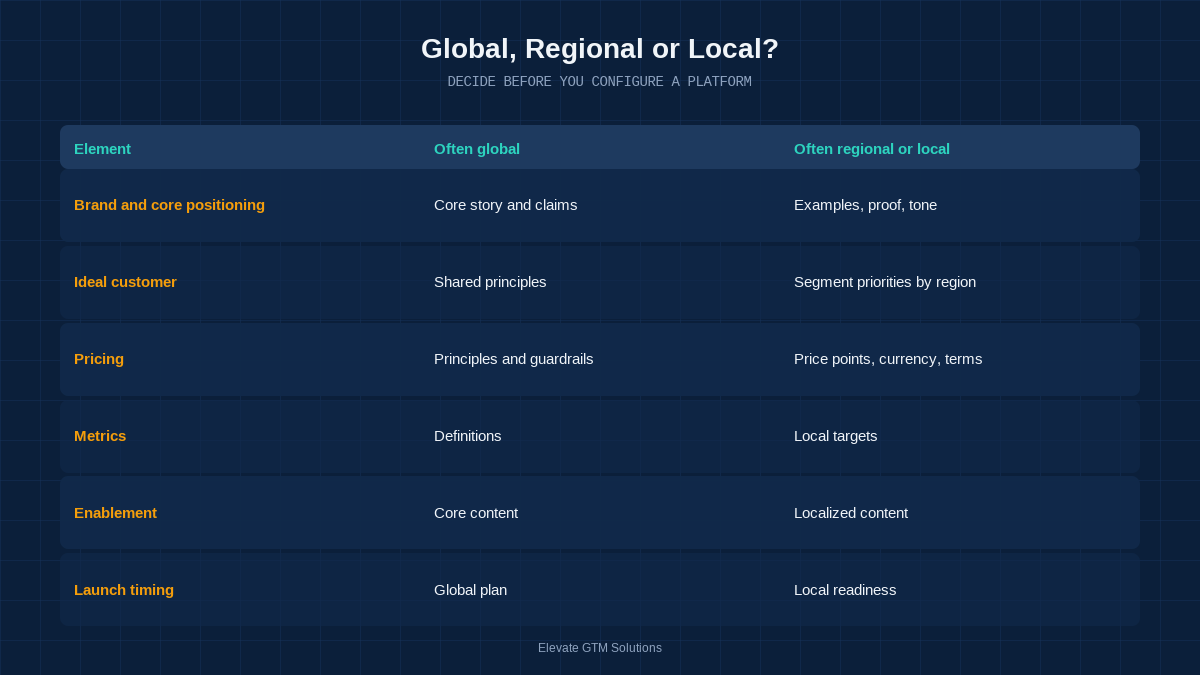
A platform will reflect your answers to a question many enterprises have never answered clearly: what must be the same everywhere, what may vary by region and what is up to local teams?
| Element | Typically global | Typically regional or local | Questions to settle |
|---|---|---|---|
| Brand and core positioning | Often global | Examples, proof, tone | What can never change? |
| Ideal customer definition | Often shared principles | Segment priorities by region | Who decides regional priorities? |
| Messaging | Core story and claims | Language, examples, emphasis | Which claims must be legally reviewed? |
| Pricing and packaging | Principles and guardrails | Local price points, currency, terms | Who approves exceptions? |
| Sales process and stages | Common stages and definitions | Local steps for buying habits | What must be consistent for reporting? |
| Metrics and definitions | Global definitions | Local targets | Who owns definitions? |
| Channels and partners | Global programs for some | Local partners and programs | How do you avoid conflicts? |
| Product launch timing | Global plan | Local readiness, regulation | Who decides regional timing? |
| Enablement | Core content | Localized and local-specific | Who translates and approves? |
Write this down as a decision rights table: for each element, who decides, who must be consulted and who is informed. Without it, you will configure a platform to reflect an argument. See who owns GTM strategy.
What the platform needs to do
Turn the enterprise complexity into requirements. Use these as a checklist, and weight them by your situation.
1. Model your structure
| Need | What to test |
|---|---|
| Multiple products with separate and shared elements | Can you define each product's strategy and the shared company-level strategy? |
| Regions and segments as dimensions | Can you view and adapt strategy by region, segment or both? |
| Business units and teams | Can you reflect reporting lines and responsibilities? |
| Many-to-many relationships | Can one account or segment relate to several products? |
| Inheritance | Can regional or product plans inherit from global elements and override specific parts? |
Inheritance matters more than most buyers expect. If a regional plan inherits positioning from the global one, a global change updates it, unless the region has overridden that part. Without inheritance, every change must be copied by hand.
2. Keep things consistent
| Need | What to test |
|---|---|
| Shared definitions | Can definitions of segments, personas, claims and terms be stored once and used everywhere? |
| Change propagation | When you change a global element, do dependent regional or product plans update or flag review? |
| Claims and approved language | Can legal-approved statements be stored and enforced? |
| Conflict detection | Does it show where two plans contradict, such as different positioning for the same segment? |
| Version history | Can you see what changed, when and by whom? |
3. Let teams adapt within rules
| Need | What to test |
|---|---|
| Local editing with guardrails | Can regions edit allowed parts and not others? |
| Comparison | Can you compare strategies by region or product side by side? |
| Approval workflows | Can changes require review before publishing? |
| Templates | Can central teams provide starting points that locals adapt? |
| Local language | How are translation and local versions handled? |
4. Control access and prove it
| Need | What to test |
|---|---|
| Role-based permissions | Can you control who sees and edits what, by product, region or team? |
| Single sign-on and identity management | Does it work with your identity system? |
| Audit trail | Is every change recorded and exportable? |
| Data handling | Where is data processed and stored, and can it meet regional requirements? |
| Retention and deletion | Can you meet your own policies? |
See the full list in our GTM platform governance checklist. If the platform uses AI, see how to tell if a GTM platform is really AI-native for tests on accuracy, sourcing and data use.
5. Connect to your systems
| Need | What to test |
|---|---|
| CRM integration | Does it read and write to your CRM, in the way you need, with your field structure? See GTM platforms that integrate with Salesforce |
| Data sources | Can it use your data warehouse, analytics and product data? |
| Execution tools | How does strategy reach marketing automation, enablement and sales tools? |
| APIs and export | Can you get your data out and connect custom systems? |
| Identity and access | Does it use your existing identity system? |
Test integrations on a real sandbox, not on the vendor's description. Enterprise CRMs often carry years of custom fields and rules.
6. Scale and perform
| Need | What to test |
|---|---|
| Number of users and plans | Does it stay fast and usable at your scale? |
| Support | What are the service levels, named contacts and escalation paths? See how to evaluate GTM platform customer support |
| Reliability | What does the vendor commit to, and what is its record? |
| Roadmap | Where is the product going, and will it fit your needs in two years? |
| Vendor stability | What is the company's position, ownership and financial stability? Mergers in this market have been frequent |
7. Support rollout and adoption
| Need | What to test |
|---|---|
| Phased deployment | Can you start with one product or region? |
| Training and onboarding | What does the vendor provide for large rollouts? |
| Admin tools | Can your team manage users, structure and settings without the vendor? |
| Usage reporting | Can you see who uses it and how? |
Categories of tools an enterprise may combine
Rarely does one product cover all of this. Understand the layers.
| Layer | What it does | Examples of categories |
|---|---|---|
| System of record | Accounts, contacts, deals, history | CRM |
| Strategy and planning | Shared segments, positioning, messaging, pricing logic, plans | GTM strategy platforms, planning documents |
| Intelligence | Market, account and competitive data | Market intelligence, sales intelligence, account-based platforms |
| Execution | Campaigns, outreach, sales process | Marketing automation, sales engagement |
| Enablement | Training, content, coaching | Enablement platforms |
| Analytics | Reporting and forecasting | BI, revenue intelligence |
| Operations and governance | Process, approvals, data | Internal operations, governance tools |
Our guides on GTM platform vs CRM, unified GTM platform vs point solutions and top GTM platforms cover how the layers relate. For an operating-system view, see AI-powered GTM operating system for enterprises and the enterprise GTM operating system implementation roadmap.
The question for an enterprise is usually not "which one platform?" but "which layers do we need, and how will they work together?"
How to evaluate: a method
Step 1: write the requirements from your own structure
Do not start from a vendor's list. Draw your structure: products, regions, segments, teams. Write the five hardest coordination problems you have today, such as "Product B and Product C are pitched to the same CFO by different teams."
Step 2: write the decision rights
Complete the global, regional and local table above, with owners.
Step 3: shortlist by layer
Decide which layers you need now and which later. Shortlist two or three candidates per layer, not twenty vendors.
Step 4: run the hard-case test
Define a test scenario that reflects your real complexity.
Example scenario, invented. Two products, two regions. Product A is sold in both. Product B only in one. Leadership decides to change the target segment for Product A. A pricing change for Product B is under review in one region. A competitor makes an announcement.
Ask each vendor to show, on your inputs:
- How the segment change propagates to positioning, messaging and enablement in both regions.
- How a regional team adapts the message within guardrails.
- How legal approves a claim and how that approval is enforced.
- How a pricing change in one region is reviewed and recorded.
- How you can see all four plans side by side.
- How the audit trail shows who changed what.
Score by what you saw, not what was promised.
Step 5: test integration in a sandbox
Connect to a sandbox copy of your CRM. Test field mapping, ownership, permissions and the handling of custom fields. Ask what breaks.
Step 6: involve the people who will live with it
Bring in representatives from global marketing, regional teams, sales operations, legal, security and IT. Local teams must see it as useful, not imposed.
Step 7: check the commercial side
Ask for the total cost across years, including seats, modules, regions, integrations, services and support. Understand renewal terms, exit rights and data return. See the AI GTM platform pricing guide and the questions to ask AI GTM vendors.
Step 8: check references like yours
Ask to speak with customers of similar scale and complexity, preferably with multiple regions, and ask what broke, what took longest and what they would do differently.
Governance: the part that decides success
A platform without governance becomes another place for conflicting plans.
Council or steering group. A small cross-functional group that owns the global elements and settles disputes. Include regions.
Clear decision rights. Written, and reflected in platform permissions.
Change process. How global changes are proposed, reviewed, published and communicated. How regional changes are approved.
Claims review. A process with legal for anything customers rely on.
Definitions owner. One owner for definitions of segments, stages and metrics. See how to measure whether your GTM strategy is working.
Regular review. Quarterly review of the global strategy and how regions use it.
Platform administration. A named owner who manages structure, access and usage. See what is GTM operations.
Rolling it out
Start narrow
Choose one product and one or two regions, with enthusiastic local teams. Aim to prove the model on a real change.
Define success
Examples: a strategy change reaches the pilot teams within a stated number of days, regional teams use shared definitions, legal approval time falls, teams stop maintaining parallel decks. Write the measures before starting.
Build the shared core first
Define global segments, positioning, claims and definitions. Add regional layers after.
Train and support
Local teams need practical training and a place to ask questions. Plan for different languages and time zones.
Review and expand
After the pilot, decide what to change before adding products and regions. Expand in groups.
See the pilot to scale framework and the enterprise GTM business case guide.
Common failure modes
Buying before deciding global vs local. The platform reflects an unresolved argument.
Forcing sameness. Regions work around it, using local decks.
Allowing total freedom. Plans diverge, and customers get mixed messages.
No owner. The platform decays.
Skipping legal. Claims differ by region and reach customers unreviewed.
Integration surprises. Custom CRM fields break the mapping.
Ignoring local teams. A global tool seen as a headquarters imposition gets minimal use.
Rolling out everywhere at once. Failures hit the whole company.
No measures. Nobody can say whether it helped.
Expecting software to fix incentives. If regions and products compete for the same accounts, a tool will not stop it.
A worked example, invented for illustration
Imagine a company with three products, sold in North America, Europe and Asia-Pacific, through direct sales in two regions and partners in the third. Each product has a marketing team. Regional teams create their own decks. Customers who buy two products hear two different stories. Legal discovers that a claim in one region's deck does not match the approved one.
The company's head of GTM operations writes the decision rights table. Brand, core positioning, claims and metric definitions are global. Segment priorities, examples, language and pricing points are regional, within global guardrails. Messaging adaptations require approval from the product marketing lead and legal for any claim.
She defines the hard-case test: one product, two regions, a change to the target segment and a claim update. She shortlists a CRM-connected strategy platform and a competing product. In the demo, she asks each vendor to run the test on her inputs. One platform shows the segment change flowing to regional plans and flags the sections that need local review. The other shows the global change in one place and requires a manual copy. She tests the CRM connection in a sandbox and finds that two custom fields do not map. The first vendor offers a mapping fix. She asks both for references from companies with several regions.
She pilots the first platform with one product and two regions for two quarters, with success defined as faster propagation of changes, fewer parallel decks and a legal review of claims in the platform. After the pilot, she adds the second product and the Asia-Pacific region. The platform did not decide what was global and what was local. The table she wrote first did.
Where Elevate GTM Solutions fits
Elevate GTM Solutions is an AI GTM platform for enterprises to create, execute, optimize and scale go-to-market strategies across markets, products and industries, according to its homepage. The homepage describes adapting strategy by region, vertical or segment, comparing strategies side by side, unified logic across positioning, messaging, pricing and channels, executive dashboards and a shared model across Marketing, Sales, Product and RevOps. Its modules include "Unified GTM Strategy," "ICP & Segmentation," "Product Positioning," "Product Messaging," "Pricing Strategy," "Distribution Channel Strategy," "Marketing Alignment" and "Sales Enablement." The homepage says "15 connected GTM modules" and names sixteen, so count what you see when you look. It also lists use cases such as "Enter a new market," "Align cross-functional teams" and "Integrate GTM after an acquisition."
Those are the company's claims, and the right way to treat them is as the list of things to test. Run the hard-case test above on Elevate as on any other vendor: ask it to propagate a global change across product and regional plans, to show approvals and audit trails, to enforce approved claims and to connect to a sandbox copy of your CRM. We have not read the company's integrations page, and third-party listings we reviewed show a short integrations list, so confirm current integrations, access controls, data handling and enterprise terms directly. Elevate is a strategy layer. It is not a CRM, a data warehouse or an execution tool, and an enterprise would use it alongside those. Whether its structure fits your decision rights is something only your test can show. For more, see what Elevate GTM Solutions is, AI-native GTM planning for the enterprise and enterprise GTM consulting services.
Common enterprise scenarios and what they call for
The right setup depends on the shape of the company. These sketches are invented, and your situation will differ.
One brand, many regions, one core product. The main risk is drift between regions. Prioritize inheritance, approved claims, local language support and comparison across regions. Governance can be light if the product is simple.
Many products, one customer base. The main risk is customers hearing several stories from the same company. Prioritize shared positioning at the company level, account-level views across products and rules for who leads in shared accounts.
Many products and many regions. Complexity multiplies. Prioritize a clear decision rights table, a structure that can express products by region, strong change propagation and a staged rollout.
A company built by acquisitions. The main risk is several unconnected strategies and tools. Prioritize a shared fact base, shared definitions and a path to consolidate stories before systems. See how to combine GTM teams after an acquisition.
A regulated industry. The main risk is a claim or message that breaks a rule. Prioritize approval workflows, claim libraries, audit trails and data residency.
A partner-led enterprise. The main risk is inconsistent messaging through partners. Prioritize partner-facing materials, controlled access and clear separation between internal and partner views. See how to build a partner and channel GTM strategy.
Measuring whether it is working
Choose a small number of measures and record a baseline before the rollout.
| Area | Example measures | Caution |
|---|---|---|
| Propagation speed | Time from a global strategy change to updated regional plans and materials | Measure the change reaching the field, not just the platform |
| Consistency | Share of customer-facing material using approved positioning and claims | Spot-check by sample |
| Local adaptation | Number of approved regional variations and time to approve | Too few may mean workarounds; too many may mean drift |
| Duplication | Number of parallel decks and plans in circulation | Ask teams directly |
| Compliance | Claims reviewed before publication; incidents | Count issues found late |
| Adoption | Active users by region and role | Use is not value |
| Business results | Win rate, cycle length and retention in pilot regions against a baseline | Many factors move these; use ranges and honest language |
See our guide on how to measure whether your GTM strategy is working.
Cost and commercial questions at enterprise scale
Enterprise pricing is often custom, and a few questions help.
- Pricing metric. Is it by user, by product, by region, by volume or a platform fee? How does the price change as you add regions and products?
- What is included. Which modules, integrations, support levels and environments, such as sandbox and production?
- Services. What implementation, training and change support is included and what is extra?
- Term and renewal. Length, automatic renewal, price protection and caps on increases.
- Exit. Data export, transition help and what happens to your content.
- Procurement and security. Documents the vendor will provide, and timelines for your own review.
Compare total cost over several years against the cost of the current situation: the time teams spend rebuilding decks, reconciling definitions and fixing inconsistent messages. That cost is real and rarely measured. Our AI GTM platform pricing guide lists cost items that often sit outside a quote.
Change management for a large rollout
Technology is the smaller part of an enterprise rollout. People are the larger part.
Name the reasons. Each group needs to know what is in it for them. Regional teams want less duplication and faster approvals. Product marketers want fewer inconsistent stories. Legal wants fewer unreviewed claims. Leaders want visibility.
Find champions. In each region and function, identify respected people who will try it early and give honest feedback.
Train in context. Use real scenarios from the team's own work, not generic demos. Short sessions with practice beat long lectures.
Make the old way harder and the new way easier. If local decks remain easier to produce than platform outputs, people will keep making decks. Remove needless steps, and retire old templates on a date.
Listen early. Collect complaints in the first weeks and act on the common ones. Visible fixes build trust.
Report progress. Share what has changed: how fast a global update reached the regions, how many parallel decks were retired, what claims were caught before publication.
Plan for turnover. People change roles. Keep documentation and onboarding current so the platform does not depend on a few individuals.
Risks to watch
| Risk | Sign | Response |
|---|---|---|
| Shelfware | Active users fall after the first months | Find out why, simplify, retrain or reconsider |
| Shadow systems | Teams keep private decks and sheets | Ask why, fix the gap |
| Governance bottleneck | Approvals take too long | Review the rules, delegate low-risk changes |
| Over-centralization | Regions feel unheard | Revisit what is local; give regions a voice in the steering group |
| Integration drift | Data differs between systems | Assign an owner, audit regularly |
| Vendor dependence | Hard to leave | Keep exports current, review contract terms and alternatives |
| AI errors | Wrong claims reach customers | Require review and sourcing for customer-facing outputs |
Review this table quarterly with the steering group. A risk that is named and watched is far cheaper than one discovered by a customer.
Glossary
Enterprise. A large organization with multiple teams, products, regions or business units. Definitions vary.
Multi-product. Offering several products, often with different buyers, teams and pricing.
Multi-region. Selling across countries or regions with different languages, rules and buying habits.
Global, regional and local elements. The parts of a strategy fixed everywhere, shared by a region or left to local teams.
Inheritance. A design in which lower-level plans take elements from higher-level ones unless overridden.
Decision rights. A written statement of who decides, who must be consulted and who is informed for each decision.
Guardrail. A rule that limits how far a team can adapt a shared element.
Audit trail. A record of who changed what and when.
Role-based access control. Permissions that depend on a user's role.
Single sign-on (SSO). A system that lets users log in once under central identity control.
System of record. The system treated as the authoritative source for a type of data.
Steering group. A cross-functional group that owns shared elements and settles disputes.
What to do this week
- Draw your structure: products, regions, segments, teams and how they relate.
- Write the global, regional and local table with a named decider for each element.
- List your five hardest coordination problems today.
- Decide which layers you need now: system of record, strategy, intelligence, execution, enablement, analytics.
- Write a hard-case test scenario that reflects your real complexity.
- Set up a sandbox copy of your CRM for integration testing.
- Name a platform owner and a steering group, before you choose a tool.
Key takeaways
- An enterprise needs consistency across products, regions and teams without forcing everything to be identical. Decide what is global, regional and local first.
- Write decision rights, because a platform reflects the decisions you have made, including unresolved ones.
- Require the ability to model your structure, propagate changes, adapt within rules, control access, integrate with your systems and scale.
- Most enterprises combine layers: a system of record, a strategy layer, execution tools and analytics. Ask which layers you need.
- Test with your hardest real case and a CRM sandbox, with the people who will use it.
- Pilot with one product and one or two regions, with measures set in advance.
- No platform resolves conflicting incentives or unclear ownership.
Sources
- Elevate GTM Solutions: descriptions of the platform, modules, audience and use cases, as stated on the company's homepage. These are the company's own claims. Integrations and enterprise terms should be confirmed directly with the company.
- Related Elevate guides linked in the text, including global vs local GTM strategy, the GTM platform governance checklist and the enterprise GTM operating system implementation roadmap.
- The requirements, the layers table, the evaluation method and the rollout approach reflect common practice and our judgment. They are not drawn from a single study, and your organization may need a different shape.
- This guide is not legal advice. Data handling, contract and regional compliance rules vary by country.
- The worked examples are invented for illustration. We cite no benchmark figures.
Frequently Asked Questions
What is the best GTM platform for an enterprise with several products, regions and teams?
There is no single best one. Look for a platform that models your products, regions and teams, lets local teams adapt within shared rules, keeps strategy and messaging consistent, controls access with audit trails, integrates with your CRM and rolls out in stages. Test it with your hardest real case.
Do enterprises need more than one GTM platform?
Usually yes. Enterprises typically combine a system of record such as a CRM, a layer that holds shared strategy, intelligence, execution and enablement tools and analytics. The useful question is which layers you need and how they connect.
How do you decide what should be global and what should be local?
Write a table of elements such as brand, positioning, ideal customer, messaging, pricing, process, metrics and enablement, and for each decide what is fixed everywhere, what a region may adapt and what local teams decide. Name who decides, who is consulted and who is informed.
What features matter most for multi-region strategy?
Inheritance from global to regional plans, change propagation, approved claims, side-by-side comparison, approval workflows, role-based access, audit trails, CRM integration and support for local language and legal review.
How do you test a platform for enterprise complexity?
Define a scenario with two products, two regions and a change that must propagate, such as a segment change and a claim update. Ask each vendor to run it on your inputs, then test the CRM connection in a sandbox and check the audit trail.
Who should own an enterprise GTM platform?
A named platform owner, often in GTM or revenue operations, working with a cross-functional steering group that owns shared elements and settles disputes. Local teams need a voice, or the tool will be seen as imposed.
How long does an enterprise rollout take?
It depends on scope and readiness, and we give no figure. Start with one product and one or two regions, measure against criteria set in advance, and expand in groups after reviewing what to change.
How do we stop regional teams from drifting apart?
Define the global elements and guardrails, store approved claims and definitions once, require approvals for sensitive changes, make differences visible side by side and review them regularly. Forcing total sameness tends to push teams to build workarounds.
What integrations does an enterprise need?
Typically the CRM, data warehouse and analytics, identity and single sign-on, marketing and sales execution tools and enablement systems, with APIs and export. Test each in a sandbox with your real field structure.
How does governance work in a GTM platform?
Through role-based permissions, approval workflows, audit trails, retention rules and clear ownership. The platform enforces the decision rights you define, so write them first. See the governance checklist for details.
Can one platform replace our CRM and other tools?
Generally no. A GTM strategy platform complements a CRM and execution tools by keeping shared strategy consistent. Check each vendor's scope and integrations before assuming any overlap.
Is Elevate GTM Solutions built for enterprises?
Its homepage describes it as an AI GTM platform for enterprises, with adaptation by region, vertical or segment and a shared model across teams. Those are company claims. Test it on your hardest case, and confirm integrations, access controls, data handling and enterprise terms directly.