
By the Elevate GTM Solutions Team · Updated November 13, 2026 · 25 min read
What Is GTM Operations? How It Differs From RevOps, What the Team Does and When You Need One
A few years ago, the people who kept a sales and marketing machine running had titles like sales operations, marketing operations and, later, revenue operations. Now job boards are full of "GTM operations," "GTM ops" and "GTM strategy and operations," and companies use the terms in ways that overlap, contradict one another or mean whatever the hiring manager needs that quarter. If you are trying to work out whether your company needs GTM operations, whether it is just RevOps with a new label or how to structure it, the sources do not agree.
This guide defines GTM operations in plain terms, separates it from the neighboring functions, lists what the work includes, shows how to structure the team, explains when a company needs it and describes how to measure it. We make a GTM strategy platform, and GTM operations is a function our platform is meant to support, so we have an interest. Where definitions vary, we say so and give you a way to write your own. We use no benchmark staffing ratios, because published ones vary by company type and are rarely comparable. Examples are invented.
What is GTM operations?
GTM operations is the function that makes a company's go-to-market work run reliably and improve over time. It owns the planning rhythm, processes, data, systems, measurement and cross-team coordination that connect strategy to execution across marketing, sales, customer success and sometimes product and partnerships. It is wider than sales operations or marketing operations, which serve one team, and it is often wider than revenue operations in scope, adding planning, enablement coordination and strategy support to the process, data and systems work RevOps does. The labels overlap heavily, so the practical test is what the team actually owns. A GTM operations function usually answers five questions: what is the plan, how does work flow between teams, what do the numbers say, which systems support it and how do we get better.
Is GTM operations the same as RevOps? Often close, sometimes identical in practice. Some companies use GTM ops for a broader remit that includes planning and strategy support. Write down what yours covers.
Who needs it? Companies where several customer-facing teams must work to one plan, and where coordination, data and process problems are slowing growth.
The short version
| Question | Answer |
|---|---|
| What is it? | The function that runs and improves the go-to-market machinery across teams |
| What does it own? | Planning rhythm, process, data and systems, measurement, coordination, often enablement support |
| How is it different from RevOps? | Overlapping. GTM ops is sometimes broader, adding planning and strategy support |
| How is it different from sales ops and marketing ops? | Those serve one team. GTM ops spans teams |
| How is it different from a GTM engineer? | GTM ops runs the machine. A GTM engineer builds new automation. See what is a GTM engineer |
| When is it needed? | When coordination, data or process is the constraint on growth |
| How is it measured? | Forecast reliability, process speed, data quality, adoption, and the results the teams it supports achieve |
Why the term exists
The functions behind these labels grew up in sequence.
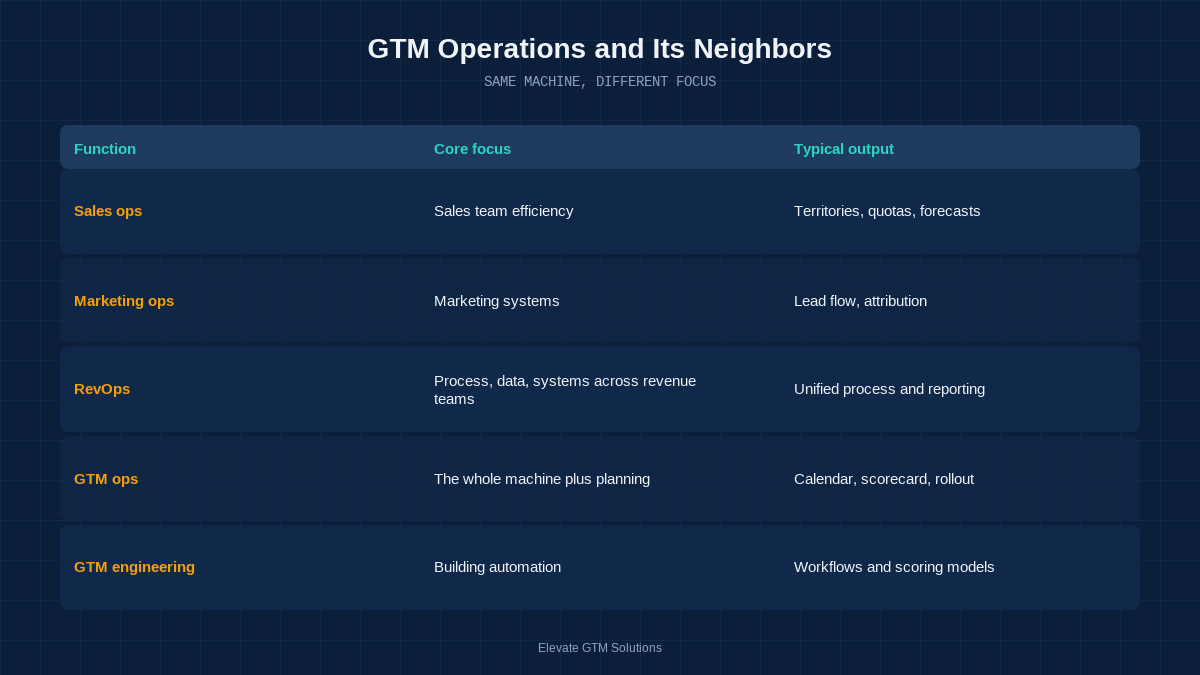
Sales operations came first, to support sellers: territories, quotas, forecasting, the CRM.
Marketing operations followed, to run marketing systems: automation, lead flow, campaign reporting.
Revenue operations emerged when companies noticed that sales ops and marketing ops, and later customer success ops, were optimizing separately, with different data and different definitions. RevOps joined them to align the revenue process end to end. See what is revenue operations.
GTM operations appeared as companies stretched the same idea further, to include the planning cycle, the strategy-to-execution handoff, enablement, pricing and packaging support, partner operations and product launch coordination. It is partly a response to a real gap: someone has to make sure the plan reaches the field and that the field's lessons reach the plan.
It is also partly fashion. Many companies relabel RevOps teams as GTM operations with no change in duties. That is fine, as long as you know what the team does.
What the work includes
Not every company needs every item. Choose by your bottleneck.
1. Planning and the operating rhythm
- Annual and quarterly planning. Setting targets, segmenting the market, assigning territories and accounts, and translating strategy into plans. See GTM planning template.
- Capacity and coverage. How many sellers, how many accounts, what pipeline is needed.
- The meeting cadence. Weekly pipeline reviews, monthly business reviews, quarterly planning. Someone must own the calendar, the inputs and the follow-up.
- Goal alignment. Targets that connect across marketing, sales and success.
2. Process design and handoffs
- The path from lead to customer to renewal, with stages and definitions.
- Handoffs. Between marketing and sales, sales and customer success, and success back to sales. See the sales and marketing SLA framework and GTM strategy handoff.
- Lead and account routing.
- Deal desk and approvals, where used.
- Documentation. Written definitions and procedures that new people can follow.
3. Data and systems
- The CRM and the GTM tool stack: administration, configuration, integration, access and cost.
- Data quality: definitions, ownership, deduplication, enrichment and rules.
- Integrations between systems and between data sources.
- Vendor selection and management, including contracts and renewals.
See our guide to how to choose a GTM platform and the GTM platform governance checklist.
4. Measurement and insight
- The scorecard: the shared set of measures the teams use. See how to measure whether your GTM strategy is working.
- Forecasting: a method, inputs and a way to check accuracy.
- Analysis: funnel, segment, cohort and win-loss analysis. See GTM analytics.
- Definitions: a single source for what each term means.
5. Enablement coordination
- Making sure the field has what it needs: training, content, playbooks and tools. Often GTM ops works with a dedicated enablement team, coordinating the calendar and the data on what works. See what is GTM enablement.
- Rollouts: launching a new process or tool to the field with training and adoption tracking.
6. Strategy support and launches
- Market and segment analysis that informs targeting. See market sizing.
- Pricing and packaging analysis, working with product and finance.
- Launch coordination: the timeline, owners and readiness across teams. See enterprise product launch readiness.
- Experiment design and tracking. See the GTM experimentation framework.
7. Partner and channel operations
For companies with a channel: deal registration, partner reporting, program administration. See how to build a partner and channel GTM strategy.
8. Customer lifecycle operations
For companies where retention and expansion matter: renewal processes, health scoring, customer data and handoffs with success teams.
GTM operations compared with its neighbors
| Function | Core focus | Scope | Typical output |
|---|---|---|---|
| Sales operations | Sales team efficiency | Sales | Territories, quotas, forecasts, CRM for sales |
| Marketing operations | Marketing systems and measurement | Marketing | Campaign infrastructure, lead flow, attribution |
| Customer success operations | Success team efficiency | Post-sale | Health scores, renewal process, tooling |
| Revenue operations | Alignment of process, data and systems across revenue teams | Marketing, sales, success | Unified process, data, reporting |
| GTM operations | The whole go-to-market machine, including planning and cross-team coordination | Revenue teams plus, sometimes, product, partners, pricing | Planning cadence, process, data, scorecard, rollout |
| GTM engineering | Building automation and experiments | Systems and workflows | Workflows, scoring models, agents |
| Strategy or planning team | Choosing direction | Whole company or GTM | Strategy, segments, positioning, targets |
| Enablement | Equipping the field | Sellers and customer-facing teams | Training, content, programs |
The lines blur. In a small company one person may be all of these. In a large one each may be a team. What matters is that every duty has an owner.
A simple way to write your own definition
Draw a grid with the duties listed above in rows and the candidate owners in columns: RevOps, sales ops, marketing ops, enablement, finance, strategy and others. Mark who owns each. Gaps and overlaps become visible. Then name what you call the function that owns the cross-team items. Whether you call it GTM ops or RevOps matters less than agreeing on the list.
When a company needs GTM operations
Signs that it is time:
- Teams optimize separately. Marketing, sales and success each have goals and data that do not add up.
- Nobody owns the plan. Targets are set, and the connection to territories, capacity and pipeline is hand-built each quarter.
- Reports are argued about. Different definitions give different numbers.
- The forecast is unreliable, or built by hand in a spreadsheet nobody trusts.
- Handoffs drop things. Leads wait, customer information gets lost, expansion signals vanish.
- Tools sprawl. Nobody knows what each tool does, who owns it or what it costs.
- Launches and changes land badly. The field hears about a new process the day it starts.
- Leaders spend their time on admin. Sales and marketing heads are doing operations work.
Signs it is too early:
- You have a handful of sellers and one marketer. A part-time owner and a good CRM will do. See best GTM tools for a small sales team with no RevOps person.
- You do not yet have a motion that works. Operations scales a process. It does not invent one. See what is a GTM motion.
- Nobody can say what problem the function would solve.
How to structure it
Where it sits
| Placement | Fits when | Watch for |
|---|---|---|
| Under the chief revenue officer | A single revenue leader runs sales, marketing and success | Marketing and success may feel it serves sales |
| Under the COO or finance | Operational discipline and neutrality matter | Distance from the field |
| Under the CEO or a chief of staff | Smaller companies, or strategy-heavy work | Lacks day-to-day connection |
| Inside each function, with a coordinating lead | Functions are strong and independent | Weak cross-team ownership |
Neutrality helps. A function that is seen as working for one team will struggle to align the others. See who owns GTM strategy and how to structure a GTM team.
Roles
Not every company needs every role. A rough progression:
First hire. A generalist who can administer the CRM, build reports, define process and talk to sellers and marketers. Pick someone with judgment and credibility more than a long tool list.
Growing team. Specializations appear: systems and data, analytics and forecasting, process and enablement coordination, planning and strategy.
Mature function. A head of GTM operations with managers over those areas, working with finance, product and the revenue leaders.
Roles that often sit nearby: a GTM engineer who builds automation, an enablement leader, a data analyst and a deal desk lead.
A first ninety days for a new GTM operations lead
Days one to thirty: listen and map. Meet leaders of marketing, sales, success and finance. Map the path from lead to renewal as it really works. List the tools, who owns them and what they cost. Collect the definitions each team uses, and note where they disagree. Find the three biggest points of pain.
Days thirty-one to sixty: fix one visible thing. Choose a problem people feel, such as the forecast, lead handoff or reporting. Fix it in a small way, and show the result. Agree on shared definitions for key terms.
Days sixty-one to ninety: build the rhythm. Set the operating calendar. Publish a one-page scorecard. Document the main processes. Propose a twelve-month plan with priorities, owners and measures.
Early credibility comes from fixing something real, not from writing a charter.
Common problems and fixes
| Problem | Likely cause | A first step |
|---|---|---|
| Two numbers for the same measure | No shared definitions | Write a definitions page, enforce it in the CRM |
| Leads ignored | No handoff agreement | Write the handoff rule with a response time and owner |
| Forecast misses | Stage definitions are loose or inputs are stale | Tighten stage exit criteria, check rep inputs against evidence |
| Tools nobody uses | No owner or rollout plan | Assign an owner, train and track adoption, or cancel |
| Planning is a scramble | No calendar or owner | Set the operating rhythm and inputs a quarter ahead |
| Field resists changes | Changes arrive without explanation or input | Involve sellers early, pilot small, explain why |
| Operations seen as a blocker | Too many controls, slow response | Publish service levels and turnaround, remove needless steps |
| Operations seen as a report factory | No link to decisions | Tie each report to a decision and retire the rest |
Tools and where they fit
GTM operations typically works with a CRM, marketing automation, customer success tools, reporting and analytics, data enrichment, forecasting tools, enablement platforms and planning tools. A GTM strategy platform fits on the planning side, helping hold segments, positioning, messaging and plans in one place. See GTM platform vs CRM, GTM platform vs revenue intelligence and unified GTM platform vs point solutions.
Operations teams have a particular responsibility in tool choice: they live with the maintenance. Before adding a tool, ask who owns it, what job it does, what it costs in total and what happens if it fails. See the questions to ask AI GTM vendors.
Measuring GTM operations
The function enables others, so its measures mix its own work and the results it supports.
| Area | Example measures | Caution |
|---|---|---|
| Planning | Plan delivered on time, share of targets with owners, coverage vs. target | Quality matters more than punctuality |
| Process | Time to route a lead, handoff acceptance rate, cycle time between stages | Fast is not good if quality drops |
| Data | Completeness, duplicate rate, accuracy by sample | Sample by hand, do not trust a dashboard alone |
| Forecasting | Forecast accuracy over several periods | Use ranges and a clear method |
| Systems | Tool adoption, cost per active user, integration failures | Count what is used, not what is owned |
| Service | Turnaround time for requests, satisfaction of internal customers | Ask the teams you serve |
| Outcomes supported | Pipeline health, conversion, retention, seller productivity | Shared with the teams; do not claim sole credit |
Ask the teams you serve a few direct questions each quarter: what is the most useful thing we did, what is the most annoying and what should we stop?
A worked example, invented for illustration
Imagine a software company with thirty sellers, a marketing team of eight and a customer success team of ten. Marketing, sales and success each have an operations person who reports into their own leader. Quarterly planning takes six weeks, every team has its own dashboard and a renewal handoff from sales to success often lacks key information.
The CEO asks the head of sales operations to take on a wider role as head of GTM operations, reporting to the chief revenue officer, with the three operations people as a team. In the first month the new head collects the definitions each team uses and finds four different meanings of "qualified." She convenes the three leaders and gets agreement on one. She maps the handoffs and finds the sales-to-success handoff is a chat message. She replaces it with a required form in the CRM covering goals, stakeholders, promises made and risks.
By the end of the quarter, planning takes three weeks because inputs are prepared a quarter ahead, there is one scorecard with definitions, and customer success reports that new customers start with more context. She does not build everything. She tackled the problems people felt and used each win to earn the standing to tackle the next. The label on the team changed. The change that mattered was that someone owned the seams between functions.
Common mistakes
Renaming without redefining. A new title with the same unclear duties.
Hiring a leader before knowing the problem. A senior hire with no mandate will invent one.
Becoming a reporting factory. Reports with no decisions behind them.
Becoming a gatekeeper. Too many approvals slow the field and breed workarounds.
Owning tools without owning outcomes. Administration is not the point.
Reporting to one function only. Others stop trusting it.
Skipping the field. Operations that does not talk to sellers and marketers builds the wrong things.
Overbuilding process early. Complexity before a motion works.
Ignoring change management. New processes fail without explanation and training.
Claiming sole credit. Operations enables. Others deliver.
Working with the teams you serve
A GTM operations function succeeds or fails on trust. A few habits build it.
Publish service levels. State how quickly you respond to requests, what you will and will not do and how to ask. A visible queue turns operations from a mystery into a service.
Explain the why. Every rule, field or process needs a one-sentence reason. People follow rules they understand, and work around those they do not.
Pilot with the field. Before a new process or tool reaches everyone, test it with a few sellers and marketers who will tell you the truth.
Remove as well as add. Each quarter, retire a report, a field or a step. A function that only adds creates drag, and the field notices.
Share the credit. When results improve, name the teams that delivered them.
Be neutral in disputes. When marketing and sales disagree on lead quality, bring data and facts, not a side.
Close the loop. When someone raises a problem, tell them what happened to it, even if the answer is "not now."
The operating calendar
A published calendar is among the most useful things a GTM operations team can produce. It shows when planning inputs are due, when reviews occur, when systems change and when launches land.
| Cadence | Typical items | Owner |
|---|---|---|
| Weekly | Pipeline review, data check, request triage | GTM operations with sales leadership |
| Monthly | Business review with the shared scorecard, forecast review, enablement calendar | GTM operations with revenue leaders |
| Quarterly | Planning, target and territory review, tool and spend review, process audit | GTM operations with finance and leadership |
| Annually | Strategy refresh inputs, org and capacity planning, scorecard reset | Leadership with GTM operations |
Publish the inputs each meeting needs a few days ahead, and send a short summary with decisions afterward. A calendar nobody owns decays into a pile of meetings.
Forecasting without drama
Forecasts cause more conflict than almost any other operations output. A calmer approach helps.
- Define stages with exit criteria. A deal moves to a stage when specific, checkable things are true, not when a seller feels optimistic.
- Use several views. Seller judgment, stage-based roll-up and a historical conversion view each have strengths. Compare them, and investigate large gaps.
- Report a range. A single number invites false precision. A low, likely and high range reflects reality.
- Track accuracy over time. Measure how forecasts compared with outcomes over several periods, and share the results.
- Review deals, not just totals. The largest and the oldest deals deserve a closer look.
- Separate forecasting from judging. If sellers are punished for honest bad news, they stop giving it.
A forecast is a tool for planning, not a promise. Our guide on measuring whether your GTM strategy is working covers leading and lagging signals.
Governance of the tool stack
Because GTM operations often owns the systems, a short governance routine prevents sprawl.
Keep a tools register. For each tool: purpose, owner, users, cost, renewal date, integrations and the data it holds.
Set a buying rule. New tools need a named problem, an owner, a trial against criteria and a cost estimate that includes people time. See questions to ask AI GTM vendors.
Review quarterly. For each tool, ask whether it is used, whether it still does its job and whether another tool now does the same thing. Cancel or consolidate.
Manage access. Review who has access to what, and remove access when people change roles or leave.
Protect the data. Define who may export or share data and under what rules. Privacy and consent rules vary by country, and this guide is not legal advice.
Plan the exit. For each critical tool, know how you would export your data and what you would do if the vendor stopped service.
Career paths and skills
If you are hiring or building a team, it helps to know the skills involved.
| Area | Skills | Backgrounds that often fit |
|---|---|---|
| Systems and data | CRM administration, integration, data modeling, SQL | Sales ops, marketing ops, analytics |
| Analytics and forecasting | Statistics basics, spreadsheet and BI skills, clear communication | Finance, analytics, sales ops |
| Process and enablement coordination | Process design, facilitation, training | Sales, success, enablement |
| Planning and strategy support | Market analysis, financial modeling, structured thinking | Strategy, finance, consulting |
| Leadership | Influence without authority, prioritization, neutrality | Any of the above, with leadership experience |
The most valuable trait across all of these is credibility with the people being served. A technically strong operator who cannot earn the trust of sellers and marketers will struggle.
A sample one-page charter
A short charter prevents scope arguments. Adapt this outline.
- Purpose. One sentence on why the function exists.
- What we own. The duties from the list above that this team is accountable for.
- What we support but do not own. Duties owned by others, with the owner named.
- Who we serve. The teams and what each can expect.
- How to ask. The request process and typical turnaround.
- Our measures. Three to five measures of our own service and the outcomes we support.
- Decision rights. What we can decide ourselves, what we recommend and who decides.
- Rhythm. The calendar of reviews we run.
- Review. When we will revisit this charter, usually annually.
Share it with the leaders of marketing, sales and success and ask them to challenge it. A charter they helped shape is far more likely to be respected.
Glossary
GTM operations. The function that runs and improves go-to-market machinery across teams: planning, process, data, systems, measurement and coordination.
Revenue operations (RevOps). The function aligning process, data and systems across marketing, sales and customer success.
Sales operations. The function supporting sales team efficiency.
Marketing operations. The function running marketing systems and measurement.
Operating rhythm. The regular cadence of meetings, reviews and planning.
Handoff. The point where responsibility passes from one team to another.
Forecast. An estimate of future revenue or pipeline outcomes.
Scorecard. A short, stable set of measures with definitions, ranges and owners.
Deal desk. A function that reviews and approves pricing and contract terms.
Routing. Rules that assign leads or accounts to people or teams.
Enablement. Giving customer-facing teams the knowledge, materials and tools they need.
System of record. The system treated as the authoritative source for a type of data.
Where Elevate GTM Solutions fits
Elevate GTM Solutions is an AI GTM platform for creating, executing and adapting go-to-market strategy. Its homepage names teams in Marketing, Sales, Product and RevOps as its audience and describes a shared model across them, executive dashboards and continuous visibility. Its modules include "Unified GTM Strategy," "Marketing Alignment," "Launch & Execute," "Measure & Optimize," "Sales Enablement" and "Customer Success," and its use cases include "Align cross-functional teams." The homepage says "15 connected GTM modules" and names sixteen, so count what you see when you look.
How that could help GTM operations: the planning and coordination work above depends on one agreed plan, shared definitions and a view of results, and a platform built on a shared model is designed to hold the plan in one place and keep the teams working from it. That is the company's design intent, and the test is whether your operations team and the teams it serves actually use it.
A platform is not the operations function. It does not own the calendar, settle disputes, define handoffs or administer your CRM. It does not replace a CRM or a forecasting tool. Those remain the work of people and of systems of record. For more, see what Elevate GTM Solutions is and the GTM operating system guide.
What to do this week
- Draw the duties grid: planning, process, data and systems, measurement, enablement coordination, launches. Mark who owns each today.
- Circle gaps and overlaps, especially the cross-team items nobody owns.
- Collect the definitions of lead, qualified, customer and churn from each team, and note where they differ.
- Choose the one problem people feel most and design a small fix.
- Decide where the function should report, and why.
- Write what the function is called and what it owns, in one paragraph.
- Ask three internal customers what is most useful and most annoying.
Key takeaways
- GTM operations runs and improves the go-to-market machinery across teams: planning, process, data, systems, measurement and coordination.
- It overlaps with RevOps and is sometimes broader. The label matters less than a written list of what the team owns.
- It differs from sales ops and marketing ops, which serve one team, and from GTM engineering, which builds new automation.
- A company needs it when coordination, data or process is the constraint on growth, and it is too early before a motion works.
- Place it where it can be neutral across teams, and start with a generalist who has credibility.
- Earn standing by fixing one real problem, then build the rhythm and the scorecard.
- Measure the function's own service and the outcomes it supports, without claiming sole credit.
Sources
- Elevate GTM Solutions: descriptions of modules, audience and use cases, as stated on the company's homepage.
- Related Elevate guides linked in the text, including what is revenue operations, how to structure a GTM team and the sales and marketing SLA framework.
- The definitions, the duties list and the structure options reflect common usage and our judgment. Companies and writers use these labels differently, and there is no single standard.
- The worked example is invented for illustration. We cite no benchmark staffing ratios or figures.
Frequently Asked Questions
What is GTM operations?
GTM operations is the function that makes go-to-market work run reliably and improve over time. It owns planning rhythm, process, data and systems, measurement and cross-team coordination across marketing, sales, customer success and sometimes product and partnerships.
What is the difference between GTM operations and RevOps?
They overlap heavily, and many companies use them interchangeably. GTM operations is sometimes used for a broader remit that adds planning, launch coordination and strategy support to RevOps' process, data and systems work. Write down what your function owns instead of relying on the label.
How is GTM operations different from sales operations?
Sales operations serves the sales team with territories, quotas, forecasting and CRM support. GTM operations spans teams, covering marketing, sales and customer success, and the planning and handoffs between them.
Is a GTM engineer the same as GTM operations?
No. GTM operations runs and governs the go-to-market machine. A GTM engineer builds new automation and experiments on top of it. In some companies the first GTM engineer sits inside the operations team.
When does a company need GTM operations?
When teams optimize separately, reports are disputed, the forecast is unreliable, handoffs drop information, tools sprawl or leaders spend their time on admin. It is too early if you have a handful of sellers or no working motion yet.
What does a GTM operations team do day to day?
It runs the planning and meeting rhythm, maintains process and handoffs, administers systems and data quality, builds the scorecard and forecasts, coordinates enablement and rollouts and supports launches and pricing analysis.
Who should GTM operations report to?
Common options are the chief revenue officer, the COO or finance, or the CEO or chief of staff. Neutrality across marketing, sales and success matters, because a function seen as working for one team struggles to align the others.
Who should be the first GTM operations hire?
Usually a generalist with credibility who can administer the CRM, build reports, define process and talk to sellers and marketers. Judgment and trust matter more than a long list of tools.
How do you measure GTM operations?
Measure planning quality, process speed, data quality, forecast accuracy, tool adoption, turnaround and satisfaction of the teams served, and the outcomes it supports. Avoid claiming sole credit for results others deliver.
Is GTM operations just a rebrand of RevOps?
Sometimes. Many companies relabel with no change in duties, which is fine if the duties are clear. In others the remit is genuinely wider. Check the job description and the list of what the team owns.
Do small companies need GTM operations?
Usually not as a team. A part-time owner for tools and data, written definitions and a weekly pipeline review often do the job. Build the function when coordination becomes the constraint.
Can software replace GTM operations?
No. Software can hold plans, data and workflows, but people own the calendar, settle disputes, define handoffs and keep systems healthy. A GTM platform can support the planning side, and it does not replace the function.