
By the Elevate GTM Solutions Team · Updated November 13, 2026 · 26 min read
What Is a GTM Engineer? What the Role Does, How It Differs From RevOps, and How to Decide Whether Your Company Needs One
A few years ago nobody had this job title. Now a search for it turns up thousands of open roles, a growing pile of newsletters, and a lot of confident claims about what the person does. Some of those claims come from companies that sell the tools a GTM engineer uses, which is worth knowing before you take any of them as settled fact.
This guide tries to answer the plain questions. What is a GTM engineer? What do they actually do in a week? How is the job different from RevOps, sales ops and marketing ops? Do they need to know how to code? What do they cost? And the one most readers care about: should your company hire one, or is that the wrong move for where you are?
We make a GTM strategy platform, so we have a point of view on where strategy ends and engineering begins, and we will say so where it matters. We also lean on sources we could actually read: Clay's own guide to the role, a vendor article from Octave, and a practitioner analysis of job descriptions from The CRO Club. Each has its own angle, and we flag it. We have not invented benchmarks. Where a number comes from a source with something to sell, we say that, and we treat the number as directional.
What is a GTM engineer?
A GTM engineer is a person who builds the automated systems that run parts of a company's go-to-market work: finding and enriching accounts, scoring and routing leads, drafting and sending outreach, updating the CRM, and triggering plays when something changes. The job sits between revenue operations and software engineering. The person is part commercial thinker and part builder, working with a CRM, data providers, workflow tools and AI, and is judged on whether the systems produce meetings, pipeline and saved hours, not on how clever the workflow is. Does your company need one? Usually only once you have a go-to-market motion that already works by hand and a volume problem that people cannot keep up with. Before that, a clearer strategy and a clean CRM help more.
Do GTM engineers have to code? Not necessarily. Many work in low-code tools. Some write SQL or scripts, and the more technical roles pay more.
Is it just RevOps with a new name? Partly overlapping, partly different. RevOps keeps the machine reliable. A GTM engineer builds new parts for it.
The short version
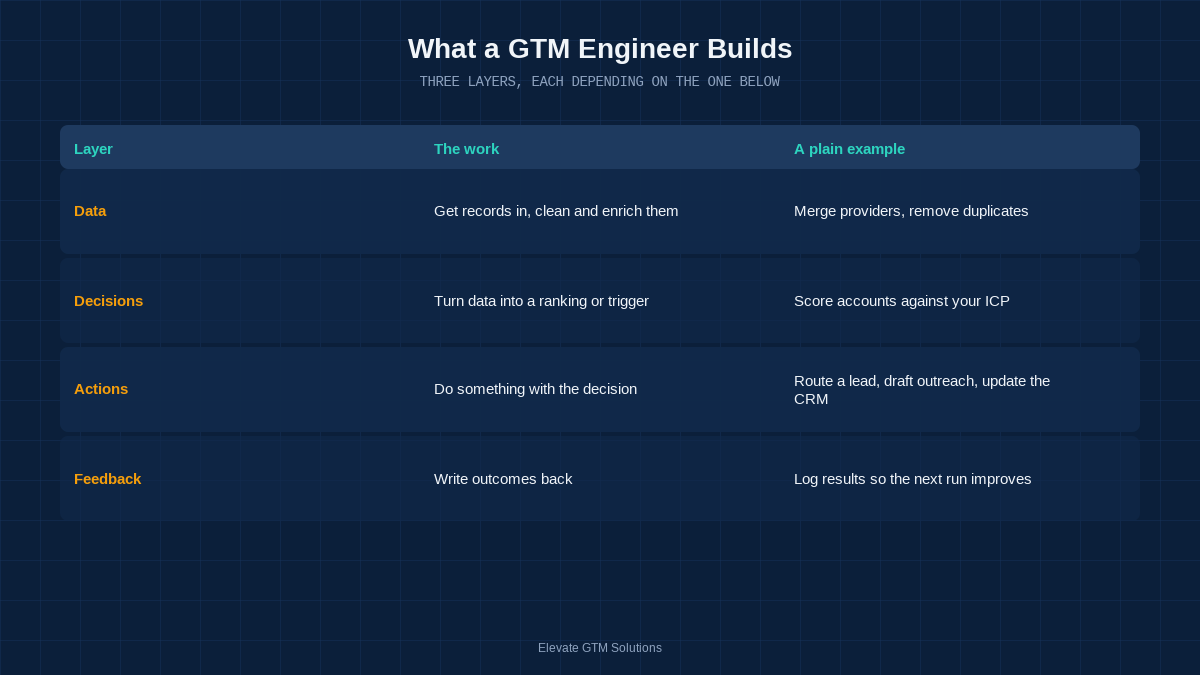
If you take away the title and look at the work, a GTM engineer does three things.
| Layer | What the work looks like | A plain example |
|---|---|---|
| Data | Get the right records in, clean them, keep them current | Pull company and contact data from several providers, remove duplicates, fill gaps |
| Decisions | Turn data into a ranking or a trigger | Score accounts against your ideal customer profile, flag a champion who changed jobs |
| Actions | Do something with the decision | Route the lead, draft a first email, create the CRM task, notify the seller |
That three-layer split is close to how Clay describes the job in its own guide to GTM engineering: a data foundation, data modeling and data activation, each depending on the one below. Octave describes a similar stack in five layers. The labels differ and the shape is the same. First data, then judgment, then action, with a record of what happened written back so the next run can learn from it.
The word "engineer" is doing real work in the title. The person is expected to build things that run on their own and that you can inspect, change and fix. A person who sends a hundred personalized emails by hand is a sales development rep. A person who builds the system that decides which hundred accounts deserve an email, drafts each one from real signals, checks it against rules, and logs the outcome is doing GTM engineering. The output is a system, not a batch.
Where the title came from
Clay says it coined the term in 2023 for people who were already doing this work inside its own team and its customers' teams, without a name for it. Whether or not that origin story is exact, the pattern behind it is easy to see. Three things happened at about the same time.
First, data and automation tools got easier to use. Work that once needed a developer, such as calling an enrichment API, parsing a response and writing a result back to the CRM, became something an ordinary operator could do in a visual builder.
Second, language models made a new kind of step possible inside those workflows: read a web page, summarize a company, draft a message, classify a reply. A workflow could now include judgment-like steps, not just copy and paste.
Third, revenue teams were under pressure to do more with fewer people. A person who could build the machinery that multiplied a small team's output was suddenly worth a lot.
The title spread quickly after that. Clay's guide, dated June 2026, says the role had appeared at companies such as Cursor, Lovable and Webflow and that around a hundred GTM engineering listings were going live each month. Octave's article cites LinkedIn as showing more than 3,000 GTM engineering roles in January 2026, roughly double the mid-2025 count. Octave sells a product in this space, and it does not show its method, so read both figures as "the role is growing fast" and not as precise counts.
What a GTM engineer does in a normal week
Job descriptions make the role sound enormous. The week looks smaller and more repetitive. Here is a fair picture, built from what Clay, Octave and the CRO Club's review of job descriptions describe.
Build and fix enrichment and routing. Take a list of accounts, add firmographic and contact data from one or more providers, check it, and push it into the CRM with ownership rules. When a provider changes its output, fix the mapping.
Maintain scoring. Run the model that ranks accounts or leads. Check whether the top of the list is actually converting. Adjust the inputs when it is not. Our guide to ICP scoring covers what a scoring model should and should not do.
Run outbound systems. Set up the sequence, the triggers and the guardrails: who gets emailed, off which signal, how many touches, what stops the sequence, who sees a reply. The CRO Club's review of more than 30 job descriptions lists AI-driven outbound and personalized outreach at scale among the common projects.
Respond to signals. A champion changes companies. A target account posts a role that suggests a new initiative. A trial user invites three colleagues. The engineer builds the play that turns each signal into a task or a message for the right person.
Connect systems. Move data between the CRM, the engagement tool, the data warehouse, the support system and the product. A large share of the job is plumbing.
Maintain what already exists. Octave's own research says GTM engineers spend more than 60 percent of their time maintaining workflows rather than building new ones. That figure comes from a vendor and a small sample, so treat it as a warning and not a statistic. The point stands: every workflow you build becomes something you own, and things break when data, tools and rules change.
Run experiments. Test a new score, a new trigger, a new message against a control. Write down what happened. The best versions of the role look a lot like growth engineering aimed at the sales and marketing process.
Talk to the people who use the systems. The most common failure is a beautiful system that sellers ignore. A good engineer spends real time with the people who will live with the output.
What it does not look like
It does not look like a developer building a product. It does not look like a marketer writing campaigns. It does not look like a manager setting strategy. The engineer implements decisions made elsewhere, and the better ones push back when the decision is unclear, because a workflow built on a fuzzy idea produces fuzzy results at speed.
The skills
Clay's guide describes a hybrid profile: a commercial thinker who is also a builder. Deep software engineering is not required, according to Clay, and one of its own GTM engineers started as a product designer and learned SQL with an AI assistant. The CRO Club's review of job descriptions lists five most-requested skills.
| Skill | What it means in practice |
|---|---|
| AI and automation fluency | Can design a workflow with an AI step, test it, and spot when it is wrong |
| Systems thinking | Sees how a change in one place shows up three steps later |
| Growth experimentation | Treats each play as a test with a control and a result |
| Full-stack tooling | Comfortable across CRM, enrichment, sequencing, data tools, sometimes SQL and APIs |
| Cross-functional collaboration | Can work with sales, marketing, RevOps and product without a turf war |
Add two more that the descriptions assume and rarely say: commercial judgment, meaning the ability to tell whether a workflow would actually help close a deal, and data discipline, meaning the habit of checking the output before trusting it. Clay's guide stresses both. A GTM engineer who can build anything but cannot tell a good account from a bad one is an expensive way to produce noise.
Do they need to code?
It depends on the company and the level. Octave's article describes pay differences across technical levels: low-code operators near the bottom, mid-level builders in the middle, and people who write Python and SQL near the top. Those pay figures are Octave's own and should be treated as directional. The more useful takeaway is the idea behind them: the more custom the system, the more code it needs, and the more a company pays for someone who can write it.
A practical way to decide: if your needs fit the standard blocks of a workflow tool, low-code is enough. If you need custom logic, large data volumes, warehouse queries or an internal service, you need someone who codes. Be honest about which you have. Hiring a coder to drag boxes around is wasteful, and hiring a box-dragger to build a data pipeline is worse.
GTM engineer, RevOps, sales ops, marketing ops: where the lines fall
The honest answer is that the lines are blurry and companies draw them differently. A workable way to think about it is by the question each role answers.
| Role | Core question | Typical output | Mindset |
|---|---|---|---|
| Revenue operations | Is the revenue machine reliable, measured and governed? | Process, reporting, forecast hygiene, system administration | Keep it running and trustworthy |
| Sales ops | Can sellers sell with less friction? | Territories, quotas, comp plans, CRM setup for sales | Support the sales team |
| Marketing ops | Does the marketing stack work and are we measuring it? | Campaign infrastructure, lead flow, attribution | Support the marketing team |
| GTM engineer | Can we build a system that does this task by itself, every time? | Workflows, scoring models, agents, integrations | Build and experiment |
| Sales development rep | Can we start conversations with the right accounts? | Outreach, meetings booked | Do the work by hand |
Octave frames it as the difference between keeping the operating system reliable and building applications on top of it. That is a helpful picture as long as you do not take it too literally. In plenty of companies the first GTM engineer sits inside RevOps, because RevOps already owns the data foundation. Clay's guide says exactly that: most companies place their first GTM engineer inside RevOps and widen the function later. The CRO Club's analysis says many GTM engineers report to a chief revenue officer, a head of growth or even the CEO, which it reads as a sign the role is not back-office. The same article admits the role is still "a bit of a black box," and does not settle whether it is RevOps, growth, engineering or sales.
That is a fair summary of where things stand. The title is new and still settling. When a candidate or a job description says "GTM engineer," ask what they actually built and what they were measured on. The answer tells you far more than the title.
Where the overlap causes trouble
Three patterns cause friction.
Two owners for the same data. RevOps owns the CRM fields. The GTM engineer writes to them from a new workflow. Without an agreement, the engineer creates fields nobody governs, and RevOps finds out when a report breaks. Settle ownership before the first workflow ships.
Automation without approval. A GTM engineer can set up outreach that goes to thousands of people. Marketing owns the brand and the sending reputation. Legal owns consent rules. A workflow that sidesteps either causes damage that is hard to undo.
Speed versus control. The engineer's instinct is to ship and test. RevOps' instinct is to document and approve. Both are right some of the time. A simple rule helps: small, reversible tests ship fast, and anything that touches customers at scale, changes shared fields or sends from the company domain goes through a short review.
The tools
Octave's article describes five layers of a GTM engineering stack, with example tools at each: data providers, intelligence tools, orchestration tools, activation tools and a system of record. The CRO Club groups the tools it saw in job descriptions into seven categories, including CRM and engagement, automation and workflow, data and analytics, ABM and intent, content and AI, and development and scripting. Clay appeared in 80 percent of the job descriptions in the CRO Club's sample, a figure from 2025 and from an informal analysis of a small set. Octave's article cites higher figures for Clay and for CRMs, and attributes them to "recent surveys" without naming them.
We will not rank tools here. A better use of space is to describe the jobs the tools do, so you can tell which you need.
| Job | What it does | What to check |
|---|---|---|
| System of record | Stores accounts, contacts, deals, history | Who owns each field; how writes are audited |
| Data providers | Supply firmographics, contacts, signals | Accuracy for your market, not the vendor's average; coverage; terms of use |
| Orchestration | Runs the steps in order, with conditions | Error handling, logging, cost per run, who can edit |
| AI steps | Research, summarize, draft, classify | How outputs are checked; where data goes; cost |
| Activation | Sends email, creates tasks, notifies sellers | Sending limits, opt-out handling, approvals |
| Warehouse or reporting | Holds history for analysis | Whether outcomes flow back so you can learn |
For more on how those categories compare with a strategy platform, see why a data orchestration tool is not a GTM operating system and our Elevate vs Clay comparison.
What a GTM engineer cannot fix
This is the part job descriptions leave out. A GTM engineer can make a go-to-market process faster, bigger and more consistent. They cannot make it correct.
If your ideal customer profile is vague, they will build a scoring model on a vague idea. If your positioning is weak, they will send weak messages to more people. If your sales process is unclear, they will automate the confusion. If the data in your CRM is a mess, they will spend their first six months cleaning it, which Clay describes as a common pattern in its guide, where it says teams spend much of their hours fixing records. Clay presents that as a typical problem and not a measured statistic, and we read it the same way.
A practical test for whether a GTM engineer will help you: can a person do this task by hand, well, ten times? If yes, a system can do it a thousand times. If the best a person can do is produce uneven results, a system will produce uneven results faster. Build the repeatable thing first, then scale it.
This is why strategy work and engineering work belong in sequence. Decide who you sell to, why they buy and what you say. Then build the machine. Teams that reverse the order often build impressive automation around a guess.
Do you need one? A decision guide
There is no universal answer, and the vendors who write about the role tend to say yes. A cooler view looks at your situation.
Octave's article says companies typically start investing after product-market fit, often around a Series A with several million dollars of annual recurring revenue. That is one vendor's rule of thumb and not a law. It does point at a useful idea: the role pays off when you have something worth scaling.
Signs you are ready
- You have a motion that works by hand. Your best sellers can describe how they find, qualify and win deals, and the steps repeat.
- You have a volume problem. People spend their days on tasks a system could do: researching accounts, copying data, routing leads, writing first drafts.
- Your data is good enough to build on. Not perfect, but you know where the accounts and contacts live, and someone owns the fields.
- You have a clear owner and a clear target. Someone can say what the engineer will build in the first ninety days and how you will know it worked.
- You have budget for tools as well as a salary. Data credits, enrichment and AI steps cost money that scales with usage.
Signs you are not ready
- You are still working out who to sell to. Strategy comes first. See how to build a GTM strategy and our guide to choosing which accounts to target first.
- Nobody owns the CRM. The engineer will either become the CRM owner by default or build on sand.
- You want a person to "do AI" with no specific problem. That is a recipe for demos nobody uses.
- You are expecting a replacement for a salesperson. The role multiplies people. It does not replace the need for sellers who can talk to customers.
- Your team is under about a handful of sellers and a single workflow would cover the need. A part-time operator, a contractor or a good tool setup may be enough.
The alternatives
| Option | Fits when | Watch for |
|---|---|---|
| Hire a full-time GTM engineer | Steady, growing automation workload and a clear owner | Maintenance load grows; a single person becomes a bottleneck |
| Grow an existing RevOps or ops person into the role | You have someone curious and trusted, with time | They may be pulled back into reporting duties |
| Use a contractor or agency for a defined build | One project with a clear end | Handover; who maintains it after |
| Use a platform with built-in workflows | Needs fit standard patterns | Limits when you need custom logic |
| Wait | Your strategy or data is not ready | Falling behind competitors who have started |
Be wary of any option that begins with the tool. Start with the problem you are trying to solve and a measure of success, then pick the option.
What a GTM engineer costs
Octave's article gives a median United States base salary range of roughly 127,500 to 135,000 dollars for 2026, with examples at large technology companies much higher, and with pay rising with technical depth. We cannot verify those numbers, and a vendor wrote them. The CRO Club's article does not discuss pay at all.
Instead of leaning on one source, treat pay as something you check against current job postings and recruiter conversations for your region and level. Expect the range to be wide, because the title covers everything from a junior operator who builds in low-code tools to a senior person who writes production code.
Salary is only one part of the cost.
- Tools. Data credits, enrichment calls, AI usage, workflow runs and seats add up. Costs often scale with volume, so a successful workflow can get more expensive over time.
- Maintenance. Plan for time spent keeping existing workflows alive. If you hire one person and they spend most of the week on upkeep, that is normal, not a failure.
- Management time. Someone has to set priorities, review output and keep the engineer connected to the sellers and marketers who use the systems.
- Risk. A bad workflow can send wrong messages to real people or corrupt records. Budget for review.
How to hire a good one
Job descriptions that read like a laundry list attract people who list every tool and prove nothing. A few practices help.
Describe the problem, not the stack. "We need to cut the time it takes to research and route inbound leads from two days to two hours" tells a candidate more than a list of tools.
Ask for a walkthrough of something they built. What was the goal? What did the data look like? What broke? What did they change? How did they measure the result? Strong candidates describe failure without flinching.
Test judgment, not just tooling. Give them a made-up list of twenty accounts and ask which five to target and why, and what they would automate. Their reasoning matters more than the tool they pick.
Look for people who talk to users. Ask how they got sellers to adopt something. Adoption is the hard part.
Check data discipline. Ask how they verify an AI step is right. Good answers include sampling, test sets, rules that block bad output, and logging.
Be honest about the job. If the first six months is cleaning data and writing documentation, say so. People who accept that will stay.
A first ninety days for a new GTM engineer
A plan with a shape helps everyone. This one is general, and you should adapt it to your situation. The examples are invented for illustration.
Days one to thirty: learn and map. Sit with sellers, marketers and RevOps. Map the actual path a lead or account takes today, step by step, noting where people copy, paste, wait or guess. Audit the CRM fields that matter and find out who owns them. List the five tasks that eat the most hours. Choose one to automate first, using three tests: it repeats, it is rules-based enough to describe, and a mistake is easy to catch.
Days thirty-one to sixty: build the first thing small. Build one workflow with a human review step. For example, enrich new inbound leads, score them and route them, with a seller checking the first fifty by eye. Log every run. Measure time saved and error rate against the manual process, not against a guess.
Days sixty-one to ninety: harden and expand. Fix what broke. Write down how the workflow works and who maintains it. Remove the human check where the error rate allows, and keep it where it does not. Pick the second workflow using what you learned. Share results, including misses, with the people who use the system.
By day ninety you should be able to say what the engineer built, what it saved, what broke and what comes next. If the answer is a long list of half-built things, the scope was too wide.
Governance and risk
Because a GTM engineer can reach customers at scale, a few rules protect the company.
Consent and outreach rules. Rules about commercial email, calling and data use vary by country and by channel. This guide is not legal advice. Have counsel review how your workflows collect and use contact data and how they handle opt-outs.
Data handling. Know where each record came from, what you may do with it and where it goes. AI steps may send data to outside services. Check what your contracts allow.
Approvals. Decide what needs review before it runs: anything sent to customers, anything that changes shared records at scale, anything that costs significant money per run.
Logging and rollback. Every workflow should leave a record of what it did and a way to undo it.
Kill switch. Someone should be able to stop a runaway workflow quickly. Test it before you need it.
Documentation. If the only person who understands a workflow leaves, you have a problem. Write down the purpose, the inputs, the rules, the owner and how to turn it off.
For a broader checklist on how to judge a platform's controls, see our GTM platform governance checklist.
How to measure whether it is working
A GTM engineer's work should show up in numbers you can check. Choose a few and agree on them at the start.
| Measure | What it tells you | Caution |
|---|---|---|
| Hours saved per week on named tasks | Whether automation replaced manual work | Count work removed, not work shifted to someone else |
| Speed to first response or to routing | Whether leads move faster | Faster only helps if the follow-up is good |
| Data quality: completeness, duplicates, accuracy samples | Whether the foundation is improving | Sample by hand; do not trust a dashboard alone |
| Conversion at the stages the system touches | Whether decisions are better | Hard to isolate; compare against a control group |
| Meetings or pipeline from automated plays | Whether output turns into results | Attribution is messy; use ranges and honest language |
| Error and rework rate | Whether the system can be trusted | Track fixes and complaints from users |
| Adoption by sellers | Whether the system is used | A tool nobody uses has zero value |
Clay's guide says the unit of work is a system that handles a task on every record, measured by outcomes like meetings booked and hours saved. That is a good starting point, as long as you count carefully and do not take credit for results that would have happened anyway. Our guide to GTM metrics and KPIs goes deeper on picking measures that hold up.
Common patterns that go wrong
The demo that never ships. A clever workflow impresses in a meeting and never reaches production because nobody owns it.
The pile of workflows. Twenty automations, none documented, built by someone who left. Maintenance becomes the whole job.
Automating a bad process. The system works as designed. The design was wrong.
The black box score. Nobody can explain why an account scored high, so sellers ignore the score.
Volume over relevance. More messages go out, replies drop and the sending domain suffers.
Tool-first thinking. A company buys a tool, then looks for a problem.
No feedback loop. Outcomes never flow back, so the system never improves.
Glossary
GTM engineer. A person who builds automated systems for go-to-market work, combining commercial judgment with technical building skills.
Go-to-market (GTM). The plan and the work of taking a product to customers: who to sell to, what to say, how to sell and how to support.
Revenue operations (RevOps). The function that aligns process, data, systems and reporting across sales, marketing and customer success.
Enrichment. Adding information, such as company size, industry or contact details, to a record from outside sources.
Waterfall enrichment. Trying several data sources in sequence until one returns an answer.
Orchestration. Coordinating the steps of an automated workflow, including conditions, retries and error handling.
Signal. An observable event that may indicate buying interest or risk, such as a job change, a funding round or a product trial.
Lead scoring. Ranking leads or accounts by how likely they are to fit and buy, based on rules or a model.
System of record. The system treated as the authoritative source for a type of data, usually the CRM for accounts and deals.
Agent. A software component that uses AI to take multi-step actions toward a goal, usually within limits you set.
Low-code. Building with visual tools and little or no hand-written code.
Ideal customer profile (ICP). A description of the companies, and the people inside them, that are most likely to benefit from your product and buy it.
Common mistakes
- Hiring before you know what to build. A title is not a plan.
- Hiring a coder when low-code would do, or the reverse.
- Letting the role become a catch-all. Reports, list pulls, tool admin and one-off requests will eat the week if you let them.
- Skipping the owner conversation with RevOps. The overlap is real. Settle it early.
- Building on an unclear ICP or weak messaging. Fix strategy first.
- Shipping without logging, approvals or a way to stop.
- Measuring activity instead of outcomes. Workflows run and emails sent are not results.
- Ignoring adoption. If sellers do not trust or use the output, it does not count.
- Trusting vendor statistics about the role. Many of the figures in circulation come from companies that sell to GTM engineers.
- Expecting the role to replace people. It multiplies a good process. It does not stand in for one.
Where Elevate GTM Solutions fits
Elevate GTM Solutions is an AI GTM platform for building, executing and adapting go-to-market strategy. Its site describes modules for unified strategy, market research, ICP and segmentation, competitive intelligence, positioning, messaging, pricing strategy, sales enablement and measurement, among others. The homepage says "15 connected GTM modules" and lists sixteen by name, so count what you see at the time you look.
That puts Elevate on the strategy side of the line this guide draws. It is not a workflow orchestration tool or a data enrichment tool, and it is not a replacement for a GTM engineer. The two jobs are complementary. A platform like Elevate is meant to help a team decide who to target, what to say and how to position, using one shared set of inputs. A GTM engineer then builds the systems that act on those decisions: the routing, the scoring, the outreach, the data flows.
In practice, the useful handoff looks like this. Strategy output gives the engineer a defined ideal customer profile, segment logic, a messaging framework and priorities. The engineer turns them into rules and workflows. Outcomes flow back, so the strategy can change. We cannot tell you how well that works for your team from here, and we make no claim about integrations with specific orchestration tools. Ask for the current integrations list and test the handoff on a small case. For more, see what Elevate GTM Solutions is and how a GTM platform compares with Clay.
What to do this week
- Write down the three manual go-to-market tasks that cost your team the most hours, with a rough weekly count.
- For each, answer: could a person do this well ten times? If not, fix the process before automating.
- Check who owns your CRM fields. If the answer is "nobody," name an owner.
- Decide whether your need is low-code, code or a mix.
- Write a ninety-day goal for a first hire or contractor in plain terms, with one measure of success.
- Pick one small workflow with a human review step and a clear way to measure it.
- Review consent and data-handling rules with counsel before anything reaches customers at scale.
Key takeaways
- A GTM engineer builds the systems that run go-to-market tasks automatically, across data, decisions and actions.
- The role is part builder and part commercial thinker. Coding depth varies by role and pay.
- It overlaps with RevOps and differs mainly in mindset: RevOps keeps things reliable, GTM engineering builds new capability.
- The role multiplies a process that works. It cannot fix a vague strategy, a messy CRM or a weak message.
- Many figures about the role come from vendors. Treat them as directional.
- Start with a problem, an owner and a measure. Choose the hire, the tool or the platform after that.
Sources
- Clay: GTM engineering guide (dated June 2026): definition, three-layer description, origin claim, team placement. Clay sells tools used in this work, so read its claims as a vendor's view.
- Octave: What is GTM engineering: responsibilities, five-layer stack, comparison with RevOps, and figures on job growth, tools and pay. Octave sells a product in this space, and most statistics are its own or unsourced, so treat them as directional.
- The CRO Club: The Role Every CRO Will Be Hiring by Q3 (updated April 2025): an informal analysis of more than 30 job descriptions. The method is not described, so treat it as a practitioner's observation.
- Elevate GTM Solutions: descriptions of modules and positioning, as stated on the company's homepage.
- Our own descriptions of the week-to-week work, the decision guide and the ninety-day plan reflect common practice and our judgment. They are not drawn from a study.
Frequently Asked Questions
What is a GTM engineer?
A GTM engineer builds the automated systems that run parts of go-to-market work, such as enriching accounts, scoring and routing leads, drafting outreach and updating the CRM. The role combines commercial judgment with technical building skills and is judged by outcomes like meetings, pipeline and hours saved.
What does a GTM engineer do day to day?
Most of the week goes to building and fixing data enrichment and routing, maintaining scoring models, running outbound systems with guardrails, building plays that respond to signals, connecting tools and maintaining existing workflows. Vendor research suggests maintenance can take more than half the time, though that figure is directional.
Do GTM engineers need to know how to code?
Not always. Many work in low-code tools, and Clay's guide says deep software engineering is not required. Roles that need custom logic, large data volumes or warehouse queries often need SQL or Python, and those roles tend to pay more.
How is a GTM engineer different from RevOps?
RevOps keeps the revenue machine reliable through process, reporting, forecast hygiene and system administration. A GTM engineer builds new automation and experiments on top of that foundation. In many companies the first GTM engineer sits inside RevOps, so the two work closely and overlap.
Where does a GTM engineer sit in the org chart?
It varies. Sources describe reporting lines into RevOps, growth, demand generation, engineering, a chief revenue officer or even the CEO. What matters more is that the person has access to the people who use the systems and a clear owner for priorities.
When should a company hire its first GTM engineer?
Usually after you have a go-to-market motion that works by hand and a volume problem that people cannot keep up with. One vendor suggests roughly after product-market fit, around a Series A, but that is a rule of thumb. If your ideal customer or messaging is unclear, fix strategy first.
How much does a GTM engineer cost?
Pay varies widely with technical depth, region and company. A vendor article cites a median United States base salary in the low to mid 100,000s for 2026, but we cannot verify it. Check current job postings for your market, and budget for tools, data credits and maintenance as well as salary.
Can AI replace a GTM engineer?
AI tools now do much of the building work, and Clay notes that some engineers learn skills such as SQL with an AI assistant. But someone still has to decide what to build, check the output, handle failures and keep systems aligned with the strategy. The judgment part of the role is the harder part to automate.
What tools do GTM engineers use?
Typically a CRM as the system of record, data providers for enrichment, a workflow or orchestration tool, AI steps, an engagement or sequencing tool and sometimes a data warehouse. One informal review found Clay in most of the job descriptions it studied. Tool choice should follow your needs, not the other way round.
Is GTM engineer a good career?
Demand has grown quickly, and the role gives people a mix of commercial and technical skills. Risks include a title that is still unsettled, a heavy maintenance load and dependence on tools that change fast. People who like building systems and talking to users tend to do well.
What is the difference between a GTM engineer and a sales development rep?
A sales development rep starts conversations by hand. A GTM engineer builds the system that decides whom to contact, drafts the outreach, checks it and records the result. One does the work, the other builds the machine that does it at volume.
Does a GTM strategy platform replace a GTM engineer?
No. A strategy platform helps decide who to target, what to say and how to position. A GTM engineer builds the systems that act on those decisions. The two are complementary, and the handoff between them is worth testing on a small case.