
By the Elevate GTM Solutions Team · Updated November 13, 2026 · 27 min read
How Does a GTM Platform Keep Strategy Current as Markets, Regions and Segments Change?
Every go-to-market strategy begins to age on the day it is approved. A competitor changes its pricing, a segment that looked promising stalls, a region needs different messaging, a product release shifts what you can promise and a new buyer role joins the purchasing group. The plan on the shared drive does not change. The people who wrote it move on, and the teams that execute it fill the gaps with their own judgment, which varies from seller to seller and market to market.
A platform that claims to keep strategy current is making a specific promise: that changes in context reach the strategy, that the strategy reaches the people and tools that act on it and that nobody needs to start from a blank page every time something moves. This guide explains how that can work, what has to be true for it to work, where it breaks, how to judge a platform's claims and what to do first. We make a GTM strategy platform, Elevate GTM Solutions, so we have an interest. We cite no statistics, we describe other approaches in general terms and our examples are invented and labeled. Where we describe Elevate, we use what our homepage and product flow state, and we suggest you confirm details with us directly.
How does a GTM platform keep strategy current as markets change?
A GTM platform keeps strategy current by holding the strategy as a living model rather than a document: the inputs (market, industry, product, segment, competitors, signals) are stored as context, the strategy is derived from that context and changes to the context flow into revised outputs. In practice that means four things. You can update the context when something changes. You can adapt the strategy for a region, vertical or segment without rewriting everything. The strategy stays connected to the workflows and assets that teams use, so changes reach them. And results from the market feed back into the next revision. None of this removes the need for human judgment about what a change means. A platform makes updating cheap and visible, and people decide what to update and why.
Does a platform update strategy automatically? Not in the sense of deciding for you. It makes changes easier to apply and track, and people still decide what changes matter.
What is the main test? Change one important input and see whether the strategy, the assets and the plan change coherently, without starting over.
The short version
| Question | Answer |
|---|---|
| Why does strategy go stale? | Context changes, the document does not, and teams fill gaps in different ways |
| How can a platform help? | Store context separately, derive the strategy from it, connect the strategy to execution, feed results back |
| What can be adapted without starting over? | A region, vertical or segment, a competitor update, a new product or goal |
| Does it decide for you? | No. People decide which changes matter |
| What has to be true? | Someone owns the context, changes are recorded and teams actually use the output |
| Where does it break? | Unowned context, unused tools and changes that never reach the people executing |
| How do you test a claim? | Change one input and watch what changes downstream |
| What should you do first? | Decide what triggers a revision and who owns the update |
Why strategy goes stale
It helps to be precise about the failure, because the fix depends on it.
The document is a snapshot. A slide deck or report captures decisions at one moment. Nothing in it updates when facts change.
Context lives in people's heads and scattered files. The reasons behind a choice, the competitor notes and the customer insights are kept in different places, and many are not written down.
Updating is expensive. If a revision takes weeks, people avoid it. They patch locally instead, and the local patches diverge.
Nobody owns the loop. Marketing, sales, product and customer success each adjust their own part, and nobody keeps the whole consistent.
Execution tools hold their own versions. Campaign templates, sequences, battlecards and enablement decks are copied from the strategy at one moment and then drift independently.
Feedback arrives but goes nowhere. Wins, losses and customer comments are recorded and not connected to the plan.
The cost shows up as mixed messages, effort aimed at the wrong accounts and a long delay between a market change and a response. See death of the static GTM strategy and continuous GTM optimization.
What "current" actually requires
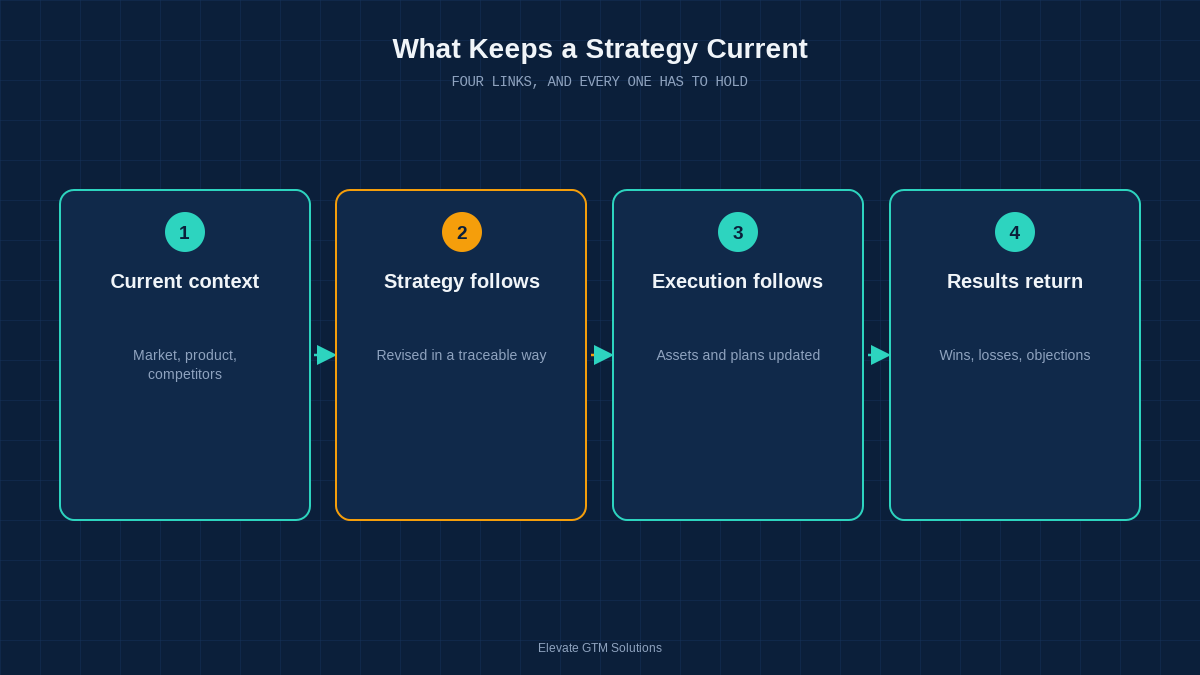
A strategy is current when four conditions hold. Think of them as a checklist for any platform or process.
1. The context is current. What you know about the market, competitors, product and customers reflects today.
2. The strategy follows the context. When context changes, the strategy is revised in a traceable way.
3. The execution follows the strategy. Messaging, plays, assets and plans used by teams reflect the current version.
4. The results inform the context. What happens in market, including wins, losses and objections, updates what you know.
If any link is broken, staleness returns. A platform that handles only the second link, regenerating a document when you press a button, leaves the others to chance.
How a platform can support each link
Keeping the context current
The first requirement is a place where context is stored as structured information rather than buried in a deck. This includes the market and industry, the product, the segments, the competitive picture and the signals and triggers you care about.
Useful capabilities here include the ability to update context at any time, not only at the start; a record of what changed and when; and clear ownership, so that someone is responsible for each part. A platform cannot know what happened in your market unless people or connected sources tell it. The value is that updating context becomes a small, routine action.
In Elevate's flow, GTM Insights is where details about the market, industry, product and segment are entered, and it can be used before or after you create a strategy. Strategy Context captures triggers, signal sources and GTM velocity, and is saved as context for the strategies you build.
Deriving the strategy from the context
The second requirement is that strategy outputs are generated from the stored context, so that changing the context changes the output. Without this, you maintain two things by hand: the context and the strategy.
Useful capabilities include the ability to regenerate or revise parts of the strategy, such as positioning for one segment, without rewriting the rest; consistency across the strategy's components, so that a change to the ideal customer carries into messaging and plans; and visibility into what changed between versions.
Adapting by region, vertical or segment
Most companies do not have one strategy. They have a core and variations. A platform should let you adapt for a region, a vertical or a segment while keeping the core consistent, which is much cheaper than maintaining separate documents.
This is where manual processes struggle most. Each variant is copied from the core, edited and then drifts. A platform that holds the core and the variations together can make a core change visible to every variant. See how to align messaging, ICP and outreach across regions and verticals and global vs local GTM strategy.
Our homepage describes adapting by region, vertical or segment and applying updated market and competitive context, then iterating without starting over while keeping consistency as you scale.
Connecting strategy to execution
The third requirement is that the people and tools who act on the strategy see the current version. If the strategy changes and the sales deck does not, nothing has been updated in practice.
Useful capabilities include structured workflows that tie work to the strategy, a way to turn the strategy into assets teams use, and a shared view for marketing, sales, product and revenue operations. Elevate's flow includes a Workflow Engine, where strategies can be edited, collaborators added and stages tracked from Draft to Defined to Launched to Optimizing, and a GTM Activation step where you choose reports and create focus assets such as a webinar, an email campaign, a landing page or an FAQ.
Feeding results back
The fourth requirement closes the loop. Results, such as which segments convert, which messages land and why deals are lost, should return to the context and prompt revision.
Useful capabilities include a regular rhythm of review, visibility into measures, and a way to turn findings into proposed changes. In Elevate's flow, GTM Pulse provides weekly actions, recommendations, team collaboration and weekly scores, and executive dashboards give leaders visibility.
What triggers a revision
A platform makes updating easy, and a process decides when to do it. Without agreed triggers, people either update constantly or never. A practical list of triggers:
| Trigger | Example | Typical response |
|---|---|---|
| Competitor change | A rival changes pricing or launches a feature | Update competitive context, check positioning and battlecards |
| Win or loss pattern | Losses cluster in one segment or to one competitor | Revisit segmentation and messaging for that segment |
| Product change | A release changes what you can promise | Update product context, claims and proof |
| Market event | A regulation, funding wave or economic shift | Revisit assumptions about demand and timing |
| New region or vertical | A decision to enter a new market | Create an adapted variant from the core |
| Pricing or packaging change | A new tier or model | Update pricing context, messaging and sales materials |
| Customer feedback | Repeated comments about a gap or a strength | Reflect in messaging and product priorities |
| Scheduled review | Monthly or quarterly | Review measures, note changes and decide what to revise |
Write the triggers down, assign an owner for each kind and set a time limit for responding. Triggers turn "we should update this" into a routine.
Ownership: the part tools cannot supply
A platform cannot keep a strategy current if nobody is responsible for it. The pattern that works has three parts.
A single owner for the whole strategy. One person or a small team keeps the core consistent and decides what a change means. See who owns GTM strategy.
Named owners for each context area. Product owns product facts, sales and customer success own customer evidence, marketing owns messaging, and so on. Each updates their part.
A visible record of decisions. When strategy changes, the reason is written down so that later readers understand it.
A useful rule is that no change to the strategy is made silently. Changes are recorded and communicated, and the people who execute are told what is different and why.
Where it breaks
Understanding the common failures helps you avoid them.
Nobody updates the context. The platform holds stale information and produces confident outputs from it.
The output is generated and ignored. The strategy changes in the platform while teams keep using old decks.
Changes are too frequent. Constant revision confuses teams. Agree a rhythm and a threshold for what warrants a change.
Changes are too rare. The tool is used at the start and never again.
Local variants drift from the core. Regions and verticals adapt without referencing the core, and consistency is lost.
Feedback is not captured. Results never return to the context, so the loop stays open.
Over-trust. People assume that because a system produced the update, it is correct. Humans must review.
How to test a platform's claim
A claim that a platform keeps strategy current can be tested in an afternoon with a demo or a trial. Try this sequence.
Step one: create a strategy for a real product. Use real context, not a toy example.
Step two: change one important input. For instance, replace the primary competitor, change the target segment or add a new constraint.
Step three: observe what changes. Does the positioning change coherently? Do the messaging and the plan follow? Is it clear what changed and why?
Step four: adapt for a region or vertical. Create a variant. Then change the core and see whether the variant reflects it or flags a conflict.
Step five: check the path to execution. Can you turn the revised strategy into the assets and plans that teams use? Can you share and track changes with collaborators?
Step six: look for the limits. What does the platform not do? Honest answers are a good sign.
Score each step simply: worked, partly or not. See evaluate continuous GTM planning platforms and how to tell if a GTM platform is really AI-native.
A worked example, invented for illustration
Imagine a company of about eighty people selling security software to mid-size organizations in North America and Europe. The details are invented.
The strategy was written in the spring. In the autumn, a competitor drops its entry price and starts targeting the company's core segment. At the same time, a regulation in Europe changes what buyers there ask for, and the product team releases a feature that closes a long-standing gap.
Under a document-based approach, the head of marketing hears about the competitor in a sales call, the European team hears about the regulation from a customer, and product announces the feature in a company meeting. Each team adjusts locally. Within a month, sellers in two regions are using different arguments, and the battlecard still describes a gap that no longer exists.
Under a platform-based approach with clear ownership, the competitor change is entered into the competitive context by the person who owns it. The regulation is added to the European variant's context by the regional lead. The product release updates the product context. The strategy owner reviews the three changes together, decides that positioning for the core segment should emphasize a different strength, revises the strategy and communicates the changes. The adapted European variant is updated to reflect both the core change and the regulation. Messaging and plans are refreshed, and the teams are told what changed and why.
The platform did not decide anything. It made it cheap to record the changes, revise the strategy in one place and see what changed. The people made the judgments.
What this looks like by company size
Small team. A single strategy and a simple monthly review may be enough. The value of a platform is mostly speed and a place for context. Do not over-engineer the process.
Growing company with several segments. Variants multiply, and drift becomes a real cost. A shared core with managed variants is where a platform earns its place.
Enterprise with regions and products. Governance matters: who can change the core, how regional leads propose changes, how changes are approved and communicated. See best GTM platform for enterprise with multiple products and regions.
A thirty-day plan to make strategy current
Days one to seven: define the loop. List the context areas, name an owner for each and write the triggers for revision. Decide the review rhythm.
Days eight to fourteen: put the context in one place. Move the market, product, segment and competitor facts out of scattered files into a shared, structured form. Record the date and source of each item.
Days fifteen to twenty-one: connect to execution. Identify the assets and plans that must follow the strategy, such as battlecards, sequences, decks and landing pages, and decide how each will be updated when the strategy changes.
Days twenty-two to thirty: run one revision. Pick a recent market change and run it through the full loop: update context, revise the strategy, update the assets, tell the teams and record the decision. Note what was slow or unclear and fix the process.
Questions to ask yourself
- What are the three most likely changes in my market in the next quarter?
- Who would hear about each, and how quickly would the strategy change?
- Where does my strategy live, and how many copies exist?
- Who owns the context, and who owns the whole?
- Which assets would be out of date a week after a revision?
- How do results from market reach the plan today?
- What would make me update the strategy, and what would not?
- How would I know if teams were using an old version?
Common mistakes
Treating a platform as a substitute for ownership. Tools store and generate. People decide.
Updating without recording why. Reasons are the most valuable and the most quickly lost part.
Revising too often. Constant change erodes trust. Agree a threshold.
Revising too rarely. A quarterly or annual rhythm cannot keep up with fast changes.
Letting variants drift. Keep regional and vertical variants tied to the core.
Forgetting the downstream assets. A revised strategy that does not reach decks and sequences has not been revised in practice.
Ignoring feedback. Capture wins, losses and objections, and review them on a schedule.
Believing an automated update is a correct update. Review it.
A change log worth keeping
If you do one practical thing after reading this guide, keep a simple change log for the strategy. It is the cheapest way to make updating visible and to keep reasons from disappearing.
| Field | What to write |
|---|---|
| Date | When the change was decided |
| What changed | The specific element: a segment, a message, a claim, a price, a priority |
| Why | The evidence or event that prompted it |
| Who decided | The person or group responsible |
| Who was told | Which teams and how |
| What else changed | Assets, plans or tools updated as a result |
| What to watch | The measure that will show whether the change worked |
| Review date | When you will look again |
Entries need only a few lines each. Over a year the log becomes a record of how the company learned. New hires read it to understand why the strategy looks the way it does, and leaders use it to see whether changes helped. It also protects against a common failure: reversing a good decision because nobody remembers why it was made.
Handling disagreements between the core and a local variant
Regional and vertical teams often know things the core team does not, and sometimes their local reality conflicts with the core strategy. A process for these conflicts saves a great deal of friction.
Make the conflict visible. The local team states what differs and why, with whatever evidence they have.
Separate three cases. Some differences are legitimate local adaptation, such as language, regulation or buyer norms. Some are evidence that the core is wrong, such as a claim that fails everywhere you test it. Some are preference, a local team simply wanting to do things its own way.
Decide who decides. Legitimate adaptations are usually approved locally within guardrails. Evidence that the core is wrong goes to the strategy owner, who can change the core for everyone. Preferences are discussed, and the core usually holds unless there is a reason.
Record the outcome. A local variant that deviates from the core should have a written reason and a review date. Without these, variants accumulate and the core loses meaning.
The aim is to keep variants close enough to the core that changes propagate, and loose enough that local teams can respond to their markets. See global vs local GTM strategy.
Signals that your strategy is out of date
You do not need to wait for a scheduled review to notice staleness. Watch for these signs.
- Sellers explain your positioning differently from each other, or from the website.
- Battlecards describe competitors in ways customers no longer recognize.
- Win rates differ sharply between segments the strategy treats as equal.
- Marketing and sales disagree about who the ideal customer is.
- New hires ask questions the documents cannot answer.
- Campaigns repeat last year's messages because nobody has told marketing what changed.
- Regional teams run their own versions of the plan.
- Leaders reference strategy documents by date, such as "the spring plan."
Any two or three of these together suggest a revision is overdue. See how to tell if your GTM strategy is broken.
What a good weekly rhythm looks like
Continuous strategy is less about big revisions than about small, regular attention. A sustainable rhythm looks like this.
Weekly: look at signals and actions. A short team check on what the market and the pipeline showed, what actions are open and what needs to change this week. This is where small adjustments happen.
Monthly: review measures and context. The strategy owner and area owners review the measures, update context that changed and decide whether anything warrants a revision.
Quarterly: revisit the strategy as a whole. Re-examine segments, positioning, pricing and priorities against what the last three months taught you. Record the decisions.
On a trigger: revise out of cycle. A major competitor move, a large win or loss pattern or a product release can justify a revision before the next scheduled review.
Keep the rhythm light. A review that takes more than an hour or two tends to be skipped. In Elevate's flow, the weekly layer corresponds to GTM Pulse, which provides weekly actions, recommendations and scores, and the monthly and quarterly layers rely on the dashboards and the strategy stages, although the cadence itself is a habit your team has to establish.
Evidence you can ask a vendor to show
When a vendor says its product keeps strategy current, ask to see it rather than to hear about it. A short list of evidence worth requesting:
- A live demonstration in which an input is changed and the downstream outputs update, using your context, not a prepared example.
- A view of what changed between two versions of a strategy, and the reason recorded.
- A demonstration of a regional or vertical variant, followed by a change to the core and the effect on the variant.
- A description of who can edit what, how collaborators are added and how approvals work.
- An explanation of how a revised strategy reaches the assets and plans teams use.
- An honest description of what the product does not do and where customers still rely on other tools.
- A reference from a customer whose market changed during their use of the product, describing what happened.
A vendor who is comfortable with these requests, including us, is more likely to be describing something real.
Roles in a living strategy
A living strategy needs a few clear roles. In a small company one person may hold several of them, and the roles still help.
| Role | Responsibility | Typical question they answer |
|---|---|---|
| Strategy owner | Keeps the core consistent, decides what a change means, communicates revisions | "Does this change alter who we serve or what we say?" |
| Context owners | Keep their area of context accurate: product, competitors, customers, pricing | "Is what we hold about this still true?" |
| Regional or vertical leads | Maintain variants, raise conflicts with the core | "Does the core hold in my market?" |
| Execution leads | Make sure assets, plans and sequences follow the current version | "Which materials are out of date?" |
| Revenue operations | Provide measures and make sure data supports the review | "What do the numbers show, and can we trust them?" |
| Executive sponsor | Clears obstacles, settles disputes the owner cannot | "What decision needs a leader?" |
Write the roles down, even in a paragraph. When a change happens at an awkward time, such as the week of a launch, people need to know who decides.
Mistakes teams make in the first quarter
The first quarter of running a living strategy teaches predictable lessons. Knowing them in advance saves time.
Starting too big. Teams try to put every piece of context into a platform at once and stall. Begin with the three areas that change most and add others later.
Confusing activity with currency. Many small edits can look like a current strategy while the core questions go unexamined. Review the big choices regularly, not only the details.
Skipping the communication step. A revision that nobody hears about changes nothing. Tell the teams what changed, why, and what they should do differently, in a few lines.
Letting one voice dominate. If only marketing updates the strategy, sales and customer success stop trusting it. Involve each function in its own context.
Forgetting to retire old material. If old decks stay in shared folders, people keep using them. Archive what has been replaced and make the current version easy to find.
Treating the first version as precious. The point of a living strategy is to improve it. Encourage people to point out what is wrong.
Glossary
Living strategy. A strategy held as structured context and outputs that can be revised, as opposed to a static document.
Context. The market, product, segment, competitor and signal information from which a strategy is derived. See what is a GTM context layer.
Variant. An adaptation of the core strategy for a region, vertical or segment.
Core. The shared elements of strategy that apply across variants.
Trigger. An event that prompts a review or revision of the strategy.
Drift. Gradual divergence between the strategy and the materials or local versions used in practice.
GTM velocity. How quickly a go-to-market team moves from signal to action. In Elevate's flow it is captured in Strategy Context.
Feedback loop. The path by which results return to the strategy.
Where Elevate GTM Solutions fits
Elevate GTM Solutions is an AI GTM platform for building, executing and evolving go-to-market strategy. Its homepage describes adapting GTM by region, vertical or segment, applying updated market and competitive context and iterating without starting over, and it positions the platform as a way to run GTM as a continuous system in place of static decks.
As we describe the product, context is captured in GTM Insights and Strategy Context, strategies are built in the Strategy Builder from fifteen modules or the Unified GTM option, and a Workflow Engine moves a strategy through the stages Draft, Defined, Launched and Optimizing with collaborators. GTM Activation turns selected reports into focus assets, GTM Playbooks record methodology and key decisions, and GTM Pulse provides weekly actions, recommendations and scores for the team, with executive dashboards for leaders.
What it does not do: it does not know what happens in your market unless you or your team tell it, it does not decide which changes matter and it does not make people use the output. The process and the ownership described in this guide are yours to run, and we recommend running the six-step test above on a real product before you decide. Confirm current features and limits with us directly. See what Elevate GTM Solutions is and what is a GTM operating system.
What to do this week
- List the five context areas that change most in your market and name an owner for each.
- Count how many copies of your strategy exist and where they live.
- Write down the triggers that should prompt a revision and the time limit for responding.
- Pick one recent market change and trace how long it took to reach sellers.
- Identify the three assets that go stale first, such as battlecards, decks and sequences.
- Decide who owns the whole strategy and write it on the document.
- Set a monthly review and a threshold for a larger revision.
- If you are evaluating a platform, prepare the six-step test with a real product.
Key takeaways
- Strategy goes stale because context changes, documents do not and nobody owns the loop.
- A strategy is current when the context, the strategy, the execution and the feedback are all connected.
- A platform helps by storing context, deriving strategy from it, supporting adaptation by region, vertical and segment, connecting to execution and feeding results back.
- People still decide what changes matter. Platforms make updating cheap and visible.
- Agree triggers, owners and a review rhythm, so updating becomes routine.
- Test claims by changing one input and watching what changes downstream.
- The common failures are unowned context, ignored outputs, drifting variants and missing feedback.
- Review automated updates before you trust them.
Sources
- Elevate GTM Solutions: descriptions of adapting by region, vertical or segment, continuous operation and the product flow, as stated on the company's homepage and in its product flow.
- Related Elevate guides linked in the text, including continuous GTM optimization and global vs local GTM strategy.
- The four-link model, triggers and tests reflect our judgment and common practice. The worked example is invented. We state no statistics and make no claims about other vendors.
Frequently Asked Questions
How does a GTM platform keep strategy current?
By holding strategy as a living model: context is stored, strategy is derived from it, changes flow into revised outputs, outputs connect to the workflows and assets teams use and results feed back. People decide which changes matter.
Does a platform update strategy automatically?
It makes updates easier to apply and track. It does not decide what a market change means for you. Review any automated change before relying on it.
What makes a strategy stale?
Context changes while the document does not, updating is expensive, nobody owns the whole and execution tools hold copies that drift from the strategy.
Can I adapt a strategy for a region or vertical without starting over?
A good platform lets you keep a shared core and adapt for a region, vertical or segment. Test whether a change to the core carries into the variants or flags a conflict.
What should trigger a revision?
Competitor changes, win and loss patterns, product changes, market events, new regions or verticals, pricing changes, repeated customer feedback and a scheduled review. Write the triggers down and assign owners.
Who should own the strategy?
One person or a small team should own the whole and keep the core consistent, with named owners for each context area and a recorded reason for each change.
How often should we revise?
A light monthly review and a fuller revision each quarter or after a significant event is a reasonable start. Avoid constant changes that confuse teams and rare changes that leave the plan behind.
How do I test a vendor's claim?
Create a strategy for a real product, change one important input, observe what changes downstream, create a regional variant and change the core, and check the path to execution. Note the limits it admits.
What are the biggest risks?
Unowned context, outputs that teams ignore, variants that drift, missing feedback and over-trust in automated updates.
Does Elevate decide what to update?
No. Elevate is designed to make updating cheaper and more visible. You and your team decide which changes matter.
How does this differ from a CRM?
A CRM holds customer and deal records. A strategy platform holds the market, segment, positioning and messaging context and the strategy derived from it, and is meant to work alongside the CRM.
Is this useful for a small team?
Yes, in a lighter form. A single strategy, a clear owner and a monthly review give most of the benefit. Add structure as segments and variants multiply.