
By the Elevate GTM Solutions Team · Updated November 13, 2026 · 27 min read
How to Align Product Messaging, ICP Segmentation and Sales Outreach Across Regions and Verticals Without Manual Rework
A B2B company with one product, one segment and one team can keep its messaging, its customer definition and its outreach consistent by talking to each other. Add three verticals and four regions and the arithmetic changes. Every change to the positioning has to be reflected in the ideal customer profile for each vertical, the messaging for each persona, the sequences each regional team uses and the enablement material each seller opens. Done by hand, that is hundreds of small edits, and it is never finished. People copy last quarter's deck, translate it, tweak it and send it, and within a year there are a dozen versions of the story, each slightly wrong.
This guide is about doing it without that manual rework. It explains where the rework comes from, a structure for messaging and ICP that lets changes flow down without being rebuilt, what to fix globally and what to leave local, how to run a change from decision to field, how to handle language and compliance, how to keep outreach aligned, how to govern the whole thing and how to measure it. We make a GTM platform with a shared model across teams, so we have an interest. We say where tooling does not help, we use no statistics and the examples are invented.
How do B2B teams align product messaging, ICP segmentation and outreach across regions and verticals without manual rework?
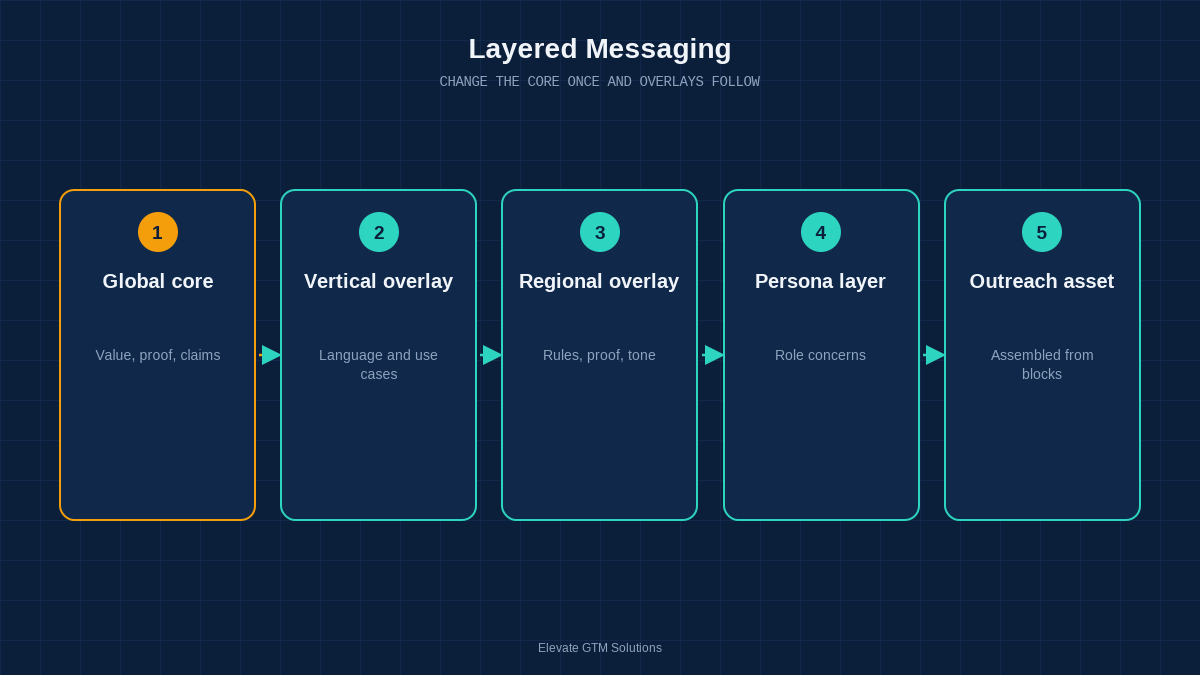
They stop treating each region and vertical as a separate copy and build a layered structure instead: a global core that holds the positioning, claims and proof, vertical and regional layers that add only what genuinely differs, such as language, pains, examples and regulations, and persona layers on top. Each layer inherits from the one above, so a change at the core flows down automatically or is flagged for review. They define in advance what local teams may change and what they may not, run every change through the same short path from decision to approval to publication to verification and measure how quickly updates reach sequences and materials. Software helps by holding the structure and the lineage, but the design and the decision rights come first. Without them, a tool just stores more copies.
Does this remove all manual work? No. It removes rebuilding and copying. People still review local fit, translate with care and judge the results.
What causes most rework? Copies. Every time a message is duplicated and edited, it becomes a separate thing to maintain.
The short version
| Question | Answer |
|---|---|
| Where does rework come from? | Copies of messages, ICPs and sequences that must be edited one by one when something changes |
| What structure prevents it? | Layers: global core, vertical and regional overlays, persona layers, with inheritance |
| What stays global? | Core positioning, claims, proof standards, brand rules, definitions of segment and account |
| What can be local? | Language, examples, local pains, regulations, channels, local proof and timing |
| How do changes flow? | Decide, assess impact, approve, publish, push to tools, verify, measure |
| Who decides? | A named owner for the core, with defined authority for vertical and regional leads |
| What does software do? | Holds the structure, tracks lineage, flags what is out of date and pushes updates to tools |
| What does it not do? | Decide what is locally true, translate with judgment or settle disputes |
Where the manual rework comes from
Before designing a fix, name the sources. Most are variations on one problem: things were copied instead of referenced.
Copied messaging. A regional team takes the global deck, translates and edits it, and now there are two decks. When the global one changes, the copy does not.
Copied sequences. Outbound sequences are cloned for each region and vertical. A change to a claim means editing every clone, and one is always missed.
Copied ICP definitions. Each region keeps its own ideal customer spreadsheet, scored on different fields, so a global view needs a reconciliation project.
Copied battlecards and objection answers. The same objection answer exists in five formats and four languages, none with a date.
Duplicated definitions in tools. The CRM field called "segment" has different values in different regions.
Manual translation loops. Each update triggers a round of emails to translators and reviewers, with no clear owner and no tracking.
Approval by inbox. Changes wait in email for a legal or brand review, then get applied by hand.
No impact view. When something changes, nobody can list the sequences, pages and materials that mention it.
Unclear authority. Regional teams do not know what they may change, so they change everything or nothing.
The cure is to reduce copies, make the relationships between things explicit and give changes a path.
A layered structure for messaging
Think of messaging as a stack, where each layer adds only what differs from the one above.
| Layer | What it holds | Who owns it | Typical rate of change |
|---|---|---|---|
| Global core | Positioning, value claims, proof standards, approved terms, what we never say | Product marketing, with leadership sign-off | Slow, deliberate |
| Vertical overlay | Pains, vocabulary, use cases, proof, regulations specific to an industry | Vertical or segment lead | Moderate |
| Regional overlay | Language, local examples, local competitors, regulatory and cultural points, channels | Regional lead | Moderate |
| Persona layer | What matters to each role: buyer, user, executive, technical evaluator | Product marketing with sales input | Moderate |
| Asset templates | Email, call opener, one-pager, landing page, deck | Marketing and enablement | Frequent |
An actual message for a given buyer is assembled from the layers: the core claim, adapted for a vertical's pains, expressed in a region's language with local proof, aimed at a persona and shaped into a format.
Why this reduces rework
If the core claim changes, you change it once. Every overlay that references it either updates or is flagged for review. If a regional team needs a local example, they add it to the regional overlay, and it does not disturb the core. If a vertical changes its vocabulary, the overlay changes and the core stays put.
An illustration with invented numbers
Consider a company with three verticals, four regions, three personas and four asset formats. If every combination is maintained as its own complete variant, that is 3 verticals times 4 regions times 3 personas times 4 formats, or 144 variants. A change to the core claim means up to 144 edits.
In a layered structure, the company maintains one core, three vertical overlays, four regional overlays, three persona layers and four asset templates, which is 15 pieces. A core change touches one piece and flags the dependent ones. The numbers are invented, and the lesson holds: the number of maintained pieces grows by addition, not multiplication.
Not every combination needs to exist. Many companies will not sell every persona in every vertical in every region. Assemble variants only for the combinations that matter, and let the layers produce the rest on demand.
Deciding what is global and what is local
The hardest part of alignment is agreeing on boundaries. A rule that is too tight frustrates regions. A rule that is too loose lets the story fragment. Decide by element, and write it down.
| Element | Usually global | Usually local, within limits |
|---|---|---|
| Core positioning | Yes | Local emphasis, not a different claim |
| Value claims and numbers | Yes, with approved proof | Local proof that meets the same standard |
| Product names and terms | Yes | Approved translations |
| Brand voice and visual rules | Yes | Tone adjustments for culture |
| Ideal customer principles | Yes | Weights, thresholds and priorities by region |
| Segment and account definitions | Yes, one dictionary | Local sub-segments mapped to the global ones |
| Persona definitions | Core set | Local variations in titles and responsibilities |
| Pricing principles and guardrails | Yes | Local price points, currency and terms within guardrails |
| Competitor positioning | Core approach | Local competitors and local objections |
| Examples and case studies | Standards | Local customers and local context |
| Channels and timing | Guidance | Local choice |
| Compliance language | Core requirements | Local legal requirements, reviewed locally |
Two principles keep this workable. First, define the dictionary globally: one agreed definition of account, segment, persona, qualified lead and customer. Local variation lives on top of shared definitions, not in place of them. Second, protect claims, not wording. A regional team can phrase a claim in a way that fits its language and culture, but it cannot make a claim that has no approved proof.
See global vs local GTM strategy and best GTM platform for an enterprise with several products and regions for related decisions.
Aligning the ICP across regions and verticals
The ideal customer profile has the same copy problem as messaging. Each region keeps its own list of what a good customer looks like, with different fields and thresholds.
A shared ICP with local weights
A workable structure has three parts.
Global principles. The common characteristics of a good customer: the problem, the type of organization, the signs of fit and the reasons they succeed. These apply everywhere.
Shared fields. A common set of criteria and definitions, so scoring in one region can be compared with another. If one region scores on employee count and another on revenue, you cannot compare them.
Local weights and thresholds. Regions and verticals may weight the criteria differently, and may add local fields. A mid-size company in one market may be large in another, so the threshold changes while the definition stays.
Keep a mapping, not a fork
When a region needs its own sub-segment, record how it maps to the global segment. That way global reporting still works, and the regional nuance survives. See ICP, ICP scoring framework and account tiering framework.
Review on evidence
Compare win rate, retention and sales cycle by region and vertical on a regular rhythm. If a regional ICP drifts without evidence, bring it back. If it differs because the evidence differs, update the global view, since the region may have found something real.
Aligning outreach and sequences
Outreach is where inconsistency becomes visible to buyers, and where manual rework is most painful, because sequences are copied freely.
Build from blocks. Instead of full emails cloned per region, create modular blocks: opening line by persona, problem statement by vertical, proof by region, call to action by stage. Sequences assemble from blocks, so a change to a block updates every sequence that uses it, or flags it.
Use references, not copies. If your tools allow templates and variables, put the shared content in one place and reference it.
Tag everything. Each sequence and template should carry its segment, persona, region, version and owner. Without tags, you cannot find what a change affects.
Retire aggressively. Old sequences nobody owns should be switched off. A single stale sequence can contradict the current positioning for months.
Set suppression rules globally. Rules about who must not be contacted, rate limits and handling of customers should not vary by team. See what is GTM orchestration.
Keep local touches human. Regions should add the local reference, the cultural nuance and the specific reason to talk. These are things a template cannot supply.
Respect local rules. Rules about contacting people differ by country and channel and change over time. This is not legal advice. Involve legal and privacy advisers for each region where you do outbound.
The change path: from decision to field
A change that has no path is changed by hand. Define a short, standard path, and use it for every change, large or small.
| Step | What happens | Owner | Typical time (example) |
|---|---|---|---|
| 1. Propose | A person records the change, the reason and the evidence | Anyone, usually product marketing or a regional lead | Same day |
| 2. Assess impact | List the overlays, sequences, assets and pages affected | Operations or the platform | Same day, if lineage exists |
| 3. Decide | The owner of the layer approves, rejects or sends back | Layer owner | A few days |
| 4. Update | The core or overlay is changed once | Layer owner | Same day |
| 5. Adapt | Dependent overlays and assets are reviewed or regenerated | Regional and vertical leads | Within an agreed window |
| 6. Review | Legal, brand or local review where required | Reviewers | Within an agreed window |
| 7. Publish and push | Updated material goes to the tools sellers use | Operations | Same day |
| 8. Verify | Check that sequences, pages and materials reflect it | Operations | Within a week |
| 9. Measure | Track use and early results | Owner | Ongoing |
The times are examples, not benchmarks. What matters is that each step has an owner and a time limit, and that the process is the same for everyone. The common failure is that steps 5 to 8 happen informally, which is where versions diverge.
Agree on review windows
Regional teams need a fair chance to adapt a change, and the company needs the change to land. A written rule such as "regional leads have five business days to adapt or raise an objection, after which the global version applies" prevents both stalling and silent forking. Choose a window that fits your business and write it down.
Distinguish three kinds of change
Core changes. A new claim, a repositioning, a new proof standard. These need leadership approval and a planned rollout.
Overlay changes. A new vertical pain, a regional example. These need the overlay owner's approval and a check against the core.
Asset changes. A new subject line, a revised one-pager. These follow a lighter path within the rules the layers set.
Using the same path for all three makes small changes slow and big changes sloppy. A tiered approach is faster and safer.
Language, translation and local adaptation
Translation is a classic source of rework.
Translate the structure, not just the text. Keep a glossary of approved terms in each language, so product names and key concepts do not drift.
Use machine translation with human review. Machine translation can produce a quick draft. A fluent local reviewer should check tone, accuracy and cultural fit, especially for claims and compliance language.
Localize, do not only translate. Examples, idioms, units, currencies, regulations and customer references often need to change, not just the words.
Keep the source linked. Each translated asset should point to the source version, so a change to the source flags the translation for review.
Budget for review time. Review delays are part of the schedule, and cutting them tends to produce errors.
Handle legal and regulatory language locally. Claims about compliance, data handling and performance may need local review. This is not legal advice.
Governance: who decides what
Alignment fails more often from unclear authority than from poor tools.
| Decision | Typical owner | Consulted |
|---|---|---|
| Core positioning and claims | Head of product marketing or CMO, with product and sales leadership | Regional and vertical leads, customer success |
| Global dictionary of terms and definitions | GTM operations or RevOps | All function leads |
| Global ICP principles | CRO or head of GTM, with marketing and product | Regional leads |
| Vertical overlay content | Vertical lead | Product marketing, sales |
| Regional overlay content | Regional lead | Product marketing, legal |
| Persona definitions | Product marketing | Sales, customer success |
| Sequence and template standards | Marketing operations and sales development leadership | Regions |
| Suppression and contact rules | GTM operations and legal | Regions |
| Tool configuration | GTM operations | IT, security |
Two further practices help. First, name a single owner for the whole structure, someone who watches the seams between layers and between regions. See what is GTM operations and who owns GTM strategy. Second, record decisions with reasons. When a regional lead asks why a rule exists, the answer should be findable. See the GTM platform governance checklist.
What tooling can and cannot do
Software cannot design the structure for you, and it can make the structure much cheaper to maintain.
Useful capabilities:
- Inheritance. A change at the core flows to overlays, or flags them.
- Lineage. You can see which assets and sequences depend on a given claim.
- Version control. History, owners and dates for every item.
- Review workflows. Approvals with time limits and reminders.
- Push to execution tools. Updated messaging reaches the CRM, engagement and enablement tools in a defined way.
- Usage and staleness views. Which materials are in use, and which are out of date.
- Role-based permissions. Regions can edit their layers and not the core.
What it cannot do:
- Decide what is locally true or appropriate.
- Translate with cultural judgment.
- Settle disputes between global and regional leaders.
- Make teams adopt the shared structure.
- Fix a muddled definition. It will propagate the muddle faster.
You can run a layered structure in documents and spreadsheets with discipline, at small scale. As verticals and regions multiply, the cost of doing it by hand rises quickly, and that is where a shared platform earns its place. See unified GTM platform vs point solutions and GTM platform to build strategy before CRM campaigns.
A worked example, invented for illustration
Imagine a company selling compliance software to financial firms, manufacturers and healthcare providers, in North America, Europe, the Middle East and Asia-Pacific. This is invented.
Before. Each region built its own deck. The healthcare team translated its content for two European markets by hand. When the company changed how it described its core capability, it took five months before every sequence reflected it, and three regional sequences still used the old description a year later. A global ICP review found four different scoring methods.
The redesign.
- Product marketing wrote the core: positioning, value claims, proof standards and a glossary.
- Each vertical lead wrote an overlay: the specific compliance pains, vocabulary and proof for their industry.
- Each regional lead wrote an overlay: language, local regulatory references, local competitors and examples.
- Personas were defined once, with vertical notes.
- RevOps wrote a global dictionary of terms and a shared ICP scoring model with local weights.
- Sequences were rebuilt from blocks, with tags for segment, persona, region, version and owner.
- A change path was written, with a five-business-day window for regional adaptation.
The first change. Three months later the company refined a core claim. Product marketing changed it once. The platform listed forty-one dependent sequences and assets. Regional leads reviewed their overlays and approved within the window. Legal reviewed the European and Middle East adaptations. The updated material was pushed to the tools, and a verification check found two sequences that still used the old claim, which were then corrected.
What changed. Time from decision to field fell from months to under a month. People spent less time copying and more time on local relevance. Disagreements still happened, but they were about substance, such as whether a claim was true in a market, not about which version was current.
This is a scenario to show the mechanism. Your results will depend on your starting point and your discipline.
A ninety-day plan
Days 1 to 15: find the copies. Inventory messaging decks, sequences, ICP definitions, battlecards and templates across regions and verticals. Note owners, dates and which versions differ. Estimate how many places mention your core claims.
Days 16 to 35: design the layers. Write the global core, the dictionary and the list of what is global and what is local. Define the layers and who owns each. Draft the change path and the review window.
Days 36 to 60: build for one vertical and one region. Create the overlays, persona layers and sequence blocks for a single combination. Tag everything. Run a real change through the path and time it.
Days 61 to 80: extend and connect. Add further verticals and regions. Connect the structure to the tools sellers use, and set up staleness and usage views.
Days 81 to 90: review. Measure the time from decision to field use, the number of active variants and the share of sequences using current messaging. Decide what to adjust before scaling further.
How to measure alignment
- Decision-to-field time. From approval of a change to its use in sequences and materials.
- Variant count. The number of separately maintained messages and sequences, which should fall or grow slowly.
- Currency. The share of active sequences and materials that reflect the current core.
- Definition agreement. Whether regions and verticals use the same definitions when asked.
- Review compliance. Share of changes that went through the path and within the windows.
- Orphans. Materials with no owner, no tag or no date.
- Local relevance. Feedback from regional sellers on whether materials fit their market.
- Comparable results. The ability to compare win rate, cycle and retention across regions and verticals using shared definitions.
Do not assume alignment improved revenue. Look at leading indicators first, and compare fairly. See GTM metrics and KPIs.
Common mistakes
Copying, then promising to keep in sync. Copies drift. Reference instead.
Making everything global. Regions then ignore the central material and build their own.
Making everything local. The story fragments, and global reporting becomes impossible.
Skipping the dictionary. Without shared definitions, comparisons and automation fail.
No named owner for the structure. Everyone owns a layer, and nobody owns the seams.
One approval path for every change. Small edits get stuck, and large ones slip through.
Translating without review. Errors in claims and tone damage credibility.
Letting retired material linger. Old sequences and decks contradict the current story.
Buying a platform before designing the layers. The platform will store copies as efficiently as it stores layers.
Treating regional adaptation as disloyalty. Local fit is the purpose of the structure.
Verticals and regions are different problems
The two get lumped together as "segments," and treating them the same causes avoidable mistakes. They vary in different ways.
| Dimension | Verticals | Regions |
|---|---|---|
| What differs | Pains, vocabulary, use cases, regulations of an industry, buying process | Language, culture, local law, market maturity, competitors, channels, time zones |
| Who knows it best | People with industry experience | People who live and sell in the market |
| Typical overlay content | "How this product solves the problems of this industry" | "How we say it, prove it and reach buyers here" |
| Source of conflict | A vertical team wants a custom pitch and custom product claims | A regional team wants local autonomy over pricing and message |
| What should stay common | Core claims and proof standards | The same |
| Main risk | Claims that stretch the product beyond what it does | Drift in definitions and loss of global comparability |
A vertical overlay is mostly about relevance: using the right language and examples for an industry. A regional overlay is mostly about fit: language, legal requirements and the way business is done locally. A company can have more verticals than regions or the reverse, and the ownership model should reflect that. In some companies, vertical leads sit in product marketing, while regional leads sit in sales. Each needs a seat in the change path.
Sample structure for a reusable outreach block
A concrete picture of "blocks" removes much of the mystery. This is an invented example of how an outbound email might be assembled.
| Block | Content source | Example, invented | Owner |
|---|---|---|---|
| Opening line | Persona layer, with a vertical hook | A line that references a pressure the role faces | Product marketing |
| Problem statement | Vertical overlay | A sentence about a problem specific to the industry | Vertical lead |
| Core claim | Global core | The approved statement of what the product does | Product marketing |
| Proof | Regional overlay | A reference or result from a customer in that market | Regional lead |
| Call to action | Stage and region | A request that suits the culture, such as a short call or a resource | Sales development lead |
| Compliance footer | Regional overlay | Required language for the market, reviewed locally | Legal with regional lead |
A sequence references these blocks and assembles the message. When product marketing updates the core claim, every sequence that uses the block either updates or is flagged. When a region adds a better proof point, only that block changes. The same idea applies to landing pages, one-pagers and talk tracks.
If your tools do not support true blocks, you can approximate them with a shared library and a naming convention, and a monthly audit that checks that sequences use the current wording. It is less elegant and still far better than unmanaged copies.
When a region or vertical disagrees with the core
Disagreement is normal and useful. Regional and vertical leaders see things the center does not. A clear way to handle it keeps the structure from being either rigid or ignored.
Ask for evidence. The question is not "who is more senior" but "what do we know?" Win rates, call themes, customer interviews and lost-deal reasons settle more arguments than opinions.
Test locally before changing globally. If a region believes a different claim works better, let it run a controlled test within agreed limits and compare results.
Separate preference from fact. Some objections are about taste, and others point to a real market difference. Handle them differently.
Allow documented exceptions. If a region needs to depart from the core for a real reason, record the exception, the reason and a review date. Silent exceptions become forks.
Promote what works. If a regional variant outperforms the core, consider adopting it globally. The structure should learn from the edges.
Escalate cleanly. When a dispute cannot be settled, the owner of the core decides, and the reasoning is recorded. A decision with a recorded reason is easier to accept than a silent override.
A short readiness check before you restructure
Honest answers to these tell you where to begin.
- Can we list every place our core claim appears?
- Do all regions use the same definitions of account, segment and persona?
- Can we say which sequences are active, who owns them and which segment they serve?
- Do we know how long a messaging change takes to reach every seller?
- Is there a written rule for what regions may change?
- Who reviews translations, and how long does it take?
- Can we compare win rate and retention across regions with the same definitions?
- Who owns the seams between regions and verticals?
If most answers are "no," start with the dictionary, the inventory and the ownership question before any tooling decision.
Glossary
Global core. The shared positioning, claims and proof from which other layers inherit.
Overlay. A layer that adds vertical- or region-specific content on top of the core.
Inheritance. The property that a lower layer takes its content from a higher one unless it deliberately differs.
Lineage. A traceable link showing which assets depend on a given claim or definition.
Dictionary. The shared definitions of terms such as account, segment, persona and qualified lead.
Variant. A separately maintained version of a message or sequence.
Localization. Adapting content, not only language, to a market.
Change path. The standard sequence of steps by which a change moves from proposal to field use.
Persona. A representative role of a buyer or user, described by what matters to them.
Where Elevate GTM Solutions fits
Elevate GTM Solutions is an AI GTM platform for creating, executing and adapting go-to-market strategy. Its homepage describes modules including "ICP & Segmentation," "Product Positioning," "Product Messaging," "Account-Based Marketing," "Marketing Alignment," "Sales Enablement" and "Unified GTM Strategy," a use case named "Align cross-functional teams" and a shared model across Marketing, Sales, Product and RevOps. The homepage says "15 connected GTM modules" and names sixteen, so count what you see.
The structure in this guide, one set of definitions with layers of local variation and a clear path for changes, is the kind of thing a shared model is designed to hold. Whether a given product supports inheritance between a global core and regional overlays, shows lineage and flags dependent material when something changes is a concrete question to put to any vendor, including us, and to test with a real change from your own business. Ask also how updated messaging reaches your CRM, engagement and enablement tools, and confirm integration details on the vendor's own information. A platform does not decide what is locally true, translate with judgment or settle a dispute between regions. See what Elevate GTM Solutions is and Elevate vs HubSpot.
What to do this week
- List every deck, sequence and ICP definition in use across regions and verticals. Mark which are copies.
- Pick one core claim and count how many places mention it.
- Write the global dictionary: account, segment, persona, qualified lead, customer.
- Draft the table of what is global and what is local, and get regional leads to react.
- Name one owner for the whole structure.
- Write a change path with owners and a review window, and use it for your next change.
- Tag your top twenty sequences with segment, persona, region, version and owner.
- Retire any sequence or deck without an owner.
Key takeaways
- Manual rework comes from copies: messages, sequences and ICP definitions duplicated per region and vertical, so every change has to be repeated.
- Replace copies with layers: a global core, vertical and regional overlays, persona layers and asset templates, each inheriting from the one above.
- Maintained pieces then grow by addition, not multiplication, and a core change touches one place and flags the rest.
- Decide in writing what is global and what is local. Define the dictionary globally and protect claims, not wording.
- Align the ICP with global principles, shared fields and local weights, and map regional sub-segments to global ones.
- Build outreach from tagged, reusable blocks and retire old sequences.
- Give every change the same short path with owners and time limits, tiered by size of change.
- Software holds the structure and lineage. People decide what is true locally and own the seams.
Sources
- Elevate GTM Solutions: descriptions of modules, use cases and shared-model design, as stated on the company's homepage.
- Related Elevate guides linked in the text, including global vs local GTM strategy, ICP scoring framework and the GTM platform governance checklist.
- The layered model, the global-versus-local table, the change path and the plan reflect our judgment and common practice. We cite no statistics. Time windows shown are examples. Legal points are not legal advice.
- The worked example and the variant-count illustration are invented for illustration.
Frequently Asked Questions
How do you align messaging across regions and verticals without manual rework?
Build layers instead of copies: a global core, vertical and regional overlays and persona layers that inherit from the core. A change at the core is made once and flows down or is flagged for review. Define what local teams may change and run every change through the same short path.
What should stay global and what can be local?
Core positioning, claims, proof standards, brand rules and the dictionary of definitions should stay global. Language, local examples, regulatory points, local competitors, channels and timing can be local, within limits.
How do I keep the ICP consistent across regions?
Use global principles, shared fields and definitions, and local weights and thresholds. Map regional sub-segments to global segments instead of creating separate definitions, so reporting still works.
How do I prevent sequences from drifting?
Build sequences from reusable, tagged blocks, reference shared content rather than copying it, retire sequences without owners and verify after each change that sequences reflect the current core.
Who should own global alignment?
A named owner for the whole structure, usually in GTM operations or product marketing, with defined authority for vertical and regional leads over their own layers. Without an owner for the seams, alignment decays.
How should I handle translation?
Translate with a glossary of approved terms, use machine translation for drafts with human review for tone and claims, localize examples and compliance language and keep each translation linked to its source so changes flag it for review.
What if regional teams resist a global structure?
Usually they resist because the rules are unclear or too tight. Give them clear authority over overlays, a fair review window and a way to propose changes to the core, and show the time saved.
Can a spreadsheet do this?
At small scale, with discipline, yes. As verticals and regions multiply, the effort of tracking dependencies and pushing changes by hand grows quickly, and a shared platform becomes more useful.
How long does it take to set up?
A focused effort for one vertical and one region can take about two months, including the design, the build and a real test change. Extending to more combinations takes longer.
How do I measure whether alignment is working?
Track decision-to-field time, variant count, the share of sequences using current messaging, definition agreement, review compliance and orphaned materials. Look at comparable win rate and retention by region and vertical using shared definitions.
Does AI make this easier?
AI can draft adaptations and flag inconsistencies quickly. It still needs a clear core, a dictionary and human review for local truth and compliance, or it will produce many fluent variants of an unclear message.
What is the most common mistake?
Copying material and promising to keep it in sync. Copies drift, and every change multiplies the work.
Contents