
By the Elevate GTM Solutions Team · Updated November 13, 2026 · 26 min read
Is There a GTM Platform That Builds the Strategy Before Campaigns Run in Your CRM? What to Look For and How the Handoff Works
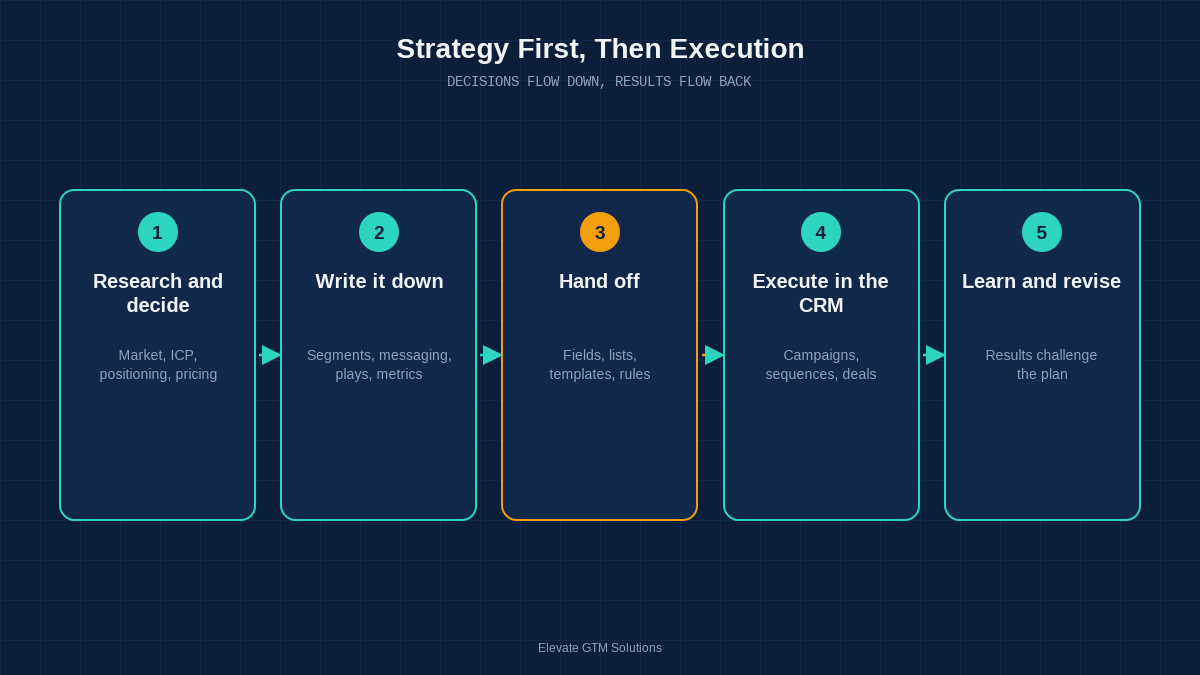
Most teams start go-to-market work in the wrong place. The CRM is open, the marketing automation tool is licensed, a campaign needs to go out on Monday, and so the "strategy" becomes whatever the first sequence or list happens to assume. Months later the team is arguing about why replies are low, why sales ignores the leads and why three regions describe the product three different ways. The CRM did exactly what it was told. Nobody had decided what it should be told.
If you are asking whether a platform exists that helps you build the strategy first, and then pushes the result into the tools where campaigns run, the short answer is yes, a small and growing group of products does that, and several other kinds of tools do part of it. This guide explains what "strategy before execution" actually produces, which categories of tools help, what to look for in one, how the handoff to a CRM works, what the platform should and should not do, and how to test a vendor's claim. We make a GTM strategy platform, so we have an interest in the answer. We say where a platform is the wrong choice, we do not state benchmark figures, and the worked example is invented.
Is there a GTM platform that builds the strategy before campaigns run in a CRM?
Yes. A GTM strategy platform is built to do the planning work that comes before campaign execution: market and customer research, ideal customer profile and segments, positioning and messaging, competitive context, pricing and channel choices, and the plan that connects them. It then hands the decisions to the systems that execute, such as your CRM, marketing automation and sales engagement tools. The CRM remains the system of record for contacts, accounts and deals. The platform is the place where the reasoning behind the campaigns lives. Other tools help with parts of this: market intelligence tools for research, ABM platforms for account selection, documents and spreadsheets for plans, and consultants for judgment. Whether a given platform really covers the strategy work, and hands it off cleanly, is something you have to test, not take from a feature page.
What should the handoff contain? Segments and target accounts, messaging by persona, plays and sequences to run, scoring and routing definitions, and the metrics that will judge the plan.
Does it replace the CRM? No. It sits upstream. The CRM keeps the records and runs the process.
The short version
| Question | Answer |
|---|---|
| Does such a platform exist? | Yes. GTM strategy platforms are built for the planning layer that comes before campaign execution |
| What does "strategy first" produce? | A written, shared set of decisions: who, why, what to say, where to compete, how to measure |
| What does it hand to the CRM? | Segments, account lists, messaging, plays, scoring and routing rules, and metrics definitions |
| Does it replace the CRM? | No. The CRM stays the system of record and the place work is executed |
| What else can do part of the job? | Market intelligence tools, ABM platforms, documents and spreadsheets, consultants |
| What should you test? | Whether strategy is generated and kept current, how the handoff works and who can change what |
| When is a platform the wrong choice? | When the strategy is already clear and the real problem is execution discipline or data quality |
Why strategy should come before campaigns
Starting in the CRM feels productive. There is a list, a template and a deadline. The trouble is that every campaign embeds decisions, and if you did not make those decisions deliberately, you made them accidentally.
A single outbound sequence quietly decides who you are targeting, what problem you claim to solve, what proof you offer, what you want the person to do and what you consider a good result. A webinar decides which topic you think matters. A lead score decides which behavior you consider a buying signal. Nobody voted on any of this, and the next person who builds a campaign will make a different set of accidental decisions.
Here is what that looks like in practice.
Different teams, different stories. Marketing describes the buyer as a director of operations. Sales chases the VP of finance. Customer success keeps hearing from the IT lead. Each group is working from a real slice of the truth, and the company has no agreed view.
Targeting by availability. Lists get built from what the data tool can export, not from a decision about who the best-fit customer is. The result is a lot of activity aimed at contacts who were easy to find.
Metrics that cannot tell you anything. If you never wrote down what a good outcome looks like for a segment, you cannot tell whether a campaign worked, only whether it ran.
Rework. When a campaign underperforms, the team changes the subject line. The real problem, such as the wrong segment or a message that does not match how buyers talk, stays in place because nobody can see it.
Doing the strategic work first does not mean a six-month planning project. It means that before a major campaign goes into the CRM, someone can answer a short list of questions on paper: who is this for, why would they care, why us, what do we want them to do and how will we know. A good platform shortens the time it takes to answer those questions and makes the answers visible to everyone who needs them. See what is a GTM strategy for the underlying concepts.
What a CRM is for, and what it is not for
A CRM is a system of record and a workflow engine. It stores who the contacts and accounts are, what has happened with them, what deals are open and who owns each piece. It enforces process: stages, required fields, assignments, reminders. It reports on what happened. That is a lot of value, and no other tool replaces it.
What a CRM is not built to do is decide what the company should sell, to whom and with what message. It has no view of the market beyond the records you put in. It cannot tell you that a segment you have never touched may be your best opportunity, or that your messaging contradicts the way buyers describe the problem in reviews. Some CRM vendors have added planning and AI features, and those can help, but the core design is record keeping and process, not strategy development.
Treating the CRM as the strategy tool leads to a familiar pattern: the strategy is whatever fits into the fields. If there is a picklist for industry, the plan is organized by industry, whether or not industry is how your buyers differ. For a more detailed comparison, see GTM platform vs CRM.
The cleaner division of labor is this:
- Upstream (strategy layer): research, decisions, reasoning, plans, messaging, definitions, assumptions.
- Downstream (execution layer): the CRM, marketing automation, sales engagement and customer success tools, where records live and work is performed.
- The handoff between them: a defined set of artifacts that move from upstream to downstream, and a feedback path for results coming back.
What "strategy before execution" actually produces
It helps to be concrete, because "strategy" is a word people use to avoid saying what they mean. A usable strategy layer produces specific artifacts. If a platform cannot produce and maintain these, it is not doing the job.
1. A defined market and a segment list
Which markets and segments you serve, in what order and why. Each segment has a short description, the problem it has, the size you estimate and the priority you assigned. See market sizing framework.
2. An ideal customer profile with reasons
Not a list of firmographic fields alone, but the characteristics that predict a good customer and the evidence behind them. See what is an ICP and the ICP scoring framework.
3. Positioning and messaging by audience
What you are, who it is for, what you do better than the alternatives and how that changes for each persona. See positioning.
4. Competitive context
Who you are compared against in real deals, what they claim and where you are honestly stronger or weaker. See what is competitive intelligence.
5. Pricing, packaging and channel choices
How you charge, which offers exist and how customers reach you: direct, partners, product-led or a mix. See how to price a new B2B product and product-led vs sales-led GTM.
6. The plan and the plays
The sequence of activities that connect the above: which plays run, for which segments, owned by whom, in what order, with what budget.
7. Success measures and assumptions
What numbers will judge each play, and what you believed when you started, so that results can confirm or challenge the beliefs. See GTM metrics and KPIs.
When these seven exist in one place and stay current, campaign building in the CRM becomes mostly translation. When they do not exist, campaign building becomes the strategy.
The kinds of tools that help, and what each does well
No single product is the only answer, and some of the tools you already own cover part of the work. Here is an honest map.
| Tool category | What it helps with | What it does not do well |
|---|---|---|
| GTM strategy platform | Builds and maintains the strategy layer; ties research, ICP, positioning and plans together; hands decisions to execution tools | Does not replace the CRM or run campaigns itself unless it includes execution features |
| Market and competitive intelligence tools | Research, competitor tracking, market signals | Usually stop at information. You still turn it into decisions and plans |
| ABM and intent platforms | Account selection, intent data, advertising to target accounts | Start from accounts, not from the whole strategy. See GTM platform vs ABM platform |
| CRM with planning or AI features | Records, process, forecasting, some AI assistance | Not built to develop strategy from market evidence |
| Documents, slides and spreadsheets | Flexible and familiar. Good for a small team with one author | Drift out of date, hard to connect to execution. See GTM spreadsheets vs a GTM platform |
| Consultants and agencies | Judgment, facilitation, outside experience | Cost, time and a risk that the work lives in a deck. See GTM platform vs GTM consultant |
| General AI assistants | Fast drafts and analysis of material you provide | No persistent shared model, no handoff to systems, quality depends on prompts and inputs |
A small company with one clear segment might do fine with documents and a good advisor. A company with several products, regions or teams usually finds that the strategy layer fragments quickly without something to hold it together. The right answer depends on how many people need the same decisions and how often those decisions change.
What to look for in a platform that builds strategy first
If you are evaluating tools in this category, these ten criteria separate platforms that genuinely cover the planning layer from products that added the word "strategy" to a feature page.
1. It starts from research, not a blank form. A strategy tool should help you gather and organize market, customer and competitor information, and show where the plan's claims come from. A tool that only gives you empty fields to fill is a template with a login.
2. It produces the seven artifacts above, not just a summary. Ask to see a segment list, an ICP with reasoning, messaging by persona, competitive context, a plan and success measures. Ask which are generated, which are edited by people and which stay empty until you fill them.
3. The outputs are connected. If you change the ICP, do the messaging and plan reflect it, or flag that they are now inconsistent? Disconnected documents drift. A shared model across modules is the point of a platform.
4. It shows its reasoning and its sources. A recommendation with no evidence is a guess. You want to see what the output is based on, so that a marketer or a skeptical executive can challenge it.
5. People can edit and override. The platform should accelerate judgment, not replace it. Check how edits are tracked and whether the system respects them when it regenerates.
6. It has a defined handoff to your execution tools. Ask which systems it connects to, which direction data moves, what objects it can create or update and what it cannot. "Integrates with your CRM" can mean anything from a deep sync to a CSV export.
7. It supports a feedback path. Results from execution, such as win rates by segment or response by message, should be able to flow back and challenge the plan. Otherwise the plan is a snapshot.
8. It handles governance. Who can approve a change to the ICP or messaging? Is there a history? Can regions adapt within limits? See the GTM platform governance checklist.
9. It is honest about what it cannot do. A good vendor will tell you where the product ends: it does not replace your CRM, it does not fix bad data and it does not remove the need for decisions. Be suspicious of a vendor who says it does everything.
10. It works with your data without a long project. If it takes a quarter to get value, you may have bought a services engagement. Ask what you will see in the first few days using your own product and market.
How the handoff to the CRM works
"Handoff" is where many strategy tools fall down, so it is worth being precise. There are three common patterns, and you should know which one a vendor offers.
Pattern 1: Export and import
The platform produces files or reports, and your team loads them into the CRM and other tools. It is the least integrated pattern and the one that needs the least setup. It works for small teams and for the first pilot. The risk is drift: after a few weeks the CRM and the strategy no longer match, and no one notices.
Pattern 2: One-way push
The platform writes selected decisions into the CRM or other tools on a schedule or on command. Typical items: account segments or tiers, custom fields recording the segment, target account lists, messaging snippets in a content library, and sequences or campaign shells. The platform stays the source of truth for strategy, and the CRM stays the source of truth for records. The risk is overwrite: if people edit the pushed fields in the CRM, the next push may erase their edits, so the rules must be clear.
Pattern 3: Two-way sync
Strategy decisions go down, and results come back up. For example, segment assignments and plays go to the CRM, and win rate, cycle time and campaign response by segment return to the platform. It is the most powerful pattern and the hardest to do well, because it needs agreed definitions and careful field mapping. Ask a vendor which objects and fields sync, how often, how conflicts are resolved and what the failure behavior is.
Whichever pattern you use, write down the contract: which fields the strategy layer owns, which the CRM owns and who resolves a disagreement. If you cannot say it in one page, the handoff is not designed yet.
What typically moves in a handoff
| Strategy artifact | Where it usually lands | Notes |
|---|---|---|
| Segments and tiers | Account fields in the CRM, lists, routing rules | Keep definitions identical in both systems |
| Target accounts | Lists, campaigns, ABM tools | Include why each is on the list |
| Messaging by persona | Content library, sequence templates, enablement tools | Version it so teams know which is current |
| Plays and sequences | Marketing automation, sales engagement | A play is more than an email. Include the trigger and the goal |
| Scoring and routing logic | CRM and automation rules | Document the reasons behind each rule |
| Metrics definitions | Dashboards and reports | Same definitions on both sides, or arguments follow |
| Assumptions to test | Strategy layer only | Used to judge results later |
A worked example, invented for illustration
Imagine a company that sells workflow software to mid-size logistics firms. This is invented to show the process, not a real case.
The team has a CRM and a marketing automation tool. For two quarters, campaigns were built directly in those tools. Results were uneven: some outbound sequences got replies from dispatchers who had no budget, while sales kept hearing that the real buyers were operations directors at firms with several depots.
They decide to build the strategy layer first, over two weeks, before launching the next campaign.
Week one. They gather what they have: closed-won and closed-lost deals, call notes, the customer list and what competitors say publicly. Using a strategy platform, they organize this into segments, and notice that customers with three or more depots renew at a different pace and describe the problem differently from single-depot firms. They write a first ICP that centers on multi-depot firms and records the evidence for it.
Week two. They draft positioning for operations directors and for finance, note the two competitors that appear in most deals, and choose one segment for the next quarter. They define a small set of metrics: meetings booked with operations directors at multi-depot firms, stage-two conversion and the time from first meeting to proposal. They record the assumption that multi-depot firms convert at a better rate, so they can check it later.
Handoff. The segment and tier are written into a field on the account record. A list of target accounts goes into the sales engagement tool. Messaging for the operations director goes into the sequence templates. The metrics definitions go into the dashboard.
Three months later. Results come back by segment. The assumption holds in one region and not in another, which prompts a revision. Nothing about this was magic. The difference is that when the numbers moved, the team could ask which decision to change, because the decisions were written down.
What the platform should not be expected to do
Being honest about limits makes the evaluation easier.
It will not fix your data. If the CRM has duplicate accounts, inconsistent industries and stale contacts, the strategy layer can describe how things should be, but the handoff will be messy. Plan some data cleanup in parallel.
It will not make the decisions for you. A platform can propose segments and messaging, but a person has to decide what the company is willing to be. If leadership cannot agree on the target customer, software will produce a polished version of the disagreement.
It will not replace sales judgment. Sellers know things about buyers that no system captures. Build in a way for that knowledge to reach the plan.
It will not guarantee results. A better plan improves the odds. It does not remove market risk, execution risk or the possibility that your product does not fit.
It will not replace the CRM, marketing automation or sales engagement tools. It sits upstream of them. If a vendor says its product replaces your CRM, test that claim as carefully as any other.
Questions to ask in a demo
Use your own product and market. Do not accept a scripted tour of a fictional company.
- Show me a strategy produced for a company like ours. What did the system generate, and what did a person have to write?
- Where does each recommendation come from? Can I see the sources?
- If I change our ICP, what happens to the messaging and the plan?
- Which tools do you connect to? For each, what moves, in which direction and how often?
- Can you write segment and tier data into our CRM? Can you read results back?
- What happens if someone edits a pushed field in the CRM?
- Who can approve a change to the ICP or the messaging, and where is the history?
- How do regional teams adapt a global plan, and how do you prevent drift?
- What will we see in the first week using our own data?
- What do customers usually still have to do outside the product?
- Which parts of the strategy are you weakest at?
- What does it cost to start, and what changes the price later? Confirm in writing.
For the longer version, see questions to ask AI GTM vendors.
Red flags
- "We replace your CRM, your marketing automation and your consultants." Be skeptical of anyone who claims to replace everything.
- No visible sources. Recommendations without evidence cannot be challenged.
- A demo that never leaves a fictional company. Insist on your own market.
- "Integrates with your CRM" with no detail. Ask which objects, which direction and which frequency.
- No edit history or approvals. In a company with several teams, that becomes chaos.
- Outputs that look generic. If the ICP and messaging could describe any company in your category, the tool is summarizing the internet, not building your strategy.
- Pressure to buy before a trial on your data.
Governance: who owns what
The platform is only useful if people know who owns each decision. A short ownership table prevents most arguments.
| Decision | Typical owner | Who is consulted |
|---|---|---|
| Target segments and ICP | Head of marketing or CRO, with product | Sales, customer success, finance |
| Positioning and messaging | Product marketing | Sales, customer success, product |
| Pricing and packaging | Product and finance leadership | Sales, marketing |
| Plays and campaign plan | Marketing and sales leaders jointly | RevOps, regional leads |
| CRM field and process design | RevOps | All teams that use the fields |
| Handoff rules and sync | RevOps with the platform owner | Marketing operations, IT |
See who owns GTM strategy and what is GTM operations for more on ownership.
A rollout plan that does not take a quarter
Days 1 to 5: define the first question. Choose one segment or one launch where the strategy is unclear. Resist the temptation to do the whole company.
Days 6 to 15: build the first version of the artifacts. Use the platform to gather evidence, draft the ICP, positioning, competitive context and plan for that one segment. Review with sales and customer success, who will catch what the data misses.
Days 16 to 25: set up the handoff for that segment. Add the segment field to the CRM, create the account list, load the messaging and define the metrics. Start with export or one-way push. Add sync later if it proves worth it.
Days 26 to 45: run and watch. Keep the campaign small enough to learn from. Record what you expected.
Days 46 to 60: compare and revise. Check results against the assumptions. Change the strategy layer first, then the campaigns.
After that: extend to the next segment and make the review a regular rhythm. See continuous GTM optimization.
How to tell whether strategy-first is working
Do not judge it by whether the plan looks impressive. Judge it by what changes.
- Decision speed. How long does it take to answer "who is this campaign for and what do we say?"
- Consistency. Do marketing, sales and customer success describe the buyer and the value in compatible ways?
- Rework. Are fewer campaigns rebuilt because the target or message was wrong?
- Traceability. When a campaign underperforms, can the team point to the decision that should change?
- Results by segment. Are the segments you chose to prioritize performing differently from the ones you did not?
- Adoption. Do sellers and marketers actually open the strategy, or is it another document nobody reads?
Results will also depend on your market, your product and your team, so do not credit the platform with everything, and do not blame it for everything either. See how to measure GTM strategy success.
Common mistakes
Buying the platform before deciding who owns the strategy. Without an owner, the tool fills with drafts that nobody approves.
Trying to model the whole company first. Start with one segment or launch and extend.
Treating the handoff as an afterthought. If the strategy never reaches the CRM in usable form, the platform becomes a nicer document.
Letting the CRM and the strategy layer disagree. Pick which one owns each field and stick to it.
Skipping sales and customer success review. They hold the closest knowledge of real buyers. A plan they have not seen will meet resistance.
Expecting the AI to be right without checking. Generated strategy is a draft that needs challenge, especially in unusual markets.
Confusing activity with strategy. A busy campaign calendar is not a plan. A plan explains why those campaigns and not others.
Never updating it. A strategy that is not revisited after the first quarter becomes the same stale deck you had before. See the death of static GTM strategy.
Glossary
Strategy layer. The set of decisions and reasoning about market, customer, positioning, competition, pricing, channels and plans that precedes and guides execution.
Execution layer. The tools and teams that carry out campaigns and sales work, such as the CRM, marketing automation and sales engagement.
System of record. The authoritative source for a type of data. For contacts, accounts and deals, usually the CRM.
Handoff. The movement of strategic decisions from the strategy layer into the execution tools, in a defined form.
Sync. Automatic exchange of data between systems, one-way or two-way.
ICP. Ideal customer profile: the description of the customers who are the best fit and why.
Play. A defined, repeatable set of actions aimed at a segment or situation, with an owner, a trigger and a goal.
Segment. A group of customers or prospects treated alike for GTM decisions.
Assumption. A belief you hold when you make a decision, written down so results can test it.
Where Elevate GTM Solutions fits
Elevate GTM Solutions is an AI GTM platform for creating, executing and adapting go-to-market strategy. Its homepage describes modules including "Unified GTM Strategy," "Market Research," "ICP & Segmentation," "Competitive Intelligence," "Product Positioning," "Product Messaging," "Pricing Strategy," "Distribution Channel Strategy," "Launch & Execute" and "Measure & Optimize," and it names Marketing, Sales, Product and RevOps as its audience. The homepage says "15 connected GTM modules" and names sixteen, so count what you see when you look. It also describes a free strategy you can generate in about five minutes, which makes it practical to see what the platform produces for your own product before you commit to anything.
That module list lines up with the strategy artifacts above: research, segments, positioning, messaging, competitive context, pricing and channels, then execution and measurement. The design intent is a shared model across the modules, so a change in one reflects in the others.
Two honest notes. First, the handoff is the part to test. Third-party directory listings mention a short list of integrations, so confirm on the vendor's own integrations page which tools it connects to, what data moves and in which direction, before you plan around a specific connection. Second, the platform does not replace your CRM, marketing automation or sales engagement tools, and it does not fix data quality or settle internal disagreements about the target customer. For more, see what Elevate GTM Solutions is and Elevate vs HubSpot or Elevate vs Salesforce for how it sits beside a CRM.
What to do this week
- List the last three campaigns you ran. For each, write who it targeted, what it claimed and how success was defined. Note which answers were never written down.
- Draft the seven strategy artifacts for one segment on one page each, even roughly.
- Decide who owns each decision, using the ownership table.
- Map what would move from the strategy layer to the CRM and other tools, and in which direction.
- Choose the handoff pattern you can run now: export, one-way push or sync.
- If you evaluate a platform, run the demo with your own product and market, and ask the twelve questions.
- Pick one metric per segment and write the assumption you expect it to confirm.
- Book a review with sales and customer success before anything is loaded into the CRM.
Key takeaways
- A GTM strategy platform is built to produce the planning layer before campaigns run: research, segments, ICP, positioning, messaging, competitive context, pricing, channels and plans.
- It hands decisions to the CRM and other execution tools. It does not replace them.
- Starting in the CRM turns accidental decisions into strategy, so write the decisions down first, even briefly.
- Other tools cover parts of the job: market intelligence, ABM platforms, documents and consultants. The right mix depends on how many people share the decisions.
- Look for research-based outputs, connected artifacts, visible sources, editability, a defined handoff, a feedback path and governance.
- The handoff comes in three patterns: export, one-way push and two-way sync. Know which one you are getting and write down which system owns each field.
- Test claims with your own market, use the demo questions and watch for the red flags.
- Start with one segment, measure by decision speed and consistency as well as results, and revise the strategy before you rewrite the campaigns.
Sources
- Elevate GTM Solutions: descriptions of modules, audience and the free strategy offer, as stated on the company's homepage.
- Related Elevate guides linked in the text, including GTM platform vs CRM, what is a GTM strategy and the GTM platform governance checklist.
- The tool categories, criteria, handoff patterns and rollout plan reflect our judgment and common practice. We cite no benchmarks.
- The worked example is invented for illustration. Integration details for any vendor, including Elevate, should be confirmed on that vendor's own site.
Frequently Asked Questions
Is there a GTM platform that helps create a strategy before running campaigns in a CRM?
Yes. GTM strategy platforms are designed for the planning layer: research, ICP and segments, positioning and messaging, competitive context, pricing and channel choices and the plan. They then pass decisions to the CRM and other tools. Test how well any specific product does this, especially the handoff.
Why not just plan in the CRM?
A CRM is built for records and process, not for developing strategy from market evidence. Planning inside it tends to produce a strategy shaped by the fields available. A separate strategy layer keeps the reasoning visible and lets you change decisions without rebuilding records.
What should a GTM strategy platform hand off to the CRM?
Segments and tiers, target account lists, messaging by persona, plays and sequences, scoring and routing definitions and metric definitions. Keep the definitions identical in both systems so reports agree.
Does a GTM strategy platform replace my CRM?
No. The CRM remains the system of record for contacts, accounts and deals and the place sales work is done. A strategy platform sits upstream of it. Be cautious about any vendor who says it replaces your CRM.
How is a GTM strategy platform different from a market intelligence tool?
Market intelligence tools mainly collect and organize information about markets and competitors. A strategy platform aims to turn information into decisions and plans, connect them and pass them to execution. Some products do both to different degrees.
How is it different from an ABM platform?
ABM platforms start from accounts: selecting them, finding intent and advertising to them. A strategy platform starts earlier, with the market, ICP, positioning and plan that decide which accounts matter. See GTM platform vs ABM platform.
Can I do this with documents and spreadsheets?
For a small team with one clear segment and one author, often yes. The problems appear when several people need the same decisions, when things change often or when the plan has to connect to execution. Documents drift, and nothing links them to the CRM.
How long does it take to get value?
That depends on the platform, your data and how clear your strategy already is. A good test is what you can see in the first week using your own product and market. If the answer is a long implementation project, ask what you are paying for.
What is the biggest risk with this kind of platform?
Treating generated output as finished. The platform can draft quickly, but people must challenge it, add what sellers and customers know and decide what the company will commit to. The second risk is a handoff nobody designed, so the strategy never reaches the CRM in usable form.
How do I keep the CRM and the strategy from drifting apart?
Decide which system owns each field, keep metric definitions identical, review the handoff on a schedule and assign an owner. If you use a one-way push, set clear rules about editing pushed fields in the CRM.
Who should own the strategy layer?
Usually a leader in marketing or revenue with input from product, sales and customer success, plus an operations owner for the handoff. If nobody owns it, it will fill with unapproved drafts.
Should I start with one segment or the whole company?
Start with one segment or one launch. It is faster, easier to review and gives you evidence about whether the platform and the handoff work. Extend after you have seen the process through once.