
By the Elevate GTM Solutions Team · Updated November 13, 2026 · 28 min read
Does Social Media and Community Influence B2B Buying Decisions, and Which Channels Actually Matter?
For years the standard advice was that B2B buyers use LinkedIn and little else. Marketing teams built their social plans around it, and the other platforms were left to consumer brands. Recent analyst research tells a more complicated story. Buyers cite a wider set of platforms than most B2B marketers use. They say they look to social media for interaction and validation, not just information. And the rankings differ depending on which survey you read, how the question was asked and who answered.
This page explains what the research says about whether social media and community influence B2B buying decisions, why the platform rankings are less reliable than they look and how a go-to-market team can build a practical plan without chasing every channel. The evidence is analyst research, mainly Forrester's 2026 buyer insights on social media and its work on influencers, and Gartner's 2023 survey of 771 buyers. For each source we say who was asked, when and how many, and what it cannot tell you. Then we add our own reading, clearly labeled, and describe where a go-to-market platform like ours can help and where it cannot.
A disclosure. We make Elevate GTM Solutions, a go-to-market strategy platform. We do not sell a social media management, social listening or community product, and we have no social data of our own. We read Forrester's January 2026 social media blog and its November 2025 influencer blog in full, and Gartner's June 2023 release in full. Other items we saw only as excerpts or abstracts, which we flag. Our examples are invented and labeled.
Does social media and community influence B2B buying decisions?
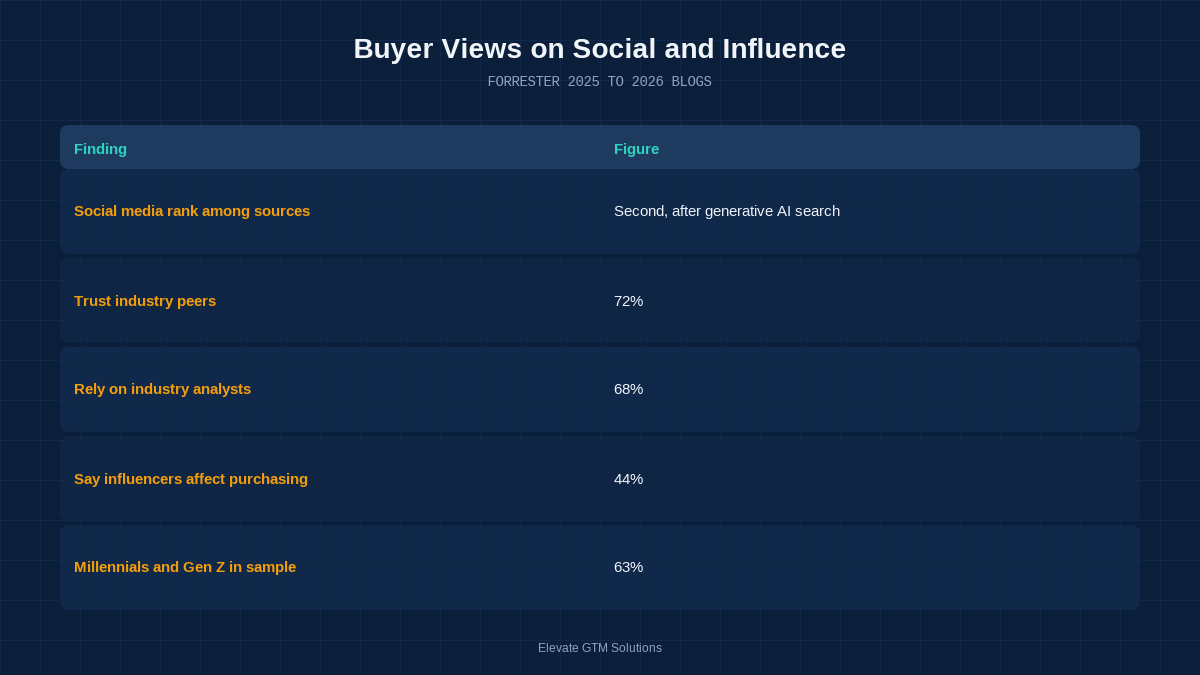
Yes, according to the analyst surveys we could read, but the platform rankings are inconsistent and the evidence on how much social drives a purchase is thin. Forrester's January 2026 blog, based on its 2026 Buyer Insights report covering more than 17,000 global business buyers, says social media is the second most meaningful information source for B2B buyers, behind generative AI search tools, and the highest-ranking digital channel vendors can publish to directly, ahead of websites. Buyers cite Facebook, Instagram, YouTube and LinkedIn most often as meaningful, in that order, and Millennials and Gen Z make up 63% of surveyed buyers. Gartner's June 2023 survey of 771 buyers ranked YouTube first, followed by Facebook, Instagram, Twitter, LinkedIn and TikTok. Forrester's November 2025 influencer blog says 72% of B2B buyers trust peers in their industry, 68% rely on industry analysts for unbiased insights and 44% say social media influencers affect their purchasing. None of these measures how many deals social channels create. They show that buyers use and value social platforms, and that peers and experts are among the voices they listen to.
Is LinkedIn enough for B2B? The rankings in both Forrester and Gartner place other platforms ahead of LinkedIn by how often buyers cite them, though Forrester asks whether that reflects platform size more than B2B value.
Does social media drive pipeline? The sources we could read do not say. They measure influence on information and validation, not sourced deals.
The short version
| Question | Answer |
|---|---|
| Forrester, January 2026 | Social media is the second most meaningful information source for buyers, behind generative AI search tools; based on a report covering more than 17,000 global business buyers |
| Platform order by meaningful citations (Forrester) | Facebook, Instagram, YouTube, LinkedIn; Reddit and Discord matter for technical depth and peer trust |
| Who is buying | Millennials and Gen Z are 63% of surveyed buyers; over half of Gen Z buyers find five or more social sites meaningful, versus 21% of Boomers |
| Gartner, June 2023 (771 buyers, November to December 2022) | YouTube led, then Facebook, Instagram, Twitter, LinkedIn and TikTok; Gartner's analyst said social channels are extremely underleveraged by B2B brands |
| Forrester, November 2025 | 72% of buyers trust industry peers, 68% rely on analysts, 44% say social media influencers affect their purchasing |
| What buyers want | Interaction and validation, content that defines the problem and its consequences, and voices from analysts, vendors, customers and leaders |
| What is missing | Evidence of how many deals or how much pipeline social channels produce |
| Main limit | Platform rankings differ by survey and may reflect platform size; the Forrester report is paywalled and we saw only the blog |
What "social media and community" covers in B2B
The words hide several different things, and the research is easier to use when you separate them.
Public social platforms. LinkedIn, YouTube, Facebook, Instagram, X (formerly Twitter) and TikTok. Buyers see posts and videos from vendors, customers, analysts and creators.
Niche communities. Reddit, Discord, Slack groups, forums and private peer networks. Forrester says these matter for technical depth and peer trust.
Creators and influencers. Individuals with an audience in a professional niche. Forrester's analysts say influencers are now a significant source of perspective for B2B buyers.
Employee and executive voices. Staff and leaders posting in their own names.
Customer voices. Reviews, replies and posts from people who use the product. We cover this in do customer advocacy and referrals drive B2B pipeline.
Vendor-owned social. The company's own pages and channels.
These do different jobs. A vendor page lets you publish. A community lets buyers talk to each other, where you may not be present. A creator lends their credibility. Treating them as one "social" budget line is the first mistake.
Why this belongs in a go-to-market plan
A go-to-market plan has to say where the target buyers learn and who they trust. If the answer is "in places we do not show up, from people we do not know," the plan has a gap that no amount of sales effort will close later.
Social and community also sit upstream of the shortlist. Buyers who form early preferences, which we cover in whether B2B buyers choose vendors before they talk to sales, form them partly through what they see and who they hear from. Social channels are one of the places that happens.
The evidence: Forrester's 2026 social media findings
The source is a Forrester blog dated January 27, 2026, by principal analyst Karen Tran, titled "Social Media Takes Center Stage In B2B Buying, Even In The AI Era." We read it in full. It summarizes a report called "2026 Buyer Insights: Social Media Preferences," which the blog says draws on data from more than 17,000 global business buyers. The blog gives no further method.
The main findings. Social media is the second most meaningful information source for B2B buyers, behind generative AI search tools. The article says buyers "crave human validation and trusted connections." It is the highest-ranking digital channel on which vendors can publish directly, ahead of websites. Millennials and Gen Z make up 63% of the surveyed buyers. More than half of Gen Z buyers find five or more social sites meaningful, compared with 21% of Boomers.
The platforms. By how often buyers cite them as meaningful, the order is Facebook, Instagram, YouTube and LinkedIn. Tran notes that LinkedIn has about one billion active users versus Facebook's roughly three billion, and asks whether the ranking reflects diverse validation sources or simply platform presence. She says most marketers see their biggest impact from LinkedIn. TikTok is gaining traction with younger buyers, and Reddit and Discord matter for technical depth and peer trust.
What buyers expect. They want engagement with analysts, vendors, customers and business leaders at every stage. Analysts rank highest among the voices buyers want to hear. They prioritize content that defines the problem and its consequences, not just product details.
The advice. Avoid a one-size-fits-all approach and tailor social strategy by generation, role and industry. Invest in thought leadership, influencer relations and advocacy programs. Consider messaging and format, since short-form video is becoming the standard.
What we could not confirm. The blog does not give survey dates, response rates or the question wording. "Meaningful" is the buyer's own judgment, not a measure of what led to a purchase. The ranking reflects how often a platform is cited, which depends on how many buyers use it. Forrester sells research to marketers and has an interest in social being seen as important.
The evidence: Forrester on influencers
In a November 10, 2025 blog titled "It's Time To Reinvent B2B Influencer Relations," Forrester analysts Ian Bruce and Karen Tran cite Forrester's Buyers' Journey Survey, 2025. We read it in full. The article does not state the sample size.
The numbers. 72% of B2B buyers trust peers in their industry, 68% rely on industry analysts for unbiased insights and 44% say social media influencers affect their purchasing. The article says the survey found that industry experts are often the trigger for buyers to engage vendors, and that external commentary can also stall purchases.
The advice. Map influence across the customer lifecycle, identifying the influencers who shape buyers during discovery, evaluation, commitment and after the sale. Prioritize influencers by trust, relevance and reach. Build mutually beneficial relationships in which influencers gain access to insights and vendors gain credibility. The article argues that influencer engagement should be a core part of brand and demand strategy, not an occasional activity.
What we could not confirm. We cannot see the survey wording or the sample. A buyer saying influencers affect their purchasing does not tell us how much, or whether the influencer was paid, independent or a customer. The advice partly serves Forrester's own analyst-relations and influencer-relations research business.
The evidence: Gartner's 2023 survey on social platforms
Gartner's June 8, 2023 release, "Gartner Marketing Survey Finds B2B Buyers Value Third-Party Interactions More Than Digital Supplier Interactions," covered 771 B2B buyers in November and December 2022. We read it in full. The release says YouTube was the top social media channel influencing a recent B2B purchase decision, followed by Facebook, Instagram, Twitter, LinkedIn and TikTok. The text gives no percentages. A trade article that reproduced the release's figure lists YouTube at 65%, Facebook at 60%, Instagram at 55%, Twitter at 48%, LinkedIn at 43%, TikTok at 22%, Quora at 18% and Reddit at 16%. We saw those numbers only in that article, not in Gartner's text, so we treat them as indicative.
Gartner's Rick LaFond said social channels are extremely underleveraged by B2B brands, and the release advises using social to show how a brand meets customers' needs and pain points at each buying stage, not only for short brand videos, and not relying only on third parties for social strategy.
A 2025 Gartner abstract, "Improve Engagement From B2B Buyers On Social Media," begins with the summary that 90% of B2B buyers use social media when considering a purchase. We saw only that line, through a search result, and could not open the document, so we do not know the sample or method.
How the two analyst surveys compare
Both Forrester and Gartner rank YouTube, Facebook and Instagram above or alongside LinkedIn by how often buyers say a platform informed or mattered to a purchase. The orders differ: YouTube led in Gartner's late-2022 survey and Facebook led in Forrester's 2025 survey. Both are "buyers who cited the platform," not "time spent" or "deals influenced."
A few reasons the rankings should not be taken as a channel plan:
- Size. Facebook and YouTube have far larger audiences than LinkedIn. A higher share citing them may reflect that more people use them, as Tran notes.
- Wording. "Informed a decision," "meaningful" and "influenced" are different questions.
- Sample. The mix of buyers by age, role and country shifts the result. Forrester says 63% of its respondents are Millennials or Gen Z.
- Date. The Gartner survey is from late 2022 and the Forrester one from 2025. Platforms and habits have changed.
- Purpose. Buyers might use Facebook groups to ask peers and LinkedIn to check a vendor's credentials. Citation counts hide the difference.
Use the rankings to widen your thinking, not to replace judgment about where your own buyers are.
Numbers that circulate, and that we could not trace
"78% of social sellers outsell peers who do not use social media." This is a widely quoted figure attributed to LinkedIn's sales solutions group. It comes from a platform that sells social selling tools. We could not locate its method and do not use it.
"LinkedIn has 65 million decision-makers." This is LinkedIn's own marketing figure, from the company that sells advertising to reach them. It is a platform claim, not a buyer survey.
"Personal profiles earn 63% higher engagement than company pages." It comes from a vendor study cited in a roundup. Engagement is not influence, and we could not check the method.
"91% of buyers use industry influencers." LinkedIn's "Business of Influence" research, which LinkedIn commissioned from GWI among more than 1,700 B2B technology buyers in the United States, United Kingdom and India, reports statistics among respondents who use industry influencers, which it says is 91% of the overall sample. It is commissioned by a platform that sells advertising, covers technology buyers in three countries and reports sub-group percentages. We saw it through LinkedIn's own announcement and cite it only as an example of vendor research.
"94% of buyers use large language models in buying." This appears in a roundup citing 6sense. We could not confirm it, and a more careful recap of that study says it did not report buyers' own AI use.
The pattern is that the platforms themselves, and the vendors who sell tools for them, publish the most striking numbers. Independent analyst surveys are more modest, and more useful.
How much weight the evidence can carry
It is strong on the direction. Two independent analyst firms say buyers use and value social channels, and Forrester says they value the interaction and validation more than the information.
It is weak on outcomes. None of the sources shows how many deals or how much pipeline social produces.
Platform rankings are fragile. They depend on audience size, wording, sample and date.
The Forrester detail is behind a paywall. We read the blogs but not the reports, so we could not check the method.
Buyer age skews the picture. Forrester's sample is 63% Millennials and Gen Z. If your buyers are older or in a conservative sector, the picture may differ.
Analysts and platforms have interests. Forrester and Gartner sell to marketers, and platform vendors sell reach.
Elevate's reading
Our interpretation, not data.
One. Social is where buyers go for people, not just information. Forrester's phrase, human validation and trusted connections, matches how most of us use these platforms. A plan built only on broadcasting misses the point.
Two. Start with where your own buyers are. Ask recent customers where they looked and whom they asked. The surveys say which platforms are cited in general. Your segment may live in a niche community or a private group.
Three. Peers and experts matter more than your own page. Seventy-two percent trusting industry peers and 68% relying on analysts, in Forrester's data, says that the voices you do not control carry weight. That is why advocacy, analyst relations and creator relationships are part of social.
Four. Content should define the problem. Forrester says buyers prioritize content that defines the problem and its consequences, not only product features. This favors teaching and point of view over announcements.
Five. Pick few channels and do them well. Gartner says B2B brands underuse social. That is not a case for being everywhere. Choose the two or three places where your segment is and keep a steady presence.
Six. Be careful about measurement. Social influence is hard to attribute. Track what you can, such as reach in your target accounts, branded searches, mentions in win and loss interviews and referral sources, and accept that the rest is inferred.
What this means for different roles
Chief executive or founder. Your own voice is one of your strongest channels. Decide whether you will use it consistently.
CMO or head of marketing. Audit where your target buyers actually are, then pick channels by segment. Tie social to the same positioning as the rest of your marketing.
Head of sales. Encourage sellers to engage authentically with buyers and communities, with clear guidance on what to say. Do not make it a quota activity.
Product marketing. Produce content that defines the problem and its consequences for each role in the buying group.
Community or customer marketing. Support customers who talk about you, give them access and keep them informed. See our page on customer advocacy.
Analyst and influencer relations. Map the experts and creators who shape your buyers, and build relationships that give them something of value.
Legal and compliance. Review rules on endorsements, paid partnerships, employee posting, data use and regulated claims. Many places require disclosure when creators are paid. This page is not legal advice.
A worked example, invented for illustration
Imagine a software company selling data integration tools to engineering teams at mid-sized companies. It posts product news on LinkedIn and gets modest engagement. The head of marketing reads that buyers cite many platforms and asks where her buyers actually spend time.
She interviews fifteen recent customers. Ten say they asked questions in a technical forum or a Discord server. Eight read a handful of independent engineers' newsletters and videos. Only four say they saw the company's LinkedIn posts. Several say the first clear explanation of their problem came from a creator's video, not a vendor.
The company changes its approach. It stops posting product news as its main content. Its engineers write short explainers on the problems customers described, and the company shares them where its buyers gather, answering questions directly. It builds relationships with three independent creators in its niche, offering early access and a place to interview its customers, with clear disclosure. It asks five customers to talk about their experience in the forum.
The team tracks mentions in win and loss interviews, branded search volume among target accounts, questions answered in the forum and referral sources recorded in the CRM. We make no claim about what a real company would find. The example shows the pattern: learn where buyers go, teach where they already are and support the people they trust.
How a go-to-market platform can help, and where it cannot
Elevate GTM Solutions is a go-to-market strategy platform. As described on our homepage, its modules cover customer segmentation, positioning, messaging, account-based marketing, customer acquisition, sales enablement, measurement and more, within a unified strategy. It is not a social media scheduler, listening tool or community platform.
Here is how that relates to the research, without overclaiming.
Choosing channels by segment. Segmentation and ideal customer profile work can state where each segment learns and whom it trusts, so channel choices follow the audience and not fashion.
Keeping the message consistent. Positioning and messaging held in one connected place help social, sales and advocacy content say the same thing.
Planning content around buyer jobs. A plan can map the problem-definition content, the validation content and the proof points to each role in the buying group. That depends on the team maintaining it.
Visibility. A weekly pulse and executive dashboards can show whether the planned actions are happening. We have no data showing improved social results.
What it cannot do. It does not publish posts, monitor conversations, run communities or measure social influence. It does not tell you where your buyers are. We have no Elevate customer data on social outcomes. For questions to ask any vendor, see questions to ask AI GTM vendors.
Questions to ask before investing in social and community
- Where did our last twenty customers look and whom did they ask before contacting us?
- Which two or three channels do our segments actually use?
- Who are the peers, analysts and creators our buyers trust?
- Does our content define the problem, or only describe the product?
- How are we present in communities where buyers talk to each other?
- Who speaks for the company, and in what voice?
- How do we support customers who talk about us?
- What rules apply to paid creators, employees' posts and regulated claims?
- How will we measure influence honestly, given that attribution is weak?
- What would make us stop a channel?
Common mistakes
Choosing channels from a ranking. Platform rankings reflect audience size and wording.
Broadcasting product news. Buyers say they want interaction, validation and content that defines the problem.
Being everywhere. A few channels done consistently beat a thin presence on many.
Ignoring communities you do not own. Peer conversations happen where you may not be present.
Treating influencers as ad inventory. Forrester advises mutually beneficial relationships, not one-off purchases of reach.
Forgetting disclosure. Paid and sponsored content often requires clear labeling.
Measuring only vanity metrics. Likes are not influence. Ask buyers what shaped their view.
Assuming all your buyers are young. Forrester's sample is 63% Millennials and Gen Z. Check your own.
What to do this week
Ask five recent customers: where did you look, whom did you ask and what was the first thing you read that explained your problem well? Write down the answers and pick one channel where you can be useful next month.
How to run a simple buyer-channel audit
A short audit gives you evidence for your own segments.
- Choose a sample. Ten to fifteen recent customers across your main segments, and a few who chose a competitor.
- Ask where they looked. Which platforms, communities, newsletters, videos and people helped them understand the problem and the options?
- Ask whom they trusted. Peers, analysts, creators, customers, reviewers?
- Ask what stuck. What was the most useful piece of content or conversation, and why?
- Ask where they were disappointed. Where did they look and find nothing useful about your category or about you?
- Map by role. Note differences between technical evaluators, budget holders and users.
- List the gaps. Where are your buyers and you are absent? Where are you present and they are not?
- Choose a small number of bets. Two or three channels or relationships to invest in for a quarter.
- Review. Ask the next ten customers the same questions and see what has changed.
The result is a more reliable guide than any platform ranking.
How to participate in communities without spoiling them
Communities have norms, and brands that ignore them are quickly shut out.
Read first. Spend time understanding what the community values and what it dislikes.
Be useful before you are visible. Answer questions, share data and explain trade-offs without a sales pitch.
Use real people. Let the engineers, product people and customer success staff who know the answers speak, with their own names and a clear affiliation.
Disclose. Say who you work for.
Do not astroturf. Fake customer voices and undisclosed employees posing as users damage trust and can break rules.
Respect the rules. Many forums limit promotion. Follow them.
Listen and report back. Bring what you hear to product and marketing.
Be patient. Reputation in a community builds slowly.
How to decide how much to invest
Social and community work competes with other uses of a small team. A simple way to size it:
Start with a floor. Keep your own pages accurate and your executives and subject experts visible on the one channel your segment uses most. This costs mostly time.
Add one community bet. Pick one forum, group or newsletter community where your buyers ask questions and commit to answering there weekly for a quarter.
Add one relationship bet. Pick two or three creators, analysts or customer voices your buyers trust, and offer them something useful, such as early access, data or an interview.
Hold back paid amplification. Boost only content that has already earned attention organically and that matches your positioning.
Review at ninety days. Look at questions answered, mentions in buyer interviews, branded search from target accounts and referral sources. Keep what worked, drop what did not.
This keeps effort proportional to the evidence, which supports influence but does not show a return.
Glossary
Social media. Online platforms where people publish and interact, such as LinkedIn, YouTube, Facebook and Instagram.
Community. A group of people who talk to each other around a shared interest, often in forums, chat servers or private networks.
Influencer or creator. An individual with an audience in a professional niche whose views carry weight.
Peer. Someone in a similar role or industry, whose view a buyer trusts as independent of a vendor.
Validation. A buyer's need to check a view with trusted others before committing.
Social listening. Monitoring public conversations about a topic or brand.
Thought leadership. Content that offers a point of view or insight, not only product information.
Attribution. Assigning credit for a result to a source, which is difficult for social influence.
Where Elevate GTM Solutions fits
Elevate GTM Solutions is a go-to-market strategy platform that its homepage describes as a way to build, execute and evolve strategy, with connected modules and a flow from insights and strategy context to a strategy builder, workflow engine, activation, playbooks, weekly pulse and executive dashboards. It speaks to this research in a narrow way: it can hold the choices about which segments to reach, through which channels, with what message, and keep them consistent. It does not publish or monitor social content. For related reading, see how much time B2B buyers spend with sellers and how B2B buyers use AI and sales reps.
Key takeaways
- Forrester's January 2026 blog, based on a report covering more than 17,000 global business buyers, says social media is the second most meaningful information source for buyers, behind generative AI search tools, and the top digital channel vendors can publish to directly.
- Buyers cite Facebook, Instagram, YouTube and LinkedIn most often as meaningful in Forrester's data, and YouTube first in Gartner's 2023 survey of 771 buyers. The rankings reflect audience size, wording, sample and date.
- Forrester says 72% of buyers trust industry peers, 68% rely on analysts and 44% say social media influencers affect their purchasing.
- Buyers want interaction, validation and content that defines the problem, from analysts, vendors, customers and leaders.
- We found no independent evidence of how many deals or how much pipeline social channels produce.
- The practical response is to learn where your own buyers go, teach where they already are, support peers and experts they trust and measure honestly.
Sources
- Forrester, Karen Tran, Social Media Takes Center Stage In B2B Buying, Even In The AI Era, blog, January 27, 2026 (summarizes the report 2026 Buyer Insights: Social Media Preferences; more than 17,000 global business buyers).
- Forrester, Ian Bruce and Karen Tran, It's Time To Reinvent B2B Influencer Relations, blog, November 10, 2025 (cites Buyers' Journey Survey, 2025; sample not stated).
- Gartner, Gartner Marketing Survey Finds B2B Buyers Value Third-Party Interactions More Than Digital Supplier Interactions, press release, June 8, 2023 (771 buyers, November to December 2022).
- MediaPost, Hotshot advice: third-party sources help sell B2B, trade article (search excerpt only; source of the platform percentages).
- Gartner, Improve Engagement From B2B Buyers on Social Media, insights abstract, March 25, 2025 (summary line seen in a search result only; the page could not be opened).
- Forrester, 2026 Buyer Insights: Social Media Preferences, data overview report (paywalled; description only).
- LinkedIn, Helping Brands Engage and Influence Buyers with New Advertising Capabilities, October 2024 (vendor-commissioned research by GWI of more than 1,700 B2B technology buyers; search excerpt only).
Frequently Asked Questions
Does social media influence B2B buying decisions?
Analyst surveys say yes. Forrester's January 2026 blog, based on a report covering more than 17,000 global business buyers, calls social media the second most meaningful information source behind generative AI search tools. None of the sources we could read shows how many deals social channels produce.
Which social platforms matter most for B2B?
It depends on the survey. Forrester's 2025 data have buyers citing Facebook, Instagram, YouTube and LinkedIn most often as meaningful, while Gartner's 2022 fieldwork put YouTube first. Rankings reflect audience size, wording and sample, so ask your own buyers where they go.
Is LinkedIn enough for B2B marketing?
The analyst rankings suggest not by itself, but they may reflect platform size. Forrester's analyst asks whether the order reflects diverse validation sources or simply platform presence, and says most marketers see their biggest impact from LinkedIn. Choose channels by where your segment is.
What do buyers want from social media?
Forrester says buyers want interaction and validation, engagement with analysts, vendors, customers and business leaders at every stage and content that defines the problem and its consequences, not only product details. Analysts rank highest among the voices buyers want to hear.
How much do buyers trust peers and influencers?
Forrester's November 2025 blog says 72% of B2B buyers trust peers in their industry, 68% rely on industry analysts for unbiased insights and 44% say social media influencers affect their purchasing. The sample size is not stated, and the figures show influence on views, not purchases.
Do younger buyers change the picture?
Forrester says Millennials and Gen Z make up 63% of the buyers it surveyed and that over half of Gen Z buyers find five or more social sites meaningful, versus 21% of Boomers. If your buyers skew older or work in conservative sectors, the picture may differ.
Are communities like Reddit and Discord relevant to B2B?
Forrester says niche communities on Reddit and Discord matter for technical depth and peer trust. They are most relevant when your buyers are technical practitioners. Follow each community's rules and disclose who you are.
Can we measure the impact of social media on pipeline?
Only partly. Influence is hard to attribute. Track reach in target accounts, branded search, mentions in win and loss interviews and referral sources, and accept that much of the effect is inferred. Be wary of vanity metrics and vendor-published statistics without a method.
Should we pay creators and influencers?
Forrester advises mutually beneficial relationships in which influencers gain something useful, such as access to insights, and vendors gain credibility. Rules on disclosure of paid partnerships vary by country, so have counsel review. This page is not legal advice.
Can a go-to-market platform help with social and community?
It can help you decide which segments to reach through which channels and keep messaging consistent across them. Elevate GTM Solutions is a strategy platform. It does not publish posts, monitor conversations or measure social influence, and we have no data showing improved social results.
What should we do first?
Ask five recent customers where they looked, whom they asked and what first explained their problem well. Use the answers to pick one channel or community where you can be useful next month.
How many social channels should a B2B team use?
The research does not give a number. A practical approach is a floor on the one channel your segment uses most, one community where you answer questions weekly and two or three trusted creators or analysts to build relationships with, reviewed at ninety days.