
By the Elevate GTM Solutions Team · Updated November 13, 2026 · 28 min read
What Are the Risks of Using Generative AI in B2B Go-to-Market, and How Do You Govern It Without Slowing Everyone Down?
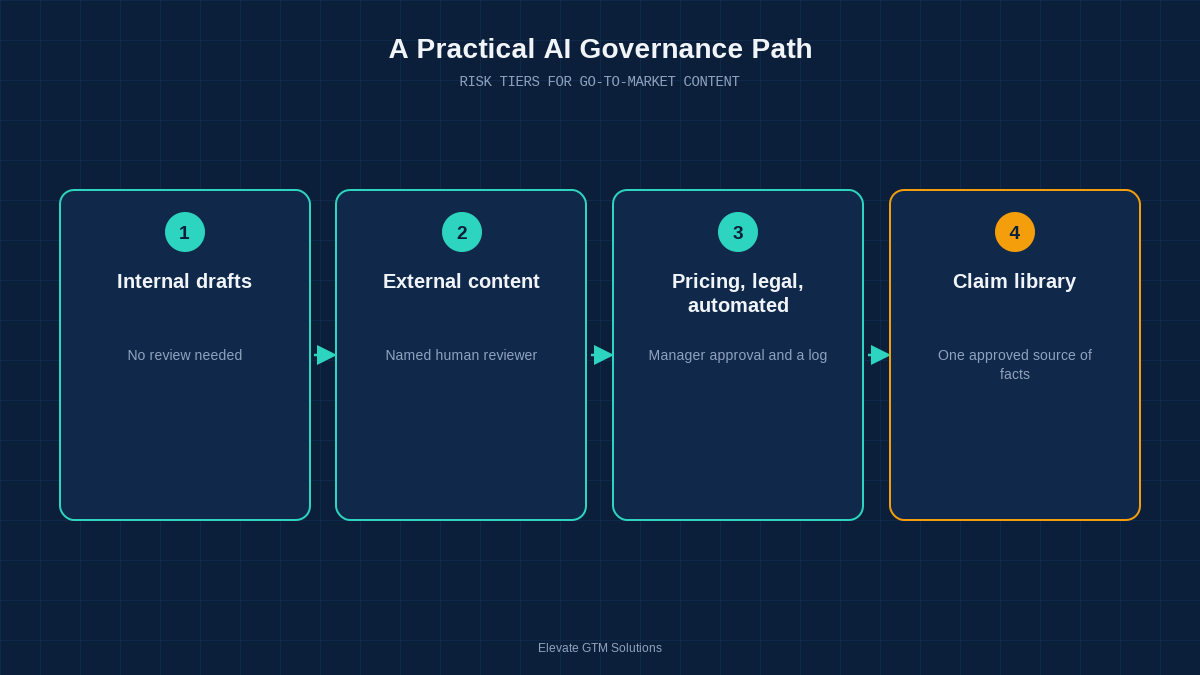
Generative AI arrived in go-to-market teams the way spreadsheets once did: from the bottom up, one person at a time, because it saved hours. A marketer drafts a landing page in minutes. A seller asks a chatbot to summarize an account. A product marketer feeds in customer notes and gets back a positioning draft. Most of this is useful and most of it goes fine. The risk is not in any single use. It is in the volume, the speed and the fact that much of what these tools produce now reaches customers directly, with no one in between who knows the facts well enough to catch a mistake.
This page explains the main risks of generative AI in B2B go-to-market and how a team can govern its use in a way people will actually follow. The evidence is analyst research, mainly Forrester's 2026 predictions for B2B marketing, sales and product, with supporting guidance from Forrester and Gartner. For each source we say what it claims, what it does not show and how much weight it can bear. Then we add our own reading, clearly marked, and describe where a go-to-market platform like ours helps and where it cannot.
A disclosure. We make Elevate GTM Solutions, a go-to-market strategy platform that uses AI, so we have an interest in how AI risk is framed and in how it is governed. We have no incident data of our own. The most quoted number on this topic is a prediction without a published method, and we say so. Our examples are invented and labeled. Nothing here is legal advice, and rules on privacy, advertising and intellectual property differ by country.
What are the risks of using generative AI in B2B go-to-market, and how do you govern it?
The main risks are inaccurate or invented content reaching customers, loss of control over what employees paste into AI tools, inconsistent claims across channels, privacy and legal exposure and automated actions nobody reviewed. Forrester's 2026 predictions for B2B marketing, sales and product, released October 28, 2025, forecast that ungoverned use of generative AI in commercial applications will cost B2B companies more than $10 billion in enterprise value through declining stock prices, legal settlements and fines, driven by new and untested functionality combined with lagging AI user skills. The release names no method for that estimate, so it is best read as a warning, not a measurement. Forrester's practical advice is that governance copied from internally built applications is inadequate for go-to-market tools, and that organizations should raise employees' AI skills and spread governance across the people who use the tools. A workable approach sorts uses by risk, sets clear rules for data and review, gives people decision guides instead of blanket bans and tracks outcomes.
Is the $10 billion figure reliable? Forrester's release does not name a methodology. Treat it as an analyst's prediction about direction and scale, not a calculated total.
Should we ban generative AI in go-to-market? The sources do not recommend that. They recommend governance that matches how the tools are used: training, guardrails and review where mistakes would be costly.
The short version
| Question | Answer |
|---|---|
| Key prediction | Ungoverned generative AI in commercial applications will cost B2B companies more than $10 billion in enterprise value (Forrester, October 28, 2025) |
| What the loss covers | Declining stock prices, legal settlements and fines, from incidents tied to untested functionality and lagging AI user skills |
| Method behind the figure | Not named in the release |
| Buyer-side signal | 19% of buyers using generative AI applications feel less confident in their purchasing decisions because of inaccurate or unreliable information (Forrester; survey not named) |
| Governance advice | Top-down governance borrowed from internal applications is inadequate; raise employees' "AI intelligence quotient" and democratize governance |
| Content shift | By end of 2026, traditional content teams will no longer create two-thirds of B2B content (Forrester prediction) |
| Related Gartner warning | Agents are only as effective as the systems they operate in; fragmented systems get scaled fragmentation (July 2026) |
| What is missing | A public tally of real go-to-market AI incidents and their cost |
| Main limit | Most of the evidence is prediction and guidance, not measured loss |
The risks, in plain terms
Governance goes better when everyone agrees on what could actually go wrong. In go-to-market the risks fall into a handful of groups.
Wrong content that sounds right. Generative AI produces fluent text whether or not it is true. In go-to-market, wrong content can be a product claim you cannot support, a customer number that does not exist, a competitor comparison that is out of date, a price that does not match your price list or a reference to a customer who never agreed to be named. Fluency makes errors harder to spot. The Forrester blog on its predictions cites a global consulting firm that refunded its client hundreds of thousands of dollars for a deliverable containing AI hallucinations, and calls the output "slop." The text does not name the firm.
Information leaving the building. Employees paste emails, call notes, contracts and customer lists into AI tools to get a quick summary. If the tool is not approved, not configured for business use or governed by terms the company has not read, that information may be stored or used in ways nobody intended. This is a data-handling question for your security and legal teams.
Inconsistent claims. When every seller and marketer prompts differently, the company ends up with many versions of its story. Gartner found that 69% of B2B buyers report inconsistencies between a seller's website and what sellers say, and AI can multiply that. Inconsistency reads to buyers as carelessness, or worse.
Privacy and legal exposure. Using personal data to personalize outreach, recording and summarizing calls, scoring individuals and sending automated messages all touch privacy, consent and commercial communication rules that differ by place. Claims in regulated areas such as finance and health carry extra rules. Intellectual property questions, such as who owns generated material and whether it copies someone else's, are unsettled in many places. Review these with counsel.
Bias and unfairness in targeting. AI used to score, rank or select accounts and people can reproduce patterns in historical data that you would not choose to repeat. In B2B this often shows up as ignoring segments that look different from past winners.
Automation nobody reviewed. Agents that send messages, update records or respond to buyers can make a small error at scale. Gartner's warning about "agent sprawl" is that agents are only as effective as the systems they operate within, and that if those systems are fragmented, agents will scale the fragmentation. See whether AI agents make sales teams more productive.
Skill gaps. Forrester links its predicted losses to "lagging AI user skills." People who do not understand what a model can and cannot do are more likely to trust output they should check.
Security. AI tools connected to company data and email introduce new ways to attack, such as manipulating a tool through crafted inputs. Your security team should assess any tool that can read or send on your behalf.
Buyer-side trust. Buyers use generative AI too, and Forrester reports that 19% of those using AI applications feel less confident in their purchasing decisions because of inaccurate or unreliable information. If your content is thin, wrong or generic, the AI summary a buyer sees about you will be as well.
Most of these risks are not new. Copying a customer's name into the wrong place was always possible. What is new is how fast and how widely one mistake can spread.
Why this belongs in a go-to-market plan
A go-to-market plan states what the company will say, to whom and through which channels. Generative AI changes who is writing and how fast. A plan that does not say how AI will be used, who reviews what and which claims are approved leaves those decisions to whoever happens to be using the tool that day.
Governance is also a competitive matter. Buyers, who are using AI themselves, are quick to notice errors, and they share their impressions with peers. A reputation for accuracy is slow to build and quick to lose.
The evidence: Forrester's 2026 predictions for B2B marketing, sales and product
The primary source is a Business Wire release dated October 28, 2025, titled "Forrester's 2026 B2B Marketing, Sales, And Product Predictions: B2B Companies Will Lose More Than $10 Billion Because Of Ungoverned Use Of Generative AI." We read it in full. Predictions are Forrester's forecasts of what will happen in the coming year, drawn from its research. They are not results.
The headline prediction. The release says generative AI in commercial applications, new and untested functionality combined with lagging AI user skills, will result in incidents that lead to the loss of more than $10 billion in enterprise value from declining stock prices, legal settlements and fines. It names no methodology or data source for the estimate.
The buyer signal. The release states that 19% of buyers using generative AI applications feel less confident in their purchasing decisions because the tools gave them inaccurate or unreliable information. It does not name the survey.
The other predictions in the release.
- In 2025, 30% of all buyers viewed generative AI tools as a meaningful interaction type during the final commit stage of their purchase, compared with 17% who said the same about interacting with product experts. Forrester expects human expertise to rival generative AI in appeal as buyers seek validation.
- 75% of enterprise B2B companies will increase budgets for influencer relations, citing Forrester's Buyers' Journey Survey, 2025.
- 20% of B2B sellers will be forced into agent-led quote negotiations. The release says that in 2025, 61% of purchase influencers reported that their organization has or will use a private generative AI engine for purchasing, a figure with no named source.
The governance advice. The release says that governance practices used for internally developed applications are inadequate to control generative AI in the commercial applications go-to-market teams use, and that organizations should improve employees' "AI intelligence quotient" and democratize governance. Sharyn Leaver, Forrester's chief research officer, said: "B2B leaders must embrace a more disciplined and evidence-driven approach to how they engage with generative AI," that "Success will hinge on investing in AI governance, balancing human expertise with AI tools," and that "accountability and clarity will be the cornerstones of competitive advantage for B2B leaders."
What we could not confirm. The $10 billion figure has no stated method. "Enterprise value" refers to the market value of companies, not revenue, and the release does not say how many companies or incidents the figure covers. We have not seen a published accounting that confirms or refutes the prediction now that the year is nearly over. Treat the number as a signal of seriousness, not a quantity.
The evidence: Forrester's blog on trust and content
In a blog post dated October 28, 2025, titled "Predictions 2026: Trust Gets Tested For B2B Marketing, Sales, And Product Leaders," analyst Renee Irion expands on three of the predictions. We read it in full.
- It repeats the prediction that ungoverned generative AI in commercial applications will cost B2B companies more than $10 billion.
- It predicts that employees outside centralized content teams will create two-thirds of B2B content, so that "traditional content teams will no longer create two-thirds of content in B2B organizations" by the end of 2026. That makes central review harder, because the writers are everywhere.
- It repeats the prediction that 75% of enterprise B2B companies will increase budgets for influencer relations.
- On governance, it says top-down practices borrowed from internally developed applications "are inadequate for governing genAI in commercial applications," that organizations must raise employees' AI skills so they can "spot and stop bad outputs before they reach customers" and that leaders should "equip employees with decision frameworks, training, and guardrails," or risk diluting their brand and degrading customer experience.
The shift described here is the important one. If content is created across the organization, quality control cannot be a single gate at the end. It has to be built into how people work.
The evidence: Forrester's go-to-market guidance on human and AI roles
Forrester's web page on B2B go-to-market strategy includes a recommendation on what it calls human-AI collaboration. It advises redesigning work so AI handles analysis and routine tasks while people provide judgment and accountability, training employees, setting responsible AI governance, validating AI outputs and measuring business outcomes rather than AI usage. The page does not give a date or sample size, and it is guidance, not a finding.
The evidence: Gartner on agents and personalization
Two Gartner items bear on risk. In its July 28, 2026 release on AI agents in sales, which we cover elsewhere, analyst Dan Gottlieb said agents "are only as effective as the systems they operate within" and that "if those systems are fragmented, the agents will scale the fragmentation." A November 11, 2026 Gartner abstract says senior marketing leaders want AI-driven personalization but lack the required infrastructure and risk scaling "creepy and irrelevant outreach." We saw the second only as an abstract. See does AI outreach and personalization work in B2B sales.
How much weight the evidence can carry
It is strong on direction and weak on size. Two firms and several documents agree that governance has lagged adoption and that the cost can be real. None gives a measured total.
A prediction is not an incident count. The $10 billion figure is a forecast. It could be too high or too low, and the public record we found does not settle it.
The analyst has an interest. Forrester sells research and advisory services on governance and on B2B strategy. A warning that makes governance urgent fits its business, and the advice is also sensible.
The 19% figure has no named source. It comes from a release that does not identify the survey or sample. It is useful as a signal about buyer trust, and we would not build a plan on the exact number.
The sources are about commercial AI in go-to-market. They do not address internal uses such as code generation or finance, which have different risks.
Rules and tools change quickly. Regulation, vendor terms and model behavior are all moving. Guidance from late 2025 may need updating.
Elevate's reading
Our interpretation, not data.
One. Most of the risk is in customer-facing output. An error in a brainstorm is cheap. An error in a pricing page, a proposal or an automated reply is expensive. Govern by where the output goes, not by which tool made it.
Two. Bans push use out of sight. If people find a tool saves hours, a ban makes them use it quietly on personal accounts. Forrester's advice to democratize governance and equip employees with decision frameworks fits this. Clear rules that people can follow beat rules they must work around.
Three. A claim library is the highest-value control. Many risks come down to people stating things about the product, customers and results that are wrong or unapproved. A single approved set of claims, proof points and customer references, which AI tools are told to use, removes a large share of the problem.
Four. Review should match risk. A tiered approach, with light review for internal drafts and strict review for customer-facing, legal, pricing and regulated content, keeps speed where it is safe.
Five. Skills are a control. Training people to check sources, spot invented facts and know what not to paste is cheaper than most technical controls and it addresses the "lagging AI user skills" Forrester names.
Six. Governance should be measured by outcomes. Count incidents, near-misses, corrections and the time it takes to fix a mistake, not just the number of policies written.
What this means for different roles
Chief executive or founder. Ask who is accountable for AI use in customer-facing work. If the answer is "nobody" or "everybody," pick a name.
CMO or head of marketing. Build the claim library first. Then define which content types need a human review and by whom.
Head of sales. Decide what sellers may and may not paste into AI tools, and which AI-written messages need review before sending. Make the rules short enough to remember.
Head of product marketing. You own much of the source of truth. Keep positioning, proof points and competitor comparisons current and accessible to tools and people.
Revenue operations. Inventory every AI tool and agent connected to your customer data. Record what each can read, write and send.
Legal, privacy and security. Set the red lines: data that never goes into external tools, content that always needs legal review and vendor requirements. Publish them in plain language.
Customer success. Decide how AI may be used in customer communications and summaries, and when a customer must be told.
A worked example, invented for illustration
Imagine a 200-person software company that sells analytics tools to healthcare administrators. Over six months, sellers, marketers and customer success staff have each adopted different AI tools. One marketer drafts a case study with an AI tool and includes a figure that she remembers from a call but that the customer never approved. A seller pastes a customer's contract summary into a public chatbot to prepare a renewal email. An agent configured by sales operations sends a follow-up to a contact who had asked to be removed.
None of these became a public incident. All three were caught by chance. The head of marketing, working with legal and security, drafts a one-page standard. It lists approved tools and bans pasting customer-identifiable data into any other. It creates a claim library with the product's approved statements and the customers who have agreed to be named. It sorts uses into three tiers: internal drafts, which need no review; external content, which needs a named human reviewer; and pricing, legal, regulated and automated customer messages, which need a manager's approval and a log. She adds a monthly fifteen-minute review of near-misses.
We make no claim about outcomes. The example shows that a short, clear standard and a claim library can address the three failures above without stopping anyone from using the tools.
How a go-to-market platform can help, and where it cannot
Elevate GTM Solutions is a go-to-market strategy platform that uses AI. As described on our homepage, it brings together modules for market research, ideal customer profile, competitive intelligence, positioning, messaging, pricing, launch, measurement, sales enablement and more, within a unified strategy. We use AI in the product, which is why we think carefully about this topic.
Here is how that relates to the research, without overclaiming.
A single source of truth for claims. Positioning, messaging and pricing decisions live in one connected place, which can serve as the approved reference that people and tools draw on. That reduces the chance of each person inventing their own version. It works only if the team keeps it current.
Visible stages and collaborators. The workflow stages we describe, from draft to defined to launched to optimizing, and the collaborators attached to a strategy, can make it clearer who has reviewed what.
Weekly visibility. A weekly pulse and executive dashboards give leaders a regular view of what is being done, which can support oversight. We have no data showing fewer incidents.
What it cannot do. It does not govern your other AI tools. It does not stop an employee from pasting data into an unapproved chatbot. It does not replace legal review, a security assessment or training. Any AI-generated draft in our product, as in any tool, should be reviewed by a person who knows the facts before it reaches a customer. We have no Elevate customer data on governance outcomes. For questions to put to any vendor, see questions to ask AI GTM vendors, and for enterprise buyer checks on data and security, see our page on what enterprise buyers check for data governance, security and CRM integration in AI GTM platforms.
Questions to ask before you scale AI in go-to-market
- Which AI tools are in use today, officially and unofficially?
- What data may and may not be put into each?
- Which outputs reach customers without a human reading them?
- Where is our approved set of claims, and do AI tools use it?
- Who is accountable for AI use in customer-facing work?
- What content always needs legal or compliance review?
- How would we find out about a mistake, and how fast could we correct it?
- What training have people had on checking AI output?
- Which vendors can access our customer data, and under what terms?
- How do we measure whether governance is working?
Common mistakes
Writing a long policy nobody reads. A one-page standard that people remember beats a thirty-page document.
Governing by tool, not by use. The same tool is low risk for a brainstorm and high risk for an automated customer email.
Banning and not providing an alternative. Without an approved option, use moves out of sight.
Skipping the claim library. Without an approved source of truth, every AI draft invents its own facts.
Trusting fluency. A smooth paragraph is not a verified one. Teach people to check the specific claim.
Forgetting existing customers. Summaries and messages to customers carry the same risks as outbound marketing.
Centralizing review while content is created everywhere. If most content is made outside a central team, review has to be built into the work, not sit at the end.
Never reviewing the governance itself. Tools, rules and vendor terms change. Set a regular review date.
What to do this week
Ask five people in different go-to-market roles which AI tools they used last week and what they put into them. Write the answers down without judgment. That list is the starting point for your standard.
A one-page AI use standard for go-to-market teams
A short standard works better than a long policy. A one-page version has six parts.
Purpose. One sentence: we use AI to work faster without putting customers, data or our reputation at risk.
Approved tools. A short named list, with a way to request additions. Everything else is off limits for company or customer data.
Data rules. What never goes into an external tool: customer-identifiable information, contracts, unreleased product details, credentials and anything covered by a confidentiality term. What may, with approved tools only.
Review rules by tier.
- Tier one: internal drafts, brainstorming and research. No review required.
- Tier two: external content such as web copy, emails, social posts and sales collateral. A named human who knows the facts reviews before publication.
- Tier three: pricing, legal, regulated claims, customer-identifiable content and anything automated that contacts customers. Manager approval and a record of what was sent.
Claims and proof. All product, performance and customer claims come from the approved claim library. If it is not there, it is not used.
Accountability and reporting. One named owner. A simple way to report mistakes and near-misses without blame. A short monthly review.
Publish it where people work, repeat it in onboarding and update it quarterly.
How to build a claim library
A claim library is a single, reviewed list of statements the company is willing to make.
- Collect. Pull claims from the website, sales deck, case studies and proposals.
- Classify. Mark each as product capability, performance result, comparison, customer reference or pricing.
- Verify. For each, record the evidence and who confirmed it. Remove anything you cannot support.
- Set limits. Note where a claim applies, such as a product tier, a region or a customer type, and when it expires.
- Approve. Have product, legal and a customer-facing leader sign off.
- Publish. Make it easy to find and, where possible, supply it to AI tools as the only allowed source for claims.
- Maintain. Review monthly, and remove claims when products or evidence change.
A claim library is dull work and one of the most effective controls available, because most AI-related go-to-market mistakes are mistakes about facts.
How to respond when something goes wrong
Have a simple plan before you need it.
Stop the spread. Pause the sequence, remove the page or recall the document. Assess. What was wrong, who saw it and what data, if any, was exposed? Involve the right people. Legal and security for data and claims, the account owner for customers who saw it. Correct. Send a plain correction where one is needed. Do not hide it. Learn. Record what allowed the mistake and what will change, and share it without blame.
How quickly and honestly a company responds matters nearly as much to buyers as the mistake itself.
Glossary
Generative AI. Software that produces text, images or other content from prompts.
Hallucination. Fluent AI output that is invented or false.
Governance. The rules, roles and checks that determine how a technology is used.
AI intelligence quotient. Forrester's phrase for employees' skill in using AI tools well, including knowing their limits.
Agent. Software that performs tasks on its own, such as sending messages or updating records.
Claim library. A reviewed list of statements the company is willing to make, with evidence.
Enterprise value. The market value of a company, which differs from its revenue.
Near-miss. A mistake that was caught before causing harm.
Where Elevate GTM Solutions fits
Elevate GTM Solutions is a go-to-market strategy platform that its homepage describes as a way to build, execute and evolve strategy, with connected modules and a flow from insights and strategy context to a strategy builder, workflow engine, activation, playbooks, weekly pulse and executive dashboards. It speaks to this research in a narrow way: it can hold positioning, messaging and pricing decisions in one place that people and tools can draw on. It does not govern your other tools, and any AI output from any tool should be reviewed by someone who knows the facts. For related reading, see AI adoption in B2B GTM and the GTM context layer.
Key takeaways
- Forrester predicts that ungoverned generative AI in commercial applications will cost B2B companies more than $10 billion in enterprise value through falling stock prices, legal settlements and fines. The release names no method, so treat it as a warning.
- Forrester says 19% of buyers using generative AI applications feel less confident in their purchase decisions because of inaccurate or unreliable information. The survey is not named.
- Forrester says governance borrowed from internal applications is inadequate for go-to-market tools, and recommends raising employees' AI skills, democratizing governance and giving people decision frameworks and guardrails.
- Forrester predicts that traditional content teams will no longer create two-thirds of B2B content by the end of 2026, which makes built-in review necessary.
- Gartner warns that agents scale whatever fragmentation exists in the systems they run on.
- A workable approach: sort uses into risk tiers, keep a claim library, set clear data rules, train people and review outcomes.
Sources
- Forrester, Forrester's 2026 B2B Marketing, Sales, And Product Predictions: B2B Companies Will Lose More Than $10 Billion Because Of Ungoverned Use Of Generative AI, Business Wire press release, October 28, 2025.
- Forrester, Renee Irion, Predictions 2026: Trust Gets Tested For B2B Marketing, Sales, And Product Leaders, blog, October 28, 2025.
- Forrester, B2B GTM Strategy: How Go-To-Market Must Change For Today's Buyers, web page (undated).
- Gartner, Gartner Predicts AI Agents Will Outnumber Sellers 10 to 1 by 2028, Yet Fewer Than 40% of Sellers Will Say Agents Improved Productivity, press release, July 28, 2026.
- Gartner, AI Won't Fix Bad Personalization. Fix Your Strategy First., insights abstract, November 11, 2026 (abstract only).
- Gartner, Gartner Sales Survey Finds 61% of B2B Buyers Prefer a Rep-Free Buying Experience, press release, June 25, 2025 (for the 69% inconsistency finding).
Frequently Asked Questions
What are the main risks of generative AI in B2B go-to-market?
Wrong or invented content reaching customers, sensitive data leaving the company through unapproved tools, inconsistent claims, privacy and legal exposure, automated actions nobody reviewed, skill gaps and security issues. Most risk sits in customer-facing output, such as web copy, proposals, pricing and automated messages.
Is Forrester's $10 billion prediction reliable?
Treat it as a warning, not a measurement. Forrester's October 2025 release predicts that ungoverned generative AI in commercial applications will cost B2B companies more than $10 billion in enterprise value, from falling stock prices, legal settlements and fines. It names no method, and we have not seen a published tally confirming it.
Should we ban generative AI in sales and marketing?
The sources do not recommend a ban. Forrester advises raising employees' AI skills, democratizing governance and giving people decision frameworks, training and guardrails. Bans tend to push use out of sight, so clear rules and approved tools usually work better.
What does "democratize governance" mean?
It means spreading responsibility for safe AI use to the people who use the tools, supported by training and simple decision guides, rather than relying on a central team to approve everything. Forrester says top-down governance borrowed from internal applications is inadequate for go-to-market tools.
What is a claim library and why does it matter?
A reviewed list of statements the company is willing to make, with evidence, owner and limits. It matters because many AI mistakes in go-to-market are mistakes about facts. If AI tools and people draw claims only from the library, invented or unapproved statements are much less likely.
What should never be pasted into an AI tool?
That is a decision for your security and legal teams, but typical red lines include customer-identifiable information, contracts, unreleased product details, credentials and anything under a confidentiality term, unless the tool is approved for that data. Publish the rule in plain language.
Which AI-generated content needs human review?
A practical approach is tiering. Internal drafts and brainstorming may need none. External content should have a named reviewer who knows the facts. Pricing, legal, regulated claims, customer-identifiable content and automated customer messages need manager approval and a record.
How do buyers react to AI-generated inaccuracies?
Forrester reports that 19% of buyers using generative AI applications feel less confident in their purchasing decisions because of inaccurate or unreliable information. The survey is not named in the release, so treat the figure as a signal of buyer concern.
Do agents add risk?
They can. Gartner's July 2026 release warns that agents are only as effective as the systems they operate in, and that fragmented systems get scaled fragmentation. Agents that send messages or change records need clear limits, logging and review. See whether AI agents make sales teams more productive.
What laws apply to AI in go-to-market?
Rules on privacy, consent, commercial communication, advertising and intellectual property differ by country and sometimes by state, and they are changing. This page is not legal advice. Have counsel review how you use personal data and automated outreach.
Can a go-to-market platform help with AI governance?
It can hold approved positioning, messaging and pricing in one place that people and tools draw on, and show stages and collaborators. Elevate GTM Solutions is a strategy platform that uses AI. It does not govern your other tools, and any AI output should be reviewed by someone who knows the facts before it reaches a customer.
What should we do first?
Ask people in different go-to-market roles which AI tools they used last week and what they put into them. Use that list to write a one-page standard with approved tools, data rules, review tiers and one named owner, and start a claim library.