
By the Elevate GTM Solutions Team · Updated November 13, 2026 · 28 min read
What Should Enterprise Buyers Check for Data Governance, Security and CRM Integration When Evaluating AI GTM Platforms?
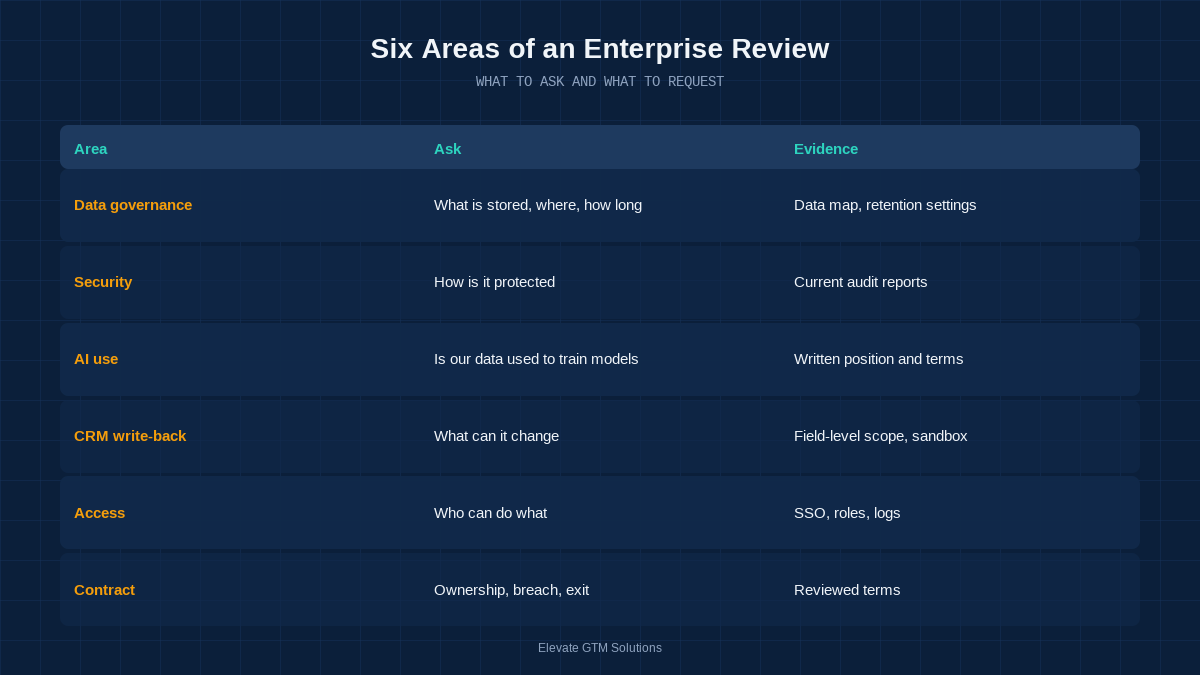
Enterprise buyers rarely lose sleep over whether an AI go-to-market platform has a clever feature. They lose sleep over what happens to customer data once it enters the product, who can see what, whether the vendor's AI trains on their information, how the platform writes back to the CRM and what the exit looks like if the relationship ends. A platform that wins the demo can still fail the security review, and a security review that takes four months can quietly kill a project that business teams wanted.
This guide is a working checklist for the people who sit in those reviews: security, privacy, legal, IT, revenue operations and the business sponsor. It explains the questions that matter, why each matters, what a good answer sounds like and what should worry you. It covers data governance, security, AI-specific risks, CRM integration, access control, vendor risk, contracts, rollout and the evidence you should ask a vendor to show. It also explains how to use peer review sites such as Gartner Peer Insights, G2 and others sensibly, without claiming what any reviewers say.
We make a GTM strategy platform, so we have an interest. We do not claim any certifications or compliance attestations on our own behalf here, and you should ask any vendor, including us, for current documentation and verify it. This is not legal, security or compliance advice, and requirements vary by industry, region and company, so involve your own specialists. We cite no statistics and describe other vendors only in general terms.
What do enterprise buyers check for data governance, security and CRM integration in AI GTM platforms?
Enterprise buyers typically check six things. First, what data the platform collects, where it is stored, for how long and who can access it. Second, the vendor's security practices, including independent audits and attestations, which you should ask to see in current form. Third, how the AI features handle your data, including whether your data is used to train models and how outputs are checked. Fourth, how the platform connects to your CRM: what it reads, what it writes, in which direction, how often and how conflicts are resolved. Fifth, access control, including single sign-on, roles and audit logs. Sixth, contract terms, including data ownership, breach notification, subprocessors and exit. Ask for evidence, not assurances, and review the documents with your own security and legal teams.
Should you trust a vendor's security page? Treat it as a starting point. Ask for current audit reports and answers to your own questionnaire.
What is the most common blind spot? The write-back path to the CRM, where a tool can change records at scale.
The short version
| Area | What to ask | A good sign | A warning sign |
|---|---|---|---|
| Data inventory | What data is collected, stored and for how long | A clear data map and retention settings | Vague answers about what is kept |
| Security evidence | Which independent audits and attestations exist | Current reports shared under NDA | Only marketing claims |
| AI data use | Is customer data used to train models | A clear written position and contractual terms | "It depends" with no document |
| CRM integration | What is read, what is written and how often | Field-level scope and a test sandbox | Broad write access by default |
| Access control | Single sign-on, roles, audit logs | Granular roles and exportable logs | Shared accounts and no logs |
| Vendor risk | Subprocessors, hosting regions, incident history | A published subprocessor list and notification terms | No list, no timeline |
| Contract | Data ownership, breach notice, exit | Clear terms and export rights | Data rights unclear or one-sided |
| Rollout | Pilot scope and review | A limited pilot with a security sign-off | Full production data on day one |
Why GTM platforms raise specific concerns
A go-to-market platform touches a particular kind of data. It often holds customer and prospect records, contact details, deal information, call notes and recordings, competitive and pricing information and strategy documents that a company would not want a competitor to see. It also tends to connect to several other systems at once, so a weakness in one connection can expose another.
Three features make a GTM platform different from many other tools:
It writes as well as reads. Many GTM tools update the CRM, create records, change fields and send communications. A mistake or a compromise can spread quickly.
It handles personal data about people who are not your customers. Prospects and contacts have rights and expectations that vary by region, and your obligations do not stop at your own customer list.
It increasingly uses AI. That adds questions about how data is processed, whether it is used to train models, where it is sent and how outputs are checked.
None of this means these platforms are unsafe. It means the review should be specific to the way they work.
Who should be in the review
A review run by one function tends to miss things. A practical group includes:
| Role | What they cover |
|---|---|
| Security | Architecture, audits, encryption, incident response, access control |
| Privacy and legal | Data processing terms, regional rules, contract risk, subprocessors |
| IT and integration | SSO, CRM and data warehouse connections, API limits, performance |
| Revenue operations | Field mapping, data quality, write-back rules, change management |
| Procurement and finance | Commercial terms, renewal, exit and total cost |
| Business sponsor | Use cases, success measures, adoption and the cost of delay |
| Compliance or risk, where relevant | Industry-specific obligations |
Agree at the start who has the final say and how disagreements are resolved. Many projects stall because nobody has the authority to accept a defined risk.
Data governance: the questions
Data governance is about knowing what data the platform holds and controlling how it is used.
What data does the platform collect and store?
Ask for a data inventory in plain terms: which categories of data the platform ingests from your systems, which it generates and which it stores. Typical categories include account and contact records, activity history, call recordings and transcripts, documents and uploaded files, usage logs and AI prompts and outputs.
For each category, ask where it is stored, in which region, for how long, in what form and who at the vendor can access it.
Can you control what goes in?
A good platform lets you choose which objects and fields to sync, rather than pulling in everything by default. Ask whether you can exclude sensitive fields, whole record types or specific business units, and whether those exclusions are enforced in the product itself rather than only in a policy document.
Where does the data live?
Ask about hosting locations and whether you can choose a region. This matters for organizations with data residency requirements. Ask also about backups, where they are stored and how long they are kept.
How long is data kept, and how is it deleted?
Ask for retention settings, deletion on request and deletion at the end of the contract. Ask how long it takes for deleted data to leave backups, and whether you receive confirmation.
Who is the controller and who is the processor?
For personal data, the contract should make roles clear. Your privacy team will know which terms they need. Ask whether the vendor offers a data processing agreement and what it covers. This is not legal advice, so involve your counsel.
What about personal data of prospects and contacts?
Ask how the platform handles opt-outs, suppression lists and data subject requests, and whether it can honor them across connected systems. Rules differ by region and change over time.
Is there data lineage?
For regulated or large organizations, it helps to know where a data point came from, when it changed and which process changed it. Ask what lineage and history the platform keeps.
What happens to derived data?
Platforms may create summaries, scores, embeddings or other derived data from your records. Ask who owns these, how long they are kept and whether they are deleted with the source data.
Security: the questions
Security questions follow familiar lines, and a vendor should be used to answering them.
What independent evidence exists?
Ask which independent audits, attestations or certifications the vendor holds, and ask for the current reports, usually under a non-disclosure agreement. Look at the scope: what systems and which period the report covers, and whether there were exceptions. A badge on a website tells you little without the report behind it.
We make no claim about any vendor's certifications here, including ours. Verify current status directly.
How is data protected?
Ask about encryption in transit and at rest, how keys are managed, whether customers can bring their own keys and how secrets and credentials are stored. Ask how environments are separated and how customer data is isolated from other customers' data.
How does the vendor handle vulnerabilities?
Ask about secure development practices, code review, dependency management, penetration testing by independent parties and how findings are fixed. Ask whether there is a way for researchers to report problems.
What is the incident response process?
Ask how incidents are detected, who responds, how quickly you would be told and in what form. Ask whether the contract commits to a notification timeline and whether there has been a past incident, and if so, what was learned. A vendor that can discuss a past incident honestly is often more trustworthy than one that says it has never had one.
How are staff access and insider risk managed?
Ask who at the vendor can see customer data, under what conditions, with what approvals and with what logging. Ask about background checks and training.
What about availability and recovery?
Ask for uptime history, recovery objectives, backup practices and how the vendor tests recovery. For a platform that sits in the middle of daily selling, downtime has a business cost.
How are third parties managed?
Ask for the list of subprocessors, what each does, where they operate and how you will be told of changes. See vendor risk below.
AI-specific questions
AI features add questions that older security checklists do not cover. Ask them directly and expect written answers.
| Question | Why it matters |
|---|---|
| Is our data used to train or improve models, yours or a third party's? | Training use can expose confidential information and may conflict with your policies |
| Which model providers process our data, and where? | These are additional subprocessors with their own terms |
| Is data retained by model providers after processing? | Retention affects exposure and compliance |
| Can we opt out of any use beyond providing our service, in writing? | Contract terms matter more than a setting that can change |
| How are prompts and outputs logged and who can see them? | Logs can contain sensitive customer content |
| How does the system prevent data from one customer appearing in another's results? | Isolation is basic and should be explained |
| How are outputs checked, and what happens when the model is wrong? | Errors in customer-facing content carry reputational risk |
| Can the AI take actions, such as sending messages or editing records, and what controls apply? | Autonomous actions need approval steps and limits |
| How do you protect against prompt injection and manipulated inputs? | Content from the web or from customers can try to steer a model |
| What documentation exists on how the AI features work and their limits? | You need it for internal risk review and, in some regions, for regulatory reasons |
Regulatory expectations for AI are developing and differ by region. Ask your legal team which rules apply to your use, and ask the vendor how it keeps up with them. See questions to ask AI GTM vendors and how to tell if a GTM platform is really AI-native.
CRM integration: the questions
Integration is where many reviews find the real risk, because it determines what the platform can change inside your system of record.
What does it read?
Ask which objects and fields the platform reads, and whether you can limit this. Reading everything by default is convenient for the vendor and often more than you need.
What does it write?
Ask which objects and fields it can create or update. Distinguish between writing to fields it owns, such as a score or a summary field, and overwriting fields your team maintains, such as owner, stage or amount. The second is far riskier.
In which direction and how often does data move?
Ask whether sync is one-way or two-way, real time or scheduled, and what happens when the same field changes in both systems. Ask who wins a conflict and how conflicts are logged.
How are errors handled?
Ask what happens when an API limit is reached, when a record fails to sync or when the connection drops. Silent failures create data that is quietly wrong. Ask for monitoring and alerts.
Can we test in a sandbox first?
A good vendor supports a test environment connection, so you can see the effect before touching production records.
Can changes be traced and reversed?
Ask whether every write is logged with the time, the source and the old and new values, and whether you can roll back a bad batch. This is a basic safeguard for any tool that writes at scale.
What permissions does the connection use?
Ask which CRM user or app the platform runs as, what permissions it holds and how you would restrict them. Least privilege is the principle: grant only what is needed. Review the connected-app permissions with your CRM administrator.
What about other systems?
CRM is usually first, but most GTM platforms also connect to marketing automation, email, calendars, data warehouses, call recording tools and messaging. Review each connection in the same way.
See how to choose a GTM platform, GTM platforms that integrate with Salesforce and GTM platform vs CRM.
Access control and auditability
Who can do what inside the platform matters as much as who can get into it.
Single sign-on. Ask whether the platform supports your identity provider and whether SSO can be required for all users.
Provisioning and deprovisioning. Ask whether users can be created and removed automatically from your identity system, so departed employees lose access promptly.
Roles and permissions. Ask how granular roles are. Can a regional team see only its region, can a contractor be limited to certain features and can an administrator role be separated from a user role?
Multi-factor authentication. Ask whether it is available and enforceable.
Audit logs. Ask what is logged, how long logs are kept, whether you can export them and whether they cover both user actions and AI actions.
Approval workflows. For actions with external effect, such as sending messages or changing records, ask whether approvals can be required.
Segregation of duties. For larger organizations, ask whether the person who configures integrations can be different from the person who approves them.
Vendor risk
You are not only buying a product. You are choosing a supplier whose own health and practices become part of your risk.
| Area | What to ask |
|---|---|
| Subprocessors | A current list, what each does, where each operates, and how changes are notified |
| Hosting | Which cloud provider and regions, and whether you can choose |
| Financial and operational stability | Funding, customer base and how long the company has operated, to the extent the vendor will share |
| Concentration | Whether the product depends on a single model provider or infrastructure supplier |
| Business continuity | What happens to your data and service if the vendor is acquired or ceases operating |
| Support | Hours, escalation paths and the process for security issues |
| Roadmap fit | Whether planned changes might alter data handling or terms, and how you are told |
| References | Customers in your industry and of your size who will speak candidly |
Newer vendors may be strong on product and thin on formal process. That is not disqualifying, but it means you should weigh evidence carefully and may want narrower initial scope.
Contract terms that matter
Your legal team will lead, and these are points that business and operations people should know to raise.
Data ownership. The contract should state that you own your data and what the vendor may do with it.
Permitted use. Limits on use for anything beyond providing the service, including model training and analytics.
Breach notification. A committed timeline and a defined process.
Subprocessor changes. Notice and a right to object.
Audit rights. Whether you can review reports and, for some organizations, conduct or commission an assessment.
Liability and indemnity. How responsibility is allocated for data incidents.
Term and renewal. Notice periods, auto-renewal and price change terms. Mark dates early.
Exit. The right to export your data in a usable format, the timeline for deletion and confirmation of deletion.
Service levels. Availability commitments and remedies.
This is not legal advice. Counsel should review the actual contract.
Using peer reviews sensibly
Enterprise buyers often read peer review sites such as Gartner Peer Insights, G2, TrustRadius and similar sources, and ask peers informally. These can add a useful perspective, with some cautions.
Read for specifics, not scores. Look for comments on integration quality, support responsiveness, data issues and implementation effort, rather than star averages.
Check relevance. Does the reviewer have a company of your size, industry and stack? Experience at a small company may not carry over to a large one.
Note the timing. Products change quickly, so an older review may describe a different product.
Watch for incentives. Some platforms offer rewards for reviews, and sentiment can be uneven. Treat reviews as input, not proof.
Do not rely on any review for security. Reviews are not audit evidence. Verify security and compliance through documents and your own assessment.
Ask for references. A direct conversation with a customer in a similar situation is usually more informative than a written review.
We have not analyzed the content of any review platform for this guide, and we make no statement about what reviewers on any site say about any product.
A scoring approach
To compare vendors fairly, score each against the same criteria, with weights set by your risk appetite.
| Criterion | Weight example | What earns a high score |
|---|---|---|
| Data controls and residency | High | Field-level control, regional choice, clear retention and deletion |
| Security evidence | High | Current independent reports, clear scope and a candid incident history |
| AI data handling | High | A written commitment on training use, clear model-provider disclosure and logging |
| CRM integration scope | High | Field-level permissions, sandbox, rollback and error monitoring |
| Access control | Medium | SSO, provisioning, granular roles and exportable logs |
| Vendor risk | Medium | Published subprocessors, notification terms and stable operations |
| Contract terms | High | Ownership, breach notice, exit and renewal clarity |
| Business fit | Medium | The use cases and adoption you need |
| Cost | Medium | Total cost including implementation and administration |
Set a minimum on the high-weight items, so a strong demo cannot outvote a security gap. Record the scores and the reasoning for each decision. See GTM platform governance checklist.
A phased rollout that limits risk
How you roll out can reduce risk as much as what you buy.
Phase one: limited pilot. Connect a sandbox or a narrow slice of production. Sync only the fields you need. Give the platform read access first. Involve security from the start.
Phase two: controlled write-back. Allow the platform to write only to fields it owns. Turn on logging and review changes daily at first. Add approval steps for external actions.
Phase three: broader use. Extend to more teams and objects after review. Keep the log reviews, and set a schedule for access reviews.
Phase four: steady state. Review permissions, subprocessors and contract terms at least annually and at each renewal. Reassess after major product changes.
A worked example, invented for illustration
Imagine a company with around 3,000 employees, a regulated customer base and a security team that reviews every new vendor. The names and numbers are invented.
A revenue operations lead wants to pilot an AI GTM platform for account research and messaging. Security asks for current audit reports, a subprocessor list and the vendor's written position on model training. Legal asks for the data processing terms and the breach notification timeline. IT asks about SSO and provisioning.
The vendor supplies most of the documents within a week and asks to arrange a call on the questions it cannot answer in writing. That responsiveness is itself a data point.
The team decides on a limited pilot. The platform connects to a CRM sandbox, reads accounts and contacts for one region, and writes only to two fields it owns. Approval is required before any message leaves the system. Logs are reviewed weekly. After eight weeks, the review looks at field changes, errors and user feedback. Security signs off on extending the pilot to a second region. A separate review is scheduled before any broader write access is granted.
Notice that the process did not rely on any single document, that the write path was narrow at first and that expansion followed evidence.
Where Elevate GTM Solutions fits
Elevate GTM Solutions is an AI GTM platform for creating, executing and adapting go-to-market strategy. Its homepage describes modules including "Market Research," "ICP & Segmentation," "Competitive Intelligence," "Account-Based Marketing," "Product Positioning," "Product Messaging," "Launch & Execute" and "Measure & Optimize," and a shared model across Marketing, Sales, Product and RevOps. The homepage says "15 connected GTM modules" and names sixteen, so count what you see.
On the topics in this guide, we do not publish certifications or attestations in this article, and we do not ask you to take our word for anything here. If you are evaluating us, or any vendor, ask for the current security documentation, subprocessor list, data processing terms, written position on AI and data use and the integration scope for your CRM, and verify each with your own teams. We suggest confirming integration details with us directly, since they depend on your CRM and configuration. See what Elevate GTM Solutions is and enterprise GTM business case.
Common mistakes
Trusting a badge. Ask for the report and read its scope.
Reviewing the product and ignoring the integration. Most real exposure is in what the platform can write.
Granting broad CRM permissions to save time. Start narrow and widen with evidence.
Skipping the AI questions. Older checklists do not cover model training, provider processing or prompt injection.
Treating peer reviews as security evidence. They are context, not proof.
Letting one function run the review. Security, privacy, IT, operations and the business each see different risks.
Going straight to production data. A sandbox pilot reveals problems cheaply.
Forgetting the exit. Know how you export data and confirm deletion before you sign.
One-time review. Vendors change. Review annually and at renewal.
Ignoring the business case. A review that blocks everything has costs too. Weigh risk against value and define acceptable risk in advance.
Questions each function should bring to the table
A shared questionnaire is useful, and each function will still have points of its own. These lists help each person prepare.
Security. How is customer data isolated from other customers? What is logged, and who reviews it? How are credentials for connected systems stored and rotated? What is the process for revoking a connection quickly?
Privacy and legal. Which personal data categories are processed, and for what purposes? How are opt-outs and deletion requests honored across connected systems? Which regions does data move through? What do the processing terms say about subprocessors and transfers?
IT and integration. Which identity providers are supported? How are users provisioned and removed? What are the API usage patterns and limits, and how does the platform behave when limits are reached? Is there a status page and a way to be told about incidents?
Revenue operations. Which fields does the platform own, and which does it only read? How are duplicates handled when it creates records? What happens to field history? Who can change mapping rules, and how are those changes reviewed?
Procurement and finance. What is included in the price and what is billed separately? What are the renewal terms? What does it cost to add users, regions or data volume? How are price changes handled?
The business sponsor. What outcome do we expect, and what is the cost of waiting another quarter? Which risks are we willing to accept, and who signs for them?
A short risk register you can copy
A simple register keeps the review honest. For each risk, note the likelihood, the impact, the control and the owner.
| Risk | Example control | Owner |
|---|---|---|
| Platform overwrites CRM fields in error | Write only to platform-owned fields, log every change, support rollback | Revenue operations |
| Customer data used to train external models | Contract term and written position, model provider list reviewed | Legal and security |
| Departed employee keeps access | SSO enforced, automatic deprovisioning, periodic access review | IT |
| Vendor incident exposes data | Notification timeline in contract, encryption, scoped data sync | Security |
| Prospect opt-out not honored | Suppression sync, deletion process, regular test | Privacy |
| AI sends an inaccurate message to a customer | Approval step for external messages, output review | Business owner |
| Vendor is acquired or changes terms | Notice of change, export rights, documented exit plan | Procurement |
| Integration fails silently | Error monitoring, alerts, periodic reconciliation | Revenue operations |
Review the register at each phase of the rollout and at each renewal. Close risks only when the control has been tested, not when it has been promised.
Evidence to request, in one list
Teams often lose weeks asking for documents one at a time. Ask for the full set up front: the current independent audit reports and their scope, the subprocessor list, the data processing agreement, the written position on model training and model providers, the data map and retention settings, the integration specification with field-level read and write scope, the incident response summary and notification terms, the business continuity and recovery summary, the list of supported identity features and logging, and a short list of references. Ask for dates on every document, because an out-of-date report says little about today.
Glossary
Data governance. Policies and controls for how data is collected, stored, used and deleted.
Subprocessor. A third party that a vendor uses to process customer data.
SSO. Single sign-on, which lets users sign in through the company's identity provider.
Least privilege. Granting only the access needed for a task.
Write-back. A platform updating records in another system, such as the CRM.
Data residency. Requirements about the geographic location where data is stored.
Audit log. A record of who did what and when.
Prompt injection. Content crafted to manipulate an AI system into ignoring its instructions.
DPA. A data processing agreement, the contract describing how a vendor handles personal data.
Sandbox. A test environment separate from production.
What to do this week
- List who must be in the review and who has the final say.
- Write your minimum requirements for the high-weight items before seeing a demo.
- Send every shortlisted vendor the same questionnaire covering data, security, AI use, integration and contract terms.
- Ask for current audit reports, the subprocessor list and the written position on model training.
- Ask your CRM administrator to define the narrowest permissions a pilot would need.
- Request a sandbox connection and a field-level description of what is read and written.
- Ask your legal team to review the data processing and breach notification terms.
- Plan a phased rollout with a security checkpoint before any write access expands.
Key takeaways
- Enterprise review of an AI GTM platform centers on data governance, security evidence, AI data handling, CRM integration, access control, vendor risk and contract terms.
- A GTM platform both reads and writes to systems of record, so the write path deserves the most care.
- Ask for current documents, not assurances, and read the scope of any audit report.
- AI features add questions about model training, provider processing, logging, isolation and prompt injection.
- Start with the narrowest permissions, a sandbox and a limited pilot, and widen with evidence.
- Use peer reviews for context and references for detail, never as security evidence.
- Fix contract terms on ownership, permitted use, breach notice, subprocessors and exit before signing.
- None of this is legal or compliance advice. Involve your own specialists.
Sources
- Elevate GTM Solutions: descriptions of modules, audience and shared-model design, as stated on the company's homepage.
- Related Elevate guides linked in the text, including GTM platform governance checklist, questions to ask AI GTM vendors and pilot to scale framework.
- The checklist reflects general security, privacy and vendor-risk practice and our own judgment. Requirements vary by industry and region. This is not legal, security or compliance advice.
- We did not analyze the content of Gartner Peer Insights, G2, TrustRadius or any other review site, and we make no claims about what reviewers say. We state no certifications for any vendor, and you should verify current status directly.
Frequently Asked Questions
What do enterprise buyers check when evaluating an AI GTM platform?
Typically data governance, security evidence, how the AI handles data, CRM integration scope, access control, vendor risk and contract terms. Ask for current documents and verify them with your own security, privacy and legal teams.
Should we ask whether our data is used to train AI models?
Yes. Ask for a written position and contractual terms covering training use by the vendor and by any model provider, including retention after processing. A setting that can change is weaker than a contract commitment.
What is the biggest integration risk with a CRM?
The write path. A platform that can overwrite fields your team maintains can spread an error quickly. Start with read access, allow writes only to fields the platform owns and require logging and rollback.
How do we verify a vendor's security claims?
Ask for the current independent audit reports, read their scope and exceptions, review the subprocessor list and send your own questionnaire. A badge on a website is not a substitute for the report.
Can we rely on Gartner Peer Insights or G2 reviews for security?
No. Reviews can add context about support and implementation, but they are not audit evidence. Verify security through documents and your own assessment, and use reference calls for detail.
What access controls should an enterprise platform support?
Single sign-on, automated provisioning and deprovisioning, granular roles, multi-factor authentication, exportable audit logs covering user and AI actions and approval workflows for external actions.
Why do subprocessors matter?
They are additional parties that handle your data, including model providers. Ask for the current list, what each does, where each operates and how you will be told of changes.
How should we run a pilot safely?
Use a sandbox or a narrow slice of production, sync only needed fields, begin with read access, restrict writes to platform-owned fields, require approvals for external actions and review logs regularly before widening scope.
What contract terms should we focus on?
Data ownership, permitted use including model training, breach notification timeline, subprocessor change notice, audit rights, liability, renewal terms and exit rights with confirmed deletion. Have counsel review the contract.
How long should a security review take?
It depends on the vendor's documentation and your process. Prepare a standard questionnaire, ask for documents early and involve every reviewing function from the start to avoid sequential delays.
How often should we review a vendor after purchase?
At least annually and at each renewal, and after major product or ownership changes. Review permissions, subprocessors, incidents and contract terms.
Does Elevate publish certifications in this guide?
No. This guide makes no certification claims for any vendor. Ask any vendor, including us, for current documentation and verify it with your own teams.