
Why Every B2B Company Needs a GTM Operating Layer
This is not just an enterprise problem anymore. The coordination gap that used to only bite large, complex revenue orgs now shows up in teams of a dozen people. Here is why the threshold moved, and what a right sized operating layer looks like at each stage.
Published 2026-07-25
A common objection to the idea of a GTM operating layer is that it is enterprise software wearing a new label, relevant to companies with hundreds of reps, dozens of systems, and a RevOps team large enough to need its own org chart. Smaller companies, the argument goes, can get by with a CRM, a couple of point tools, and good judgment.
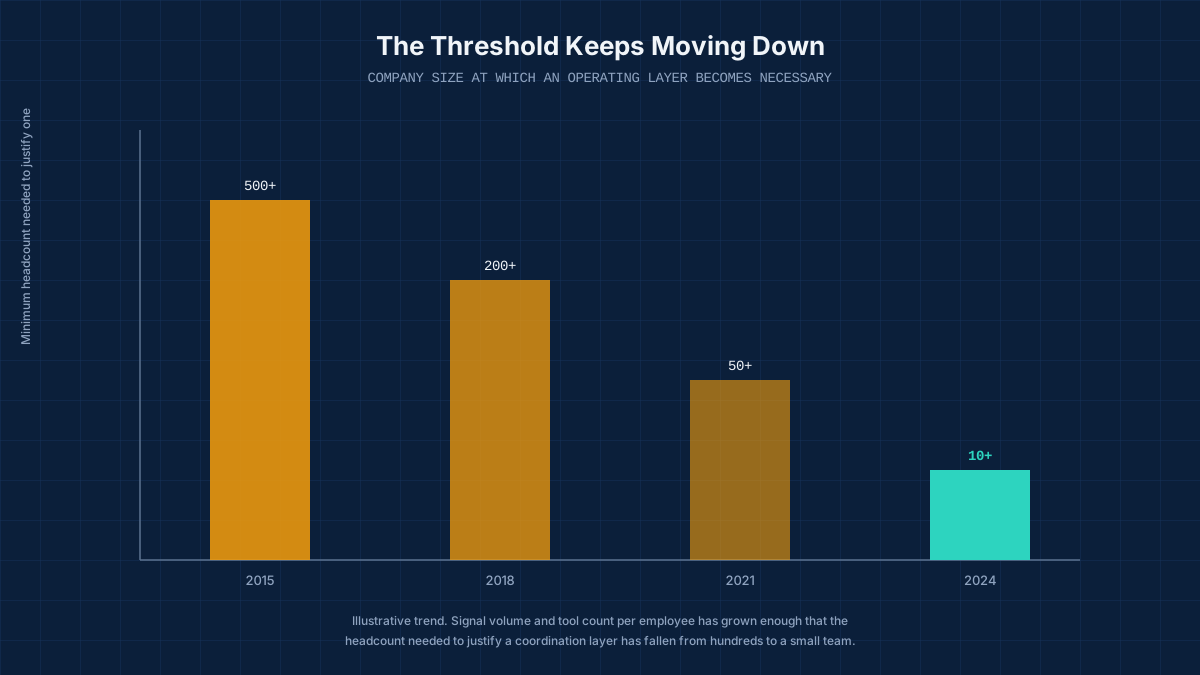
That objection made sense five years ago. It does not hold up well today, and the reason is not that operating layers have gotten cheaper or easier to buy. It is that the underlying condition an operating layer exists to address, more signal and more tools than a team can coordinate manually, now shows up at a much smaller company size than it used to.
This piece makes the case that a GTM operating layer, some version of a coordination system that sits above point tools and turns signal into action, is no longer an enterprise specific need. It is a need that scales down further than most revenue leaders assume, and the companies most likely to underestimate that are exactly the ones small enough to still believe they are too small for it.
This is not an argument that every company needs the same operating layer, built at the same scale, with the same governance and complexity. A ten person team and a two thousand person revenue org face the same underlying coordination problem at wildly different scales, and the right answer for each looks different. What this piece argues is narrower and more specific: the underlying condition that makes some form of coordination layer worth having, more signal and more tools than a team can track by hand, now shows up at a company size small enough that most founders and early GTM leaders have not yet updated their mental model to account for it.
Why the Threshold Moved
The idea that operating layers are only for large, complex organizations rests on a reasonable historical observation: coordination problems get worse as an organization gets bigger, because more people, more tools, and more handoffs create more opportunities for things to fall out of sync. That observation is still true. What has changed is not the logic, it is the starting point.
A decade ago, a company with fifteen people in go to market functions typically ran a lean stack, a CRM, an email tool, maybe a spreadsheet for territory planning. The signal volume was modest enough that a sharp RevOps generalist, or even a founder paying close attention, could reasonably track what mattered by hand. Coordination problems were real but manageable without dedicated software to solve them.
That same fifteen person team today typically runs a meaningfully larger stack, because the baseline expectations for a competent GTM motion have expanded. Intent data is now table stakes rather than a luxury add on. AI powered outreach tools have proliferated and multiplied the volume of activity a small team can generate, which also multiplies the volume of signal that activity produces. Product usage data, once relevant mainly to larger, more mature product led companies, is now a standard input even for early stage sales led businesses. The result is that a company at the same headcount, doing the same fundamental job, now operates with meaningfully more signal and more tools than an equivalent company did in 2018, without a proportional increase in the people available to manually coordinate it.
Three specific shifts explain most of this change, and it is worth naming them individually because each one is easy to underestimate in isolation.
AI powered tooling multiplies output without multiplying headcount. A two person SDR function using modern outreach tooling can now generate a volume of activity, and therefore a volume of resulting signal, replies, engagement, intent shifts, that would have required a much larger team a few years ago. This is usually framed as a productivity win, and it is, but it has a less discussed side effect: it also multiplies the coordination burden on whoever is responsible for making sense of that output, without adding any corresponding increase in the people available to do that sense making. A team that triples its outbound volume using AI assisted tooling has, in effect, also tripled the number of replies, objections, and buying signals that now need to be triaged and routed correctly, a workload increase that easily outpaces any productivity gains on the triage side of the equation unless a coordination layer is explicitly built to absorb it.
Intent and signal data moved from premium add on to default expectation. A few years ago, third party intent data was a differentiated capability that primarily larger, better funded teams could afford and justify. It has since become a commoditized, lower cost category that most competent GTM teams now use by default, regardless of stage. This is good for access to better information. It is also one more continuously updating signal source that somebody has to reconcile against everything else the team already tracks.
Product led motions pushed usage data into companies that never used to need it. Product usage signal, once a specialized concern for companies built around self serve or freemium motions, has become a standard part of even traditionally sales led GTM stacks, as more companies adopt some hybrid of sales assist and product qualified lead motions. That is a valuable signal source. It is also a new stream of continuously arriving data that a small team now has to fold into its prioritization, on top of everything it was already tracking.
None of these three shifts happened because small teams decided they wanted more complexity to manage. Each one happened because it made the team more capable or more informed in isolation. The coordination burden is a side effect nobody explicitly chose, which is exactly why it tends to go unaddressed until it becomes visibly painful.
Signal Complexity Has Outpaced Headcount at Every Stage
This shift shows up consistently across company stages, not just at the smallest end of the market. The table below sketches the pattern.
| Stage | Typical GTM headcount | Typical active tools and signal sources | What was true five years ago |
|---|---|---|---|
| Seed / Series A | 3 to 15 | 6 to 10 | Usually 2 to 4, manageable without coordination software |
| Series B / C | 15 to 60 | 12 to 18 | Usually 6 to 10, coordination handled by a strong RevOps hire |
| Growth stage | 60 to 250 | 20 to 28 | Usually 12 to 16, still mostly manageable with dedicated tooling budget |
| Pre-IPO / public | 250+ | 28 to 40+ | Usually 18 to 25, the traditional home of enterprise RevOps platforms |
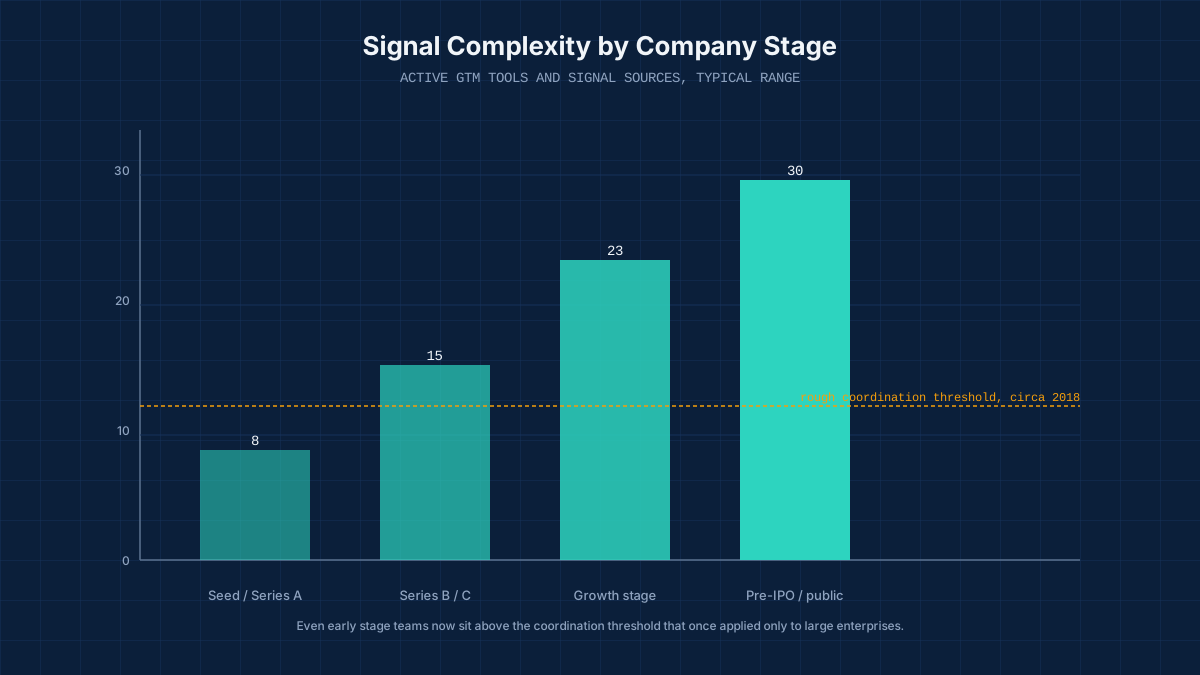
The specific numbers will vary by company and category, and they should be read as illustrative rather than precise benchmarks. The pattern they illustrate is the point: the tool and signal count that used to sit comfortably inside the growth stage or enterprise range now shows up routinely at the Series A stage. A team that would have been considered lean and simple five years ago is, by the standards that mattered when operating layers were first built, already operating in enterprise territory.
It is worth being clear about what drives the count in that table upward, because it is not simply that teams are buying more software for its own sake. Each additional tool usually gets added to solve a specific, real problem, better deliverability, better call analysis, better data enrichment, in the same way described earlier in this content series about tool sprawl more broadly. The difference at the smaller end of the market is that there is rarely a dedicated RevOps function yet to manage the resulting complexity, which means the coordination burden of an expanding stack lands directly on individual reps or on a generalist operator already stretched across several other responsibilities. A twenty person enterprise RevOps team facing eighteen tools has capacity most twenty person total headcount startups facing a similar tool count simply do not have.
A Familiar Pattern: Infrastructure Thresholds Always Fall
This is not the first category of infrastructure to move from an enterprise exclusive concern to something small teams need from early on, and the earlier examples are useful for calibrating how fast this kind of shift tends to happen once it starts.
Cloud infrastructure followed exactly this arc. In the early 2000s, the ability to run scalable, reliable server infrastructure was effectively an enterprise capability, requiring capital, specialized staff, and a level of operational maturity that small companies simply did not have. Cloud computing did not just make that capability cheaper, it moved the threshold at which a team needed to think seriously about infrastructure architecture down to nearly zero, to the point where a two person startup today routinely runs infrastructure that would have required a dedicated ops team a generation earlier. Nobody today argues that a small company is too small to think about how its infrastructure is architected. That question simply moved down market as the tools got more accessible.
Business intelligence and analytics followed a similar, if less dramatic, path. Serious data infrastructure and analytics capability used to be something only larger companies with dedicated data teams could build. As tooling matured and became more accessible, the expectation shifted, and a reasonably resourced team of a few people is now expected to have real visibility into its own metrics from an early stage, not because analytics got less valuable at scale, but because the threshold for needing it moved down as the tools got easier to adopt.
GTM coordination is following the same arc, on a compressed timeline. What used to require a dedicated RevOps platform, a large integration budget, and specialized headcount to justify is increasingly available in lighter, more accessible forms that a much smaller team can adopt without the overhead that used to gate access to this kind of capability. The pattern in each case is the same: the underlying need does not appear suddenly at a large company size, it exists earlier than most people assume, and it only becomes visible once accessible tooling exists to address it at that smaller scale.
What Breaks First, by Size
The coordination gap does not manifest the same way at every company size. It is worth being specific about the symptoms, because a leader evaluating whether their team needs a layer like this often looks for enterprise style symptoms, cross team conflict, attribution disputes, and dismisses smaller scale versions of the same underlying problem as unrelated, everyday friction.
In small teams, the gap shows up as manual triage overload. With a lean stack and a handful of people, there is usually no dedicated RevOps function to build coordination logic, so the burden falls on individual reps or founders to personally sort through signal from several tools and decide what to act on. This works, barely, until signal volume crosses a threshold where a person simply cannot keep up, at which point most of the signal quietly gets missed rather than acted on late. The team does not experience this as a coordination failure. It experiences it as being busy, which makes the underlying problem easy to misdiagnose as a headcount or prioritization issue rather than an architecture issue. A founder doing outbound personally, checking four or five different tools each morning to decide who to contact, is doing manually, at a small scale, exactly the job a coordination layer exists to automate, and is usually the person least likely to recognize that fact, because from the inside it just feels like part of the job rather than a symptom of missing infrastructure.
In growth stage teams, the gap shows up as cross tool conflict. By this stage, a team usually has enough tools that different systems start producing different, sometimes contradictory, views of the same account, one tool's lead score disagreeing with another's, one tool's routing logic sending an account somewhere the account scoring model would not have prioritized. Nobody owns reconciling these conflicts full time, so they get resolved inconsistently, ad hoc, by whichever team member happens to notice the disagreement. This is often the stage where a company first hires a dedicated RevOps person specifically because these conflicts have become frequent and visible enough to justify the role, though that hire, without a coordination layer to support them, often ends up doing the reconciliation manually rather than building a system that prevents the conflicts from recurring, which is a common and understandable but ultimately limited use of that person's time.
In enterprise teams, the gap shows up as orchestration paralysis. With enough systems and enough teams involved, coordinating a response to any single significant signal can require input from several groups, each with its own tooling and its own priorities, and the process of getting everyone aligned slows action down to a pace that defeats the purpose of having noticed the signal quickly in the first place. A significant intent signal on a strategic account, for instance, might need input from field marketing, the account team, and a sales engineer before a coordinated response goes out, and if each of those groups works from a different system with no shared, automatically updated view of the account, simply assembling everyone's context can take longer than the signal remains actionable.
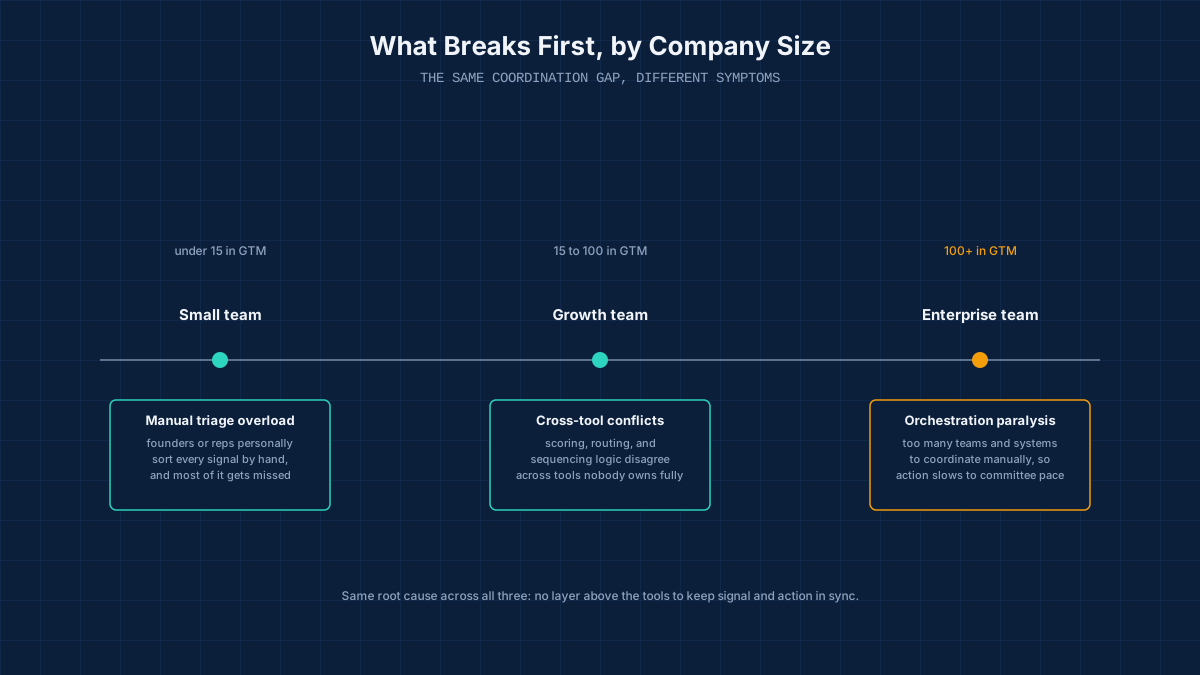
The specific symptom differs. The underlying cause, no layer above the individual tools keeping signal and action in sync, is identical at every size. That is the core argument for why this is not an enterprise specific problem: it is the same structural gap, showing up earlier and in a different costume depending on how big the team is when it hits the threshold.
| Stage | Dominant symptom | Where the cost lands |
|---|---|---|
| Small team | Manual triage overload | Missed signal, disguised as being busy |
| Growth stage | Cross tool conflict | Inconsistent prioritization, eroded trust in scoring |
| Enterprise | Orchestration paralysis | Slow response to time sensitive signal, lost to faster competitors |
What makes this pattern easy to miss internally is that each symptom looks, from inside the team experiencing it, like a normal operational challenge rather than a structural gap. A small team attributes missed signal to being understaffed. A growth stage team attributes scoring disagreements to needing better data hygiene. An enterprise team attributes slow response times to needing better cross functional alignment. Each of these diagnoses is not wrong exactly, but each one treats a structural coordination problem as a people or process problem, which tends to produce incremental fixes, more headcount, better meetings, cleaner data, that address the symptom without closing the underlying gap.
Objections and Counterarguments
"We are too small to need this." This deserves to be taken seriously rather than dismissed, because it is sometimes correct. A three person GTM team selling a single product with a handful of active tools genuinely may not have enough signal complexity to benefit from a dedicated coordination layer, and adding one at that stage would likely be over engineering a problem that a spreadsheet and good judgment can still solve. The mistake is treating that exception as the default rather than the edge case. The relevant question is not company size in the abstract, it is signal and tool complexity relative to the number of people available to coordinate it manually, and for a meaningful and growing share of B2B companies, that ratio crosses the point where manual coordination breaks down well before headcount reaches what most people still associate with needing this kind of system.
"We cannot afford enterprise software at our stage, and that is what this is." This objection conflates a category of problem with a specific class of expensive, complex product built to solve it at enterprise scale. It is a fair criticism of enterprise RevOps platforms priced and built for large organizations, and a much weaker criticism of the underlying idea that some coordination layer, sized appropriately, is worth having. A minimal version, described later in this piece, can be built with a fraction of the cost, complexity, and implementation time of an enterprise platform, precisely because it does not need the governance, scale, and integration depth that make enterprise versions expensive.
"Our team is small enough that we can just talk to each other." This is a genuine strength of small teams, and it is worth preserving rather than replacing prematurely with process. The issue is that informal, conversational coordination scales with headcount and inversely with signal volume, and the second variable has grown faster than the first at most companies over the last few years. A team that could reliably coordinate through hallway conversations and a weekly sync at ten signals a day cannot necessarily do the same at eighty, even if headcount has not changed, because the volume of things that need to be individually noticed and discussed has outgrown what informal coordination can absorb.
"Adding a coordination layer this early adds complexity we do not need yet." This is the most legitimate version of the skepticism, and it is worth taking as a real design constraint rather than dismissing outright. The response is not to reject the idea of a coordination layer, but to insist on a minimal, right sized version rather than assuming the only options are no layer at all or a full enterprise implementation. A minimal version, built with lightweight tooling and a small number of clear rules, adds meaningfully less complexity than the manual reconciliation work it replaces, which is the actual comparison that matters rather than comparing it to doing nothing.
The Objection That Sounds Reasonable but Usually Is Not
The most common counterargument, already addressed above, is worth summarizing in a simple comparison, because the honest evaluation usually comes down to a short list of observable signals rather than an abstract judgment about company size.
| Signal you are actually too small for this | Signal you have already crossed the threshold |
|---|---|
| Fewer than five active GTM tools, low signal volume | Signals routinely reviewed hours or days after they matter |
| One or two people can realistically track every account personally | Different tools disagree about which accounts deserve attention |
| Sales cycle is long enough that a delayed response rarely costs a deal | Reps report missing good signal because it arrived in a tool they check less often |
| No dedicated RevOps or GTM engineering function yet, by design | Someone on the team already spends real time manually reconciling data between tools |
The Minimal Version Scales Down Further Than People Expect
Part of what keeps the "too small for this" objection alive is an assumption that a GTM operating layer necessarily means the full, enterprise grade version, with dozens of connected sources, complex governance, and a dedicated team to run it. That version exists, and it is genuinely appropriate for large, complex organizations. It is not the only version.
A minimal operating layer does three jobs: it unifies whatever signal sources a team already has, even if that is only a handful, it ranks or scores accounts automatically rather than requiring someone to manually decide priority every day, and it triggers or recommends the next action based on that ranking. That is a meaningfully smaller undertaking than a full enterprise implementation, and it can be built with lightweight tooling, sometimes even a well designed workflow automation setup, rather than requiring a dedicated platform purchase.
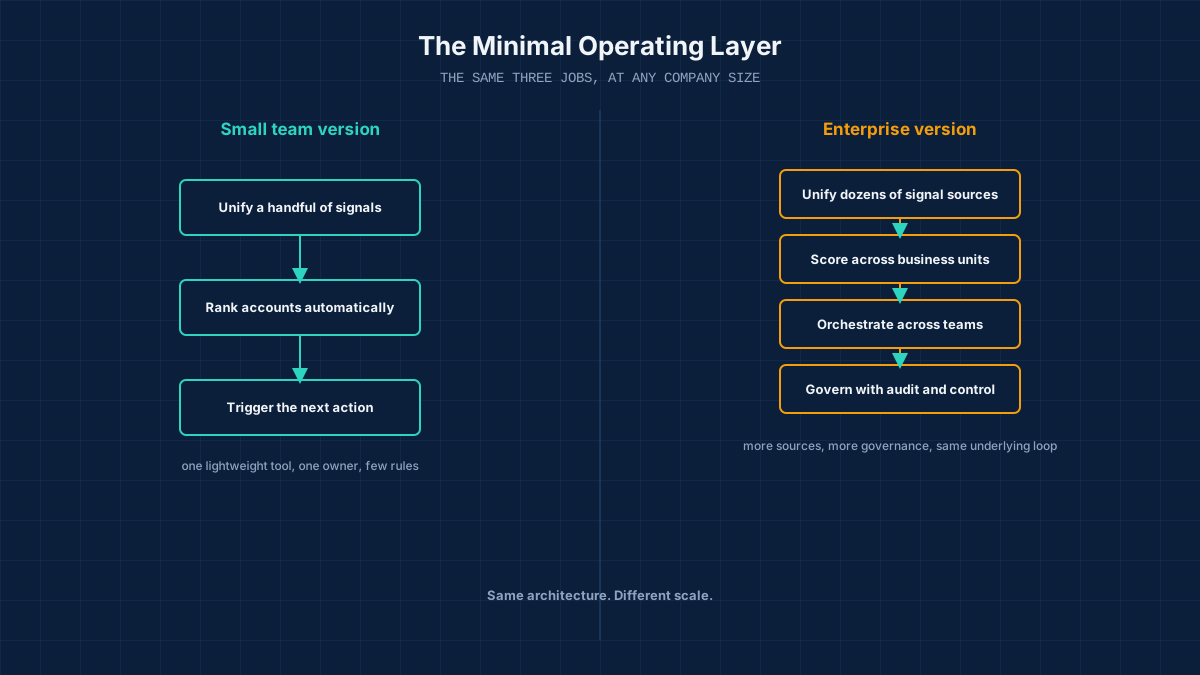
The architecture is the same at both ends. What changes is scope: how many sources get unified, how sophisticated the scoring logic is, how much governance and audit capability sits around the orchestration layer. A ten person team does not need enterprise grade governance. It does need the same underlying loop, signal in, decision made, action triggered, even in a much simpler form, because the coordination gap that loop closes exists at that scale too, just with lower stakes per individual missed signal and a smaller, simpler set of tools to unify.
| Element | Minimal version | Enterprise version |
|---|---|---|
| Signal sources unified | Three to six core sources | Fifteen or more, often across business units |
| Scoring logic | A small number of clear, explainable rules | More sophisticated models, often with dedicated ownership |
| Orchestration | Simple triggers into existing tools | Cross team sequencing with escalation paths |
| Governance | Light, often a single owner reviewing periodically | Formal audit trails, access controls, change management |
| Typical build approach | Workflow automation platform or lightweight purpose built tool | Dedicated GTM operating system platform |
A concrete way to picture the minimal version: a small team might connect its CRM, its intent data provider, and its product analytics tool into a simple automation layer that scores accounts on a handful of explicit criteria, intent surge combined with a qualifying firmographic trait combined with recent product engagement, and automatically creates a prioritized task for the right rep when an account crosses a defined threshold, with a Slack or email alert so nothing sits unnoticed in a dashboard nobody checks. That is a meaningfully smaller build than an enterprise implementation, achievable by a single capable operator in days rather than months, and it closes a large share of the coordination gap described earlier without requiring the governance and scale that make enterprise systems expensive and slow to implement.
The mistake to avoid is treating the minimal version as a lesser, temporary stopgap rather than a legitimate, right sized solution. For a team at this stage, the minimal version is not a compromise on the way to something better. It is the correctly scoped answer to the actual problem at that size, and outgrowing it, adding sources, refining scoring, adding governance, should happen gradually as complexity actually increases, not preemptively based on an assumption about what a "real" operating layer is supposed to look like.
The Cost of Waiting
Companies that delay building any version of a coordination layer, on the assumption that they will get to it once they are bigger, usually underestimate the compounding cost of that delay.
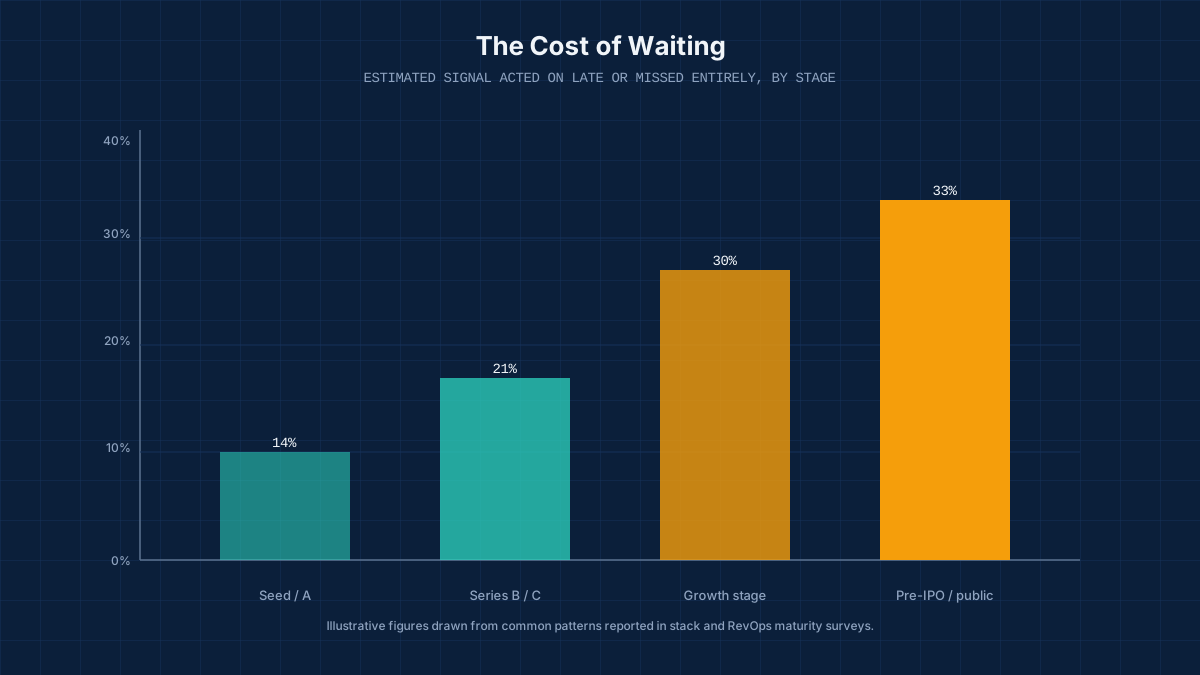
Two dynamics make this cost worse than it first appears. First, the volume of signal a team generates tends to grow faster than headcount, particularly as AI powered tools multiply how much outreach, content, and engagement a small team can produce, which means the coordination gap widens even between funding rounds, not just at the moment a company crosses into the next stage. A team that decides at ten people that it does not yet need a coordination layer may find, eighteen months later at twenty five people, that the gap has grown far more than headcount alone would suggest, simply because signal volume per person has also increased over that period.
Second, habits formed early are hard to unwind later. A team that has spent several years manually triaging signal, and has built its processes, its hiring, and its expectations around that manual model, tends to find it harder to adopt a coordination layer later than a team that builds the discipline of trusting a system to prioritize signal from an earlier, simpler stage. This shows up concretely in how reps behave: a rep who has spent two years building their own personal system for deciding what to work on each day, informed by intuition and habit, is often more resistant to trusting an automated prioritization system than a rep who joined a team that already worked this way from the start. The organizational muscle memory built during the manual period becomes something a later system has to actively overcome, rather than something it can simply build on.
There is a third, less obvious cost worth naming directly: opportunity cost in hiring and process design. Teams that operate without any coordination layer for years tend to build their RevOps and GTM hiring around people skilled at manual reconciliation and synthesis, valuable skills, but not the same skill set needed to design and refine the rules and thresholds a coordination layer runs on. Making the transition later often means not just implementing new software, but partially retooling what the team looks for in its RevOps hires, which is a slower and more disruptive change than building the right hiring profile from an earlier stage.
What This Means in Practice
For a GTM leader at a smaller company evaluating this argument, a few practical takeaways follow.
Do not wait for a specific headcount number. The right trigger is not "we will build this once we hit fifty people in GTM." It is a set of observable symptoms, signal being missed or acted on late, tools disagreeing with each other, someone already spending meaningful time on manual reconciliation, that indicate the coordination gap has already opened, regardless of what the org chart says. A useful practice is to periodically and explicitly ask the team, not just leadership, whether anyone has recently noticed a signal that arrived too late to be useful, or a case where two tools gave conflicting guidance about the same account. Those specific, concrete incidents are more reliable indicators than any abstract headcount threshold.
Start with the minimal version, not the enterprise one. A small team evaluating this space does not need, and usually cannot justify, a full enterprise platform. The right starting point is the smallest version of the loop, unify signal, score accounts, trigger action, built with whatever lightweight tooling fits the team's actual stack and budget, with room to grow in sophistication as the company does. Resist the temptation to over specify the first version, since the goal at this stage is closing the most costly part of the coordination gap quickly, not building a comprehensive system that anticipates every future need.
Treat this as infrastructure, not a later stage luxury purchase. Companies that build even a simple coordination layer early tend to scale it incrementally as complexity grows, adding sources and refining logic gradually, in the same way a well designed codebase is easier to extend than one that has to be substantially rewritten. Companies that wait tend to face a much larger, more disruptive build later, once the gap has grown large enough to be undeniable, at a point where the team has also built years of habits around manual coordination that the new system has to overcome, and where the volume of legacy process and tribal knowledge to untangle has grown considerably.
Assign clear ownership even at a minimal scale. One of the more common failure modes for early coordination layers is building the system but leaving its rules and thresholds unowned, so that as the business changes, nobody updates the logic and it slowly drifts out of alignment with how the team actually operates, eventually becoming as unreliable as the manual process it replaced. Even a minimal version benefits from having one clearly accountable person responsible for periodically reviewing and adjusting its rules, even if that responsibility is a small fraction of that person's overall role.
Revisit the assumption regularly, not once. Because the threshold for needing this keeps moving down as tooling and signal volume continue to grow, a decision made a year ago that a coordination layer was not yet necessary is worth revisiting, not assumed to still be correct. The pace of change in this specific area has been fast enough that a team's honest answer to "are we too small for this" can shift meaningfully within a single funding cycle, and building a habit of asking the question periodically, rather than deciding it once and moving on, is itself a useful discipline.
Early Evidence This Is Already Happening
A few observable patterns suggest this shift is not just a theoretical prediction but something already visible in how early stage GTM teams operate.
Lightweight automation platforms built around connecting a small number of GTM tools and triggering simple, rule based actions have grown quickly in adoption among small teams over the past few years, filling a gap that used to only be addressed by expensive, complex enterprise platforms. Their growth is itself evidence that a real, underserved need exists at a smaller scale than the traditional RevOps platform market was built to address.
Job postings at early and growth stage companies increasingly include some version of GTM systems responsibility even in generalist RevOps or marketing operations roles, well before those companies reach the size that would traditionally justify a dedicated systems function. This reflects hiring managers recognizing, even if informally, that coordination work has become part of the baseline job at a smaller scale than it used to be.
And perhaps most tellingly, founders and early GTM leaders increasingly describe a specific, recognizable frustration in public forums and conversations, the sense that their small team's tools do not talk to each other well enough, well before those companies reach a size anyone would traditionally call complex. That frustration, repeated across a large number of otherwise different early stage companies, is a strong signal that the coordination gap is arriving earlier than the market's existing solutions were built to address.
Where Elevate GTM Solutions Fits
This piece has argued that the right size of a GTM operating layer scales down further than most teams assume, from a full enterprise implementation to a minimal version built around the same underlying loop. Elevate GTM Solutions is built to serve that need directly, as the AI-native GTM platform and GTM operating system for companies that have concluded, using the evaluation in this piece, that their coordination gap has already opened.
Elevate is designed to help enterprises build, activate, and execute go-to-market strategy across markets, products, and industries, with the same core architecture, unifying GTM context, applying GTM intelligence, executing through structured workflows, and staying current through continuous analytics, scaling from a single, focused motion to a broader, multi-market GTM operation as a company's actual signal complexity grows. Rather than asking a team to build every layer described in this piece from scratch, Elevate provides that architecture as a starting point, letting a team that has recognized its coordination gap act on that recognition directly rather than beginning with a lengthy internal build.
Conclusion
The idea that GTM operating layers are an enterprise concern made sense when the coordination problems they solve mostly showed up at enterprise scale. That is no longer where the problem starts. Signal volume and tool count have grown faster than headcount at nearly every company stage, which means the threshold at which manual coordination breaks down has moved down the org chart faster than most leaders' mental model of when they will need to address it.
This does not mean every company needs the same operating layer, or needs it today. It means the honest evaluation is not company size, it is whether signal is already being missed, whether tools already disagree with each other, and whether someone on the team is already doing, by hand, the reconciliation work a much smaller and simpler coordination layer could do automatically. For a growing number of companies, smaller and earlier than the old conventional wisdom would suggest, the honest answer to that evaluation is yes, and the cost of waiting for a headcount milestone that no longer reflects when the problem actually starts is higher than most teams realize until they have already paid it.
The broader pattern here is one worth remembering beyond this specific category. Infrastructure thresholds have a consistent history of falling as the underlying tooling matures and becomes more accessible, and each time that happens, the companies that adapt their mental model early tend to build a durable advantage over the ones still operating under the old assumption about what size company needs what kind of capability. GTM coordination is in the middle of exactly that kind of shift right now. The question worth asking is not whether a company is the kind of company that eventually needs an operating layer. Most growing B2B companies eventually do. The more useful question is whether the honest answer to that question has already arrived earlier than the team currently assumes, and whether waiting for a more obvious, more painful signal to confirm it is a decision being made deliberately, or simply by default.
Contents
Related Research
GTM Research
Explore research, benchmarks, technology landscapes, and perspectives on the evolution of go-to-market.
View Research Library →