Why GTM Operating Systems Will Replace CRM-Centric GTM
CRM was built to record what already happened. GTM now moves faster than any record can keep up with. Here is why an operating layer, not another point tool, is what closes the gap.
Published 2026-07-25
For thirty years, the center of gravity in go to market software has been a record keeping system. First it was a rolodex. Then it was a database of contacts and deals called a CRM. Every tool that came after, marketing automation, sales engagement platforms, intent data providers, was built to feed information into that record or pull information out of it.
That model made sense when go to market work was slow, linear, and mostly manual. A rep called a lead, logged the call, updated a stage, and moved on. The CRM's job was to remember what happened. It did that job well.
It is a much worse fit for how revenue teams actually operate today. Buying signals now arrive continuously, from product usage, from ad engagement, from support tickets, from job changes, from intent data providers refreshing hourly. Teams run dozens of tools that each hold a partial, fast decaying picture of an account. And the work of go to market, deciding who to contact, what to say, and when, increasingly needs to happen automatically, at a pace no human updating a CRM field can match.
This piece lays out why that gap is not a temporary inconvenience to be solved with another integration, but a structural mismatch between what CRM was designed to do and what go to market now requires. It argues that the category winning this decade will not be a better CRM. It will be a GTM operating system: a layer that sits above the record and continuously turns signal into coordinated action.
This is not a claim that CRM has failed, or that the vendors who built the category made a mistake. It is a claim about scope. CRM was designed to answer questions about the past and present state of a deal. Go to market today increasingly requires a system that can also decide, continuously and at scale, what should happen next. Those are two different jobs, and trying to stretch one system to do both is where most of the friction described in this piece originates.
What CRM Was Actually Built to Do
It helps to be precise about what a CRM is, because a lot of the confusion in this market comes from asking a record keeping system to do operational work it was never designed for.
A CRM is, at its core, a relational database with a sales shaped user interface on top of it. Contacts, accounts, opportunities, and activities are rows in tables, connected by keys, displayed as records and pipelines. Its job is to answer questions like: who do we know at this account, what stage is this deal in, and what happened on the last call.
That is a system of record. Systems of record share a few defining traits.
| Trait | What it means in practice |
|---|---|
| Human entry dependent | Fields update when someone, or an integration acting on someone's behalf, writes to them |
| Point in time accurate | A record reflects the state of the world at the moment it was last touched, not the current moment |
| Passive by design | The database does not initiate action on its own, it waits to be read or written to |
| Structured around deals and contacts | The unit of work is a record, not a decision or a signal |
None of this is a criticism. Every mature category needs a reliable system of record, and CRM has earned its place as one of enterprise software's most durable categories precisely because it does this one job consistently. The issue is not that CRM does its job badly. The issue is that the job it does was never the whole job of running go to market, and the gap between the two has widened every year since intent data, product led growth motions, and AI powered outreach became normal parts of the revenue stack.
It also helps to remember why CRM won its category in the first place. The earliest sales databases in the 1980s and 1990s competed on a simple promise: replace paper files and personal notebooks with a shared, searchable record that survived a rep leaving the company. That promise was enough to build a multi billion dollar category, because the alternative it replaced, information trapped in one person's head or one person's desk drawer, was genuinely worse for everyone else in the organization.
The generation of CRM that followed added workflow on top of storage: pipeline stages, approval steps, forecast rollups. This made the record more useful to managers, but it did not change what the system fundamentally was. It remained a place things got written down after they happened, viewed by people trying to understand a snapshot of the business. Even the most modern, well designed CRM interface today inherits this lineage. It is a very good filing cabinet with excellent search. It was never architected to be the thing that decides, in real time, what should happen next across a hundred different accounts simultaneously.
That distinction, between storing what happened and deciding what happens next, is the entire argument of this piece. It is easy to miss because both jobs happen to live, historically, inside the same login screen.
Where CRM Centric GTM Breaks Down Today
Three forces have exposed the limits of a record centric model faster than most revenue leaders expected.
Signal volume outpaced human bandwidth. A revenue team in 2015 might have tracked a handful of signals per account: form fills, email opens, maybe a firmographic update once a quarter. A team in 2026 has access to intent surges, product usage events, hiring signals, funding announcements, support ticket sentiment, and website visitor identification, often from a dozen different vendors. No rep or RevOps analyst can manually synthesize that volume of signal into a next action for every account in their book, every day. The record cannot keep pace with the signal.
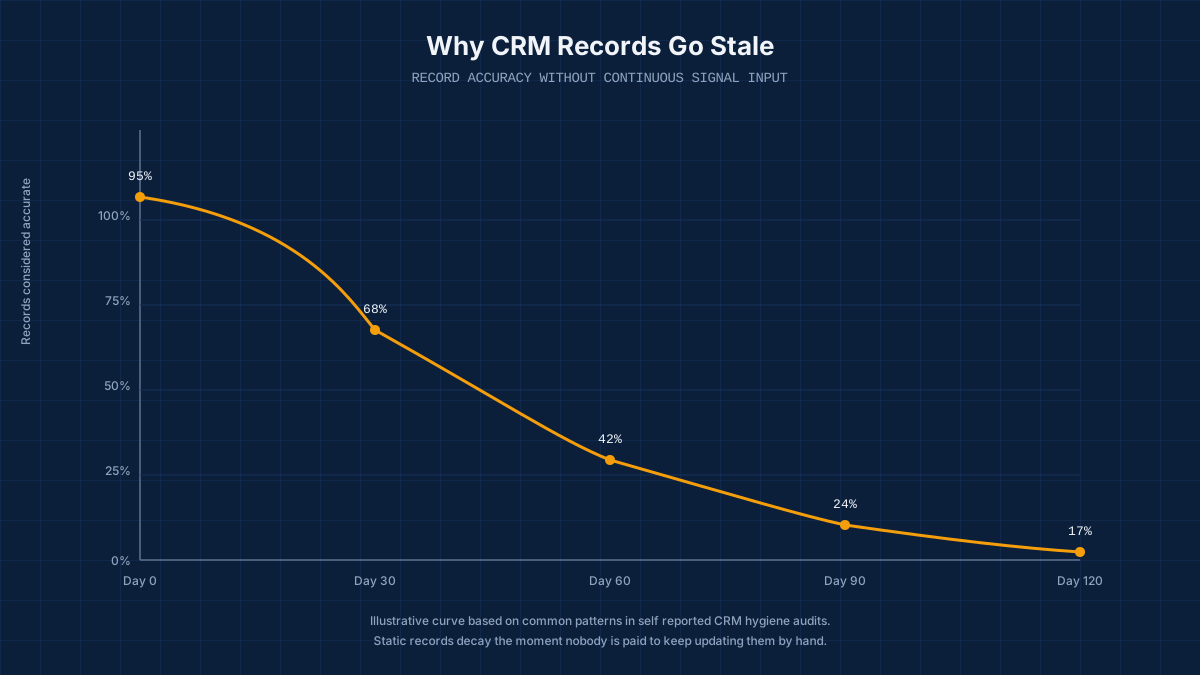
Data goes stale the moment nobody is paid to update it. CRM hygiene is a constant, losing battle in most organizations, not because reps are careless, but because manual entry does not scale with signal volume. A field updated last week is already out of date if the account had three new signals since then. The chart below illustrates a common pattern found in CRM hygiene audits: accuracy decays sharply within the first thirty to sixty days after any given update, because nothing in a passive system triggers a refresh.
Point solutions solved narrow problems and created a new one. The response to CRM's limitations, over the last decade, was to bolt on point solutions. Sales engagement platforms for sequencing outreach. Intent data providers for surfacing buying signals. Conversation intelligence tools for call analysis. ABM platforms for account targeting. Each solved a real, narrow problem. But stacking them did not create coordination between them. It created more systems that each hold a partial, disconnected view, and more manual work stitching outputs from one tool into inputs for another. The table below outlines how this fragmentation typically shows up inside a revenue org.
| Tool category | What it owns | What it cannot see |
|---|---|---|
| CRM | Deal stage, contact history, forecast | Real time product usage, live intent, channel level engagement |
| Sales engagement | Sequence status, email and call activity | Whether the account is actually in market right now |
| Intent data | Topic and keyword surges by account | Whether a rep has already reached out, or should |
| Marketing automation | Campaign engagement, lead scoring | Sales activity happening outside marketing touches |
| Product analytics | Usage, activation, expansion signals | Whether the account is a target of an active sales motion |
Each of these tools is good at what it does. None of them, and no manual process connecting them, can reliably turn a signal that appears in one system into a coordinated action across the others, fast enough to matter. That coordination gap is what a GTM operating system exists to close.
Response speed became a competitive variable, not just an efficiency metric. There is a growing body of research, going back over a decade to work popularized by companies like InsideSales and repeated in various forms since, showing that the odds of qualifying or converting a lead drop sharply with every additional minute of response delay. That research predates most of the current AI tooling conversation, but AI has raised the stakes. When a buyer can get an instant, well informed answer from a competitor's AI powered outreach or chat experience, the bar for what counts as a fast response resets for the whole market. A CRM centric process, where a signal sits in a queue until a human logs in, checks a dashboard, and decides what to do, was already too slow for the fastest moving deals before AI. It is now too slow by a wider margin, because the standard it is being compared against moved.
Put together, these four forces, signal volume, data decay, tool fragmentation, and rising speed expectations, do not describe a temporary rough patch that a better dashboard or a cleaner data warehouse will fix. They describe a structural mismatch between an architecture built for periodic, human mediated updates and a go to market environment that now runs continuously.
The Rise of GTM Tool Sprawl
The scale of this fragmentation is easy to underestimate until you count the tools involved. What was an eight to twelve tool stack a decade ago has become, in many mid market and enterprise revenue orgs, a stack of thirty or more overlapping platforms, each with its own login, its own partial data set, and its own workflow logic.
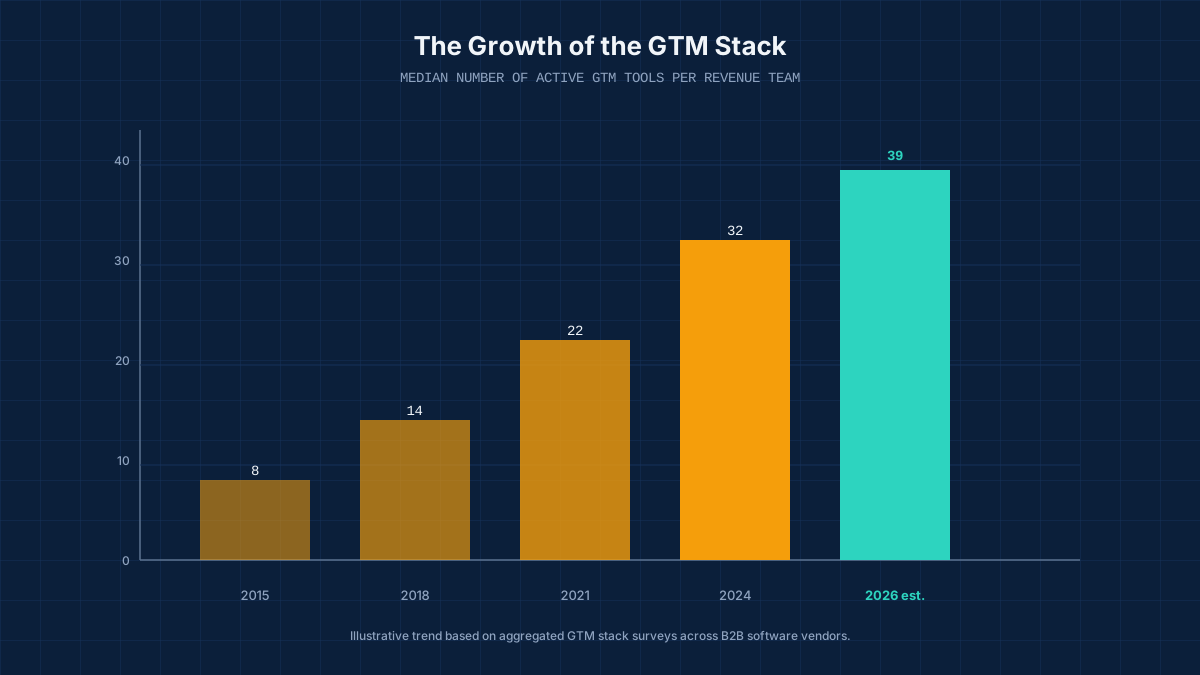
This growth was not irrational. Each individual tool was usually purchased to solve a specific, urgent problem: better email deliverability, more accurate intent scoring, faster call transcription. The rational decision at each individual purchase point added up to an irrational whole. RevOps teams now spend a meaningful share of their time on integration maintenance, deduplication, and reconciling conflicting data between systems that were never designed to talk to each other in the first place.
This is the practical, day to day version of the CRM centric problem. It is not an abstract architectural argument. It is a RevOps leader discovering that the lead routing logic disagrees with the account scoring logic, because they live in two different tools that were updated on two different schedules by two different teams.
The Economics of a Coordination Gap
Tool sprawl is usually discussed as a budget line item, how much the stack costs in annual contracts. That framing understates the real cost, because most of the expense of a fragmented stack shows up as labor and lost speed, not as a subscription invoice.
| Cost category | Where it shows up | Why it is easy to underestimate |
|---|---|---|
| Integration maintenance | RevOps and sales engineering time spent keeping syncs and field mappings working | Rarely tracked as a discrete cost, it gets absorbed into general headcount |
| Manual reconciliation | Analysts resolving conflicting scores, duplicate records, and mismatched routing rules | Treated as normal operational overhead rather than a symptom of a fixable architecture problem |
| Delayed or missed action | Signals that surface in one tool but never reach the rep who should act on them | Invisible by definition, since a missed action leaves no record behind |
| Redundant capability | Two or more tools scoring or segmenting the same accounts with different logic | Often discovered only during a renewal or stack audit, well after the redundancy was purchased |
None of these costs disappear by adding another point tool. Most of them get worse, because every additional tool is one more source of signal that needs to be reconciled with everything already in the stack. This is the underlying economic argument for a coordination layer: it does not just add a new capability, it removes a category of cost that grows automatically as the stack grows, regardless of how good any individual tool in that stack is.
Defining the GTM Operating System
An operating system, in the computing sense, does not replace the hardware underneath it. It sits above the hardware and coordinates how every application uses shared resources: memory, storage, input, output. Applications do not need to know how to talk to the disk directly. The operating system handles that, consistently, so every application above it can focus on its own job.
A GTM operating system does the equivalent job for revenue teams. It does not replace the CRM, the ad platform, or the sales engagement tool. It sits above them, ingests signal from all of them continuously, applies a consistent decision layer, and coordinates action across the tools that actually execute outreach, routing, and follow up.
| Layer | Function | Analogous to |
|---|---|---|
| System of record | Holds the authoritative account, contact, and deal data | Disk storage in a computer |
| Data and signal layer | Unifies intent, usage, firmographic, and engagement data continuously | Memory and input devices |
| Intelligence layer | Scores, prioritizes, and recommends the next best action per account | The kernel's scheduling logic |
| Orchestration layer | Sequences plays across channels and owners in real time | Process management |
| Activation layer | Executes the action: outreach, routing, alerts, workflow triggers | Applications running on the OS |
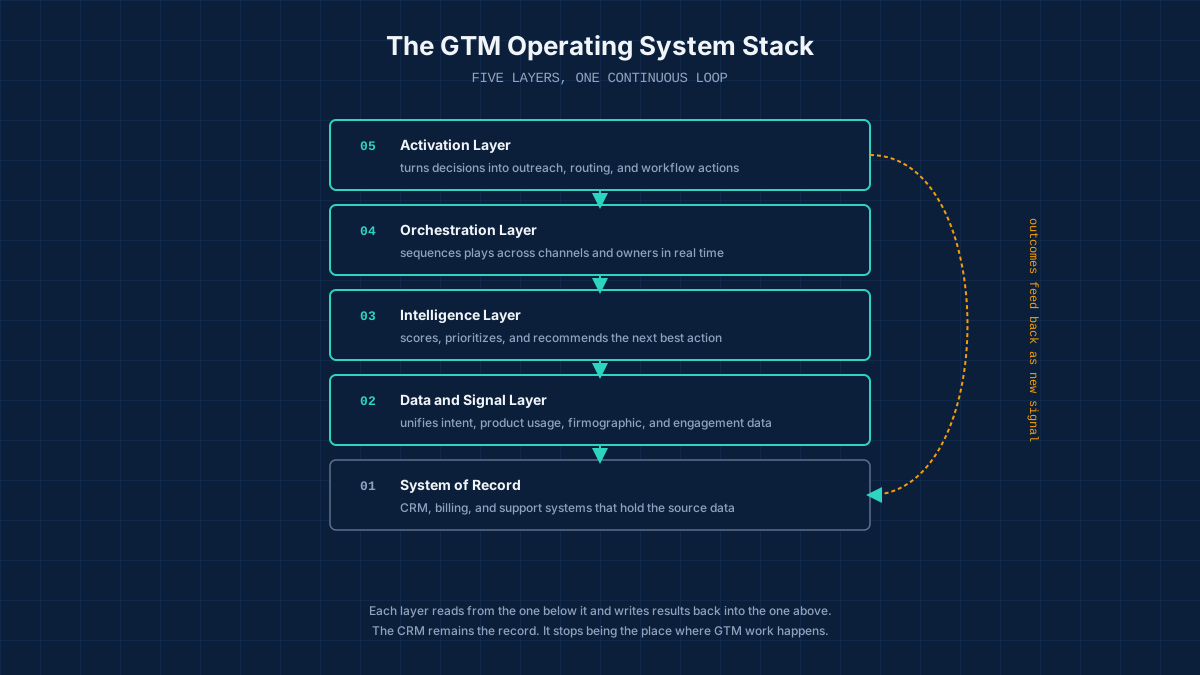
Each layer deserves a slightly closer look, because the term operating system can otherwise stay abstract.
The data and signal layer is not simply a data warehouse. A warehouse is built to answer analytical questions well after the fact. This layer is built to normalize and route signal as it arrives, within seconds or minutes rather than overnight, so that the layers above it are always working from close to current information rather than yesterday's batch export.
The intelligence layer is where scoring and prioritization happen, and it is the layer most vendors currently associate with AI. That association is understandable but incomplete. Scoring which account deserves attention today is a real and valuable capability, but on its own it still leaves a human to decide what to do with that score. The intelligence layer earns its place in an operating system specifically by feeding its output directly into orchestration, not by stopping at a ranked list.
The orchestration layer is the least visible layer to most end users and arguably the most important architecturally. It is the layer that decides, given a scored account and an intended action, which channel to use, which owner is responsible, and how that action sequences against anything else already happening with that account. Without this layer, even excellent scoring just produces a better informed human bottleneck rather than removing the bottleneck.
The activation layer is where the work becomes visible again: an email sent, a call task created, a lead routed, a Slack alert delivered to the right owner. This is the layer most similar to what existing point tools already do well, which is exactly why an operating system is designed to coordinate these tools rather than replace them. The activation layer's job is not to out execute a dedicated sales engagement platform at sending emails. It is to make sure the right email gets triggered, through the right existing tool, at the right moment, based on what every other layer below it has already determined.
The critical design principle is the loop, not just the layers. A record centric system is a straight line: data goes in, a human reads it, a human acts. An operating system is a loop: signal comes in, gets scored, triggers coordinated action, and the outcome of that action becomes new signal that refines the next decision. That loop is what allows the system to keep pace with a volume and speed of signal that no manual process can match.
How a GTM Operating System Differs From a CRM
It is worth being explicit about the differences, because the two categories are often described in ways that make them sound interchangeable when they are not.
| Dimension | CRM (system of record) | GTM operating system |
|---|---|---|
| Primary job | Store and display account, contact, and deal data | Continuously turn signal into coordinated action |
| Update trigger | Human entry or scheduled integration sync | Real time signal from any connected source |
| Unit of work | A record (contact, account, deal) | A decision (who, what, when, through which channel) |
| Relationship to other tools | Other tools write into it or read from it | Other tools are coordinated by it |
| Failure mode | Stale, incomplete, or duplicate records | Uncoordinated or conflicting actions across channels |
| Where value shows up | Reporting, forecasting, historical record | Speed and consistency of go to market execution |
None of this makes CRM obsolete. Finance, legal, and compliance functions will continue to need an authoritative, auditable system of record, and that requirement is not going away. What changes is where the operational center of gravity sits. The CRM stops being the place where go to market decisions get made in real time, and becomes the ledger that a smarter layer above it reads from and writes back to.
This transition is easiest to see in what a rep's daily experience looks like under each model. Under CRM centric GTM, a rep typically starts the day by checking several tools separately, the CRM for pipeline status, a sales engagement platform for sequence performance, an intent tool for new signal, and manually decides where to focus. Under a GTM operating system, that synthesis has already happened before the rep logs in. The system has already scored the accounts, decided which ones warrant attention today, and queued the recommended action. The rep's job shifts from gathering and interpreting information to executing and refining judgment calls the system surfaces, which is a meaningfully different, and for most reps more productive, use of their time.
What a GTM Operating System Is Not
Because the term is new and already being used loosely across the market, it is worth being equally clear about what does not qualify, even when a vendor uses similar language.
It is not a customer data platform. A CDP unifies customer data for the purpose of segmentation and activation, mostly in a marketing context, and mostly built around identity resolution as its core problem. That is a real and valuable capability, and it often functions as a useful input to the data and signal layer described earlier. But a CDP on its own does not include the decisioning and orchestration layers that turn unified data into coordinated, cross channel action across sales and marketing. Unifying data is a necessary step, not the whole loop.
It is not an ABM platform. Account based marketing platforms are built around identifying and targeting a defined set of accounts with coordinated marketing content. That is a specific, valuable use case within a broader operating layer, but it is scoped to marketing activation and typically does not extend into sales sequencing, support signal, or product usage in the way a full operating layer does.
It is not a workflow automation tool wrapped around a CRM. Many CRM ecosystems include automation builders that let a team create if this then that style rules inside the CRM itself. These are useful and often underused, but they operate on the CRM's own data model and update cadence, which brings back the exact staleness and single tool blind spot problems described earlier. A rule built inside a system of record inherits that system's limitations, no matter how sophisticated the rule itself is.
It is not simply AI added to an existing tool. Adding an AI feature to a CRM, a sales engagement platform, or an intent data tool can genuinely improve that tool's own output, better lead scoring, better email drafts, better call summaries. That is valuable, but it is not the same as coordinating across tools. An AI feature that only ever sees the data inside its own platform is still operating with a partial view, just a more sophisticated partial view than before.
The common thread across all four is scope. Each of these categories does a real job well within its own boundary. A GTM operating system is defined by working across those boundaries, continuously, which is a structurally different problem than doing any single one of those jobs better in isolation.
The Historical Shift: From Record Systems to Operating Systems
This pattern, a record keeping system giving way to an operating layer once the surrounding ecosystem gets too complex for manual coordination, is not new. It has played out in enterprise software before.
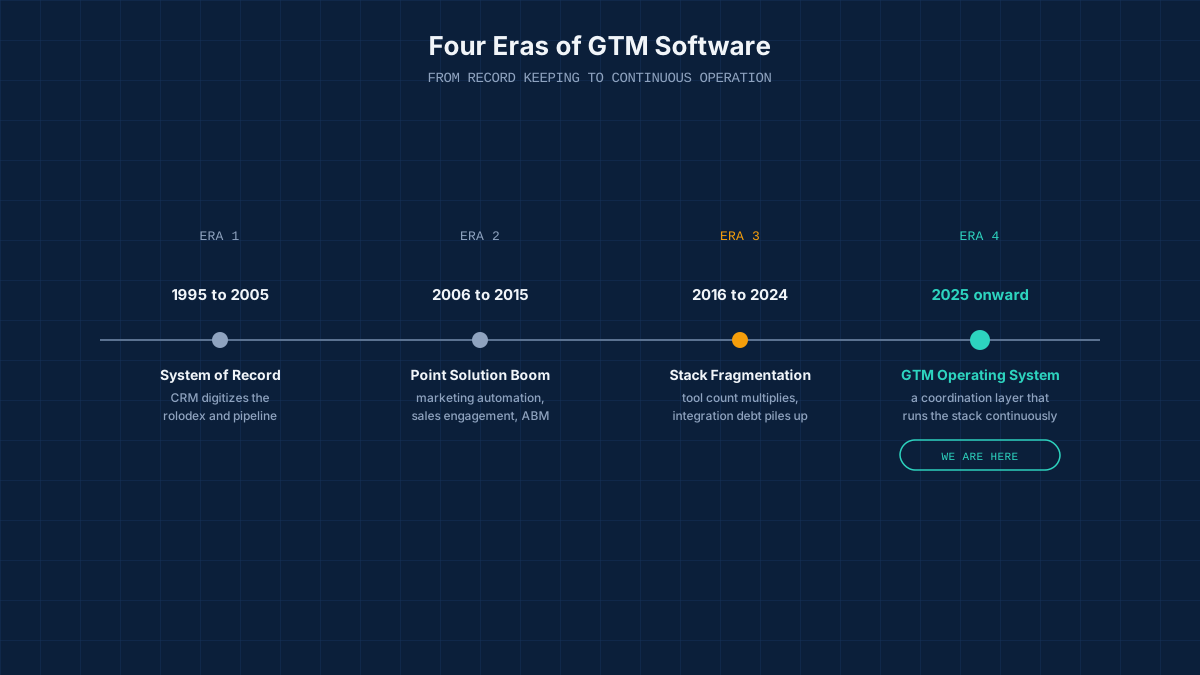
Enterprise resource planning followed a similar arc. Early ERP systems were record systems for finance and inventory, essentially a ledger with more structure. As supply chains got more complex, spanning more suppliers, more warehouses, and more shipping lanes than any planner could track by hand, a layer of planning and orchestration software grew up around and eventually inside ERP to coordinate demand, supply, and logistics in something closer to real time. The ledger did not disappear. It became the foundation that a smarter coordination layer read from and wrote back to, which is the exact relationship this piece argues will develop between CRM and a GTM operating system.
IT infrastructure followed the same arc more literally, and on a faster timeline. In the early 2000s, running an application meant provisioning and manually managing individual physical servers, each configured by hand. Virtualization abstracted the hardware, letting teams run many virtual machines on shared infrastructure, but someone still had to manually decide which machine ran which workload. As the number of services running across a typical company's infrastructure grew from dozens to thousands, that manual decision making stopped scaling. Orchestration layers like Kubernetes emerged specifically to solve that coordination problem: given a pool of infrastructure and a set of workloads, continuously decide what runs where, restart what fails, and rebalance load automatically, without a human making each individual placement decision.
The pattern across both examples is consistent. A record or resource layer handles storage and provisioning. Complexity grows past what manual coordination can handle. An orchestration layer emerges specifically to close that gap, not by replacing the layer underneath it, but by continuously making the coordination decisions that used to require a person watching a dashboard and reacting.
GTM is crossing that same threshold now. The number of signals, channels, and tools involved in a single account's buying journey has grown past what manual coordination, however well staffed the RevOps team, can reliably keep synchronized. That is the condition under which an operating layer stops being a nice to have and starts being the only way the system holds together.
Early Evidence the Shift Is Already Underway
This shift is not purely theoretical. A few observable patterns, visible across the current GTM software market, point in the same direction.
Category boundaries are blurring on purpose. Sales engagement platforms have added intent data ingestion. Intent data providers have added workflow and orchestration features. CRM vendors have added AI scoring layers on top of the record. Each of these moves, taken individually, looks like feature creep. Taken together, they describe every adjacent category reaching toward the same coordination layer from a different starting point, which is usually a sign that a market has identified a real gap and has not yet agreed on who will fill it.
A new job function is forming around this exact problem. Titles like GTM engineer, RevOps engineer, and GTM systems architect have moved from rare to common in job postings at growth stage and enterprise B2B companies over the last few years. These roles are explicitly defined around connecting signal to action across a fragmented stack, often through code, automation platforms, and increasingly through purpose built orchestration tools rather than manual CRM configuration. The existence of a job title is a lagging but reliable indicator that a category of work has become large and repetitive enough to specialize around.
Buying committees are asking a different question in vendor evaluations. RevOps and GTM leaders evaluating new tools increasingly ask not just what a tool does on its own, but what it does with the signal already present elsewhere in the stack. That question did not used to be a standard part of a vendor evaluation. Its growing prominence reflects a market that has started treating coordination, not just capability, as a purchase criterion.
None of these signals alone proves the shift is complete. Together, they describe a market moving in a consistent direction, from vendors, from job markets, and from buyers, well before any single company has fully defined or won the GTM operating system category.
What This Means for Revenue Teams
For a revenue leader evaluating this shift, the practical implications fall into a few categories.
Data strategy becomes an operating concern, not a reporting concern. Under a CRM centric model, data quality mostly matters for forecasting accuracy and reporting. Under a GTM operating system, data quality directly determines whether the right account gets the right action at the right time. Bad data does not just make a dashboard wrong, it makes the system take the wrong action, at scale, automatically.
Tool consolidation pressure will increase, but not in the way most vendors expect. The instinct in a fragmented stack is to consolidate by buying one platform that claims to replace five others. That rarely works cleanly, because most of those five tools are genuinely good at their narrow job. The more durable form of consolidation is coordination: keeping the specialized tools, but adding a layer above them that makes their outputs consistent and their actions coordinated, rather than trying to replace them outright.
RevOps shifts from maintenance to design. A large share of current RevOps time goes to keeping fragmented systems roughly in sync: deduplication, manual routing rule updates, reconciling conflicting scores. An operating layer absorbs much of that maintenance work, which frees RevOps time for designing the logic that governs how signal turns into action, a higher leverage and more strategic use of that function's time.
The skills and roles inside GTM teams will shift accordingly. Less time will go to manually updating records and more will go to defining and refining the rules, thresholds, and playbooks that an operating layer executes continuously. That is a meaningful change in what a good RevOps or GTM engineering hire looks like, and most organizations are still early in adapting their hiring and training to it.
Budget conversations will shift from per seat licensing to per outcome value. Much of the current GTM software market is priced by seat, which made sense when the software's main job was giving a human a place to view and edit records. A coordination layer's value is not primarily about how many people log into it, it is about how much signal it processes and how many correct actions it triggers. Expect pricing models in this category to lean more heavily on usage, signal volume, or outcome based structures over time, which is itself a useful signal for spotting genuine operating layer vendors versus repositioned point tools still priced the old way.
The table below summarizes how day to day responsibilities shift for a few common revenue functions under this model.
| Function | Under CRM centric GTM | Under a GTM operating system |
|---|---|---|
| RevOps | Manual data hygiene, integration maintenance, routing rule updates | Designing scoring logic, playbooks, and escalation thresholds |
| SDR or BDR | Manually checking multiple tools to decide who to contact next | Working a prioritized, system generated queue with context attached |
| Account executive | Piecing together account context from several logins before a call | Receiving a synthesized account view with recommended next steps |
| Marketing operations | Reconciling lead scores against sales' own account priorities | Feeding signal into a shared scoring model both teams trust |
Objections and Counterarguments
A claim this direct deserves honest counterarguments, not just supporting evidence. Anyone advising a revenue team on this shift should be able to argue the other side convincingly, both because it sharpens the case where it genuinely holds and because it identifies the conditions under which it does not.
"CRM vendors will just build this layer themselves." This is plausible, and some are trying. The counterargument is architectural, not competitive: CRM's core data model and pricing structure were built around records and seats, not around continuous signal ingestion and real time decisioning. A vendor can add features that resemble an operating layer, but retrofitting a fundamentally different architecture onto an existing, large, revenue generating record system is slower and more constrained than building the operating layer natively. History suggests incumbents usually ship a version of the new capability eventually, but rarely lead the category that capability creates.
"Most companies do not have signal volume complex enough to need this." True for some. A small team selling a single product with a short sales cycle may genuinely be well served by CRM plus a couple of point tools, and does not need an orchestration layer to coordinate signal it does not have much of. The case for a GTM operating system strengthens specifically as signal volume, channel count, and deal complexity increase, which is why enterprise and complex mid market motions are the leading edge of this shift rather than the whole market at once.
"This is just another rebrand of RevOps tooling." There is a real risk of this becoming a marketing term applied loosely to products that do not actually implement the layered, closed loop architecture described here. The distinguishing test is not what a vendor calls itself. It is whether the product genuinely closes the loop, ingesting signal, scoring it, coordinating action, and feeding outcomes back in, rather than simply adding another dashboard or another point of manual configuration on top of an already fragmented stack.
"Giving software more autonomy over outreach and routing is risky, not just powerful." This is a fair concern and worth taking seriously rather than waving away. An orchestration layer that acts on bad data, or on a poorly designed scoring model, does not just fail quietly the way a stale CRM field does, it can send the wrong message to the wrong account at scale, faster than a human would have caught the mistake. The practical answer is not to avoid automation, it is to build in the same kind of guardrails that mature engineering teams use for any automated system: staged rollouts, human review thresholds for higher stakes actions, clear audit trails, and the ability to pause or roll back a playbook quickly. Teams evaluating this category should ask vendors directly how much visibility and control they retain over what the system does autonomously versus what it recommends for human approval, and treat a vague answer to that question as a warning sign.
What to Do Now
For teams evaluating whether and how to move toward this model, a few practical starting points hold up across most organizations.
Start by mapping where signal currently dies. Walk through your actual stack and identify every point where a signal appears in one system but requires a human to notice it, interpret it, and manually act on it elsewhere. Those are the exact points an operating layer is designed to close, and they are usually more numerous than teams expect once mapped out explicitly.
Audit tool count against actual coordination, not just spend. Most stack audits focus on cost. The more useful audit asks which tools' outputs currently reach other tools automatically, and which require a human intermediary. The second category is where fragmentation is actually costing time and speed, regardless of what each individual tool costs.
Treat the CRM as the record, not the workspace. This is a mindset shift as much as a technical one. Reps and revenue leaders should increasingly expect to work from a layer that already knows what is happening across the stack, rather than treating the CRM as the primary place where go to market decisions get made and logged.
Pilot the loop, not just a new point tool. Whatever platform or approach a team evaluates, the test is whether it closes an actual signal to action loop end to end for a defined use case, rather than adding one more dashboard that still requires manual synthesis. A narrow, well chosen pilot that demonstrates a closed loop is more convincing, and more useful internally, than a broad rollout that only adds visibility without adding coordination.
Give the effort an owner with both technical and revenue context. This kind of work tends to fail when it is treated purely as an IT integration project or purely as a RevOps process project. It needs someone who understands both the technical shape of the data flowing between systems and the practical judgment calls a rep or account executive makes in the field, because the scoring and orchestration logic at the center of an operating layer is really a codified version of that judgment. Organizations that get early traction usually have a single accountable owner for this effort, rather than splitting it across teams with no shared mandate.
Where Elevate GTM Solutions Fits
The five layer architecture described throughout this piece, a system of record feeding a continuously updated signal layer, an intelligence layer that scores and prioritizes, an orchestration layer that sequences action, and an activation layer that executes, is not a purely theoretical model. Elevate GTM Solutions is the AI-native GTM platform and GTM operating system built to run this architecture in practice, specifically for the strategic and planning layer of GTM that this piece has argued a CRM was never designed to own.
Where a CRM remains the system of record, Elevate is built to sit as the operating layer above it, unifying GTM context, applying GTM intelligence to keep positioning, messaging, and market strategy current as conditions change, and connecting that strategy directly to structured execution and analytics, rather than leaving strategy as a static plan a CRM has no native way to keep up to date. This is consistent with the broader argument in this piece: the record and the operating system are different things, and Elevate is built specifically to be the latter for the strategic layer of GTM, working alongside a CRM rather than attempting to replace what a CRM already does well.
Conclusion
CRM is not going away, and this is not an argument that it should. It remains the right system of record for account, contact, and deal data, and every operating layer described here depends on that record being accurate and well maintained. What is changing is where the operational center of gravity sits inside go to market.
For thirty years, that center of gravity was the record. Increasingly, it is the layer that continuously turns signal from across a fragmented stack into coordinated, timely action, and feeds the results of that action back in to make the next decision better. That is what a GTM operating system is, and it is why the category built around that layer, not another CRM alternative, is where the next decade of go to market software gets built.
This shift will not announce itself with a single obvious moment. It will look, from inside most organizations, like a series of small decisions: a pilot that closes one signal to action loop successfully, a RevOps hire whose job description looks more like an engineer's than an analyst's, a renewal conversation where a vendor is asked what it does with signal it did not generate itself. None of these decisions individually feels like a category shift while it is happening. Looked at together, over a few years, they describe exactly the kind of structural change this piece has argued is already underway.
Revenue teams that treat this as a tooling decision will likely be slower to benefit from it than teams that treat it as what it actually is: a shift in how go to market work gets coordinated, with real implications for data strategy, team structure, and where an organization spends its RevOps time. The teams that recognize the shift early will spend the next few years building the operating layer. The teams that wait will spend that time still trying to keep their records up to date.
Contents
Related Research
GTM Research
Explore research, benchmarks, technology landscapes, and perspectives on the evolution of go-to-market.
View Research Library →