
By the Elevate GTM Solutions Team · Updated November 24, 2026 · 27 min read
How to Get a Quote for a Go-to-Market Strategy Project or GTM Software Across Several Teams
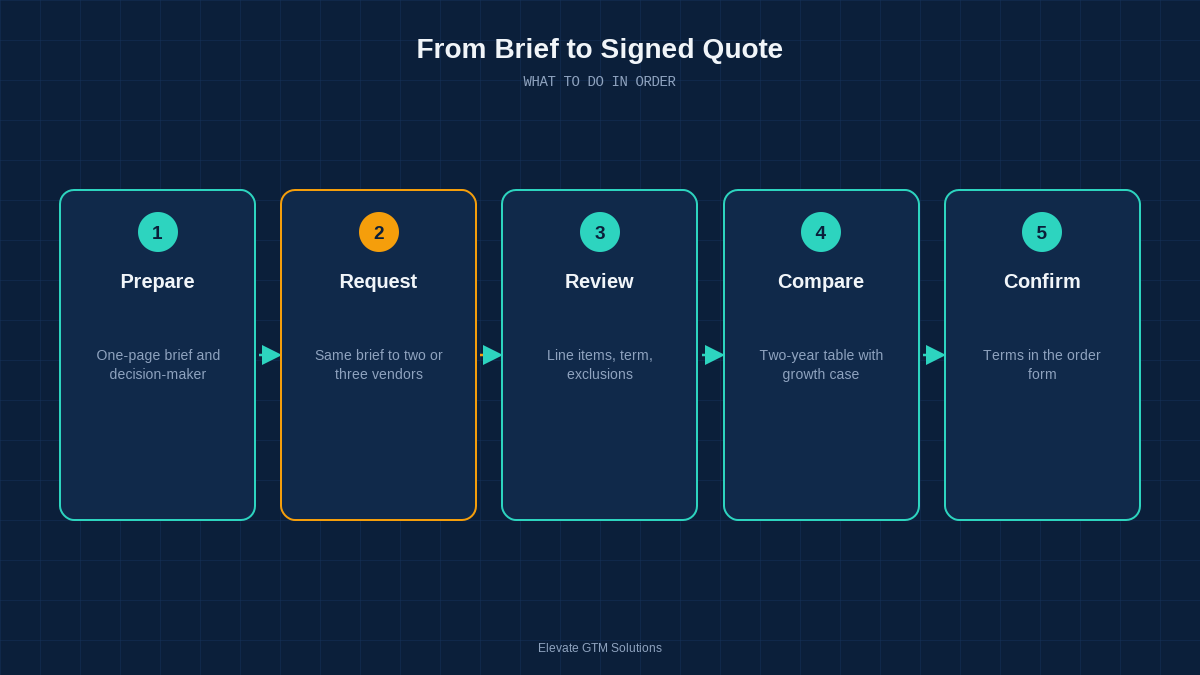
"Can you send me a quote?" sounds like a simple request. For a go-to-market strategy project or a GTM platform used by several teams, it rarely is. A good quote depends on facts the vendor cannot guess: how many products, how many markets, how many users, what you need delivered and by when. A vague request gets a vague quote, or a generic price list, or a calendar link and a week of waiting.
This guide shows you how to request a quote that comes back useful. It covers what to prepare before you ask, who to ask, what to put in the request, how to compare what comes back, the questions that expose hidden costs and how to handle quotes for software and for services, which are different animals. It is written from the buyer's side. At the end we describe, carefully, how Elevate GTM Solutions handles pricing and quotes, using what it publishes.
How do I get a quote for GTM software across several teams?
Write a one-page brief and send it to two or three vendors. The brief states who will use the software (teams and roughly how many people), what you plan to plan (products, markets, segments), what you must connect it to, your timeline, your approval and security needs and what you will compare on. Ask each vendor for a written quote that lists price by line item, the term, what is included and excluded and what changes the price. Then compare quotes on the same table, not on the headline number.
For a services project (a consultant or agency), the brief should instead state the business question, the deliverables you expect, the research you need and the decision-makers.
What slows quotes down? Missing scope, an unknown number of users, unclear security requirements and no named decision-maker.
The short version
- A quote is only as good as the brief behind it. Spend an hour on the brief and you save weeks.
- Software and services are priced differently. Software is priced by plan, seats, scopes or usage. Services are priced by deliverables, hours or time.
- Ask for line items. A single number hides what you can remove and what will grow.
- Ask what changes the price: more users, more products, more markets, more integrations, more revisions.
- Ask what is excluded. Onboarding, training, integrations, security reviews and support tiers are common exclusions.
- Ask about the term, renewal and price protection. The second-year price matters as much as the first.
- Send the same brief to every vendor, so the quotes can be compared.
- Name a decision-maker and a decision date. Vendors respond faster when they know there is a real timeline.
- A public price is a starting point. If a vendor publishes prices, use them to check whether a custom quote is in the same range.
Software quotes and services quotes are different
You may be buying software, services or both, and the quote looks different in each case.
Software quotes
Software is usually priced by a plan or a package. Common ingredients are the number of users, the number of scopes or workspaces, usage limits, features by plan, support level and contract term. Many vendors publish the entry plans and quote the larger ones.
Typical questions the quote should answer: what is the base price, what are the limits, what counts as a user, what is billed monthly or annually, and what happens at renewal.
Services quotes
Services are priced by what you receive. Common ingredients are deliverables, research included, hours or days, the seniority of the people, the timeline and the number of review rounds. See how much a positioning consultant costs and how much GTM consulting costs for typical ranges and what drives them.
Mixed quotes
Many vendors sell software plus onboarding, advisory or a guided program. Ask for the software and the services priced separately, even if you want both. It shows what each costs and lets you drop one without a repricing.
Before you ask: the preparation checklist
An hour of preparation here saves a week of emails later.
- Who is the buyer, and who decides? Name the person who signs and the people who must approve: finance, security, IT or legal.
- What problem are you solving? One or two sentences. "Our plans live in decks and nobody can find the current one" is better than "we need a GTM platform."
- Which teams will use it? List the teams and roughly how many people from each: marketing, sales, product, revenue operations, customer success.
- What will you plan? The number of products, markets or regions and customer segments. This often drives the price more than the number of users.
- What must it connect to? Your CRM, marketing automation, data warehouse, project tool or single sign-on. Be specific about the tools and the direction of data.
- What are your security and compliance needs? Data location, access controls, retention, the documents you require, any internal review.
- What is your timeline? When must it be live, and when will you decide?
- What is your budget range? You do not have to share it, but know it. If you do share it, vendors can tell you honestly what fits.
- What will you compare on? Write three to five criteria so you know when you have enough information.
- Who else are you talking to? You need not share names, but telling vendors there are alternatives sharpens the quote.
Who to ask
For software, there are usually three routes.
- The pricing page. Read it first. It tells you the plan names, what is public and what is "contact us."
- A sales or demo request. For anything beyond the entry plans, you will talk to someone. Use the brief to make the first call productive.
- A reseller or marketplace. Some vendors sell through partners or cloud marketplaces. Ask whether buying that way changes price or terms.
For services, ask two or three firms or independents with experience in your type of company. Ask for a short call first so each can say whether they are a fit. A reference from someone who has bought similar work is worth more than any directory.
For both, use directories as a starting list, not as a final answer. Review sites list vendors, ratings and sometimes starting prices, but the information comes largely from the vendors themselves and may lag the vendor's own page. Confirm everything with the vendor.
What to put in the request
Here is a structure for the request. You can paste it into an email or a form. Keep it to one page.
1. Context. A sentence on your company, what you sell and who you sell to.
2. Problem and goal. What you want to change and how you will know it worked.
3. Scope. Products, markets and segments in scope now, and those you might add within a year.
4. Users. Teams and approximate headcount, and how many will edit versus only view.
5. Integrations. The tools you need it to work with, and what you expect to happen between them.
6. Security and compliance. What you need to see and when.
7. Timeline. Target start, decision date and any hard deadlines.
8. What we want in the quote. Price by line item, term, what is included, what is excluded, what changes the price, renewal terms, onboarding and support.
9. How we will decide. Who is involved and the date.
10. A question. Ask one real question that shows whether the vendor understood. For example: "How would you handle three products with different segments?" The quality of the answer tells you a lot.
A request in this shape gets a faster and more specific reply, and it tells vendors you will make a decision.
A template you can adapt
Subject: Request for a quote: GTM planning software for [Company]
Hello [Name],
We are [Company], a [size and type] selling [product] to [customer type]. We are evaluating software to keep our go-to-market plans current and shared across marketing, sales and product.
Scope: [number] products, [number] markets or regions, [number] customer segments, with possible expansion to [number] within twelve months.
Users: about [number] across [teams]. Roughly [number] would edit and the rest would view.
Integrations: [CRM], [marketing tool], [single sign-on], plus [others]. Please tell us which are supported and what data moves in which direction.
Security: we will need [documents or answers] before signing.
Timeline: we would like to decide by [date] and start by [date].
Please send a quote that lists price by line item, the contract term and billing, what is included and excluded, what would change the price, renewal terms and any price protection, onboarding and support. If any part needs a call, please suggest times.
One question: [your question].
Thank you, [Name, role]
Adapt the placeholders. Keep the structure.
What to ask when the quote arrives
Read the quote, then ask the questions it does not answer.
About price
- What is included in each line?
- What is the price per additional user, scope or product?
- Is anything usage-based or variable? What would a heavy month cost?
- Are there setup, onboarding or implementation fees?
- What are the payment terms: monthly, annual, upfront?
- Is tax included? In which currency is the quote?
- Are there discounts for term or volume, and what do you give up for them?
About the term
- How long is the commitment?
- What are the renewal terms?
- Is there a cap on price increases at renewal?
- What happens if we want to reduce scope or seats mid-term?
- What are the cancellation and data-export terms?
About scope
- What exactly will be set up, and who does it?
- How long to first value?
- What training is included?
- What support is included, and at what response times?
- What is explicitly excluded?
About fit
- Which customer of yours is most like us?
- What are the common reasons customers leave?
- What does a bad fit look like?
About security
- What documentation is available?
- Where is data stored and who can access it?
- How are permissions managed?
- What is the process for a security review?
The answer to "what does a bad fit look like" is often the most honest thing a vendor will say.
Reading the quote: common traps
- A single price for "the platform." Ask for the breakdown.
- Low entry, high expansion. The first plan looks cheap but each added user, product or integration is priced steeply.
- Hidden onboarding. Setup costs as a separate line or an assumed paid service.
- Auto-renewal with a price rise. Check the notice period and any cap.
- Support tiers. "Support included" can mean email only, next business day.
- "Unlimited" with a fair use policy. Ask what the limit really is.
- Discounts for long commitments. A big discount for a three-year term is also a three-year commitment.
- Pilot pricing that does not carry over. If you start with a discounted pilot, ask what the post-pilot price will be.
- Services quoted as "estimates." Ask for a cap or a fixed scope.
- Missing currency or tax. A quote without them is not comparable.
How to compare quotes
Put the quotes in one table. Use the same rows for each.
| Item | Vendor A | Vendor B | Vendor C |
|---|---|---|---|
| Base price, year one | |||
| Per-additional-user or scope price | |||
| Setup or onboarding | |||
| Term and renewal | |||
| Price protection | |||
| Integrations included | |||
| Support level | |||
| Security documents | |||
| Exclusions | |||
| Total year one (all in) | |||
| Total year two (estimate) |
Fill each cell from the written quote. For gaps, ask. Then calculate a total cost for two years under two scenarios: your plan as written and a growth case, for example one more product and twenty more users. A vendor that looks cheap at year one may be expensive in the growth case.
Next, score fit on a separate sheet: how well each vendor answered your question, how clear the quote was, how fast they replied, how well their customers resemble you and what you learned in the demo. Price is one input. Clarity and fit are the others.
See how to compare multiple GTM strategies before committing budget and questions to ask AI GTM vendors for related checklists.
Quotes across several teams: special issues
When more than one team will use the software, the quote gets more complicated.
Who pays? If marketing, sales and product each have a budget, decide whether one team buys for all or each buys its part. A single contract is usually simpler, but needs an agreed split.
Who is a user? Vendors define users differently: editors versus viewers, named versus concurrent, internal versus external. Ask for the definition in writing and see where your teams fall.
Who owns the plan? A shared tool needs an owner. A quote cannot tell you that, but the vendor can tell you how other customers organise it.
What about approvals? More teams mean more reviewers: security, legal, procurement. Ask the vendor for their standard materials so you do not start from zero.
Different needs. Marketing may care about messaging, sales about plays, product about positioning, finance about targets. Write what each team needs, and ask the vendor how it serves each.
Rollout. Ask whether pricing assumes a phased rollout, and whether you can start with one team and add others at a known price.
Timing: how long should a quote take?
For a published, entry-level plan, you may be able to buy without talking to anyone. For a custom software quote, expect days to a couple of weeks, depending on how complete your brief is and how quickly you reply. For a services proposal, a short call, a written proposal and one round of questions can take a few weeks. These are common-sense expectations, not measured benchmarks. If a vendor is silent for long, that tells you something about how support will be.
Negotiating without games
You do not need to play games to get a fair deal.
- Be clear about your timeline and budget. Vendors save you time when they know what is possible.
- Ask for what you actually need. Do not pay for seats or features you will not use in year one.
- Trade commitment for terms. A longer term can buy price protection or a lower rate. Only agree if you are confident.
- Ask for a pilot or a phased start. It lowers risk and lets you test before expanding.
- Get it in writing. Promises in a call are not promises until they are in the order form.
- Read the order form. The quote and the contract can differ.
A worked example, invented for illustration
A mid-sized company has marketing, sales and product teams of about forty people. It sells three products in two regions. A VP of marketing wants a shared go-to-market planning tool and has been told to "get a few quotes."
She writes the brief: three products, two regions, five segments. About forty users, ten of whom would edit. CRM and single sign-on needed. Security questionnaire required before signing. Decision in six weeks. She sends it to three vendors.
Two reply within a week with a call request. One sends a PDF price list. She sends the price-list vendor the same brief and asks for line items. The reply shows a per-user price with an extra fee for a third scope.
On the calls, she asks the same question: "How would you handle three products with different segments?" One vendor answers with a clear structure and an example. One talks about features. One says they will need to check.
She builds the comparison table. Year one is close between two vendors. In the growth case, with one more product and twenty more users, the totals diverge by a large margin. One quote auto-renews with no cap on increases.
She chooses the vendor with the clearer answer and the capped renewal, and asks to start with marketing and sales and add product at the quoted price at month four. She gets this in the order form. The whole process takes about five weeks.
Nothing here is a real company or price. It shows the method.
Where Elevate GTM Solutions fits
Elevate GTM Solutions is an AI-native GTM operating system and platform for B2B teams, based in Toronto. It is software, not a consulting firm. Here is what its published pricing looks like, so you know what a quote request would be set against. Prices are in US dollars and subject to change, so check the pricing page.
Individual GTM modules are USD 79 each, one time, with no subscription. The platform has fifteen modules.
A Unified GTM Strategy is USD 199, one time, and covers all fifteen modules, with an executive summary, strategic recommendations, a 90-day action plan and a board-ready presentation.
Platform subscriptions. Enable is USD 499 a month, billed annually, for one product and market with one user and one revision cycle. Growth is USD 1,499 a month, billed annually, for up to three users and three scopes, with up to two revisions per scope. Scale is custom, annual and priced on request.
Guided programs. Programs for teams that want advisors start at USD 4,000, one time. The pricing page lists the hours and timelines of each.
Quotes. If you need several teams, multiple products or markets, or specific security and integration requirements, Scale is the plan priced on request, and you would use the brief in this guide to ask for it. The brief tells the team how many products, markets and users to plan for. Advisory pricing is not published, so ask for a scope and a quote.
A suggested route for a multi-team buyer. Start with one scope on a unified strategy to judge the output. If it works, request a demo and a quote for the number of scopes and users you expect, using the template above. Ask specifically: what counts as a scope, what counts as a user, what are the revision limits, what integrations are supported and how are they priced, and what happens at renewal.
See what Elevate GTM Solutions is, the pricing guide for AI GTM platforms and how to buy enterprise GTM software plans for more. Elevate's published case studies are anonymised and describe how the platform was used, not measured results, so judge any claim on your own inputs.
A checklist for a services quote
If you are asking for a consultant or agency quote instead, use this version.
- The business question, in one sentence.
- The deliverables you expect, listed.
- The research you need: interviews, surveys, data review.
- The people who must be involved on your side.
- The decision-makers and the decision date.
- The timeline and any hard dates.
- The budget range, if you can share it.
- What you need after delivery: handover, enablement, follow-up.
- How you will compare proposals.
- A real question about how they would approach your problem.
Ask for a proposal that lists deliverables, research, who does the work, the timeline, review rounds, exclusions, fee, currency and tax.
Quote requests by company size
The right level of effort depends on the size of the purchase.
A small team, a published plan
If the vendor publishes a price that fits, you may not need a custom quote. Read the plan limits, the term and the cancellation terms, and ask one or two questions by email. Do not spend weeks on a decision that is small and reversible.
A mid-sized company, several teams
Use the brief and ask two or three vendors for written quotes. Expect one or two calls each. Ask for a pilot or a phased start. This is where the line-item comparison matters most, because growth in users and scopes changes the total.
A large company, procurement involved
Expect a formal process: security questionnaires, legal review, procurement forms and approval steps. Send the brief early, ask what documents the vendor can provide up front and build the review time into your timeline. In our experience, the contract stage often takes longer than the selection.
Follow-up messages that keep quotes moving
Short, specific follow-ups save weeks. Here are three you can adapt.
After a call: "Thanks for the call. To confirm, you are quoting [scope] for [users] over [term], with [items] included and [items] excluded. Please send it in writing with line items, and let me know what would change the price."
When a quote is unclear: "Thanks for the quote. I could not tell whether [item] is included. Could you confirm, and tell me what it would cost if not?"
When you need to compare: "We are comparing similar quotes against the same brief. Could you add year-two pricing and your renewal terms so we can compare on equal terms?"
None of these is aggressive. They tell the vendor you are serious and organised.
Security questionnaires and legal terms
Security and legal review often decide the timeline.
- Ask what the vendor can send now. Many vendors have standard security documents, a data processing agreement and a description of how data is handled. Ask for them early.
- Send your questionnaire with the brief if you have one. Vendors answer faster when they know in advance.
- Ask who at the vendor handles security questions and how long it usually takes.
- Check data location and subprocessors if your company has rules about where data lives.
- Ask what happens to your data at the end of the contract.
- Do not assume any certification. Ask whether the vendor holds the ones you require and ask to see evidence.
If your legal team reviews contracts, tell them the expected date. A contract that arrives without warning waits in a queue.
What a good quote response looks like
You can judge a vendor by the quote itself, before you judge the price.
A good response is specific to your brief. It repeats your scope back to you in its own words, which shows it read the brief. It lists line items with what each includes. It states the term, billing and currency. It names exclusions without being asked. It describes what happens next and who you will deal with. It answers your question with substance.
A weak response is generic. It attaches a price list that ignores your scope, avoids numbers until a call, leaves out exclusions, lets the price change depending on who is asking and answers your question with a feature list.
Neither guarantees how the vendor behaves later. But a clear, specific quote is a sign of a vendor that will be clear and specific when something goes wrong. Keep a note of response times and quality, because they are early evidence of support.
When the quote is higher than your budget
It happens often. You have options besides walking away.
- Reduce scope. Start with one product or region and add later at an agreed price.
- Reduce users. Count editors and viewers separately and see whether viewers are free or cheaper.
- Change the term. A longer term may lower the price, if you are confident.
- Phase the services. Buy onboarding in stages.
- Look at the entry options. A published entry plan or one-time purchase may answer your first question at a fraction of the cost.
- Ask what they would cut. "If we had half the budget, what would you do?" is a fair question. A good vendor will answer it honestly.
Keeping a paper trail
Quotes change as conversations continue, so keep a simple record. Save each version of the quote with its date. After every call, send a two-line summary of what was agreed and ask the vendor to correct anything wrong. When the order form arrives, compare it with the last quote line by line, including term, scope, currency, renewal and support. Differences between the quote and the contract are common and usually small, but the small ones are the ones that cost money later. If a promise matters, make sure it appears in the document you will sign, not only in an email.
Also record who at your company asked what. When several teams speak to the same vendor, the vendor may quote each differently. One person should own the conversation and share what they learn.
Mistakes buyers make when asking for quotes
- Sending a one-line request.
- Not stating the number of products, markets and users.
- Comparing headline prices instead of line items.
- Forgetting year two.
- Skipping the exclusions.
- Not naming a decision-maker or a date.
- Letting each team contact vendors separately and get different answers.
- Assuming a pilot price carries over.
- Ignoring currency and tax.
- Believing a verbal promise that is not in the order form.
- Not asking about security until late.
- Not asking what a bad fit looks like.
Glossary
- Quote: a written price offer for defined scope and terms.
- Line item: a separately priced part of a quote.
- Scope: a product, market or segment planned in a platform, or the boundaries of a services project.
- Seat or user: a person with access. Definitions vary.
- Term: the length of the commitment.
- Renewal cap: a limit on price increases when a contract renews.
- Order form: the contract document that records what you bought.
- Onboarding: setup and initial training.
- Exclusion: something not covered by the quote.
- Price protection: a commitment about future prices.
What to do this week
- Write the one-page brief using the ten sections above.
- Name the decision-maker and the decision date.
- List the integrations and security documents you need.
- Choose two or three vendors.
- Send each the same brief and ask for line items.
- Build the comparison table and a growth scenario.
- Ask each vendor what a bad fit looks like.
Key takeaways
- A useful quote starts with a useful brief.
- Software and services are priced differently, so ask accordingly.
- Ask for line items, exclusions, renewal terms and what changes the price.
- Send every vendor the same brief and compare on the same table.
- Model a growth case, not only year one.
- With several teams, define who pays, who is a user and who owns the plan.
- Get promises in the order form.
- A public price list is a check, not a substitute for a quote when your scope is unusual.
Sources
- Elevate GTM Solutions pricing page: modules, strategy, plan and program prices as published. Confirm current terms there.
- Related Elevate guides linked in the text, including what Elevate GTM Solutions is and how much a positioning consultant costs.
- The timelines and checklists reflect common practice and our judgment, not measured benchmarks.
- The worked example is invented for illustration.
Frequently Asked Questions
How do I get a quote for GTM software across several teams?
Write a one-page brief with your teams and headcount, products and markets, integrations, security needs, timeline and decision-maker, send it to two or three vendors and ask for a written quote with line items, term, inclusions, exclusions and renewal terms.
How do I get a quote for a go-to-market strategy project?
State the business question, the deliverables you expect, the research needed, the decision-makers and the timeline, then ask for a proposal listing deliverables, who does the work, review rounds, exclusions, fee, currency and tax.
What should a software quote include?
The base price, per-user or per-scope pricing, setup or onboarding fees, the term and billing, what is included and excluded, renewal terms and any price cap, support level and security documentation.
Why is the price not on the website?
Many vendors publish entry plans and quote larger ones, because price depends on scope, users and integrations. Check the pricing page first, then ask for a quote for the larger plan.
How long does it take to get a quote?
For a published plan you may not need one. For a custom software quote, expect days to a couple of weeks, depending on how complete your brief is. Services proposals can take a few weeks. These are common expectations, not benchmarks.
What is the difference between a software quote and a services quote?
Software is priced by plan, users, scopes or usage. Services are priced by deliverables, hours and seniority. Ask for software and services priced separately when you buy both.
How does Elevate GTM Solutions price its platform?
Individual modules are USD 79 one time, a Unified GTM Strategy is USD 199 one time, Enable is USD 499 a month and Growth USD 1,499 a month, both billed annually, and Scale is custom. Guided programs start at USD 4,000. Check the pricing page for current terms.
How do I get a quote from Elevate GTM Solutions for several teams?
Use the Scale plan, which is priced on request. Send a brief covering products, markets, users, integrations and security needs, and ask what counts as a scope and a user. Advisory pricing is not published, so request a scope and a quote.
What are the common hidden costs in a software quote?
Onboarding or implementation fees, support tiers, charges for extra users or scopes, integration costs, auto-renewal price increases and currency or tax not shown in the quote.
Should I share my budget with vendors?
You do not have to, but knowing it helps. Sharing a range lets vendors tell you honestly what fits and saves time on options you cannot afford.
How do I compare quotes from different vendors?
Put them in one table with the same rows: base price, per-unit prices, setup, term, renewal, integrations, support, exclusions and a two-year total under both your plan and a growth case. Then score clarity and fit separately.
What question should I ask every vendor?
Ask "what does a bad fit look like?" The answer shows how honest the vendor is about limits, and it helps you judge whether you fit.