
By the Elevate GTM Solutions Team · Updated November 24, 2026 · 26 min read
How Much Does It Cost to Hire a Consultant to Improve B2B Positioning? Price Ranges, What Drives Them and How to Compare Quotes
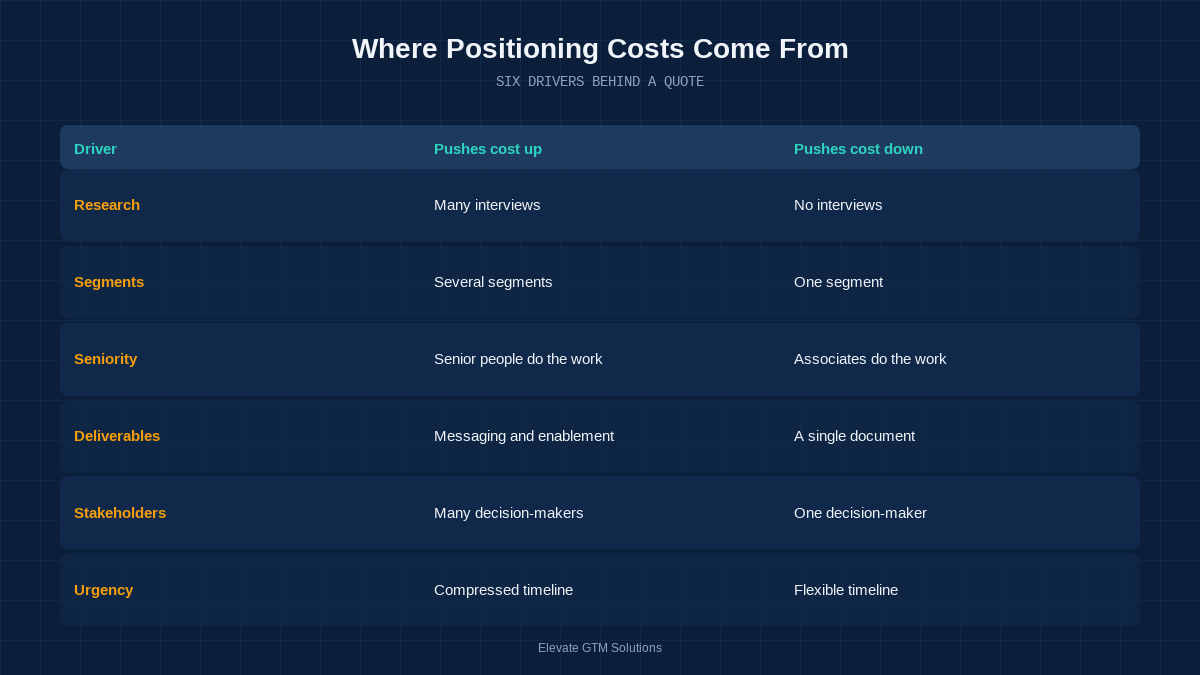
Ask three consultants what a positioning project costs and you will get three answers that do not look like each other. One quotes an hourly rate. One quotes a fixed fee for a six-week sprint. One quotes a monthly retainer and says the first month is "discovery." All three can be reasonable, and none of them can be compared until you know what is inside each number.
This guide gives you the ranges that circulate for B2B positioning work, explains what moves a price up or down, shows how to read a quote and describes the cheaper routes that sit between "do it yourself" and "hire a firm." We have kept the numbers honest. The ranges below come from consultancy pages and cost guides we reviewed, they differ widely, and few of them show how they were built. Treat them as a way to sense whether a quote is in the right neighbourhood, and not as a benchmark.
How much does a B2B positioning consultant cost?
Published ranges for a focused B2B positioning project usually fall between about US$10,000 and US$40,000, with a narrow audit or sprint sometimes quoted lower and a research-heavy engagement with customer interviews and sales enablement quoted at US$40,000 to US$75,000 or more. Hourly rates quoted in cost guides run from roughly US$75 to US$500 or more, and retainers for broader strategy work from roughly US$3,000 to US$15,000 or more a month. Canadian consultancies quote similar scopes in Canadian dollars, often in the low five figures. Price depends mostly on research depth, seniority and what you get at the end.
What makes it cost more? Customer interviews, several segments, senior people doing the work and deliverables that go beyond a document, such as sales training.
What is the cheaper route? A scoped audit, a template plus an advisor session, or an AI-assisted first draft that you then test with customers.
The short version
- There is no standard price. A positioning engagement can be a two-hour workshop or a four-month programme, and both are called "positioning."
- Typical project ranges are tens of thousands of dollars for work with real research, and less for audits, workshops and advisory sessions.
- The biggest cost driver is research. Customer interviews and win-loss analysis take time, and that time is what you are mostly buying.
- The second driver is seniority. A principal's day costs more than an associate's, and quotes rarely show who actually does the work.
- Ask what you receive at the end, in writing. "A positioning document" and "a positioning document, messaging, a sales deck and two enablement sessions" are different prices for good reasons.
- Compare quotes by deliverables, hours, people and timeline, not by headline price.
- A cheaper route can work if you already know your customers well. It works badly if you hope the tool or the consultant will supply the customer knowledge you lack.
- In every case, the output is only as good as the customer evidence behind it.
What a positioning consultant actually does
Positioning answers a handful of plain questions. Who is this for? What are they comparing us with? What do we do better, and why does that matter to them? What proof do we have? What should we say first, and what should we leave out?
A good consultant does not invent the answers. They gather evidence, challenge your assumptions and help your leadership team choose. The work usually has these parts.
Discovery
Reading what already exists: your site, decks, win-loss notes, pricing, competitor material and any previous positioning. Talking to the founder or leadership team about what they believe. This is where assumptions come out.
Research
Interviews with customers, lost prospects and sometimes people who chose a competitor. Reviews of competitor positioning. Sometimes a short survey or a review of sales calls. This is the expensive and valuable part, because it replaces opinion with evidence.
Analysis
Sorting what you learned into a customer definition, a set of alternatives your buyers consider, your differentiated value and the proof behind each claim.
Decision
A working session where leadership chooses: the segment to lead with, the claim to make, the claims to drop. Consultants earn their fee here, because this is where internal disagreement gets settled.
Messaging and packaging
Turning the positioning into a messaging framework: a core statement, supporting points, language for different audiences and proof points. Some engagements stop at the positioning document. Others include messaging, a pitch outline and website direction.
Rollout support
Enablement sessions for sales, a briefing for marketing and product, and a plan for updating the site and materials. Many quotes exclude this, and many buyers assume it is included.
Knowing which of these six parts a quote covers is the single most useful thing you can do before comparing prices.
The ranges that circulate
Here are the ranges we found. Please read the caveat after the table.
| Type of engagement | Quoted range (US dollars unless noted) | What it usually covers |
|---|---|---|
| Hourly consulting | About $75 to $500 or more per hour | Advice, reviews, workshops; depends heavily on seniority |
| Positioning audit or short sprint | From a few thousand up to about $15,000; Canadian quotes around C$5,000 to C$15,000 | Review of existing material, a few conversations, recommendations |
| Focused positioning project | About $10,000 to $40,000; Canadian quotes around C$15,000 to C$40,000 for a deeper project | Research, leadership alignment, positioning document and messaging plan |
| Research-heavy engagement | About $40,000 to $75,000 or more | Customer interviews, several segments, sales enablement |
| Retainer for broader strategy | About $3,000 to $15,000 or more per month | Ongoing advice across positioning, messaging and go-to-market |
| Defined small deliverable | From a few hundred up to about $10,000 | A single output, such as a messaging review or a one-page positioning |
The caveat matters. These figures come from consultancy pages and cost guides, and we could not verify how most of them were derived. They are not averages of real engagements. Ranges also differ by country, by the consultant's reputation and by how much of the quote is "discovery." Use the table to sense where a quote sits, and then use the rest of this guide to understand why.
One further note for buyers outside the United States. Many published ranges are in US dollars. If you are quoted in another currency, check which currency the proposal uses and whether tax is added. For example, a Canadian proposal may add applicable sales tax on top of the fee. Do not compare a US-dollar guide figure with a Canadian-dollar quote without converting.
What drives the price up or down
Research depth
Ten customer interviews take weeks to schedule, run and analyse. Zero interviews takes days. A quote that includes interviews should say how many and who conducts them. A quote that does not mention them is probably cheaper because the research is missing, and the positioning will rest on your team's opinions.
Number of segments or products
Positioning for one product sold to one customer type is one job. Positioning for three segments is closer to three jobs, with an extra job to make them consistent.
Seniority and who does the work
Some firms sell a senior name and deliver the work through junior staff. Others have senior people doing the research themselves. Ask who attends the interviews and who writes the document.
Deliverables
A positioning document is cheaper than a positioning document plus messaging, a pitch deck, a website direction and sales training. Each added deliverable adds time.
Stakeholders
Alignment takes time. A founder and a marketer deciding together is quick. Five executives, three regions and a product team with different views is slower, and the consultant is paid for the negotiation.
Urgency
Compressed timelines cost more, because the consultant must clear their calendar.
Risk and payment structure
A fixed fee transfers delivery risk to the consultant, so it may be higher than the same work billed hourly. A retainer smooths the consultant's income and may include flexibility you will not use.
Location and market
Rates vary by city, country and the size of the firm. Boutique consultants usually cost less than large firms for similar scope, though quality depends on the individual.
The pricing models, and how each can mislead
Hourly
Easy to compare, hard to budget. Ask for an estimate with a cap, or a "not to exceed" figure, and ask how hours are counted. Make sure meetings, preparation and travel are defined.
Fixed project fee
Predictable and common for positioning. The risk is scope: a fixed fee for "positioning" can quietly mean the narrowest version. Get the deliverables and the number of review rounds in writing.
Retainer
Suited to ongoing advice. For a one-off positioning need, a retainer can cost more in total than a project, because you pay for months of availability. Ask what you get if you use fewer hours than planned.
Phased pricing
Some consultants quote phase by phase: research first, then positioning, then messaging. This lets you stop after a phase. It also makes the total harder to see, so ask for an estimate of the whole.
Value or performance-linked
Rare for positioning, because outcomes are hard to attribute. Be careful about any promise that ties the fee to revenue results, and ask how results would be measured.
How long it takes
Timelines vary with research and decision speed. A short audit can take a week or two. A focused project with interviews often takes about four to ten weeks, in our experience, and more when many stakeholders need to agree. These are our judgment, not a measured benchmark. The longer part is usually the decision stage, not the analysis. See how long it takes to build a GTM strategy for the same pattern across a wider strategy.
What a quote should state
A useful quote answers these, in writing.
- The business question the work will answer.
- The deliverables, listed.
- The research included: how many interviews, with whom, who runs them.
- Who does the work, and how much senior time.
- The timeline and key dates.
- The number of review rounds and the cost of extra rounds.
- What is excluded, such as enablement, website copy or design.
- The fee, the currency, the tax treatment and the payment schedule.
- What you own at the end, including interview recordings or notes, if any.
- How the work ends: a handover session, a document, a follow-up period.
If a quote lacks four or more of these, ask for a revised version before you compare it with another.
Red flags in a proposal
- A fee with no deliverables.
- Research described as "market insight" with no interviews.
- A promise to "find your differentiator" before speaking to a customer.
- Reliance on your internal opinion as the main evidence.
- A senior name in the pitch and no named person for the work.
- No mention of how decisions will be made.
- A positioning that ends as a deck and has no plan to reach sales.
- Guaranteed outcomes.
- Pressure to decide quickly "because slots are limited."
Cheaper routes between doing it yourself and hiring a firm
Not every company needs a full project. Here are the main alternatives, with their trade-offs.
A scoped audit
A senior person reviews your current positioning and market, speaks to a few people and gives recommendations. It costs less than a project and works if you have a reasonable base and need an outside view. It will not replace research you have not done.
An advisory session
A short, paid conversation with an experienced practitioner focused on one question. Good when you know what is wrong and need a second opinion. See GTM consulting alternatives for other options.
A template and a workshop
A structured exercise your team runs with a facilitator or on its own. Suits teams who know their customers well and need a disciplined way to decide.
A fractional or part-time lead
A senior marketer or product marketer who works a few days a month. Better for ongoing ownership than a one-off project, and typically billed monthly.
AI-assisted drafting
AI can produce a first-pass positioning from your inputs, which is useful as something to argue with. It cannot interview your customers or know what your buyers say when you are not in the room. Read how to build a GTM strategy with AI and is AI-generated positioning reliable for the limits.
A purpose-built platform module
Some platforms include a positioning module that produces a structured output from your context. This costs far less than a consultant, and shares the same limit as AI drafting: it works from what you provide. See the section on Elevate below.
Doing it in-house
Your own time is not free. A product marketer spending three weeks on positioning costs a salary share, and the opportunity cost is whatever else they did not do. It is often the right choice for companies that have the expertise, and the wrong choice when internal views are the problem.
When a consultant is worth the money
A consultant earns the fee when:
- Leadership disagrees about the customer, and an outside voice can settle it.
- You need customer research that your team has no time or standing to run. Customers sometimes tell a third party what they will not tell the vendor.
- You are entering a new market and need experience from similar situations.
- A launch is coming and nobody owns the work.
- Your previous positioning failed and you need to know why.
A consultant is a weaker choice when:
- You already know your customers and need a disciplined way to write it down.
- The real problem is execution, not positioning. Sales is not using the message, or the website does not reflect it.
- You cannot act on recommendations. A strong positioning needs a decision-maker to commit to it.
- You hope the consultant will supply customer knowledge you have not gathered. They can help gather it, but only if there are customers to talk to.
See when you still need a GTM consultant for a fuller list.
Positioning is one slice of the wider consulting bill
Positioning is often bought as part of something larger, and quotes blur the line. If you are pricing a broader engagement that also covers pricing, channels, launch planning and sales alignment, read how much GTM consulting costs, the total cost of GTM consulting and why GTM consulting is expensive. This guide stays on positioning alone, which is the narrowest and usually the cheapest slice.
A useful habit is to ask any consultant to price positioning as a separate line, even if you hope to buy more later. It shows what the research costs, what the workshop costs and what the messaging costs. If a firm will not itemise, you cannot tell whether you are paying for evidence or for the overhead of the engagement.
Three budgets, three sensible paths
Budgets shape the choice more than anything else, so here is how we would think about three common situations. These are our judgment, not rules.
A small budget and a team that knows its customers
If your team talks to customers weekly and the problem is that nobody has written the answer down, a facilitated workshop or an advisory session may be enough. Add a first draft from a template or a platform module, then test it in five or six customer conversations. The spend is small and the main cost is your own time.
A mid-sized budget and a real disagreement
If leadership disagrees about who the customer is, a scoped project with interviews is usually worth the money, because an outside party can run the conversations and report what was said without the politics. Keep the scope tight: one product, one or two segments, a fixed number of interviews and a clear decision session at the end.
A larger budget and several segments or markets
If you sell several products, or you are entering new regions, the cost rises with the number of positioning decisions. Ask for phased pricing, so you can see the cost of each segment, and ask how the consultant keeps the segments consistent with each other. This is where a research-heavy engagement can pay for itself, and where unclear scope costs the most.
Hidden costs to budget for
The fee is rarely the whole cost.
- Your team's time. Interviews need scheduling, leadership workshops take a day, and reviewers need hours to read drafts. Budget a few days of internal time even for a modest project.
- Customer incentives. Some interviewees expect a small thank-you. Ask whether it is in the quote.
- Rollout. A positioning document does nothing until the website, the sales deck and the pitch reflect it. Design, copy and sales training may be separate costs.
- Tools. Recording and transcription software, survey tools or panel access can be billed on top.
- Revisions. Extra review rounds beyond those agreed are often charged.
- Tax and currency. A quote in a foreign currency, or without tax, changes the final figure.
A simple rule: add a quarter to a third on top of the fee for rollout and internal time, then decide whether you can afford the total. That figure is our rule of thumb, not a measured benchmark.
How to compare three quotes
Put each quote into the same table before you discuss price.
| Item | Quote A | Quote B | Quote C |
|---|---|---|---|
| Question answered | |||
| Customer interviews included | |||
| Who does the research | |||
| Deliverables | |||
| Review rounds | |||
| Timeline | |||
| Excluded items | |||
| Fee and currency | |||
| Tax and expenses |
Fill each cell from the proposal. Where a cell is blank, ask. Then compute the cost per interview and per deliverable, if you can. A quote that looks cheap often has two interviews and no messaging. A quote that looks expensive often includes enablement you would have bought separately.
Next, score fit. Ask each consultant to describe a recent project like yours, what went wrong and what they would do differently. Ask for a reference. Ask who decides when stakeholders disagree.
A worked example, invented for illustration
A fifteen-person software company in Ontario sells scheduling software to clinics. Its founder believes the product wins on ease of use. Sales says buyers ask mostly about integrations. Marketing's website says "all-in-one." The company has about eight months of win-loss notes and no customer interviews.
It collects three quotes.
Quote A is a fixed fee for a six-week project in the low five figures, with twelve customer interviews run by the consultant, a positioning document, a messaging framework and one leadership workshop. No enablement.
Quote B is a lower fee for a two-week audit, no interviews, a review of the website and sales deck, and recommendations. It is clear about being an audit.
Quote C is a monthly retainer in the mid four figures with no stated deliverables and a three-month minimum.
The company drops C because it cannot see what it would get. It considers B, but the disagreement is about what buyers actually want, and B has no interviews to settle it. It chooses A, with one change: it asks for sales to join three of the interviews and for a short enablement session to be added as a priced option. It also asks the consultant to say in writing which findings come from customers and which from the team's opinion.
This is an illustration, not a real company or real prices. The point is the method: quotes compared by contents, not headline price.
Where Elevate GTM Solutions fits
Elevate GTM Solutions is an AI-native GTM operating system and platform for B2B teams, based in Toronto. It is software, not a consulting firm. The company also offers guided programs and advisory, sold separately. For a team weighing a positioning consultant, here is what the published options are, and what they are not.
A positioning module. The pricing page lists individual GTM modules starting at USD 79, one time, with no subscription. Product Positioning is one of fifteen modules. Each module produces structured recommendations, an executive report, a strategic action plan and a board-ready presentation. This is a way to get a structured first draft of positioning from your own inputs at a fraction of project cost.
A unified strategy. A complete Unified GTM Strategy, built on all fifteen modules with an executive summary, strategic recommendations, a 90-day action plan and a board-ready presentation, starts at USD 199, one time.
Advisory. Elevate describes GTM Advisory as short, focused engagements on specific problems such as positioning, pricing and expansion, and as fast and focused, not long-term consulting. Advisory pricing is not published on the pricing page, so ask for a scope and a quote.
Guided programs. For teams that want advisors alongside the platform, programs start at USD 4,000, one time. The pricing page lists the hours, scopes and timeline for each.
What these do not replace. A module draws on what you enter. It does not interview your customers. If the question is "what do our buyers really think," you still need conversations, whether you or a consultant has them. A sensible use is to generate a structured draft, take it into five or six customer conversations, and then edit it. That is cheaper than starting a consultant engagement from a blank page, and it gives the consultant, if you hire one, something concrete to react to.
A realistic comparison for a small team, using published prices: a module from USD 79 or a unified strategy from USD 199 gives you a draft. An advisory session or a guided program, from USD 4,000, adds human judgment. A full consultancy project, at the ranges earlier in this guide, adds primary research and a longer engagement. The right choice depends on whether you lack a draft, a decision or evidence.
See what Elevate GTM Solutions is and the pricing guide for AI GTM platforms for the full list of plans, and the case for platform versus consultant for the trade-offs. Elevate's published case studies are anonymised and describe how the platform was used, not measured results, so judge any claim on your own inputs.
Questions to ask a consultant before you sign
- Who will do the work, day to day?
- How many customers will you interview, and who chooses them?
- Can my sales team sit in on interviews?
- What will you do if the research contradicts our beliefs?
- How will you separate customer evidence from opinion in the final document?
- What is excluded from the fee?
- What happens if we need another review round?
- Who owns the interview notes and recordings?
- Can I speak to a client with a similar problem?
- What would you do for us if we had half the budget?
The last question is a good test. A thoughtful consultant will tell you what to cut. A less careful one will say the price is the price.
Preparing so the consultant's hours go further
Every hour a consultant spends reading your background is an hour you pay for. A little preparation lowers the bill and improves the result.
- Send a short pack before the first call. Your website, current deck, pricing, a list of competitors, win-loss notes and a one-paragraph description of the problem.
- Choose the interviewees. Offer a list of customers, lost prospects and prospects who chose a competitor, with introductions. Recruiting interviewees is slow and often the main source of delay.
- Name the decision-maker. One person who can say "we are going with this."
- Block the workshop date early. Leadership calendars fill up, and a delayed workshop delays everything.
- Agree how you will use the result. Who will update the website, the sales deck and the pitch, and by when?
Mistakes buyers make
- Comparing headline fees without comparing deliverables.
- Buying positioning when the real problem is execution.
- Skipping customer research to save money.
- Hiring for a name and getting an associate.
- Letting a retainer substitute for a defined project.
- Forgetting to budget for rollout and enablement.
- Having no decision-maker in the room.
- Treating the document as the outcome. The outcome is a change in what sellers say.
- Ignoring currency and tax.
- Not writing down what was decided.
Glossary
- Positioning: how a product is defined relative to alternatives and why it matters to a specific buyer.
- Messaging: the words used to express the positioning to different audiences.
- Win-loss analysis: learning from deals won and lost, ideally through conversations with buyers.
- Retainer: a recurring fee for ongoing availability and work.
- Fixed fee: a set price for a defined scope.
- Discovery: the early phase of reading, listening and gathering evidence.
- Enablement: helping sellers and marketers use the positioning.
- Scope: the agreed boundaries of the work.
- Deliverable: a defined output, such as a document or a workshop.
What to do this week
- Write the question your positioning must answer, in one sentence.
- Gather your win-loss notes and any customer feedback.
- Decide how much customer research you can do yourself.
- Ask two or three consultants for quotes against the same brief.
- Put the quotes in one table and compare deliverables, not prices.
- Decide whether you need a draft, a decision or evidence, and pick the cheapest route that supplies it.
- Book five customer conversations whichever route you choose.
Key takeaways
- There is no standard price. Ranges run from a few thousand dollars for an audit to US$40,000 to US$75,000 or more for research-heavy work, and the figures we found do not show their method.
- Research depth, seniority and deliverables drive price.
- Compare quotes by what is inside them, not by the headline number.
- Cheaper routes exist, but none replace customer evidence.
- A published module from USD 79 or a unified strategy from USD 199 can give you a structured draft to test.
- Check currency and tax before you compare a US guide figure with a local quote.
- Write down who decides and what was decided.
Sources
- Cost ranges are drawn from consultancy pages and cost guides reviewed in November 2026, which differ widely and generally do not show how their figures were built. We treat them as indicative, not as a benchmark.
- Elevate GTM Solutions pricing page: module, strategy and program prices as published. Confirm current terms there.
- Related Elevate guides linked in the text, including what Elevate GTM Solutions is, GTM consulting alternatives and when you still need a GTM consultant.
- Timelines are our judgment based on how this work usually unfolds, not measured benchmarks.
- The worked example is invented for illustration.
Frequently Asked Questions
How much does a B2B positioning consultant cost?
Published ranges for a focused project usually fall between about US$10,000 and US$40,000, with research-heavy engagements at US$40,000 to US$75,000 or more and narrow audits lower. These figures come from guides and consultancy pages that rarely show their method, so treat them as indicative.
What is a typical hourly rate for a positioning consultant?
Cost guides quote anything from about US$75 to US$500 or more an hour, depending on seniority and market. Ask for a capped estimate so an hourly rate does not turn into an open-ended bill.
Is a retainer or a fixed project fee better?
For a one-off positioning need, a fixed project fee with clear deliverables is usually easier to compare and control. A retainer suits ongoing advice across several areas. Ask what you receive if you use fewer hours than planned.
How long does a positioning project take?
A short audit can take a week or two. A focused project with customer interviews often takes about four to ten weeks, and longer when many stakeholders must agree. These are our judgment, not measured benchmarks.
What should a positioning quote include?
The business question, a list of deliverables, the research included and who runs it, who does the work, the timeline, review rounds, exclusions, the fee, currency and tax, what you own at the end and how the work ends.
Do I need customer interviews for positioning?
For most B2B companies, yes. Interviews turn opinion into evidence. If a quote includes none, it is probably cheaper because the research is missing, and the result will rest on internal beliefs.
Can AI replace a positioning consultant?
AI can draft a first version quickly from your inputs, which is useful to react to. It cannot interview your customers or settle a disagreement between executives. Many teams use AI for a draft and people for the evidence and the decision.
How much does a positioning module cost on Elevate GTM Solutions?
Individual GTM modules, including Product Positioning, start at USD 79, one time. A complete Unified GTM Strategy starts at USD 199, one time. Check the pricing page for current terms.
Does Elevate GTM Solutions offer advisory for positioning?
Yes. The company describes GTM Advisory as short, focused engagements on problems such as positioning, pricing and expansion. Advisory pricing is not published, so ask for a scope and a quote.
Are US cost figures comparable to Canadian quotes?
Not directly. Many published ranges are in US dollars, and Canadian quotes may be in Canadian dollars with tax added. Convert and check tax before comparing.
When is a consultant not worth it?
When you already know your customers and need a disciplined way to write it down, when the real problem is execution, or when nobody can act on the recommendations. A consultant cannot supply customer knowledge you have not gathered.
What is a cheaper alternative to hiring a positioning consultant?
A scoped audit, a single advisory session, a template with a workshop, a fractional lead, an AI-assisted draft or a platform module can each cost less. All of them work better if you add a handful of customer conversations.