
By the Elevate GTM Solutions Team · Updated November 13, 2026 · 28 min read
How Should B2B Companies Structure Revenue Operations, and Does Centralizing Actually Help?
Revenue operations, or RevOps, started as a sensible idea and became a fashion. The idea: marketing operations, sales operations and customer success operations each tune their own corner of the revenue process, and the customer feels every seam between them. Put them under one roof, with shared data and shared goals, and the seams close. The fashion: rename the sales operations team, add a vice president and expect the problems to go away.
This page explains what the research says about how B2B companies organize revenue operations, why structure is only part of the answer and how a leadership team can choose a design that fits its stage without copying someone else's org chart. The evidence is analyst research from Forrester and Gartner. For each source we say who was surveyed, when and how many, and what it cannot tell you. Then we add our own reading, clearly labeled, and describe where a go-to-market platform like ours can help and where it cannot.
A disclosure. We make Elevate GTM Solutions, a go-to-market strategy platform. We are not a RevOps consultancy or a RevOps software vendor, and we have no data on RevOps team outcomes. We read Forrester's May 2021 and November 2023 blogs and Gartner's April 2023 release in full. We saw other Gartner and Forrester items only as abstracts or search excerpts, which we flag. Our examples are invented and labeled.
How should B2B companies structure revenue operations?
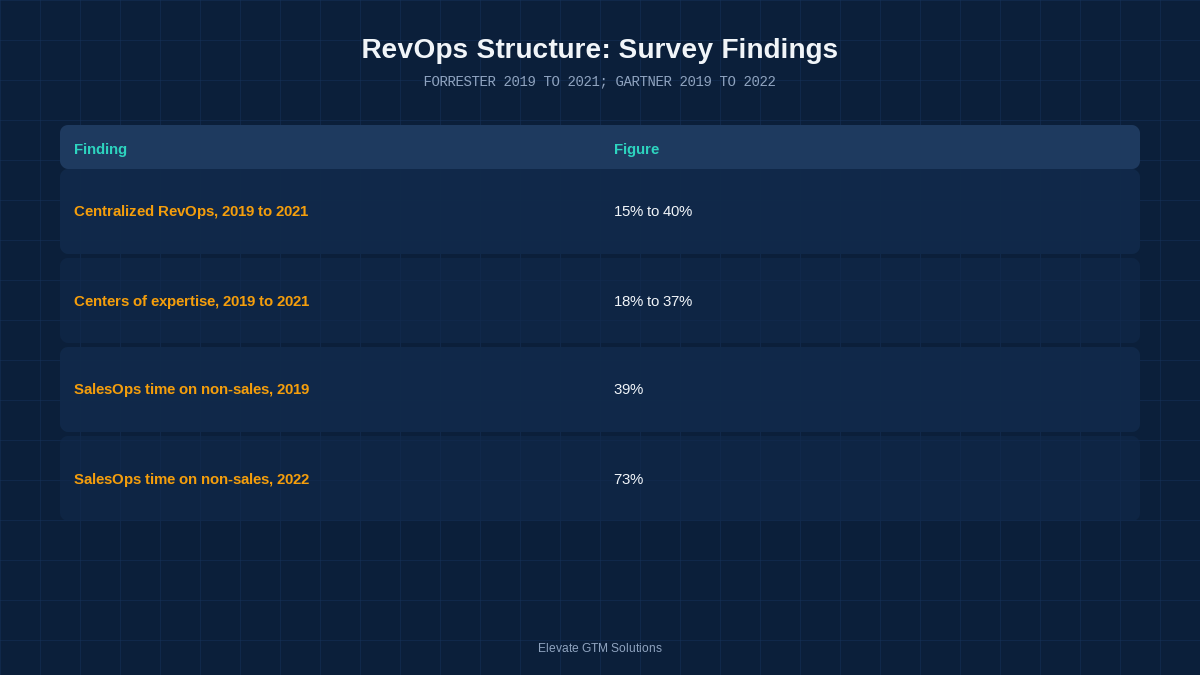
There is no single structure the research proves best. Forrester's 2021 survey of 316 respondents found centralized revenue operations rose from 15% to 40% of organizations between its 2019 and 2021 studies, and centers of expertise rose from 18% to 37%. Forrester's Anthony McPartlin warned that treating RevOps only as an organizational design risks the centralization not lasting, and argued in November 2023 that "structures are just one lever of change" and that teams need a full operating model covering stakeholders, offerings, capabilities, structure, governance and operating principles. Gartner's April 2023 survey of 318 sales leaders found sales operations professionals spend 73% of their time supporting non-sales functions, up from 39% in 2019. Gartner describes revenue operations as an end-to-end model that unifies customer engagement across functions and integrates people, processes and technology. A workable design starts with the problems you need to fix, such as conflicting metrics and disconnected data, then picks the lightest structure that fixes them.
Should RevOps report to the CEO, the CRO or the CFO? The sources we read do not say. Choose the reporting line that gives the team authority over data and process across marketing, sales and customer success.
Is RevOps just a rebrand of sales operations? Gartner says it is often mistaken as one, but describes it as all operations related to customer revenue working together.
The short version
| Question | Answer |
|---|---|
| Forrester, May 2021 (316 respondents) | Centralized revenue operations rose from 15% to 40% between 2019 and 2021; centers of expertise rose from 18% to 37% |
| Forrester, November 2023 | Structure is one lever; build an operating model with six layers |
| Gartner, April 2023 (318 sales leaders, fielded August to September 2022) | Sales operations professionals spent 73% of their time supporting non-sales functions, up from 39% in 2019 |
| Gartner's definition | Revenue operations is an end-to-end model unifying customer engagement across functions and integrating people, process and technology |
| Gartner prediction | In 2021 it predicted 75% of the highest-growth companies would deploy a RevOps model by 2025; its current web page says by 2026, up from less than 30% |
| Forrester APAC survey excerpt | Leaders cite misaligned technology, conflicting metrics and inadequate processes as key obstacles |
| What is missing | Independent public evidence that one structure outperforms another |
| Main limit | The surveys describe what companies do and say, not which design produces better results |
What RevOps is, and what it is not
The term has had many meanings, and Gartner's own guidance acknowledges it. Some organizations treat it as a title change, others as an org structure and others as a software category.
What it is. In Gartner's description, revenue operations is an end-to-end model that unifies customer engagement across functions and integrates people, processes and technology across the business. Forrester says RevOps teams are not just a combination of marketing, sales and customer success operations. They have an expanded responsibility to connect strategy and execution across functions and to transform the revenue ecosystem to enable consistent growth.
What it is not. It is not just a new name for sales operations. A July 2024 Gartner abstract for tech CEOs makes that point, saying RevOps is often mistaken as a rebrand of sales operations or a convergence of sales and marketing, when it is a reflection of all operations related to customer revenue working together. We saw that only as an abstract.
What the work usually covers. Shared definitions of stages and metrics, a single view of the customer and the pipeline, planning and forecasting, tools and data, process design and increasingly the oversight of AI tools and automations that touch customers.
Why this belongs in a go-to-market plan
A go-to-market plan makes promises that operations has to keep. It says who the target customers are, how they will be reached and how success will be measured. If marketing counts a lead one way, sales another and customer success a third, the plan cannot be run, however good it looks on paper.
The research on execution says the same. We cover that in why B2B go-to-market strategies fail in execution and in how to keep sales, marketing and product aligned on go-to-market. Structure is one of the tools for making that alignment real. It is not the only one.
The evidence: Forrester's 2021 survey of revenue operations models
In a blog dated May 13, 2021, Forrester's Anthony McPartlin reported on the second major revenue operations survey Forrester had run, after a first in 2019. We read it in full. The 2021 survey had 316 respondents, with balanced representation across industries, business models and maturity.
What changed. Centralized revenue operations rose from 15% to 40% of organizations over the two years between surveys. Centers of expertise or excellence rose from 18% to 37%. McPartlin describes this as a significant shift toward consolidating operations resources.
The caution. He writes that revenue operations should be treated as a cultural change, not only an organizational design. If it is seen only as an operating model, the centralization may not last.
The values he recommends. Four: accountability, meaning fair commitments from each function and open reporting; outside-in focus, meaning measuring the value created for buyers during their purchase; balance, weighing short-term revenue targets against long-term investments such as brand and market penetration; and ownership, letting operations teams define their own values so they apply them daily.
What we could not confirm. The blog gives the share of organizations using each model but not whether centralized teams performed better. It is from 2021. We do not know how the percentages split by company size. The survey is Forrester's, and Forrester sells research to operations leaders.
The evidence: Forrester on operating models
In a November 29, 2023 blog titled "RevOps Strategies Are Missing An Operating Model," McPartlin argues that discussions focus too much on structure. We read it in full. It contains no statistics.
The argument. "Structures are just one lever of change." A centralized or decentralized chart does not by itself connect strategy to sustained execution. When one set of priorities is favored over others, the team struggles to achieve true integration, and the strategy can lose sustainability.
The framework. Forrester introduced a High-Performance Operating Model Framework for Revenue Operations at B2B Summit EMEA in October 2023. It has six layers.
- Customers and stakeholders: decide which stakeholders the function serves and in what priority.
- Stakeholder value drives offerings: build and promote a set of offerings that meet internal needs, and treat the stakeholders' experience of working with you as seriously as customers' experience.
- Capabilities: assess and grow the maturity of talent, data, processes, technology and intellectual property.
- Structures: make them adaptable and built to maximize stakeholder value, not to protect territory.
- Leadership and governance: keep the model from becoming dysfunctional, and consider them at every stage of design.
- Operating principles: agreed guardrails that make trade-offs explicit.
What we could not confirm. The framework is Forrester's own, and the detail is behind a paywall. We cannot tell whether companies using it do better.
The evidence: Gartner on sales operations and RevOps
The April 2023 survey. In a press release dated April 12, 2023, Gartner reported a survey of 318 sales leaders conducted in August and September 2022. We read it in full. Sales operations professionals reported spending 73% of their time supporting non-sales functions, up from 39% in 2019. In 2022, 27% of support time went to the sales function, down from 61% in 2019, and 68% went to non-client-facing functions such as supply chain, enterprise analytics, finance, HR and IT. Greg Hessong, a Senior Director in Gartner's sales practice, said that "For many organizations, these shifts in support time are intentional," linked to the move toward revenue operations and cross-functional alignment. More than 70% of leaders rated statistical analysis, stakeholder management and analytic problem solving as slightly to much more important for the future. The release offers no explicit recommendations.
The prediction. In May 2021 Gartner predicted that by 2025, 75% of the highest-growth companies in the world would deploy a RevOps model. A Gartner web page we saw states that by 2026, 75% of the highest-growth companies will adopt a RevOps model, up from less than 30% today. The target year moved, which tells you it is a forecast, not a count. The 2021 release also quoted Doug Bushée, a senior director analyst, saying functional silos handing off clients and using different technologies, people and processes are a barrier to revenue growth. We saw that only as an excerpt.
The guidance page. Gartner's RevOps page lists steps that include integrating a centralized source of data and insights from finance, marketing, customer success and sales. It says RevOps does not need to start with a large organizational transformation and can be implemented at any level. We saw this through excerpts.
What we could not confirm. The survey measures how sales operations teams spend time, not whether that time improves results. A shift to non-sales work is consistent with a move toward RevOps and equally with simply being asked to do more. The prediction defines "highest-growth companies" in a way we could not check.
The evidence we saw in part
A Forrester blog on APAC B2B leaders, citing its Revenue Operations Survey 2024, says respondents cite misaligned technology, conflicting metrics and inadequate processes as their organizations' key operations obstacles. A Forrester report description says B2B organizations with an aligned revenue engine grow faster and more profitably than their peers. We saw both only as excerpts of descriptions and cannot see the method behind the second claim.
Numbers that circulate, and that we could not trace
Articles on RevOps quote many figures, including that 58% of B2B companies cite process misalignment as their primary barrier to growth, attributed to a Forrester "State of RevOps 2025" survey, and that 80% of B2B purchases involve complex buying groups, attributed to Forrester. We could not locate a primary source for the first. The second is commonly quoted in vendor posts. We do not use either. Several posts also describe "three dominant RevOps models" in 2026 without a source. Use them as descriptions of common practice, not as findings.
How much weight the evidence can carry
It describes adoption, not performance. The Forrester and Gartner surveys show more companies centralizing. They do not show that centralizing improves growth or profit.
The data are several years old. The Forrester structure survey is from 2021 and the Gartner time survey from 2022. AI tools have since changed what operations teams do.
Analysts sell what they study. Forrester and Gartner both sell research and advisory services to operations and sales leaders. A message that structure is not enough, and that you need an operating model or a maturity assessment, fits their business. It is also sensible.
"Highest-growth companies" is a selected group. A prediction about what they will do tells you what leaders are doing, not what causes growth.
Context decides. A twenty-person company and a two-thousand-person company need different things.
Elevate's reading
Our interpretation, not data.
One. Start with the problem, not the chart. The common problems are conflicting definitions, disconnected data and unclear ownership. Fix those, and the right structure often becomes obvious.
Two. Authority matters more than reporting line. A RevOps team that can set definitions, manage the stack and arbitrate between functions can work from many places on the chart. One that can only advise will struggle wherever it sits.
Three. Smaller companies should start light. Gartner says RevOps can start at any level without a large transformation. A single person who owns definitions and data across marketing, sales and success can do a lot.
Four. Treat internal customers as customers. Forrester's point about stakeholder experience is practical. If sales finds the RevOps team slow or obstructive, they will route around it.
Five. The function now includes AI oversight. As teams adopt agents and AI drafting tools, someone needs to decide which tools run, on what data and with what review. RevOps is a natural home. See our page on governing generative AI in go-to-market.
Six. Revisit the design as you grow. A shared service that works at one stage may need to become a more centralized function or a center of expertise at another.
What this means for different roles
Chief executive or founder. Decide who has the authority to set revenue definitions and own the data. That choice matters more than the title.
Chief revenue officer or head of sales. If RevOps reports to you, give it a mandate that includes marketing and success. If it does not, agree on shared definitions anyway.
CMO or head of marketing. Agree one definition of a qualified opportunity and one view of pipeline. Do not run a separate version.
Head of customer success. Make sure retention and expansion data are in the same system as pipeline. See what is a good net revenue retention rate.
CFO. Reconcile revenue reporting between finance and go-to-market, and agree who owns forecasts.
Head of RevOps. Define your offerings, stakeholders and principles in writing, and measure how internal partners experience your service.
Heads of product and enablement. Ask for the data you need and agree how requests are prioritized.
A worked example, invented for illustration
Imagine a software company with 150 employees. Marketing operations reports to the CMO, sales operations to the head of sales and customer success operations to the head of success. Each uses a different tool and a different definition of an active customer. The board sees three versions of pipeline.
The chief executive asks for a design review. The team lists the problems: conflicting stage definitions, three customer lists, forecasts that do not match finance numbers, and requests that go to whoever is most senior. They consider three options: leave the structure and add a council that sets definitions, create a shared service reporting to the chief revenue officer, or fully centralize all three teams under a head of revenue operations.
They choose the second for the next year. The shared service owns definitions, the data model and the stack. The three functional teams keep their own priorities and sit in it with dotted lines. They write six operating principles, including who decides when functions disagree, and agree to review the design in twelve months.
They track time to answer a data request, the number of conflicting definitions remaining and a short quarterly survey of internal partners. We make no claim about what a real company would see. The example shows the pattern: name the problems, choose the lightest design that addresses them, write the principles down and review it.
How a go-to-market platform can help, and where it cannot
Elevate GTM Solutions is a go-to-market strategy platform. As described on our homepage, its modules cover segmentation, positioning, messaging, account-based marketing, pricing, sales enablement, measurement and more, within a unified strategy with collaborators and workflow stages. It is not a CRM, a data warehouse or an operations consulting service.
Here is how that relates to the research, without overclaiming.
A shared plan. A strategy that holds target segments, positioning, messaging and goals in one connected place gives operations a common reference for definitions and priorities. That depends on the team keeping it current.
Visible ownership. Workflow stages and collaborators can show who is responsible for which part of a strategy. They do not replace formal accountability.
Weekly visibility. A weekly pulse and executive dashboards give leaders a regular view of progress against the plan. We have no data showing better operational results.
What it cannot do. It does not unify your CRM, marketing and billing data. It does not design your organization, set your reporting lines or settle disputes between functions. We have no Elevate customer data on RevOps outcomes. For questions to ask any vendor, see questions to ask AI GTM vendors, and for who should own the strategy itself, see who owns GTM strategy.
Questions to ask before reorganizing
- What specific problems are we trying to fix, and how will we know they are fixed?
- Where do definitions conflict today, and who decides?
- How many customer lists and pipeline views do we have?
- Who has the authority to change a stage definition or a field?
- What do marketing, sales and success each need from operations?
- How do internal partners experience working with the operations team today?
- What is the lightest change that would fix the main problems?
- Which decisions will operations own, which will it advise on and which will stay with functions?
- How will we review the design as we grow?
- Who oversees AI tools and automations that touch customers?
Common mistakes
Reorganizing before naming the problem. A new chart does not fix conflicting definitions.
Giving the team accountability without authority. If it cannot set definitions or manage the stack, it will advise and be ignored.
Renaming sales operations and calling it RevOps. Gartner notes this mistake.
Centralizing in a way that sidelines a function. Forrester warns about win and lose scenarios when one set of priorities dominates.
Ignoring culture. Forrester's caution is that centralization may not last if it is seen only as a structure.
Buying tools to fix a structural problem. More software does not settle who owns a definition.
Never revisiting the design. What suits a small company may not suit a larger one.
Forgetting internal customers. Operations teams that do not manage their stakeholders' experience lose trust.
What to do this week
Ask marketing, sales and customer success to write down their definition of a qualified opportunity and an active customer. Put the three versions on one page. The gaps are your first agenda.
Three common designs, and when each tends to fit
These are descriptions of common practice, not findings from the research.
A council with shared definitions. The three operations teams stay where they are. A small group meets regularly to set definitions, resolve conflicts and agree on priorities. It is the lightest option and suits small companies or those early in the effort. Its weakness is that decisions rest on goodwill, and a council with no authority can stall.
A shared service or center of expertise. A central team owns definitions, data, tools and common processes, while functional teams keep their own priorities and often have dotted-line relationships. This is the middle path and suits companies that have outgrown a council but are not ready for full centralization. Forrester's data show centers of expertise rising from 18% to 37% of organizations between 2019 and 2021.
A fully centralized function. Marketing, sales and customer success operations report to one head of revenue operations. It gives the clearest ownership of data and process and suits companies with the scale and leadership alignment to support it. Its risks are distance from the functions it serves and, as Forrester warns, being treated as an organizational design only.
There is no evidence in the sources we read that any of these outperforms the others. Choose based on your problems, your size and the authority you can give the team.
How to write a one-page RevOps charter
A short charter makes the design concrete.
- Purpose. One sentence on what the function exists to do.
- Stakeholders. Which groups it serves and in what priority.
- Offerings. The services it provides, such as reporting, tool administration, planning support and process design.
- Decision rights. What it decides, what it advises on and what stays with functions.
- Data ownership. Who owns definitions, the customer record and the stack.
- Principles. Three to six rules for resolving trade-offs, such as which function's priority wins when two conflict.
- Measures. How you will know it is working, including how internal partners rate the service.
- Review date. When you will revisit the design.
Share it with every function and ask for objections before it is final.
How to tell whether your current design is failing
Reorganizations are expensive, so look for evidence first. These are signs that operations structure, and not individual performance, is the problem.
The same number has several answers. Ask three leaders how many qualified opportunities exist this quarter. If you get three answers, definitions are unowned.
Reports take days and are argued over. When every review begins with a debate about whose data is right, no one has authority over the data.
Handoffs lose information. What marketing knew about a lead or sales promised to a customer does not reach the next team.
Requests go to the most senior person. If operations priorities are set by whoever shouts loudest, there is no agreed way to choose.
Tools multiply. Each function buys its own software, and integrations are patched by hand.
Operations staff are overloaded and unclear on their mandate. Gartner's finding that sales operations time has moved heavily toward non-sales functions is consistent with this, though it does not prove it.
Internal partners route around the team. People build their own spreadsheets because the official process is too slow.
If you see several of these, a design change is worth considering. If you see only one, a narrower fix, such as a single owner for one definition, may be enough.
How to sequence the change
A gradual approach tends to hold better than a large announcement.
- Agree on the problems. Write them down with examples and have each function confirm them.
- Fix definitions first. Choose one meaning for the ten or so terms that matter most, such as lead, qualified opportunity, active customer and churn.
- Name an owner for data. One person or team owns the customer record and the pipeline view.
- Consolidate tools where it helps. Do this only after definitions are agreed. Otherwise you move the disagreement into a new system.
- Change reporting lines last. Do it when the earlier steps show that authority, not goodwill, is the missing piece.
- Review after two quarters. Check the measures you set, and adjust.
Forrester's caution that centralization may not last without a cultural change is a reason to take the first three steps seriously.
What a RevOps team measures about itself
A function that asks others to be accountable should be accountable too. A short scorecard keeps it honest.
Service. How long a typical data or reporting request takes, and how many are waiting.
Trust in the numbers. The number of conflicting definitions still in use, and how often a review starts with an argument about data.
Adoption. The share of the team that uses the shared process and tools, as opposed to private spreadsheets.
Partner experience. A short quarterly survey of marketing, sales and customer success leaders on whether operations makes their work easier.
Change. How many process or definition changes were agreed, shipped and followed.
Forrester's advice to treat internal partners' experience as seriously as customers' experience is the basis for the fourth measure. Publish the scorecard to the same leaders it serves.
Glossary
Revenue operations (RevOps). An end-to-end model that unifies operations across marketing, sales and customer success around customer revenue.
Sales operations. The function that supports sellers with process, data, tools and planning.
Marketing operations. The function that runs marketing systems, data and campaign measurement.
Customer success operations. The function that supports customer success with process, data and tools.
Center of expertise. A central team that sets standards and provides specialist support while functions keep their own teams.
Centralized model. One organization owns operations across the revenue functions.
Operating model. The combination of stakeholders, offerings, capabilities, structure, governance and principles that determines how a function works.
Stack. The set of software tools a team uses.
Where Elevate GTM Solutions fits
Elevate GTM Solutions is a go-to-market strategy platform that its homepage describes as a way to build, execute and evolve strategy, with connected modules and a flow from insights and strategy context to a strategy builder, workflow engine, activation, playbooks, weekly pulse and executive dashboards. It speaks to this research in a narrow way: it can hold the shared plan and goals that operations teams work from and give leaders regular visibility. It does not design organizations or unify operational data. For related reading, see do AI agents make sales teams more productive.
Key takeaways
- Forrester's 2021 survey of 316 respondents found centralized revenue operations rose from 15% to 40% between 2019 and 2021, and centers of expertise from 18% to 37%.
- Forrester argues structures are just one lever, and teams need an operating model with six layers, including stakeholders, capabilities, governance and principles.
- Gartner's 2023 survey of 318 sales leaders found sales operations professionals spend 73% of their time supporting non-sales functions, up from 39% in 2019.
- Gartner predicts most of the highest-growth companies will adopt a RevOps model, but the target year has moved, so treat it as a forecast.
- We found no independent evidence that one structure outperforms another.
- Start with the problems, give the team real authority and choose the lightest design that fixes them.
Sources
- Forrester, Anthony McPartlin, B2B Revenue Operations Is Seeing Greater Centralization, But Can Organizations Make It Stick?, blog, May 13, 2021 (survey of 316 respondents).
- Forrester, Anthony McPartlin, RevOps Strategies Are Missing An Operating Model, blog, November 29, 2023.
- Gartner, Gartner Survey Finds Sales Operations Teams Dedicate Most of Their Time to Non-Sales Functions, press release, April 12, 2023 (survey of 318 sales leaders, August to September 2022).
- Gartner, Gartner Predicts 75% of the Highest Growth Companies in the World Will Deploy a RevOps Model by 2025, press release, May 17, 2021 (search excerpts only).
- Gartner, Revenue Operations (RevOps): Best Practices to Grow Your Business, web page (search excerpts only).
- Gartner, Tech CEO Insight: Early-Stage Companies Must Prepare to Adopt RevOps, insights abstract, July 11, 2024 (abstract only).
- Forrester, Why Revenue Operations (RevOps) Should Be On Your Radar, blog (search excerpt only; cites Revenue Operations Survey 2024, APAC).
Frequently Asked Questions
How should a B2B company structure revenue operations?
The research does not prove one structure best. Common designs are a council that sets shared definitions, a shared service or center of expertise, and a fully centralized function. Start with the problems you need to fix, give the team real authority and choose the lightest design that works.
How common is centralized RevOps?
In Forrester's 2021 survey of 316 respondents, centralized revenue operations rose from 15% to 40% of organizations between its 2019 and 2021 studies, and centers of expertise rose from 18% to 37%. The data are several years old and do not show that centralizing improves performance.
Is RevOps the same as sales operations?
No. Gartner says RevOps is often mistaken as a rebrand of sales operations, but it covers all operations related to customer revenue, across sales, marketing and customer success, working together. Gartner's 2023 survey found sales operations staff spend 73% of their time supporting non-sales functions.
Does centralizing revenue operations improve growth?
The sources we read do not show it. They describe adoption and offer guidance. Forrester warns that if RevOps is treated only as an organizational design, centralization may not last, and says an operating model matters more than structure alone.
What is an operating model for revenue operations?
Forrester describes six layers: the stakeholders you serve, the offerings you build for them, your capabilities, your structure, leadership and governance, and operating principles that make trade-offs explicit. The detail sits behind a paywall, so we summarize only what its blog states.
Who should RevOps report to?
The sources we read do not say. Choose a reporting line that gives the team authority over definitions, data and process across marketing, sales and customer success, and that is trusted by all three.
How small can a company start with RevOps?
Gartner's guidance says RevOps does not need to begin with a large transformation and can be implemented at any level. One person who owns shared definitions and data across the revenue functions can be a useful first step.
Is Gartner's prediction about RevOps adoption reliable?
Treat it as a forecast. In 2021 Gartner predicted 75% of the highest-growth companies would deploy a RevOps model by 2025, and a current page says by 2026, up from less than 30%. The target year moved, and "highest-growth companies" is a selected group.
Does RevOps include AI oversight?
Increasingly it can. As teams adopt agents and AI drafting tools, someone has to decide which tools run, on what data and with what review. That is a judgment call about your organization, not a finding from the sources here. See our page on governing generative AI in go-to-market.
Can a go-to-market platform replace RevOps?
No. Elevate GTM Solutions is a strategy platform that can hold the shared plan, goals and workflow stages and give leaders visibility. It does not unify operational data, design your organization or settle disputes between functions, and we have no data on RevOps outcomes.
What should we do first?
Ask marketing, sales and customer success to write their definitions of a qualified opportunity and an active customer, and compare them. The gaps give you the first agenda for shared definitions and ownership.
How do we know whether our RevOps design is working?
Track how long data requests take, how many conflicting definitions remain, how much of the team uses the shared process and how internal partners rate the service in a short quarterly survey. Forrester advises treating internal partners as seriously as customers.