
By the Elevate GTM Solutions Team · Updated November 13, 2026 · 28 min read
Why Do B2B Go-to-Market Strategies Fail in Execution, and How Do You Close the Gap Between Plan and Results?
Almost every B2B company has a go-to-market plan, and almost every leadership team believes it matters. The trouble shows up later. The plan is approved, the launch date passes, and six months in the numbers sit below the model. Nobody can point to one broken piece. Marketing says the leads were fine. Sales says the leads were thin. Product says the message did not match the roadmap. The strategy was never really wrong or right. It just never fully turned into what people did every day.
This page explains why that happens and what a team can change. It uses analyst research as evidence: a 2026 Harvard Business Review Analytic Services survey of 522 B2B go-to-market professionals, Forrester's current thinking on go-to-market and its 2026 marketing survey, and Gartner's July 2026 survey of chief sales officers. For each source we say who ran it, how many people were asked and what it cannot tell you. Then we add our own reading, clearly marked, and describe how a go-to-market platform like ours can help and where it cannot.
A disclosure. We make Elevate GTM Solutions, a platform for building, executing and evolving go-to-market strategy, so we have an obvious interest in a story that says strategy and execution drift apart. We have no data of our own. Every figure here comes from a named source we read, and the main survey was sponsored by a software vendor, which we flag. Our interpretation is labeled as ours, and our examples are invented and labeled.
Why do B2B go-to-market strategies fail in execution?
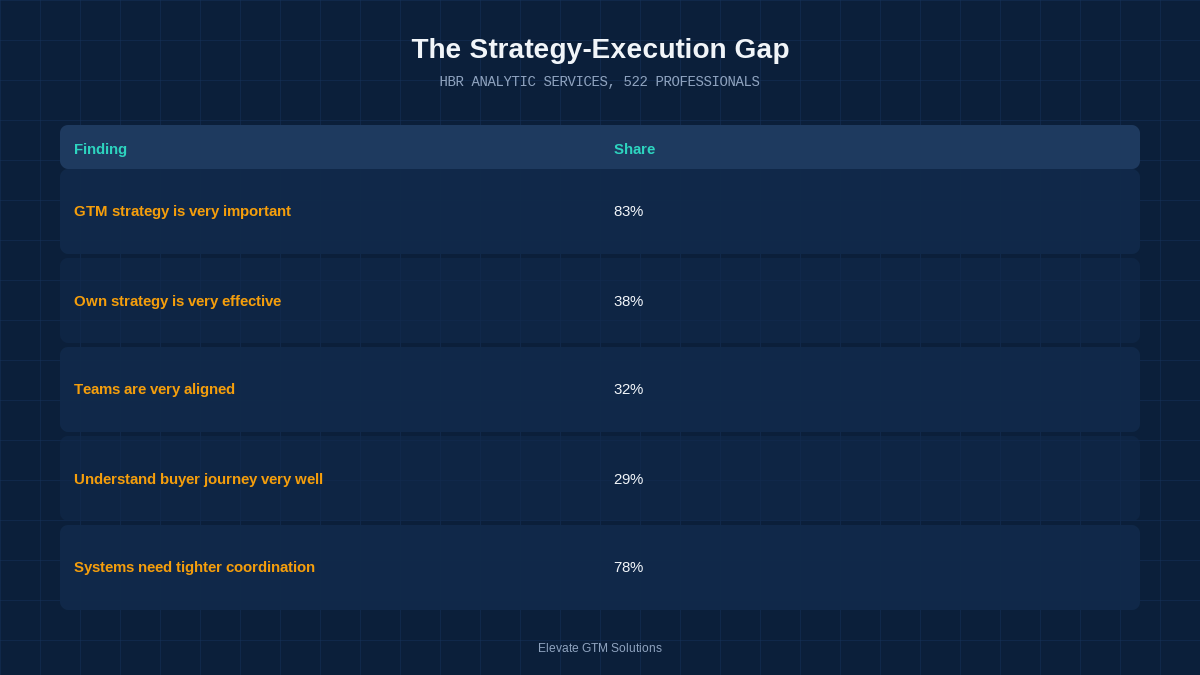
Mostly because the strategy lives in one place and the work happens in many. In a 2026 Harvard Business Review Analytic Services survey of 522 B2B go-to-market professionals, sponsored by LeanData, 83% said go-to-market strategy is very important but only 38% called their strategy very effective. The same report found that 78% agree their go-to-market systems need tighter coordination while only 32% say their teams are very aligned, and that the most cited challenges were a more complex buyer journey (55%), poorly integrated systems or data sources (48%) and siloed data that hides the full picture of buyer engagement (43%). Forrester reports that B2B marketing decision-makers achieve on average 85% of their revenue plan, and says 92% of executives believe their go-to-market teams are aligned against 57% of practitioners. Gartner's July 2026 survey found 60% of chief sales officers say their revenue number is largely driven by factors outside their control. The common thread is not a lack of strategy. It is weak links between strategy, data, teams and the buyer's actual path.
Is the problem the strategy or the execution? In the HBR survey the gap is between importance (83%) and effectiveness (38%). That points to translation, not a lack of ideas.
What do the better performers do differently? The report says leaders align teams, metrics and systems around the buyer, clarify roles, define shared metrics and treat go-to-market improvement as ongoing work.
The short version
| Question | Answer |
|---|---|
| What is the headline gap? | 83% say go-to-market strategy is very important; 38% say theirs is very effective (HBR Analytic Services, 522 professionals) |
| Who ran the main survey? | Harvard Business Review Analytic Services, sponsored by LeanData, fielded September 2025, published March 2026 |
| Top execution barriers | A complex buyer journey (55%), systems or data not well integrated (48%), siloed data that hides buyer engagement (43%) |
| Alignment | 78% say systems need tighter coordination; 32% say teams are very aligned |
| Buyer understanding | 92% say alignment with the buyer journey is essential; 29% understand today's journey very well |
| Plan attainment | B2B marketing decision-makers achieve on average 85% of their revenue plan (Forrester Marketing Survey, 2026) |
| Perception gap inside companies | 92% of executives think teams are aligned versus 57% of practitioners (Forrester, survey not named on the page) |
| Control | 60% of chief sales officers say their revenue number is largely outside their control (Gartner, July 2026) |
| Main limit | The largest survey is vendor-sponsored and self-reported, and the gap is between two opinions, not two measurements |
Where a go-to-market strategy actually breaks
A strategy is a set of decisions: who you sell to, what you say to them, how you reach them, what you charge, and what you will measure. Execution is thousands of smaller decisions made by people who were not in the room when the strategy was written. The distance between the two is where plans fail, and it opens in a handful of predictable places.
The strategy is a document, not a working system. A deck is approved at the planning offsite and then lives in a folder. Six months later the ideal customer profile in the deck is not the one sales uses, and the messaging in the deck is not what appears on the website. Nobody changed their mind. Nobody was ever asked to keep the document and the work in step.
Each function translates the plan on its own. Marketing turns the strategy into campaigns. Sales turns it into territories and talk tracks. Product turns it into a roadmap. Customer success turns it into a renewal plan. Each translation is reasonable. Together they can disagree, because each team filled in the gaps with its own assumptions.
The data does not connect. When strategy depends on a view of the account and the buyer, but that view is split across a customer system, a marketing platform, an intent tool and a spreadsheet, every team sees a different slice. The HBR survey's top execution challenge is exactly this: siloed data that hides the whole picture of buyer engagement.
The buyer's path is more complicated than the plan. Strategies tend to assume a clean sequence. Real purchases involve many people, loop back and happen partly out of sight. A plan built for a tidy funnel will keep running into a buyer who does not follow it. The HBR report found 92% agree alignment with the buyer journey is essential, yet only 29% understand today's journey very well.
Nobody owns the connection. Everyone owns a piece. No one is accountable for whether the pieces fit together. We cover this at length in our page on keeping sales, marketing and product aligned on go-to-market and on who owns GTM strategy.
Measurement rewards the wrong thing. If each team is measured on its own activity, the plan will be executed as a set of separate activities. Forrester's current guidance is to track shared outcomes, such as buyer preference, revenue contribution and retention, and not only functional engagement metrics.
The plan is treated as finished. Markets, competitors and buyers change. A strategy that is only revisited at the annual planning cycle will drift out of date even if it was good on day one. See the death of static GTM strategy.
None of these is a failure of intelligence. They are structural, and the fixes are structural too, which is why the research below keeps pointing at alignment, shared data and shared metrics instead of at better ideas.
Why this belongs in a go-to-market plan
A go-to-market plan usually contains a section on target segments, positioning, channels, pricing and a launch calendar. It rarely contains a section on how the plan will be carried out: who is accountable for each decision, which data every team will use, how the plan changes when results differ from the model, and how success is measured across functions. Adding that section does not make the plan longer by much. It makes the plan testable.
If you can only fix one thing, fix the answer to a simple question: when the plan and the results disagree, who notices, and what happens next? Many teams cannot answer that, and the research below suggests why it matters.
The evidence: what the Harvard Business Review Analytic Services survey found
The central source for this page is a research report from Harvard Business Review Analytic Services titled Aligning Go-to-Market Execution with Strategy to Better Address Complex Buyer Journeys. It is sponsored by LeanData, a company that sells go-to-market orchestration software. The executive summary we read says the survey covered 522 B2B go-to-market professionals, was fielded in September 2025 according to a chart source note and was published in March 2026.
The headline gap. 83% of respondents say go-to-market strategy is very important for selling to B2B buyers. Only 38% describe their strategy as very effective. The report calls this a 45-point gap, and 54% cite increased revenue as the top benefit of better go-to-market execution.
The challenges named. The summary lists three that stand out. 55% cite a more complex buyer journey as a top challenge. 48% say systems or data sources are not well integrated when designing strategy. 43% cite siloed data that does not give a holistic view of buyer engagement as an execution challenge. The summary also lists 44% for difficulty creating a cohesive experience, 43% for ineffective team coordination and 42% for misaligned or conflicting goals, with a note that the chart's labels and percentages do not map cleanly. We therefore rely on the three figures above and treat the others as indicative.
Understanding the buyer. 92% agree that alignment with the buyer journey is essential, but only 29% understand today's journey very well. Strong journey understanding is reported by 53% of the respondents the report labels leaders, 18% of followers and 11% of laggards.
Team alignment. 78% agree their go-to-market systems need tighter coordination, yet only 32% say the teams involved are very aligned. Strong alignment is reported by 63% of leaders and 11% of laggards. Collaboration is named as a priority by 81% of leaders and 48% of laggards.
Technology and AI. 68% agree AI is important to their go-to-market strategy. 76% of leaders and followers are exploring new tools, against 51% of laggards. Current uses named include analyzing data for insights, optimizing marketing campaigns, coaching sales reps and personalizing content at scale.
What the report says leaders do. Build execution models that align teams, metrics and systems around the buyer. Clarify roles and expectations, define shared metrics and agree on a common go-to-market strategy. Treat go-to-market improvement as ongoing work and not a one-time project. The report's own line is that "Leaders are significantly less likely to report misaligned goals and ineffective coordination."
What we could not confirm. We read the executive summary, not the full report. We do not know how the report defines leaders, followers and laggards beyond the labels, how respondents were selected from the HBR audience or the exact question wording. The press materials describe the sample as professionals from a global audience across industries.
The evidence: what Forrester says about go-to-market and plan attainment
Forrester's page on B2B go-to-market strategy argues that traditional go-to-market strategies are failing because linear funnels, functional handoffs and isolated metrics no longer reflect how B2B buyers discover, evaluate, purchase and adopt solutions. It gives a handful of figures, and it is candid about neither naming every survey nor giving samples, so we mark what we can and cannot trace.
- 85% of revenue plan. In Forrester's Marketing Survey, 2026, B2B marketing decision-makers reported on average only 85% achievement of their revenue plan. No sample size is given on the page.
- 94% use AI in at least one stage. From Forrester's Buyers' Journey Survey, described as the latest. No date or sample is given.
- 68% start with a preferred vendor, who wins 80% of the time. Same survey, same limits. We discuss this in our page on how buyers choose vendors before they talk to sales.
- 85% of buyers are dissatisfied with at least one aspect of their chosen provider's buying experience. The page attributes this to Forrester's research without naming the survey.
- 92% of executives versus 57% of practitioners. The page says 92% of executives believe their go-to-market teams are aligned, versus 57% of practitioners. The survey is not named.
Forrester's recommendations are consistent with the HBR report. Agree on target segments and buyer personas. Use shared outcome measures instead of functional metrics. Create feedback loops linking strategy, execution and optimization. Share customer insights across functions. Align strategy, planning, execution requirements, execution and measurement around shared customer and business outcomes. On AI, it recommends redesigning work so AI handles analysis and routine tasks while people provide judgment and accountability, and measuring business outcomes rather than AI usage.
What we could not confirm. Several of the Forrester figures are given without a survey name, date or sample, which limits how far they can be quoted. The 92% versus 57% perception gap is striking, and we treat it as a single data point from an unnamed source, not as a settled finding.
The evidence: what Gartner's 2026 sales survey adds
In a July 28, 2026 release, Gartner reported a survey of 210 chief sales officers and senior sales executives conducted from January through February 2026. It found that 60% say their revenue number is largely driven by elements outside their control. The release was about AI agents and sales productivity, and we cover it in detail in whether AI agents make sales teams more productive. It matters here because it describes how sales leaders feel about their plans: a majority see the target as something that is partly outside what they can steer.
That perception does not prove the targets are unfair. It does show a plan that does not give leaders confidence in the link between what they do and what they are asked to deliver. A plan that connects activities to outcomes through shared data and clear ownership should make that link easier to see.
How much weight the evidence can carry
The strongest point is the direction, not the percentages. Three sources from different organizations point at the same cluster of causes: weak alignment, disconnected data, and a buyer journey that is more complicated than the plan assumed. That agreement matters more than any single number.
The main survey has a sponsor with an interest. LeanData sells orchestration software, and a story about uncoordinated systems helps that business. This does not make the findings false. HBR Analytic Services runs its own research under a sponsorship model, and we read only the executive summary. Hold the percentages loosely and the pattern more firmly.
Self-reported effectiveness is an opinion. "Very effective" is the respondent's judgment of their own strategy. A respondent who believes the strategy is excellent but cannot prove it, and one who is harsh on a decent strategy, both count. The 45-point gap is a gap between importance and self-rated effectiveness.
Leaders and laggards are labels, not controlled groups. Comparing leaders with laggards shows what differs between them. It cannot show that aligning teams makes a laggard into a leader. Better-run companies may also be better at alignment because they are better run.
Revenue plan attainment depends on the plan. If a plan is aggressive, 85% attainment may be strong. If it is conservative, 85% may be weak. Forrester's figure is an average across respondents and says nothing about target quality.
The surveys are about B2B marketing and sales professionals. They tell you how those people see the problem. They do not include buyers, finance teams or customers, who might name different causes.
Elevate's reading
Our interpretation, not data.
One. Strategy and execution are separated by handoffs, not by effort. The HBR figures describe a population that mostly knows what to do and says it is not working. When people try hard and the plan still slips, the cause is usually the structure around them: unclear owners, different data, separate tools.
Two. A strategy is only as useful as the number of people who are working from the same copy of it. If five teams each hold a slightly different version of the ideal customer profile and the messaging, the strategy has already forked. Part of closing the gap is giving the plan one home that people actually use and update.
Three. Shared metrics beat shared meetings. Alignment meetings are the usual response to alignment problems, and they help briefly. Forrester's advice to use shared outcome measures instead of functional metrics changes what people are rewarded for, which is what changes behavior.
Four. The buyer's journey is part of the strategy, not a downstream detail. Only 29% say they understand today's journey very well. A strategy built on a guess about how buyers buy will fail in execution however well it is carried out. See how B2B buyers use AI and sales reps for part of that picture.
Five. Treat improvement as a rhythm. The report's point that leaders treat go-to-market improvement as ongoing work matches a simple practice: a weekly look at a small number of numbers, a monthly look at what the plan assumed, and a quarterly decision about what to change.
Six. Be honest about what is outside your control. Sixty percent of chief sales officers say the revenue number is largely outside their control. Some of that is true of any market. A plan that names its assumptions about the market makes it easier to tell a missed assumption from a missed execution.
What this means for different roles
Chief executive or founder. Ask one question in your next planning review: for each major decision in the strategy, who is accountable, and where is the current version written down? If the answers are vague, the gap starts there.
CMO or head of marketing. Check whether the campaigns you are running trace to a named segment and message in the plan. If they trace to last year's plan, the plan and the work have already separated.
Head of sales. Compare the accounts your team is working with the accounts in the strategy. Where they differ, ask why. Sometimes the team is right and the plan needs to change. That is useful too.
Head of product. Ask whether the message sales uses matches what the roadmap will deliver in the next two quarters. Gaps here turn into broken promises.
Customer success leader. The strategy usually stops at the sale. Check whether it says anything about adoption, renewal and expansion. If not, add it.
Revenue operations. You hold the data. Map which source is the truth for which field in the plan, and where two teams use different numbers for the same thing.
A worked example, invented for illustration
Imagine a software company with a 40-person go-to-market team that sells to mid-market finance teams. The annual plan targets three segments, sets one core message and expects a new product tier to account for a quarter of new revenue.
By the end of the second quarter, the new tier is under target. The post-mortem is familiar. Marketing ran campaigns for all three segments, but sales concentrated on one because those accounts closed faster. The core message was rewritten twice by regional teams. The new tier's pricing was explained differently by two sellers. Customer success learned about the tier from a customer.
The head of revenue operations draws a simple map. For each of the plan's five major decisions, segments, message, pricing, channels and success measures, she writes down who decided, where the current version lives and who uses it. Four of five have more than one version. She does not propose a new plan. She proposes one owner and one written version for each decision, a monthly review in which owners report whether the work matches the plan, and a short list of shared outcome measures that replace three team-specific scorecards.
We make no claim that this would improve results by any amount. It reflects what the research suggests: connect the pieces before adding effort.
How a go-to-market platform can help, and where it cannot
Elevate GTM Solutions is a go-to-market strategy platform. As described on our homepage, it is built around the idea of building, executing and evolving strategy, with connected modules for market research, ideal customer profile and segmentation, competitive intelligence, account-based marketing, positioning, messaging, pricing, customer acquisition, distribution channels, marketing alignment, launch and execution, measurement and optimization, sales enablement, customer success and customer advocacy, plus a unified strategy view that connects them. It can adapt to region, vertical and segment, and the homepage says a first draft can be ready in five minutes or less.
Here is how that relates to the research, without overclaiming.
A shared home for the strategy. A platform that holds the strategic decisions in one connected place, and tracks a strategy through stages from draft to defined to launched to optimizing, can make it harder for the plan to fork into five versions. That helps only if teams actually work from it.
A link from strategy to action. As we describe the product flow, a strategy moves from insights and context into a strategy builder, a workflow engine with collaborators, then activation with a short list of focus assets, playbooks, a weekly pulse with recommended actions, and executive dashboards. The intent is to keep a visible line from the plan to the work and to the results. We have no data showing that this closes any execution gap.
Comparing options before committing. Users can create more than one strategy and compare them, which can help a team discuss trade-offs before budget is committed instead of after.
What it cannot do. It cannot make teams agree. It cannot fix a buyer journey the team does not understand. It cannot supply accountability that leadership does not assign. It is another tool, and the HBR survey's own point is that tools and data need to connect. It adds value only if people use it, and it does not replace the owner who keeps the plan current. We have no Elevate customer data on execution outcomes, and we do not claim any. For a comparison of approaches, see unified GTM platform vs point solutions and how to choose a GTM platform.
Questions to ask yourself
- If the plan and the results disagree, who notices first, and what happens next?
- For each major decision in the plan, who is accountable and where is the current version?
- Do sales, marketing, product and success use the same definition of the ideal customer?
- Which three shared outcome measures do all teams see weekly?
- When did we last compare the plan's assumptions about buyers with what buyers actually did?
- Which part of our revenue number do we truly not control, and have we said so in the plan?
- What changed in the plan in the last quarter, and who decided?
Common mistakes
Writing a better plan when the problem is carrying it out. Another round of strategy work will not fix a handoff problem. Ask where the existing plan broke first.
Treating alignment as a meeting. A weekly sync can reveal disagreement and still not resolve it. Pair it with shared measures and named owners.
Letting each function keep its own version. Local copies feel faster and slowly turn into different strategies.
Measuring activity. Emails sent, content published and meetings held are easy to count and do not tell you whether the plan is working.
Skipping the buyer journey. Planning from internal process, not buyer behavior, is how a strategy ends up rehearsing a funnel nobody follows.
Buying a tool to fix a structural problem. A tool can make a good structure easier to run. It cannot replace the structure.
Treating a missed quarter as a verdict. A single miss can come from a wrong assumption about the market, not poor work. Separate the two before assigning blame.
What to do this week
Pick the one decision in your plan that most affects revenue, perhaps your primary segment. Write down who owns it, where the current written version lives and which two teams use it. If any answer is unclear, resolve it before doing anything else.
A simple way to find where your plan breaks
You can run this in a week with no new tools.
- List the plan's decisions. Segments, ideal customer profile, positioning, messaging, pricing, channels, launch dates, success measures. Eight to ten items is enough.
- Trace each one to the work. For each, find one concrete place where it shows up in practice: the campaign brief, the sales deck, the pricing sheet, the onboarding plan.
- Mark the mismatches. Where the work says something different from the plan, note it. Do not assign blame yet.
- Sort the mismatches. Some are the plan being out of date. Some are the work drifting. Some are a missing owner. Each needs a different fix.
- Choose three fixes. Pick the three mismatches that most affect revenue and assign an owner and a date for each.
- Set a monthly check. Ask each owner one question: does the work still match the plan, and if not, which one should change?
This is not sophisticated, and that is the point. Most execution gaps are visible once someone looks for them in an organized way.
What a monthly plan review should cover
A useful review is short and has a fixed shape. Spend the first part on results against the plan, with no explanation yet. Spend the second on assumptions, listing what the plan assumed about market size, buyer behavior, competitors, conversion and price, and marking each as confirmed, unclear or wrong. Spend the third on decisions: what the team will change, who owns the change and when it will be reviewed. End with a short note on what the plan now says, so that the document and the work stay in step.
Two habits keep the review honest. First, separate "we did not do what we planned" from "we did what we planned and it did not work." Those lead to different actions. Second, record the decision, not just the discussion. A review that produces no changes to the plan has not closed the loop.
Glossary
Go-to-market strategy. The decisions about who you sell to, what you say, how you reach them, what you charge and how you measure success.
Execution gap. The distance between how important a strategy is believed to be and how effectively it is carried out.
Alignment. Agreement among functions about the same target, message and measures, held under pressure.
Orchestration. Coordinating tools, data and teams so that actions follow from the plan. Vendors use the term in different ways.
Buyer journey. The path buyers take from recognizing a problem to a decision and beyond. Real journeys are not linear.
Shared outcome measure. A metric that several functions are accountable for together, such as revenue contribution or retention.
Plan attainment. The share of the revenue target actually achieved.
Where Elevate GTM Solutions fits
Elevate GTM Solutions is a go-to-market strategy platform described on its homepage as a way to build, execute and evolve strategy, with connected modules and a flow from insights and strategy context through a strategy builder, a workflow engine, activation, playbooks, a weekly pulse and executive dashboards. It speaks to the research in one narrow way: it aims to keep the strategy and the work visible in the same place. It does not remove the need for owners, shared measures or an honest view of the buyer. For a structured check, use our guide to how to tell if your GTM strategy is broken and the GTM readiness framework.
Key takeaways
- In a 2026 HBR Analytic Services survey of 522 B2B go-to-market professionals, 83% said strategy is very important and 38% said theirs is very effective.
- The top challenges named were a more complex buyer journey (55%), poorly integrated systems or data (48%) and siloed data hiding buyer engagement (43%).
- 78% agree systems need tighter coordination, yet only 32% say teams are very aligned. Only 29% understand today's buyer journey very well.
- Forrester reports an average of 85% revenue plan attainment among B2B marketing decision-makers, and a perception gap between executives (92%) and practitioners (57%) on alignment, from an unnamed survey.
- Gartner found 60% of chief sales officers say their revenue number is largely outside their control.
- The main survey is vendor-sponsored and self-reported. The pattern across sources is more reliable than any single percentage.
- The fixes are structural: named owners, one working version of the plan, shared measures and a regular review.
Sources
- Harvard Business Review Analytic Services, sponsored by LeanData, Aligning Go-to-Market Execution with Strategy to Better Address Complex Buyer Journeys, executive summary, March 2026 (survey of 522 B2B go-to-market professionals; executive summary read, not the full report).
- LeanData, HBR Research Reveals Execution Gap in B2B Go-to-Market Strategy, press release, March 31, 2026 (read through search-result excerpts).
- Forrester, B2B GTM Strategy: How Go-To-Market Must Change For Today's Buyers, web page (undated).
- Gartner, Gartner Predicts AI Agents Will Outnumber Sellers 10 to 1 by 2028, Yet Fewer Than 40% of Sellers Will Say Agents Improved Productivity, press release, July 28, 2026.
Frequently Asked Questions
Why do B2B go-to-market strategies fail in execution?
Usually because the strategy and the work are separated by handoffs, disconnected data and unclear ownership, not because the strategy was poor. In a 2026 HBR Analytic Services survey of 522 B2B professionals, 83% said strategy is very important and only 38% said theirs is very effective. The top named challenges were a complex buyer journey, poorly integrated data and siloed views of buyer engagement.
Is the execution gap real or just opinion?
It is an opinion gap, measured through self-reported surveys. That still matters, because it shows how practitioners experience their plans. It does not prove any specific plan failed, and the largest survey was sponsored by a software vendor. The consistent pattern across HBR, Forrester and Gartner is more persuasive than any single percentage.
What is the biggest cause of poor execution?
The sources point at a cluster, not one cause: weak alignment between teams, data that does not connect and a buyer journey the team does not fully understand. In the HBR survey only 32% said their teams are very aligned and only 29% understand the buyer journey very well.
What do high-performing teams do differently?
The HBR report says leaders build execution models that align teams, metrics and systems around the buyer, clarify roles, define shared metrics and agree on a common strategy. It also says they treat go-to-market improvement as ongoing work. These are associations among survey respondents, not proof that copying them will produce the same results.
How much of the revenue plan do B2B teams typically hit?
Forrester's 2026 Marketing Survey reports that B2B marketing decision-makers achieve on average 85% of their revenue plan. The page does not give a sample size, and the figure depends on how ambitious the plans were.
Do executives and practitioners see alignment differently?
According to a Forrester page, 92% of executives believe their go-to-market teams are aligned, compared with 57% of practitioners. The survey is not named on the page, so treat it as a single data point. It suggests that leaders may overestimate alignment, which is worth testing in your own team.
Does buying more technology close the gap?
Not by itself. The HBR survey names integration of systems and data as a top challenge, so connecting what you have may matter more than adding tools. Forrester's guidance on AI is to redesign work first and measure business outcomes, not tool usage.
What should we measure to know if strategy is being executed?
Forrester recommends tracking buyer preference, customer value, revenue contribution, retention and growth, not only engagement metrics. A simple internal check is to trace each major plan decision to the work that implements it and note mismatches. See our GTM metrics and KPIs page.
Who should be accountable for closing the gap?
Someone named, for each decision, and one person or small group accountable for whether the pieces fit together. Many companies lack that connecting role. See who owns GTM strategy.
Can a go-to-market platform fix the execution gap?
It can help keep strategy, workflow and measurement in one visible place, which makes drift easier to see. It cannot create agreement or accountability. Elevate GTM Solutions is designed to connect strategy building, workflow, activation, playbooks, weekly pulse and dashboards, and we have no customer data showing it closes execution gaps.
How current is this research?
The HBR survey was fielded in September 2025 and published in March 2026. The Forrester page is undated, and the Gartner survey was fielded in January and February 2026. All are recent, though several figures come from sources that did not state their samples.
What should we do first?
Pick the single decision in your plan that most affects revenue, write down who owns it and where the current version lives, and fix any ambiguity. Then trace that decision to the work and note where they differ.