
By the Elevate GTM Solutions Team · Updated November 13, 2026 · 22 min read
What Is Deal Intelligence? Definition, Signals, Uses, Limits, and How It Differs From Revenue Intelligence and GTM Intelligence
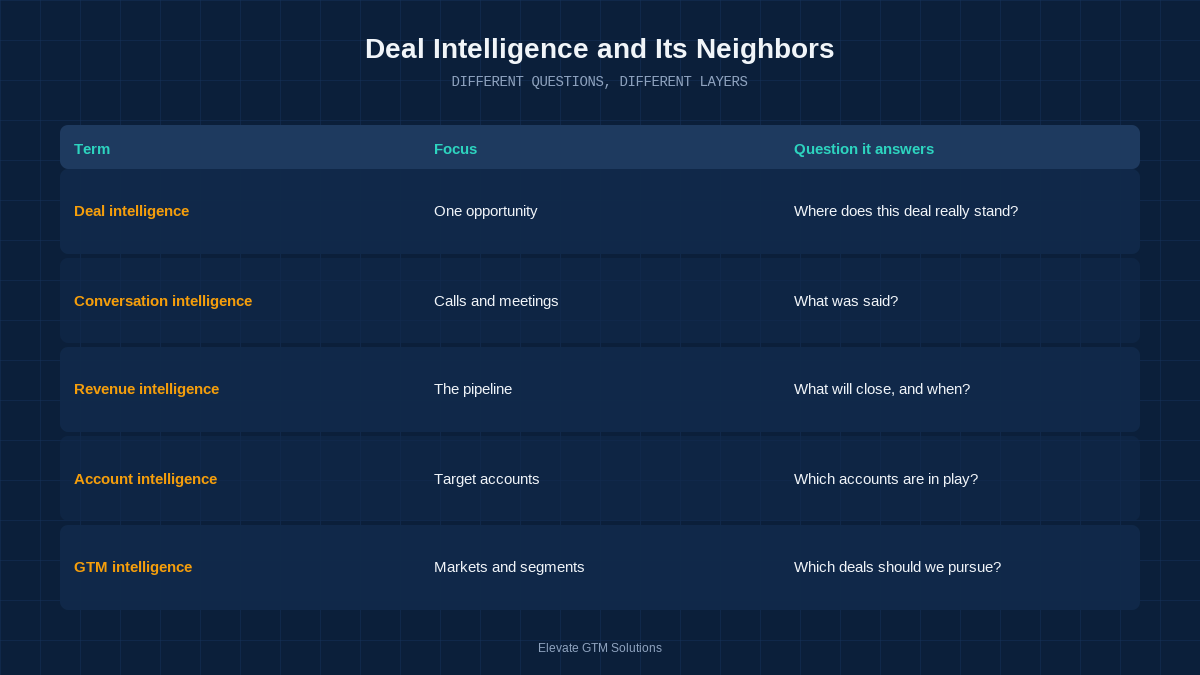
A deal review used to be a conversation. A manager asked a rep how the deal was going, the rep gave a view and the manager decided whether to believe it. Deal intelligence is the attempt to add evidence to that conversation: what has actually happened in the deal, who is involved, what was said and whether the pattern looks like deals that closed or deals that stalled.
The term is used loosely, and it overlaps with revenue intelligence, conversation intelligence, pipeline analytics and sales forecasting. This guide defines it plainly, lists the signals it uses, describes what it is good for and where it misleads, separates it from neighboring ideas (including GTM intelligence, a different thing that the two phrases sometimes get confused with) and offers a practical way to start without buying anything. We give no benchmark figures, since we have no verified ones to offer, and our worked examples are invented.
Elevate GTM Solutions makes a GTM strategy platform. It is not a deal intelligence product, and we say so in the closing section. We mention vendor names only as examples of the category and do not rank them.
What is deal intelligence?
Deal intelligence is the use of evidence from a specific sales opportunity, such as emails, meetings, calls, contacts, stage history and buyer behavior, to understand where the deal really stands, what is at risk and what to do next. It is usually delivered by software that captures activity and analyzes it, and it feeds deal reviews, coaching and forecasts. It is about individual deals. GTM intelligence, by contrast, is about the market, segments and strategy that decide which deals to pursue in the first place.
Is deal intelligence the same as revenue intelligence? Close. Revenue intelligence usually adds forecasting and pipeline analysis across many deals. Terms vary by vendor.
Can it predict whether a deal will close? It can flag patterns that have preceded wins or losses in the past. It cannot know what the buyer will decide.
The idea in one example
Imagine a deal marked "Commit" with a close date at the end of the quarter. A traditional review asks the rep if it is solid. A deal intelligence view would show something like this, with invented details:
| Evidence | What it shows |
|---|---|
| Contacts engaged | Two people from the buyer, both from the user team |
| Last meeting | Eighteen days ago |
| Emails | The champion replied twice in a month, the second after a long gap |
| Stakeholders missing | No finance approver, no procurement, no security contact |
| Next step | "Follow up" with no date |
| Calls | Competitor named twice on the last call |
| Stage history | Moved to Commit six days ago, after sitting in Proposal for ten weeks |
None of this proves the deal will fail. It does tell the manager where to ask questions: who approves the budget, what is the date, why did the stage jump? That is the value. Deal intelligence does not replace judgment. It improves the questions.
What deal intelligence uses
| Signal type | Examples | What it can tell you |
|---|---|---|
| Activity | Emails, meetings, calls, their frequency and recency | Whether the deal has momentum |
| People | Who is involved, their roles and seniority | Breadth of engagement and missing stakeholders |
| Conversation | Topics, questions, objections, competitors mentioned, next steps | What the buyer cares about and what worries them |
| Stage and timing | Time in stage, movement, changes to the close date | Whether the deal is aging or being pushed |
| Commercial | Amount changes, discounts, proposals and contracts | Negotiation dynamics |
| Buyer behavior | Opens and views of proposals and shared materials | Interest, with caution |
| Context | Account events such as funding, hiring or leadership changes | Whether the buyer's situation has shifted |
| Internal | Who on your side is involved, executive sponsor presence | Capacity and support |
A fair way to think about it: some signals are facts (a meeting happened), some are extractions (a competitor was mentioned) and some are inferences (this deal looks at risk). The further down that list, the more caution you need. Our guide to accurate deal data without manual entry covers how to test each layer.
What it is used for
Deal reviews. Managers inspect deals from evidence rather than from a rep's account alone, and spend the time on the questions that matter.
Risk flags. The tool highlights patterns that often precede stalled deals: single-threading, silence, missing stakeholders, no dated next step.
Coaching. Calls and sequences show how a rep handles discovery, objections and next steps, which makes feedback specific.
Forecasting. Evidence feeds an estimate of likely outcomes, alongside the rep's call. Used well, it narrows the range. Used poorly, it adds a second opinion that is also wrong.
Handoffs. A record of what was said and agreed helps when a deal moves between people, or to customer success after the sale.
Learning. Over time, you can compare patterns in won and lost deals and test hypotheses. See our win-loss analysis framework.
Rep productivity. Summaries and drafted follow-ups reduce administrative work, which is often the first benefit people notice.
What it is not
| It is not | Why it matters |
|---|---|
| A crystal ball | It reads patterns in the past and cannot see the buyer's private decisions |
| A substitute for conversation | The evidence points to questions. People still have to ask them |
| A measure of rep quality | Activity and outcomes reflect territory, product fit and luck as well as skill |
| The same as GTM intelligence | That is about markets, segments and strategy |
| A fix for unclear stages | If stage definitions are vague, the tool will record vague data faithfully |
| Free of privacy questions | Capturing calls and email raises consent and employment questions |
Deal intelligence and its neighbors
The terms overlap, and vendors use them differently. A working map:
| Term | Typical meaning | Focus |
|---|---|---|
| Deal intelligence | Evidence and analysis for individual opportunities | One deal |
| Conversation intelligence | Recording and analysis of calls and meetings | What was said |
| Revenue intelligence | Activity capture, deal analysis, pipeline and forecast, across many deals | The revenue pipeline |
| Sales analytics | Reporting on pipeline, conversion and performance | Aggregated metrics |
| Account intelligence | Data and signals about target accounts | Which accounts to pursue |
| Market and competitive intelligence | Information on markets, buyers and rivals | The environment |
| GTM intelligence | Intelligence that informs go-to-market decisions across segments, accounts and products | Strategy and planning |
Deal intelligence sits downstream. By the time a deal exists, the choice of segment, message and price has been made. If the strategy is wrong, good deal intelligence will tell you precisely how the wrong approach is failing, which is useful and also late. Our guides on GTM intelligence and GTM platform vs revenue intelligence platform explain how the upstream and downstream layers fit together.
How the software works, in plain terms
Without naming a particular product, most tools follow the same pattern.
- Connect. The tool links to email, calendar, phone or video meetings and the CRM.
- Capture. It records activity and matches it to accounts, contacts and opportunities.
- Transcribe and analyze. For calls, it turns speech into text and extracts topics, questions, next steps and mentions of competitors.
- Model. It combines signals into indicators: engagement scores, risk flags, suggested next steps and forecast estimates.
- Present. It shows these in deal views, dashboards, alerts and summaries.
- Learn. Some tools adjust their models using your historical outcomes.
Each step can fail. Matching activity to the wrong deal, mis-transcribing a name, mistaking a joke for an objection and extrapolating from a small history are all possible. That is why testing matters.
Where it helps most
| Situation | Why deal intelligence helps |
|---|---|
| Long, multi-stakeholder deals | There are many signals to track and many ways to miss a stakeholder |
| Large teams | Managers cannot listen to every call |
| Distributed teams | Context travels without meetings |
| High turnover or many new reps | Coaching can be targeted |
| Forecasting under pressure | An independent view of deal health supplements the rep's |
| Complex handoffs | A record preserves what was agreed |
Where it helps least
| Situation | Why it helps less |
|---|---|
| Very few, very large deals | Too little history for models; people know every deal |
| Short, transactional sales | Little to inspect, and the cost may exceed the gain |
| Poor CRM hygiene and unclear stages | The tool cannot fix definitions |
| Teams with no habit of deal review | The best data does nothing if nobody uses it |
| Sales driven mostly by relationships off the record | Much of what matters is invisible |
Reading a risk flag
Tools produce flags, such as "single-threaded," "no recent activity" or "close date pushed twice." A flag is a question, not a verdict. A short method for a manager:
- Look at the evidence behind the flag. What exactly was seen?
- Ask the rep for context. There may be a reason, such as a buyer on vacation or a conversation by phone that was not logged.
- Decide what would change your view. A meeting with the budget holder, a dated mutual plan, a security review started.
- Agree the next step and the date.
- Record the outcome, so you can later check whether the flag was useful.
If a flag is wrong half the time, tell the vendor and tune it, or switch it off. A tool that cries wolf trains people to ignore it.
What good deal inspection asks
Whether or not you buy a tool, the following questions improve deal reviews. They work because they ask for observable facts.
| Area | Question |
|---|---|
| Problem | What problem is the buyer trying to solve, in their words? |
| Impact | What happens if they do nothing, and who feels it? |
| People | Who is the economic buyer? Who has we not met? Who might block this? |
| Process | What are the steps and dates until a signature? |
| Competition | What are they comparing us with, including doing nothing? |
| Evidence | What has the buyer done, not said, that shows commitment? |
| Risk | What could stop this, and what is our plan? |
| Next step | What is agreed, with whom, by when? |
Our guides to B2B buying groups and sales cycle length offer context on why the people and process questions matter, and what published research says about them.
A starter approach without new software
You can get much of the benefit with a few habits and a spreadsheet.
Week one. Write stage definitions as observable events. For example, "Stage three: we have met the person who controls the budget, and they have confirmed the problem and a budget range." Tell the team.
Week two. Add four fields to the deal record, or a shared sheet: economic buyer identified (yes or no, name), next step with a date, competitor in play and date of last two-way contact.
Week three. Change deal reviews. For each deal, ask the questions in the table above and note the answers.
Week four. Pick a handful of deals and compare the review notes with what happened over the next month. Which questions turned out to be most predictive in your business?
This builds the habit and the definitions that any tool would depend on. Many teams discover that the missing piece was the discipline, not the technology.
Evaluating a deal intelligence tool
If you decide to buy, test the claims.
| Question | What to look for |
|---|---|
| What does it capture, from which systems, and how are activities matched to deals? | A clear description, with a way to correct matches |
| Which outputs are facts, which extractions and which inferences? | A candid split |
| How accurate is each, measured how, on what data? | A method and honest limits |
| Can we test on our own closed deals before buying? | Yes, with a defined test |
| Does the forecast beat a simple baseline on our history? | Willingness to test |
| Can we see the evidence behind each flag? | Evidence shown, not just a score |
| How does it handle unrecorded calls and personal email? | Controls and gaps stated |
| What consent and privacy features exist? | Announcements, exclusions, retention controls |
| Who needs a license, and what do managers and viewers cost? | Written pricing by role |
| How do we export our data and leave? | A clear process |
See our guides to questions to ask AI GTM vendors and the governance checklist for the wider diligence.
A fair test on your own history
- Choose fifty closed deals from the past two quarters, with wins and losses.
- Pick a date in the middle of each deal's life.
- Ask the tool, or its analysts, what it would have said at that date.
- Compare with the outcome, and with a simple baseline such as "deals older than the median are less likely to close."
- Record where the tool added information the baseline lacked, and where it did not.
If the vendor cannot or will not support a test like this, treat that as a finding.
The effect on people
Deal intelligence changes how people feel about being watched.
For reps, it can remove tasks such as note-taking and updating fields, and it can feel like surveillance if introduced badly. Explain what the data is for and what it is not for. Let reps see their own data first. Do not use activity counts as a performance score unless you want to produce activity.
For managers, it replaces opinion with evidence, and also tempts them to micromanage. The best use is to ask better questions, not to issue more instructions.
For leaders, it provides a second view of the forecast. Treat disagreement between the rep's call and the tool as a prompt for a conversation.
For buyers, the effect should be invisible or helpful, such as a rep who remembers what was said and follows up promptly. Recording and analysis should be disclosed as the law and good practice require.
Privacy, consent and fairness
- Recording and transcription. Rules on consent differ by country and sometimes by region. Ask how the tool announces recording and what it does when someone objects.
- Email and calendar access. Decide what is captured, what is excluded and how employees can see and correct it.
- Personal data. Names, titles and messages of buyers are personal data in many places. Know what is stored, for how long and why.
- Fairness. Models trained on past deals may reproduce past patterns, including patterns that reflect biased assumptions. Review flags for unexpected skews.
- Employment law. In some countries, tools that monitor employees need consultation. Check with your legal team.
This is not legal advice. Involve legal and HR early.
AI and deal intelligence
AI has changed what these tools do. Summaries of calls are now routine. Tools suggest next steps, draft follow-up emails, answer questions about a deal in plain language and flag risks. Three cautions apply.
Summaries can be wrong. They may omit the one thing that mattered or state something that was not said. Check summaries on important calls.
Confidence is not accuracy. A fluent explanation of why a deal is at risk can be wrong. Ask for the evidence.
Data goes somewhere. Calls and emails may be sent to AI providers. Ask what is sent, what is stored and whether it is used for training.
A worked deal review, with an invented deal
This example shows how evidence changes a review. The company, deal and numbers are made up.
A software company is selling a workflow product to a regional logistics firm. The rep, Dana, has the deal at the Commit stage for the end of the quarter. Her manager, Priya, opens the deal view before the review.
What the view shows. The buyer-side contacts are an operations manager and a team lead. The operations manager has replied to three of the last five emails, and the last reply came nine days ago. The last meeting was a demo, twenty days ago. The call transcript from that demo includes two mentions of a competitor and a question from the team lead about "how this fits with our security review." The next step field says "Send proposal." The proposal was sent twelve days ago, and the shared document has been opened twice by someone outside the contact list. The stage moved from Proposal to Commit five days ago.
Priya's questions. She does not ask "is this solid?" She asks six things.
- Who signs, and have we spoken to them? (The answer is no. The operations manager says the finance director signs.)
- What is the security review, who runs it and how long does it take? (Dana does not know.)
- Who opened the proposal twice? (Possibly the finance director or IT. Nobody has asked.)
- What did the buyer say about the competitor? (The team lead said the competitor was cheaper. Dana did not follow up.)
- What is the next step, with a date? (None.)
- Why did the stage change five days ago? (Dana hoped it would pressure the buyer.)
The decision. Priya moves the deal back to Proposal in the forecast, and agrees three actions with Dana for the week: ask the operations manager for an introduction to the finance director, send the security documentation before anyone asks for it and propose a dated plan to a decision, with the buyer's own milestones. They agree to look again in seven days.
What the evidence did. It did not say the deal would fail. It surfaced three gaps (the signer, the security review and the missing date) that Dana could close. Without the evidence, the review would likely have taken Dana's word that the deal was solid. With it, the conversation focused on action.
What the evidence did not do. It could not tell Priya whether the operations manager was a true champion. It could not tell her what the finance director thought. It showed that those questions were open.
Evidence by stage
A checklist of evidence by stage keeps reviews consistent. Adapt the stages and evidence to your own process. The items are examples, not a standard.
| Stage | Evidence a manager should expect to see |
|---|---|
| Discovery | A recorded problem in the buyer's words, the people affected and the current workaround |
| Qualified | Contact with someone who owns the problem and someone who controls budget, or a named path to them |
| Evaluation | The buyer's criteria, the alternatives they are comparing, a trial or demo with their data and the people who took part |
| Proposal | A written proposal, a reply from the buyer, named reviewers and a legal or security process identified |
| Negotiation | Draft terms exchanged, procurement involved and a dated path to signature |
| Commit | A signature date confirmed in writing by the approver, with no open blockers known |
The right column describes things the buyer did or said. That is what makes the evidence reviewable and, where possible, capturable by software.
Common risk patterns
Teams tend to see the same warning signs. Each is a prompt for a question, not a conclusion.
| Pattern | What it may mean | A useful question |
|---|---|---|
| One contact only | The deal depends on one person's enthusiasm and availability | Who else will decide or influence, and when will we meet them? |
| Silence after a proposal | The buyer may be busy, blocked or leaning elsewhere | What has changed since the proposal, and who reviewed it? |
| Close date pushed repeatedly | The date comes from the seller's wish, not the buyer's process | What is the buyer's own deadline and why? |
| Late-arriving stakeholder | A new person with a veto, such as security or procurement | What will they need, and can we meet them now? |
| Competitor mentioned and not explored | The seller avoided an uncomfortable topic | How do they see the difference, in their words? |
| Stage jump | The stage was changed to influence the forecast or the buyer | What buyer action justified the move? |
| No dated next step | Nobody owns the next move | What is agreed, by whom and by when? |
| Discount requested early | Price may be a proxy for unclear value | What would the buyer need to see to justify the price? |
| Champion changes role or leaves | The deal loses its advocate | Who else believes in this, and how do we find them? |
Forecasting with deal evidence
Deal evidence supports forecasts in three practical ways.
Cleaning the commit. Remove deals that fail basic evidence checks, such as no contact with the approver or no dated next step. This usually reduces optimism more than it adds precision.
Setting ranges. Instead of a single number, report a range based on deal categories: deals with strong evidence, deals with partial evidence and deals with little. Track how each category has converted in your own history.
Spotting aging. Compare time in stage with the distribution for deals that closed. Deals far past the usual range deserve a review. Our guide to B2B sales cycle length explains how to calculate that distribution by cohort and segment.
An honest forecast says what it knows, what it assumes and how wrong it has been before. Report your forecast error each period, so people learn how much to trust it.
Multi-threading and mutual plans
Two practices go hand in hand with deal intelligence, because the tool will often flag their absence.
Multi-threading means building real relationships with several people in the buying group. Research on buying groups, which we summarize in our page on how big a B2B buying group is, reports that groups are often larger than sellers assume. A simple way to start is a role map for each important deal: who uses it, who pays, who approves, who could block, and which of those you have spoken to.
A mutual plan is a shared, dated list of the steps to a decision, agreed with the buyer. It might include a technical review, a security check, a legal review, a budget approval and a signature, each with a date and an owner on both sides. A buyer who engages with a mutual plan is giving you evidence. A buyer who will not discuss dates is also giving you evidence.
Introducing deal intelligence to a team
Tools fail more often through adoption than through technology. A sequence that helps:
- Start with the problem sellers share. Often it is administrative work. Show them that the tool takes notes and drafts follow-ups before you show them risk flags.
- Pilot with willing reps and managers. Let them find the rough edges.
- Share the rules. Write down what the data will be used for, who can see it and what will not be done with it.
- Change the review format together with the tool. If reviews stay the same, the tool is decoration.
- Track adoption and quality. How many deals have a dated next step? How many reviews use the evidence? How often are flags useful?
- Retire what does not help. Switch off alerts nobody acts on.
When deal intelligence and strategy meet
Deal evidence is also a source of strategic learning, if someone collects it. Patterns across many deals can show that a segment closes faster, that a competitor appears more often in certain industries or that a message gets a stronger response. Those findings belong in the strategy conversation, not only in deal reviews. A monthly session where sales operations shares three patterns with product marketing and leadership, and where the group decides what to change in targeting or messaging, closes the loop. Our guide to GTM experimentation describes how to turn such patterns into tests, and be careful about the difference between a pattern and a cause.
A closing thought on evidence and judgment
The best deal reviews use evidence to sharpen judgment, not to replace it. A manager who has seen many deals knows things a model cannot, and a model sees patterns across more deals than any manager can remember. The two together are better than either alone, but only if people keep asking why. When a flag appears, ask what it means. When a rep disagrees, listen to the reason. When the outcome arrives, go back and check who was right, so that next time you know how much weight to give each view.
Glossary
Champion. A person on the buyer side who advocates for your solution.
Conversation intelligence. Software that records and analyzes calls and meetings.
Deal intelligence. Evidence and analysis about individual sales opportunities.
Economic buyer. The person who controls the budget and can approve the purchase.
Multi-threading. Building relationships with several people in the buying group.
Mutual plan. A dated plan shared with the buyer of the steps to a decision.
Revenue intelligence. Software that combines activity, conversation and pipeline data to analyze deals and forecasts.
Single-threaded. A deal that depends on one contact at the buyer.
Common mistakes
- Buying a tool before defining stages.
- Treating flags as verdicts.
- Using activity counts as a performance score.
- Not testing on your own history.
- Introducing capture without explaining the purpose.
- Ignoring consent and privacy.
- Leaving managers' habits unchanged.
- Trusting summaries without a check.
- Assuming the tool covers calls that were never recorded.
- Confusing deal intelligence with strategy.
Where Elevate GTM Solutions fits
Elevate GTM Solutions is an AI-native platform for GTM strategy and planning. It is not a deal intelligence, conversation intelligence or revenue intelligence product. It works upstream, on who to target, how to position, what to say and how to plan and review execution, and it has an analytics area that feeds results back into the next planning cycle. A team might reasonably use a deal intelligence tool for inspecting live deals and a GTM platform for deciding which segments and messages to pursue. They answer different questions. For more, see GTM platform vs revenue intelligence platform, GTM analytics and what Elevate GTM Solutions is.
What to do this week
- Rewrite your stage definitions as observable events.
- Add four fields: economic buyer, dated next step, competitor and last two-way contact.
- Change one deal review to use the inspection questions.
- Ask legal what applies to call and email capture.
- If you are considering a tool, pull fifty closed deals for a test.
- Tell sellers what the data will and will not be used for.
Key takeaways
- Deal intelligence uses evidence from a specific opportunity to understand where it stands, what is at risk and what to do next.
- It is about individual deals. GTM intelligence is about markets, segments and strategy.
- Signals range from facts to extractions to inferences, and caution should rise along that range.
- Flags are questions, not verdicts. Ask for the evidence.
- Test any tool on your own closed deals against a simple baseline.
- Clear stage definitions, good review habits and honesty about privacy matter as much as the software.
Sources
- Elevate GTM Solutions platform overview: the description of what the platform is and is not.
- The definitions, tables and methods in this guide reflect common industry usage and the writers' judgment. Vendors and analysts use the terms differently. The example deal and tables are invented and are not benchmarks.
- Laws on recording, privacy and employee monitoring vary. This page is not legal advice.
Frequently Asked Questions
What is deal intelligence?
It is the use of evidence from a specific sales opportunity, such as emails, meetings, calls, contacts and stage history, to understand where the deal stands, what is at risk and what to do next. It is usually delivered by software and used in deal reviews, coaching and forecasts.
How is deal intelligence different from revenue intelligence?
Terms vary by vendor. Deal intelligence usually focuses on individual opportunities. Revenue intelligence usually adds pipeline analysis and forecasting across many deals.
How is deal intelligence different from GTM intelligence?
Deal intelligence is about individual deals after they exist. GTM intelligence is about the market, segments, accounts and strategy that decide which deals to pursue and how.
What signals does deal intelligence use?
Activity such as emails and meetings, people involved and their roles, conversation content, stage and timing, commercial changes, buyer behavior with shared materials, account events and internal involvement.
Can deal intelligence predict whether a deal will close?
It can flag patterns that preceded wins or losses in your history. It cannot know what the buyer will decide. Test any prediction against a simple baseline on your own closed deals.
What are the limits of deal intelligence?
It cannot see what happens off the record, cannot fix vague stage definitions, can misread conversations and matches, and reflects the data it can see. Flags are prompts for questions.
Do I need software for deal intelligence?
Not to begin. Evidence-based stage definitions, a few extra fields and better deal review questions deliver much of the benefit. Software helps at scale and with call analysis.
How should managers use risk flags?
Look at the evidence behind the flag, ask the rep for context, decide what would change your view, agree a dated next step and record the outcome to see whether the flag was useful.
What privacy issues come with deal intelligence?
Call recording consent, email and calendar capture, buyer personal data, employee monitoring rules and fairness of models. Involve legal and HR early. This page is not legal advice.
How do I evaluate a deal intelligence tool?
Ask what it captures and how it matches activity to deals, which outputs are facts and which are inferences, how accuracy was measured, whether you can test on your own deals, whether it beats a baseline and how you export your data.
Is Elevate GTM Solutions a deal intelligence tool?
No. It is a GTM strategy and planning platform that works upstream on targeting, positioning, messaging and planning, and it can sit alongside a deal intelligence tool.
Who benefits most from deal intelligence?
Teams with long, multi-stakeholder deals, large or distributed sales organizations, many new reps and a habit of regular deal review.