
By the Elevate GTM Solutions Team · Updated November 13, 2026 · 28 min read
How Much Does Pricing Affect B2B Profit, and How Do You Build Pricing Discipline?
Pricing is the part of go-to-market that most teams treat as an afterthought and a few treat as the whole game. It is often set late, by a small group, using competitor lists and gut feel, and then defended in every deal by whoever is under pressure to close. McKinsey has published research for years arguing that this is a costly habit, and one number from it is quoted more than almost any other in B2B strategy: a 1% improvement in price yields a much larger improvement in operating profit than a 1% improvement in cost or volume.
This page explains how much pricing affects B2B profit, what the often-quoted 8.7% means and does not mean, and how a team can build pricing discipline. The evidence is McKinsey's research. We say what McKinsey reported, from which analysis and when, what a 2025 McKinsey survey on AI in pricing found and what none of it tells a software company deciding what to charge. Then we add our own reading, clearly labeled, and describe how a team can act, including where a go-to-market platform like ours fits and where it does not.
A disclosure. We make Elevate GTM Solutions, which includes a pricing strategy module, so we have an interest in pricing being taken seriously. We have no pricing data of our own. We could not open McKinsey's own site for this research. We read the statements below through excerpts of McKinsey's pages that appeared in search results, including a 2010 article, a McKinsey Quarterly piece and a 2025 survey article, and we mark where that limits us. Check the originals before you quote a figure. Our examples are invented and labeled.
How much does pricing affect B2B profit?
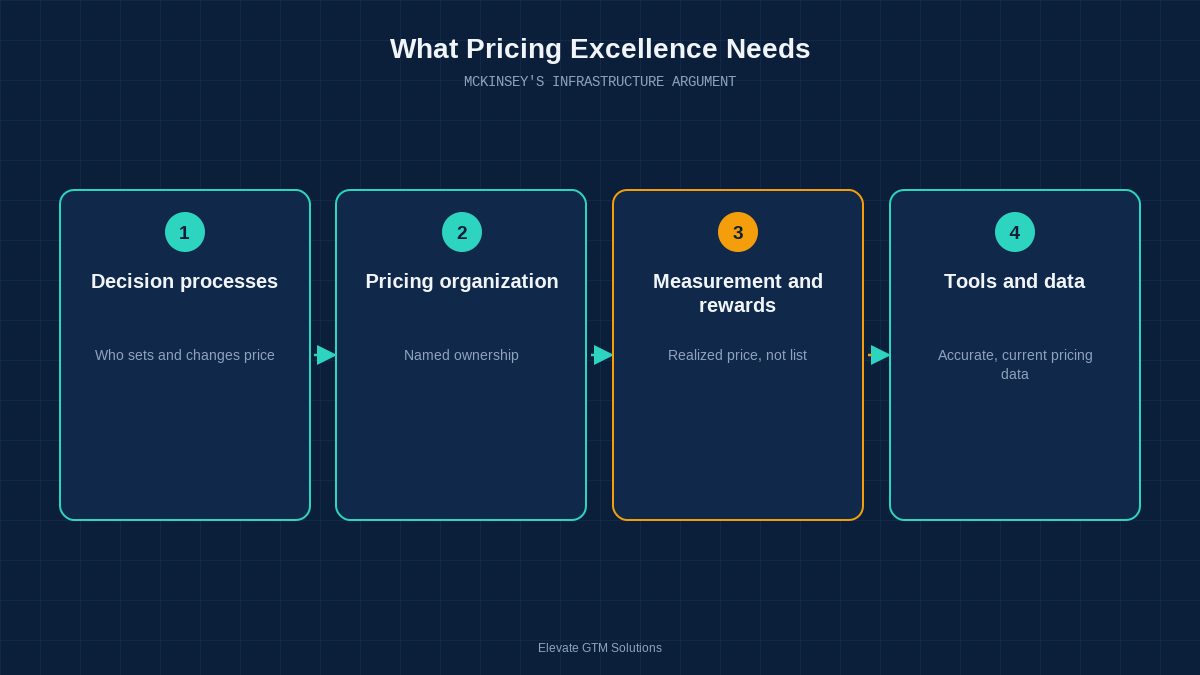
A great deal, on McKinsey's analysis, but the famous 8.7% figure is a reason to take pricing seriously, not a forecast for your business. McKinsey's long-running analysis says a one-percentage-point improvement in average price leads to an 8.7% increase in operating profits for the typical Global 1200 company, assuming no loss of volume. That is larger than the gain from a similar improvement in variable costs, fixed costs or volume. A well-executed pricing improvement program, McKinsey wrote in 2010, often yields price increases of two to four percentage points or more, so sustaining a price advantage may represent roughly 15% to 25% of a typical company's total profits. McKinsey also argues that many companies are lax about pricing, basing prices on anecdote, and that pricing excellence needs infrastructure: decision processes, a specialized organization, measurement and rewards, and support tools and data. A November 2025 McKinsey survey of more than 400 B2B pricing executives found 65% to 85% expect to adopt generative or agentic AI in pricing within one to three years, up from 10% to 30% today. The 8.7% figure assumes no loss of volume, comes from large public companies and is more than a decade old in its best-known form, so it argues for taking pricing seriously and does not predict what a price change will do for your business.
Is pricing really the biggest profit lever? McKinsey's analysis says a 1% price improvement beats a 1% change in variable costs, fixed costs or volume, assuming no volume loss.
Should we raise prices by 1%? Not on the strength of that number. It assumes volume does not fall, and your customers may react differently.
The short version
| Question | Answer |
|---|---|
| What is the headline claim? | A 1% price improvement yields an 8.7% rise in operating profit for the typical Global 1200 company, assuming no volume loss |
| Where is it from? | McKinsey analysis, restated in a 2010 article, a McKinsey Quarterly piece and a 2025 AI pricing article |
| Another McKinsey figure | Almost 8% on average across the S&P 1000 in the McKinsey Quarterly article |
| What does a pricing program yield? | McKinsey says often two to four percentage points of price or more; sustaining it may be 15% to 25% of typical total profits |
| What is the main requirement? | Pricing infrastructure: decision processes, a specialized pricing organization, measurement and rewards, support tools and data |
| 2025 survey | More than 400 B2B pricing executives; 65% to 85% expect to adopt generative or agentic AI in pricing within one to three years, up from 10% to 30% |
| Biggest caveat | The 8.7% assumes no loss of volume and comes from large public companies |
| Distributor study | McKinsey estimated a 1% price increase would yield a 22% increase in EBITDA margins across about 130 distributors |
How pricing leaks profit, and why it gets so little attention
Most companies lose money on price in ways nobody decided on. The list price says one thing and the price customers pay says another. The difference is realized price, and it leaks through several routes:
- Discounts granted to close a deal, then repeated at renewal.
- Exceptions approved by whoever is under the most pressure, with no record of why.
- Bundles that give away features the customer would have paid for separately.
- Renewals that roll over at the old price year after year.
It gets little attention because ownership is split. Sales negotiates, finance sets cost-plus rules, product decides packaging and nobody sees the whole. Pricing gets set once, late, and defended deal by deal.
A modest first step is to measure rather than redesign:
- Track realized price against list, by segment and by seller.
- Write down who can approve a discount, up to what level and for what reason.
- Review exceptions quarterly and ask which ones should become policy.
- Test price changes on a small group before rolling them out.
The sections below set out what McKinsey's research says, what the famous 8.7% figure does and does not mean, and where it stops being useful for a software company deciding what to charge.
Where pricing sits in a go-to-market plan
A go-to-market plan answers who you sell to, what you say and how you reach them. Price is part of what you say, because it signals position, and part of who you sell to, because it filters buyers. It also determines how much of every dollar of revenue you keep. A plan that spends months on segmentation and messaging and then sets price in an afternoon is out of balance.
Three kinds of pricing decision belong in the plan. The structure, meaning what you charge for: seats, usage, outcomes or packages. The level, meaning how much. And the discipline, meaning who can change it, under what rules and how you learn from the results. McKinsey's research is mostly about the third kind, discipline and infrastructure, which is the one most small teams have least of.
The evidence: what McKinsey reported
The 8.7% figure
In "Building a better pricing infrastructure," published in August 2010, McKinsey wrote that a one-percentage-point improvement in average price of goods and services leads to an 8.7% increase in operating profits for the typical Global 1200 company. The same figure appears in a later McKinsey article on "Using big data to make better pricing decisions," which states that on average a 1% price increase translates into an 8.7% increase in operating profits, "assuming no loss of volume, of course." It appears again in McKinsey's 2025 article on B2B pricing and AI, again with the assumption of no loss of volume.
A McKinsey Quarterly article, "Bringing discipline to pricing," gives a similar figure for a different group: a 1% improvement in price yields bigger gains in operating profit than a similar improvement in variable costs, fixed costs or volumes, almost 8% on average across the S&P 1000. It adds that companies often base prices on anecdotal evidence.
What to take from it. The arithmetic is simple. If a company keeps most of each revenue dollar as costs, a small percentage change in price, with costs unchanged, falls almost entirely to profit, so the profit percentage change is much larger than the price change. The figure shows that for the kinds of companies in the study, price changes leverage profit more than other changes. It is not a promise that a price increase will stick.
What a pricing program yields
The 2010 article says that because a well-executed pricing improvement program often yields price increases of two to four percentage points or more, sustaining a long-term price advantage may represent roughly 15% to 25% of a typical company's total profits. It lists frameworks for finding pricing opportunities, such as pocket-price waterfalls, price bands and value maps, as widely accepted, and argues that successful companies build a pricing infrastructure to support them.
What to take from it. The claim is about what a disciplined program can yield over time. It is stated as "may represent," and rests on McKinsey's experience with large companies.
The infrastructure argument
The 2010 article's central claim is that pricing excellence requires deliberate decision processes, a specialized pricing organization, mechanisms to measure and reward pricing performance, and dependable support tools and systems. It says pricing excellence demands an investment in systems to collect accurate, current pricing data and tools to turn that data into insight.
What to take from it. This is the most transferable part. It says the barrier is mostly organizational, not analytical. A company can know that discounting is excessive and still discount, because nobody owns the rules and nobody is rewarded for holding price.
The distributor finding
In a McKinsey article titled "Pricing: Distributors' most powerful value-creation lever," the authors estimate, from a database of about 130 publicly traded distributors, that a 1% price increase would yield a 22% increase in EBITDA margins and a 25% uplift in stock price. The article says many industry leaders relegate pricing to a "deal desk" instead of making it central to commercial excellence.
What to take from it. The size of the number reflects the thin margins typical of distribution, where small price changes represent large shares of profit. It illustrates that the leverage depends on your margin structure. A software company with high gross margins will see a smaller multiple, though price still matters.
The 2025 survey on AI in pricing
McKinsey's article "B2B pricing: Navigating the next phase of the AI revolution" reports a survey of more than 400 B2B pricing executives and decision-makers, with a November 2025 survey exhibit citing 419 respondents. It finds 65% to 85% of organizations expect to adopt generative or agentic AI in pricing over the next one to three years, up from just 10% to 30% today. It says customers' own efforts to build AI for procurement are creating pressure, and lists pricing tasks that these technologies can perform.
What to take from it. It reports expectations, not results. It says what pricing leaders plan to do. The gap between 10% to 30% today and 65% to 85% expected is a prediction about intent, and intent often outruns delivery. The connection to Gartner's warning about agents and fragmented systems, which we cover in whether AI agents make sales teams more productive, applies here too.
What the 8.7% does not mean
This number is quoted constantly, often with the caveats removed. Here is what to keep attached to it.
It assumes no loss of volume. McKinsey says so in its own text: "assuming no loss of volume, of course." In real markets, higher prices can lose customers. The 8.7% is a statement about margin leverage, not a forecast of what happens when you raise prices.
It describes the typical large public company. The Global 1200 and the S&P 1000 are large, mostly established firms with particular cost structures. A software start-up with very high gross margins and a different cost mix will see different leverage.
It is an average. Some companies in the data will have far more leverage and others far less.
Its best-known form is over a decade old. The 2010 article and the earlier analysis behind it predate cloud software pricing norms, usage-based models and AI features. McKinsey repeats the figure in 2025, which suggests it still regards it as useful, but we do not know whether it was recomputed.
It is about average price realization, not list price. The profit leverage applies to the price actually received after discounts, rebates and terms. A list price increase that is discounted away does nothing.
It does not say what a good price is. It says price matters a lot. It gives no rule for finding the right level.
How much weight the pricing research can carry
It comes from a consultancy that sells pricing work. McKinsey has a pricing practice. Its articles argue that pricing deserves investment, and some mention its pricing capability. That is a reason to read with care and not to dismiss the arithmetic, which is sound.
We read excerpts, not full articles. We could not open McKinsey's site directly for this research. Quotations here are from excerpts as displayed, and we have labeled which came from where. For anything you will use in a decision, read the original.
The survey is of pricing executives. People who work in pricing may be more optimistic about it than people elsewhere.
Different samples. Global 1200, S&P 1000, 130 distributors and 419 survey respondents are four different populations. Do not combine them.
Elevate's reading
Our interpretation, not data.
One. The lesson is about discipline, not about the number. If you remember one thing, make it McKinsey's infrastructure argument: decision processes, ownership, measurement and data. Without them, a pricing "strategy" is a spreadsheet that nobody enforces.
Two. Realized price is the number to watch. List price is what you say. Realized price is what you get. The gap, discounts, free months, extras thrown in to close, is where most B2B pricing leaks. Track it.
Three. Price is part of positioning. A price tells a buyer where you sit among alternatives. Cutting it to win a deal sends a signal that may undercut the confidence Gartner's research says buyers need. See why B2B buyers regret purchases.
Four. Pricing is a cross-functional decision. Finance, sales, marketing, product and customer success all have views and levers. The Forrester argument about unowned go-to-market applies strongly to pricing. See keeping sales, marketing and product aligned on go-to-market.
Five. Test where you can. Because the volume effect is the uncertainty in McKinsey's number, your own tests are the way to learn it: new customers offered a different package, a price change for one segment, a structured discount rule.
Six. Be careful with AI in pricing. A survey saying most pricing leaders expect to adopt AI is not evidence that AI sets better prices. The data foundations McKinsey says pricing needs are the same ones AI needs.
What this means for different roles
CEO or founder. Decide who owns pricing and write it down. In a small company it is often the founder. Look at your realized price over the last year, not just list price.
Head of sales. Ask how many deals involved a discount, how large, who approved and whether the approval had rules. If it is all case by case, you are in the situation McKinsey describes.
Head of marketing. Your messaging and positioning set expectations for price. If you position as premium and sales discounts like a commodity, buyers notice.
Product leadership. Packaging, meaning what is in each tier, is a pricing decision. Review it as often as features.
Finance. Measure realized price, discount depth and the effect of changes on win rate and retention, and share them.
Customer success. Renewals and expansions are price events. Gartner's research on renewal regret suggests buyers resent friction at those moments.
Revenue operations. Build the discount and deal data so that questions about realized price can be answered in an afternoon.
A worked example, invented for illustration
Imagine a company that sells analytics software to logistics firms at three tiers. List prices were set at launch two years ago by the founder, who looked at three competitors. Since then, sellers have offered discounts case by case to hit quarterly targets. Nobody has looked at the total.
The new head of revenue reads the McKinsey material and decides to start with discipline, not with a price change. She pulls the last year of closed deals and calculates, for each tier, the average realized price against list. She finds discounting is deepest at the end of the quarter and among deals with no competitor in play. She finds two sellers rarely discount and win at a similar rate to those who do. She writes a short discount policy with a small number of reasons for which discounts are allowed and who approves each. She tells sellers why: realized price, not list price, is what builds the business.
She does not announce a price increase. She plans a small test for the next quarter: a modest increase for new customers in one segment, compared with the others. She does not predict the result. McKinsey's number says price matters, and her own test will say how her customers react.
How to find out what price changes do to volume
The question McKinsey's figure leaves open, whether volume falls, is the one every pricing decision turns on. Here are practical ways to learn it for your business.
Look at your own history. Did win rates change when discounting changed? Did a past price change affect conversion? Records are often scattered, but a few hours of digging can answer.
Compare segments. If different segments pay different prices for similar value, compare their win rates and retention. Beware of differences in fit.
Run a staggered change. Raise price for new customers in one segment or region and compare with a similar one over a defined period.
Test packages, not just prices. Offering a new tier or different inclusions often reveals willingness to pay more cleanly than changing one number.
Talk to customers. Ask recent buyers and lost prospects what they compared and what the price meant to them. Do not ask only whether the price was fair.
Watch what discounts buy. If a deal would have closed without the discount, it was a giveaway. Ask sellers to record whether it was needed.
Mind the long run. A price change can look fine for a quarter and show up in churn the next year. Check retention.
Write down what you expected. Before any test, record the result you expect. It stops you from reading success into anything afterward.
Our page on how to price a new B2B product covers the level and structure questions in more depth.
A discount policy that holds
McKinsey's complaint that pricing is often relegated to a deal desk, where each discount is argued case by case, points to the most practical first step: a written discount policy. It does not need to be long. It needs to be specific enough that a seller knows what is allowed, a manager knows what to approve and finance knows what to expect.
State the reasons discounts are allowed. For example: a multi-year commitment, a larger volume than the standard tier, a reference or case study, a competitive situation with evidence, a strategic account named in advance. If a reason is not on the list, it is not a reason.
Set bands, not a single number. A seller may offer up to a first level without approval. A manager approves up to a second. Beyond that, a named senior person decides. Each step should require a stated reason.
Ask for something in return. A discount with nothing attached trains buyers to ask. A discount for a longer term, earlier payment, a case study or broader use teaches them that price moves with commitment.
Record every discount and the reason. If the record is a free-text field, the data will be useless. Use a short list of reasons, and add "other" with a note so you can see what is missing.
Look at the pattern monthly. Where is discounting deepest: by seller, by segment, by quarter week? If most discounting happens in the last days of a quarter, it is probably driven by targets, not by customers.
Check whether discounts were needed. Ask sellers whether the deal would have closed at list. Over time you will see which situations really need a concession.
Protect renewals. Heavy first-year discounts turn into resistance at renewal, when the buyer sees a higher number. Plan for the step up, and tell the buyer at signing.
Review the policy twice a year. Markets and products change. A policy nobody revisits becomes another unwritten rule.
None of this requires new technology. It requires someone with the authority to write the policy, and agreement from sales leadership that it applies to everyone, including their best sellers.
Packaging and structure: the pricing choices before the number
McKinsey's research is mostly about discipline and level. In software and services, a lot of pricing power sits in structure. These are the choices to make before you argue about the number.
What you charge for. Seats, usage, outcomes, platform access or a bundle. The unit should rise as the customer gets more value, so that growing customers pay more without feeling punished. A unit that does not track value creates friction at renewal.
How many tiers. Three is common because it helps buyers compare and gives a natural middle. Too many tiers confuse. Too few leave money unclaimed or exclude smaller buyers.
What is in each tier. Put the capabilities that matter most to your best-fit segment where that segment will pay, and avoid putting everything valuable in the top tier so that most buyers feel they cannot afford what they need.
What is a paid add-on. Add-ons give flexibility and can raise realized price. They also add complexity to selling and renewing.
What is free. Free tiers and trials can lower the barrier to trying a product. Forrester's reporting that more than 60% of buyers use some form of trial before a full purchase, which we discuss in how B2B buyers use AI and sales reps, is one reason to think carefully about trials. A trial should lead somewhere.
How you handle contracts. Annual versus multi-year, payment timing, auto-renewal terms and price protection are all part of pricing. They affect cash, risk and how a buyer feels at renewal.
What you say about price. Publishing prices, publishing ranges or hiding them all send signals. Buyers who want to self-serve, as Gartner reports many do, will go elsewhere if they cannot find any sense of cost.
How it differs by segment. Different segments may need different packages. A mid-size customer and an enterprise customer rarely want the same thing, and a single package aimed at both often suits neither.
Treat each of these as a hypothesis, test it where you can and write down what you expect, the same way you would for the number.
How a go-to-market platform can help, and where it cannot
Elevate GTM Solutions is a go-to-market strategy platform. Its homepage describes building, executing and evolving strategy with connected modules, including a pricing strategy module alongside market research, ideal customer profile and segmentation, competitive intelligence, account-based marketing, product positioning, product messaging, customer acquisition, distribution channels, marketing alignment, launch, measurement, sales enablement, customer success and customer advocacy, plus a unified strategy. The product flow, as we describe it, runs from GTM Insights and Strategy Context through Strategy Builder, a Workflow Engine, Strategy Insights, GTM Activation, GTM Playbooks, GTM Pulse and executive dashboards. Users can create multiple strategies and compare them.
Here is how that relates to McKinsey's research, without overclaiming.
Pricing as part of the strategy. The pricing module sits next to positioning, segmentation and competitive work, which is where price decisions belong. That helps keep price from being set in isolation. It does not set the price for you.
Comparing options. Because users can create more than one strategy and compare them, a team could set out two pricing and packaging approaches next to their positioning and segmentation and compare them before committing. The comparison reflects the inputs, and cannot predict how customers will respond.
A record of reasons. The workflow stages and collaborators help record who contributed to a decision and why, which supports the decision process McKinsey says pricing needs.
Weekly review. GTM Pulse provides weekly actions and scores, which a team could use to look at realized price and discount patterns if it chooses to track them.
What it cannot do. It is not a pricing engine, does not hold your transaction data, cannot enforce discount rules in your quoting system and cannot tell you what customers will pay. We have no pricing outcome data from customers and do not claim improvement. For comparison with other approaches, see AI GTM platform pricing guide and how much should you budget for go-to-market.
Questions to ask yourself
- Who owns pricing in our company, by name?
- What is our realized price versus list, by tier and segment?
- How do we decide on a discount, and who approves it?
- Do we know what happened to volume the last time we changed price?
- What does our price say about our position?
- What is in each package, and when did we last review it?
- How do renewals and expansions handle price?
- What data would we need to answer these questions in a day?
- What do we expect a price change to do, written down before we try it?
- Which statistics are we relying on, and have we read the original?
Common mistakes
Quoting 8.7% without the volume caveat. McKinsey's own text includes it.
Confusing list price with realized price. Discounts erase list price changes.
Treating price as a one-time decision. McKinsey's argument is about ongoing discipline.
Discounting at quarter end by habit. If the deal would have closed anyway, the discount is a gift.
Setting price from competitor lists alone. It tells you where others are, not what your customers value.
Skipping ownership. Without an owner, there is no discipline.
Assuming AI will set better prices. Expectation is not evidence.
What to do this week
Pull the last twenty deals you closed. For each, write list price, price paid and the reason for any difference. Add them up. The gap between list and paid is the first number McKinsey's research would have you look at, and you can find it in an afternoon.
Glossary
Realized price. The price actually received after discounts, rebates and terms, as distinct from list price.
Pocket-price waterfall. A view of how list price erodes through discounts and other adjustments to the price the company keeps.
Price realization. How much of list price a company actually captures.
Pricing infrastructure. McKinsey's term for the decision processes, specialized organization, measurement and rewards and support tools and data that sustain pricing excellence.
Operating profit. Profit from a company's core operations, before interest and taxes.
EBITDA. Earnings before interest, taxes, depreciation and amortization.
Elasticity. How much demand changes when price changes.
Packaging. What is included in each product tier or plan.
Where Elevate GTM Solutions fits
Elevate GTM Solutions is a go-to-market strategy platform for building, executing and evolving strategy through connected modules, including pricing strategy. In relation to McKinsey's research, it offers a place to keep pricing decisions beside positioning and segmentation, compare approaches and review weekly. It does not provide a pricing engine, transaction data or proof of what a price change will do. For related reading, see what is demand generation and GTM strategy framework.
Key takeaways
- McKinsey's analysis says a 1% price improvement yields an 8.7% increase in operating profit for the typical Global 1200 company, assuming no loss of volume, and almost 8% across the S&P 1000.
- McKinsey wrote in 2010 that well-executed pricing programs often yield price increases of two to four percentage points or more, and that sustaining that advantage may represent roughly 15% to 25% of typical total profits.
- Its central argument is about infrastructure: decision processes, ownership, measurement and data.
- A November 2025 McKinsey survey of more than 400 B2B pricing executives found 65% to 85% expect to adopt generative or agentic AI in pricing within one to three years, up from 10% to 30%.
- The 8.7% assumes no volume loss and comes from large public companies. It argues for taking pricing seriously, not for a specific price move.
- Measure realized price, assign an owner and test changes on your own customers.
Sources
- McKinsey & Company, Building a better pricing infrastructure, August 2010 (read through search-result excerpts).
- McKinsey & Company, Using big data to make better pricing decisions (read through a search-result excerpt).
- McKinsey Quarterly, Bringing discipline to pricing (read through a search-result excerpt).
- McKinsey & Company, B2B pricing: Navigating the next phase of the AI revolution, based on the November 2025 McKinsey AI in Pricing Survey (read through search-result excerpts of the McKinsey Germany site's copy).
- McKinsey & Company, Pricing: Distributors' most powerful value-creation lever (read through search-result excerpts).
Frequently Asked Questions
How much does pricing affect profit?
On McKinsey's long-running analysis, a one-percentage-point improvement in average price lifts operating profit by 8.7% for the typical Global 1200 company, assuming no loss of volume. That is a reason to treat pricing as a discipline, not a prediction for your business, because your customers may react differently.
What is the McKinsey 8.7% pricing statistic?
McKinsey's analysis says a one-percentage-point improvement in average price leads to an 8.7% increase in operating profits for the typical Global 1200 company, assuming no loss of volume. The same figure appears in a 2010 article and again in a 2025 article on B2B pricing and AI.
Does that mean raising prices 1% raises profit 8.7%?
No. McKinsey's own text says it assumes no loss of volume, and it describes an average across large public companies. Your customers may react to a price change by buying less or switching, so test before you rely on it.
Why is price such a strong lever?
If costs stay the same, a price increase falls almost entirely to profit, so a small percentage change in price becomes a large percentage change in profit. That is why McKinsey says price beats equivalent changes in variable costs, fixed costs or volume, as long as volume holds.
What does McKinsey say a pricing program can achieve?
In 2010 it wrote that well-executed programs often yield price increases of two to four percentage points or more, and that sustaining a long-term price advantage may represent roughly 15% to 25% of a typical company's total profits. It is stated as a possibility, based on large companies.
What does McKinsey say is needed for pricing excellence?
Pricing infrastructure: deliberate decision processes, a specialized pricing organization, mechanisms to measure and reward pricing performance and support tools and systems that collect accurate, current pricing data.
What did the 2025 McKinsey survey find about AI in pricing?
It surveyed more than 400 B2B pricing executives and found 65% to 85% expect to adopt generative or agentic AI in pricing over the next one to three years, up from 10% to 30% today. It reports expectations, not results.
What is realized price?
The price a company actually receives after discounts, rebates and terms. McKinsey's profit leverage applies to realized price, so a list price increase that is discounted away does not help.
Should we copy the distributor numbers?
No. McKinsey's distributor study estimated a 1% price increase would yield a 22% increase in EBITDA margins across about 130 distributors, a result of thin margins in that industry. Leverage depends on your margin structure.
Can a GTM platform set my prices?
No. Elevate GTM Solutions includes a pricing strategy module for keeping pricing decisions beside positioning and segmentation and for comparing approaches, but it is not a pricing engine and cannot tell you what customers will pay. We have no pricing outcome data.
How current is this research?
The pricing infrastructure article is from 2010, the S&P 1000 article and the distributor study are older McKinsey pieces and the AI pricing survey is from November 2025. We read excerpts, not full pages, so check the originals before quoting.
What should we do first?
Pull your last twenty closed deals and write list price, price paid and the reason for any difference. The gap between list and realized price is the first number McKinsey's research would have you examine, and you can find it in an afternoon.