
By the Elevate GTM Solutions Team · Updated November 13, 2026 · 25 min read
Best Alternatives to Demandbase for a Mid-Size B2B Company: Five Kinds of Replacement and How to Pick Between Them
People search for a Demandbase alternative for a handful of reasons, and the reason decides the answer. Some want the same thing for less money. Some find it too much platform for a team of their size. Some need something it does not do. Some are just doing due diligence before a renewal. A list of vendor names does not help much until you know which of those you are.
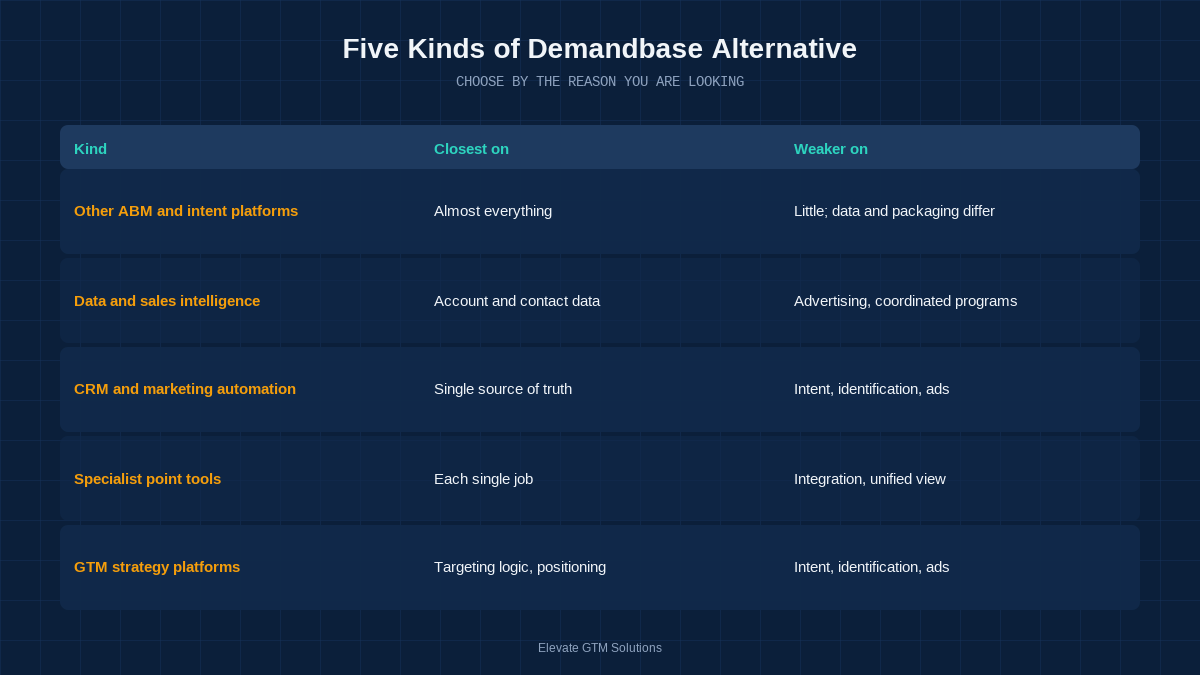
This guide takes a different route. Instead of ranking products, it sorts the alternatives into five kinds, explains what each kind does well and badly, describes who tends to prefer it, and gives you a way to decide using your own situation. It names vendors as examples of each kind, with one-line descriptions that are the vendors' own or general knowledge, and it asks you to check current details on their sites. Products change quickly, and several in this market have merged or changed ownership recently.
We make a GTM strategy platform, and we compare ourselves with Demandbase on a separate page, so we have a stake here. We say where Elevate GTM Solutions does and does not fit. We use no invented customer quotes, no made-up scores and no benchmark numbers. Examples are labeled as invented.
What is the best alternative to Demandbase for a mid-size B2B company?
There is no single best one, because the right alternative depends on why you are leaving or looking. If you want account-based marketing with intent data and advertising at lower cost or less complexity, look at other account-based platforms such as 6sense or the ABM tools inside larger marketing suites. If you mainly need contact and company data and outreach, look at data and sales intelligence tools such as ZoomInfo or Apollo. If your marketing and CRM already live in one system, check what an extension of HubSpot or Salesforce can do before buying a separate platform. If your problem is the strategy behind the targeting, such as who to pursue, what to say and how to position, a GTM strategy platform such as Elevate GTM Solutions addresses that layer, though it is not a like-for-like replacement for Demandbase's advertising and intent features. Many mid-size teams do best by choosing the smallest tool that does the job they actually do.
Is there a cheaper Demandbase alternative? Often, but cost depends on scope. A smaller tool that does less costs less. Compare the same set of jobs, not list prices.
Can a CRM replace it? For some teams, partly. It depends on whether you need intent data, advertising and account scoring at scale.
First, what Demandbase is, so you know what you are replacing
Demandbase describes itself as an AI-powered go-to-market intelligence platform. According to its own descriptions, it combines account intelligence, business-to-business advertising, sales intelligence and AI agents. It acquired Engagio, an account-based marketing company, in 2020. Details of its current packaging change, so check its site.
In practice, teams use it for some mix of these jobs:
| Job | What it means |
|---|---|
| Account identification | Recognize which companies are visiting your site or showing interest |
| Intent and engagement signals | Detect which target accounts are researching topics related to your product |
| Account scoring and selection | Rank accounts by fit and readiness |
| Targeted advertising | Show ads to chosen accounts |
| Sales alerts and orchestration | Tell sellers which accounts are heating up and what to do |
| Reporting | Show how target accounts progress and what they influence |
When you look for an alternative, list which of these your team actually uses. A common finding is that a team pays for six jobs and uses two. If that is you, the best alternative may be something smaller.
Why mid-size companies look elsewhere
These reasons come up often. Seeing which fits you helps narrow the field.
Cost relative to value. Enterprise platforms price for large teams. A mid-size company may feel it pays for capability it does not use.
Complexity and setup. Getting full value from an account-based platform takes configuration, data hygiene, integration work and often a dedicated person. A team without that person may under-use it.
Team readiness. Account-based programs depend on sales and marketing agreeing on a target list and acting on signals together. Without that, the platform's signals go nowhere.
Data fit. Intent and identification data vary in quality by region, industry and company size. Some teams find the data less useful for their market.
A different primary need. A team may realize its problem is targeting and messaging, or outbound data, not advertising.
Contract or renewal timing. Many searches start two or three months before a renewal. That is a good time, because you have leverage and time to run a proper trial.
Change in the market. Vendors merge, get acquired or change focus. For example, Terminus, another account-based marketing vendor, merged into DemandScience in November 2024. A change in a vendor's direction can prompt a review.
If you cannot name your reason in one sentence, write it down before you read the rest. The list that follows is much less useful without it.
Five kinds of alternative
1. Other account-based marketing and intent platforms
These do broadly the same job: identify accounts, score intent, support advertising and alert sellers.
Examples: 6sense is the best-known direct competitor. Other account-based marketing tools exist, and some larger marketing suites include account-based modules. Check each vendor's current site for what it offers.
Strengths. Closest like-for-like replacement. Your team's skills and processes carry over. You can compare the data on a real list of your own accounts.
Weaknesses. If your problem is cost, complexity or unused features, a like-for-like swap may not fix it. Switching costs are real: re-integration, retraining and rebuilding audiences.
Fits when. You use most of the platform's features, you are unhappy with price, data or support, and you want to keep the same approach.
How to compare. Run both on the same list of accounts for a defined period and compare identification accuracy, intent signal usefulness and how many alerts sellers actually acted on. See our Elevate vs 6sense comparison for a related view.
2. Data and sales intelligence platforms
These focus on company and contact data, sometimes with outreach tools and signals. They tend to be built for sellers more than for marketing programs.
Examples: ZoomInfo and Apollo are widely used. Apollo describes itself as an AI sales platform with a free plan after a trial, though details change. See Elevate vs ZoomInfo and Elevate vs Apollo.
Strengths. Strong when the main need is accurate contacts, firmographics and a way to reach people. Usually simpler to adopt for a sales team. Pricing models vary and some start low.
Weaknesses. Less built for coordinated marketing and advertising to chosen accounts. Data accuracy varies by market, so test it. Contact data comes with consent and compliance duties that you must handle.
Fits when. Your team is outbound-led and mainly needs data and a way to act on it, and you did not rely on the advertising features.
3. Your CRM and marketing automation system
Many mid-size companies already own a CRM with marketing tools. Before buying a separate platform, check how far the system you have can go.
Examples: HubSpot and Salesforce, with their respective marketing and sales tools. See Elevate vs HubSpot, alternatives to HubSpot for GTM strategy and GTM platform vs CRM.
Strengths. One system, one source of truth, fewer integrations, often lower total cost. Good for teams with a modest list of target accounts and straightforward programs.
Weaknesses. Account identification, intent data and account-based advertising usually need add-ons or partners. Reporting on account progress can take effort to set up.
Fits when. Your target list is small, your programs are simple and you want to start with what you have. A well-run CRM often beats a poorly used platform.
4. Specialist tools for single jobs
Some teams do better by assembling a few focused tools than by buying a suite. Examples include a visitor identification tool, an intent data provider, an advertising platform that supports account lists, a revenue intelligence tool for sales calls and a data orchestration tool for enrichment and workflows.
Strengths. You pay for what you use and can swap parts. Each tool can be best in its category.
Weaknesses. More integration work, more vendors, more places for data to disagree. Someone has to run the stack. See our guide to unified platforms versus point solutions.
Fits when. You have operations capability, a clear picture of the single job each tool will do and the patience to integrate.
5. GTM strategy platforms
This kind addresses the layer before and around account-based execution: who to target, what segments to prioritize, how to position, what to say, how to price and how to align teams. It does not primarily supply intent data or run advertising.
Examples: Elevate GTM Solutions is one. See our comparison of Elevate and Demandbase for details on how they differ.
Strengths. Useful when the weak link is strategy rather than signals: unclear ideal customer, generic messaging, misaligned teams or a plan that lives in slides. Can pair with an execution tool.
Weaknesses. Not a replacement for intent data, identification or account-based advertising. If those are what you use Demandbase for, you will need something else for them.
Fits when. Your problem is deciding and aligning, not detecting and advertising. Or when you realize that better signals have not helped because you do not agree on whom to target.
A side-by-side view
| Kind | Closest to Demandbase on | Weaker than Demandbase on | Often cheaper or simpler? |
|---|---|---|---|
| Other ABM and intent platforms | Almost everything | Little; differences are in data and packaging | Not necessarily |
| Data and sales intelligence | Account and contact data, sales alerts | Advertising, coordinated programs | Often, depending on scope |
| CRM and marketing automation | Reporting, single source of truth | Intent, identification, advertising | Often, if you already own it |
| Specialist point tools | Each single job | Integration, a unified view | Depends on how many you stack |
| GTM strategy platforms | Segmentation and targeting logic, positioning | Intent, identification, advertising | Different job; compare as a complement |
How to choose: a seven-step method
Step 1: write your reason. One sentence on why you are looking. "We pay too much for features we do not use" leads to a different search from "our data is poor in Europe."
Step 2: audit what you use. For each job in the earlier table, answer: do we use it weekly, rarely or never? Pull usage data if the platform provides it. Ask sellers and marketers directly.
Step 3: list the jobs you cannot lose. These are your must-haves. Everything else is negotiable.
Step 4: check readiness. Do you have a shared target account list, an agreed process for acting on signals and someone who owns the platform? If not, a new platform will not fix it, and may be the wrong thing to buy.
Step 5: pick one or two candidate kinds, not ten vendors. The kinds above are more useful than a long list. Choose the ones that match your reason and must-haves.
Step 6: run a fair test. Use your own accounts and your own team for a set period, usually a few weeks. Agree on pass criteria in advance. See below.
Step 7: model the total cost. Include licenses, integration, training, data fees, the person who runs it and the cost of switching. Our AI GTM platform pricing guide lists the cost items that often sit outside a quote.
How to run a fair test
Vendor demos use clean data and friendly examples. A fair test uses yours.
Use a real list. Take two hundred or so of your own accounts, including ones you know well, so you can judge the answers.
Check identification accuracy. For companies you know visited, did the tool identify them? Were there false positives?
Check intent usefulness. Do the signals match what sellers see in real conversations? Ask three sellers to rate a sample of alerts as useful, neutral or noise.
Check data in your region and segment. Accuracy often differs by geography and company size.
Check integration. Does it write to your CRM in the way you need? Test with a small, low-risk set of records. See GTM platforms that integrate with Salesforce for how field mapping can fail.
Check effort. How long did setup take? How many hours per week does it need once running?
Write down pass criteria first. For example, "sellers act on at least half the alerts" or "identification is right for most known visitors." The wording is yours. The point is to decide before you see the results.
What to ask any vendor, including us
- Which of our current jobs does your product do, and which does it not?
- What does it cost for our size, including everything outside the quote?
- How is your data sourced, how often is it refreshed and how do you measure accuracy for companies like ours?
- What does implementation involve, and who does the work?
- What does a typical team need to staff to run it?
- What are the contract terms: length, renewal, price changes, exit and data return?
- What do customers like ours say, and can we speak to one?
- Which integrations are native, and which require middleware?
Our questions to ask AI GTM vendors goes further. For governance questions, see the GTM platform governance checklist.
Switching without losing your footing
If you decide to move, a few precautions help.
Time it with the renewal. Start at least a quarter early. Leave room to negotiate, including a shorter extension if you need more time.
Export your data. Ask what you can take with you: account lists, scores, audience definitions, history. Confirm the format and the timeline in writing.
Run in parallel briefly. Overlap for a month or so if you can afford it, so you can compare and avoid gaps.
Plan the rebuild. Audiences, rules and dashboards will need to be recreated. Budget time.
Retrain and communicate. Sellers and marketers need to know what is changing and why.
Keep the lessons. Whatever tool you use next, the knowledge of which accounts matter, which signals mattered and which messages worked belongs to you.
Common situations and likely answers
These are tendencies, not rules, and the examples are invented.
A 150-person software company with two marketers, a ten-person sales team and a named list of 300 target accounts. Probably needs less platform than a full account-based suite. Check the CRM first, consider a data tool for contacts, and add intent data only if sellers prove they will use it.
A 400-person company with a dedicated marketing operations lead, a large target list and a real advertising budget aimed at accounts. Likely to get value from a full account-based platform. A like-for-like comparison, including data quality on its own accounts, makes sense.
A company with a good platform but poor results. Look at strategy and alignment before blaming the tool. Do sales and marketing agree on the list? Is the message specific? Does anyone act on signals? A different platform will not fix those.
A company expanding into a new region. Test data coverage in that region before committing. Accuracy can differ a lot.
A company with a small outbound team and little marketing support. Probably better served by data and sales intelligence plus a strategy layer than by account-based advertising.
Mistakes teams make
Choosing by list of logos. Big names are not the same as fit.
Skipping the usage audit. You may be replacing a tool you under-use with another you will also under-use.
Comparing price lists instead of total cost.
Testing on the vendor's data. Use your own accounts.
Buying for the team you hope to have. Buy for the team you have, with room to grow.
Ignoring the people factor. A platform needs an owner. If nobody owns it, results suffer whatever you buy.
Leaving strategy out. If sales and marketing do not agree on whom to target, more signals only create more arguments.
Underestimating switching costs. Rebuilding audiences and retraining people takes real time.
Believing a single comparison page. That includes this one. Verify against current vendor sites and a trial.
What to expect in the first ninety days with a new platform
Whichever kind you choose, the first quarter decides whether the switch pays off. A plan with a shape keeps the team honest.
Days one to thirty: connect and clean. Connect the CRM, load the target account list and agree on the definitions that matter: which accounts are in scope, what counts as an engaged account and what a seller should do with an alert. Expect most of the time to go on data cleanup. If account records are duplicated or owners are missing, the new tool will inherit the mess. Fix the worst of it before turning anything on for sellers.
Days thirty-one to sixty: start small. Switch on one use case for one team. For example, send sellers an alert when a top-tier account shows a defined level of activity, with a written suggestion for what to do. Keep a simple log of which alerts led to action and what happened. Resist the urge to switch on every feature at once. A team that gets ten kinds of notification ignores all ten.
Days sixty-one to ninety: review against your pass criteria. Compare the results with the criteria you wrote before the trial. Did sellers act on the alerts? Did the accounts you reached move further through the pipeline than comparable accounts you did not reach? Were there data problems that need the vendor's attention? Decide what to expand, what to fix and what to drop.
The same discipline applies if you stay with Demandbase. Many teams that think the platform has failed have actually never defined a use case small enough to test.
Questions to ask your own team before you ask any vendor
Vendors are good at answering the questions you ask. These are the ones that tend to expose the real issue.
- When did a seller last change what they did because of an alert from this platform? What was it?
- Which three reports do we actually open each month?
- Who is the person who knows how this platform is configured, and what happens if they leave?
- If we turned off advertising to target accounts tomorrow, what would we lose, and would we notice within a quarter?
- Do sales and marketing agree on the target account list today, in writing?
- If we could keep only two of the six jobs in the first table, which two would they be?
Teams that cannot answer the first question usually have an adoption problem, which no vendor switch will cure. Teams that answer it clearly usually have a short list of must-haves, which makes the comparison much easier.
How the commercial side tends to work
Pricing for platforms in this category is often quoted by account volume, feature bundle and contract length, and it varies by customer. We do not give figures here because we cannot verify what a particular company would be charged. A few patterns are worth knowing before a conversation with any vendor.
Multi-year commitments can lower the annual price and raise the exit cost. If you are unsure about fit, ask for a shorter term, even at a higher annual price, and compare the total.
Bundles hide usage. A suite price may cover modules you will not use. Ask for a price by module and for what happens if you drop one at renewal.
Renewal uplifts are common. Ask what the price will be in year two and year three, and get it in writing.
Data and advertising spend can sit outside the license. Ask whether media spend, data credits or extra seats are extra.
Switching costs are real on both sides. A vendor that knows you are unlikely to leave has less reason to give you a good price. A credible evaluation of alternatives, started early, is the strongest negotiating tool a buyer has.
What would make us wrong
It is worth saying where this guide could mislead you. Vendor products change often, and descriptions here reflect general positioning rather than a feature-by-feature review. Some of the firms named have merged or changed focus in the last two years, and others may by the time you read this. Your market, region and account list may behave differently from the cases we describe. And our own product sits in one of the five kinds, so we have an obvious interest in the fifth. Use the method here, the usage audit, the readiness check and the fair test, rather than our conclusions about any vendor.
Glossary
Account-based marketing (ABM). Focusing marketing and sales effort on a chosen list of accounts instead of a broad audience.
Intent data. Signals suggesting an account is researching topics related to your product.
Account identification. Recognizing which company is behind an anonymous visit or interaction.
Firmographics. Facts about a company, such as size, industry and location.
Sales intelligence. Data and tools that help sellers find and understand prospects.
Revenue intelligence. Tools that analyze sales activity and conversations to improve forecasting and coaching.
Orchestration. Coordinating the steps of an automated workflow across tools.
Point solution. A tool built for one specific job.
Unified platform. A product that covers several jobs on a shared set of data and logic.
Total cost of ownership. The full cost of a tool, including licenses, integration, staff time and switching.
Ideal customer profile (ICP). A description of the companies and people most likely to buy and succeed with your product.
Target account list. The named accounts a team has agreed to pursue.
Where Elevate GTM Solutions fits
Elevate GTM Solutions describes itself as an AI GTM platform for enterprises to create, execute, optimize and scale go-to-market strategies. Its homepage lists modules including "ICP & Segmentation," "Competitive Intelligence," "Account-Based Marketing," "Product Positioning," "Product Messaging" and "Unified GTM Strategy," and says "15 connected GTM modules" while naming sixteen, so count what you see when you look. It also lists the use case "Win against a dominant competitor," and publishes a comparison with Demandbase.
How it relates to the question in this guide: Elevate sits in the fifth kind above, the strategy layer. It is built to help decide whom to target, what to say and how to align teams around one plan. It is not built to replace the identification, intent and advertising features that Demandbase offers, and we would not tell a team that depends on them to drop them. A team may use a strategy platform to sharpen its targeting and messaging, then use an execution tool to act. Another team may find that the strategy work was what it needed and that it was paying for signals it did not act on.
Pricing listings we reviewed, from Software Advice and Capterra, show Elevate plans starting at monthly subscription tiers, and also one-time modules and a guided program. We read pricing from third-party listings and not from the company's own pricing page, so confirm current prices with the company. See Elevate vs Demandbase for the direct comparison and what Elevate GTM Solutions is.
What to do this week
- Write one sentence on why you are looking for an alternative.
- List each job your current platform does, and mark each as weekly, rare or never used.
- Name your must-have jobs.
- Check your readiness: shared target list, signal process, platform owner.
- Choose one or two kinds of alternative, not a long vendor list.
- Prepare a test list of about two hundred of your own accounts and write your pass criteria.
- Find your renewal date and work back to a start date for the evaluation.
Key takeaways
- The best alternative depends on why you are leaving. Write the reason first.
- Sort alternatives into five kinds: other ABM and intent platforms, data and sales intelligence, your CRM and marketing automation, specialist point tools and GTM strategy platforms.
- Audit what you really use. Many teams pay for six jobs and use two.
- A strategy platform is a different layer, not a like-for-like replacement for intent and advertising features.
- Test on your own accounts, with pass criteria written in advance, and model total cost.
- Time the move with your renewal, protect your data and plan the rebuild.
Sources
- Demandbase: the company's description of its platform as an AI-powered go-to-market intelligence platform with account intelligence, advertising, sales intelligence and AI agents. Packaging and features change, so check the current site.
- 6sense, ZoomInfo, Apollo, HubSpot and Salesforce: named as examples of each kind, with descriptions based on the vendors' general positioning. Confirm current details with each vendor.
- Elevate GTM Solutions: homepage descriptions of modules and use cases. Plan prices referenced here come from third-party listings on Software Advice and Capterra and should be confirmed with the company.
- Terminus merged into DemandScience in November 2024, and Demandbase acquired Engagio in 2020, per public announcements. Verify against current sources.
- The five kinds, the seven-step method and the test design reflect common practice and our judgment. Examples are invented for illustration. We cite no benchmark figures or customer quotes.
Frequently Asked Questions
What is the best alternative to Demandbase for a mid-size B2B company?
It depends on why you are looking. For a like-for-like account-based platform, 6sense is the best-known competitor. For data and outreach, tools such as ZoomInfo or Apollo fit. For simpler needs, an extension of your CRM may do. If the gap is strategy and targeting logic, a GTM strategy platform addresses that layer.
Is there a cheaper alternative to Demandbase?
Often, but compare the same set of jobs and the total cost, including integration, data fees and the person who runs it. A cheaper tool that does less may leave you buying other tools. Usage audits often show you can drop features you do not use.
Why do companies leave Demandbase?
Common reasons are cost relative to value, setup and staffing needs, data quality in a particular region or segment, a different primary need and renewal timing. Some also reconsider when sales and marketing have not aligned on a target list, so signals go unused.
Can HubSpot or Salesforce replace Demandbase?
For some teams, partly. A CRM and marketing system can handle a modest target list and straightforward programs. Intent data, account identification and account-based advertising usually need add-ons or partners, so check which of those you rely on.
What does Demandbase do?
It describes itself as an AI-powered go-to-market intelligence platform that combines account intelligence, business-to-business advertising, sales intelligence and AI agents. Teams typically use it to identify accounts, track intent, select targets, advertise to them and alert sellers.
How do I compare Demandbase with 6sense?
Run both on the same list of your own accounts for a set period. Compare identification accuracy, usefulness of intent signals and how many alerts sellers act on. Check integration with your CRM, setup effort and total cost, not just list price.
Is Elevate GTM Solutions a Demandbase replacement?
Not like for like. Elevate focuses on the strategy layer: ideal customer and segmentation, positioning, messaging and alignment. It does not primarily supply intent data or run account-based advertising. A team might use it alongside an execution tool or find that strategy was the real gap.
How long does it take to switch from Demandbase to another platform?
It depends on integrations, audiences and training. Start the evaluation at least a quarter before renewal, run in parallel briefly if possible, export your data in advance and budget time to rebuild rules, audiences and dashboards.
What should I test before switching?
Use about two hundred of your own accounts. Check identification accuracy, usefulness of intent signals as rated by sellers, data quality in your regions and segments, CRM integration and the hours per week the tool needs. Write pass criteria before you see results.
Do I need an account-based platform at all?
Not always. If your target list is small, your programs are simple and your CRM can track accounts, you may not. If you have a large list, real advertising spend aimed at accounts and operations support, a platform can pay off. Check your readiness first.
What happened to Terminus?
Terminus merged into DemandScience in November 2024, according to public announcements. If you used it, confirm current product and support arrangements with the vendor.
How much does Elevate GTM Solutions cost?
Third-party listings show monthly plans, one-time modules and a guided program, but we have not read the company's own pricing page. Confirm current prices and terms with the company before you decide.