
By the Elevate GTM Solutions Team · Updated November 13, 2026 · 27 min read
Which GTM Platform Supports Your Industry and Product Category? What "Industry-Specific" Should Mean and How to Test It
A vendor says its platform supports seventy industries and hundreds of product categories. The claim sounds reassuring, and it should prompt a question: what does support mean? A list of industries on a website could mean a dropdown menu, a library of tailored templates, a model trained on industry material or a team that has worked in the field. Those are very different things, and the difference matters when you are a bank, a cybersecurity vendor or a manufacturer with a six-month sales cycle and a compliance team that reads every claim.
This guide explains what industry-specific go-to-market actually involves, how industries differ in ways that change strategy, what to ask a platform vendor, how to test industry support in an afternoon, what a good result looks like and where generic tools fall short. We make a GTM strategy platform, Elevate GTM Solutions, whose homepage lists industries and product categories, so we have an interest, and we explain what our own claims do and do not mean in a clearly marked section. We cite no statistics, we describe other vendors in general terms and our examples are invented and labeled.
Which GTM platform supports your industry and product category?
No honest answer can name one platform for every industry, so the useful question is how to tell whether a given platform supports yours. Industry support should show up in four places: the platform asks about the factors that matter in your industry, such as regulation, buying committee, sales cycle and proof requirements. It produces segments, positioning and messaging that reflect how buyers in your industry talk. It lets you adapt a strategy for an industry or product category without starting over. And it is honest about what it cannot know, leaving industry-specific facts and compliance review to you and your experts. Test this with a real product from your industry, in a trial or a demo, and judge the output with someone who knows the field.
Does a long list of industries prove support? No. A list shows breadth of intent. Test depth with your own product.
Who should judge the output? A seller, marketer or product lead who knows your industry and its buyers.
The short version
| Question | Answer |
|---|---|
| What should industry support mean? | Relevant questions, industry-aware output, easy adaptation and honesty about limits |
| Does a long industry list prove it? | No. It shows breadth, not depth |
| How do industries differ in GTM? | Buying committees, regulation, cycles, proof, channels, language and risk tolerance |
| How do you test a platform? | Use a real product from your industry and have an expert judge the output |
| What cannot a platform know? | Your specific customers, local regulation details and recent events, unless provided |
| What if my category is unusual? | Provide more context and expect more review |
| What is a warning sign? | Generic output with the industry name swapped in |
| What should you do first? | List the five ways your industry's buyers differ from a generic buyer |
Why industry matters in go-to-market
A generic strategy template treats a bank, a hospital and a retailer as if they bought software the same way. They do not. Several dimensions differ in ways that change what you should say and do.
Buying committee. Who is involved, how many people and which functions have veto power. Security, compliance, procurement and clinical or operational leads carry different weight in different industries.
Regulation and compliance. Some industries require certifications, audits, data residency or specific language in contracts and marketing. The cost of a wrong claim varies.
Sales cycle and process. Cycle length, procurement steps, pilot expectations and budget calendars differ.
Proof requirements. What counts as credible: peer references in the same industry, independent validation, case studies with named customers or demonstrations on real data.
Channels. Where buyers look for information and who influences them: trade bodies, conferences, analysts, resellers, consultants or direct outreach.
Language. Terms of art differ, and a message that sounds fluent in one industry sounds foreign in another.
Risk tolerance. Some buyers move early and others wait for peers to prove a product.
Economics. Typical deal sizes, pricing norms and contract structures vary.
A platform that ignores these will produce output that reads smoothly and misses what matters. See how to move upmarket from SMB to enterprise and how to enter a new market without wasting budget.
Industry and product category are different things
Two terms are easy to blur.
Industry is where your customers operate: banking, healthcare, manufacturing, retail, telecommunications.
Product category is what you sell: a security tool, an analytics platform, a payments service, a logistics system.
Your go-to-market depends on both. A security product sold to banks differs from the same product sold to retailers, and a payments product sold to retailers differs from an analytics product sold to the same retailers. When you test a platform, include both: your category and the industries you target. A platform that handles your category in general and none of your target industries, or the reverse, covers only half the job.
What industry support should look like in practice
1. The platform asks about industry-relevant factors
During setup, a good platform asks more than your industry name. It asks about regulation, buyer roles, sales cycle, proof expectations and channels, or lets you supply them. If the only industry input is a dropdown, expect generic output.
2. The output reflects how your buyers talk
Positioning and messaging should use language that sounds right to people in your industry, and should address concerns they actually have. A message for hospital administrators should not read like one for software startups.
3. It is easy to adapt across industries
Most companies sell into several industries. A platform should let you hold a core strategy and adapt it for each industry, changing the audience, language, proof and compliance points without rebuilding. See how to align messaging, ICP and outreach across regions and verticals.
4. It is honest about limits
No platform knows your customers or the latest regulation in your jurisdiction. A good one makes it clear what it is inferring and what you must verify. Compliance-sensitive claims need review by your own experts.
5. Your experts can edit it easily
The output is a starting point. The platform should make it easy for an industry expert to correct and extend it, so that the corrections become part of the context.
How industries differ: a general guide
The table below gives general patterns for the industries named on our homepage. These are broad tendencies, not rules or statistics, and your market may differ. Use them as prompts for what to check, not as facts.
| Industry | Things that often shape GTM | What to check in your case |
|---|---|---|
| Cybersecurity | Skeptical technical buyers, proof of efficacy, competitive noise, trust and credibility | Who evaluates technically, what independent validation buyers expect |
| B2B SaaS | Many alternatives, product-led and sales-led mixes, fast-moving competition | Which motion fits your segment, how buyers compare options |
| AI and data platforms | Fast change, claims scrutinized, data governance concerns | How buyers judge claims, what data and security questions arise |
| Telecommunications | Long cycles, large deals, complex procurement, integration with legacy systems | Procurement process, integration requirements, partner roles |
| Banking and financial services | Regulation, risk and compliance reviews, security scrutiny, long cycles | Which reviews apply, what claims are permitted, who holds veto power |
| Fintech and payments | Regulation, partner ecosystems, integration with banks and processors, trust | Which regulators and partners matter, integration expectations |
| Insurance | Regulation, legacy systems, conservative buying, distribution channels | Channel structure, legacy integration, compliance constraints |
| Healthcare and life sciences | Clinical and compliance stakeholders, privacy rules, long evaluations | Who influences purchases, privacy and validation requirements |
| Manufacturing and industrial | Operational focus, long equipment cycles, distributors, on-site realities | How decisions are made at plant and corporate level, role of distributors |
| Logistics and supply chain | Thin margins, operational pressure, integration with carriers and systems | Pain points tied to cost and service, integration needs |
| Retail and ecommerce | Seasonality, fast decisions, margin pressure, many vendors | Buying calendar, how results are judged, decision speed |
| Professional services | Partner-led decisions, utilization focus, relationship-driven buying | Who decides, how value is judged, role of reputation |
Treat each row as a starting list of questions. Your own customers will tell you which apply.
Questions to ask a platform vendor
Use the same list for every vendor and write down the answers.
| Question | What a good answer sounds like |
|---|---|
| What does "supports our industry" mean in your product? | A specific description: inputs asked, outputs adapted, examples, not just a list |
| What does the platform ask about industry factors? | Regulation, buyer roles, cycle, proof, channels, or ways to supply them |
| Can we see output for a product like ours in our industry? | A live demonstration using our context, not a prepared example |
| How do we adapt one strategy across several industries? | A clear mechanism for core and variants |
| How do experts on our side correct and extend the output? | Easy editing, with corrections retained as context |
| What do you not know about our industry? | Honest limits, and a statement that compliance review is ours |
| How do you handle regulated claims? | A process for flagging, and acknowledgment that review is the customer's responsibility |
| Which customers in our industry use you, and what do they do with it? | Specific references or a clear statement of what is available |
| How does the platform handle an unusual product category? | Guidance on providing more context and expecting more review |
A vendor who can answer these plainly, including the limits, is more likely to be describing something real.
A test you can run in an afternoon
Use a trial or demo, and a real product.
Step one: choose a product and an industry you know well. Ideally one where you have won and lost deals, so you can judge output against experience.
Step two: provide specific context. Describe the product, the target buyers in that industry, the main alternatives, the common objections and the regulatory or buying-process factors you know about.
Step three: generate a strategy and read it with an expert. Ask a seller or marketer who knows the industry to mark what is right, what is generic and what is wrong.
Step four: check the language. Would buyers in the industry say these words? Replace the industry name with another and see whether the message still reads the same. If it does, the output is generic.
Step five: adapt for a second industry. Create a variant and note what changes. Does it change the audience, concerns, proof and language, or only the name?
Step six: probe the limits. Ask a question about a regulation or a niche you know well. Look for honesty about what the platform cannot know.
Step seven: score the result. Rate each step as strong, partial or weak, and record specific examples.
If the platform's output only improves when you rewrite it yourself, you have learned something useful about how much work remains.
What good looks like and what bad looks like
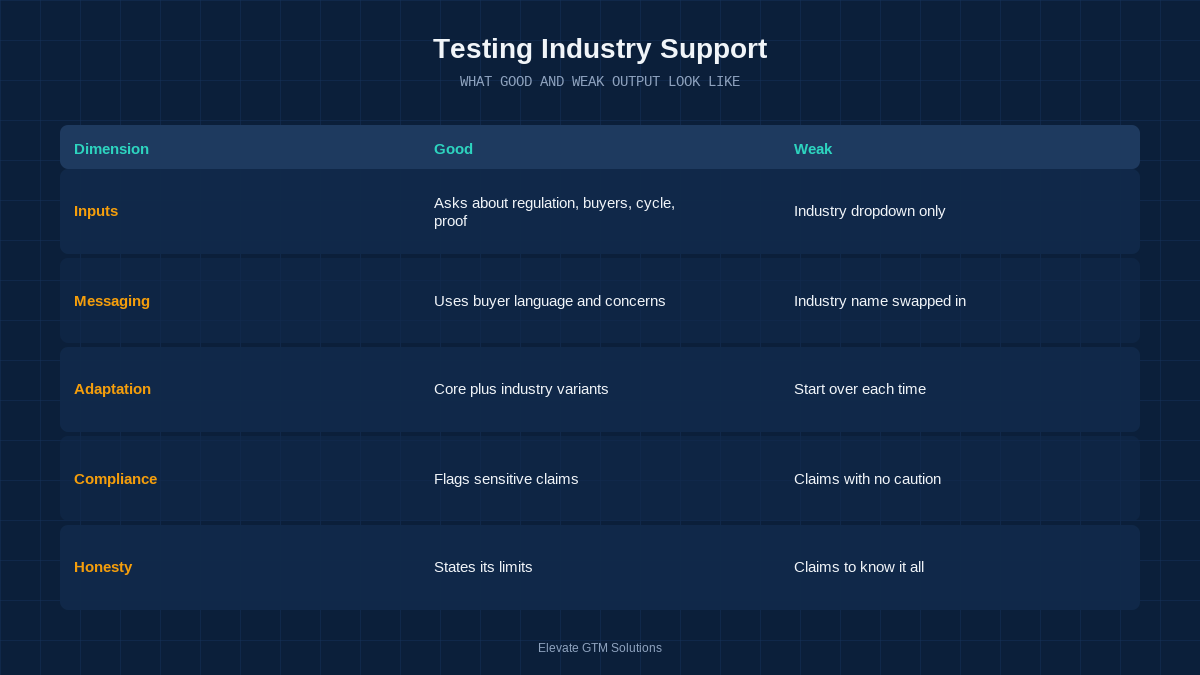
| Dimension | Good | Bad |
|---|---|---|
| Inputs | Asks about regulation, buyer roles, cycle, proof, channels | Only an industry dropdown |
| Segments | Reflect industry structure, such as sizes, sub-sectors or regulatory classes | Generic firm-size segments |
| Messaging | Addresses real industry concerns in industry language | Same message with the industry name replaced |
| Proof | Suggests proof types buyers in that industry trust | Generic case studies |
| Compliance | Flags sensitive claims and leaves review to you | Makes claims with no caution |
| Adaptation | Core plus industry variants | Separate starts each time |
| Honesty | States limits | Claims to know your industry fully |
Unusual or new product categories
If your category is new or unusual, no platform will have much prior material about it. That is not disqualifying, and it changes what you should expect.
Provide more context. Describe the problem you solve, the existing alternatives buyers use today and how buyers currently talk about the issue.
Expect more review. The output will lean more on your inputs and less on patterns from similar products. Check it harder.
Use analogies carefully. Comparing your category to an established one can help buyers, and can also mislead them.
Validate with buyers early. In a new category, language and positioning are less settled, so conversations matter more.
See positioning and can AI build a full GTM strategy in minutes.
Regulated industries: extra care
If you sell into banking, insurance, healthcare or other regulated sectors, treat any platform's output as a draft that needs compliance review.
- Claims about performance, security or outcomes may be restricted or require substantiation.
- Language about data handling and privacy may need legal approval.
- Marketing to certain buyers may carry rules about content and disclosures.
- Customer references may require permissions.
This is not legal advice. Involve your own legal and compliance specialists, and agree how review will work before you scale content. A platform can speed up drafting and consistency. It cannot take on your compliance responsibility.
A worked example, invented for illustration
Imagine a company of about sixty people selling fraud detection software. The details are invented.
The company sells to banks, fintech firms and insurers. The head of marketing is evaluating platforms and runs the afternoon test with the bank segment. She provides context: the product, the buyers (a fraud operations lead, a chief information security officer and a procurement team), the main alternatives, the usual objections about integration with legacy systems and model explainability and the fact that every claim goes through a compliance review.
The first platform produces a clean strategy that talks about "financial institutions" generally, with messaging about speed and accuracy. When she replaces "banks" with "retailers," the messaging barely changes. A fraud operations lead who reviews it says it reads like marketing for any software.
The second platform asks about regulation and the buying committee during setup, produces segments by institution size and regulatory exposure and writes messaging that addresses explainability and integration directly, with proof suggestions such as independent validation and peer references. When she creates an insurer variant, the audience, concerns and proof change. It flags performance claims as needing substantiation. The fraud lead still edits several passages but says the structure is right.
She chooses the second, not because it knows banking better than she does, but because it asked the right questions, adapted structurally and was honest about what it could not verify. She plans a compliance review step before any asset is published.
Notice that the test used her own knowledge as the standard, and that the platform's honesty about limits was part of the score.
Common mistakes
Trusting the industry list. Test depth with your own product.
Testing with a toy example. Use a real product and real context.
Skipping an expert reviewer. Someone who knows the industry must judge.
Ignoring compliance. In regulated industries, plan review from the start.
Treating industry and category as one thing. Test both.
Expecting the platform to know your customers. Provide your own evidence.
Accepting generic output. If swapping the industry name changes nothing, the output is generic.
Forgetting adaptation. Most companies serve several industries, so test variants.
Questions to ask yourself
- Which five factors make my industry's buyers different from a generic buyer?
- Which industries and product categories do I need covered now?
- Who on my team can judge the output for each industry?
- Which claims in my industry need compliance review?
- Do I need a core strategy with industry variants?
- What proof do buyers in my industry trust?
- What would make me reject a platform's output?
- How much of my industry knowledge am I willing to supply as input?
An industry brief you can fill in
Whatever platform you use, a short written brief for each industry you target makes the output better and gives your team a shared reference. Keep it to a page.
| Field | What to write |
|---|---|
| Industry and sub-segment | For example, regional banks, or hospital networks above a certain size |
| Typical buyers and roles | Who initiates, who evaluates, who approves, who can block |
| Main problems we solve | In the words buyers use |
| Alternatives they use today | Competitors, internal tools, doing nothing |
| Regulation and compliance factors | What reviews apply, what claims are restricted |
| Typical sales process | Steps, pilots, procurement, approximate timing |
| Proof they trust | References in the industry, independent validation, demonstrations |
| Where they look for information | Trade bodies, events, analysts, peers, partners |
| Common objections | The top three and the honest answers |
| Language to use and avoid | Terms buyers use, and terms that sound off |
| Open questions | What we do not know yet |
Fill in what you know, mark what you believe and list what you do not know. The last row is the most valuable, since it tells you what to learn from the first conversations in the industry. Feed the brief to any platform as context, and keep it updated.
Choosing which industries to start with
Companies that sell into many industries are tempted to cover them all at once. A better approach is to start with one or two and build depth.
Look at your own evidence. In which industries do you win most often, retain best and grow accounts? Start where you already have proof.
Check the size of the reachable market. How many organizations in the industry fit your product and can be reached with your channels?
Consider the cost of entry. Regulation, certifications and integration requirements raise the cost. Be honest about what it will take.
Count your available expertise. Do you have someone who knows the industry, or can you hire or partner for it?
Think about references. One credible reference in an industry can open others. An industry with none is harder.
Pick the one or two industries where the evidence, the market and your expertise line up, and treat the rest as later phases. This is also how to use a platform well: depth in a few industries beats thin coverage of many.
Proof, by type, and where industries differ
Proof is one of the largest differences between industries, so it deserves its own look.
| Type of proof | Where it tends to matter most | Cautions |
|---|---|---|
| Named customer references | Conservative or regulated industries where peers influence decisions | Needs permission, and references in the same industry carry more weight |
| Case studies with specific outcomes | Most industries | Avoid vague results. Only claim what you can substantiate |
| Independent validation or certification | Security, finance, healthcare | Verify current status before mentioning it. State no certification you do not hold |
| Live demonstration on real data | Technical buyers and complex products | Needs preparation and a safe environment |
| Pilots or proofs of concept | Long-cycle, high-stakes purchases | Define success criteria and timelines in advance |
| Analyst or peer recognition | Buyers who rely on third-party views | Do not overstate what a listing or review means |
| Trial or free tier | Product-led motions | Make the first success quick |
When you provide context to a platform, state which proof you actually have, so that it proposes messaging you can back up. A message that implies a certification or reference you lack creates risk, in any industry.
Keeping industry knowledge current
Industries change: regulation shifts, new competitors appear, buyers' priorities move. A strategy built on last year's picture will slowly drift.
Name an owner for each industry. One person is responsible for keeping the brief current.
Capture what sellers hear. A short monthly note from sellers who work the industry, on new objections, new competitors and shifts in language.
Watch for triggers. A regulatory change, a major incident, a merger or a large competitor move can justify an out-of-cycle update.
Review the brief quarterly. Compare it with win and loss data and customer conversations, and update it.
Update the platform's context. When the brief changes, update the context in your tools so that new output reflects it. See how a GTM platform keeps strategy current as markets change.
Partners and channels by industry
In many industries, partners shape how products are bought: resellers, systems integrators, consultants, distributors and industry associations. If you sell through or alongside partners, include them in your industry brief.
Ask which partners influence purchases, what they need to sell or recommend your product, how they are compensated, what training and material they need and how their involvement changes the sales cycle. Partner motions differ across industries, so a platform test should include at least one partner-related scenario if partners matter to you. See how to build a partner and channel GTM strategy.
When a generic approach is good enough
Industry depth is not always necessary. If your product is sold horizontally to many industries with little difference in buying process, such as a general productivity tool, a generic strategy with light adaptation may be enough. If your product is bought by a function, such as finance or HR, in much the same way across industries, function-specific messaging may matter more than industry-specific messaging. The test is simple: do your wins and losses vary by industry for reasons other than chance? If not, do not add complexity.
Scoring sheet for comparing platforms by industry fit
If you evaluate more than one platform, a simple sheet keeps the comparison fair. Score each criterion from one to five and write a one-line reason.
| Criterion | Weight | Platform A | Platform B | Notes |
|---|---|---|---|---|
| Asks industry-relevant questions | 3 | |||
| Output reflects buyer language | 3 | |||
| Segments reflect industry structure | 2 | |||
| Suggests proof buyers trust | 2 | |||
| Flags sensitive claims | 3 | |||
| Adapts across industries | 3 | |||
| Easy for experts to edit | 2 | |||
| Honest about limits | 3 | |||
| Handles our product category | 2 |
Have two reviewers score independently, compare the differences and discuss the reasons. Pay attention to the highest-weight rows, and do not let a pleasing interface outweigh weak industry fit.
Mistakes that look like platform problems but are input problems
Sometimes the output is generic because the input was. Before blaming a platform, check that you gave it enough to work with.
- The product description is a paragraph of marketing language and not a plain account of what it does and does not do.
- The target buyer is described as a job title with no situation, such as "head of operations" with no mention of what keeps them up at night.
- Alternatives are missing, so the platform cannot position against anything.
- Regulation and compliance constraints were not mentioned.
- Proof you hold, such as references and validation, was not stated.
- The goal of the strategy was left vague.
Provide specific inputs, rerun the test and compare. If the output improves a great deal with better input, the platform is working as designed and your preparation was the limit. If it stays generic with good input, you have learned something about the platform.
Doing it in sequence: one industry well, then the next
A practical rollout for a company selling into several industries looks like this.
Weeks one and two: pick the first industry and write the brief. Choose where you have the most evidence. Fill in the industry brief, including open questions.
Weeks three and four: build and review. Create the strategy for that industry. Have an expert review it and mark what is wrong. Correct the context so the next output improves.
Weeks five to eight: test in market. Run a small set of conversations and outreach. Capture language, objections and proof that work.
Week nine: review and update the brief. Fold what you learned into the brief and the platform context.
Weeks ten onward: adapt for the second industry. Start from the core, create the variant and write its brief. Repeat the cycle, faster this time.
By the third industry, the team usually has a repeatable process, and the cost of each new industry falls.
What to do when your industry is not on any list
If your industry is not named by a vendor, do not assume it is unsupported, and do not assume it is supported either. Ask directly, and run the test. Many industries are variations of ones that are named: a niche manufacturer shares features with the broader manufacturing sector, and a specialty lender shares many traits with banking. Describe your situation in detail, point to the nearest named industry and note where yours differs. The platform's behavior with your input, and its honesty about what it cannot know, will tell you more than any list. If your industry has unusual regulation or a very small number of buyers, expect to supply more of the context yourself and to rely more on direct customer conversations.
Glossary
Industry. The sector in which your customers operate.
Product category. The type of product or service you sell.
Vertical. Another word for an industry segment targeted by a go-to-market effort.
Buying committee. The group of people involved in a purchase decision. See how big is a B2B buying group.
Core and variant. A shared strategy and its adaptations for an industry, region or segment.
Proof. Evidence buyers accept as credible.
Compliance review. Checking content and claims against applicable regulation and company policy.
Where Elevate GTM Solutions fits
Elevate GTM Solutions is an AI GTM platform for building, executing and evolving go-to-market strategy. Our homepage lists support for more than seventy industries and more than two hundred and fifty product categories, and names industries including cybersecurity, B2B SaaS, AI and data platforms, telecommunications, banking and financial services, fintech and payments, insurance, healthcare and life sciences, manufacturing and industrial, logistics and supply chain, retail and ecommerce and professional services.
In plain terms, those figures describe the range of industries and categories the platform can be used for, as our homepage states them. They are not a claim that the platform holds deep expertise in each, and they do not replace the afternoon test above. As we describe the product, you enter market, industry, product and segment details in GTM Insights, capture triggers and signals in Strategy Context and build a strategy in the Strategy Builder from fifteen modules or the Unified GTM option. Our homepage also describes adapting by region, vertical or segment.
What it does not do: it does not replace industry knowledge, customer evidence or compliance review, and the quality of the output depends on the context you provide. We suggest running the test described here with a real product, having an industry expert judge the result and confirming with us directly how industry and category are handled in your case. See what Elevate GTM Solutions is.
What to do this week
- List the industries and product categories you need covered now.
- For each industry, write the five ways its buyers differ from a generic buyer.
- Choose one product and one industry for a test.
- Gather the context: buyers, alternatives, objections, regulation and proof.
- Line up an expert to review the output.
- Prepare the questions for each vendor from the table above.
- Run the afternoon test, including an adaptation for a second industry.
- Decide how compliance review will work before you publish anything.
Key takeaways
- A list of supported industries shows breadth of intent, not depth. Test with your own product.
- Industries differ in buying committees, regulation, cycles, proof, channels, language, risk tolerance and economics.
- Industry and product category are different, so test both.
- Real support shows in the questions asked, the language of the output, easy adaptation and honesty about limits.
- An expert from your industry should judge the output, and swapping the industry name should change more than the name.
- In regulated industries, plan compliance review from the start. The platform does not carry that responsibility.
- Unusual categories need more context and more review.
- Ask every vendor the same questions and record the answers.
Sources
- Elevate GTM Solutions: the industry and product-category figures, industry list and product descriptions, as stated on the company's homepage and in its product flow.
- Related Elevate guides linked in the text, including how to move upmarket from SMB to enterprise and positioning.
- The industry table, test and criteria reflect our judgment and common practice, and are general tendencies and not statistics. The worked example is invented. Compliance points are not legal advice. We make no claims about other vendors.
Frequently Asked Questions
Which GTM platform supports my industry?
No platform fits every industry equally. Test whether a given platform asks industry-relevant questions, produces output in your buyers' language, adapts easily across industries and is honest about its limits, using a real product and an expert reviewer.
Does a long list of industries mean deep support?
No. It shows breadth of intent. Depth shows in how the platform handles your specific context.
What should industry support include?
Questions about regulation, buyer roles, sales cycle, proof and channels, output reflecting industry language and concerns, easy adaptation across industries and clear limits.
How do I test a platform for my industry?
Use a real product, supply specific context, have an industry expert judge the output, swap in a second industry to see whether more than the name changes and probe the platform's limits.
What if my product category is unusual?
Provide more context, expect more review and validate language and positioning with buyers early.
Are regulated industries different?
Yes. Claims, privacy language and marketing content may need legal and compliance review. A platform can speed up drafting and cannot take on your compliance responsibility. This is not legal advice.
How many industries does Elevate support?
Our homepage lists more than seventy industries and more than two hundred and fifty product categories. Those figures describe the range the platform can be used for. Confirm how your industry is handled directly with us.
What is the difference between industry and product category?
Industry is where your customers operate. Product category is what you sell. Go-to-market depends on both, so test both.
Can I adapt one strategy across several industries?
A good platform lets you hold a core strategy and create industry variants without rebuilding. Test whether changes to the core carry into the variants.
Who should review the output?
A seller, marketer or product lead who knows the industry and its buyers, and compliance specialists where claims are regulated.
What is a warning sign?
Generic output with the industry name swapped in, no questions about industry factors and claims to know your industry fully.
Should I trust a platform's industry templates?
Treat them as starting points. Check them against your customers, your wins and losses and your experts.