
By the Elevate GTM Solutions Team · Updated November 13, 2026 · 26 min read
When Should a Founder Stop Doing the Selling, and How Do You Hand Off Without Losing Deals?
Almost every B2B startup begins the same way: the founder sells. They take the calls, write the proposals, answer the odd technical question at nine at night and learn, deal by deal, what customers actually care about. That is how most early companies find their market, and it is one of the best things a founder can do. It is also a trap. A founder who keeps selling forever becomes the ceiling on growth, and a founder who hands off too early can watch revenue stall because nobody else can sell the product yet.
The hard part is the timing and the way the handoff happens. This guide explains the signs that you are ready to stop being the only seller, the signs that you are not, what has to be written down before a hire can succeed, who to hire first, how to hand off in stages, what the founder should keep doing, how to measure whether it works and the mistakes that cost the most. We make a GTM strategy platform used by teams in this situation, so we have an interest, and we say where software does not help. We cite no benchmark figures for ramp times or quotas, because published numbers vary too much to trust, and the examples are invented.
When should a founder stop doing the selling?
A founder should start handing off selling when the sales process is repeatable enough that someone else can follow it, not when the founder is tired of it. The signs are that you can describe your best customer and why they buy, that several deals have closed for similar reasons, that you have a pitch, price and proof you can write down, and that your own time is now the limit on growth. Hand off in stages: first the work around selling, such as finding and qualifying leads, then smaller deals, then most deals, while the founder stays close to the largest deals and to what customers are saying. If you cannot yet describe how you win, hiring a salesperson will not discover it for you. The founder usually has to keep selling until the pattern is clear.
What is the biggest mistake? Hiring a salesperson to find product-market fit. Salespeople scale a motion that works. They are poorly placed to invent one.
Does the founder ever stop completely? Rarely. In most B2B companies the founder keeps a role in strategic deals and customer conversations long after the first sales hire.
The short version
| Question | Answer |
|---|---|
| When should you hand off? | When the way you win is repeatable and written down, and your time is the limit on growth |
| What must exist first? | A clear ICP, a pitch, pricing, proof, a qualification method and some record of how deals actually went |
| What should you hand off first? | Prospecting and qualification, then smaller or more standard deals |
| What should the founder keep? | Strategic deals, product learning and the voice of the customer |
| Who should be the first hire? | Usually a hands-on seller who can work with ambiguity, not a senior executive who manages a team that does not exist yet |
| How long until it works? | Longer than expected. Plan for months of ramp, and decide in advance how you will judge progress |
| What is the main risk? | Handing off a process that only the founder can run, or abdicating and losing the customer signal |
| What helps most? | A written playbook built from real deals, call recordings and weekly deal reviews |
Why founders sell first
Early on, the founder is the best seller for good reasons. They know the product deeply, they believe in it and customers can feel it. They can change the pitch in the middle of a call, change the product the following week and make a decision on price without asking anyone. Most importantly, they hear what customers actually say. Those early conversations produce the knowledge that later makes the company easier to sell for.
That is why delegating too soon is a real danger. If a hire takes over before the founder understands why customers buy, the company loses its main source of learning, and the new person has nothing to follow but a slide deck and hope.
Why founders eventually have to stop
At some point the same founder becomes the constraint.
Time. Selling, building, hiring, raising money and running the company do not all fit into one person's week. Something gets neglected, and it is often the thing that does not shout, such as product direction or team development.
Capacity. A founder can only run so many deals at once. If the pipeline is larger than one person can work, leads age and opportunities go cold.
Dependence. If every customer relationship runs through the founder, the company is fragile, and valuable only as long as one person remains available.
Pattern fatigue. Founders who have made the same pitch hundreds of times often get less sharp at it, or too clever for the buyer.
Growth math. A company that wants to double will not do so with one seller, even a very good one. See how to structure a GTM team.
Signs you are ready to hand off
Look for several of these, not one.
- You can name your best customer and say in plain words why they buy. See what is an ICP.
- Several deals have closed for similar reasons, with similar buyers, similar objections and similar price points.
- The pitch has stabilized. You no longer rewrite it every week.
- You have proof you can show: customer results, references or case notes that a stranger can use.
- Pricing is settled enough that someone else can quote it without asking you each time. See how to price a new B2B product.
- You know how deals go wrong: the common objections, the stalls and the competitors.
- Pipeline exceeds your capacity, or you are turning away conversations you cannot hold.
- You can write down the process from first contact to close, even if roughly.
- You can afford the hire and the ramp time, with realistic expectations.
Signs you are not ready
These are just as important.
- Wins feel random. Different buyers, different reasons and no pattern you can describe.
- You still change the product to fit each deal. The offer is not stable enough to hand over.
- You cannot say why you lose. If you do not know, a new hire certainly will not.
- There is no pipeline. A hire needs leads to work. If you generate them by personal network alone, there is nothing to hand to anyone.
- Closing depends on your relationships. Deals that close because buyers like and trust you personally do not transfer easily.
- You want to stop because you dislike it, and not because the process works. Avoidance is a bad reason to hire.
- You cannot afford six months of ramp. A hire who does not produce quickly can strain cash.
If most of the second list applies, keep selling, and work on finding the pattern. Every deal you close or lose is data. See pmf and GTM strategy for startups.
What must be written down before you hire
A new seller cannot read your mind. The more of what you know lives only in your head, the longer the ramp and the higher the chance of failure. Write these down, even as a rough first draft. Your notes from real deals are the best raw material.
1. Who you sell to, and who you do not
The ideal customer profile with reasons. The titles of the buyer and the user. The signals that suggest a good fit and the ones that suggest a poor one. See ICP scoring framework.
2. Why they buy
The problems you solve, in the buyer's words, with examples. What was happening before they bought. What triggered the search.
3. The pitch
How you open, how you explain the problem, how you demonstrate, what you say about competitors and how you ask for the next step. Include a recording of a good call or two.
4. Qualification
The questions that tell you whether a deal is real: need, budget, authority, timing, alternatives. What you walk away from, and why.
5. Objections and answers
The ten objections you hear most and the honest answers you give, with examples of conversations where the answer worked. Include objections you have no good answer to, so the new person is not surprised.
6. Pricing and terms
The price list, the discount rules, who can approve exceptions and what you give up in negotiation. A contract template.
7. Proof
Case studies, references, numbers with their conditions and a demo that works.
8. The process
The steps from first conversation to signed contract, the typical time between steps and the paperwork involved.
9. Competitors
Who you meet in deals, how you win against each and where you lose. See what is competitive intelligence.
10. How you measure
The five or six numbers that tell you whether the sales process is working, and where you record them. See GTM metrics and KPIs.
Together these are a sales playbook. It does not have to be pretty. It has to be true. See what is a GTM playbook.
Who to hire first
The first sales hire is one of the riskiest decisions a young company makes. The wrong profile is costly in time and morale.
| Option | Strengths | Risks | Fits when |
|---|---|---|---|
| Hands-on account executive | Can sell directly, adapts to a rough process | Needs enough leads and a clear playbook | The motion is somewhat repeatable and the founder can coach |
| Sales development representative | Builds pipeline, lower cost, frees the founder from outreach | Needs a clear target and message, cannot close | Lead generation is the bottleneck, not closing |
| Head of sales or VP | Builds a team, brings structure | Expensive, often expects a team and process that do not yet exist, may be a mismatch for early work | The motion works and you are scaling it |
| Fractional sales leader | Experience at lower cost, flexibility | Part-time attention, may not carry deals | You need a process built and want to test before committing |
| Founder-plus-advisor | Keeps costs low | Founder remains the bottleneck | Early, and you are still learning |
| Partners or resellers | Use others' relationships | Less control, slower learning. See how to build a partner or channel GTM strategy | A channel already reaches your buyer |
| Product-led motion | Lets customers start without a seller. See what is product-led growth | Needs a product that sells itself | The product can show value quickly |
A very common mistake is hiring a senior sales executive first, on the theory that experience will solve the problem. A senior leader typically expects to manage a team, with a pipeline, a playbook and a budget. If those do not exist, they may spend their first months building them instead of selling, and be frustrated that the founder still holds the best deals. Sometimes a senior person is the right choice, but only if the founder is ready to give real authority and the motion is proven.
What to look for in the first seller
- Comfort with ambiguity. The product is changing, the process is rough and there is no script.
- Curiosity about the customer. They should learn and report back.
- Evidence of selling something similar to a similar buyer, or the ability to learn quickly.
- Willingness to prospect. In a small company, nobody else will do it for them.
- Honesty. They will tell you what is not working.
- Humility about the founder's role. They need to be able to work with a founder who still cares about every deal.
- Fit with the company's values and pace.
Ask them to do a real exercise: review a recorded call, build a short plan for a target account or run a mock discovery call with someone playing a buyer. Their approach tells you more than their résumé.
How to hand off in stages
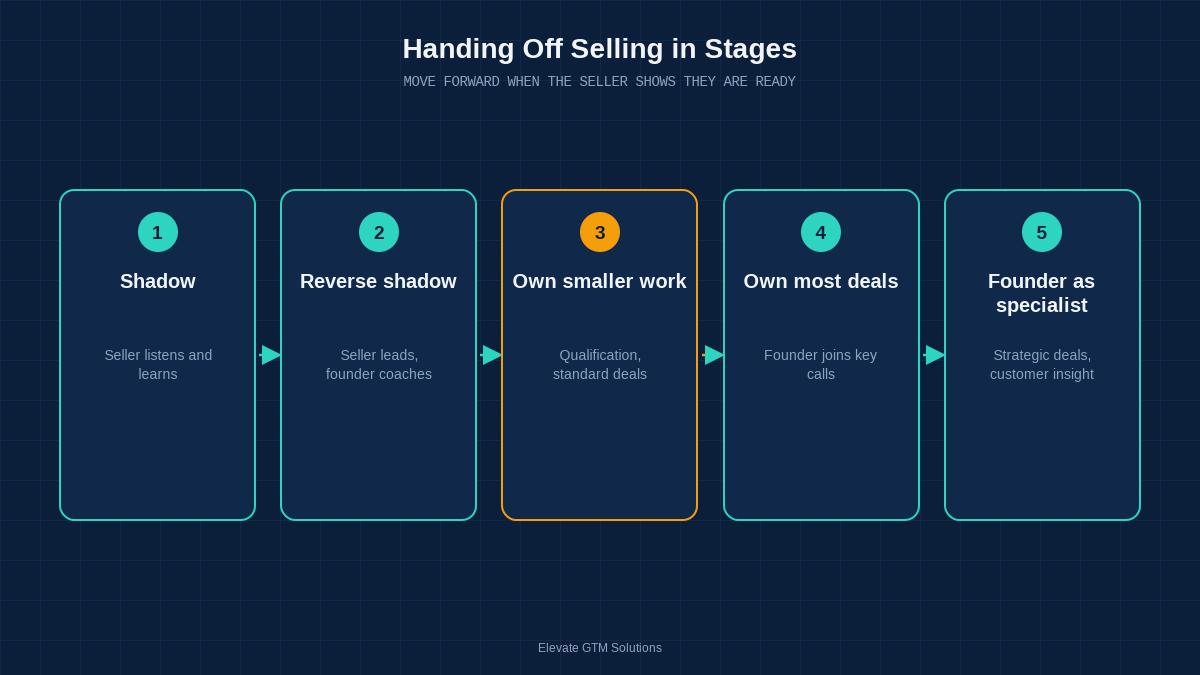
A sudden handoff, where the founder announces they will no longer take sales calls, often fails. Stages work better. These are common patterns, not fixed rules.
Stage 1: Shadowing
The new seller joins the founder's calls and listens. They read the notes, watch recordings and ask questions. The founder explains choices after each call. Duration is typically a few weeks.
Stage 2: Reverse shadowing
The new seller leads calls with the founder present. The founder steps in when needed and gives feedback afterward. This is the point where a lot of practical learning happens.
Stage 3: Own the smaller work
The new seller takes ownership of lead qualification, first calls and smaller or more standard deals. The founder reviews each opportunity weekly and handles anything unusual.
Stage 4: Own most deals
The seller runs most opportunities from start to finish. The founder joins selected calls, such as large accounts or competitive situations, and does regular deal reviews.
Stage 5: Founder as specialist
The founder takes part in strategic deals, key relationships and customer conversations that inform product and strategy. They stop running the day-to-day pipeline.
| Stage | Seller does | Founder does | Review rhythm |
|---|---|---|---|
| 1. Shadow | Listens, learns, asks | Sells, explains afterwards | After each call |
| 2. Reverse shadow | Leads calls | Observes, coaches | After each call |
| 3. Smaller work | Qualifies, runs standard deals | Handles unusual deals, reviews pipeline | Weekly |
| 4. Most deals | Runs most deals | Joins key calls, reviews | Weekly |
| 5. Specialist | Owns the process | Strategic deals and customer insight | Weekly or biweekly |
The pace depends on the person, the product and the complexity of the sale. Move forward when the seller shows they can handle the current stage, not when a calendar says so. Be ready to move back if a stage fails.
What a founder should keep doing
Even after the handoff, some selling work remains valuable.
Strategic and large deals. Senior buyers often want to speak to a founder. A founder's presence can be decisive, and also unrepeatable, so use it deliberately, not as a crutch.
Customer conversations. Keep talking to customers regularly. It is the best source of product and positioning insight. Many founders lose touch with the market after they stop selling, and the company pays for it.
Competitive and lost deals. Review why deals were lost. A founder's perspective on a loss often differs from the seller's.
Coaching and deal reviews. A founder who gives specific feedback on real deals can accelerate a new seller dramatically.
Setting the story. The founder is usually the keeper of why the company exists. Keep that story consistent as more people tell it.
What the founder should not do is take back a deal the moment it gets difficult. That teaches the team that hard deals belong to the founder, and the seller will never grow.
The economics of the first hire
A first sales hire is a bet, and it helps to look at the numbers honestly. These figures are invented to show the reasoning.
Suppose a first account executive costs $14,000 a month fully loaded, including salary, benefits and tools. Suppose it takes five months before their first deal closes. That is $70,000 spent before any revenue. If the average first-year contract is $24,000 and gross margin is 75 percent, each deal produces about $18,000 of gross margin in its first year. $70,000 divided by $18,000 is about 3.9, so the seller must close roughly four deals just to cover the cost of those first five months, and ramp time continues to cost more until they are productive.
This does not mean the hire is a bad idea. It means that the hire only makes sense if the company has enough pipeline for them to work, enough cash to carry the ramp and a motion that can be taught. A single hire who is given no leads, no playbook and no coaching can burn a large fraction of a small company's cash and conclude, wrongly, that sales hiring does not work.
Also compare with the cost of the founder's time. If the founder spends half their week selling and that time would be better spent on product, hiring, or fundraising, there is a real cost to not delegating.
Compensation and expectations
Be clear and fair from the start.
Compensation. A base plus variable pay is common, but the right structure depends on the stage and the market. Early sellers often take a risk in an unproven setting, so some companies provide more base or a guaranteed period. Avoid over-complicated plans. Write down how commission is calculated and when it is paid. Take legal and tax advice on compensation structures and on any equity grant, because rules vary.
Quota. Do not set a number by copying a typical figure. Base it on the pipeline you can provide and the deals you have closed. A quota the seller cannot reach damages trust.
Ramp. Expect months before a new seller is fully productive, and set expectations in writing. Define what progress should look like at thirty, sixty and ninety days: calls shadowed, calls led, opportunities created, first deals.
Support. Commit to what you will provide: leads, coaching time, tools, a deal review each week. A promise to "be hands-off" often means abandonment.
Honesty about the stage. Tell candidates that the process is rough, the product changes and the playbook is a draft. Good candidates want to know.
Measuring whether the handoff works
Compare the new seller with the founder, and with a fair baseline.
| Measure | What it tells you | Caution |
|---|---|---|
| Qualified opportunities created | Pipeline building | Check quality, not just count |
| Conversion by stage | Where deals leak | Compare with the founder's rates on similar deals |
| Win rate on comparable deals | Whether the process transfers | Founder deals may have been easier because of personal trust |
| Sales cycle length | Efficiency | Early deals vary a lot |
| Average deal size and discounts | Price discipline | A rep who discounts heavily is buying wins |
| Founder time spent on sales | Whether the founder is actually freed | Track hours honestly |
| Quality of notes and CRM data | Process discipline | Needed for learning |
| Customer feedback on the sales experience | Fit with buyers | A few conversations can tell you a lot |
| Time to first closed deal | Ramp | Compare with the plan |
Judge over a sensible period. In a long-cycle business, early results are weak signals and you need to watch leading measures. See go-to-market strategy for a long sales cycle. If a hire is not working, diagnose before deciding: is it the person, the playbook, the leads or the product? See how to tell if your GTM strategy is broken.
A worked example, invented for illustration
Imagine a founder of a small company selling inventory software to specialty food distributors. This is invented to show the process.
Where she is. Twenty-two customers, all closed by her. She can describe the best customer: a distributor with two to five warehouses and a handful of perishable product lines. Deals close in four to eight weeks. She has four recorded calls she considers good, a pricing sheet and three customer stories. Her calendar is full, and several inbound leads have gone cold.
The decision. She is ready for a first hire. She decides on a hands-on account executive, because the pipeline is bigger than she can work and the pitch is stable. She also arranges a part-time SDR a few weeks later, because outreach is the weakest part of the process.
Preparation. Over two weekends she writes a ten-page playbook from her notes: the ICP, the questions she asks, the eight common objections with her answers, the price rules and the steps of a typical deal. She marks the places where she is unsure.
Handoff. The new executive shadows ten calls over three weeks, then leads calls with the founder present for three more weeks. In the second month, the executive owns qualification and first calls and runs deals under a certain size. The founder reviews every opportunity weekly. By month four the executive runs most deals, and the founder joins only larger distributors and competitive situations.
What she keeps. She talks to two customers every week, joins every deal over a set size and reviews all lost deals with the team.
Review. At ninety days she compares pipeline created, conversion by stage and discount levels against her own history. The executive's discounting is higher than hers, so they revise the discount rules together. The playbook gains a section on handling a competitor that the new hire met first.
Notice that the hire did not replace the founder's judgment. It spread it, with the founder still close to customers.
When the first hire does not work
Many first sales hires fail, and it is not always the person's fault. Check these before concluding.
No pipeline. A seller with nothing to work cannot sell. Make sure they have enough leads.
No playbook. If the founder cannot explain how deals are won, the seller guesses.
Mixed signals. The founder undermines the seller by jumping into their deals or changing price and promises.
Wrong profile. A big-company seller in a startup, or a pure hunter where relationships and product knowledge matter.
The product is not ready. Deals fail for product reasons that no seller can overcome.
Unrealistic expectations. A seller judged by results in the first month in a six-month cycle will fail whatever they do.
The founder cannot let go. The seller learns they are not trusted, and either leaves or stops trying.
If it still does not work after a fair attempt, end the arrangement quickly and respectfully, learn from it and adjust before the next hire. Employment law and contract terms vary by location, so involve proper advice for any termination.
Alternatives to hiring a salesperson
Not every company should hire a seller. Consider these options, alone or together.
Strengthen the product-led path. If customers can start and see value without a seller, invest in onboarding and let sales handle larger accounts.
Use partners. If a channel already reaches your buyer, a partner may produce leads or even deals. See how to build a partner or channel GTM strategy.
Hire for the parts around selling. A sales development hire or a marketing hire may free the founder from tasks that are not closing.
Use an experienced advisor or fractional leader to build the process while the founder still sells.
Improve the pipeline first. If the problem is volume, not capacity, better lead generation may matter more than a second seller.
Use tools to reduce load. Better notes, call recording, summaries and scheduling can free founder time. They do not replace a seller or a pattern.
Common mistakes
Hiring to discover the pattern. Salespeople scale what works. They do not usually invent it.
Hiring a senior executive too early. Leadership without a team or a playbook is expensive and frustrating.
Handing off all at once. Stage it, and watch.
Vanishing. Abdication removes the founder's learning and the seller's coaching.
Taking deals back. It teaches the team to wait for rescue.
No playbook. A new seller with only the founder's memory will take longer and miss more.
Unrealistic quotas or timelines. They damage trust and drive good people away.
Ignoring the CRM. If deal data is in the founder's head, nobody can learn from it.
Underinvesting in pipeline. A seller without leads is a cost, not a capacity.
Treating one failed hire as proof that sales hiring fails. Diagnose what went wrong.
Glossary
Founder-led sales. Selling conducted mainly by the founders, usually in the earliest stage.
Playbook. A written description of how the company sells: ICP, pitch, qualification, objections, pricing and process.
Ramp time. The time a new seller needs to reach full productivity.
Quota. The sales target assigned to a seller for a period.
SDR. Sales development representative. A role that generates and qualifies leads.
Account executive. A seller who runs opportunities through to close.
Fractional leader. An experienced executive who works for several companies part-time.
Deal review. A regular meeting to examine open opportunities and decide how to advance them.
Shadowing. Observing another person's work to learn it.
Where Elevate GTM Solutions fits
Elevate GTM Solutions is an AI GTM platform for creating, executing and adapting go-to-market strategy. Its homepage describes modules including "ICP & Segmentation," "Product Positioning," "Product Messaging," "Pricing Strategy," "Sales Enablement," "Competitive Intelligence" and "Measure & Optimize," and it offers a free strategy you can generate in about five minutes. The homepage says "15 connected GTM modules" and names sixteen, so count what you see.
The first half of this guide, writing down who you sell to, why they buy, how you pitch, what you charge and who you compete with, is the kind of work a platform can help structure and keep current, and a founder can use it to produce a first draft of a playbook faster than starting from nothing. It does not replace the founder's own conversations with customers, which are the source of the facts, and it does not hire, coach or motivate a seller. See what Elevate GTM Solutions is, GTM strategy for startups and what is a GTM playbook.
What to do this week
- Write one sentence about your best customer and why they buy. Share it with one trusted person and see whether they agree.
- List your last ten deals, won and lost, with the reason each way. Look for patterns.
- Check for the signs of readiness and non-readiness. Count how many apply honestly.
- Start the playbook: ICP, pitch, qualification questions, objections, price rules and the deal steps.
- Record or collect three of your best calls.
- Decide which part of the sales work you want to hand off first, and why.
- Estimate the cost of the first hire and the pipeline they would need.
- Write what you will keep doing after the handoff.
Key takeaways
- A founder should hand off selling when winning is repeatable and written down, and when the founder's time limits growth. Tiredness is not a reason.
- Do not hire a seller to find product-market fit. Sales hires scale a motion that works.
- Write the playbook first: ICP, buying reasons, pitch, qualification, objections, pricing, proof, process, competitors and measures.
- The first hire is usually a hands-on seller comfortable with ambiguity, not a senior executive with no team to manage.
- Hand off in stages: shadow, reverse shadow, own smaller work, own most deals, founder as specialist.
- Keep talking to customers, joining key deals and reviewing losses. Do not take deals back at the first difficulty.
- The first hire is a bet with real costs. Make sure there is pipeline, cash for the ramp and a process that can be taught.
- Measure against fair baselines, and diagnose before blaming the person.
Sources
- Elevate GTM Solutions: descriptions of modules and the free strategy offer, as stated on the company's homepage.
- Related Elevate guides linked in the text, including GTM strategy for startups, what is a GTM playbook and how to structure a GTM team.
- Published guidance on founder-led sales and early sales hiring often quotes ramp times, quotas and success rates without a clear method, so we cite no figures. The signs, the staging, the profiles and the measures reflect our judgment and common practice.
- The economics example and the worked example are invented for illustration. Statements about compensation, equity and employment are not legal or tax advice, and rules vary by location.
Frequently Asked Questions
When should a founder stop doing sales?
When the sales process is repeatable and written down, several deals have closed for similar reasons and the founder's time has become the limit on growth. Do not stop just because selling is tiring, and keep selling if you cannot yet explain how you win.
Should the first sales hire be a VP of sales?
Usually not. A senior executive typically expects a team, a pipeline and a playbook, and may spend months building them. A hands-on account executive, sometimes with a development representative, is often a better first step unless the motion is already proven and you are scaling it.
What should I write down before hiring a salesperson?
Your ideal customer, why they buy, your pitch, qualification questions, common objections and answers, pricing and terms, proof, the deal process, competitors and the measures you track. Real call recordings and deal notes are the best material.
How long does it take a new seller to become productive?
It varies with the product, price and cycle length, and published figures are unreliable. Plan for months, set expectations in writing and define what progress looks like at thirty, sixty and ninety days.
What should a founder keep doing after hiring a seller?
Join strategic deals, keep talking to customers, review lost deals, coach through deal reviews and keep the company story consistent. Avoid taking deals back when they get hard.
Can I hand off sales if I have only a few customers?
You can try, but with few deals it is hard to know whether you have a pattern. Often the founder should keep selling until several deals show why customers buy and how deals go wrong.
Is it better to hire an SDR or an account executive first?
It depends on the bottleneck. If you lack leads, a development representative may help most. If you have more leads than you can work and a stable pitch, an account executive may be better. Some companies start with one and add the other soon after.
What if the first hire does not work?
Diagnose before deciding. Check pipeline, playbook, founder behavior, hiring profile, product readiness and expectations. If a fair attempt fails, end it respectfully and quickly, learn from it and adjust. Seek proper advice on employment terms.
How do I measure whether the handoff is working?
Compare qualified opportunities, conversion by stage, win rate on comparable deals, cycle length, discounting, founder time spent on sales and the quality of deal notes against your own history and the plan. Allow for a fair period.
Are there alternatives to hiring a salesperson?
Yes: strengthening a product-led path, using partners, hiring for lead generation or marketing, using a fractional leader or advisor and improving the pipeline first. The right choice depends on your product and buyer.
How much should I pay a first salesperson?
It depends on the market, location and stage, so we give no figures. Define the structure clearly, avoid over-complication, set quota from your pipeline and closed deals, and take legal and tax advice on compensation and equity.
Can software replace the founder in sales?
No. Tools can reduce admin and help organize your playbook and messaging, but they do not replace the conversations that teach you what customers want, and they do not sell. Use them to support the people who do.