
By the Elevate GTM Solutions Team · Updated November 13, 2026 · 27 min read
How to Plan Go-to-Market for a Long Sales Cycle: Pipeline Math, Buying Groups, Staying Warm and Knowing Whether It Is Working
A short sales cycle forgives bad planning. If deals close in three weeks, a wrong guess about the target customer shows up within a month and you correct it. A long sales cycle does not forgive anything quickly. If a typical deal takes nine or fifteen months, a misjudged segment can cost an entire year before the numbers say so, a champion can leave in the middle of a deal, a budget cycle can slide a purchase by two quarters and the pipeline you needed had to be created long before anyone asked for it.
Most go-to-market advice assumes cycles measured in weeks. This guide is for companies where the cycle is measured in quarters: large enterprise software, infrastructure, regulated industries, complex services and anything bought by committee. It covers why long cycles change the plan, where the time actually goes, how to choose accounts and timing, how to map and reach a buying group, how to stay useful during the wait, how to design pipeline math, compensation and forecasting for a slow motion, how to shorten the cycle without forcing it and how to tell whether the strategy is working before the deals close. We make a GTM platform and work with companies that have long cycles, so we have an interest. We cite no cycle-length benchmarks, and the examples are invented.
How do you plan go-to-market for a long sales cycle?
Plan backwards from the revenue date, because pipeline must exist many months before it can close. Choose fewer, better-fit accounts and time your effort to their triggers and budget cycles. Map the buying group early and build relationships with several people, not one champion. Give each stage a purpose and a useful piece of proof, so the buyer progresses with evidence and not with pressure. Reduce avoidable delay, such as security reviews, legal terms and procurement steps, by preparing for them early. Measure leading indicators, such as qualified meetings, stakeholders engaged and mutual plan milestones, because final results arrive too late to steer. Design compensation, ramp time and forecasting for the real length of the cycle, and treat "no decision" as your main competitor. Finally, protect cash: a long cycle means the cost of winning is spent well before the revenue arrives.
Can you shorten a long cycle? Often partly, by removing friction and building proof sooner, but not by pushing. Some cycles are long because the decision is genuinely large.
What is the most common failure? Single-threading to one champion, then losing the deal when that person changes roles or loses an internal argument.
The short version
| Question | Answer |
|---|---|
| What changes with a long cycle? | Pipeline must be built earlier, results lag, buying groups are bigger, and cash is spent before revenue |
| How should you choose accounts? | Fewer, better-fit accounts, timed to triggers and budget cycles |
| What is the main risk inside a deal? | Dependence on one champion, and stalls that end in "no decision" |
| How do you stay warm? | Give value at each stage: evidence, peer proof, useful analysis, not repeated check-ins |
| How do you steer without closed deals? | Leading indicators: qualified meetings, stakeholders reached, mutual plan milestones, stage progression |
| How do you shorten the cycle? | Prepare for security, legal and procurement early, use scoped pilots, and offer proof before it is requested |
| What breaks compensation? | Quotas and commissions designed for a short cycle punish people who build long-cycle pipeline |
| What breaks forecasting? | Optimism about stalled deals. Use stage aging and explicit commit rules |
Why a long cycle changes the whole plan
Five things happen at once, and each one affects a different part of go-to-market.
Pipeline has to exist earlier. If the average deal takes nine months from first qualified conversation to signature, then deals meant to close this fiscal year had to be in the pipeline three quarters ago. Pipeline created now mostly pays next year.
Feedback arrives late. You will not know whether a new segment or message works until deals either close or die, which can take longer than a whole planning period. Teams that wait for closed-won data to steer are always a year behind.
More people decide. Large purchases involve users, managers, finance, security, legal, procurement and often an executive sponsor. Winning means reaching and persuading several of them. See B2B buying groups evidence.
More can go wrong in the wait. Champions leave, budgets are frozen, priorities change, competitors arrive and the company is acquired. The longer the cycle, the more of these events you will see.
Cash is committed up front. You pay sellers, sales engineers and marketing programs now. The revenue comes later. A slow quarter of closed deals can be a healthy quarter of pipeline, and a company that cannot tell the difference will make panicked decisions.
See B2B sales cycle length evidence for what published research can and cannot tell you about cycle lengths, and treat any single figure with caution, because definitions of "start" and "end" vary widely.
Where the time actually goes
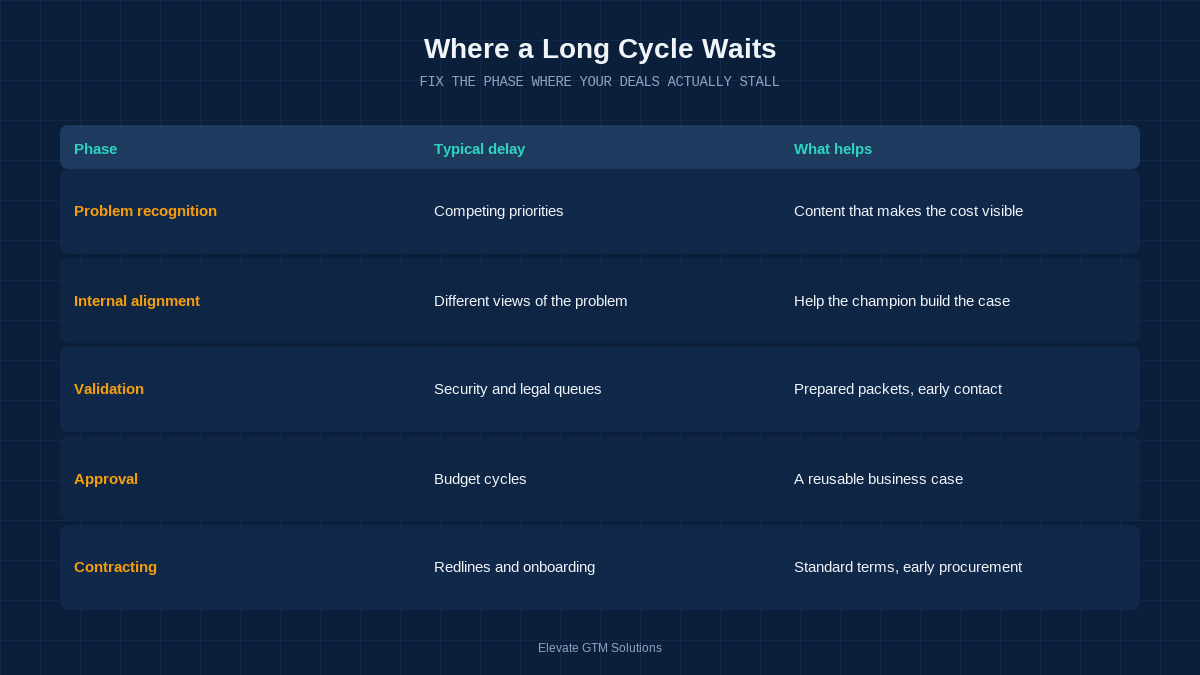
"Long cycle" hides several different delays, and the fix for each is different. Map your own deals, because the pattern varies by company and market.
| Phase | What happens | Typical source of delay | What helps |
|---|---|---|---|
| Problem recognition | The buyer realizes the problem matters enough to act | Competing priorities, no urgency | Relevant content and triggers that make the cost visible |
| Internal alignment | Stakeholders agree there is a project | Different people see different problems | Help the champion build the case for others |
| Evaluation | Vendors are compared, demos and trials run | Many vendors, many opinions | Clear criteria, proof on the buyer's data |
| Validation | Security, architecture, legal and compliance review | Queues, questionnaires, missing documents | Pre-prepared packets, early involvement |
| Business case and approval | Budget, sponsors and executives sign off | Budget cycles, approval committees | A business case the champion can reuse. See enterprise GTM business case |
| Procurement and contracting | Terms, price and paperwork | Redlines, vendor onboarding, legal queues | Standard terms, early procurement contact |
| Decision and start | Signature, kickoff | Timing, resourcing | Clear first-phase plan |
The more precisely you can say where your deals wait, the better you can attack it. Some companies find that the evaluation is quick and the legal queue takes four months. Others find that the buyer needs a year simply to decide there is a project. A fix aimed at the wrong phase does nothing.
Choose accounts and timing deliberately
A long cycle makes every account expensive to work. That argues for a narrower list and more care in choosing it.
Narrow the field
With limited seller capacity and months per deal, a seller can only carry so many live opportunities. Spreading effort thinly across a hundred accounts produces a hundred stalled conversations. Choose the accounts where fit, need and access are strongest, and give them real attention. See account tiering framework and ICP scoring framework.
Time effort to triggers and budget cycles
Large organizations buy on a calendar and in response to events. Look for:
- Budget cycles. When does the target planning window open and close? A conversation that ends just after budgets are set can wait a year. A conversation that starts just before them can be funded.
- Trigger events. New leadership, a regulatory change, a reorganization, an acquisition, a failed project or a major launch often start buying processes. See what is signal-based selling.
- Contract renewals. If the buyer's current tool or service expires on a known date, work back from it.
- Internal commitments. A public goal or board promise creates urgency that a generic pitch cannot.
Record these for each priority account, and plan outreach to land before the window, not during it.
Qualify for the decision, not just the interest
Interest is cheap in a long cycle. A better test is whether the account has a real route to a decision. Useful questions:
- Who owns the problem, and what happens to them if it is not solved?
- Is there a budget, or a credible path to one, and when is it decided?
- Who else must agree, and what do they need to see?
- What is the alternative, including doing nothing?
- What has happened to similar projects in this company?
A deal with an enthusiastic user and no budget path should be treated as a long-term relationship, not as pipeline. Mislabeling it inflates forecasts and wastes capacity.
Map the buying group and build several relationships
The single biggest cause of long-cycle losses is depending on one person. Champions are valuable, and they are also fragile: they change jobs, lose arguments, go on leave or discover the project is lower on the list than they thought.
Who is usually involved
| Role | What they care about | What to give them |
|---|---|---|
| Day-to-day user | Does it make my work easier? | Hands-on proof, a short trial |
| Champion | Credit, results, avoiding risk | Materials to make the case, early warnings, honest advice |
| Manager of the user | Team results, resources | Evidence of outcomes, an implementation plan |
| Economic buyer | Budget, return, strategic fit | A clear business case and references from peers |
| Technical evaluator | Architecture, integration, reliability | Documentation, access to engineers |
| Security and compliance | Risk, controls, audits | Prepared answers and evidence. Only state what is true |
| Legal and procurement | Terms, price, vendor risk | Standard terms, quick turnaround |
| Executive sponsor | Strategic priority | Brief, relevant, outcome-focused communication |
| Blocker | Disruption, status quo, competing project | Understanding of the objection, and a chance to be heard |
Practices that reduce single-threading
- Map the group in writing early in the deal, and update it. Mark who you have spoken to, who is supportive, neutral or opposed and who you have not reached.
- Ask the champion to introduce others, and explain why. A good champion wants the deal to survive scrutiny.
- Set a goal for the number of stakeholders engaged by each stage. A deal with one contact at proposal stage is at risk.
- Engage the economic buyer before the end. Surprise at the approval stage is a common cause of delay.
- Keep a second route. If the champion leaves, do you know anyone else?
- Take the blockers seriously. Understand their concerns. Some will become supporters if heard, and others should be planned around.
Stay useful during the wait
In a long cycle, buyers spend most of their time not talking to you. What you do in that time matters.
Give each stage a purpose
Replace "checking in" with something that moves the buyer forward.
| Stage | A useful contribution | What to avoid |
|---|---|---|
| Early | An honest view of how peers frame and solve the problem | A product pitch before the problem is agreed |
| Alignment | A short briefing the champion can share with colleagues | Long decks that nobody reads |
| Evaluation | Clear criteria, a scoped proof on the buyer's data | A generic demo |
| Validation | A ready security and architecture packet | Making the buyer chase documents |
| Business case | A model the buyer can adjust, with sources for each assumption | Inflated savings that finance will dismiss |
| Contracting | Standard terms, a named contact, quick answers | Reopening agreed points |
| Decision | A clear first-phase plan and what the buyer can expect | Last-minute pressure discounts |
Content that works in a long cycle
- Peer proof. Stories from similar organizations, with honest conditions and results. Buyers in long cycles lean heavily on what comparable companies did.
- Decision tools. Checklists, evaluation criteria and business case templates that help the buyer do their internal work.
- Executive briefings. Short, specific and relevant to the person's role.
- Updates tied to the buyer's situation. A relevant regulatory change, a new customer in their sector, a relevant analysis.
- Community and events, where buyers meet peers who have gone through the process.
Keep the rhythm without nagging
Agree the next step at the end of every conversation, with a date. Use a shared plan, so both sides can see what is expected. When a deal goes quiet, a message offering something useful, such as new evidence, is more effective than "just checking in." See what is deal intelligence for signals that suggest a deal is cooling.
Use a mutual action plan
A mutual action plan is a shared document that lists the steps both sides must take to reach a decision, with owners and dates: technical validation, security review, business case, legal review, procurement, sign-off. It is not a pressure tool, and it should not be used as one. Its value is that it exposes unknowns early, such as a procurement step nobody mentioned, and gives the champion something to point to internally. If a buyer will not agree to one, that is itself information.
Reduce avoidable delay
Some of the cycle is real deliberation. Some is friction you can remove.
Prepare the validation packet before you need it. Security answers, architecture overviews, data handling descriptions, compliance information you can honestly provide and common questionnaire responses. Keep them current. Do not claim certifications you do not hold.
Offer standard terms and a quick path through legal. Prepare the usual redlines and know which points you will concede.
Contact procurement early. Ask what process the buyer's company follows, which forms are needed and how long each step usually takes.
Use scoped pilots. A small, time-limited, paid pilot with agreed criteria can shorten the evaluation and build internal support. See pilot to scale framework. Make sure the pilot ends in a decision.
Offer proof early. Do not wait for the buyer to ask for references or results.
Help build the business case. Many deals wait while a champion struggles to justify the purchase. Give them tools. See enterprise GTM business case.
Plan the first phase. A clear, small first deployment reduces the perceived risk of a big commitment.
Do not force it. Pressure tactics, such as artificial deadlines and last-minute discounts, may close a deal sooner and damage trust, the next renewal and your reputation. If the decision is genuinely large, it takes time.
Treat "no decision" as your main competitor
In many long-cycle markets, the most common outcome is not a loss to a rival but a stall that ends in nothing. The buyer keeps the status quo.
Reasons include unclear urgency, disagreement inside the buying group, fear of change, competing priorities and a champion who lacks power. Responses:
- Make the cost of inaction visible. Use the buyer's own numbers where possible, with care and honesty.
- Build consensus, not just preference. A deal that one person likes and others tolerate is fragile.
- Offer a smaller first step. A narrow start can overcome fear of a large commitment.
- Understand what the status quo gives them. People keep the old way for reasons, and ignoring them does not remove them.
- Qualify out early. If there is no real path to a decision, redirect effort.
Track "no decision" as a loss reason. If it is the largest category, your problem is not competitors. See win-loss analysis framework.
Pipeline math for a slow motion
The calculation changes when time matters. Here is an invented example to show how.
A company sells to large enterprises. The average first-year deal is $150,000. It wants $3,000,000 in new annual recurring revenue to close during the fiscal year. The average cycle from first qualified meeting to signature is nine months. About 25 percent of qualified opportunities close.
Step 1: deals needed. $3,000,000 divided by $150,000 is 20 deals.
Step 2: qualified opportunities needed. 20 divided by 0.25 is 80 qualified opportunities.
Step 3: timing. With a nine-month cycle, opportunities created after about the third month of the year will mostly close after the fiscal year ends. So those 80 opportunities must be in the pipeline either at the start of the year or created in the first quarter, which is roughly 27 per month if all come from the first three months.
Step 4: pipeline value. 80 times $150,000 is $12,000,000, or four times the $3,000,000 target.
Step 5: what this implies. The pipeline that determines this year's revenue is built last year and in the first quarter. If the company waits until mid-year to see that it is short, it cannot fix the shortfall in time. It can only reduce next year's problem.
Notice also how the second half of the year works: the opportunities created then are mostly next year's revenue. A company that measures its marketing and outbound teams only on closed revenue this year will starve next year's pipeline.
All figures here are invented and are not benchmarks. The principle holds with any numbers: pipeline needed equals target divided by deal size, divided by win rate, and timing is set by the cycle.
Leading indicators you can steer with
Because closed deals arrive late, watch what comes earlier.
| Indicator | What it shows | Notes |
|---|---|---|
| Qualified opportunities created per month, by segment | Whether future pipeline is being built | Compare with the number required |
| Stakeholders engaged per opportunity | Multi-threading | A drop at later stages warns of risk |
| Stage progression and aging | Whether deals move or stall | Set expected time per stage from your own history |
| Mutual plan milestones completed | Real buyer commitment | Missed milestones are early stall signals |
| Proof delivered: pilots started, references used | Evidence engaged | |
| Executive meetings held | Access to decision makers | |
| Pipeline coverage by close quarter | Whether each future quarter is covered | Check coverage for each quarter, not only the total |
| Loss reasons, especially "no decision" | Where deals die | Review quarterly |
Review cohorts: deals that entered pipeline in the same quarter, followed through to their outcome. Cohorts show whether conversion is improving in a way that a blended average hides.
Design the team for a slow motion
Compensation
Plans built for short cycles reward the closer and ignore the builder. In a long cycle, a seller who spends a year building three large opportunities may earn little in that year and a lot in the next. Consider whether your plan:
- Provides some credit for milestones that predict wins, such as qualified opportunities or validated pilots.
- Protects new hires during a longer ramp.
- Does not push sellers to force premature closes through discounting.
- Rewards multi-threaded deals and clean handoffs to customer success.
- Handles the specialists, such as sales engineers, who contribute throughout.
This is a design problem to work out with finance and sales leadership. See how to structure a GTM team.
Ramp time
New sellers need longer to reach full productivity when the cycle is long, because their first deals will not close for months. Plan hiring accordingly: a seller hired in the second half of the year will not contribute to this year's revenue in a nine-month cycle. Budget the cost of ramp, and be careful about judging new hires on early results.
Roles
Long-cycle deals benefit from specialist support: sales engineers for technical validation, solution architects for design, deal desk for pricing and terms, customer success for references and handoff, and executives for senior relationships. Decide who owns what, and make handoffs smooth. See GTM strategy handoff.
Forecasting
Forecasting in a long cycle is where optimism does the most damage. A few rules help.
- Use explicit stage definitions with evidence required to enter each stage.
- Track age. A deal that has been in a stage far longer than your history suggests is less likely to close, whatever the seller feels.
- Require a mutual plan and an identified economic buyer for deals in the forecast commit.
- Review stalled deals on a schedule, and move them out of the commit when evidence is missing.
- Forecast by close quarter and test coverage for each quarter separately.
- Separate commit, best case and pipeline, and track accuracy over time to calibrate.
Protect the cash
A long cycle shifts spending and revenue apart. If the company mistakes a slow revenue year for a failing strategy, it may cut the very pipeline-building activity that would repay it. If it ignores the lag, it may overspend ahead of revenue that arrives too late.
- Model the cash curve. Show when spending occurs and when revenue is expected, under cautious and expected cases.
- Stage the investment. Release spending in tranches linked to pipeline and progress. See how much should you budget for go-to-market.
- Consider what shortens payback. Faster first phases, upfront or annual payments and pilots with real fees can change the cash picture.
- Do not equate a slow quarter with failure. Look at leading indicators first.
- Watch for the opposite. Strong pipeline with no conversions after several cycles' time is a real warning. See how to tell if your GTM strategy is broken.
When a deal stalls
Stalls are normal, and handling them well is a skill. Diagnose before acting.
| Reason for the stall | Signs | Response |
|---|---|---|
| Champion has lost influence or left | Slow replies, no access to others | Find a new sponsor, ask to meet the successor, review the group map |
| Budget moved | Mention of "next fiscal year" | Confirm the timing, agree a date and keep a light, useful presence |
| Priority shifted | Other projects dominate | Reconnect to a goal that remains a priority, or pause gracefully |
| Hidden blocker | Pushback in meetings you did not attend | Ask directly who has concerns, and address them |
| Security or legal queue | Waiting on documents | Escalate through your contact, supply what is missing, ask for a status date |
| Competing vendor | Questions that suggest a comparison | Clarify criteria, offer comparative proof honestly |
| No real urgency | Polite interest, no dates | Make the cost of waiting concrete, or move to long-term nurture |
Do not keep a stalled deal in the forecast out of hope. Move it to a separate "long-term" list with a plan to revisit, and free the seller's time for deals that are moving.
A worked example, invented for illustration
An invented company sells compliance monitoring software to regional banks. Its typical cycle is about fourteen months. Past results: many first meetings, few closings, and several deals lost to "no decision."
Diagnosis. A review of the last twenty deals shows that most that closed involved the head of compliance, the head of operations and the CFO's office, while most that stalled involved only a compliance analyst. Closed deals also had a validated pilot. Many stalled deals waited months on security questionnaires.
Changes.
- Qualification now requires access to a senior sponsor within the first two meetings, or the account moves to long-term nurture.
- Each opportunity has a stakeholder map, with a target of at least three roles engaged before proposal.
- A prepared security and architecture packet goes to the buyer in the first month, not at the end.
- The company offers a scoped paid pilot with criteria written with the compliance head.
- A short business case template, with the buyer's own cost assumptions, is provided to every champion.
- Marketing now builds content for each stage, including peer stories from banks of a similar size and a regulatory calendar tied to the buyers' budget cycles.
- Compensation includes credit for validated pilots, and quota relief for new hires during their first year.
- Forecast commit requires a mutual plan and an identified economic buyer.
Measures. Qualified opportunities with three or more roles engaged, pilot starts, time in each stage, coverage by close quarter and the share of losses attributed to "no decision."
Result after two cycles, in the invented scenario. Fewer opportunities in the pipeline, because weak ones are screened out sooner, with higher conversion and a shorter average cycle. The sales team reports that their forecast conversations are more honest. The improvement came from fewer, better-fit deals and earlier multi-threading, not from pushing harder.
A ninety-day plan
Days 1 to 15: understand your cycle. Pull the last twenty to thirty closed deals, won and lost. Map time spent in each phase. Note stakeholders engaged and loss reasons.
Days 16 to 35: fix the plan. Re-tier accounts, mark budget cycles and triggers, define stages with evidence requirements and write the qualification questions about decision paths.
Days 36 to 60: build the assets. Prepare the security packet, standard terms, a business case template, a mutual plan template, stakeholder map template and stage-specific content.
Days 61 to 90: change the habits. Run weekly deal reviews on stakeholder coverage and stage aging. Start reporting leading indicators. Review compensation and forecasting rules with leadership.
At the end, check which phase of the cycle shortened, which indicators moved and which assumptions were wrong. See continuous GTM optimization.
Common mistakes
Single-threading. Relying on one champion for months.
Treating interest as pipeline. Enthusiasm without a decision path inflates the forecast.
Waiting for closed-won data to steer. By the time it arrives, the year has passed.
Starving next year's pipeline. Cutting early-stage activity to hit this year's number.
Forcing the close. Artificial deadlines and last-minute discounts damage trust.
Ignoring procurement and legal until the end. They can add months.
Weak proof. Generic demos and unsupported claims do not carry a committee.
Compensation that punishes patience. Sellers will optimize for what you pay.
Optimistic forecasts. Stalled deals stay in the commit because nobody wants to remove them.
Ignoring "no decision." It is often the largest competitor.
Mistaking a slow quarter for failure. Check leading indicators before cutting.
Glossary
Sales cycle. The time from a defined starting point, such as first qualified meeting, to a signed contract. Definitions vary, so state yours.
Buying group. The set of people involved in a purchase decision.
Champion. A buyer-side advocate for your solution.
Economic buyer. The person who controls the budget for the purchase.
Multi-threading. Building relationships with several stakeholders in a deal.
Mutual action plan. A shared plan of steps, owners and dates that both sides follow to reach a decision.
Pipeline coverage. The ratio of pipeline value to the revenue target for a period.
Stage aging. The time a deal has spent in its current stage.
No decision. A deal outcome in which the buyer takes no action and keeps the status quo.
Cohort. A group of deals or customers that share a starting period or characteristic.
Where Elevate GTM Solutions fits
Elevate GTM Solutions is an AI GTM platform for creating, executing and adapting go-to-market strategy. Its homepage describes modules including "ICP & Segmentation," "Competitive Intelligence," "Account-Based Marketing," "Product Messaging," "Sales Enablement," "Launch & Execute" and "Measure & Optimize," with use cases that include moving upmarket to enterprise, and a shared model across Marketing, Sales, Product and RevOps. The homepage says "15 connected GTM modules" and names sixteen, so count what you see.
For a long sales cycle, the relevant strengths are planning and consistency: choosing and tiering accounts, keeping messaging and enablement aligned with each stage and tracking leading indicators against a plan that people can see. A platform does not reach a buyer's executive sponsor, build a champion's trust or shorten a procurement queue. Those are relationships and operating habits. Use any tool to keep the plan visible and the evidence current, and test whether your sellers use it in real deals. See what Elevate GTM Solutions is, how to move upmarket from SMB to enterprise and account tiering framework.
What to do this week
- Pull your last twenty closed deals, won and lost, with dates for each stage.
- Find where deals wait longest, and write one fix for that phase.
- List how many stakeholders you had engaged in each won and lost deal.
- Write the pipeline math: target, deal size, win rate, opportunities needed and when they must be created.
- Add budget cycle dates and trigger events to your top fifty accounts.
- Draft a mutual action plan template and a stakeholder map template.
- Prepare or update your security and architecture packet, and standard terms.
- Review the forecast: remove deals with no sponsor, no plan or unusual age.
Key takeaways
- A long sales cycle moves the pipeline problem earlier, delays feedback, enlarges the buying group, adds risk during the wait and spends cash before revenue arrives.
- Find where your own cycle waits, because each phase needs a different fix.
- Choose fewer, better-fit accounts and time effort to budget cycles and trigger events.
- Map the buying group, and build several relationships. Single-threading is the most common cause of loss.
- Give each stage a useful contribution: proof, decision tools, peer stories and a mutual action plan.
- Remove avoidable delay by preparing security, legal and procurement early, using scoped pilots and helping with the business case. Do not force the decision.
- Treat "no decision" as the main competitor, and track it as a loss reason.
- Steer with leading indicators, design compensation, ramp and forecasting for the real cycle and protect cash.
Sources
- Elevate GTM Solutions: descriptions of modules, audience and use cases, as stated on the company's homepage.
- Related Elevate guides linked in the text, including B2B sales cycle length evidence, B2B buying groups evidence and account tiering framework.
- Many vendors and consultancies publish enterprise go-to-market guides and cycle-length figures with differing definitions, so we cite no figures. The phases, practices, tables and plan reflect our judgment and common practice.
- The pipeline example and the worked example are invented for illustration and are not benchmarks. Statements about security or compliance claims are not legal advice.
Frequently Asked Questions
How do you plan go-to-market for a long sales cycle?
Plan backwards from the revenue date, since pipeline must exist months before it closes. Choose fewer, better-fit accounts, time your effort to budget cycles and triggers, map and reach the buying group, give each stage useful proof and measure leading indicators.
How can I shorten a long sales cycle?
Remove avoidable friction: prepare security and legal materials early, contact procurement sooner, use scoped pilots, offer proof before it is asked for and help the champion build the business case. Avoid pressure tactics, which can harm trust.
Why do deals stall so often?
Common reasons are a champion losing influence, budget timing, shifting priorities, a hidden blocker, security or legal queues, a competing vendor or no real urgency. Diagnose the reason before choosing a response.
What is a buying group and why does it matter?
It is the set of people involved in a purchase, such as users, managers, finance, security, legal, procurement and executives. In long cycles you need to reach and persuade several of them, so depending on one champion is risky.
What is a mutual action plan?
A shared plan of steps, owners and dates that both buyer and seller follow to reach a decision, covering technical validation, security, business case, legal, procurement and sign-off. It exposes unknowns early and gives the champion something to point to internally.
How should I forecast with a long cycle?
Use clear stage definitions with required evidence, track stage age, require a mutual plan and an identified economic buyer for commit deals, review stalled deals regularly, forecast by close quarter and track accuracy over time.
How do I measure progress before deals close?
Track leading indicators such as qualified opportunities created, stakeholders engaged per opportunity, stage progression and aging, mutual plan milestones, pilots started and pipeline coverage by close quarter.
How should I compensate sellers in a long cycle?
Consider credit for predictive milestones, protection for new hires during a longer ramp, safeguards against forced discounting, rewards for multi-threaded deals and fair handling of specialists. Design it with finance and sales leadership.
What is "no decision" and why does it matter?
It is a deal that ends with the buyer keeping the status quo. In many long-cycle markets it is more common than losing to a competitor. Track it as a loss reason and respond with consensus-building, a smaller first step and a clear cost of inaction.
How many accounts should a seller work?
It depends on deal size, cycle length and support. Long cycles argue for fewer, better-fit accounts per seller, so each gets real attention. Test the right number from your own deal data.
Do pilots help in long cycles?
Often. A scoped, time-limited pilot with agreed success criteria can speed evaluation and build internal support. It must end in a decision, or it becomes another stall.
How do I protect cash during a long cycle?
Model when spending and revenue occur, stage investment in tranches tied to pipeline progress, consider terms that improve cash timing and avoid cutting early-stage activity just because a quarter has few closings.